oil pressure SSANGYONG KORANDO 1997 Service Owner's Manual
[x] Cancel search | Manufacturer: SSANGYONG, Model Year: 1997, Model line: KORANDO, Model: SSANGYONG KORANDO 1997Pages: 2053, PDF Size: 88.33 MB
Page 283 of 2053

GENERAL ENGINE INFORMATION 1A2 -- 11
D AEW OO M Y_2000
CYLINDER PRESSURE LEAKAGE TEST
3 Engine Oil Filler Cap
5 Vibration Damper6 Cylinder Pressure Leakage Tester with
Connecting Hose
Permissible Pressure Leakage
At Whole EngineMax. 25 %
At Valve and Cylinder Head GasketMax. 10 %
At Piston and Piston RingMax. 20 %
Cylinder Number By Mark On Vibration Damper At TDC
TDC MarkOT (TDC)UT (BDC : 180°)
Cylinder Number1, 42, 3
Universal Tool
Cylinder Pressure Leakage TesterBosch, EFAW 210A
Sun, CLT 228
Page 284 of 2053
1A2 -- 12 GENERAL ENGINE INFORMATION
D AEW OO M Y_2000
Leakage Test
1. Warm the engine up to normal operating tempera-
ture.
2. Disconnect the negative battery cable.
3. Remove the spark plugs.
4. Check the coolant level by opening the coolant
surge tank cap and replenish if insufficient.
5. Open the engine oil filler cap.
6. Connect the tester to air pressure line and adjust the
scale of tester.
7. Install the connecting hose to spark plug hole.
YAA1A2080
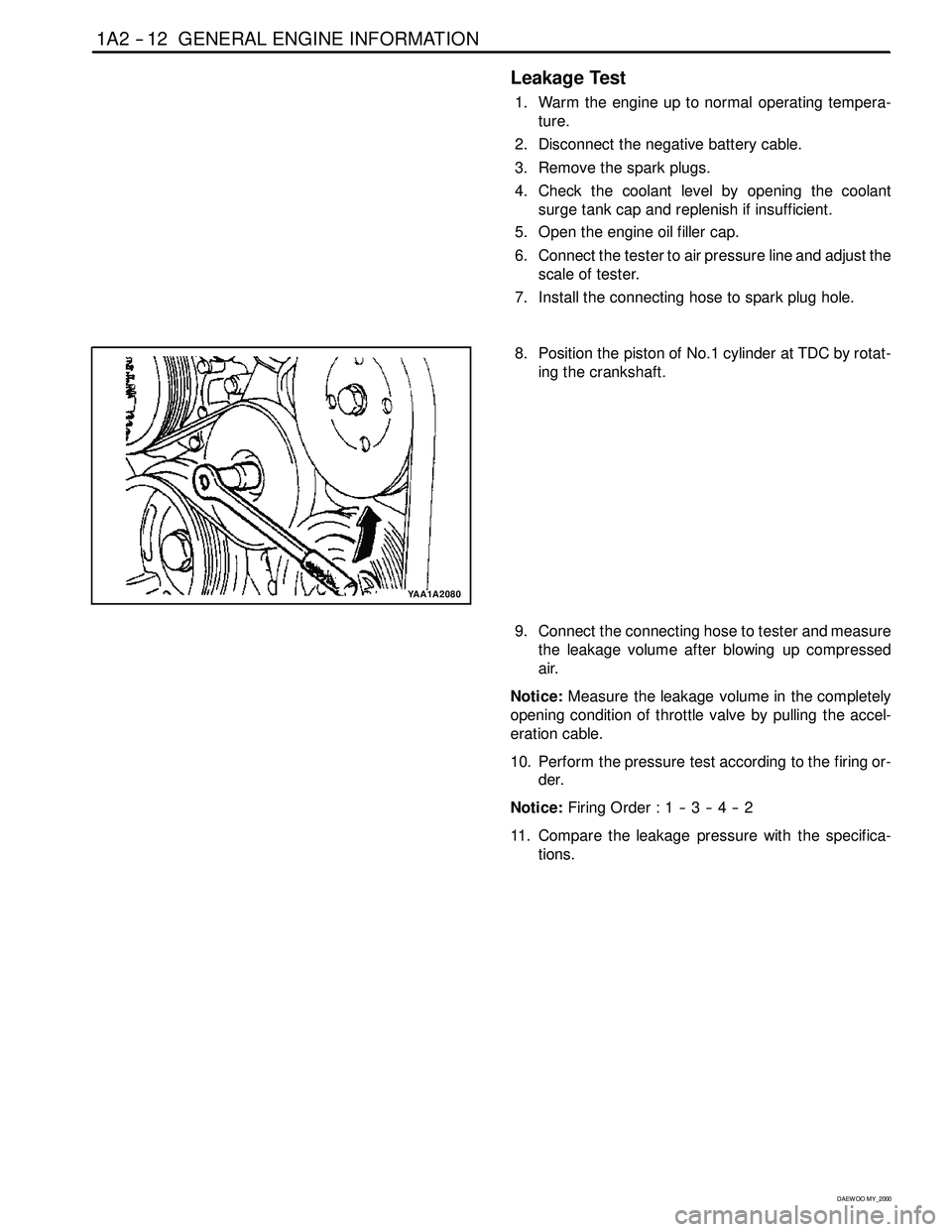
8. Position the piston of No.1 cylinder at TDC by rotat-
ing the crankshaft.
9. Connect the connecting hose to tester and measure
the leakage volume after blowing up compressed
air.
Notice:Measure the leakage volume in the completely
opening condition of throttle valve by pulling the accel-
eration cable.
10. Perform the pressure test according to the firing or-
der.
Notice:Firing Order : 1 -- 3 -- 4 -- 2
11. Compare the leakage pressure with the specifica-
tions.
Page 286 of 2053
1A2 -- 2 GENERAL ENGINE INFORMATION
D AEW OO M Y_2000
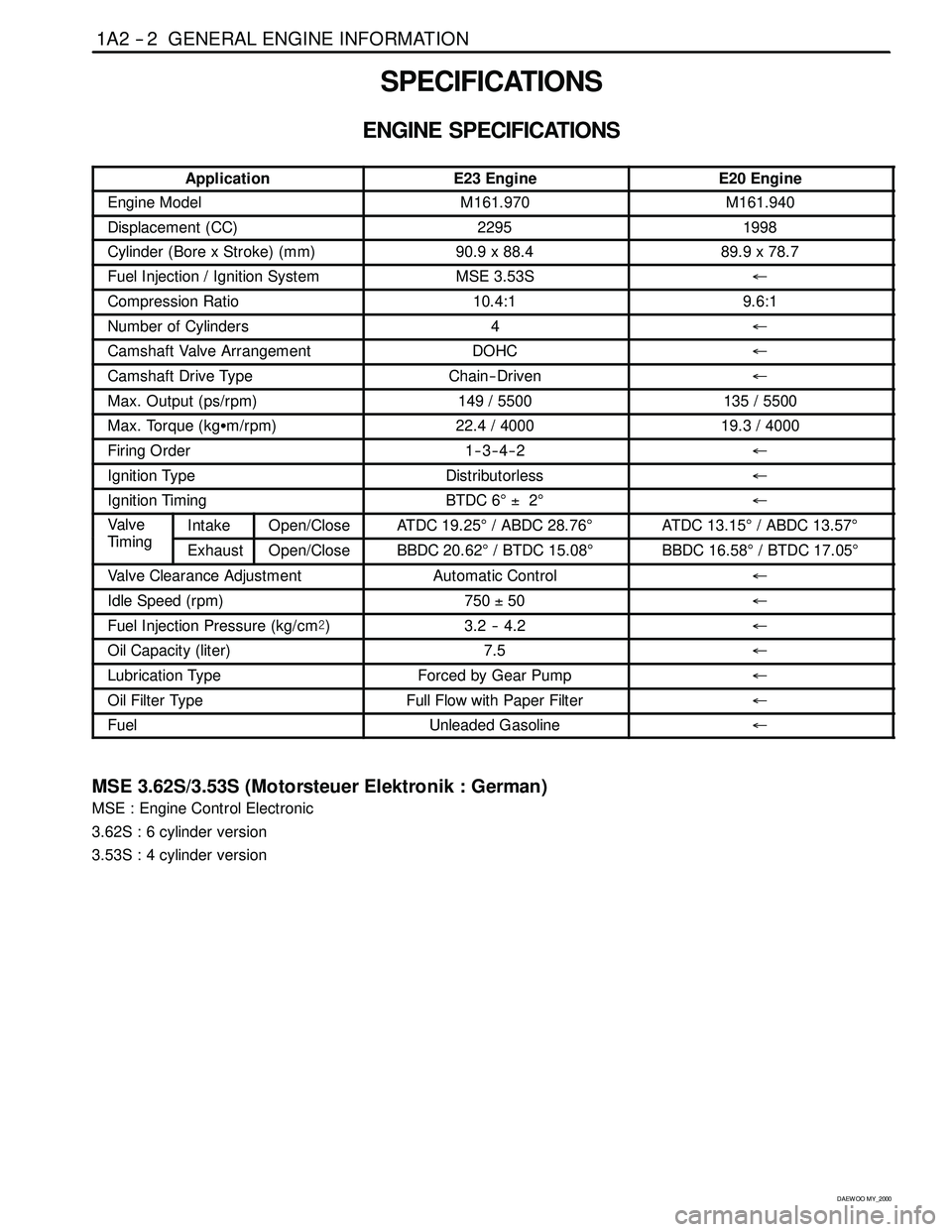
SPECIFICATIONS
ENGINE SPECIFICATIONS
ApplicationE23 EngineE20 Engine
Engine ModelM161.970M161.940
Displacement (CC)22951998
Cylinder (Bore x Stroke)(mm)90.9 x 88.489.9 x 78.7
Fuel Injection / Ignition SystemMSE 3.53S←
Compression Ratio10.4:19.6:1
Number of Cylinders4←
Camshaft Valve ArrangementDOHC←
Camshaft Drive TypeChain-- Driven←
Max. Output (ps/rpm)149 / 5500135 / 5500
Max. Torque (kgSm/rpm)22.4 / 400019.3 / 4000
Firing Order1--3--4--2←
Ignition TypeDistributorless←
Ignition TimingBTDC 6°±2°←
Va lv e
Tii
IntakeOpen/CloseATDC 19.25°/ ABDC 28.76°ATDC 13.15°/ ABDC 13.57°
Tim in gExhaustOpen/CloseBBDC 20.62°/ BTDC 15.08°BBDC 16.58°/ BTDC 17.05°
Valve Clearance AdjustmentAutomatic Control←
Idle Speed (rpm)750±50←
Fuel Injection Pressure (kg/cm@)3.2 -- 4.2←
Oil Capacity (liter)7.5←
Lubrication TypeForced by Gear Pump←
Oil Filter TypeFull Flow with Paper Filter←
FuelUnleaded Gasoline←
MSE 3.62S/3.53S (Motorsteuer Elektronik : German)
MSE : Engine Control Electronic
3.62S : 6 cylinder version
3.53S : 4 cylinder version
Page 291 of 2053
GENERAL ENGINE INFORMATION 1A2 -- 7
D AEW OO M Y_2000
DIAGNOSIS
OIL LEAK DIAGNOSIS
Most fluid oil leaks are easily located and repaired by
visually finding the leak and replacing or repairing the
necessary parts. On some occasions a fluid leak may be
difficult to locate or repair. The following procedures may
help you in locating and repairing most leaks.
Finding the Leak
1. Identify the fluid. Determine whether it is engine oil,
automatic transmission fluid, power steering fluid,
etc.
2. Identify where the fluid is leaking from.
2.1 After running the vehicle at normal operating
temperature, park the vehicle over a large sheet
of paper.
2.2 Wait a few minutes.
2.3 You should be able to find the approximate loca-
tion of the leak by the drippings on the paper.
3. Visually check around the suspected component.
Check around all the gasket mating surfaces for
leaks. A mirror is useful for finding leaks in areas that
are hard to reach.
4. If the leak still cannot be found, it may be necessary
to clean the suspected area with a degreaser, steam
or spray solvent.
4.1 Clean the area well.
4.2 Dry the area.
4.3 Operate the vehicle for several miles at normal
operating temperature and varying speeds.
4.4 After operating the vehicle, visually check the
suspected component.
4.5 If you still cannot locate the leak, try using the
powder or black light and dye method.
Powder Method
1. Clean the suspected area.
2. Apply an aerosol-- type powder (such as foot powder)
to the suspected area.
3. Operate the vehicle under normal operating condi-
toins.
4. Visually inspect the suspected component. You
should be able to trace the leak path over the white
powder surface to the source.
Black Light and Dye Method
A dye and light kit is available for finding leaks, Refer to
the manufacturer ’s directions when using the kit.
1. Pour the specified amount of dye into the engine oil fill
tube.
2. Operate the vehicle normal operating conditions as
directed in the kit.
3. Direct the light toward the suspected area. The dyed
fluid willappear as a yellow path leading to the
source.
Repairing the Leak
Once the origin of the leak has been pinpointed and
traced back to its source, the cause of the leak must be
determined n order for it to be repaired properly. If a gas-
ket is replaced, but the sealing flange is bent, the new
gasket will not repair the leak. Thebent flange must be
repaired also. Before attempting to repair a leak, check
for the following conditions and correct them as they
may cause a leak.
Gaskets
DThe fluid level/pressure is too high.
DThe crankcase ventilation system is malfunctioning.
DThe fasteners are tightened improperly or the threads
are dirty or damaged.
DThe flanges or the sealing surface is warped.
DThere are scratches, burrs or other damage to the
sealing surface.
DThe gasket is damaged or worn.
DThere is cracking or porosity of the component.
DAn improper seal was used (where applicable).
Seals
DThe fluid level/pressure is too high.
DThe crankcase ventilation system is malfunctioning.
DThe seal bore is damaged (scratched, burred or
nicked).
DThe seal is damaged or worn.
DImproper installation is evident.
DThere are cracks in the components.
DThe shaft surface is scratched, nicked or damaged.
DA loose or worn bearing is causing excess seal wear.
Page 294 of 2053
D AEW OO M Y_2000
SECTION 1B2
M161 ENGINE MECHANICAL
CAUTION: Disconnect the negative battery cable before removing or installing any electrical unit or when a
tool or equipment could easily come in contact with exposed electrical terminals. Disconnecting this cable
will help prevent personal injury and damage to the vehicle. The ignition must also be in LOCK unless other -
wise noted.
TABLE OF CONTENTS
Specifications 1B2 -- 2............................
Fastener Tightening Specifications 1B2 -- 2..........
Special Tools 1B2 -- 4.............................
Special Tools Table 1B2-- 4.......................
Maintenance and Repair 1B2 -- 7...................
On-- Vehicle Service 1B2-- 7.........................
Engine Assembly 1B2-- 7.........................
Crankcase Ventilation System 1B2-- 14.............
Generator 1B2-- 18..............................
Engine Mount 1B2-- 19...........................
Poly V-- Belt 1B2 -- 20.............................
Tensioning Device 1B2-- 22.......................
Tensioning Device Shock Absorber 1B2-- 23........
Poly V-- Belt Inspection 1B2-- 24...................
Cylinder Head Cover 1B2-- 26.....................
Cylinder Head Front Cover 1B2 -- 28...............
Cylinder Head 1B2-- 30...........................
Timing Gear Case Cover 1B2-- 34.................
Crankshaft Sealing Rear Cover 1B2-- 37...........
Belt Pulley and Vibration Damper 1B2-- 39..........
Crankshaft Front Radial Seal 1B2-- 42.............
Crankshaft Rear Radial Seal 1B2-- 44..............
Crankshaft 1B2-- 45.............................
Flywheel / Driven Plate 1B2 -- 51...................
Camshaft Adjuster 1B2-- 54.......................Camshaft Sprocket Bolt 1B2-- 57..................
Camshaft 1B2-- 58..............................
Camshaft Timing Position 1B2 -- 61................
Valve Spring 1B2 -- 63............................
Valve Stem Seal 1B2-- 67........................
Chain Tensioner 1B2-- 68.........................
Timing Chain 1B2-- 72............................
Tensioning Rail 1B2-- 77..........................
Cylinder Head Guide Rail 1B2-- 78.................
Crankcase Guide Rail 1B2-- 80....................
Crankshaft Sprocket 1B2-- 81.....................
Piston 1B2-- 83..................................
Connecting Rod 1B2-- 86.........................
Piston Ring 1B2 -- 88.............................
Oil Pan 1B2-- 90.................................
Engine Oil and Oil Filter Element 1B2-- 92..........
Oil Pump 1B2-- 95...............................
Oil Pressure Relief Valve 1B2-- 97.................
Oil Non-Return Valve 1B2-- 98....................
Oil Dipstick Guide Tube 1B2-- 99..................
Unit Repair 1B2 -- 100............................
Core Plugs in Crankcase 1B2-- 100................
Cylinder Bore 1B2-- 102..........................
Crankcase Mating Surface 1B2-- 104..............
Cylinder Head Mating Surface 1B2-- 106...........
Page 296 of 2053
M161 ENGINE MECHANICAL 1B2 -- 3
D AEW OO M Y_2000
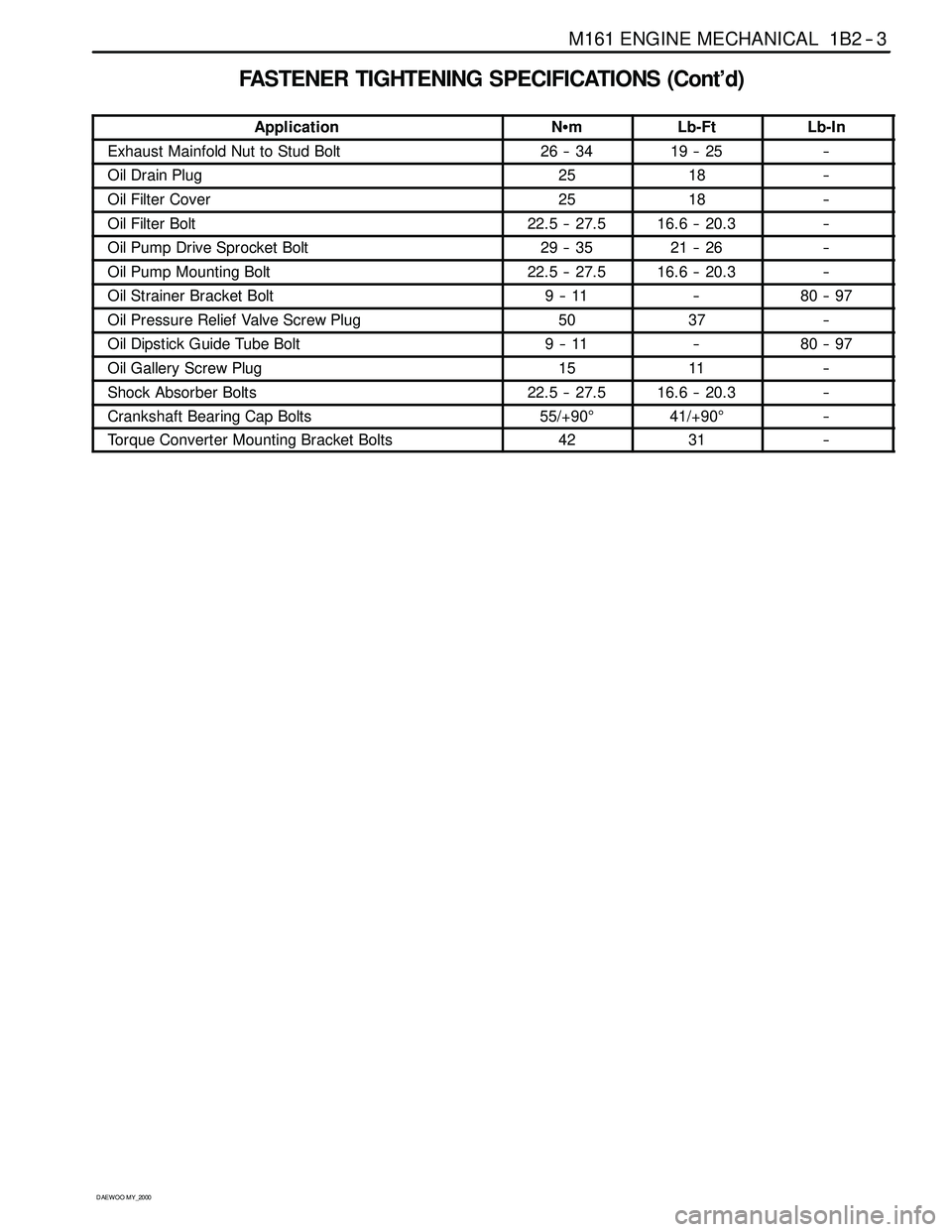
FASTENER TIGHTENING SPECIFICATIONS (Cont’d)
ApplicationNSmLb-FtLb-In
Exhaust Mainfold Nut to Stud Bolt26 -- 3419 -- 25--
Oil Drain Plug2518--
Oil Filter Cover2518--
Oil Filter Bolt22.5 -- 27.516.6 -- 20.3--
Oil Pump Drive Sprocket Bolt29 -- 3521 -- 26--
Oil Pump Mounting Bolt22.5 -- 27.516.6 -- 20.3--
Oil Strainer Bracket Bolt9--11--80 -- 97
Oil Pressure Relief Valve Screw Plug5037--
Oil Dipstick Guide Tube Bolt9--11--80 -- 97
Oil Gallery Screw Plug1511--
Shock Absorber Bolts22.5 -- 27.516.6 -- 20.3--
Crankshaft Bearing Cap Bolts55/+90°41/+90°--
Torque Converter Mounting Bracket Bolts4231--
Page 308 of 2053

M161 ENGINE MECHANICAL 1B2 -- 15
D AEW OO M Y_2000
Operation at Idling and Mid- Load
DThe throttle valve (6) is closed or very partially
opened, and the vacuum pressure in intake manifold
is high.
The blow-- by gas and the fresh air that is additionally
supplied through the vent connection (D) in the crank-
case in partial load gets supplied to the combustion
chamber from the crank chamber (12) through the oil
separation chamber (11), air -- conditioner bracket
(10), vent line (9), and restrictor (7) mounted to the
cylinder head.
The circulated engine oil returns to the oil pan through
the oil return pipe (13) at the bottom of oil separation
chamber (11).
The fresh air gets supplied to the crank chamber (12)
through the HFM sensor (1), intake air duct (4), vent
line (5), oil separation chamber (3), chain housing
(17), and the timing gear case cover (15).
The additional supply of the fresh air is needed to pre-
vent from forming the residues of the engine oil.
Page 385 of 2053

M161 ENGINE MECHANICAL 1B2 -- 97
D AEW OO M Y_2000
OIL PRESSURE RELIEF VALVE
Preceding Work: Removal of oil pan
1 Screw Plug 50 NSm (37 lb-ft) ................
2 Compression Spring3 Guide Pin
4Piston
Removal & Installation Procedure
1. Remove the screw plug (1).
Installation Notice
Tightening Torque
50 NSm (37 lb-ft)
2. Remove the spring (2), guide pin (3) and the piston
(4).
3. Installation should follow the removal procedure in
the reverse order.
Notice:Don’t use the seal for the screw plug.
Page 397 of 2053
1D2 -- 2 M161 ENGINE COOLING
D AEW OO M Y_2000
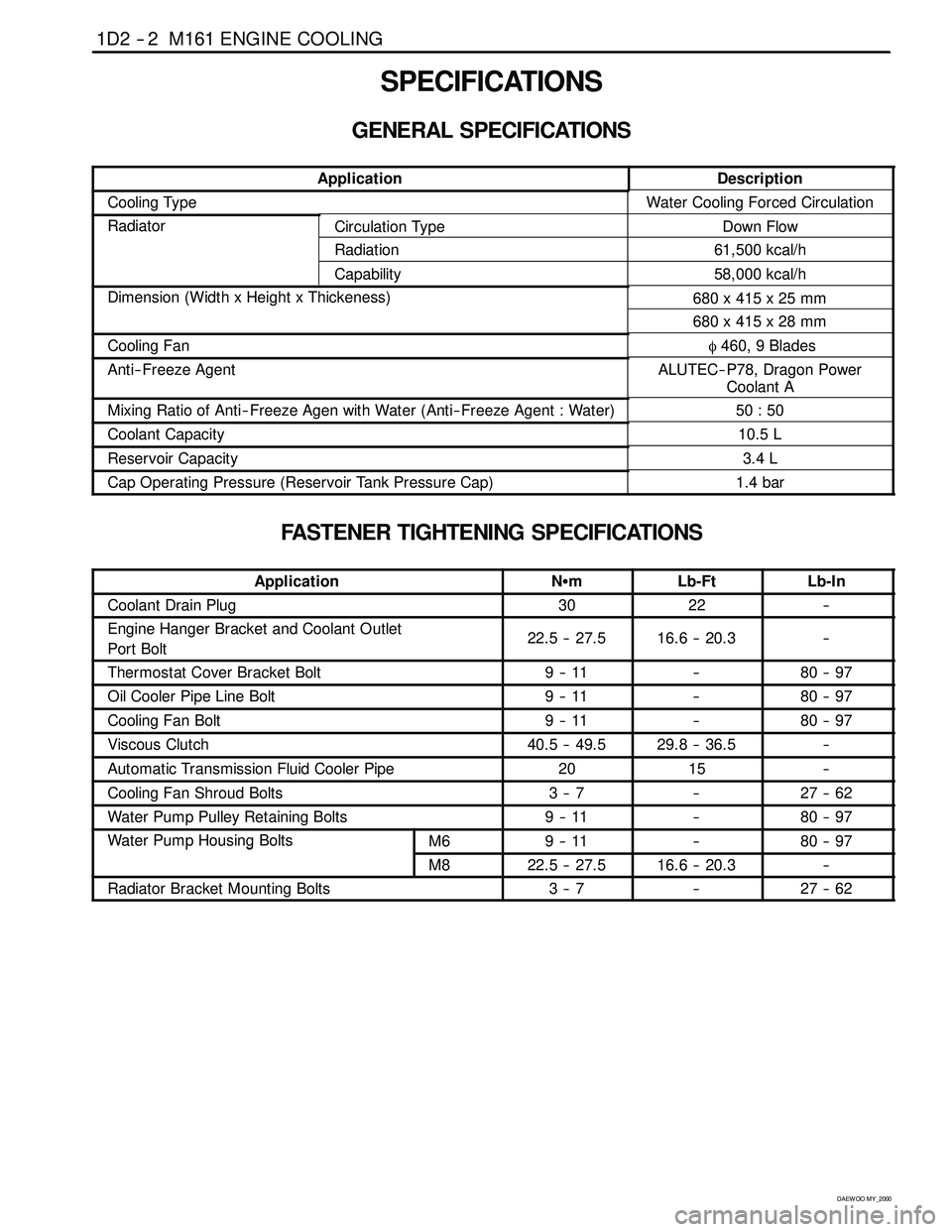
SPECIFICATIONS
GENERAL SPECIFICATIONS
ApplicationDescription
Cooling TypeWater Cooling Forced Circulation
RadiatorCirculation TypeDown Flow
Radiation61,500 kcal/h
Capability58,000 kcal/h
Dimension (Width x Height x Thickeness)680 x 415 x 25 mm(g)
680 x 415 x 28 mm
Cooling Fanφ460, 9 Blades
Anti-- Freeze AgentALUTEC-- P78, Dragon Power
Coolant A
Mixing Ratio of Anti-- Freeze Agen with Water (Anti-- Freeze Agent : Water)50 : 50
Coolant Capacity10.5 L
Reservoir Capacity3.4 L
Cap Operating Pressure (Reservoir Tank Pressure Cap)1.4 bar
FASTENER TIGHTENING SPECIFICATIONS
ApplicationNSmLb-FtLb-In
Coolant Drain Plug3022--
Engine Hanger Bracket and Coolant Outlet
Port Bolt22.5 -- 27.516.6 -- 20.3--
Thermostat Cover Bracket Bolt9--11--80 -- 97
Oil Cooler Pipe Line Bolt9--11--80 -- 97
Cooling Fan Bolt9--11--80 -- 97
Viscous Clutch40.5 -- 49.529.8 -- 36.5--
Automatic Transmission Fluid Cooler Pipe2015--
Cooling Fan Shroud Bolts3--7--27 -- 62
Water Pump Pulley Retaining Bolts9--11--80 -- 97
Water Pump Housing BoltsM69--11--80 -- 97pg
M822.5 -- 27.516.6 -- 20.3--
Radiator Bracket Mounting Bolts3--7--27 -- 62
Page 423 of 2053

D AEW OO M Y_2000
SECTION 1F2
ENGINE CONTROLS
CAUTION: Disconnect the negative battery cable before removing or installing any electrical unit or when a
tool or equipment could easily come in contact with exposed electrical terminals. Disconnecting this cable
will help prevent personal injury and damage to the vehicle. The ignition must also be in LOCK unless other -
wise noted.
TABLE OF CONTENTS
Engine and ECM Problem Check Report 1F2 -- 2....
Specifications 1F2 -- 3............................
Engine Data Display Table 1F2 -- 3.................
Fastener Tightening Specifications 1F2 -- 4..........
Fuel System Specification 1F2 -- 5.................
Temperature vs Resistance 1F2 -- 5................
Special Tools and Equipment 1F2 -- 6..............
Special Tools Table 1F2 -- 6.......................
Schematic and Routing Diagrams 1F2 -- 7..........
ECM Wiring Diagram
(2.3L DOHC -- MSE 3.53S) 1F2 -- 7..............
Diagnosis 1F2 -- 14................................
Failure Code Diagnosis 1F2 -- 14.....................
Clearing Failure Codes 1F2 -- 14...................
Failure Codes Table 1F2 -- 14.....................
Ignition System 1F2 -- 18...........................
Ignition Coil 1F2 -- 20.............................
Crankshaft Position (CKP) Sensor 1F2 -- 22.........
Camshaft Position (CMP) Sensor 1F2 -- 26..........
Camshaft Actuator 1F2 -- 30......................
Knock Sensor (KS) 1F2 -- 32......................
Spark Plug 1F2 -- 34.............................
System Voltage 1F2 -- 38.........................
Ignition Switch 1F2 -- 39..........................
Fuel System 1F2 -- 40..............................
Fuel Pump 1F2 -- 42.............................
Fuel Injector 1F2 -- 46............................
Purge Control Valve 1F2 -- 50.....................
Fuel Rail 1F2 -- 52...............................
Fuel Pressure Regulator 1F2 -- 54.................
Induction System 1F2 -- 56..........................
Throttle Valve Actuator 1F2 -- 56...................
Hot Film Air Mass (HFM) Sensor 1F2 -- 60..........
Engine Coolant Temperature (ECT) Sensor 1F2 -- 64.
Accelerator Pedal Module 1F2 -- 68................Cooling Fan 1F2 -- 72............................
A/C Compressor Relay 1F2 -- 73...................
Cruise Control Switch 1F2 -- 74....................
Traction Control System (TCS) 1F2 -- 75............
Stop Lamp Switch 1F2 -- 76.......................
Engine RPM 1F2 -- 77............................
Exhaust System 1F2 -- 78...........................
Catalytic Converter 1F2 -- 78......................
Oxygen Sensor 1F2 -- 80.........................
Engine Control Module 1F2 -- 86.....................
Serial Data Communication 1F2--88...............
Internal Failure 1F2 -- 90..........................
Electronic Throttle Controller Safety
Malfunction 1F2 -- 92...........................
Immobilizer 1F2 -- 94.............................
Maintenance and Repair 1F2 -- 95..................
On -- Vehicle Service 1F2 -- 95........................
Discharging the Pressure in Fuel System 1F2 -- 95...
Fuel Pump 1F2 -- 95.............................
Fuel Filter 1F2 -- 96..............................
Fuel Tank 1F2 -- 97..............................
Fuel Pressure Regulator 1F2 -- 98.................
Fuel Rail and Injector 1F2 -- 99....................
Engine Coolant Temperature Sensor 1F2 -- 100......
Throttle Body (Integrated with the
Actuator) 1F2 -- 101............................
Hot Film Air Mass (HFM) Sensor 1F2 -- 102.........
Knock Sensor 1F2 -- 102..........................
Pedal Position Sensor 1F2 -- 103...................
Oxygen Sensor 1F2 -- 103........................
Purge Control Valve 1F2 -- 104....................
Canister 1F2 -- 104...............................
Camshaft Position Sensor 1F2 -- 104...............
Crankshaft Position Sensor 1F2 -- 105..............
Engine Control Module 1F2 -- 105..................