wheel SSANGYONG KORANDO 2012 User Guide
[x] Cancel search | Manufacturer: SSANGYONG, Model Year: 2012, Model line: KORANDO, Model: SSANGYONG KORANDO 2012Pages: 1082, PDF Size: 96.1 MB
Page 328 of 1082

01-4
Engine mounting bracket
2. MAJOR COMPONENTS
Front View ▶
Cylinder head front cover
Timing gear case cover
EPS idler pulley
Alternator
Water pump pulley
A/C compressor
Crankshaft pulley
Oil pan assembly
Rear View ▶
Camshaft position sensor
Breather nipple
Purge control solenoid valveCoolant temperature sensor
Electronic throttle body
T-MAP sensor
MCC complete
VIS solenoid valve Cylinder head cover
Dual mass flywheel
Crankshaft position sensor
Hydraulic tensioner assembly
Page 331 of 1082
01-70000-00
3) General Instructions
Before lifting up the vehicle with a lift, correctly support the lifting points.
When using a jack, park the vehicle on a level ground and place the wheel chocks under the tires.
Position the jack under the frame and lift up the vehicle and then support with chassis stand before
service work.
Make sure to disconnect the negative (-) cable from the battery to prevent any damage to electric
systems.
If you have to work on vehicle, cover the seats and floor with protection covers to avoid any
damage and contamination.
Brake fluid and anti-freeze can damage the painted surface of body. So carefully handle them
during service work.
To improve the efficiency of service work, use only recommended and specified tools.
Use only Ssangyong genuine spare parts.
Never reuse the cotter pin, gasket, O-ring, oil seal, lock washer and self-locking nut. Replace them
with new ones. If reused, normal functions cannot be maintained.
Store the disassembled parts as a set based on disassembly order and unit.
Pay particular attention not to miss or mix the fasteners.
If necessary, especially for inspection, clean the removed parts completely.
Apply the oil or grease on the running and sliding surfeces before installation. Use the specified
sealant and gasket to prevent leakage if necessary.
Tighten the fasteners to the specified tightening torque.
As a final stage of service work, check if the serviced system is working properly and the problem
has been eliminated clearly. (1)
(2)
(3)
(4)
(5)
(6)
(7)
(8)
(9)
(10)
(11)
(12)
(13)
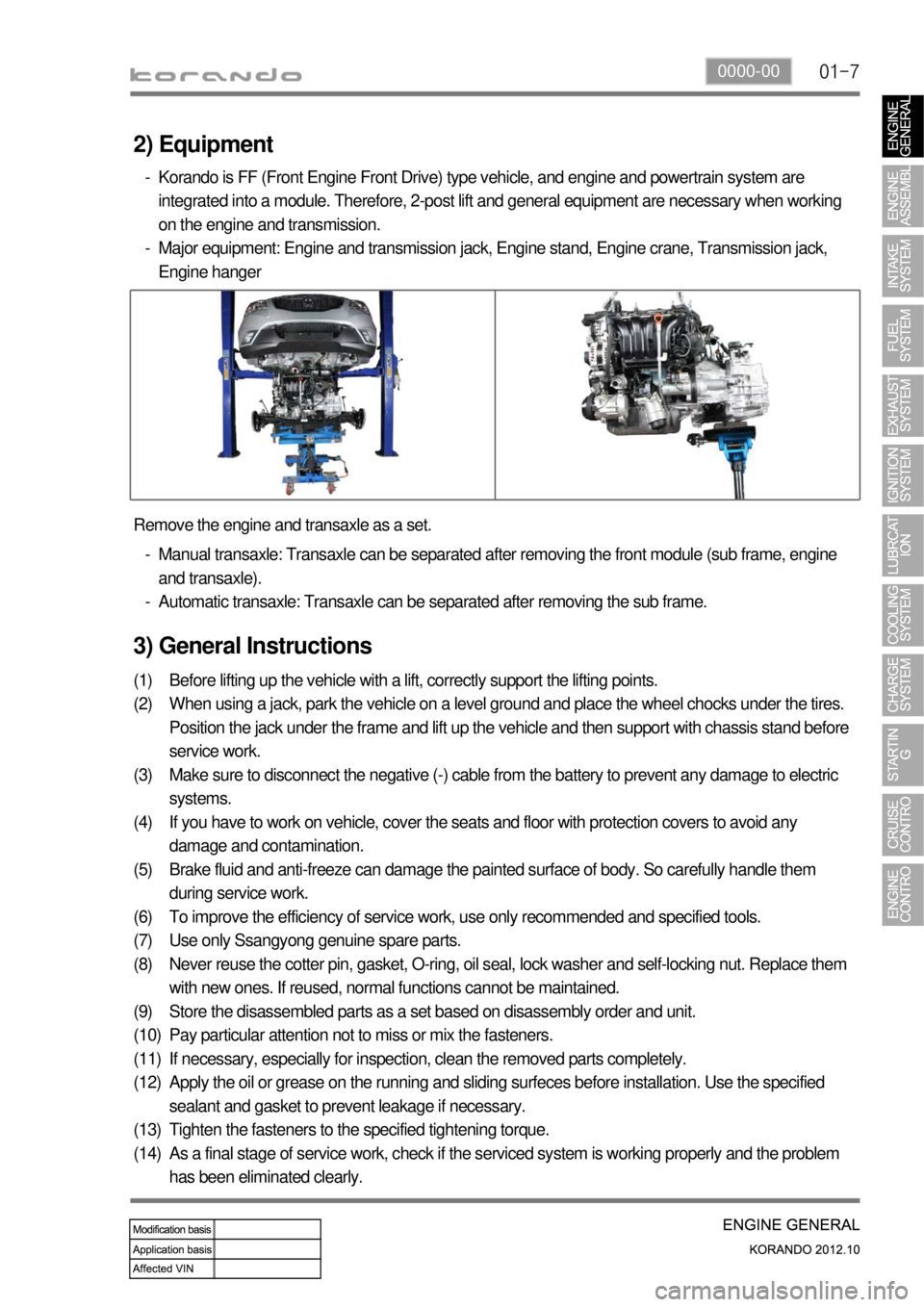
(14) Remove the engine and transaxle as a set.
Manual transaxle: Transaxle can be separated after removing the front module (sub frame, engine
and transaxle).
Automatic transaxle: Transaxle can be separated after removing the sub frame. -
-
2) Equipment
Korando is FF (Front Engine Front Drive) type vehicle, and engine and powertrain system are
integrated into a module. Therefore, 2-post lift and general equipment are necessary when working
on the engine and transmission.
Major equipment: Engine and transmission jack, Engine stand, Engine crane, Transmission jack,
Engine hanger -
-
Page 332 of 1082
01-8
4) Basic Inspection
(1) Horn operation
Listen for the horn sound when pressing the horn pad on the steering wheel. -
(2) Brake operation
Check if there is any abnormal noise, unusually long braking distance, or uneven braking force. If the
brake warning lamp does not go out even after starting the engien or are flashing during driving,
have the brake system checked immediately.
Check the brake pipes and hoses for connection, oil leak, crack or interference after changing the
position of tires. When replacing the tires, check the brake disc for surface condition and wear.
Check the parking brake cable and brake operation. Shorten the checking interval if the parking
brake is used frequently. -
-
-
(3) Exhaust system
Be aware to any changes in sound or smell from the exhaust system. These may be caused by leak or
overheat. Have the exhaust system checked and repaired immediately.
Inspect the exhaust system including catalytic converter. Inspect all the components and body frame
near the exhaust system. -
-
(4) Tires
Unusual vibration of the steering wheel and seats or pulling to one side on the straight and level roads
may indicates the uneven tire inflation pressure or poor wheel balance. -
(5) Steering and suspension system
Inspect the front and rear suspension and the steering system for damage, looseness or missing
parts, signs of wear or lack of lubrication. Inspect the power steering line and the hoses for
connection, leak, crack and chafing. Inspect the drive axle boot and seals for damage, tear or leak.
Replace or repair the system if necessary. -
(6) Engine oil
Check the oil level when the engine is still warm and add the specified engine oil if necessary. -
(7) Coolant
Check the coolant level in the coolant reservoir, coolant conditions (contamination, foreign material),
and hoses for damage and leak. Replace or add the Ssangyong genuine coolant, if needed. -
(8) Engine drive belt
Check all drive belts on the engine for wear, crack and looseness. Retighten or replace the belt, if
needed. -
Page 350 of 1082
02-4
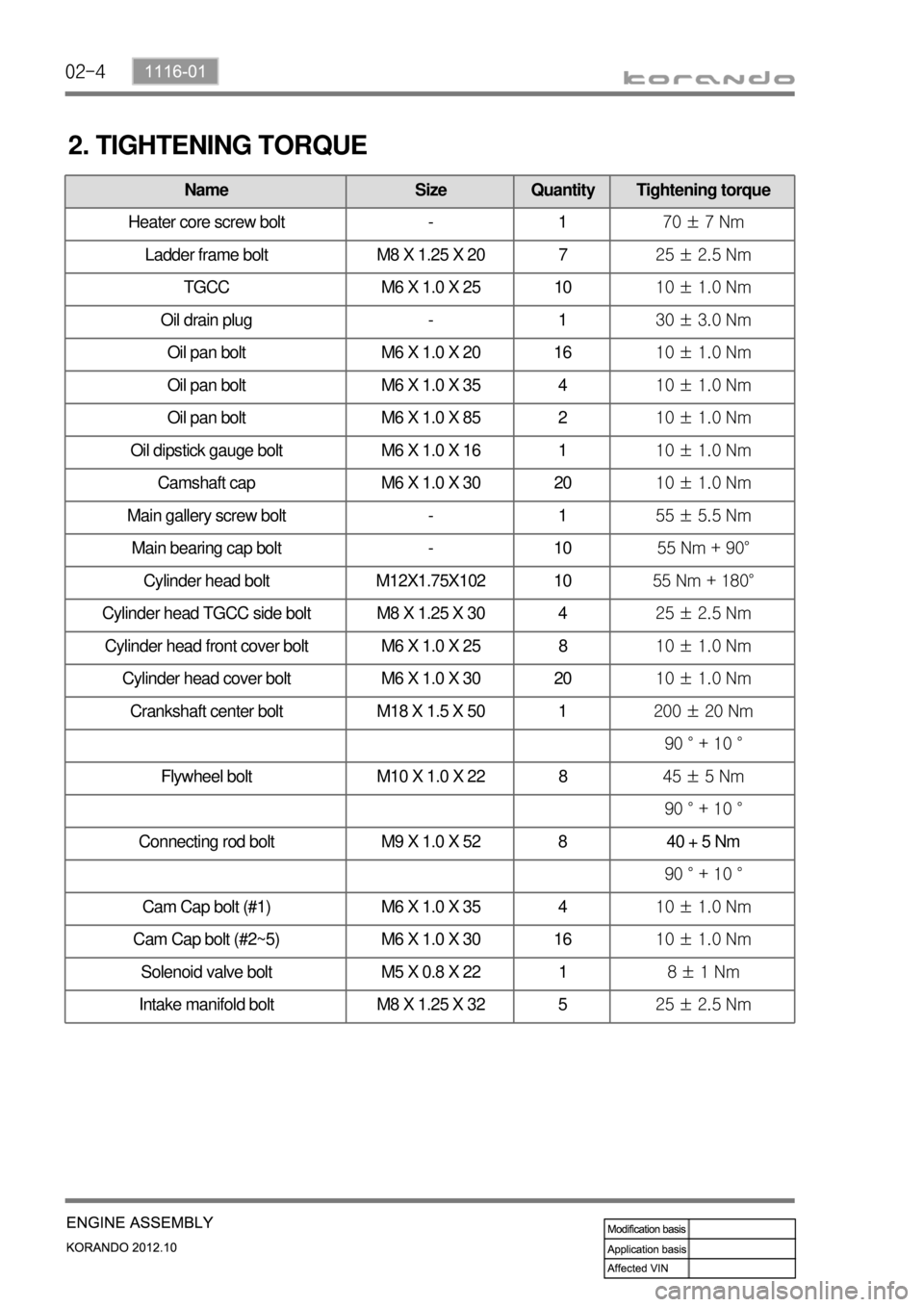
2. TIGHTENING TORQUE
Name Size Quantity Tightening torque
Heater core screw bolt - 170 ± 7 Nm
Ladder frame bolt M8 X 1.25 X 20 725 ± 2.5 Nm
TGCC M6 X 1.0 X 25 1010 ± 1.0 Nm
Oil drain plug - 130 ± 3.0 Nm
Oil pan bolt M6 X 1.0 X 20 1610 ± 1.0 Nm
Oil pan bolt M6 X 1.0 X 35 410 ± 1.0 Nm
Oil pan bolt M6 X 1.0 X 85 210 ± 1.0 Nm
Oil dipstick gauge bolt M6 X 1.0 X 16 110 ± 1.0 Nm
Camshaft cap M6 X 1.0 X 30 2010 ± 1.0 Nm
Main gallery screw bolt - 155 ± 5.5 Nm
Main bearing cap bolt - 1055 Nm + 90°
Cylinder head bolt M12X1.75X102 1055 Nm + 180°
Cylinder head TGCC side bolt M8 X 1.25 X 30 425 ± 2.5 Nm
Cylinder head front cover bolt M6 X 1.0 X 25 810 ± 1.0 Nm
Cylinder head cover bolt M6 X 1.0 X 30 2010 ± 1.0 Nm
Crankshaft center bolt M18 X 1.5 X 50 1200 ± 20 Nm
90 ° + 10 °
Flywheel bolt M10 X 1.0 X 22 845 ± 5 Nm
90 ° + 10 °
Connecting rod bolt M9 X 1.0 X 52 8 40 + 5 Nm
90 ° + 10 °
Cam Cap bolt (#1) M6 X 1.0 X 35 410 ± 1.0 Nm
Cam Cap bolt (#2~5) M6 X 1.0 X 30 1610 ± 1.0 Nm
Solenoid valve bolt M5 X 0.8 X 22 18 ± 1 Nm
Intake manifold bolt M8 X 1.25 X 32 525 ± 2.5 Nm
Page 373 of 1082

02-271130-13
1) Overview
Dual mass flywheel (DMF)
- Manual transaxleDrive plate
- Automatic transaxle
Dual mass flywheel reduces the unbalanced
rotation of crankshaft in manual transaxle
equipped vehicle. The flywheel is installed on the
crankshaft and is engaged to the clutch disc to
transfer the driving torque from the engine to the
powertrain system. Additionally, DMF decreases
the rattling noise in transaxle and the vehicle
vibration by reducing the differences of torque and
rotational speed due to the combustion in engine.The drive plate initially drives the powertrain
system by using the power from the start motor
when starting the engine. The drive plate is
installed on the crankshaft and is engaged to the
torque converter of automatic transaxle to transfer
the driving torque from the engine to the powertrain
system.
Page 374 of 1082

02-28
2) Operation of DMF
Compensating the irregular operation of engine: The secondary flywheel operates almost evenly so
does not cause gear noises
The mass of the primary flywheel is less than conventional flywheel so the engine irregularity
increases more (less pulsation absorbing effect).
Transaxle protection function: Reduces the torsional vibration to powertrain (transaxle) by reducing
the irregularity of engine. -
-
-
Compression stroke Combustion stroke
Small changes from engine (k):
Damper increases the torque changes to clutchLarge changes from engine (j):
Damper decreases the torque changes to
transaxle by absorbing the impact
Torque change curve of engine and drive shaft
Page 375 of 1082

02-291130-13
3) Features of DMF
Reduced vibration noise from the powertrain by blocking the torsional vibrations
Enhanced vehicle silence and riding comforts: reduced engine torque fluctuation
Reduced shifting shocks
Smooth acceleration and deceleration -
-
-
-
4) Advantages of DMF
Improved torque response by using 2-stage type spring: Strengthens the torque response in all
ranges (low, medium, and high speed) by applying respective spring constant at each
range.
Stable revolution of the primary and secondary wheel by using planetary gear: Works as auxiliary
damper against spring changes
Less heat generation due to no direct friction against spring surface: Plastic material is covered on the
spring outer surface
Increased durability by using plastic bushing (extends the lifetime of grease) -
-
-
-
Page 453 of 1082
11-51462-01
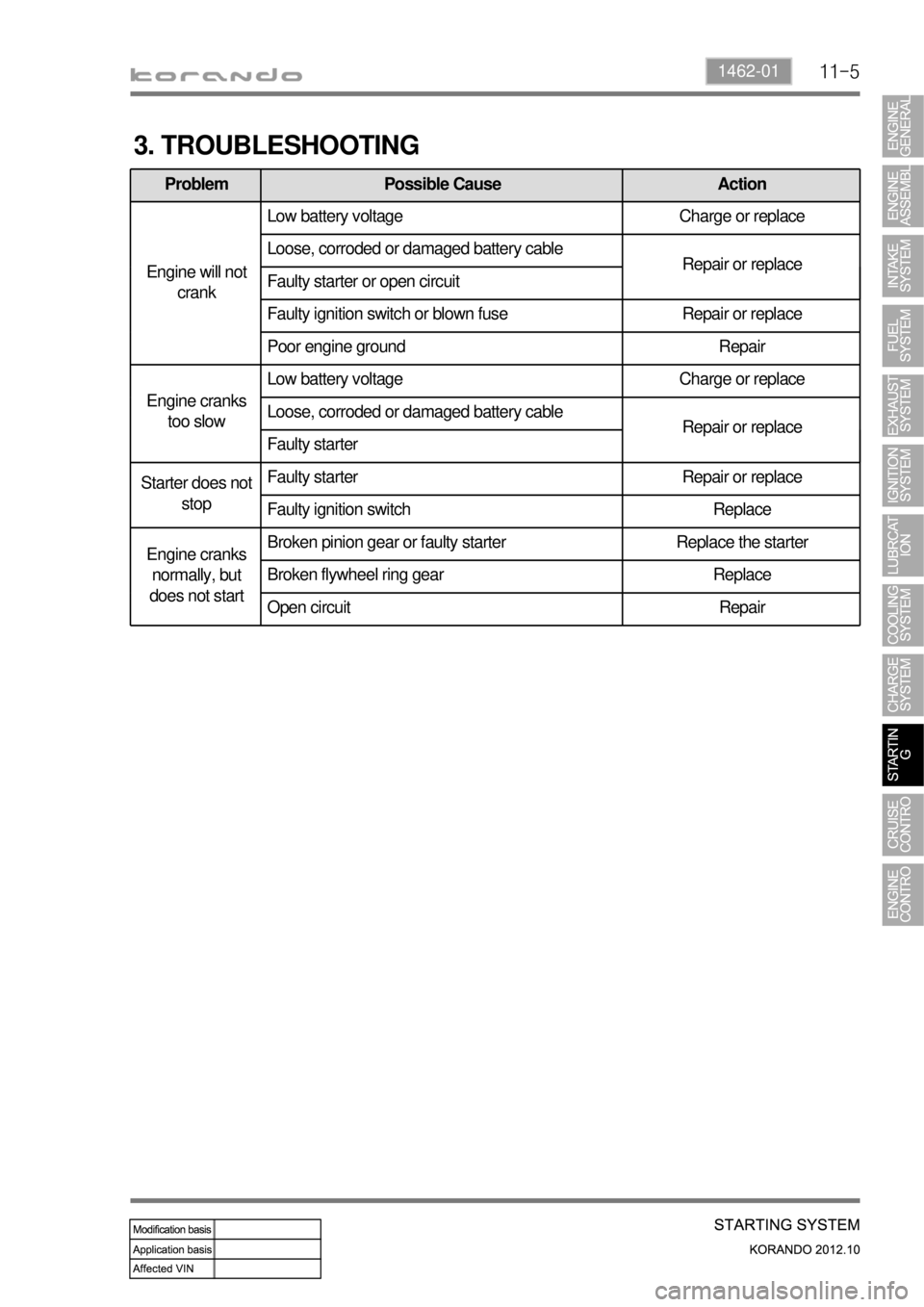
3. TROUBLESHOOTING
Problem Possible Cause Action
Engine will not
crankLow battery voltage Charge or replace
Loose, corroded or damaged battery cable
Repair or replace
Faulty starter or open circuit
Faulty ignition switch or blown fuse Repair or replace
Poor engine ground Repair
Engine cranks
too slowLow battery voltage Charge or replace
Loose, corroded or damaged battery cable
Repair or replace
Faulty starter
Starter does not
stopFaulty starter Repair or replace
Faulty ignition switch Replace
Engine cranks
normally, but
does not startBroken pinion gear or faulty starter Replace the starter
Broken flywheel ring gear Replace
Open circuit Repair
Page 482 of 1082
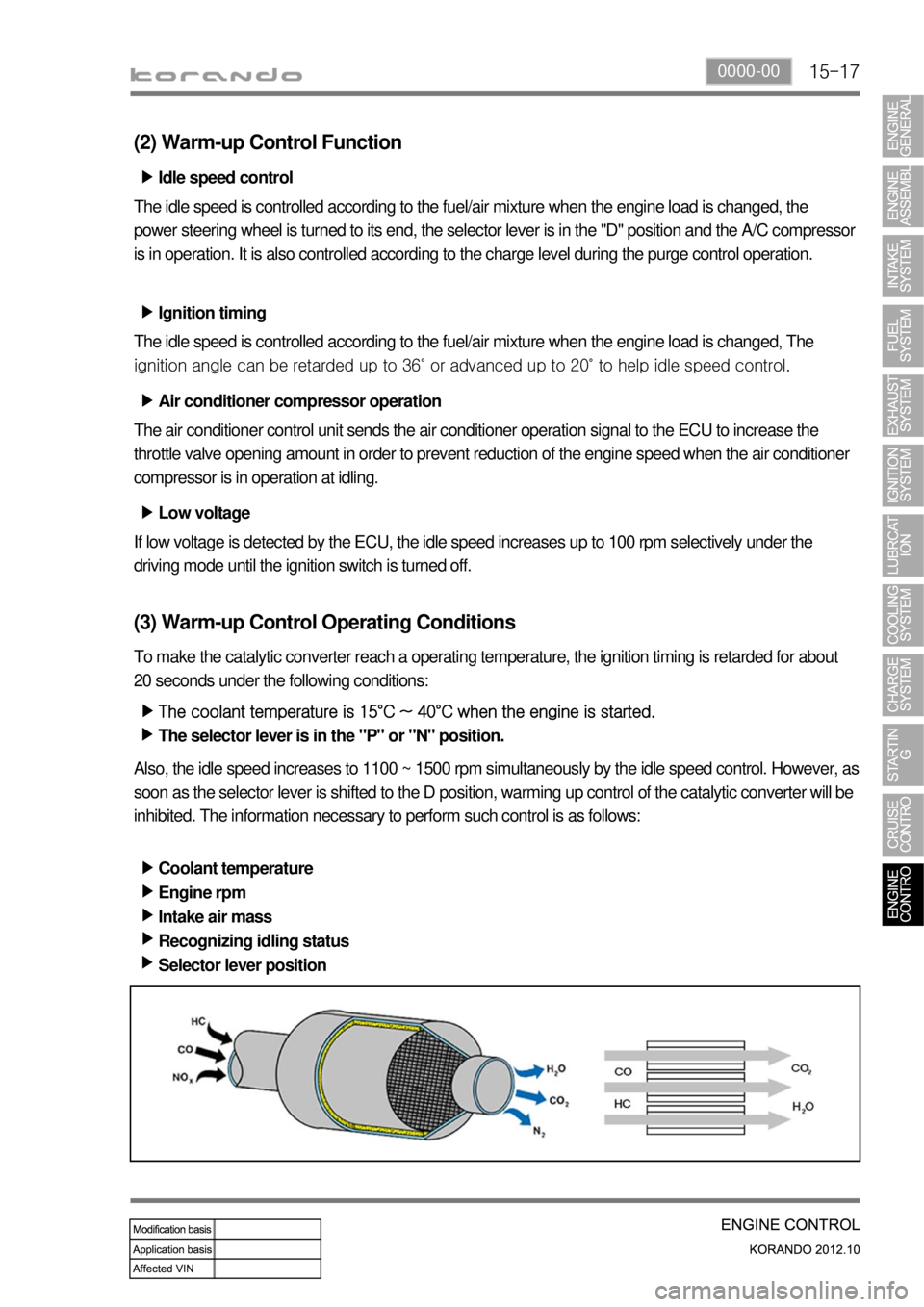
15-170000-00
(2) Warm-up Control Function
Low voltage ▶
If low voltage is detected by the ECU, the idle speed increases up to 100 rpm selectively under the
driving mode until the ignition switch is turned off. Idle speed control ▶
The idle speed is controlled according to the fuel/air mixture when the engine load is changed, the
power steering wheel is turned to its end, the selector lever is in the "D" position and the A/C compresso
r
is in operation. It is also controlled according to the charge level during the purge control operation.
Ignition timing ▶
The idle speed is controlled according to the fuel/air mixture when the engine load is changed, The
<0090008e00950090009b009000960095004700880095008e0093008c0047008a0088009500470089008c00470099008c009b00880099008b008c008b0047009c00970047009b00960047005a005d020b00470096009900470088008b009d00880095008a00
8c008b0047009c00970047009b0096004700590057020b0047>to help idle speed control.
Air conditioner compressor operation ▶
The air conditioner control unit sends the air conditioner operation signal to the ECU to increase the
throttle valve opening amount in order to prevent reduction of the engine speed when the air conditioner
compressor is in operation at idling.
(3) Warm-up Control Operating Conditions
To make the catalytic converter reach a operating temperature, the ignition timing is retarded for about
20 seconds under the following conditions:
The coolant temperature is 15°C ~ 40°C when the engine is started.
The selector lever is in the "P" or "N" position. ▶
▶
Also, the idle speed increases to 1100 ~ 1500 rpm simultaneously by the idle speed control. However, as
soon as the selector lever is shifted to the D position, warming up control of the catalytic converter will be
inhibited. The information necessary to perform such control is as follows:
Coolant temperature
Engine rpm
Intake air mass
Recognizing idling status
Selector lever position ▶
▶
▶
▶
▶
Page 495 of 1082

01-70000-00
Brake Master cylinder type Tandem type
Booster type Vacuum assisted booster type
Brake type Front wheel Disc
Rear wheel Disc
Parking brake Mechanical type
Suspension Front suspension MacPherson + Coil spring
Rear suspension Multi-link + Coil spring
Air
ConditionerRefrigerant (capacity)
R-134a(430 ± 30g)
Electrical Battery type / Capacity (V-AH) MF / 12 - 90
Starter capacity (V-KW) 12 - 2.3
Alternator capacity (V-A) 14V-140A (EPS), 14V-120A (NPS)
* ( ) option
DescriptionDiesel 2.0 Engine
(D20DTF(Low CO2))
Manual
TransaxleOperating type Floor change type
Gear ratio 1st 3.385
2nd 1.708
3rd 1.033
4th 0.786
5th 0.730
6th 0.595
Reverse 3.747
Transfer Case Model 4WD
Type Electronic control type
Clutch Operating type Hydraulic type
Disc type Dry single diaphragm type
Power
SteeringType Rack and pinion
Steering angle Inner39.0°
Outer31.24°
Rear Axle Drive shaft type Independent
suspensionBall joint type (4WD)
Axle housing type Build-up type (4WD)