door SSANGYONG KORANDO 2013 Service Manual
[x] Cancel search | Manufacturer: SSANGYONG, Model Year: 2013, Model line: KORANDO, Model: SSANGYONG KORANDO 2013Pages: 1336, PDF Size: 92.18 MB
Page 1210 of 1336

(7) Self-diagnosis
Diagnostic trouble code
The FATC has a self-diagnosis function that can diagnose the system by itself. If this system is
defective, the LCD display shows the diagnostic trouble code (DTC) to inform a driver of defects on the
device such as a sensor or actuator. The driver can see the each sensor data on the air conditioning
system after entering self-diagnosis mode. Before checking each component, be sure to check the
default code by using self diagnosis function.
The diagnostic trouble code (DTC)
flashes twice and is displayed
repeatedly in order as long as a
separate operation is not performed.
Code Defective part
00 Normal
21 Ambient temperature sensor
22 Incar sensor
23 Water temperature sensor
24 Intake sensor
26 Temp door (control)
31 Mode door (vent)
32 Mode door (bi-level)
33 Temp door (cool)
34 Mode door (foot)
35 Mode door (defroster & foot)
36 Mode door (defroster)
37 Intake door (fresh air)
38 Intake door (1/3)
39 Intake door (recirculation)Diagnostic trouble code
Open circuit in sensor
Diagnostic trouble code
Page 1217 of 1336

6810-00
(4) Air source control
When pressing the air source selection switch, the air source mode is changed via the intake actuator's
operation. The air source mode is switched between the fresh air and recirculation alternatively each
time the switch is pressed. You can see the air source mode through the switch's indicator. (the indicator
comes on at recirculation mode)
Control by vehicle speed
The air source selection is controlled in accordance with the vehicle speed while driving. Operating
conditions and control process are as follows:
When the PTC heater operates at fresh air mode in winter
When the vehicle speed is 45 km/h or lower in fresh air mode, the air source door is open 30% of its
maximum opening. If the vehicle speed is 65 km/h or more, then the air source door is completely
open. -
-
However, the electronic fan should be more than 7.5 V.
Air source selection switch
Page 1229 of 1336
3. CAUTIONS FOR AIR BAG SYSTEM
Cautions for air bag maintenance
Whenever installing or removing the devices related to the air bag system, disconnect the negative
battery cable and wait for at least 30 seconds.
Do not connect a tester probe to the inflator to measure the resistance of the component of the air
bag system. The detonator of the inflator may explode due to a sudden extra power supplied by the
tester.
Note that the used components related to the air bag system, especially the air bag unit, should be
packed in an air tight container and prevent it from any impact or damage.
When there is any deployed air bag (including curtain air bag and seat belt pretensioner), the entire
system including the air bag unit should be replaced. The deployed air bag unit should not be reused
since it has status data when it is deployed, and the data cannot be cleared with a diagnostic device.
The air bag and seat belt pretensioner systems contain explosive charges, so handle carefully when
disposing or replacing them. 1.
2.
3.
4.
5.
Cautions for air bag maintenance
Do not modify, change or apply impact on any air bag component. The air bag may be deployed
abruptly, causing serious injuries.
Children and infants should ride in a rear seat. Seating in the passenger seat with carrying a
child or infant is strictly prohibited. An infant or a child could be severely injured by the air bag
deployment.
A child restraint system must not be installed on the front seat. An infant or a child could be severely
injured by the air bag deployment when it is fitted to the passenger seat.
Do not place any objects on the air bag inflation location. You may get injured by those objects during
deployment.
Never put your arms around the front seat from behind, lean on the front seatback, or put your arms
out of the window. You can severely injured when the side air bag deploys.
Never lean on the door since it becomes very dangerous when the side air bag deploys.
The side air bag deploys when there is a severe side collision.
Do not slam the front door to close it. The side air bag may deploy unexpectedly.
When an occupant fastens the seat belt in an unstable or inclined posture, the air bag system cannot
protect the occupant properly. Moreover, the occupant can be injured by the air bag.
Do not move your seat too close to the steering wheel or dashboard. Being too close to the
steering wheel or instrument panel during the air bag deployment could cause serious injury,
including death
Hold only the outer rim of the steering so that the air bag can inflate without any hindrance.
Do not incline toward the steering wheel. Never allow the passenger to put hands or feet on the dash
board. The air bag cannot work properly Do not hold and operate the steering wheel by crossing your
arms You could get seriously injured when the air bag deploys. 1.
2.
3.
4.
5.
6.
7.
8.
9.
10.
11.
Page 1232 of 1336

8810-00
1. AIR BAG SYSTEM OVERVIEW
The air bag system is divided into front air bag system and side air bag system. The system protects the
occupant's body by deploying the air bags in the event of a collision. The system consists of 8 inflators
including the inflators of the seat belt pretensioners, air bag unit (SDM), and 4 impact sensors on the
front side and both sides of the vehicle. The air bag unit (SDM) determines the operation of each air bag
module and seat belt pretensioners using the crash signals from the front and side impact sensors in the
event of a collision. The front and side air bag systems are operated independently, and the body control
module (BCM) activates the auto door unlock function and various lamps including hazard warning lamp
and room lamps, when the crash signal from the SDM is received to notify others of emergency situation
and let the occupant escape easily. The SDM is equipped with self diagnosis function, and it performs
the diagnosis on the internal/external devices of the air bag system for a certain period of time after IGN
ON. And it monitors the air bag system regularly and turns on the air bag warning lamp on the
instrument cluster when a fault is found in the system, to notify the driver. The SDM has event data
recorder (EDR) function that stores the driving information data transmitted through CAN communication
from various units (vehicle speeds, engine rpm, brake application, etc.) in a crash or near crash event,
when the acceleration sensor in the air bag unit detects a sharp acceleration change, regardless of the
air bag deployment
Page 1233 of 1336
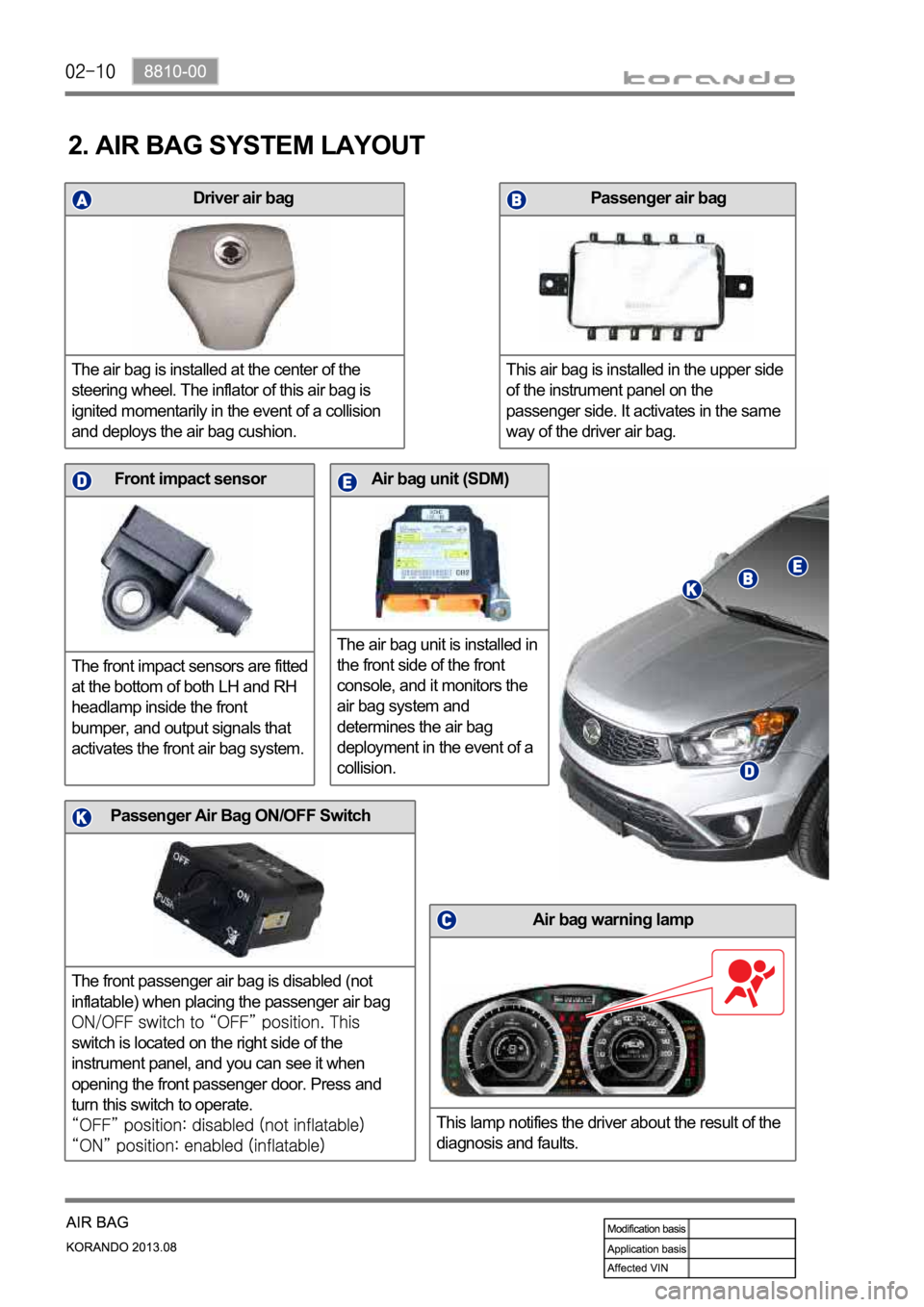
Driver air bag
The air bag is installed at the center of the
steering wheel. The inflator of this air bag is
ignited momentarily in the event of a collision
and deploys the air bag cushion.
Air bag unit (SDM)
The air bag unit is installed in
the front side of the front
console, and it monitors the
air bag system and
determines the air bag
deployment in the event of a
collision.Front impact sensor
The front impact sensors are fitted
at the bottom of both LH and RH
headlamp inside the front
bumper, and output signals that
activates the front air bag system.
Air bag warning lamp
This lamp notifies the driver about the result of the
diagnosis and faults.
Passenger air bag
This air bag is installed in the upper side
of the instrument panel on the
passenger side. It activates in the same
way of the driver air bag.
2. AIR BAG SYSTEM LAYOUT
Passenger Air Bag ON/OFF Switch
The front passenger air bag is disabled (not
inflatable) when placing the passenger air bag
switch is located on the right side of the
instrument panel, and you can see it when
opening the front passenger door. Press and
turn this switch to operate.
Page 1234 of 1336
8810-00
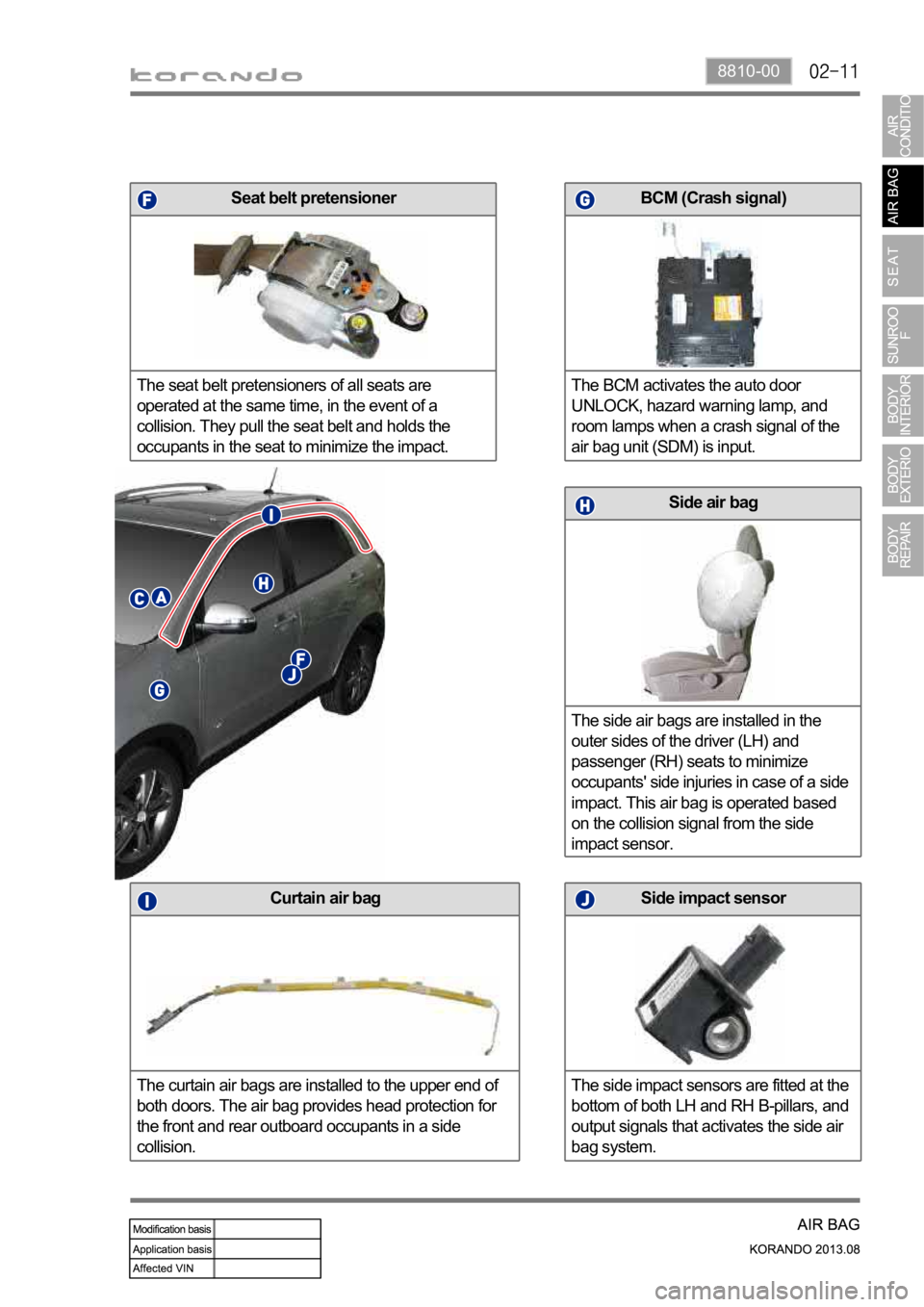
Side air bag
The side air bags are installed in the
outer sides of the driver (LH) and
passenger (RH) seats to minimize
occupants' side injuries in case of a side
impact. This air bag is operated based
on the collision signal from the side
impact sensor.
Curtain air bag
The curtain air bags are installed to the upper end of
both doors. The air bag provides head protection for
the front and rear outboard occupants in a side
collision.Side impact sensor
The side impact sensors are fitted at the
bottom of both LH and RH B-pillars, and
output signals that activates the side air
bag system.
BCM (Crash signal)
The BCM activates the auto door
UNLOCK, hazard warning lamp, and
room lamps when a crash signal of the
air bag unit (SDM) is input.Seat belt pretensioner
The seat belt pretensioners of all seats are
operated at the same time, in the event of a
collision. They pull the seat belt and holds the
occupants in the seat to minimize the impact.
Page 1235 of 1336

3. AIR BAG SYSTEM OPERATING PROCESS
1) Air Bag System Input/Output
The air bag unit (SDM) performs the internal/external diagnosis on the air bag system for about 6
seconds after IGN ON. The air bag unit is ready to deploy air bag after this diagnosis, and when a
certain level of collision occurs, it determines the deployment of the air bag using the signals from the
impact sensors, deploys the corresponding air bag, and stores the collision data and EDR data. The
body control module (BCM) activates the auto door unlock function and various lamps including hazard
warning lamp and room lamps, when the crash signal from the SDM is received to notify others of
emergency situation and let the occupant escape easily.
Major functions
Detects frontal and side collision (Rear-end collision only with EDR trigger)
Activates the front air bag, side air bag, curtain air bag and belt pretensioners
Indicates system readiness and faults to the driver by means of a fault warning lamp
Facilitates servicing capability via a serial diagnostic communication interfaces
Records crash data and DTCs
Keeps power for deployment of air bag even when the power to the air bag unit is cut off due to the
collision
Event data recorder (EDR) -
-
-
-
-
-
-
Page 1239 of 1336

(2) Side air bag system deployment
The side air bag system is activated in the event of a left side or right side collision. The seat side air bags
are installed to the driver and passenger seat (one on each seat) and the curtain air bags are installed in
the end of the roof located on the upper sides of both doors. The side air bags and the curtain air bags are
operated by the same signal. The air bags of the driver seat and passenger seat are operated separately
according to the impact position (left side, right side).
ItemImpact to (side)
LH RH
Side air bag - Driver side Ignite Not ignite
Side air bag - Passenger side Not ignite Ignite
Curtain air bag - Driver side Ignite Not ignite
Curtain air bag - Passenger side Not ignite Ignite
Seat belt pretensioner - Driver side Not ignite Not ignite
Seat belt pretensioner - Passenger side Not ignite Not ignite
(3) Component change after deployment
Side air bag deployed
Deployed side air bag, air bag unit and its wirings (including connectors), side impact sensor, other
damaged trim, seat components
Curtain air bag deployed
Deployed curtain air bag, air bag unit and its wirings (including connectors), side impact sensor,
damaged trim, seat and roof headlining
Page 1242 of 1336
8810-00
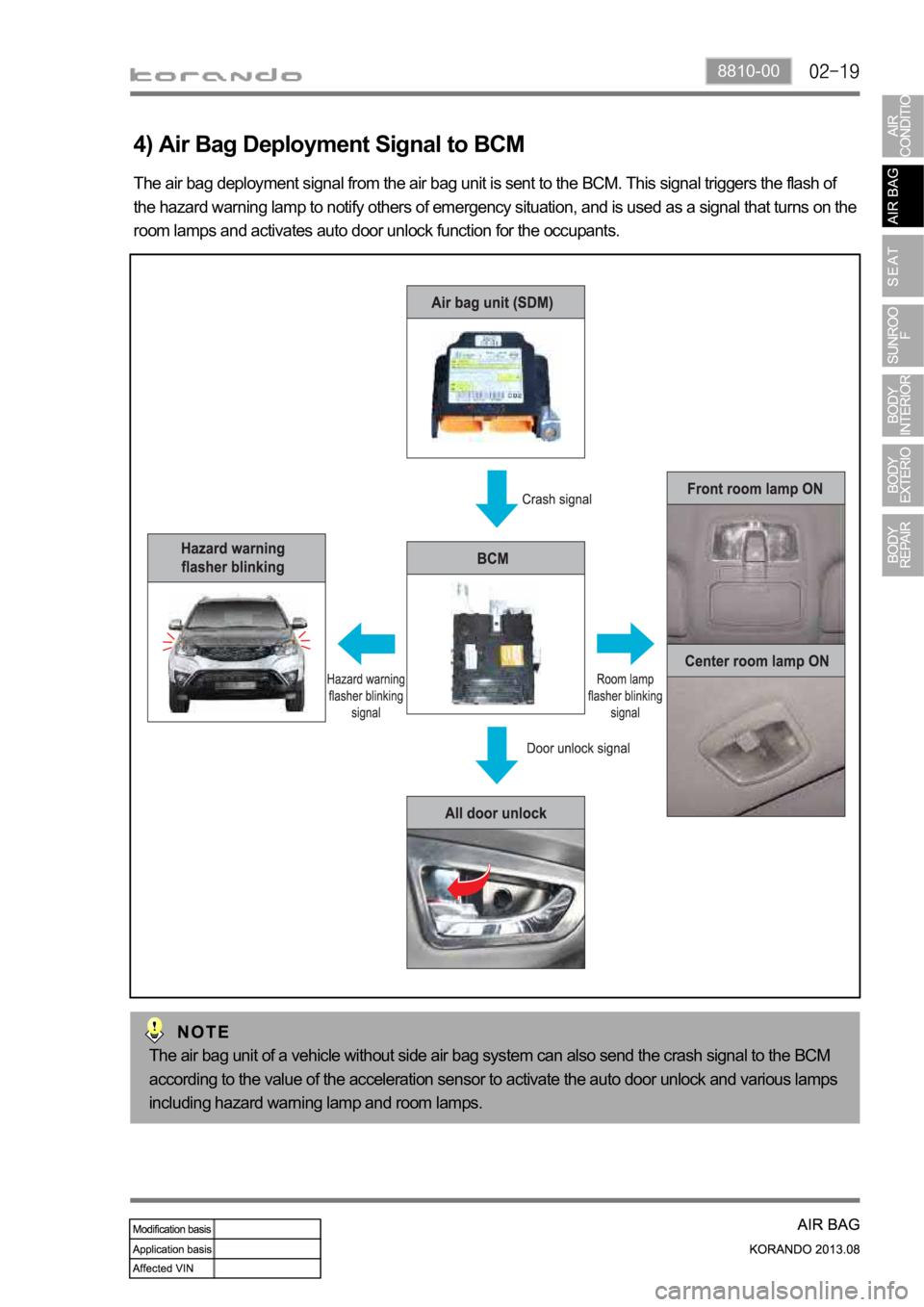
4) Air Bag Deployment Signal to BCM
The air bag deployment signal from the air bag unit is sent to the BCM. This signal triggers the flash of
the hazard warning lamp to notify others of emergency situation, and is used as a signal that turns on the
room lamps and activates auto door unlock function for the occupants.
The air bag unit of a vehicle without side air bag system can also send the crash signal to the BCM
according to the value of the acceleration sensor to activate the auto door unlock and various lamps
including hazard warning lamp and room lamps.
Page 1244 of 1336

8810-00
Operation 2.
Signal from unlock relay is output for 5 seconds (T3) after 40 ms (T2)
When turning IGN OFF during 5 seconds (T3) of unlock relay signal output
Signal from unlock relay is input for the rest of the time B.
C.
D.
E. Operation 1.
Air bag deployment signal is not input for initial 7 seconds (T4) after IGN ON A.
The room lamp comes on when the air bag deployment signal is input except when the room lamp
switch is turned off.
The hazard warning lamp flashes when the air bag deployment signal is input.
Resetting the auto door unlock function turns off the battery (cutting off BCM power). -
-
-
(2) BCM control when air bag deployment signal is input
The UNLOCK by the air bag deployment signal takes priority over the LOCK/UNLOCK control from
other functions.
The LOCK/UNLOCK requests from other functions during or after the UNLOCK output by the air
bag signal are ignored. However, the LOCK control is carried out when the ignition switch is turned
to the "OFF" position.
The same request during the LOCK/UNLOCK output is ignored. However, the UNLOCK by the air
bag deployment signal or operation by the smart key is carried out.
When LOCK and UNLOCK outputs occur at the same time, the LOCK output is carried out and
UNLOCK is ignored. 1.
2.
3.
4.