lamp SSANGYONG KORANDO 2013 Manual Online
[x] Cancel search | Manufacturer: SSANGYONG, Model Year: 2013, Model line: KORANDO, Model: SSANGYONG KORANDO 2013Pages: 1336, PDF Size: 92.18 MB
Page 742 of 1336

AUTO hazard warning flasher control
The hazard warning lamp comes on 3 times (T3) when the AUTO hazard warning lamp switch is
pressed for less than 0.6 seconds (T1). A. Operation 1.
The hazard warning lamp comes on 10 times (T4) when the AUTO hazard warning lamp switch is
pressed for 0.6 seconds or more (T2).
The turn signal lamp switch is pressed during the AUTO hazard warning lamp operation.
The corresponding turn signal lamp is activated after this AUTO hazard warning lamp operation. B.
C.
D. Operation 2.
The AUTO hazard warning lamp can be controlled only with IGN ON.
The input from the AUTO hazard warning lamp switch is ignored during the turn signal lamp
operation by the turn signal lamp switch.
Priority of operation: (Hazard warning lamp switch > LH/RH turn signal lamp > AUTO hazard
warning lamp switch) -
-
-
Operating process
Page 744 of 1336

Emergency hazard warning lamp control (coupled with ABS)
The emergency stop signal is input from the ABS/ESP module with the vehicle driven at 50 km/h or
more.
The hazard warning lamp flashes at 4 Hz (T1) and internal buzzer (chime) sounds at 1.25 Hz. A.
B. Operation 1. (emergency stop signal)
During operation 1 (emergency stop signal activated)
The vehicle speed decreased to 50 km/h or less
The hazard warning lamp flashes for 10 seconds (T2) at 1.25 Hz and then goes out. C.
D.
E.
The BCM activates emergency hazard warning lamp operation when receiving emergency braking
signal from the ESP/ABS.
Priority of operation
(Manual operation of hazard warning lamp > Emergency stop signal > Emergency AUTO hazard
warning lamp > AUTO hazard warning lamp) -
lamp)
During operation 2 (emergency AUTO hazard warning lamp)
The hazard warning lamp switch is turned OFF.
The hazard warning lamp is turned OFF because the manual operation overrides the emergency
AUTO operation. F.
G.
H.
The emergency stop signal and emergency AUTO hazard warning lamp signal are switched off
when the vehicle speed exceeds 10 km/h (if emergency stop signal is input).
Page 746 of 1336

Operating process
The BCM activates emergency hazard warning lamp operation when receiving emergency braking
flasher ON signal from the ESP/ABS.
When the emergency stop signal is input through the P-CAN, the hazard warning lamp flashes with the
frequency of 4 Hz and the internal buzzer sounds at 1.25 Hz.
P-CAN signal during operation: Emergency Stop=EBL_INFO=0*0=Hazard Warning Lamp unrequested
Page 747 of 1336
8710-01
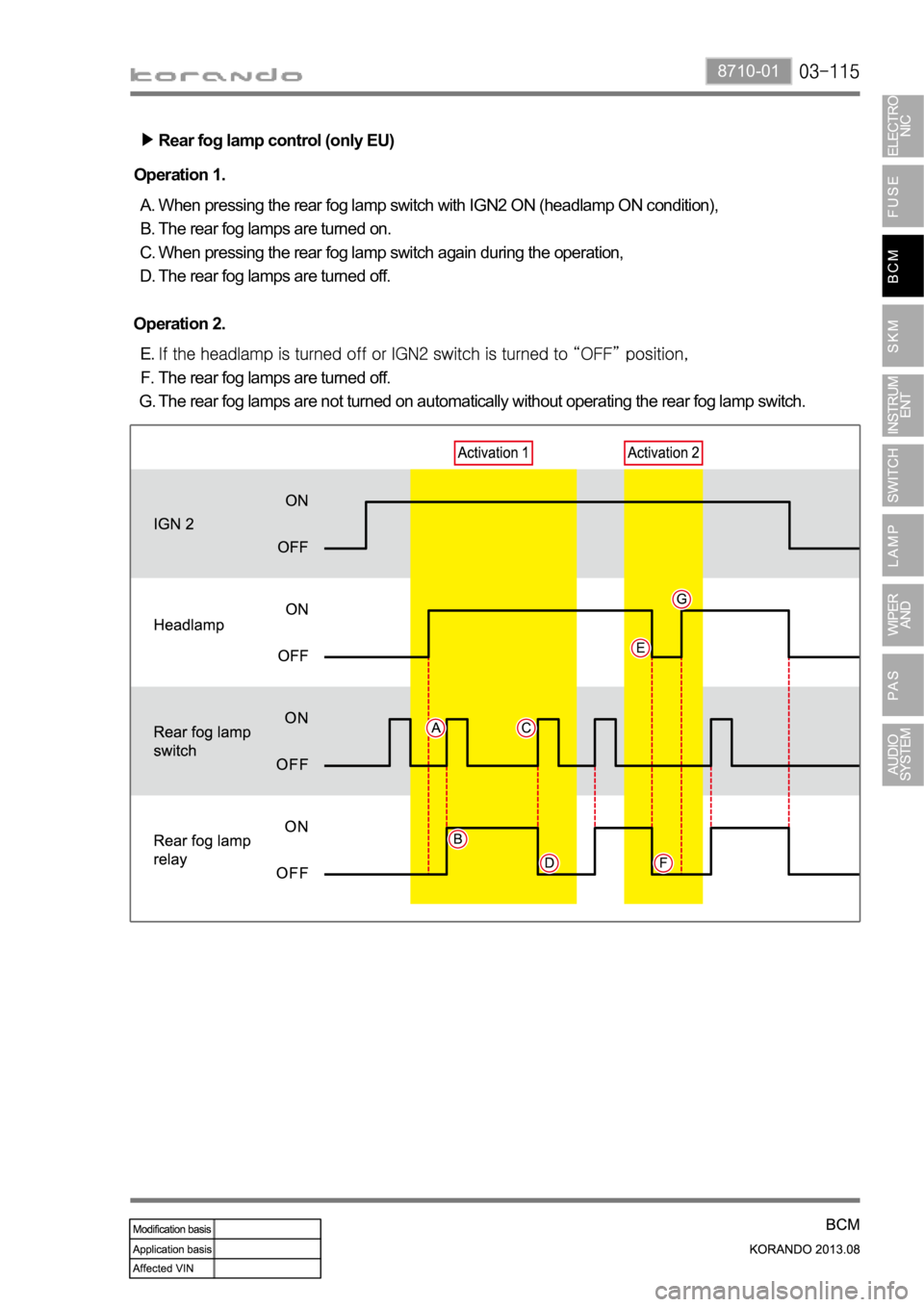
Rear fog lamp control (only EU)
When pressing the rear fog lamp switch with IGN2 ON (headlamp ON condition),
The rear fog lamps are turned on.
When pressing the rear fog lamp switch again during the operation,
The rear fog lamps are turned off. A.
B.
C.
D. Operation 1.
The rear fog lamps are turned off.
The rear fog lamps are not turned on automatically without operating the rear fog lamp switch. E.
F.
G. Operation 2.
Page 749 of 1336

8710-01
Approach lamp control (for vehicles without SKM)
The lamp is illuminated for 30 seconds when the REKES key UNLOCK signal is received in theft
deterrent mode.
The lamp is illuminated when the driver door is opened after the ignition is turned OFF. A.
B. Operation 1. (Puddle lamp ON conditions)
When the door LOCK signal is received with the lamp ON (the system enters the theft deterrent
mode)
When the ignition is turned ON with the lamp ON.
Thirty seconds after the lamp ON C.
D.
E. Operation 2. (Puddle lamp OFF conditions)
22. APPROACH (PUDDLE) LAMP
Approach lamp control (for vehicles with SKM)
The lamp is illuminated for 30 seconds when UNLOCK signal by the smart key or door handle switch
is received in theft deterrent mode.
The lamp is illuminated when the driver door is opened after the ignition is turned OFF. A.
B. Operation 1. (Puddle lamp ON conditions)
When the door LOCK signal is received with the lamp ON (the system enters the theft deterrent
mode)
When the ignition is turned ON with the lamp ON.
Thirty seconds after the lamp ON C.
D.
E. Operation 2. (Puddle lamp OFF conditions)
Page 763 of 1336

8712-03
(3) Passive LOCK
The passive LOCK (door LOCK) is activated by the door handle switch with a valid smart key present
within the passive entry actuation area.
Passive LOCK and verification by door handle switch
The ignition is turned OFF or ACC is turned ON.
All doors are closed and the driver door is unlocked.
The door handle switch on the driver or passenger door is pressed briefly.
The SKM verifies if a smart key is outside the vehicle using the door handle antenna (LF verification)
(The SKM searches the last smart key used first. Searching for a smart key signal from the outside
the vehicle is followed by searching from the inside the vehicle).
The verification signal (RF verification) from the smart key is sent to the REKES antenna of the SKM.
The SKM sends the Passive LOCK signal to the BCM through the B-CAN if the verified smart key is
found outside the vehicle.
The BCM receives the signal from the SKM and controls the door LOCK actuator and turn signal
lamp. (The buzzer sounds once and hazard warning lamp flashes twice when the system enters the
theft deterrent mode) -
1.
2.
3.
4.
5.
6.
If no smart key is identified as being outside the vehicle, the passive LOCK process is stopped and
restarted when the next signal is received from the door handle switch.
When the door handle switch is pressed with ACC ON and driver door unlocked, the SKM changes
the ignition status to OFF and sends the passive LOCK signal to the BCM through the B-CAN to lock
the door. The BCM ignores the signal if the ignition is turned ON. -
-
Page 764 of 1336

(4) Passive UNLOCK
The passive UNLOCK (door UNLOCK) is activated by the door handle switch with a valid smart key
present within the passive entry actuation area.
Passive UNLOCK and verification by door handle switch
The driver door is locked and the system in the theft deterrent mode.
The door handle switch on the driver or passenger door is pressed briefly.
The SKM verifies if a smart key is outside the vehicle using the door handle antenna (LF verification)
(The SKM searches the last smart key used first).
The verification signal (RF verification) from the smart key is sent to the REKES antenna of the SKM.
The SKM sends the Passive UNLOCK signal to the BCM through the B-CAN if the verified smart key
is found outside the vehicle.
The BCM receives the signal from the SKM and controls the door UNLOCK actuator and turn signal
lamp. (The buzzer sounds twice and hazard warning lamp flashes once when the theft deterrent
mode is deactivated) 1.
2.
3.
4.
5.
6.
If no smart key is identified as being outside the vehicle, the passive UNLOCK process is stopped
and restarted when the next signal is received from the door handle switch.
When the driver door is locked with ACC ON, the SKM sends the Passive UNLOCK signal to the
BCM through the B-CAN to unlock the door without changing the ignition status to OFF. (The vehicle
power is turned OFF when the door is opened.)
Smart key searching
* Theft deterrent mode: deactivated after searching the outside vehicle
* Theft deterrent mode deactivated: outside searching after inside searching -
-
-
Page 766 of 1336
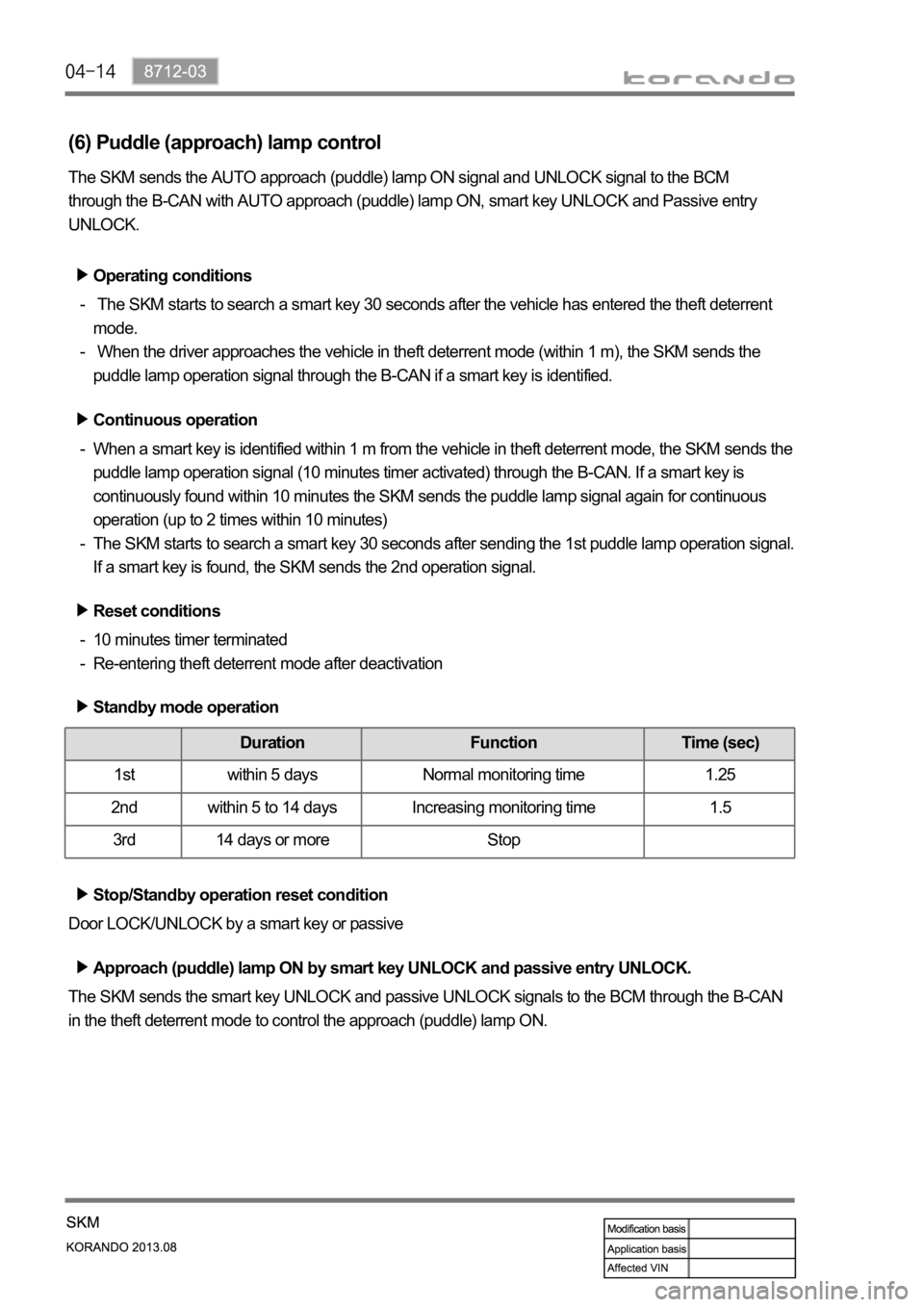
(6) Puddle (approach) lamp control
Operating conditions
The SKM starts to search a smart key 30 seconds after the vehicle has entered the theft deterrent
mode.
When the driver approaches the vehicle in theft deterrent mode (within 1 m), the SKM sends the
puddle lamp operation signal through the B-CAN if a smart key is identified. -
-
Continuous operation
Reset conditions
Standby mode operation
When a smart key is identified within 1 m from the vehicle in theft deterrent mode, the SKM sends the
puddle lamp operation signal (10 minutes timer activated) through the B-CAN. If a smart key is
continuously found within 10 minutes the SKM sends the puddle lamp signal again for continuous
operation (up to 2 times within 10 minutes)
The SKM starts to search a smart key 30 seconds after sending the 1st puddle lamp operation signal.
If a smart key is found, the SKM sends the 2nd operation signal. -
-
10 minutes timer terminated
Re-entering theft deterrent mode after deactivation -
-
Duration Function Time (sec)
1st within 5 days Normal monitoring time 1.25
2nd within 5 to 14 days Increasing monitoring time 1.5
3rd 14 days or more Stop
The SKM sends the AUTO approach (puddle) lamp ON signal and UNLOCK signal to the BCM
through the B-CAN with AUTO approach (puddle) lamp ON, smart key UNLOCK and Passive entry
UNLOCK.
Door LOCK/UNLOCK by a smart key or passiveStop/Standby operation reset condition
The SKM sends the smart key UNLOCK and passive UNLOCK signals to the BCM through the B-CAN
in the theft deterrent mode to control the approach (puddle) lamp ON. Approach (puddle) lamp ON by smart key UNLOCK and passive entry UNLOCK.
Page 768 of 1336
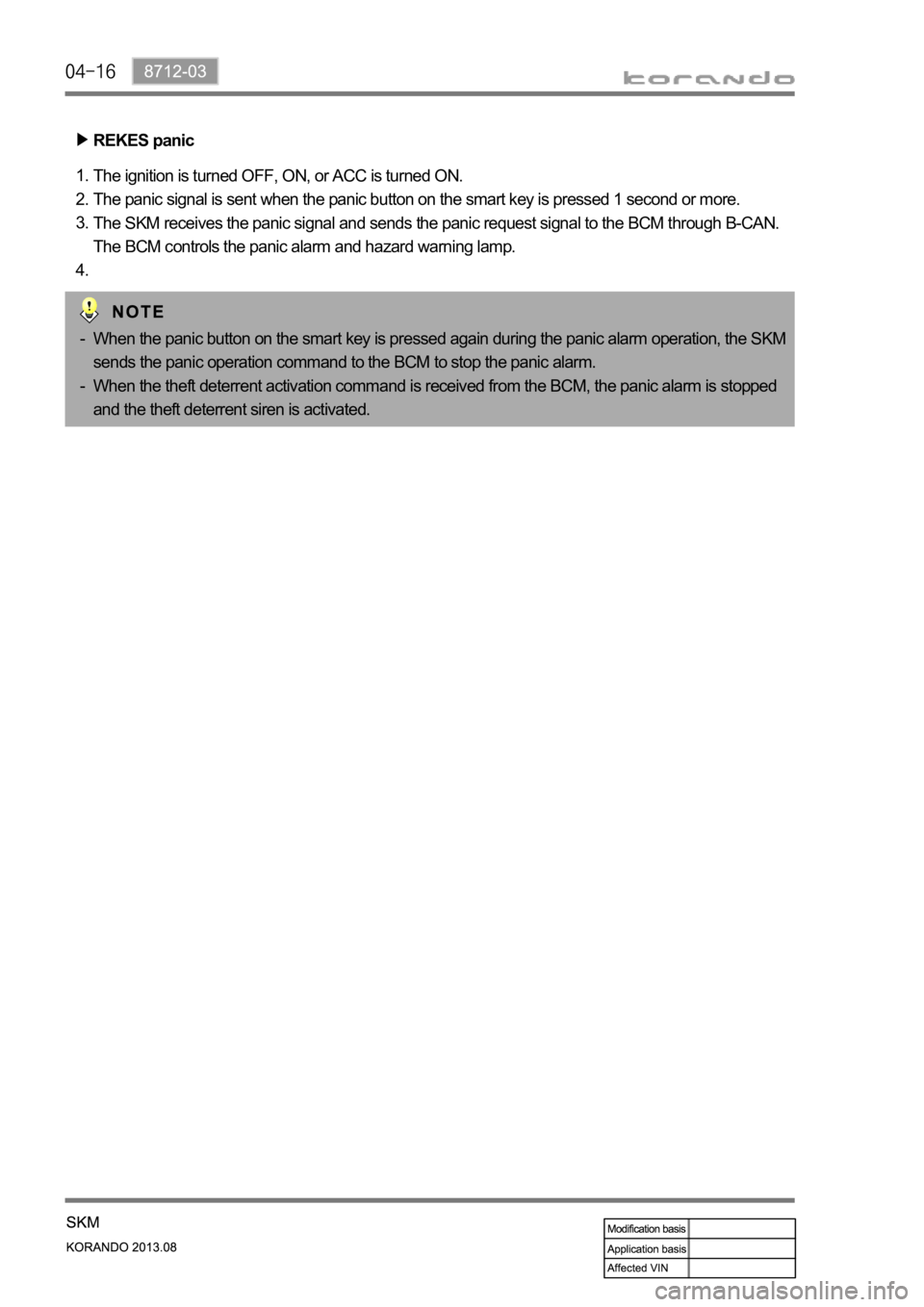
REKES panic
The ignition is turned OFF, ON, or ACC is turned ON.
The panic signal is sent when the panic button on the smart key is pressed 1 second or more.
The SKM receives the panic signal and sends the panic request signal to the BCM through B-CAN.
The BCM controls the panic alarm and hazard warning lamp. 1.
2.
3.
4.
When the panic button on the smart key is pressed again during the panic alarm operation, the SKM
sends the panic operation command to the BCM to stop the panic alarm.
When the theft deterrent activation command is received from the BCM, the panic alarm is stopped
and the theft deterrent siren is activated. -
-
Page 776 of 1336
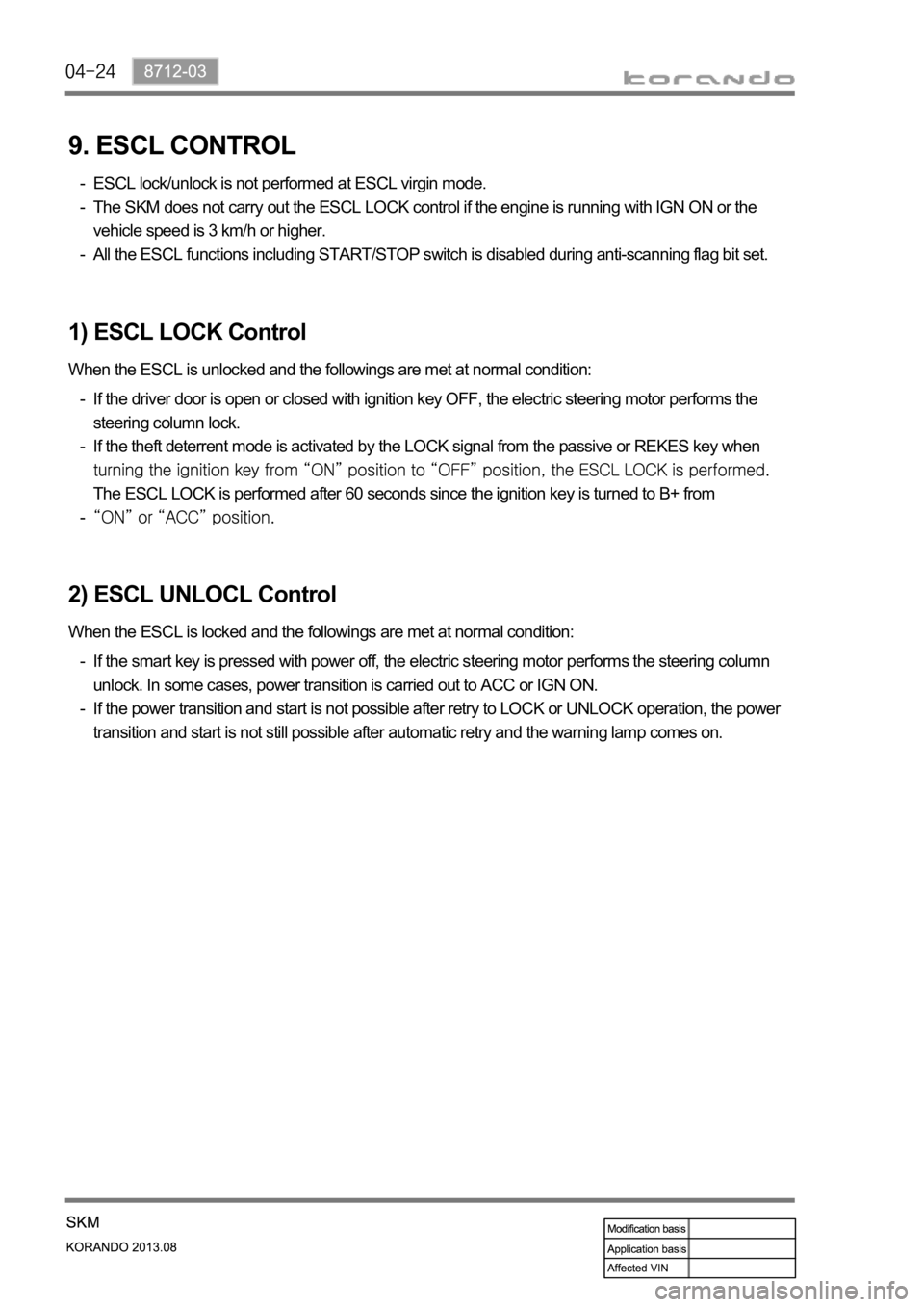
9. ESCL CONTROL
ESCL lock/unlock is not performed at ESCL virgin mode.
The SKM does not carry out the ESCL LOCK control if the engine is running with IGN ON or the
vehicle speed is 3 km/h or higher.
All the ESCL functions including START/STOP switch is disabled during anti-scanning flag bit set. -
-
-
If the smart key is pressed with power off, the electric steering motor performs the steering column
unlock. In some cases, power transition is carried out to ACC or IGN ON.
If the power transition and start is not possible after retry to LOCK or UNLOCK operation, the power
transition and start is not still possible after automatic retry and the warning lamp comes on. -
-
1) ESCL LOCK Control
When the ESCL is unlocked and the followings are met at normal condition:
If the driver door is open or closed with ignition key OFF, the electric steering motor performs the
steering column lock.
If the theft deterrent mode is activated by the LOCK signal from the passive or REKES key when
The ESCL LOCK is performed after 60 seconds since the ignition key is turned to B+ from
-
-
-
2) ESCL UNLOCL Control
When the ESCL is locked and the followings are met at normal condition: