AUTO TRANS SSANGYONG NEW ACTYON SPORTS 2013 User Guide
[x] Cancel search | Manufacturer: SSANGYONG, Model Year: 2013, Model line: NEW ACTYON SPORTS, Model: SSANGYONG NEW ACTYON SPORTS 2013Pages: 751, PDF Size: 72.63 MB
Page 421 of 751

07-77810-01
Emitter lens
The LED which is located at
bottom emits the infrared rays and
the lens guides the infrared rays to
target point.
Auto light sensor
Enlarged auto light sensor section
Auto light sensor (Vertical)
Auto light sensor (Horizon)
Wiper (HI, LO) relays
Used 3-way relay consisting of 5-pinSTICS
It receives the signals regarding the rain
sensor, multifunction wiper switch and
vehicle speed to control the wiper system
with the various functions.
Multifunction wiper switches
AUTO: Wiper operates automatically by rain
sensor
FAST to SLOW: Auto delay/auto speed control. A
position that can control sensitivity against rains
on the windshield and transmits wiping demand
signal accordingly.
Wiper relay (LO) Wiper relay (HI)
Rain sensor unit
Integrated into the auto light sensor. Detects and sends amount of rain drops to STICS
Page 427 of 751
08-38610-09
Multifunction Wiper Switch:
AUTO and Sensitivity Control
1. OVERVIEW
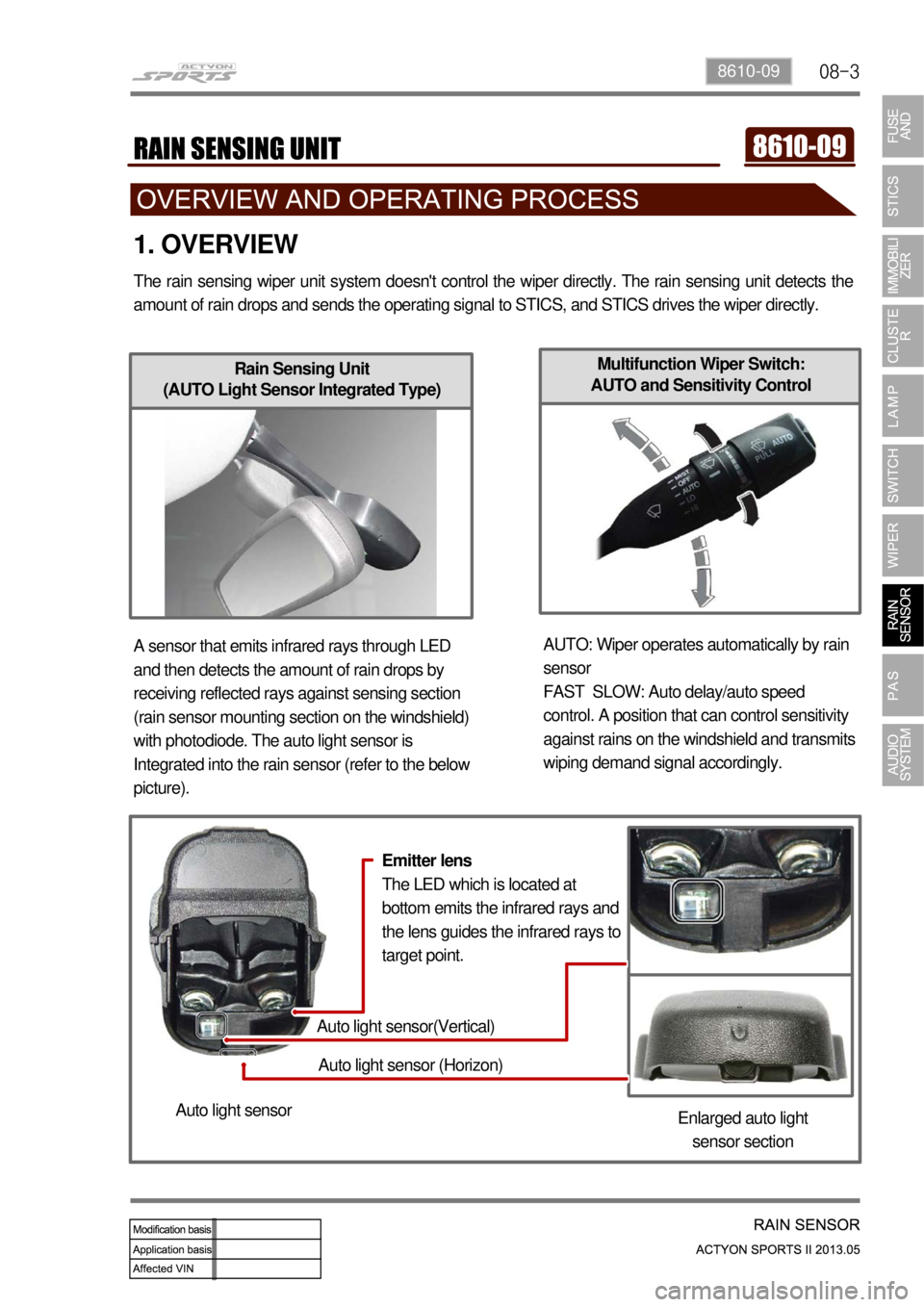
The rain sensing wiper unit system doesn't control the wiper directly. The rain sensing unit detects the
amount of rain drops and sends the operating signal to STICS, and STICS drives the wiper directly.
Rain Sensing Unit
(AUTO Light Sensor Integrated Type)
A sensor that emits infrared rays through LED
and then detects the amount of rain drops by
receiving reflected rays against sensing section
(rain sensor mounting section on the windshield)
with photodiode. The auto light sensor is
Integrated into the rain sensor (refer to the below
picture).AUTO: Wiper operates automatically by rain
sensor
FAST SLOW: Auto delay/auto speed
control. A position that can control sensitivity
against rains on the windshield and transmits
wiping demand signal accordingly.
Emitter lens
The LED which is located at
bottom emits the infrared rays and
the lens guides the infrared rays to
target point.
Auto light sensor
Enlarged auto light
sensor section
Auto light sensor(Vertical)
Auto light sensor (Horizon)
Page 449 of 751
01-33680-01
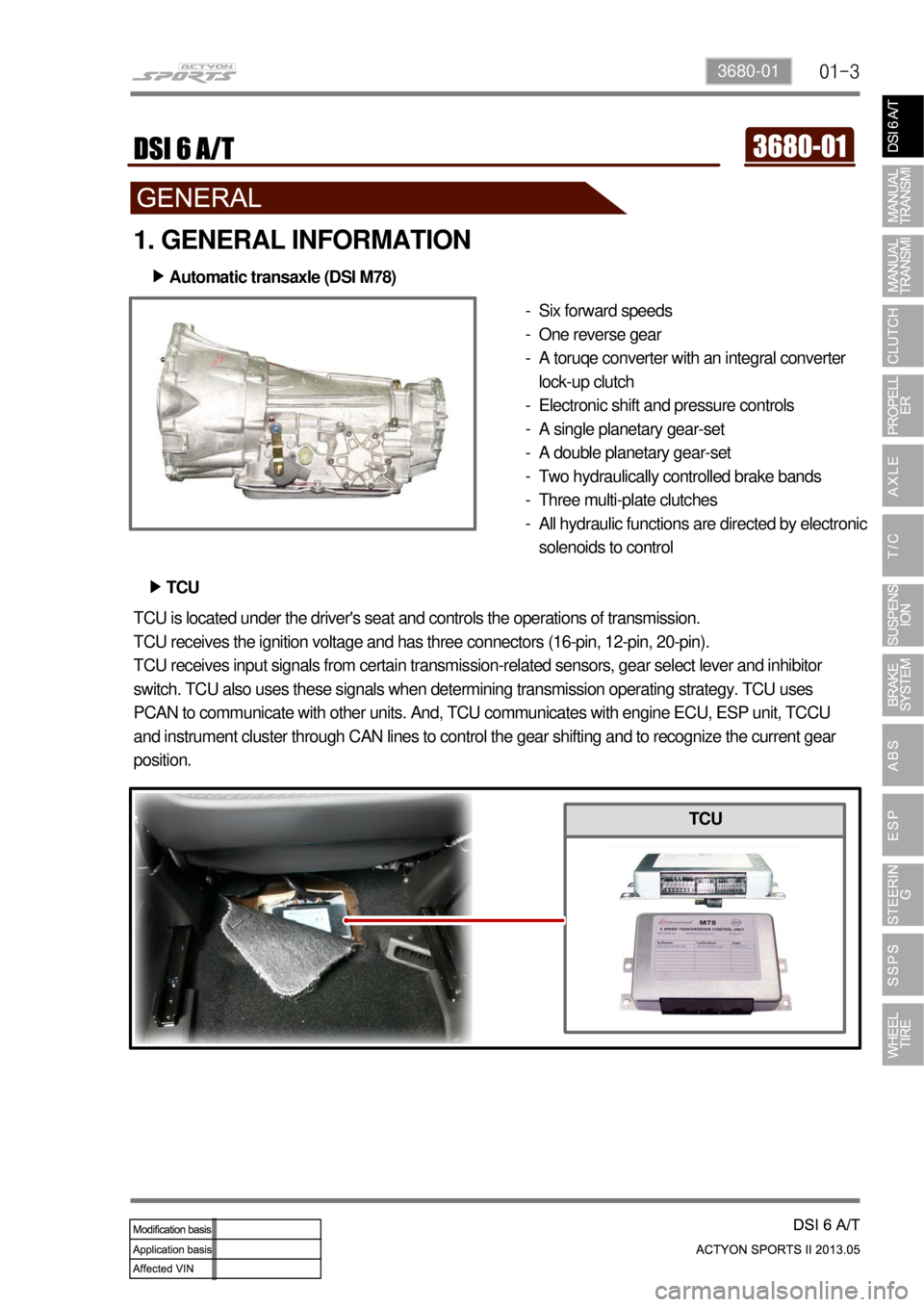
1. GENERAL INFORMATION
Six forward speeds
One reverse gear
A toruqe converter with an integral converter
lock-up clutch
Electronic shift and pressure controls
A single planetary gear-set
A double planetary gear-set
Two hydraulically controlled brake bands
Three multi-plate clutches
All hydraulic functions are directed by electronic
solenoids to control -
-
-
-
-
-
-
-
- Automatic transaxle (DSI M78) ▶
TCU ▶
TCU is located under the driver's seat and controls the operations of transmission.
TCU receives the ignition voltage and has three connectors (16-pin, 12-pin, 20-pin).
TCU receives input signals from certain transmission-related sensors, gear select lever and inhibitor
switch. TCU also uses these signals when determining transmission operating strategy. TCU uses
PCAN to communicate with other units. And, TCU communicates with engine ECU, ESP unit, TCCU
and instrument cluster through CAN lines to control the gear shifting and to recognize the current gear
position.
TCU
Page 452 of 751

01-6
4WD Automatic Transmission ▶
Torque converter
Oil cooler outletOil cooler return
Inhibiter switch Adapter housing
2) Appearance
Connector plug
Transfer case
Page 453 of 751

01-73680-01
2WD Automatic Transmission ▶
Torque converter
Oil cooler outletOil cooler return
Inhibiter switch Flange for
propeller shaft
Connector plug
Flange for propeller
shaft
Page 457 of 751
01-113680-01
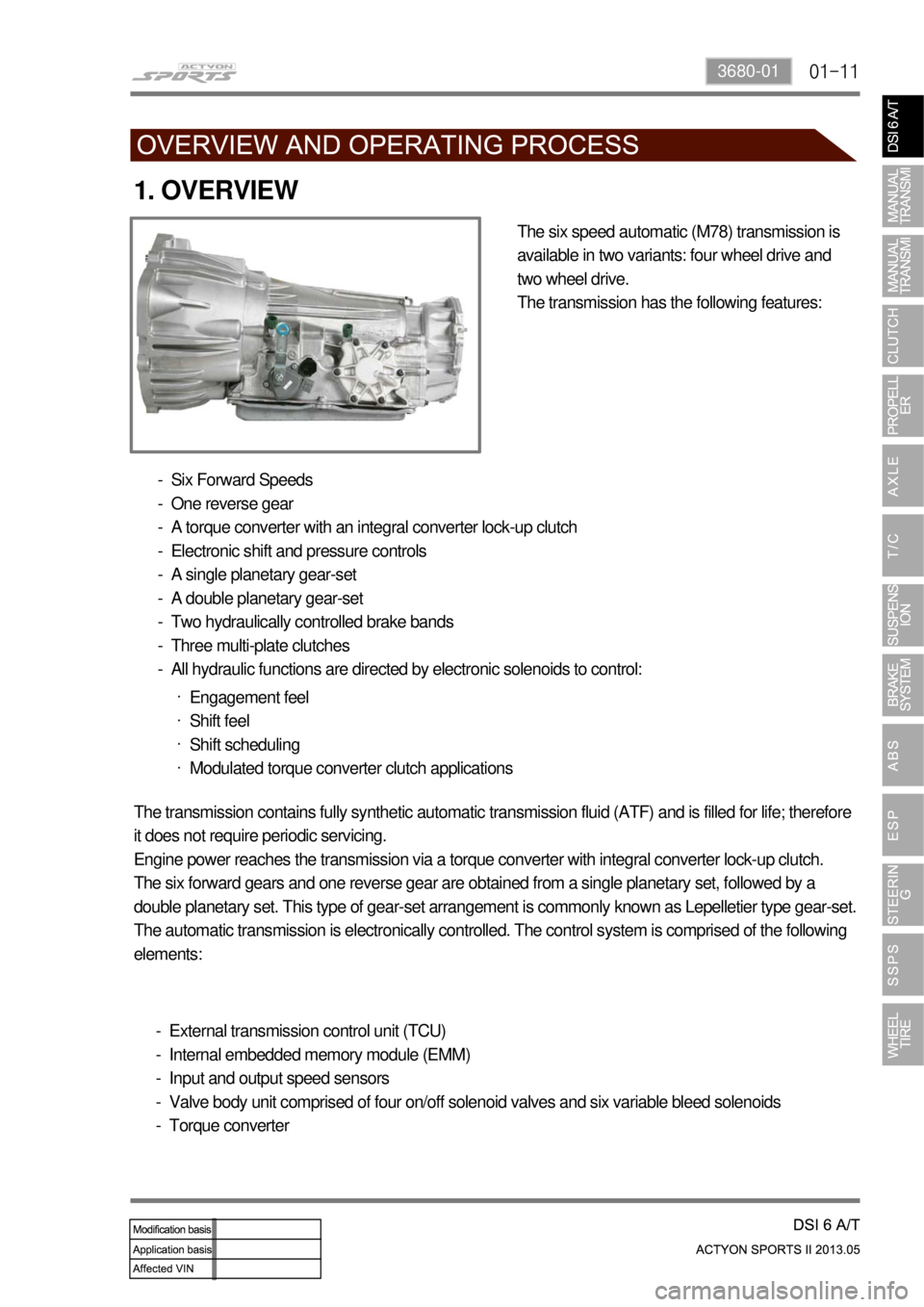
1. OVERVIEW
The six speed automatic (M78) transmission is
available in two variants: four wheel drive and
two wheel drive.
The transmission has the following features:
Six Forward Speeds
One reverse gear
A torque converter with an integral converter lock-up clutch
Electronic shift and pressure controls
A single planetary gear-set
A double planetary gear-set
Two hydraulically controlled brake bands
Three multi-plate clutches
All hydraulic functions are directed by electronic solenoids to control: -
-
-
-
-
-
-
-
-
Engagement feel
Shift feel
Shift scheduling
Modulated torque converter clutch applications ·
·
·
·
The transmission contains fully synthetic automatic transmission fluid (ATF) and is filled for life; therefore
it does not require periodic servicing.
Engine power reaches the transmission via a torque converter with integral converter lock-up clutch.
The six forward gears and one reverse gear are obtained from a single planetary set, followed by a
double planetary set. This type of gear-set arrangement is commonly known as Lepelletier type gear-set.
The automatic transmission is electronically controlled. The control system is comprised of the following
elements:
External transmission control unit (TCU)
Internal embedded memory module (EMM)
Input and output speed sensors
Valve body unit comprised of four on/off solenoid valves and six variable bleed solenoids
Torque converter -
-
-
-
-
Page 459 of 751

01-133680-01
2) Cooling System
The transmission cooling system ensures rapid warm-up and constant operating temperature resulting
in reduced fuel consumption and refined shift quality.
It also includes a cooler by-pass within the hydraulic system to allow sufficient cooling and lubrication to
the transmission drivetrain in the event of a blockage in the transmission cooler.
Gear Shift ▶
Coastdown ▶
Torque Demand ▶ Transmission gear change is controlled by the TCU. The TCU receives inputs from various engine and
vehicle sensors to select shift schedules and to control the shift feel and torque converter clutch (TCC)
operation at each gear change
Coastdown downshifts occur at 0% accelerator pedal when the vehicle is coasting down to a stop. To
reduce the shift shock and to improve the shift feeling during downshift, TCU electronically controls the
transmission.
Torque demand downshifts occur (automatically) when the driver demand for torque is greater than the
engine can provide at that gear ratio. If applied, the transmission will disengage the TCC to provide
added acceleration.
3) Shift Strategy
Page 461 of 751

01-153680-01
2) Mode “M” (Manual Shift Mode)
This allows the driver to define the highest possible gear by selecting "+" or "-" on the gear selector when
the lever is in the "M" position. When the lever is first moved to the manual "M" position the transmission
will select the lowest possible gear.
When maximum engine rpm is reached the transmission will upshift automatically regardless of the
driver selected limit. 4WD models with low range will not automatically upshift when low range is
selected.
1st gear position ▶
2nd gear position ▶
3st gear position ▶
4th gear position ▶
5th gear position ▶
6th gear position ▶Use on a rugged road, mountain path and steep hill. Engine braking effect on steep hill is
available. -
Use on a long and gentle slope. 2-1 automatic kickdown shift is available. Engine braking effect is
available. -
Use on a long and gentle slope. 3-2 and 2-1 automatic kickdown shift is available. Engine
braking effect is available. -
Use on a long and gentle slope. 4-3, 4-2 and 4-1 automatic kickdown shift is available. -
5-4 and 5-3 automatic kickdown shift is available. -
6-5 and 6-4 automatic kickdown shift is available. -
Kickdown Function
If you need to accelerate rapidly, depress the accelerator pedal completely to the floor.
Then, a one- or two-lever gear will automatically be engaged. This is called the Kickdown function.
Page 462 of 751
01-16
4. LIMP HOME MODE
In case of transmission malfunction ▶
If a serious fault occurs in the automatic transmission, the TCU enters the limp home mode to
secure safe driving and protect the automatic transmission.
As power is no longer supplied to the solenoid, the current basic function (P, R, N, D) is
maintained and the 4th gear can be maintained only by the operation of the hydraulic system
without electrical operation.
The ECU communicates with other electric modules with CAN. If a serious fault occurs, the
transmission automatically enters the limp home mode for service.
The TCU monitors all factors which can affect to the performance of the transmission and
diagnose the system according to OBD II regulation. 1.
2.
3.
4.
In case of overheated transmission ▶
The TCU enters the limp home mode when the batter voltage drops below 8 V.
If the transmission is overheated, the shift pattern is changed to the hot mode to cool the
transmission more efficiently.
While the transmission is overheated, the selector lever symbol and engine temperature warning
lamp on the instrument cluster blink until the transmission is cooled down to the normal operation
temperature. If the transmission is excessively overheated, the gear cannot be shifted but
remains in the neutral position. 1.
2.
3.
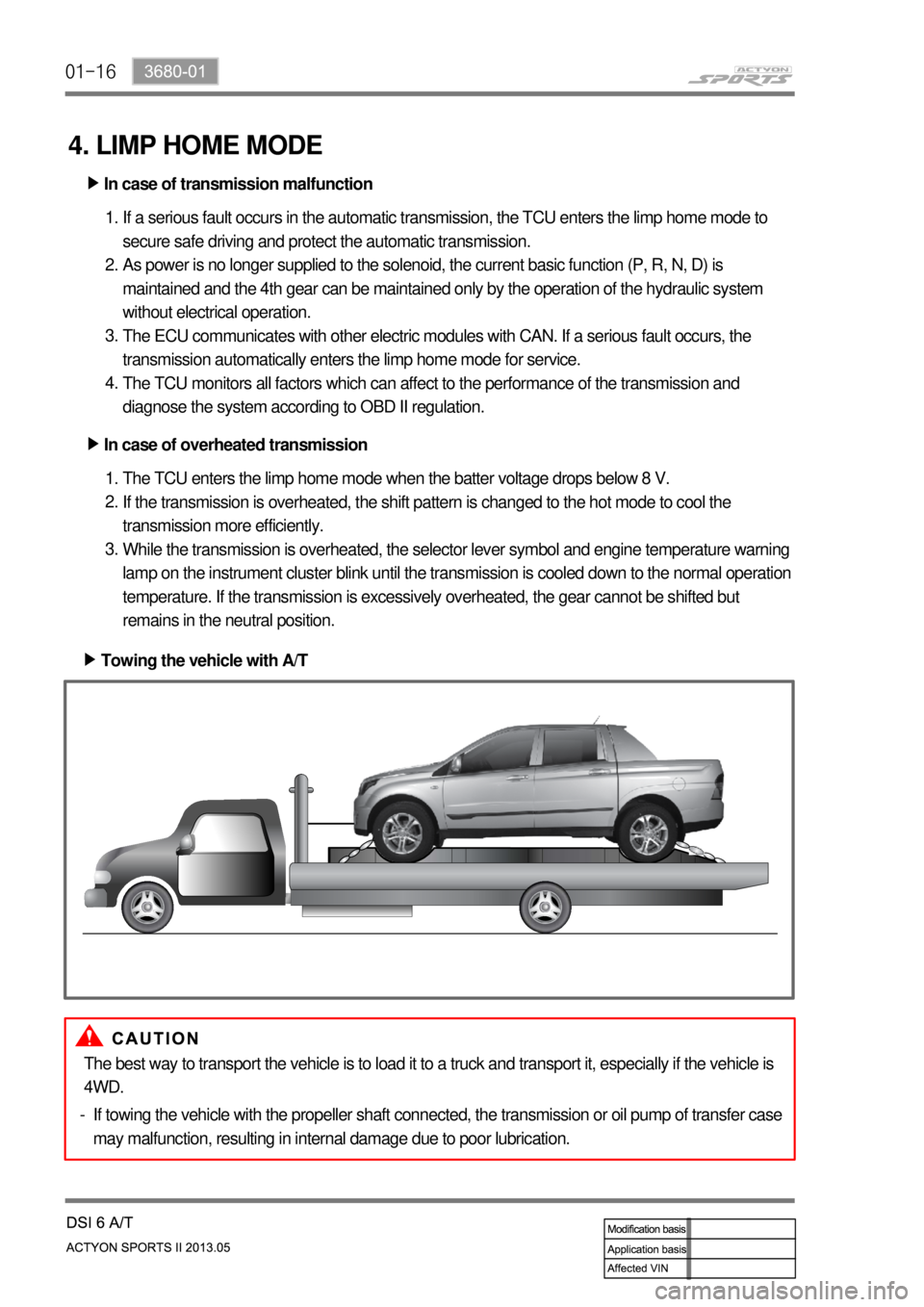
Towing the vehicle with A/T ▶
The best way to transport the vehicle is to load it to a truck and transport it, especially if the vehicle is
4WD.
If towing the vehicle with the propeller shaft connected, the transmission or oil pump of transfer case
may malfunction, resulting in internal damage due to poor lubrication. -
Page 463 of 751
01-173680-01
5. ELECTRONIC CONTROL SYSTEM
1) Overview
The transmission control unit (TCU) and its input/output networks control the operations of transmission:
Shift timing
Line pressure
Clutch pressure (shift feel)
Torque converter clutch -
-
-
-
In addition, the TCU receives input signals from certain transmission-related sensors and switches. The
TCU also uses these signals when determining transmission operating strategy. Using all of these input
signals, the TCU can determine when the time and conditions are right for a shift, or when to apply or
release the torque converter clutch. It will also determine the pressure needed to optimise shift feel. To
accomplish this, the TCU operates six variable bleed control solenoids and four ON/OFF solenoids to
control the operations of transmission.
2) Transmission Control Unit (TCU)
The transmission control unit (TCU) is mounted under the driver's seat and controls the operation of the
transmission.
TCU processes the analog information from the internal sensors and the digital information through CAN
communication lines. TCU monitors all the input and output signals. If there is any failure, TCU changes
the system to “Limp Home Mode” and alerts to the driver through the warning lamp on the
instrument cluster.
(1) Hard-wired (Analog) Input/Output
Input/Output Data between TGS Lever and TCU ▶
Position and conditions of gear select lever
Driving moded (Winter or Standard) -
-
Position of inhibitor switch - Input/Output Data between Inhibitor and TCU ▶
6 control signals for variable bleed solenoid
4 control signals for ON/OFF solenoid
Transmission input speed
Transmission output speed
Transmission oil temperature
EMM (Embeded Memory Module) -
-
-
-
-
- Input/Output Data between Automatic Transmission and TCU ▶
Input/Output Data between Self Diagnostic Connector and TCU ▶
Various DTC codes and TCU information -