ABS SSANGYONG TURISMO 2013 User Guide
[x] Cancel search | Manufacturer: SSANGYONG, Model Year: 2013, Model line: TURISMO, Model: SSANGYONG TURISMO 2013Pages: 796, PDF Size: 78.99 MB
Page 616 of 796
06-53310-01
1. OVERVIEW
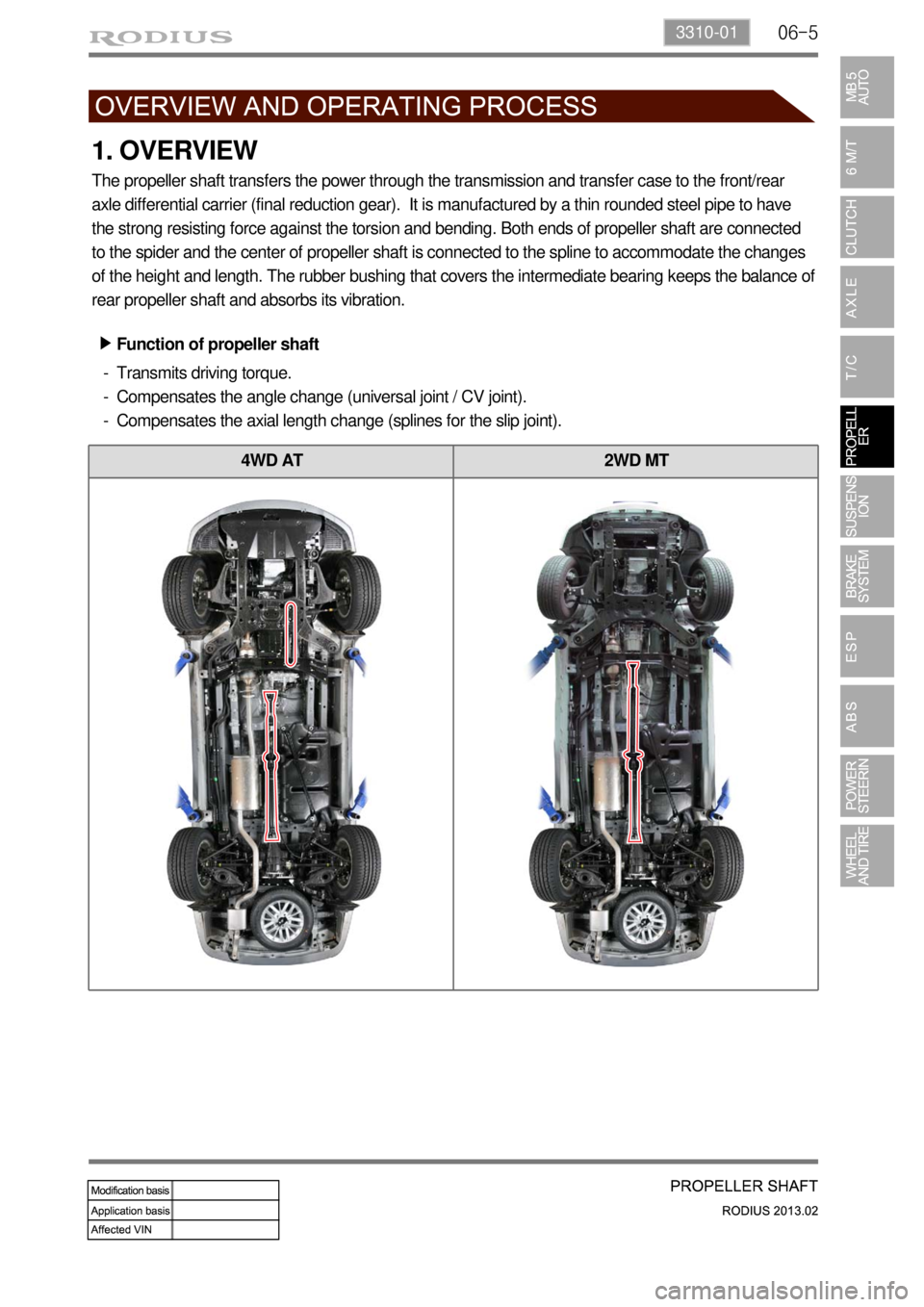
The propeller shaft transfers the power through the transmission and transfer case to the front/rear
axle differential carrier (final reduction gear). It is manufactured by a thin rounded steel pipe to have
the strong resisting force against the torsion and bending. Both ends of propeller shaft are connected
to the spider and the center of propeller shaft is connected to the spline to accommodate the changes
of the height and length. The rubber bushing that covers the intermediate bearing keeps the balance o
f
rear propeller shaft and absorbs its vibration.
Function of propeller shaft ▶
Transmits driving torque.
Compensates the angle change (universal joint / CV joint).
Compensates the axial length change (splines for the slip joint). -
-
-
4WD AT 2WD MT
Page 618 of 796
07-34411-01
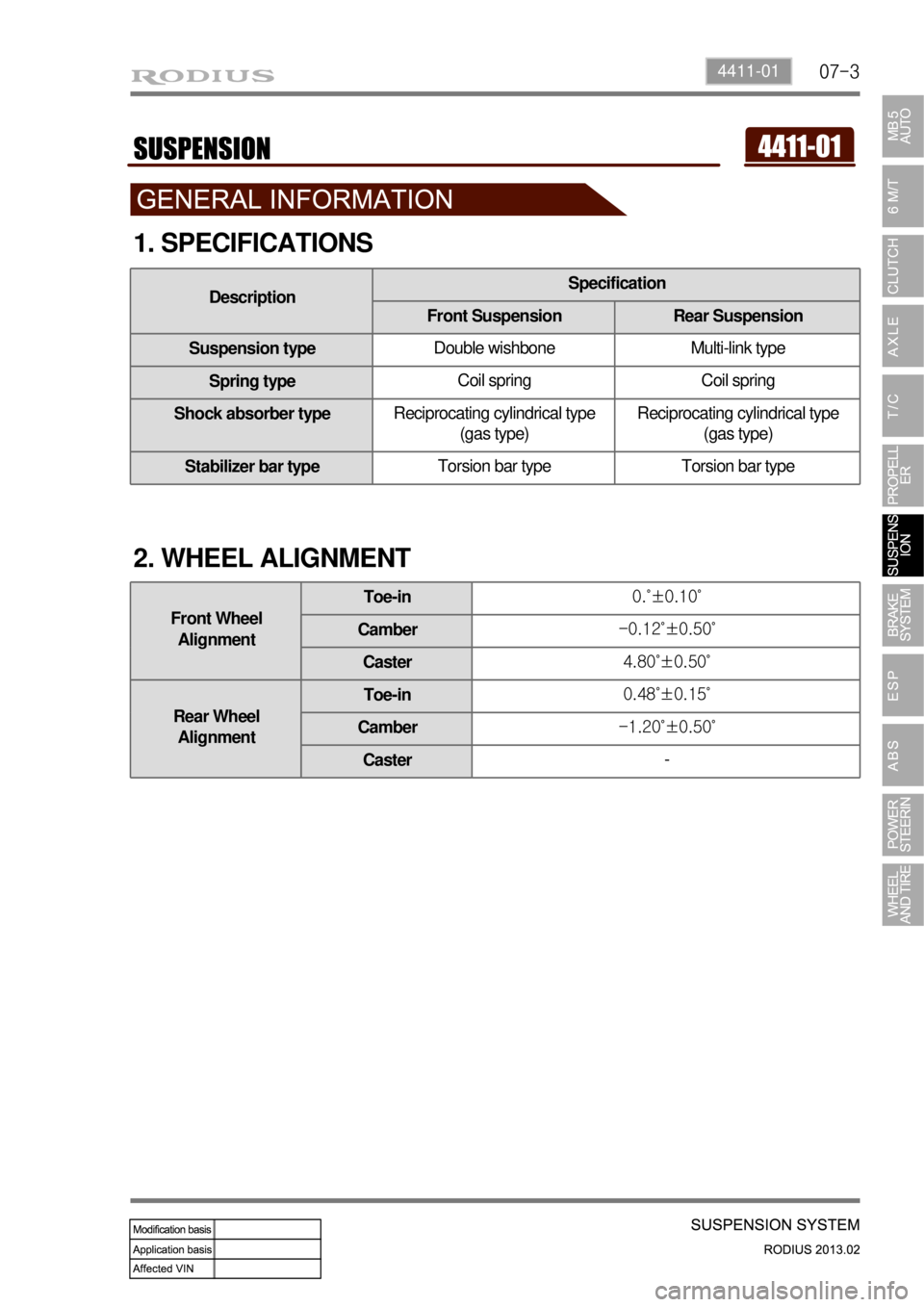
1. SPECIFICATIONS
DescriptionSpecification
Front Suspension Rear Suspension
Suspension typeDouble wishbone Multi-link type
Spring typeCoil spring Coil spring
Shock absorber typeReciprocating cylindrical type
(gas type)Reciprocating cylindrical type
(gas type)
Stabilizer bar typeTorsion bar type Torsion bar type
2. WHEEL ALIGNMENT
Front Wheel
AlignmentToe-in0.˚±0.10˚
Camber-0.12˚±0.50˚
Caster4.80˚±0.50˚
Rear Wheel
AlignmentToe-in0.48˚±0.15˚
Camber-1.20˚±0.50˚
Caster-
Page 620 of 796
07-54411-01
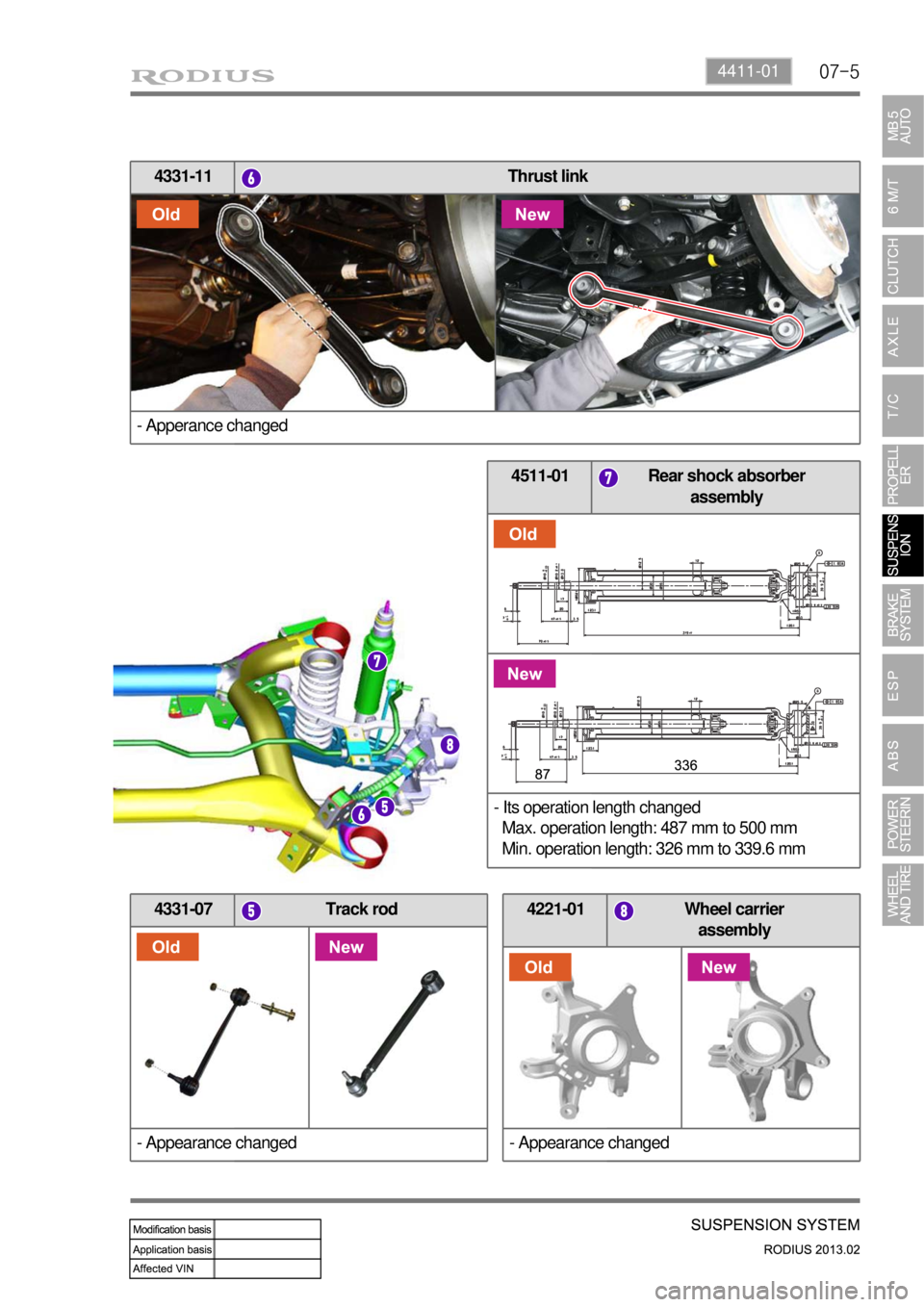
4331-07 Track rod
- Appearance changed4221-01 Wheel carrier
assembly
- Appearance changed
4331-11 Thrust link
- Apperance changed
4511-01 Rear shock absorber
assembly
- Its operation length changed
Max. operation length: 487 mm to 500 mm
Min. operation length: 326 mm to 339.6 mm
Page 621 of 796
07-6
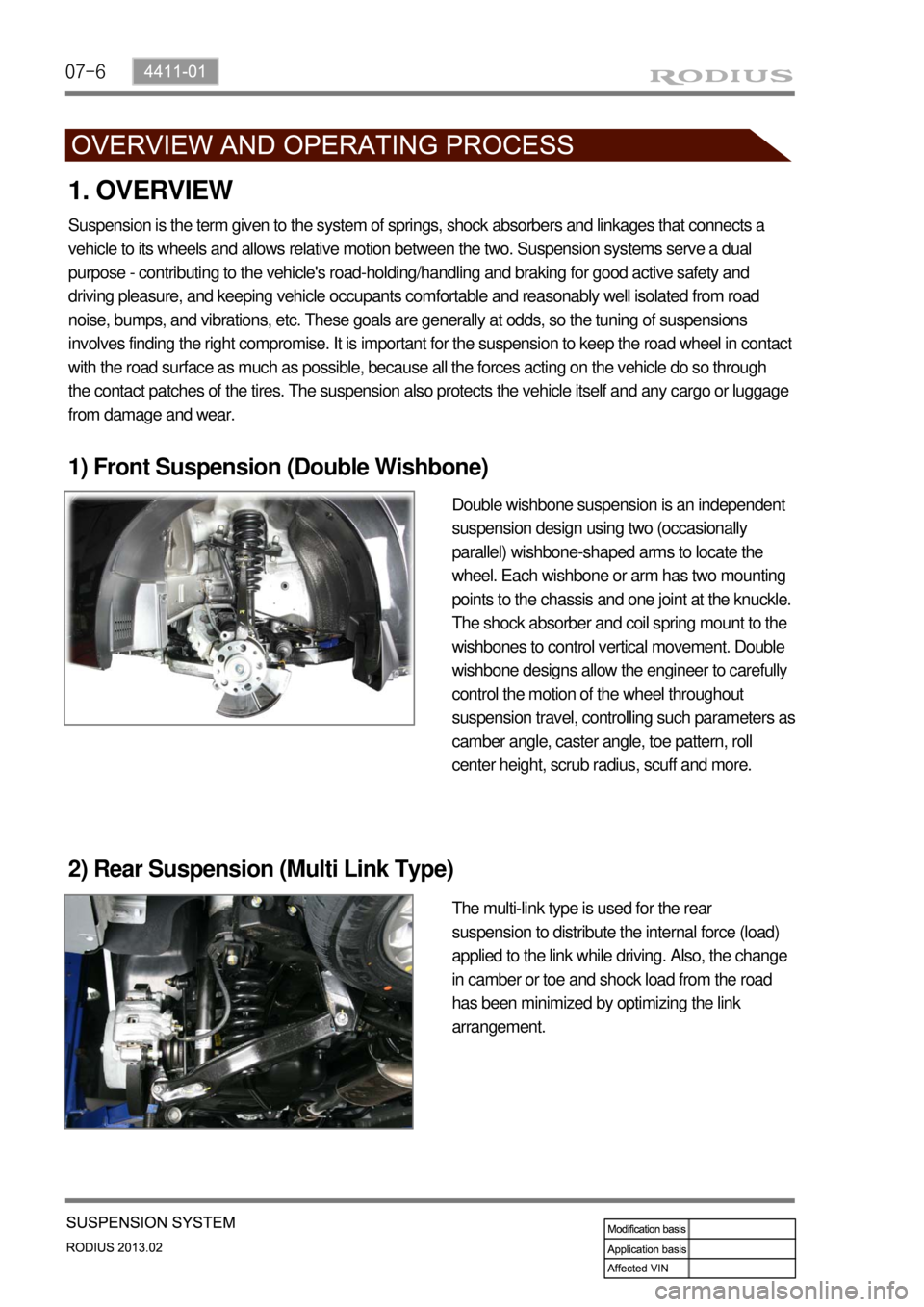
1) Front Suspension (Double Wishbone)
Suspension is the term given to the system of springs, shock absorbers and linkages that connects a
vehicle to its wheels and allows relative motion between the two. Suspension systems serve a dual
purpose - contributing to the vehicle's road-holding/handling and braking for good active safety and
driving pleasure, and keeping vehicle occupants comfortable and reasonably well isolated from road
noise, bumps, and vibrations, etc. These goals are generally at odds, so the tuning of suspensions
involves finding the right compromise. It is important for the suspension to keep the road wheel in contac
t
with the road surface as much as possible, because all the forces acting on the vehicle do so through
the contact patches of the tires. The suspension also protects the vehicle itself and any cargo or luggage
from damage and wear.
2) Rear Suspension (Multi Link Type)
1. OVERVIEW
Double wishbone suspension is an independent
suspension design using two (occasionally
parallel) wishbone-shaped arms to locate the
wheel. Each wishbone or arm has two mounting
points to the chassis and one joint at the knuckle.
The shock absorber and coil spring mount to the
wishbones to control vertical movement. Double
wishbone designs allow the engineer to carefully
control the motion of the wheel throughout
suspension travel, controlling such parameters as
camber angle, caster angle, toe pattern, roll
center height, scrub radius, scuff and more.
The multi-link type is used for the rear
suspension to distribute the internal force (load)
applied to the link while driving. Also, the change
in camber or toe and shock load from the road
has been minimized by optimizing the link
arrangement.
Page 623 of 796
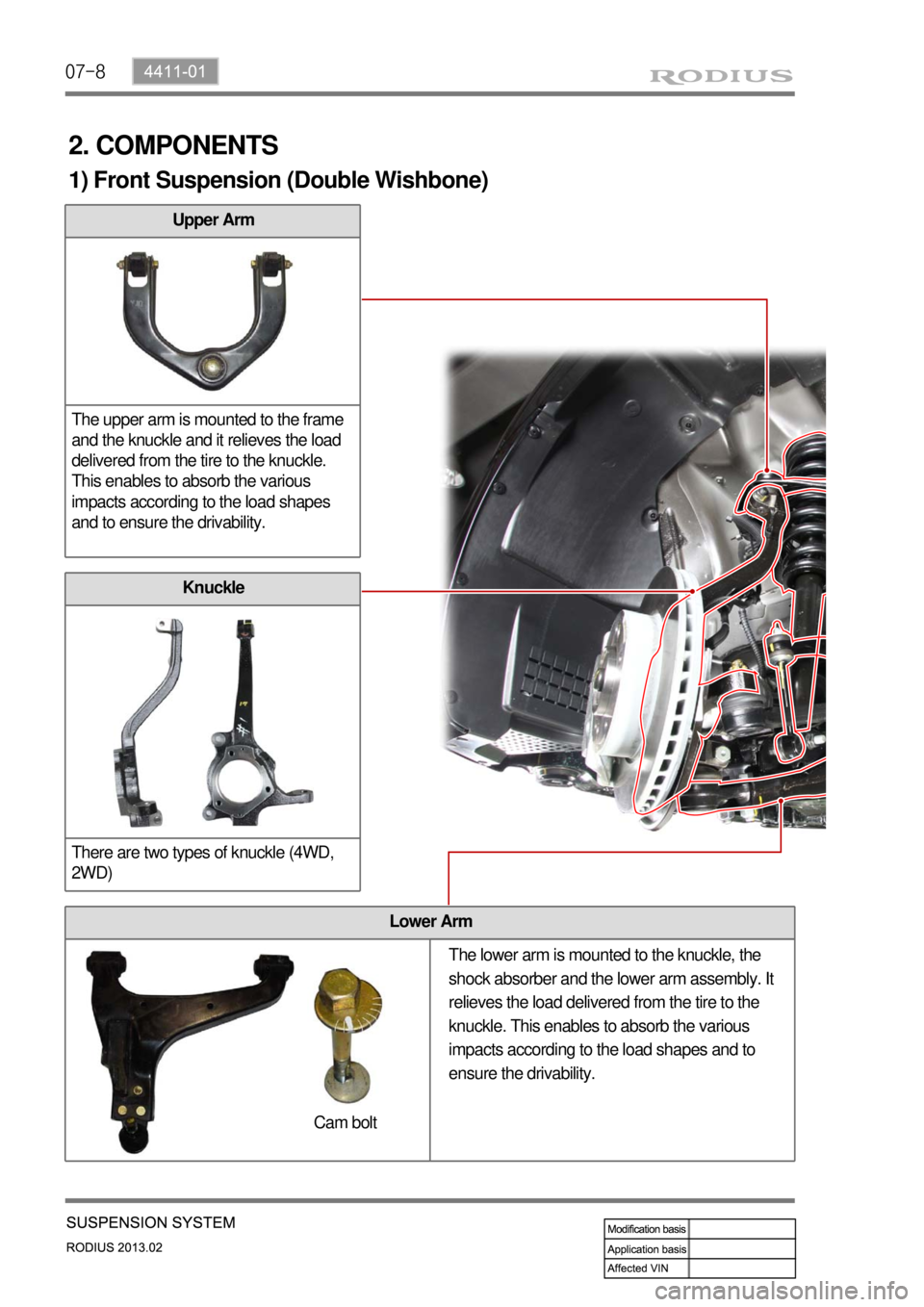
07-8
Upper Arm
The upper arm is mounted to the frame
and the knuckle and it relieves the load
delivered from the tire to the knuckle.
This enables to absorb the various
impacts according to the load shapes
and to ensure the drivability.
Lower Arm
Knuckle
There are two types of knuckle (4WD,
2WD)
Cam bolt
1) Front Suspension (Double Wishbone)
The lower arm is mounted to the knuckle, the
shock absorber and the lower arm assembly. It
relieves the load delivered from the tire to the
knuckle. This enables to absorb the various
impacts according to the load shapes and to
ensure the drivability.
2. COMPONENTS
Page 624 of 796
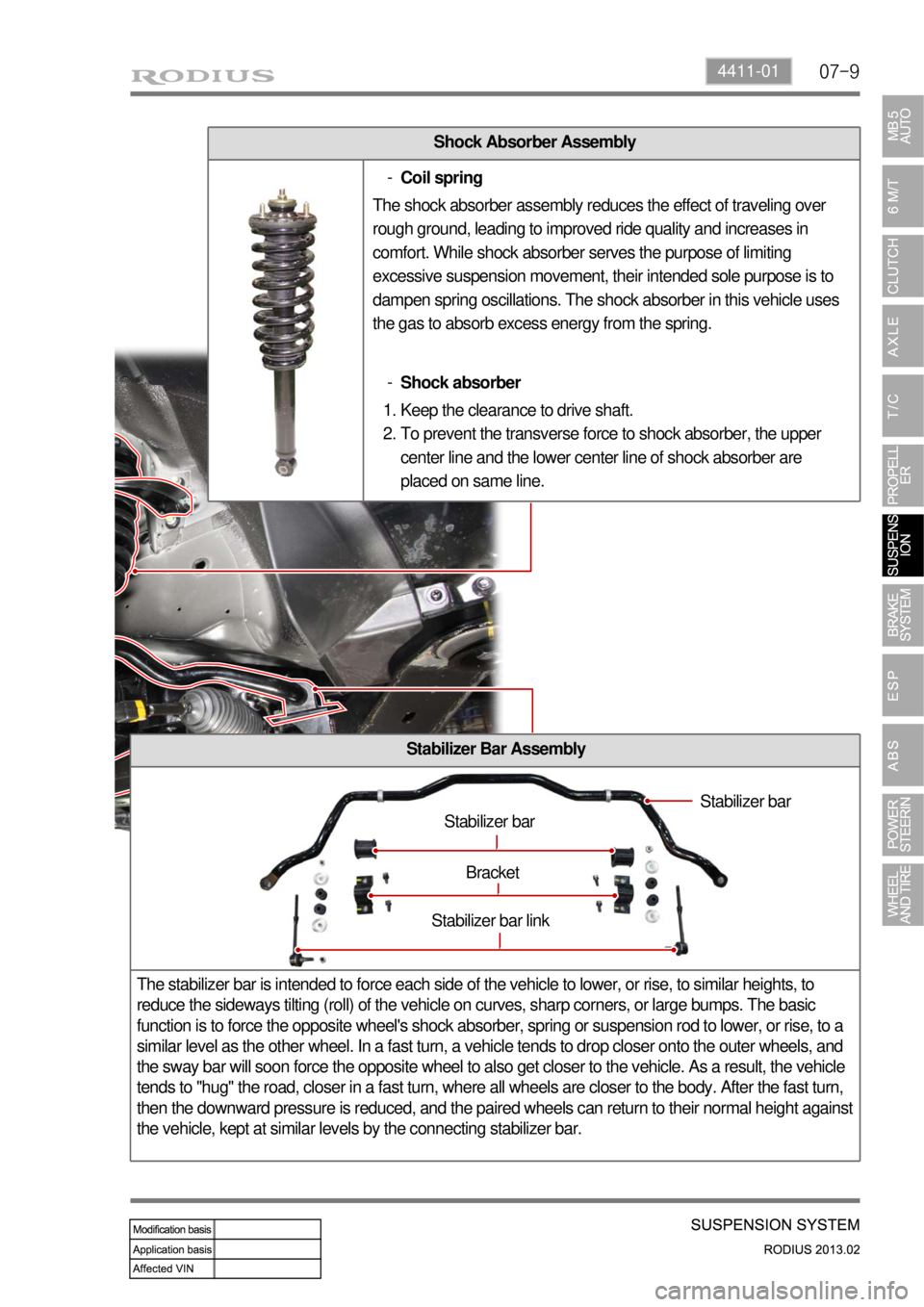
07-94411-01
Shock Absorber Assembly
Stabilizer Bar Assembly
The stabilizer bar is intended to force each side of the vehicle to lower, or rise, to similar heights, to
reduce the sideways tilting (roll) of the vehicle on curves, sharp corners, or large bumps. The basic
function is to force the opposite wheel's shock absorber, spring or suspension rod to lower, or rise, to a
similar level as the other wheel. In a fast turn, a vehicle tends to drop closer onto the outer wheels, and
the sway bar will soon force the opposite wheel to also get closer to the vehicle. As a result, the vehicle
tends to "hug" the road, closer in a fast turn, where all wheels are closer to the body. After the fast turn,
then the downward pressure is reduced, and the paired wheels can return to their normal height against
the vehicle, kept at similar levels by the connecting stabilizer bar.
Stabilizer bar
Stabilizer bar
Bracket
Stabilizer bar link
Coil spring -
The shock absorber assembly reduces the effect of traveling over
rough ground, leading to improved ride quality and increases in
comfort. While shock absorber serves the purpose of limiting
excessive suspension movement, their intended sole purpose is to
dampen spring oscillations. The shock absorber in this vehicle uses
the gas to absorb excess energy from the spring.
Shock absorber -
Keep the clearance to drive shaft.
To prevent the transverse force to shock absorber, the upper
center line and the lower center line of shock absorber are
placed on same line. 1.
2.
Page 625 of 796
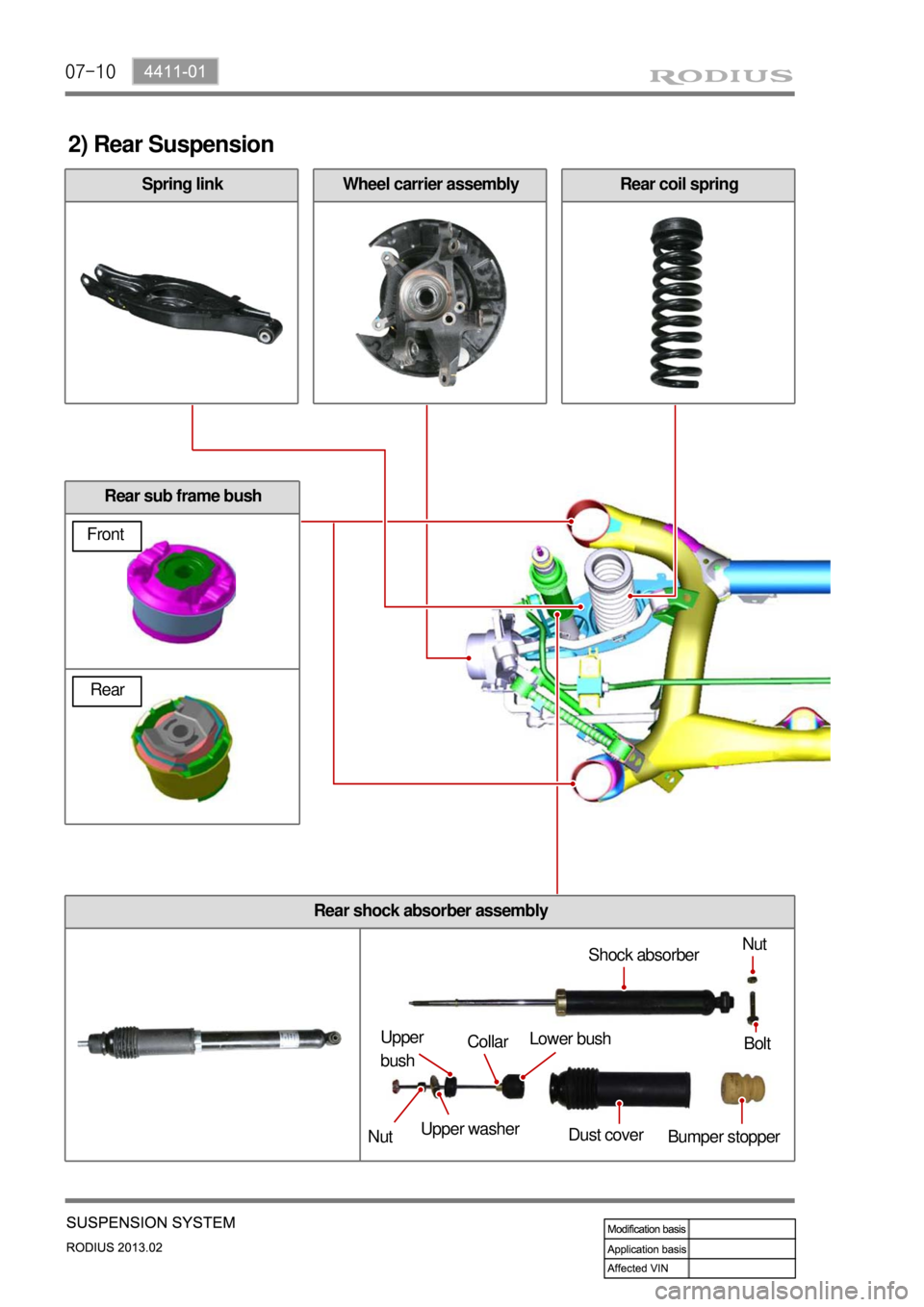
07-10
Spring link
2) Rear Suspension
Rear coil springWheel carrier assembly
Rear sub frame bush
Nut
Upper washer Upper
bush
Bumper stopper Lower bush
Dust coverShock absorber
Bolt
NutCollar
Front
Rear
Rear shock absorber assembly
Page 628 of 796
07-134411-01
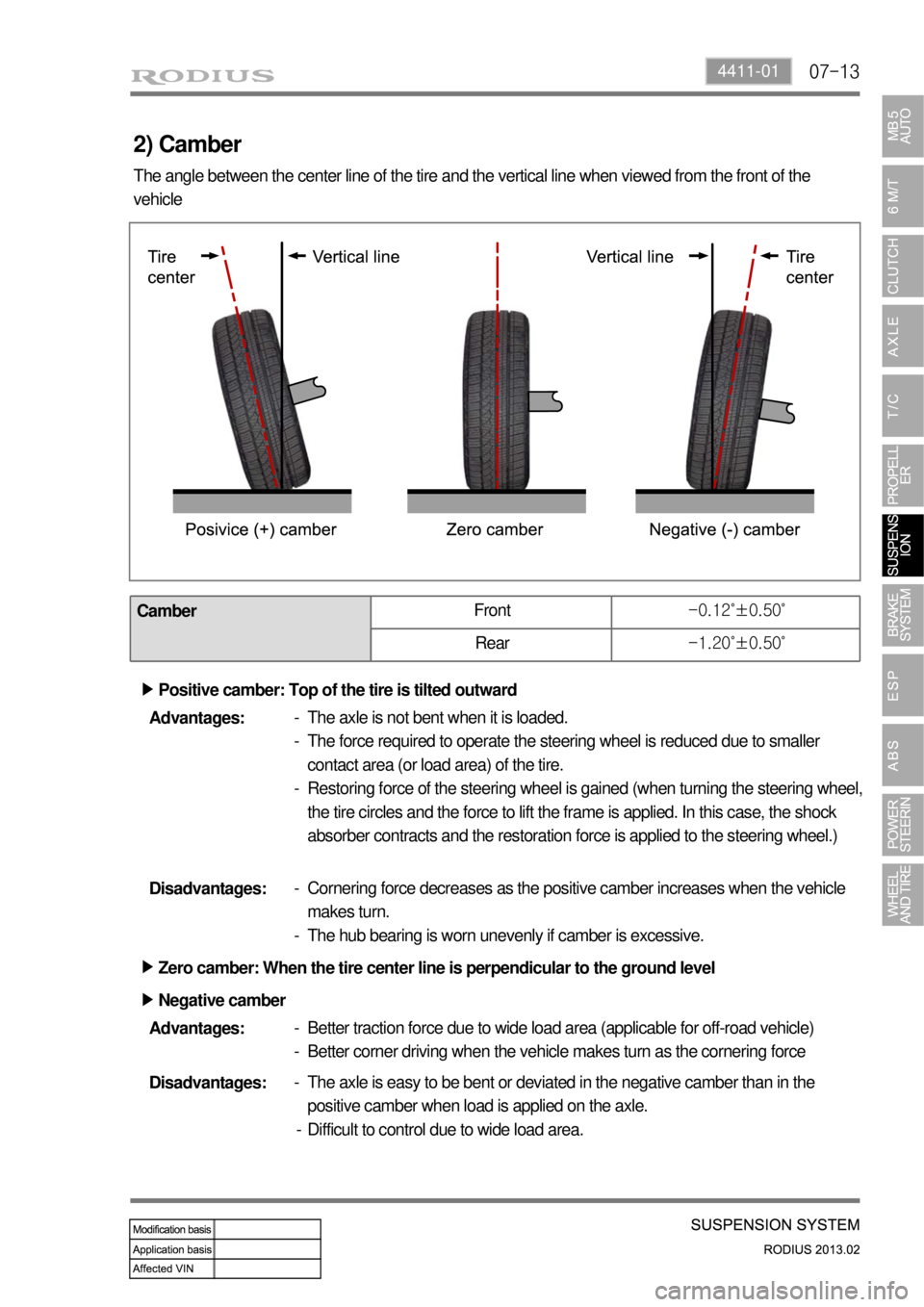
2) Camber
The angle between the center line of the tire and the vertical line when viewed from the front of the
vehicle
CamberFront-0.12˚±0.50˚
Rear-1.20˚±0.50˚
Zero camber: When the tire center line is perpendicular to the ground level ▶
Disadvantages:The axle is easy to be bent or deviated in the negative camber than in the
positive camber when load is applied on the axle.
Difficult to control due to wide load area. -
- Advantages:Better traction force due to wide load area (applicable for off-road vehicle)
Better corner driving when the vehicle makes turn as the cornering force -
- Negative camber ▶Disadvantages:Cornering force decreases as the positive camber increases when the vehicle
makes turn.
The hub bearing is worn unevenly if camber is excessive. -
- Advantages:The axle is not bent when it is loaded.
The force required to operate the steering wheel is reduced due to smaller
contact area (or load area) of the tire.
Restoring force of the steering wheel is gained (when turning the steering wheel,
the tire circles and the force to lift the frame is applied. In this case, the shock
absorber contracts and the restoration force is applied to the steering wheel.) -
-
- Positive camber: Top of the tire is tilted outward ▶
Page 631 of 796
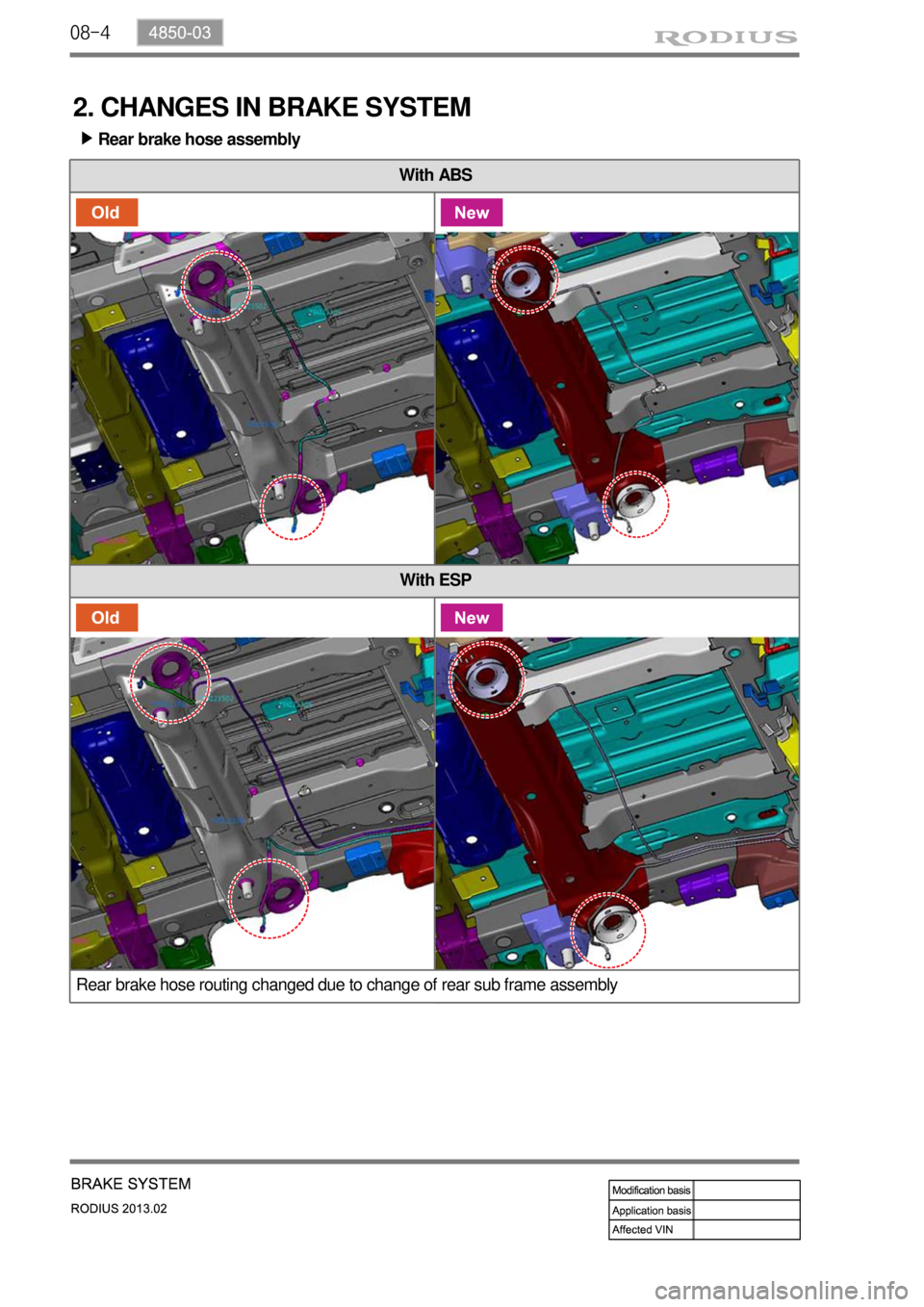
08-4
2. CHANGES IN BRAKE SYSTEM
Rear brake hose assembly ▶
With ABS
With ESP
Rear brake hose routing changed due to change of rear sub frame assembly
Page 649 of 796

09-34891-01
1. SPECIFICATIONS
1) Pressure Sensor
UnitDescription
Location
ABS ESP
HECU
(Hydraulic &
Electronic Control
Unit) CPU:MCU60 (32bit)
Clock Frequency:
28 MHz
Memory: 128~256 KB CPU:MCU60 (32bit)
Clock Frequency:
28 MHz
Memory:256~512 KB Under the front washer
reservoir
Wheel Speed
SensorActive type wheel speed
sensorActive type wheel speed
sensorOn each wheel
Front air gap:
0.3 ~ 1.3mm,
Rear air gap:
0.3 ~ 1.3 mm
Steering Wheel
Angle SensorN/AMaximum angular speed:
1500°/sec
Operating voltage:
9~16 VUnder the steering
wheel
Sensor ClusterN/AIntegrated with yaw rate
sensor and lateral sensorUnder the audio
assembly
Pressure Sensor
N/A Analog outputUnder the master
cylinder
Description Specification
Supplying voltage approx. 5 V (4.75~5.25 V)
Max. pressure 350 bar