ABS SSANGYONG TURISMO 2013 Owner's Manual
[x] Cancel search | Manufacturer: SSANGYONG, Model Year: 2013, Model line: TURISMO, Model: SSANGYONG TURISMO 2013Pages: 796, PDF Size: 78.99 MB
Page 651 of 796
09-54891-01
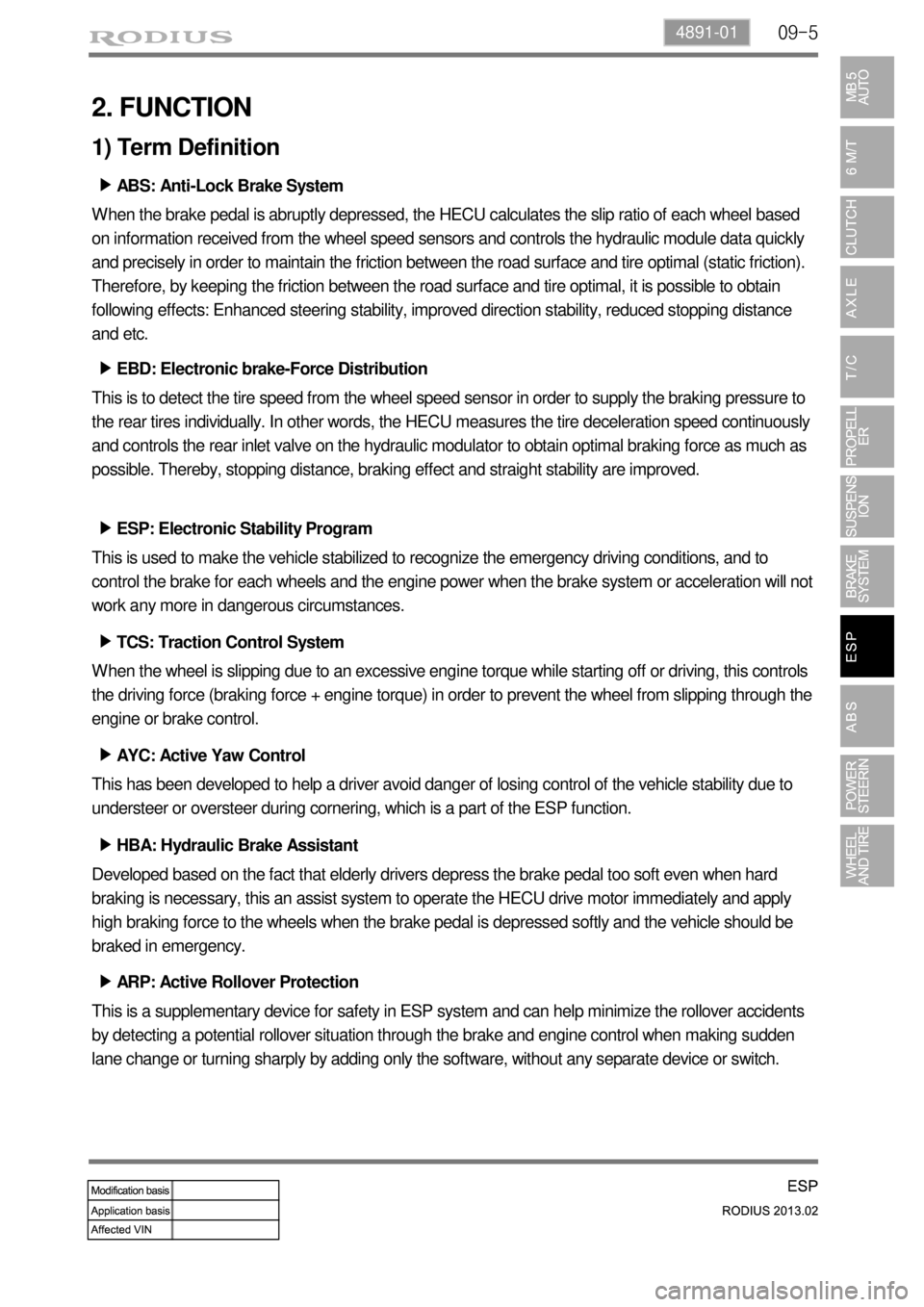
2. FUNCTION
1) Term Definition
ABS: Anti-Lock Brake System ▶
When the brake pedal is abruptly depressed, the HECU calculates the slip ratio of each wheel based
on information received from the wheel speed sensors and controls the hydraulic module data quickly
and precisely in order to maintain the friction between the road surface and tire optimal (static friction).
Therefore, by keeping the friction between the road surface and tire optimal, it is possible to obtain
following effects: Enhanced steering stability, improved direction stability, reduced stopping distance
and etc.
EBD: Electronic brake-Force Distribution ▶
This is to detect the tire speed from the wheel speed sensor in order to supply the braking pressure to
the rear tires individually. In other words, the HECU measures the tire deceleration speed continuously
and controls the rear inlet valve on the hydraulic modulator to obtain optimal braking force as much as
possible. Thereby, stopping distance, braking effect and straight stability are improved.
ESP: Electronic Stability Program ▶
This is used to make the vehicle stabilized to recognize the emergency driving conditions, and to
control the brake for each wheels and the engine power when the brake system or acceleration will not
work any more in dangerous circumstances.
TCS: Traction Control System ▶
When the wheel is slipping due to an excessive engine torque while starting off or driving, this controls
the driving force (braking force + engine torque) in order to prevent the wheel from slipping through the
engine or brake control.
AYC: Active Yaw Control ▶
This has been developed to help a driver avoid danger of losing control of the vehicle stability due to
understeer or oversteer during cornering, which is a part of the ESP function.
HBA: Hydraulic Brake Assistant ▶
Developed based on the fact that elderly drivers depress the brake pedal too soft even when hard
braking is necessary, this an assist system to operate the HECU drive motor immediately and apply
high braking force to the wheels when the brake pedal is depressed softly and the vehicle should be
braked in emergency.
ARP: Active Rollover Protection ▶
This is a supplementary device for safety in ESP system and can help minimize the rollover accidents
by detecting a potential rollover situation through the brake and engine control when making sudden
lane change or turning sharply by adding only the software, without any separate device or switch.
Page 652 of 796
09-6
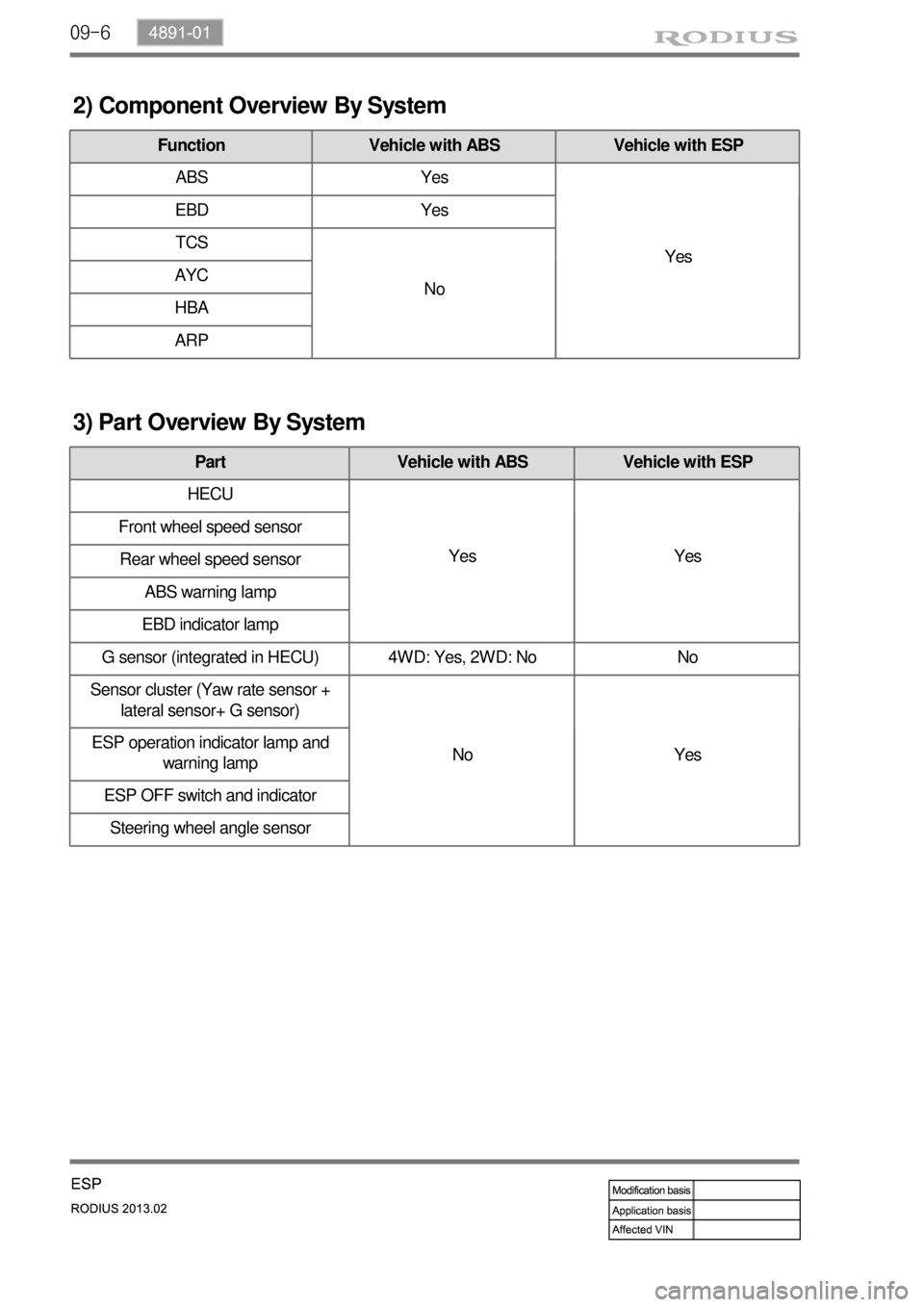
2) Component Overview By System
Function Vehicle with ABS Vehicle with ESP
ABS Yes
Yes EBD Yes
TCS
No AYC
HBA
ARP
3) Part Overview By System
Part Vehicle with ABS Vehicle with ESP
HECU
Yes Yes Front wheel speed sensor
Rear wheel speed sensor
ABS warning lamp
EBD indicator lamp
G sensor (integrated in HECU) 4WD: Yes, 2WD: No No
Sensor cluster (Yaw rate sensor +
lateral sensor+ G sensor)
No Yes ESP operation indicator lamp and
warning lamp
ESP OFF switch and indicator
Steering wheel angle sensor
Page 653 of 796
09-74891-01
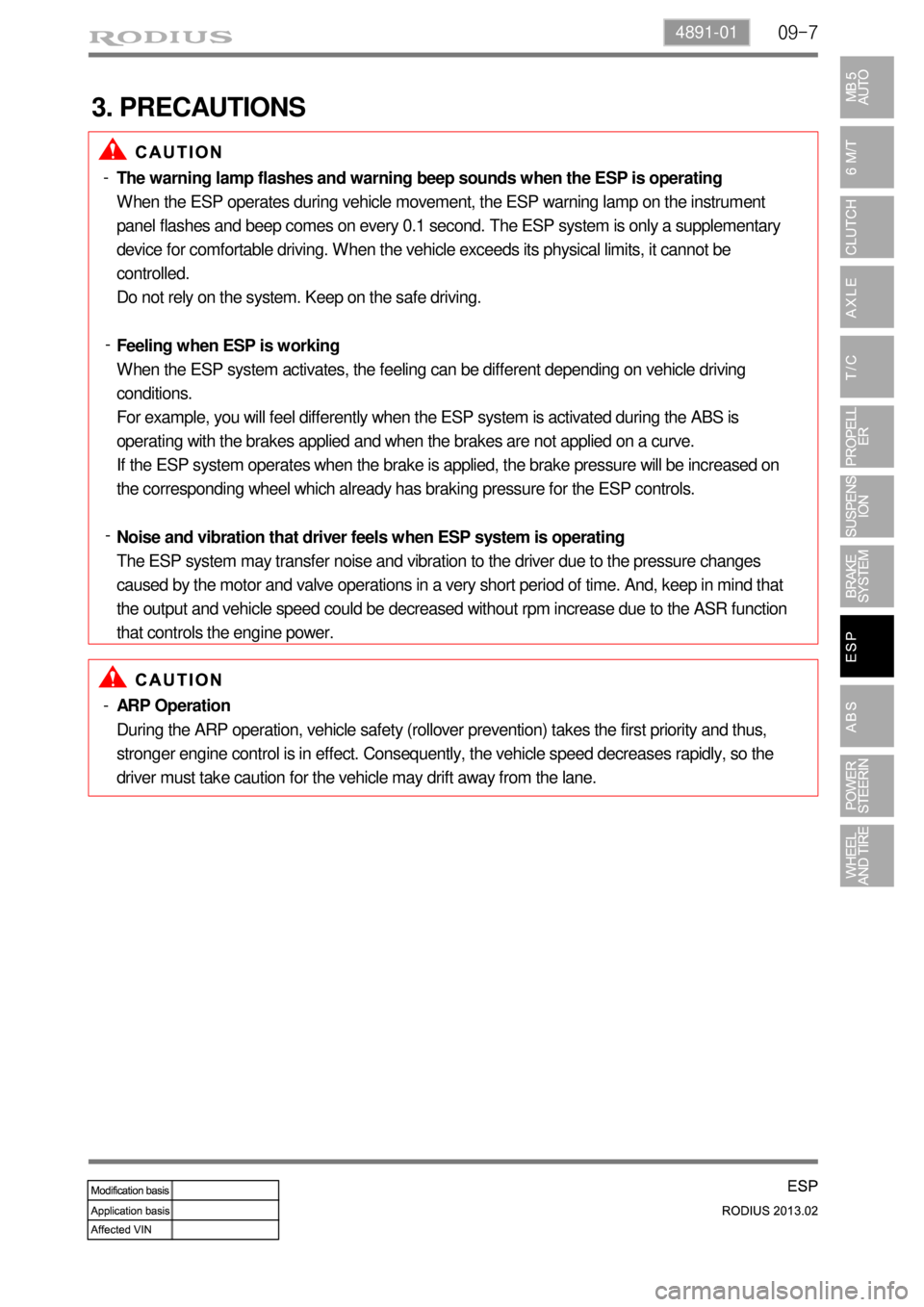
3. PRECAUTIONS
The warning lamp flashes and warning beep sounds when the ESP is operating
When the ESP operates during vehicle movement, the ESP warning lamp on the instrument
panel flashes and beep comes on every 0.1 second. The ESP system is only a supplementary
device for comfortable driving. When the vehicle exceeds its physical limits, it cannot be
controlled.
Do not rely on the system. Keep on the safe driving.
Feeling when ESP is working
When the ESP system activates, the feeling can be different depending on vehicle driving
conditions.
For example, you will feel differently when the ESP system is activated during the ABS is
operating with the brakes applied and when the brakes are not applied on a curve.
If the ESP system operates when the brake is applied, the brake pressure will be increased on
the corresponding wheel which already has braking pressure for the ESP controls.
Noise and vibration that driver feels when ESP system is operating
The ESP system may transfer noise and vibration to the driver due to the pressure changes
caused by the motor and valve operations in a very short period of time. And, keep in mind that
the output and vehicle speed could be decreased without rpm increase due to the ASR function
that controls the engine power. -
-
-
ARP Operation
During the ARP operation, vehicle safety (rollover prevention) takes the first priority and thus,
stronger engine control is in effect. Consequently, the vehicle speed decreases rapidly, so the
driver must take caution for the vehicle may drift away from the lane. -
Page 655 of 796
09-94891-01
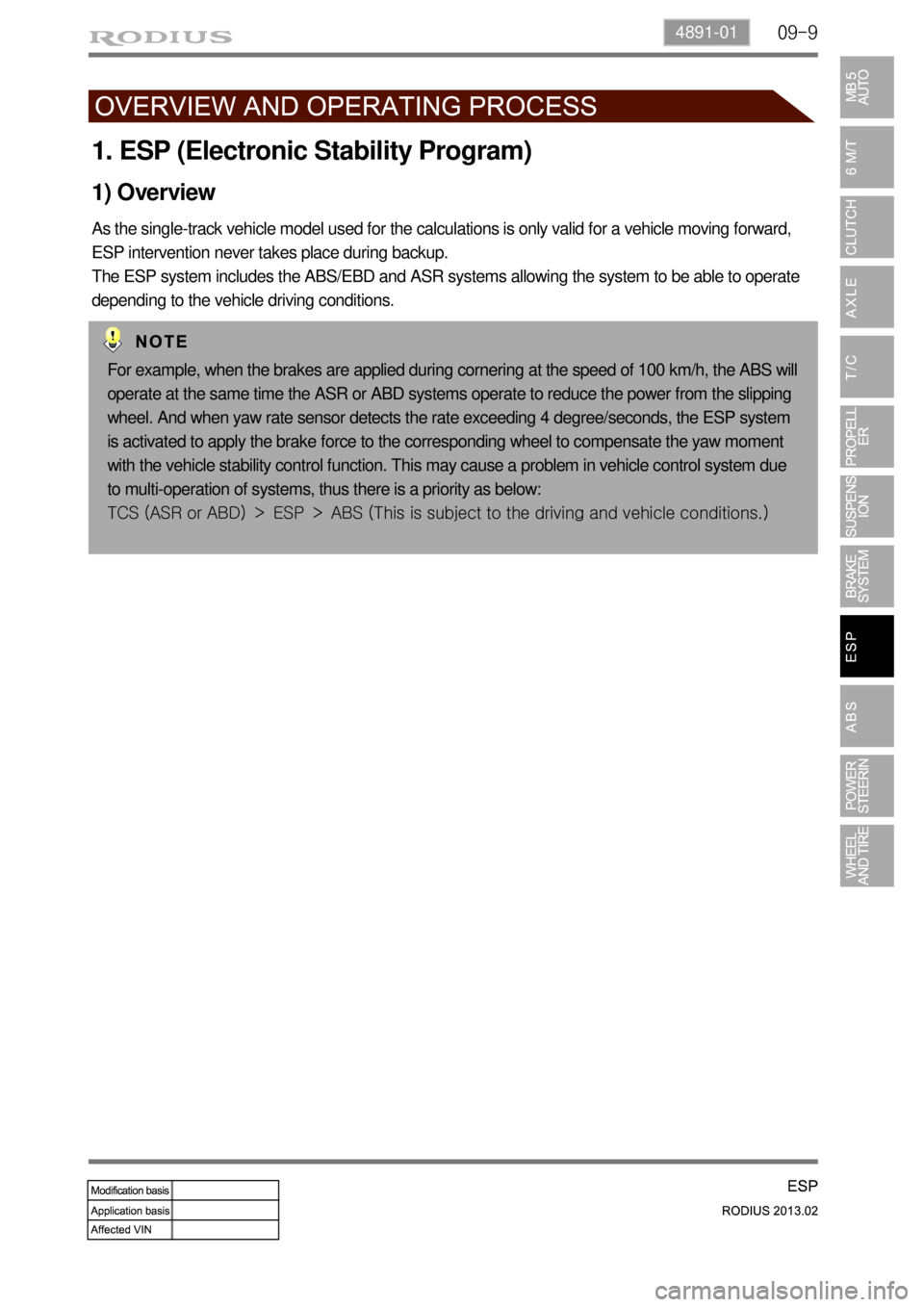
1. ESP (Electronic Stability Program)
As the single-track vehicle model used for the calculations is only valid for a vehicle moving forward,
ESP intervention never takes place during backup.
The ESP system includes the ABS/EBD and ASR systems allowing the system to be able to operate
depending to the vehicle driving conditions.
1) Overview
For example, when the brakes are applied during cornering at the speed of 100 km/h, the ABS will
operate at the same time the ASR or ABD systems operate to reduce the power from the slipping
wheel. And when yaw rate sensor detects the rate exceeding 4 degree/seconds, the ESP system
is activated to apply the brake force to the corresponding wheel to compensate the yaw moment
with the vehicle stability control function. This may cause a problem in vehicle control system due
to multi-operation of systems, thus there is a priority as below:
TCS (ASR or ABD) > ESP > ABS (This is subject to the driving and vehicle conditions.)
Page 656 of 796
09-10
Pressure Sensor
InstalledRemoved
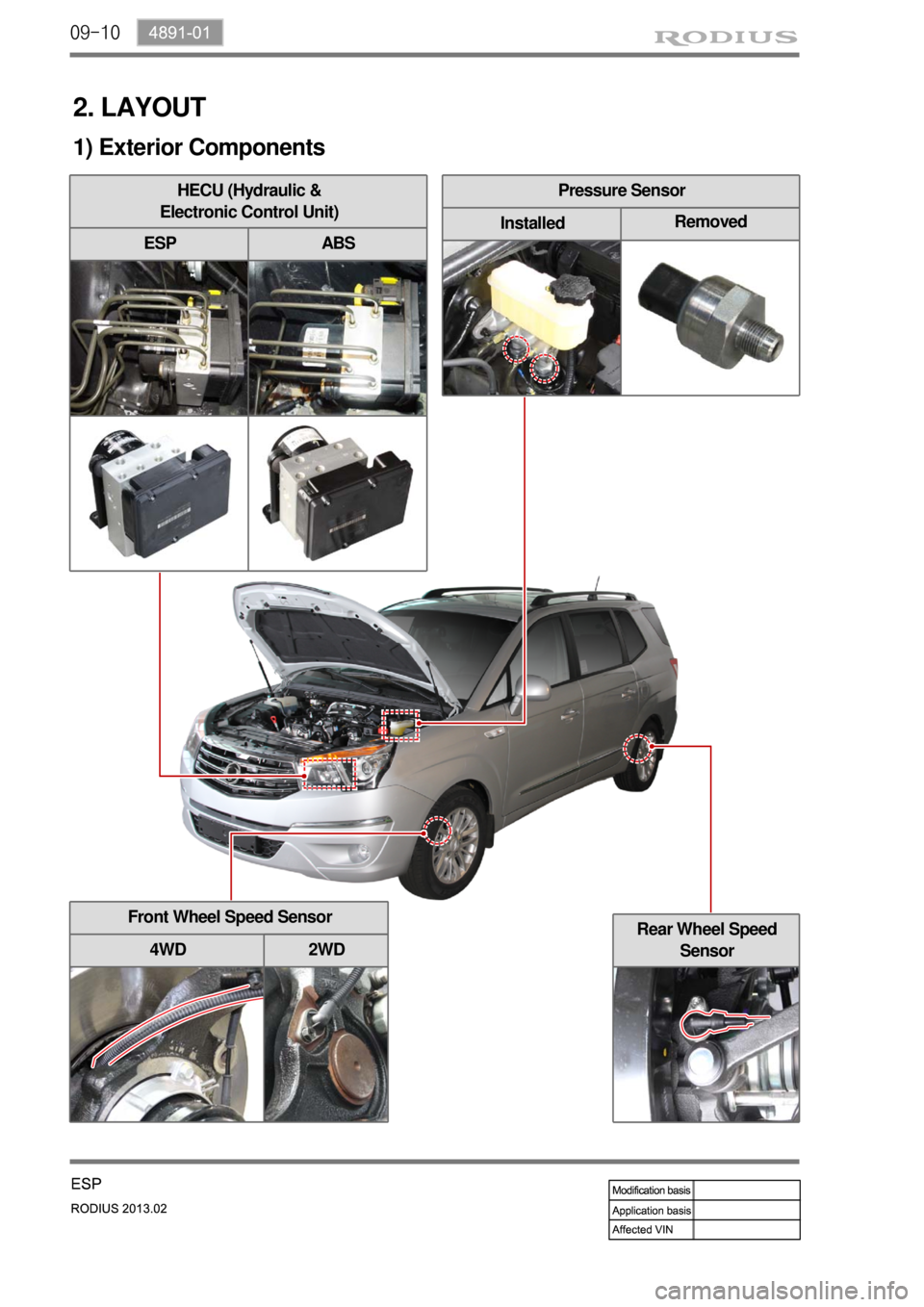
2. LAYOUT
HECU (Hydraulic &
Electronic Control Unit)
ESP ABS
Front Wheel Speed Sensor
4WD 2WDRear Wheel Speed
Sensor
1) Exterior Components
Page 657 of 796
09-114891-01
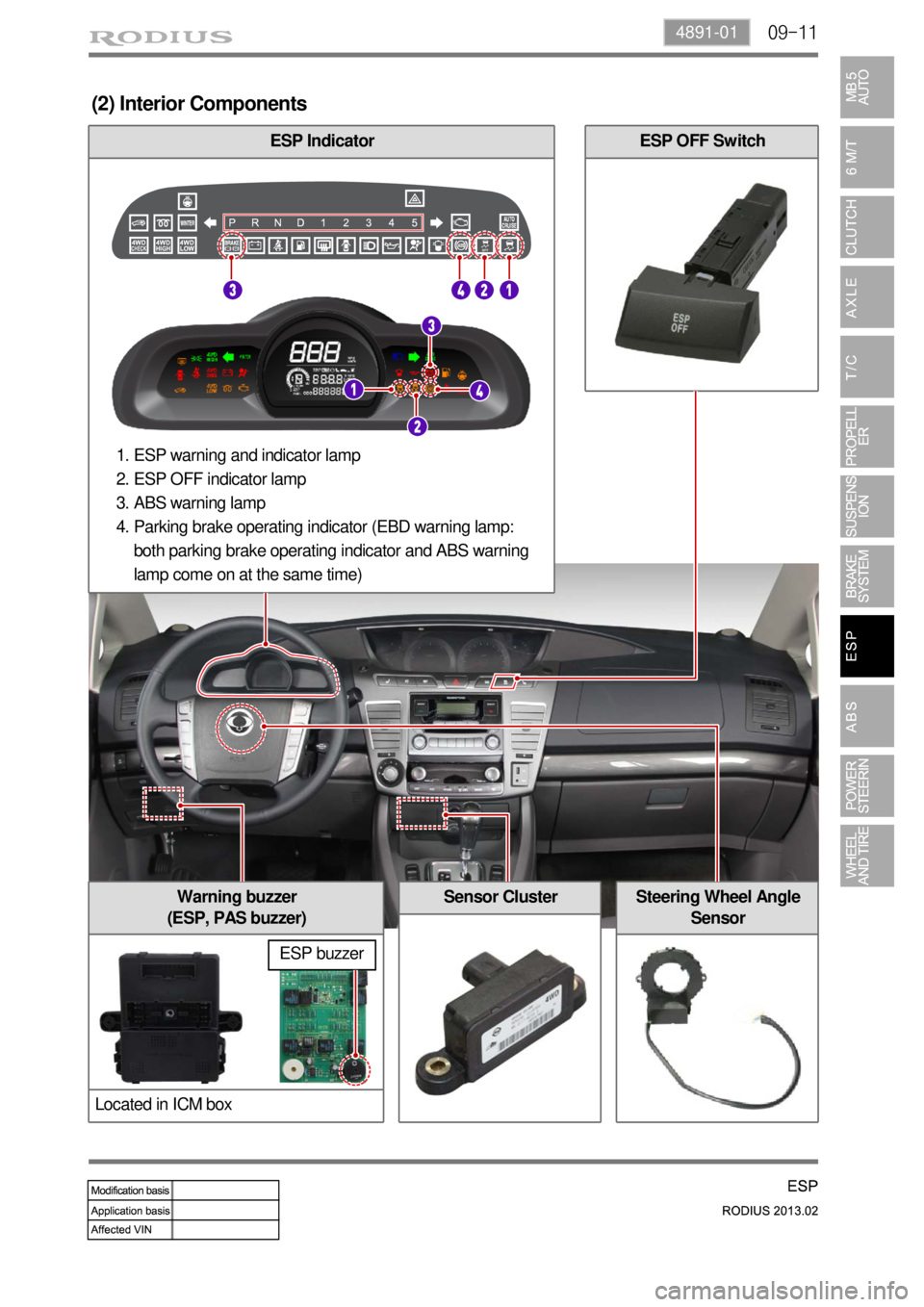
(2) Interior Components
ESP Indicator
Sensor Cluster
ESP OFF Switch
Steering Wheel Angle
SensorWarning buzzer
(ESP, PAS buzzer)
Located in ICM box
ESP warning and indicator lamp
ESP OFF indicator lamp
ABS warning lamp
Parking brake operating indicator (EBD warning lamp:
both parking brake operating indicator and ABS warning
lamp come on at the same time) 1.
2.
3.
4.
ESP buzzer
Page 662 of 796
09-16
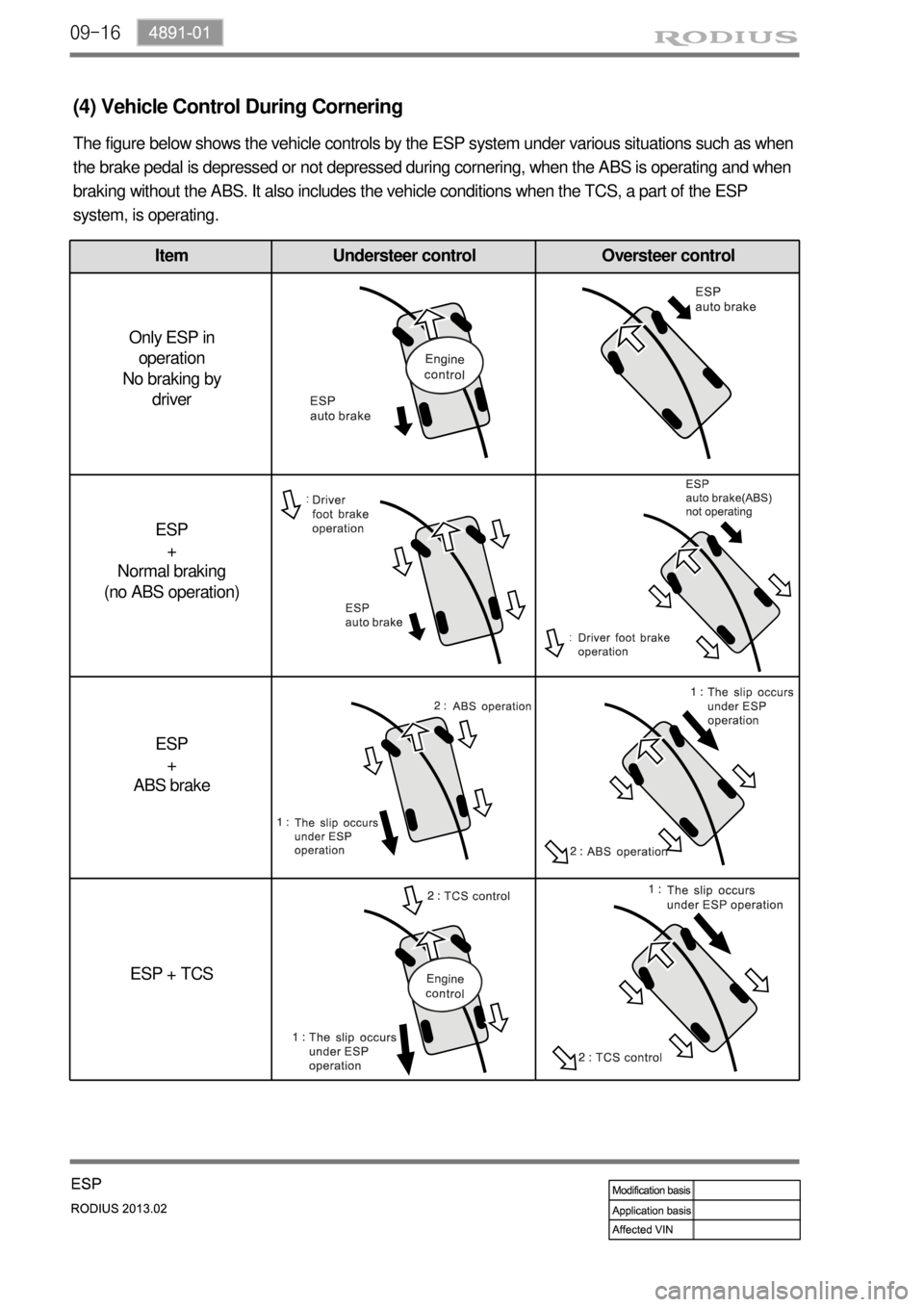
(4) Vehicle Control During Cornering
The figure below shows the vehicle controls by the ESP system under various situations such as when
the brake pedal is depressed or not depressed during cornering, when the ABS is operating and when
braking without the ABS. It also includes the vehicle conditions when the TCS, a part of the ESP
system, is operating.
Item Understeer control Oversteer control
Only ESP in
operation
No braking by
driver
ESP
+
Normal braking
(no ABS operation)
ESP
+
ABS brake
ESP + TCS
Page 665 of 796
09-194891-01
4) ARP (Active Roll-Over Protection)
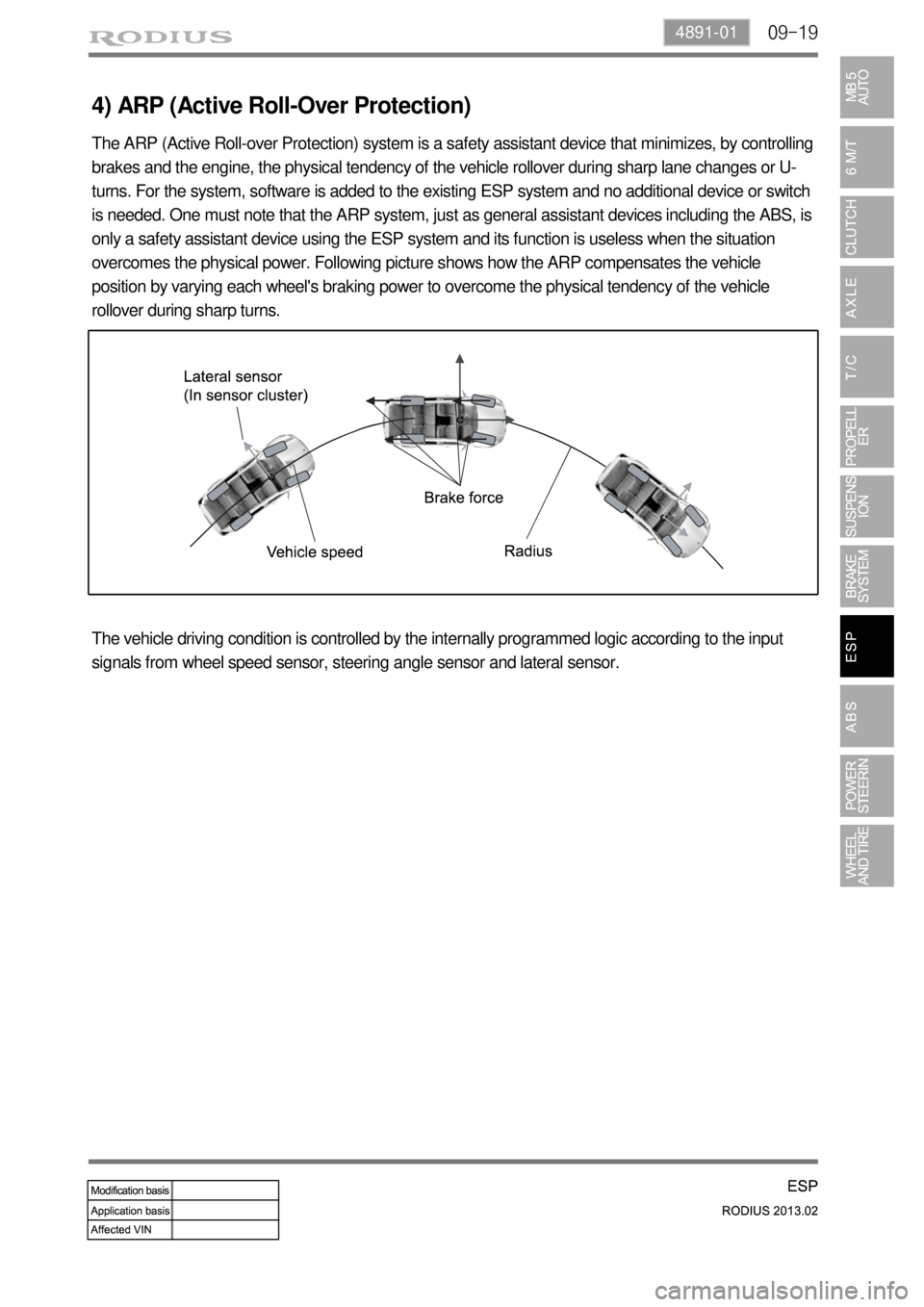
The ARP (Active Roll-over Protection) system is a safety assistant device that minimizes, by controlling
brakes and the engine, the physical tendency of the vehicle rollover during sharp lane changes or U-
turns. For the system, software is added to the existing ESP system and no additional device or switch
is needed. One must note that the ARP system, just as general assistant devices including the ABS, is
only a safety assistant device using the ESP system and its function is useless when the situation
overcomes the physical power. Following picture shows how the ARP compensates the vehicle
position by varying each wheel's braking power to overcome the physical tendency of the vehicle
rollover during sharp turns.
The vehicle driving condition is controlled by the internally programmed logic according to the input
signals from wheel speed sensor, steering angle sensor and lateral sensor.
Page 667 of 796
09-214891-01
4. SCHEMATIC DIAGRAM
When equipped with ABS, the braking force at each wheel will be controlled with 3-channel 4-sensor
method. And when equipped with ESP, 4 wheels will be controlled independently with 4-channel
method. (When controlling ABS system only, it will be operated with 3-channel method.) When
compared to the vehicle equipped with ABS/EBD only, the internal hydraulic circuit has a normally-open
separation valve and a shuttle valve in primary circuit and in secondary circuit. When the vehicle brakes
are not applied during engine running or when applying the non-ABS operating brakes, the normally-
open separation valve and the inlet valve are open, whereas the normally-closed shuttle valve and the
outlet valve are closed. When the ESP system is operating, the normally-open separation valve will be
closed by the solenoid valve operation and the hydraulic circuit will be established by the shuttle valve.
Then, the inlet and outlet valves will be
closed or open depending on the braking pressure increase, decrease or unchanged conditions.
▶The warning lamp comes on and warning beep sounds when the ESP is operating
Driving feeling when the ESP is operating ▶
▶Noise and vibration that driver senses when the ESP is operating
1) Hydraulic Circuit Diagram
When the ESP operates during vehicle movement, the ESP warning lamp on the instrument panel
flickers and beep comes on every 0.1 second. The ESP operation shows that the vehicle stability is
extremely unstable and it is used to warn the driver. The ESP system is just a supplementary system
for the vehicle motion and it cannot control the vehicle when it exceeds the physical limits. Do not
solely rely on the system but be advised to drive the vehicle safely.
When the ESP system activates, the driving feeling can be different depending on vehicle driving
conditions. For example, you will feel differently when the ESP system is activated during when ABS
is operating with the brakes applied and when brakes are not applied on a curve. Thus, the ESP
system would make the driver feel more abruptly when the brakes are applied during the ESP
system activation.
The ESP system may transfer noise and vibration to the driver due to the pressure changes caused
by the motor and valve operations in a very short period of time. Extreme cornering will trigger the
ESP operation and this will make the driver feel noise and vibration due to sudden brake application.
Also, the ESP system controls the engine output. So, the driver may notice the engine output
decrease even when the accelerator pedal is being applied.
Page 668 of 796
09-22
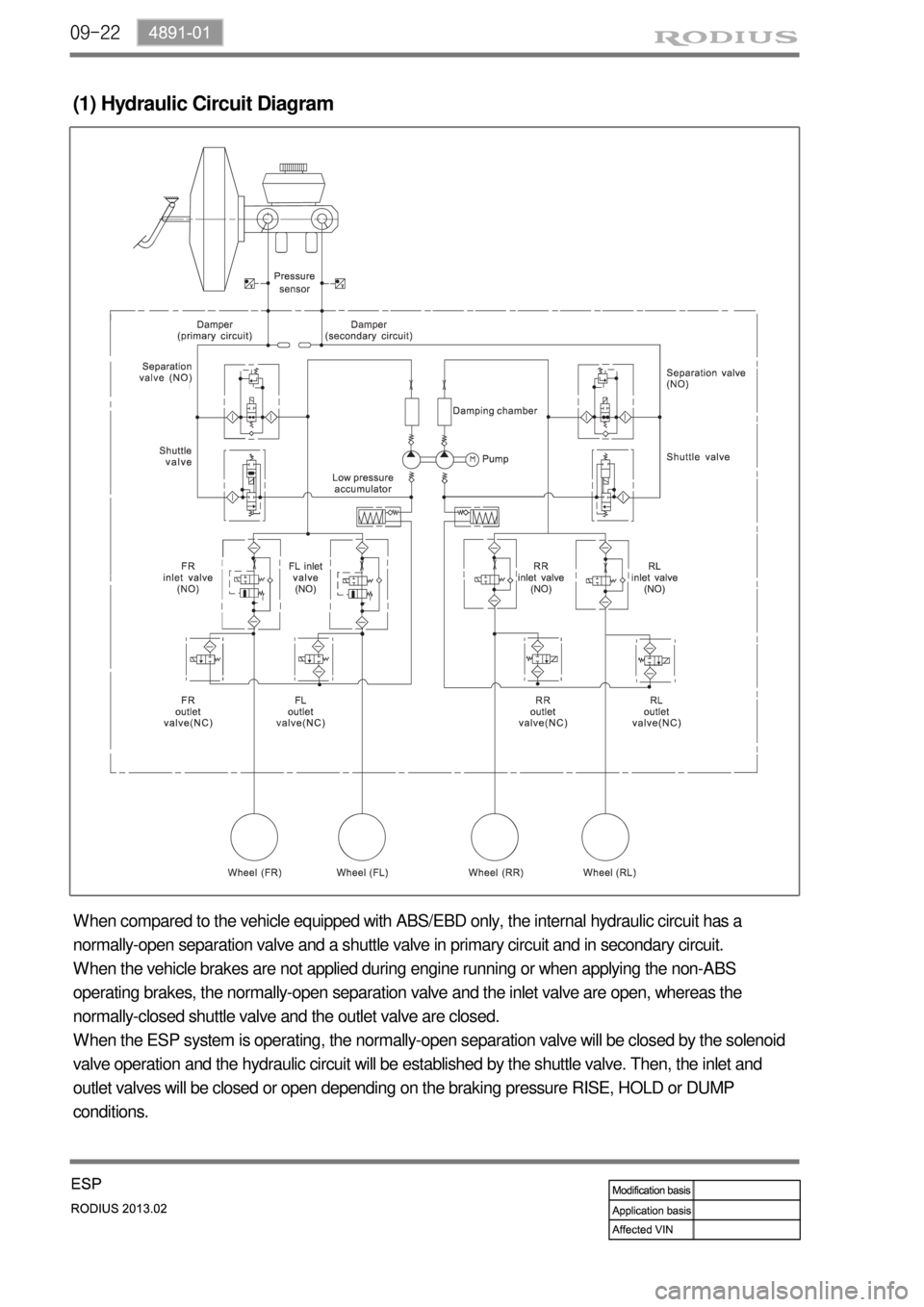
(1) Hydraulic Circuit Diagram
When compared to the vehicle equipped with ABS/EBD only, the internal hydraulic circuit has a
normally-open separation valve and a shuttle valve in primary circuit and in secondary circuit.
When the vehicle brakes are not applied during engine running or when applying the non-ABS
operating brakes, the normally-open separation valve and the inlet valve are open, whereas the
normally-closed shuttle valve and the outlet valve are closed.
When the ESP system is operating, the normally-open separation valve will be closed by the solenoid
valve operation and the hydraulic circuit will be established by the shuttle valve. Then, the inlet and
outlet valves will be closed or open depending on the braking pressure RISE, HOLD or DUMP
conditions.