check engine SSANGYONG TURISMO 2013 User Guide
[x] Cancel search | Manufacturer: SSANGYONG, Model Year: 2013, Model line: TURISMO, Model: SSANGYONG TURISMO 2013Pages: 796, PDF Size: 78.99 MB
Page 220 of 796

03-132210-01
How To Use Pressure Tester ▶
Press the "TEST" button on the tester to
check if the message "TEST?" is displayed.
If the button is pressed again at 4 seconds
after starting engine cranking, the highest
pressure is displayed on the tester. 1.
2.
The fuel rail pressure value can be checked using a diagnostic device.
Page 221 of 796
03-14
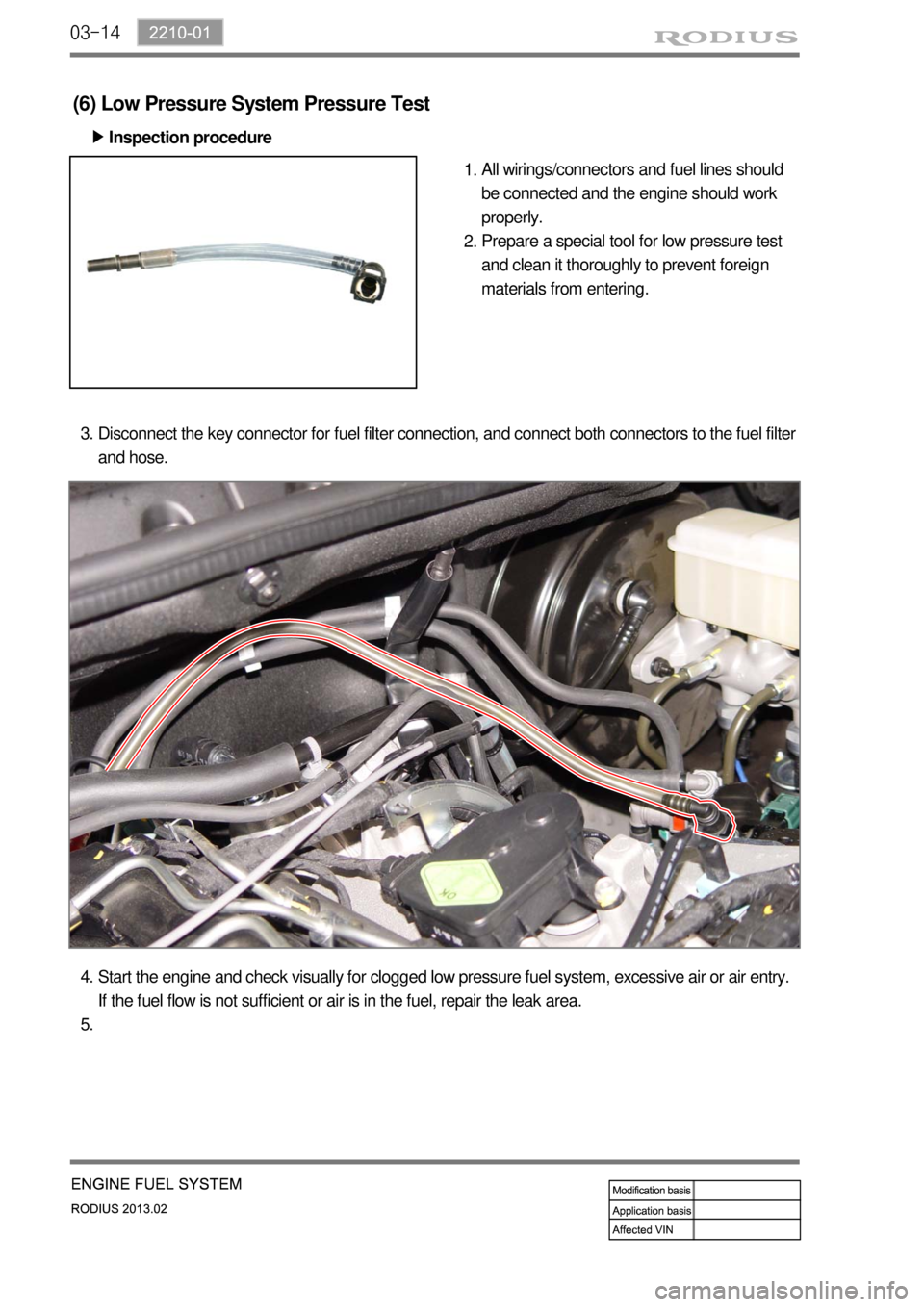
(6) Low Pressure System Pressure Test
Inspection procedure ▶
All wirings/connectors and fuel lines should
be connected and the engine should work
properly.
Prepare a special tool for low pressure test
and clean it thoroughly to prevent foreign
materials from entering. 1.
2.
Disconnect the key connector for fuel filter connection, and connect both connectors to the fuel filter
and hose. 3.
Start the engine and check visually for clogged low pressure fuel system, excessive air or air entry.
If the fuel flow is not sufficient or air is in the fuel, repair the leak area. 4.
5.
Page 222 of 796
03-152210-01
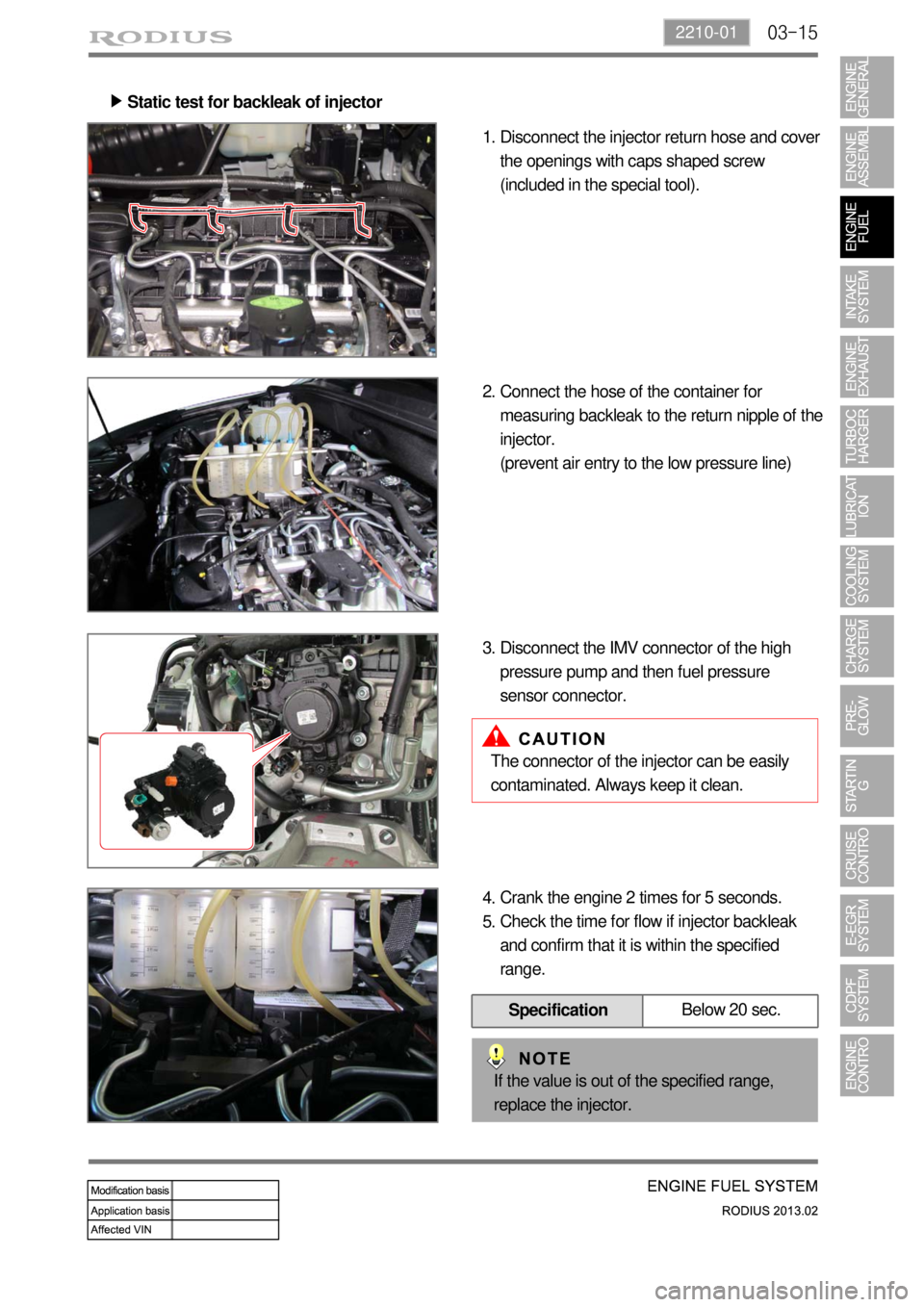
Static test for backleak of injector ▶
Disconnect the injector return hose and cover
the openings with caps shaped screw
(included in the special tool). 1.
Connect the hose of the container for
measuring backleak to the return nipple of the
injector.
(prevent air entry to the low pressure line) 2.
Disconnect the IMV connector of the high
pressure pump and then fuel pressure
sensor connector. 3.
The connector of the injector can be easily
contaminated. Always keep it clean.
Crank the engine 2 times for 5 seconds.
Check the time for flow if injector backleak
and confirm that it is within the specified
range. 4.
5.
If the value is out of the specified range,
replace the injector.
SpecificationBelow 20 sec.
Page 223 of 796
03-16
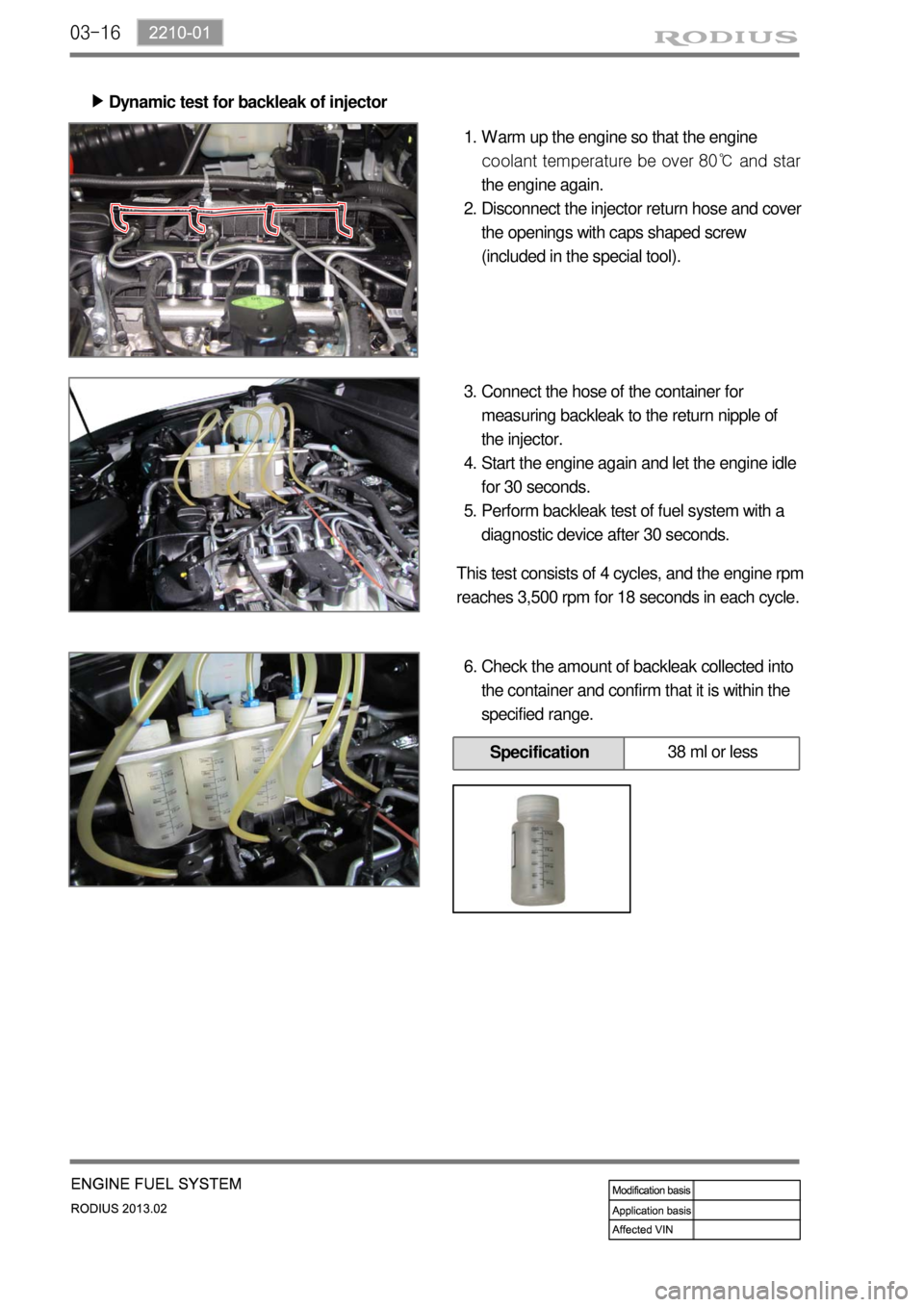
Dynamic test for backleak of injector ▶
Warm up the engine so that the engine
coolant tem
perature be over 80℃ and star
the engine again.
Disconnect the injector return hose and cover
the openings with caps shaped screw
(included in the special tool). 1.
2.
Connect the hose of the container for
measuring backleak to the return nipple of
the injector.
Start the engine again and let the engine idle
for 30 seconds.
Perform backleak test of fuel system with a
diagnostic device after 30 seconds. 3.
4.
5.
This test consists of 4 cycles, and the engine rpm
reaches 3,500 rpm for 18 seconds in each cycle.
Check the amount of backleak collected into
the container and confirm that it is within the
specified range. 6.
Specification38 ml or less
Page 225 of 796
03-18
3. CAUTIONS FOR DI ENGINE
1) Cautions for DI Engine
This chapter describes the cautions for DI engine equipped vehicle. This includes the water separation
from engine, warning lights, symptoms when engine malfunctioning, causes and actions.
DI Engine 1.
Comparatively conventional diesel engines, DI engine controls the fuel injection and timing electrically,
delivers high power and reduces less emission.
System Safety Mode 2.
When a severe failure has been occurred in a vehicle, the system safety mode is activated to protect
the system. It reduces the driving force, restricts the engine speed (rpm) and stops engine operation.
Refer to "Diagnosis" section in this manual.
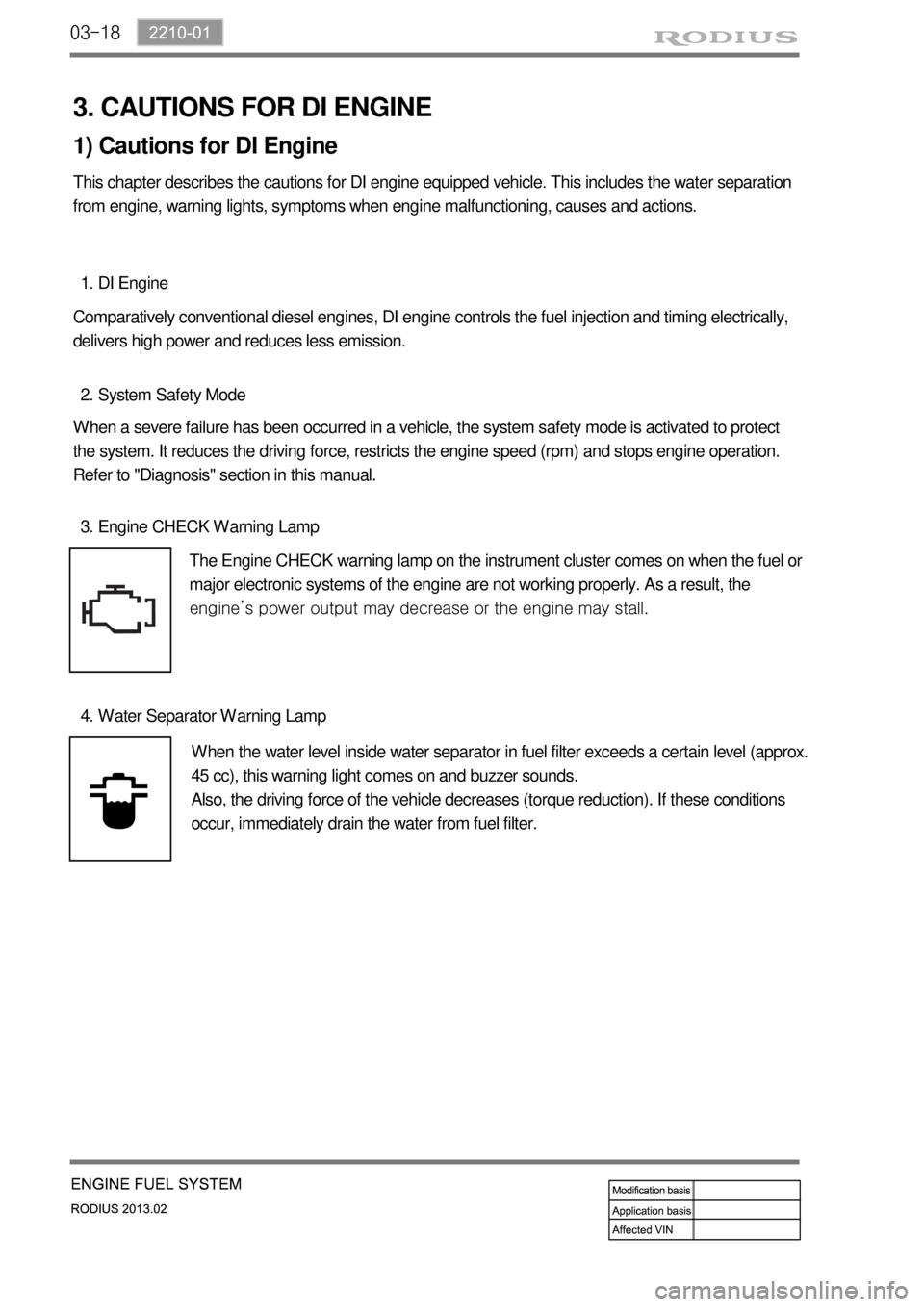
Engine CHECK Warning Lamp 3.
The Engine CHECK warning lamp on the instrument cluster comes on when the fuel or
major electronic systems of the engine are not working properly. As a result, the
engine’s power output may decrease or the engine may stall.
Water Separator Warning Lamp
4.
When the water level inside water separator in fuel filter exceeds a certain level (approx.
45 cc), this warning light comes on and buzzer sounds.
Also, the driving force of the vehicle decreases (torque reduction). If these conditions
occur, immediately drain the water from fuel filter.
Page 227 of 796
03-20
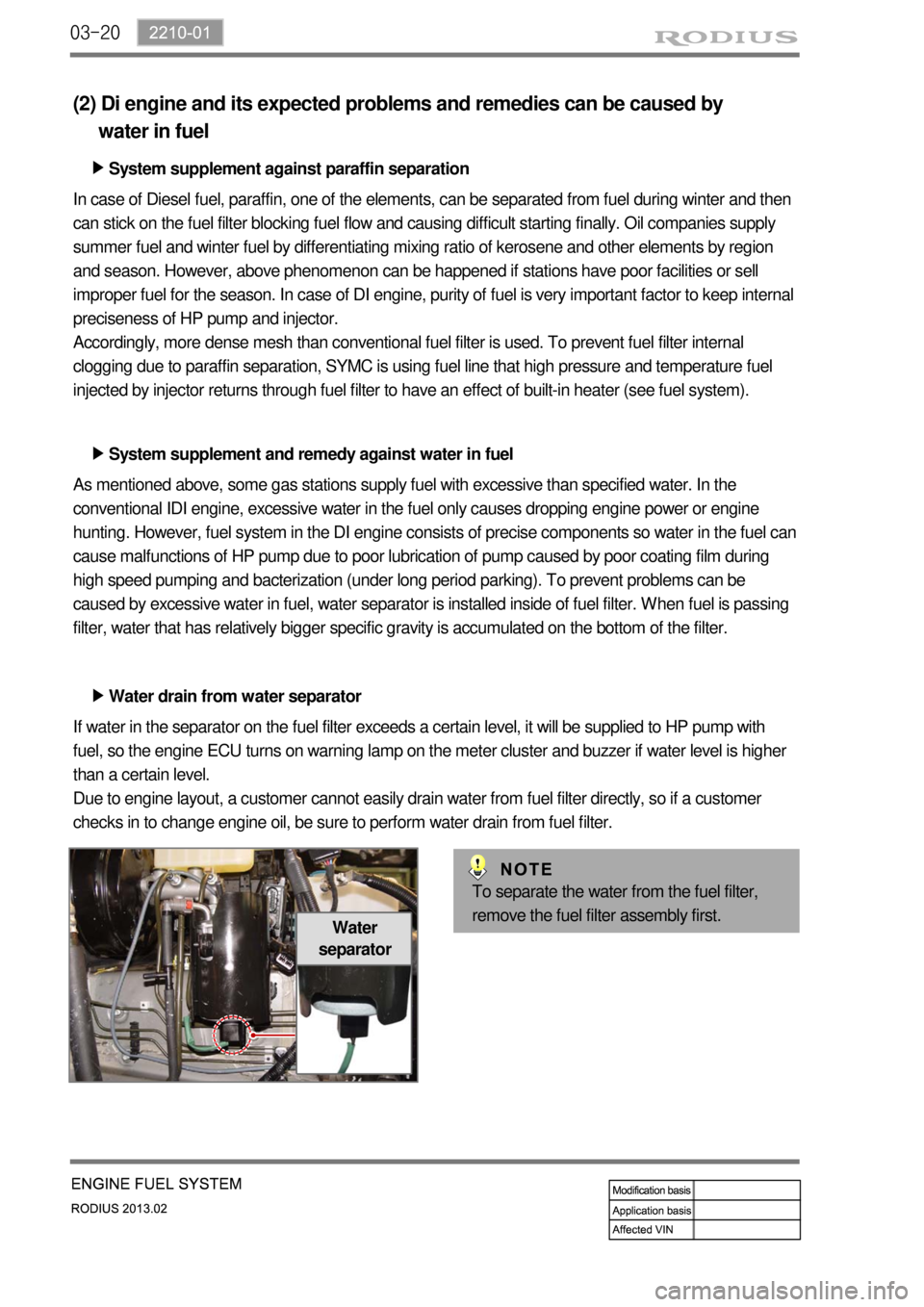
Water
separator
(2) Di engine and its expected problems and remedies can be caused by
water in fuel
System supplement against paraffin separation ▶
In case of Diesel fuel, paraffin, one of the elements, can be separated from fuel during winter and then
can stick on the fuel filter blocking fuel flow and causing difficult starting finally. Oil companies supply
summer fuel and winter fuel by differentiating mixing ratio of kerosene and other elements by region
and season. However, above phenomenon can be happened if stations have poor facilities or sell
improper fuel for the season. In case of DI engine, purity of fuel is very important factor to keep internal
preciseness of HP pump and injector.
Accordingly, more dense mesh than conventional fuel filter is used. To prevent fuel filter internal
clogging due to paraffin separation, SYMC is using fuel line that high pressure and temperature fuel
injected by injector returns through fuel filter to have an effect of built-in heater (see fuel system).
System supplement and remedy against water in fuel ▶
As mentioned above, some gas stations supply fuel with excessive than specified water. In the
conventional IDI engine, excessive water in the fuel only causes dropping engine power or engine
hunting. However, fuel system in the DI engine consists of precise components so water in the fuel can
cause malfunctions of HP pump due to poor lubrication of pump caused by poor coating film during
high speed pumping and bacterization (under long period parking). To prevent problems can be
caused by excessive water in fuel, water separator is installed inside of fuel filter. When fuel is passing
filter, water that has relatively bigger specific gravity is accumulated on the bottom of the filter.
Water drain from water separator ▶
If water in the separator on the fuel filter exceeds a certain level, it will be supplied to HP pump with
fuel, so the engine ECU turns on warning lamp on the meter cluster and buzzer if water level is higher
than a certain level.
Due to engine layout, a customer cannot easily drain water from fuel filter directly, so if a customer
checks in to change engine oil, be sure to perform water drain from fuel filter.
To separate the water from the fuel filter,
remove the fuel filter assembly first.
Page 235 of 796

04-4
2. INSPECTION
1) Troubleshooting
When Abnormal Noises are Heard from the Engine Room ▶
For the vehicle equipped with DI engine, if a learning noise occurs in each range or other noises
occur, the major cause of it is a faulty turbocharger assembly. But an interference issue, poor
tightness or loose in the intake and exhaust system also can cause those noises. This is mainly
because the operator didn't follow the instruction exactly when reconnecting the intake hoses and
pipes which were disconnected to check the system or replace the air cleaner. If the intake system
is free of any faults, check the EGR and PCV oil separator connected to the intake system.
The figure may be different from the actual engine. Therefore, read thoroughly below before
replacing the parts.
2) Abnormal Noise Caused by Poor Tightness of Intake System
When the DI engine is running, the air entered into the engine flows in the sequence as shown above.
If high intake pressure is applied to the loose or damaged part, a whistling noise may occur, the intake
air volume is measured incorrectly or the engine power is derated.
Page 236 of 796

04-51719-00
3) Troubleshooting Sequence
The basic checks for intake system are as follows:
Basic Checks for Intake System ▶
Make sure to replace or clean the air cleaner
element periodically. Otherwise, engine will be
derated or work abnormally because of low
intake air volume.
Unlike the fuel system, which is a closed
circuit, the intake system is an open circuit
system. Therefore any malfunction may occur
due to dust and dirt.
Most of the connections consist of hoses so the
system cannot withstand high temperature and
pressure. Also it can be deformed or loosened
easily because it is a clamp mounting system.
Thus, when checking the engine, basic
inspections, such as tightened status check and
visual inspection for hose, etc., should be carried
out in advance.
Other Checks for Intake System ▶
If the intake system is free of any faults,
check for EGR and PCV oil separator.
Page 245 of 796

05-51729-01
3. CAUTIONS
Do not park the vehicle on flammable materials, such as grass, leaves and carpet.
Do not touch the catalyst or the exhaust gas ignition system when the engine is running.
If a misfire occurs in the combustion chamber or the emission of pollutant exceeds the specified
level, the catalyst can be damaged.
When servicing or replacing components of the exhaust system, makes sure that the components
are positioned at regular intervals from all other parts of the under body.
Be careful not to damage the exhaust system when lifting the vehicle from its side.
All components and body parts of the engine exhaust system should be inspected for crack,
damage, air hole, part loss and incorrect mounting location. Also check for any deformation which
can result in exhaust gas drawn into the vehicle.
Make sure that the exhaust pipe is cooled down sufficiently before working on it because it is still hot
right after the engine is stopped.
Wear protective gloves when removing the exhaust pipe. -
-
-
-
-
-
-
-
Page 249 of 796

06-4
2. INSPECTION
1) Cautions During Driving
The following lists cautions to take during test drive and on the turbocharger vehicle, which must be
considered during the operation.
It's important not to drastically increase the engine rpm starting the engine. It could make rotation at
excessive speed even before the journal bearing is lubricated and when the turbocharger rotates in
poor oil supply condition, it could cause damage of bearing seizure within few seconds.
If the engine is running radically after replacing the engine oil or oil filter brings poor oil supply
condition. To avoid this, it's necessary to start off after idling the engine for about 1 minute allowing
oil to circulate to the turbocharger after the replacement.
When the engine is stopped abruptly after driving at high speed, the turbocharger continues to rotate
in condition where the oil pressure is at '0'. In such condition, an oil film between the journal bearing
and the housing shaft journal section gets broken and this causes abrasion of the journal bearing
due to the rapid contact. The repeat of such condition significantly reduces life of the turbocharger.
Therefore, the engine should be stopped possibly in the idle condition. 1.
2.
3.
After string for long period of time during winter season or in the low temperature condition where
the fluidity of engine oil declines, the engine, before being started, should be cranked to circulate
oil and must drive after checking the oil pressure is in normal condition by idling the engine for few
minutes.