height SSANGYONG TURISMO 2013 User Guide
[x] Cancel search | Manufacturer: SSANGYONG, Model Year: 2013, Model line: TURISMO, Model: SSANGYONG TURISMO 2013Pages: 796, PDF Size: 78.99 MB
Page 639 of 796

08-12
Let the engine run for 1 to 2 minutes and
stop it. If the brake pedal stroke is shortened
as pumping the brake pedal, the system is
normal. If not, the system is defective. 1.
Depress the brake pedal several times with
engine off. If the brake goes down when
starting engine with pedal depressed, the
system is normal. If not, the system is
defective. 2.
If the above three checks are OK, the system is
normal. If any condition is not met, check the
valve, vacuum hose and brake booster.
3) Brake Booster
OK
NG
Engine stopped
Engine running
Depress the brake pedal when the engine is
running. If the pedal height is not changed
for 30 seconds after stopping the engine, the
system is normal. If not, the system is
defective. 3.
Page 701 of 796
12-6
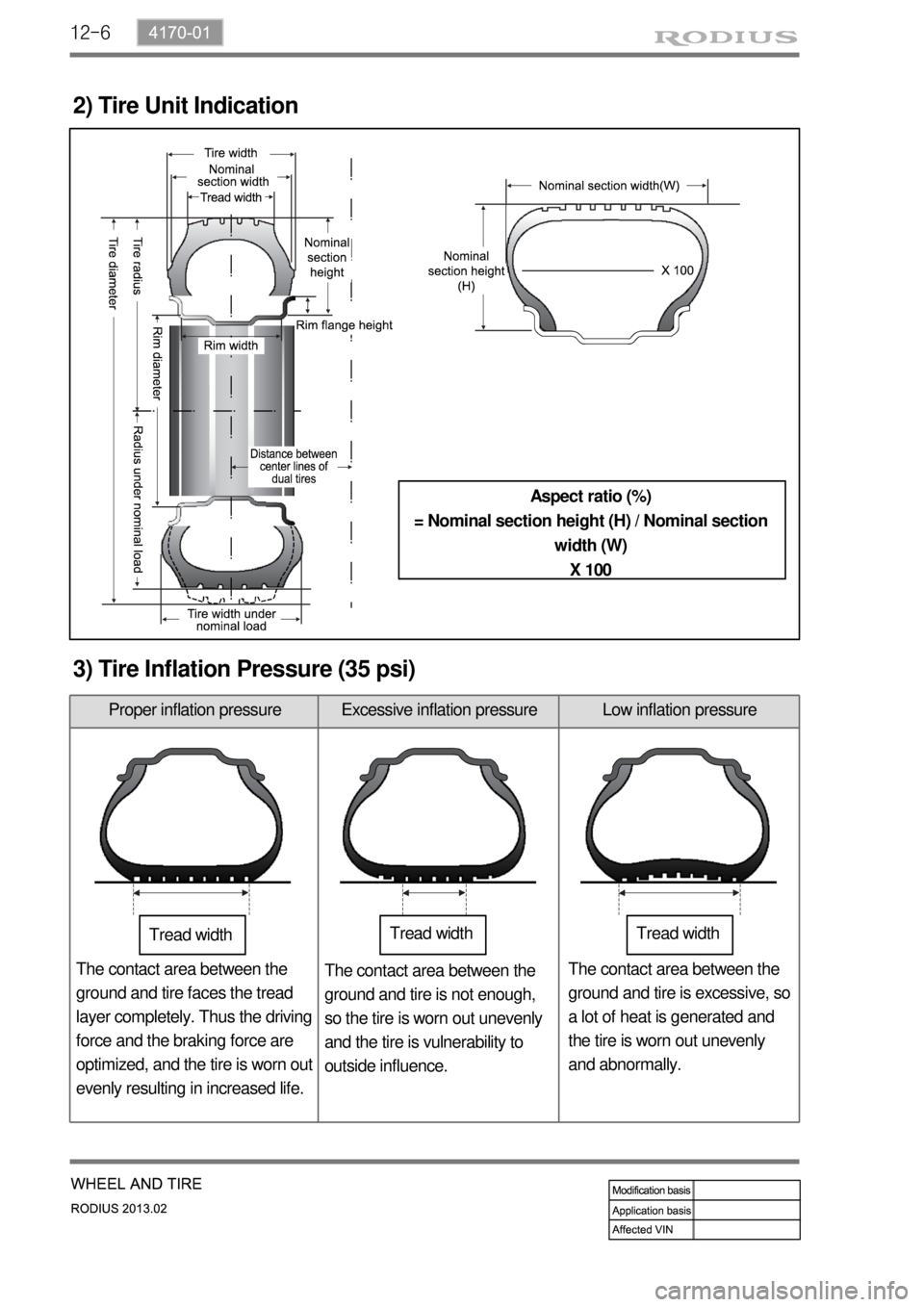
2) Tire Unit Indication
Aspect ratio (%)
= Nominal section height (H) / Nominal section
width (W)
X 100
3) Tire Inflation Pressure (35 psi)
Proper inflation pressure Excessive inflation pressure Low inflation pressure
The contact area between the
ground and tire faces the tread
layer completely. Thus the driving
force and the braking force are
optimized, and the tire is worn out
evenly resulting in increased life.The contact area between the
ground and tire is not enough,
so the tire is worn out unevenly
and the tire is vulnerability to
outside influence.The contact area between the
ground and tire is excessive, so
a lot of heat is generated and
the tire is worn out unevenly
and abnormally.
Tread widthTread widthTread width
Page 745 of 796
03-6
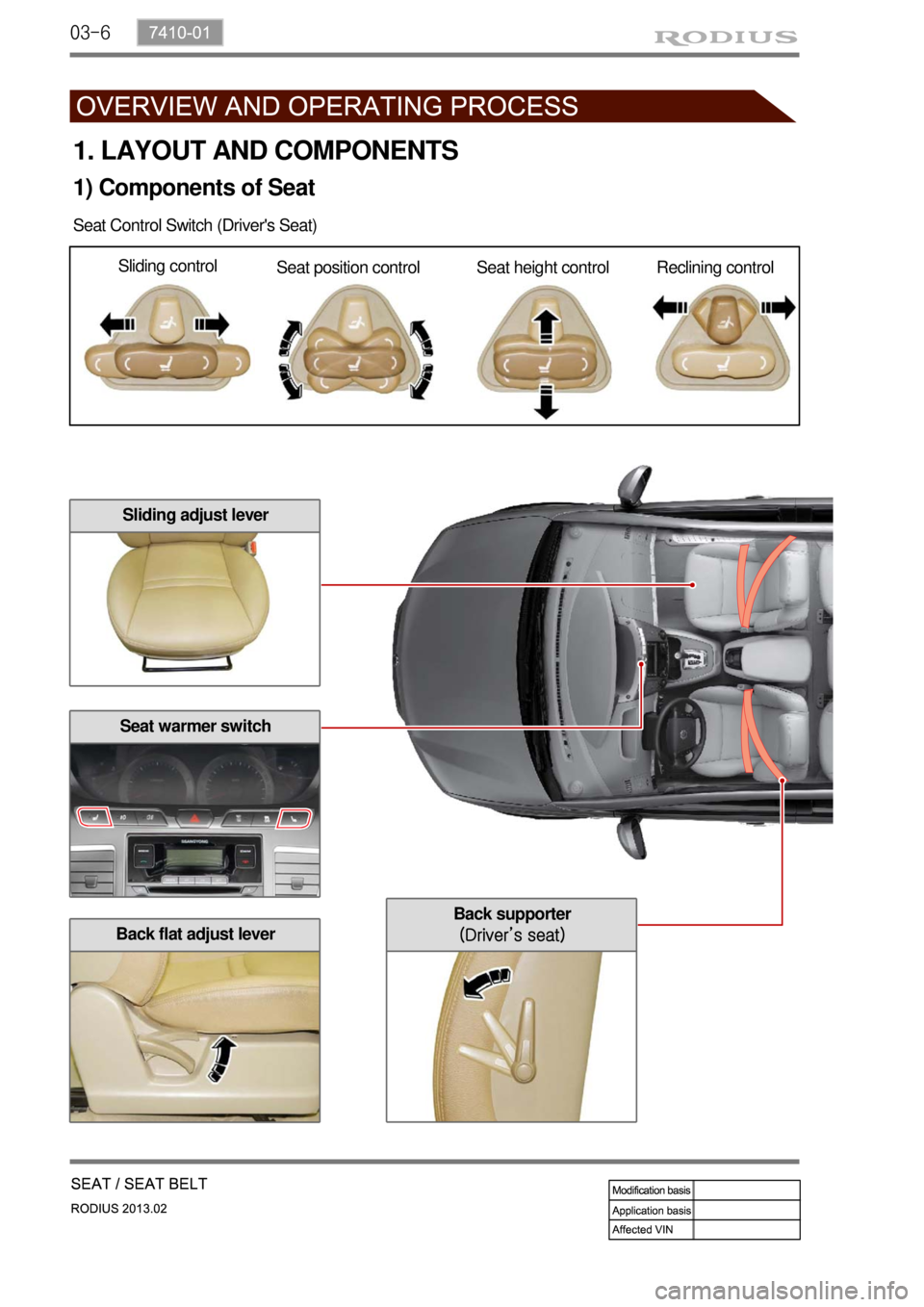
Seat warmer switch
Sliding adjust lever
Back flat adjust lever
1. LAYOUT AND COMPONENTS
1) Components of Seat
Seat Control Switch (Driver's Seat)
Seat position control Seat height control Reclining control
Back supporter
(Driver’s seat)
Sliding control
Page 757 of 796

03-18
Headrest Height Adjustment
To adjust the height of the headrest, raise
the headrest without operating the
headrest support sleeve (A) and lower it
while pressing the headrest support
sleeve.
(However, raise the headrest while
pressing the headrest support sleeve (A)
in order to remove it.)
4. FRONT SEAT
1) To Adjust Front Seat
While the driver seat is provided as two models: a power seat and a manual seat, the manual seat is
only used for front passenger seat.
To adjust headrest ▶
To adjust headrest tilting
Move the headrest to the arrow direction
to adjust the angle.
Page 759 of 796

03-20
Power Seat
To adjust seat cushion angle
When moving the front and rear parts of the
slide switch upwards or downwards, the front
and rear up/down motors rotate the rails to
move the front and rear side of the cushion
up/down.
To adjust seat height
When moving the slide switch up/down,
the front rear up/down motor rotates the rail to
move the whole seat cushion up/down.Manual Seat
To adjust seat cushion angle and
height
Turn the adjusting knob on the side of the seat
clockwise or anticlockwise to adjust the height
or angle of the front side or rear side of the
cushion.
To adjust driver seat lumbar support
When you raise and lower the adjusting lever
on the power and manual seats, the lumbar
support goes in and out of the seat.
The lumbar support is only fitted to the vehicle without the seat air bag.
Page 762 of 796

03-237410-01
Seat cushion height adjustment
Seat moves up/down
controlled by seat height
control switch
Seatback reclining
Seat back reclining controlled
by seat reclining control switch
Page 769 of 796
03-30
6. CHILD RESTRAINTS AND PREGNANT WOMAN
1) Pregnant Women
We recommend that pregnant women use the seat belts throughout their pregnancy. Keeping the
mother safe is the best way to keep the baby safe.
Infants and tiny children should always be restrained in an infant or child restraint.
Never install a rear-facing child restraint in the front seat with front passenger air bag.
A child in a rear-facing child restraint installed in the front seat can be seriously injured if the front
passenger air bag inflates. Secure a rear-facing child restraint in the rear seat.
A front-facing child restraint should be secured in the rear seat whenever possible. If installed in the
front passenger seat, adjust the seat as far back as it will go.
When installing a child restraint system, follow the instructions provided by the manufacturer.
When your child restraint is not in use, secure it in the vehicle with the seat belt or remove it from
the vehicle.
In a collision an unrestrained child, even a tiny baby, can become a missile inside the vehicle. The
force required to hold even an infant on your lap can become so great that you could not hold the
child, no matter how strong you are.
Do not allow a child in the cargo areas while the vehicle is moving.
If the shoulder belt contacts the face or neck, move the child closer to the center of the vehicle.
Never allow a child to put the shoulder belt under an arm or behind their back.
Please note that the three point seat belt is designed for a person who is taller than 140 cm. -
-
-
-
-
-
-
-
-
-
2) Child Restraints
When transporting infants or small children, an appropriate child restraint system should always be
used. The child restraint system should be appropriate for your child’s weight and height and
properly fit the car’s seat. Accident statistics indicate that children are safer when properly
restrained in the rear seat rather than in the front seat.
3) Securing Methods of Child Restraint System
Child restraint systems are designed to be secured in vehicle seats by seat belts or the latch system
(ISOFIX seat - if equipped).
Pregnant women should wear 3-point seat belt whenever possible according to the professional
recommendations by her doctor.
Pregnant women should wear the lap portion of the belt across the thighs and as snugly and low
as possible. -
-