change wheel SSANGYONG TURISMO 2013 Service Manual
[x] Cancel search | Manufacturer: SSANGYONG, Model Year: 2013, Model line: TURISMO, Model: SSANGYONG TURISMO 2013Pages: 796, PDF Size: 78.99 MB
Page 197 of 796
02-38
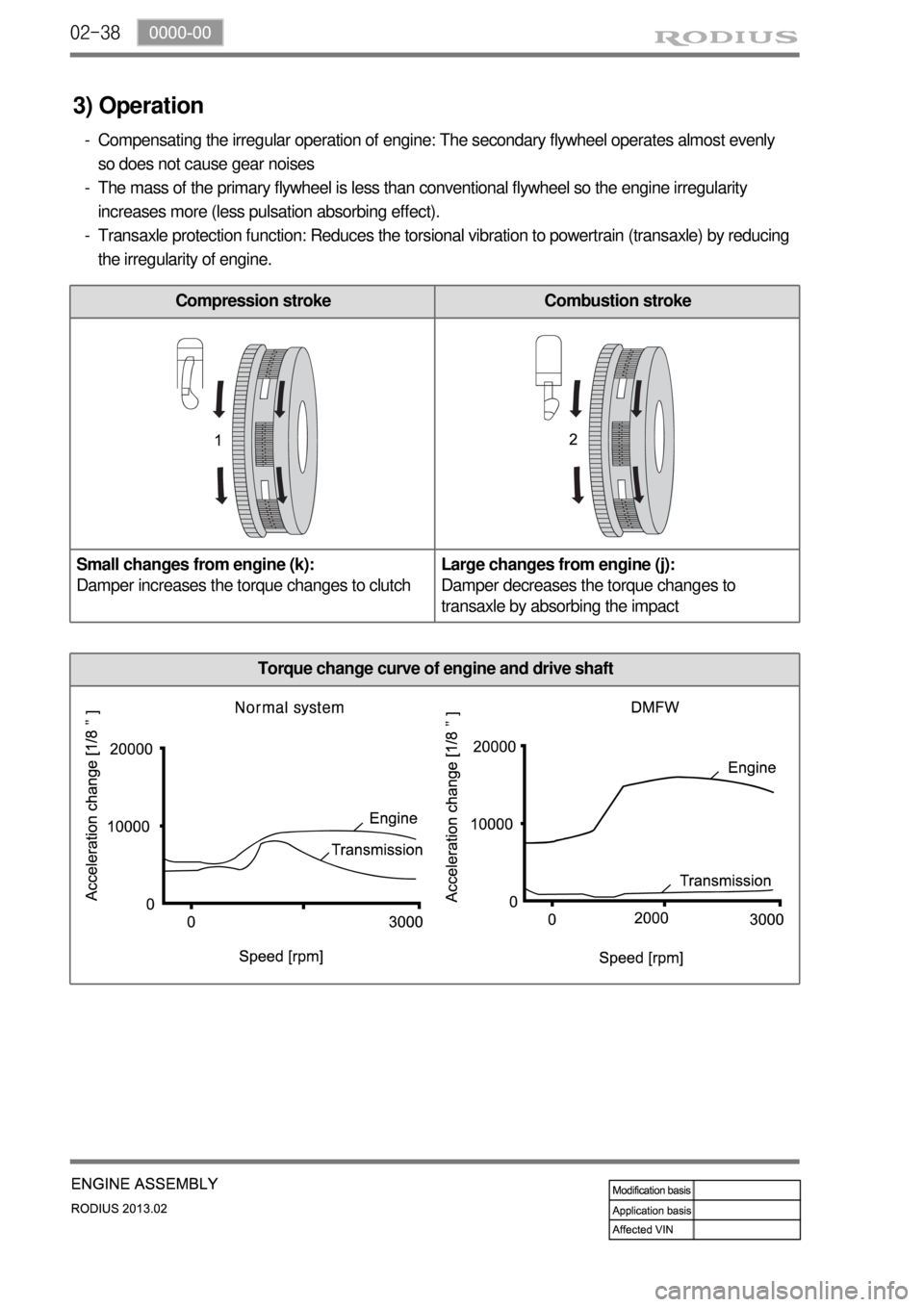
Torque change curve of engine and drive shaft
Compression stroke Combustion stroke
Small changes from engine (k):
Damper increases the torque changes to clutchLarge changes from engine (j):
Damper decreases the torque changes to
transaxle by absorbing the impact
3) Operation
Compensating the irregular operation of engine: The secondary flywheel operates almost evenly
so does not cause gear noises
The mass of the primary flywheel is less than conventional flywheel so the engine irregularity
increases more (less pulsation absorbing effect).
Transaxle protection function: Reduces the torsional vibration to powertrain (transaxle) by reducing
the irregularity of engine. -
-
-
Page 198 of 796
02-390000-00
4) Features
Reduced vibration noise from the powertrain by blocking the torsional vibrations
Enhanced vehicle silence and riding comforts: reduced engine torque fluctuation
Reduced shifting shocks
Smooth acceleration and deceleration -
-
-
-
5) Advantages
Improved torque response by using 3-stage type spring: Strengthens the torque response in all
ranges (low, medium, and high speed) by applying respective spring constant at each range.
Stable revolution of the primary and secondary wheel by using planetary gear: Works as auxiliary
damper against spring changes
Less heat generation due to no direct friction against spring surface: Plastic material is covered on
the spring outer surface
Increased durability by using plastic bushing (extends the lifetime of grease) -
-
-
-
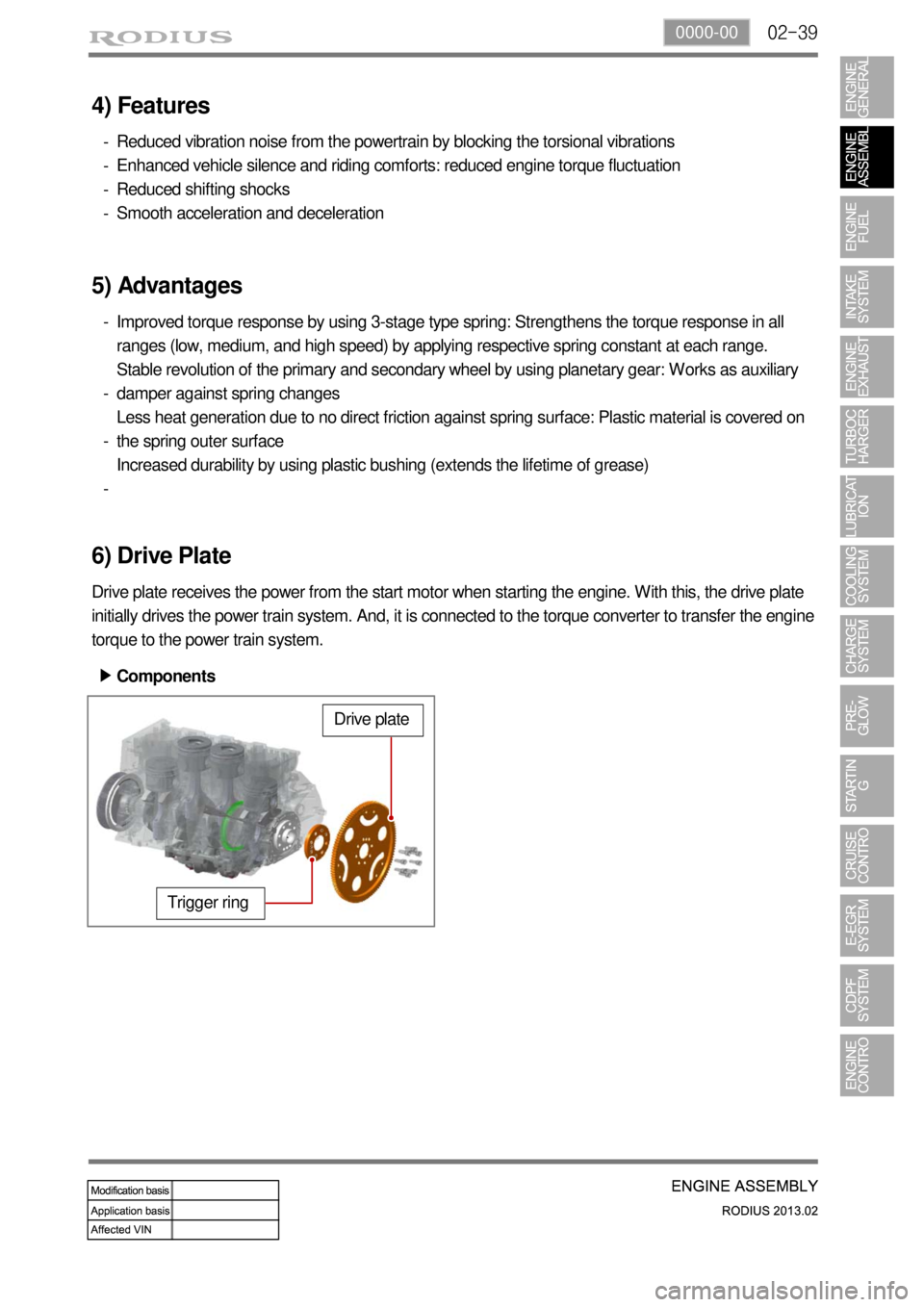
6) Drive Plate
Drive plate receives the power from the start motor when starting the engine. With this, the drive plate
initially drives the power train system. And, it is connected to the torque converter to transfer the engine
torque to the power train system.
Trigger ring
Drive plate
Components ▶
Page 256 of 796
06-111914-01
3. TROUBLESHOOTING
The followings are cautions to take in handling defects of turbocharger, which must be fully aware of.
1) Cautions
After stopping the engine, check whether the bolts on pipe connecting section are loose as well as
the connecting condition of vacuum port and modulator, which is connected to the actuator.
During idling of the engine, check for leakage in the connecting section of pipe (hoses and pipes,
duct connections, after the turbocharger) by applying soap water. The leakage condition in the
engine block and turbine housing opening can be determined by the occurrence of abnormal noise
of exhaust.
By running the engine at idle speed, abnormal vibration and noise can be checked. Immediately
stop the engine when abnormal vibration and noise is detected and make thorough inspection
whether the turbocharger shaft wheel has any damages as well as checking the condition of
connections between pipes.
In case where the noise of engine is louder than usual, there is possibility of dampness in the areas
related with air cleaner and engine or engine block and turbocharger. And it could affect the smooth
supply of engine oil and discharge.
Check for damp condition in exhaust gas when there is sign of thermal discoloration or discharge of
carbon in connecting area of the duct.
When the engine rotates or in case where there is change in noise level, check for clogging of air
cleaner or air cleaner duct or if there is any significant amount of dust in the compressor housing.
During the inspection of center housing, inspect inside of the housing by removing the oil drain pipe
to check for sludge generation and its attachment condition at shaft area or turbine side.
Inspect or replace the air cleaner when the compressor wheel is damaged by inflow of foreign
materials.
Inspect both side of the turbocharger wheel after removing inlet and outlet pipe of the turbocharger. 1.
2.
3.
4.
5.
6.
7.
8.
9.
Page 419 of 796
01-6
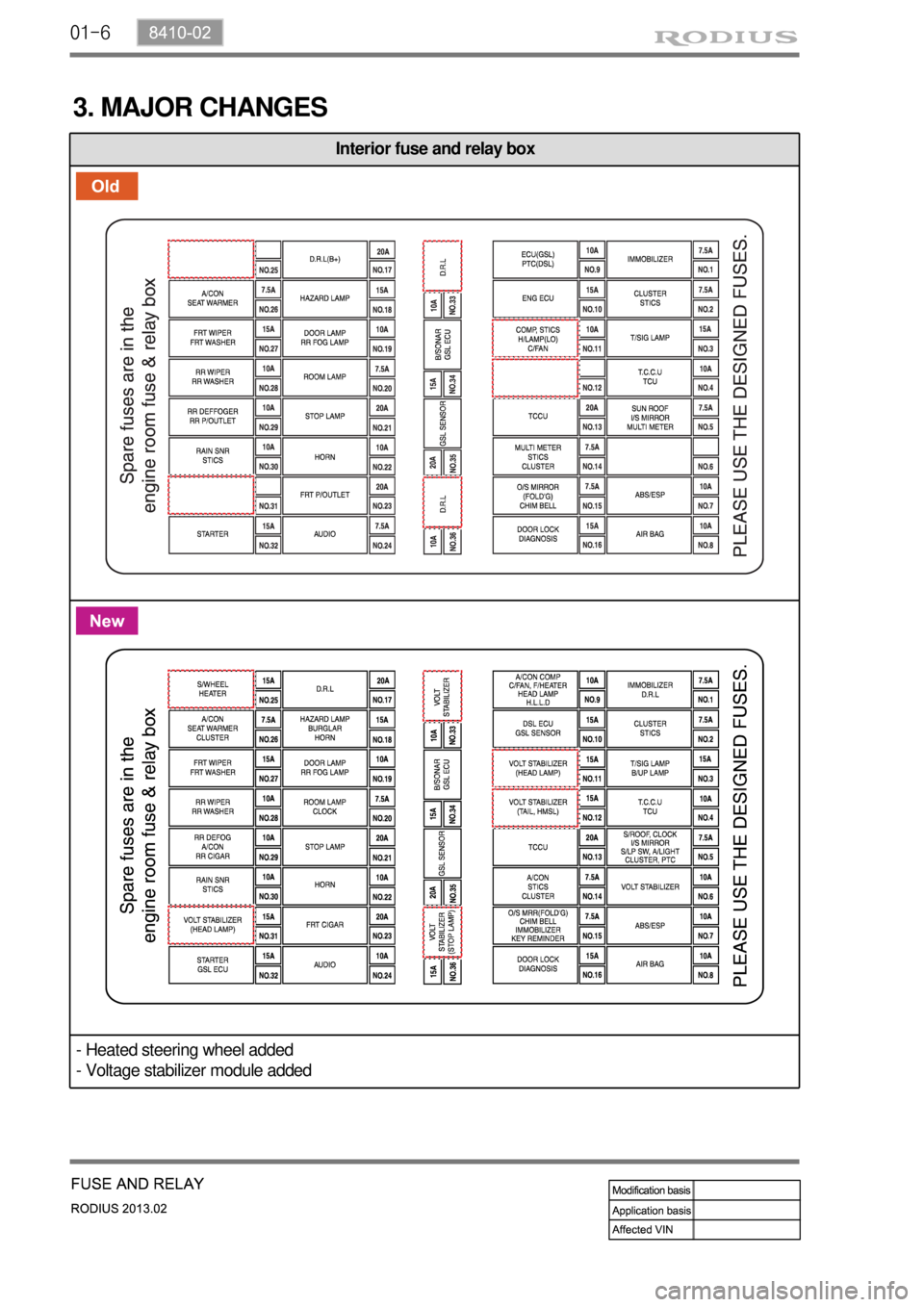
3. MAJOR CHANGES
Interior fuse and relay box
- Heated steering wheel added
- Voltage stabilizer module added
Page 505 of 796

06-58510-00
2. MAJOR CHANGES
Center fascia switch
- Design changed
Steering wheel switch assembly
- Power button deleted, steering wheel heating (option) switch added
- Design changed
Multifunction switch assembly
- Connector pin layout changed due to newly added steering wheel heating (option) circuit
- Contact coil and steering wheel angle sensor changed
Page 542 of 796
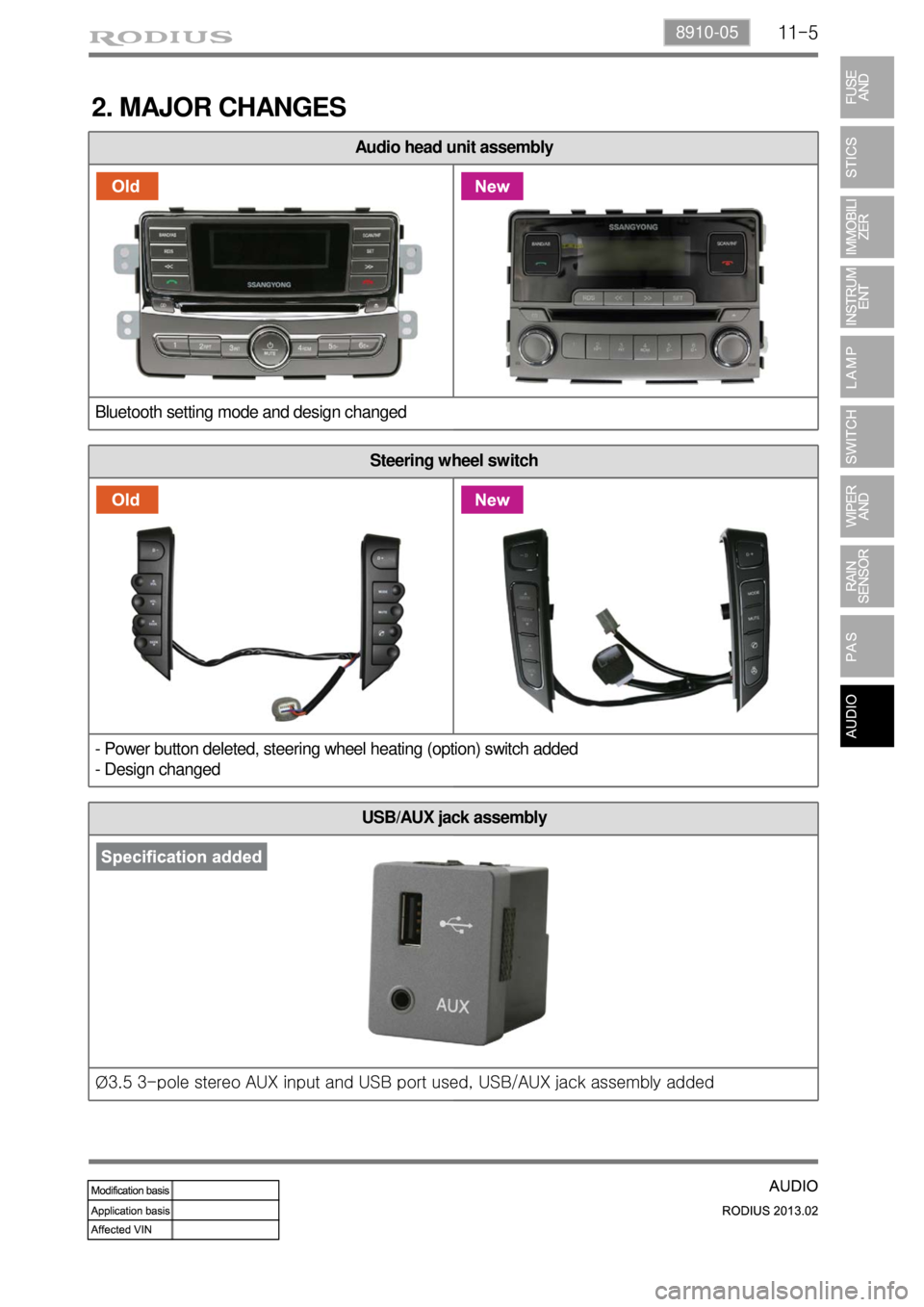
11-58910-05
Audio head unit assembly
Bluetooth setting mode and design changed
Steering wheel switch
- Power button deleted, steering wheel heating (option) switch added
- Design changed
2. MAJOR CHANGES
USB/AUX jack assembly
Ø3.5 3-pole stereo AUX input and USB port used, USB/AUX jack assembly added
Page 593 of 796

03-73010-00
1. OVERVIEW
The hydraulic clutch transmits the force required to operate the clutch pedal to the concentric slave
cylinder fitted to the clutch housing as a hydraulic pressure.
(The hydraulic pressure is transmitted in the following order: Clutch pedal - Clutch master cylinder -
Clutch pipe - Clutch damper - Clutch pipe and hose - Concentric slave cylinder - Pressure plate -
Flywheel.)
If a driver depress the clutch pedal, the hydraulic pressure is generated in the master cylinder. It is
transmitted to the concentric slave cylinder through the pipe, resulting in the cylinder being forced out.
At this time, the clutch disc is forced against the cylinder by pushing the cover. This, in turn, remove the
flywheel from the pressure plate. As a consequence, the power from the engine will be cut off and the
gear change can be carried out.
Page 597 of 796
03-113010-00
3. DUAL MASS FLYWHEEL (DMF)
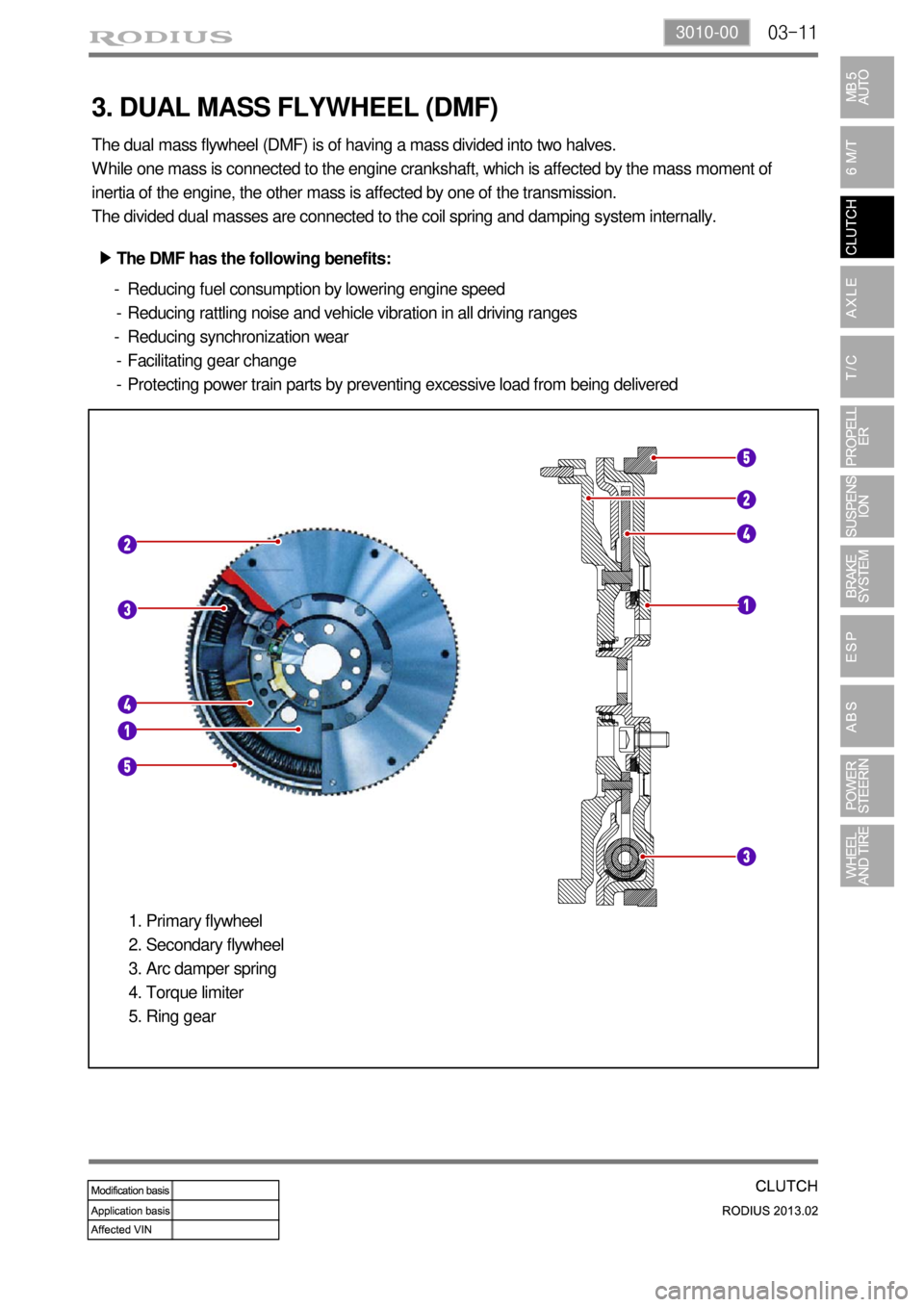
The dual mass flywheel (DMF) is of having a mass divided into two halves.
While one mass is connected to the engine crankshaft, which is affected by the mass moment of
inertia of the engine, the other mass is affected by one of the transmission.
The divided dual masses are connected to the coil spring and damping system internally.
The DMF has the following benefits: ▶
Reducing fuel consumption by lowering engine speed
Reducing rattling noise and vehicle vibration in all driving ranges
Reducing synchronization wear
Facilitating gear change
Protecting power train parts by preventing excessive load from being delivered -
-
-
-
-
Primary flywheel
Secondary flywheel
Arc damper spring
Torque limiter
Ring gear 1.
2.
3.
4.
5.
Page 604 of 796

05-53240-01
Operation ▶
Description Mode Conditions
Driving mode 2H 2 Wheel drive
(rear wheel)Rear-wheel drive mode. This is used under normal
or high-speed driving conditions on public roads or
highways.
4H 4 Wheel drive
(high speed)This is used under sandy, muddy or snow-covered
road conditions
4 L 4 Wheel drive
(low speed)This is used for maximum traction.
When cornering with low speed in 4WD condition,
there could be tire dragging, some
mechanical shocks and resistances in vehicle’s
drive train. These are normal conditions due to
internal resistance in the drive train when the
4WD system is properly working
Mode change2H ↔
4H 2 Wheel drive
↔4 Wheel driveShifting is possible while driving at the speed of
70 km/h or less
2H, 4H
↔ 4L 2 Wheel drive,
4 Wheel drive
(high speed)
↔4 Wheel drive
(low speed)
To make the mode change easily, stop the
vehicle on level ground and turn the mode
switch to the desired position and move the
shift lever to "N"-"R"-"N" while depressing the
brake pedal. For Automatic Transmission:
Stop the vehicle on level ground and move the
gear selector lever into the “N”
position. Turn
the switch to the desired position. -
For Manual Transmission:
Stop the vehicle on level ground and move the
gear selector lever into the “N” position.
Then turn the switch to the desired position
while depressing the clutch pedal. -
Page 620 of 796
07-54411-01
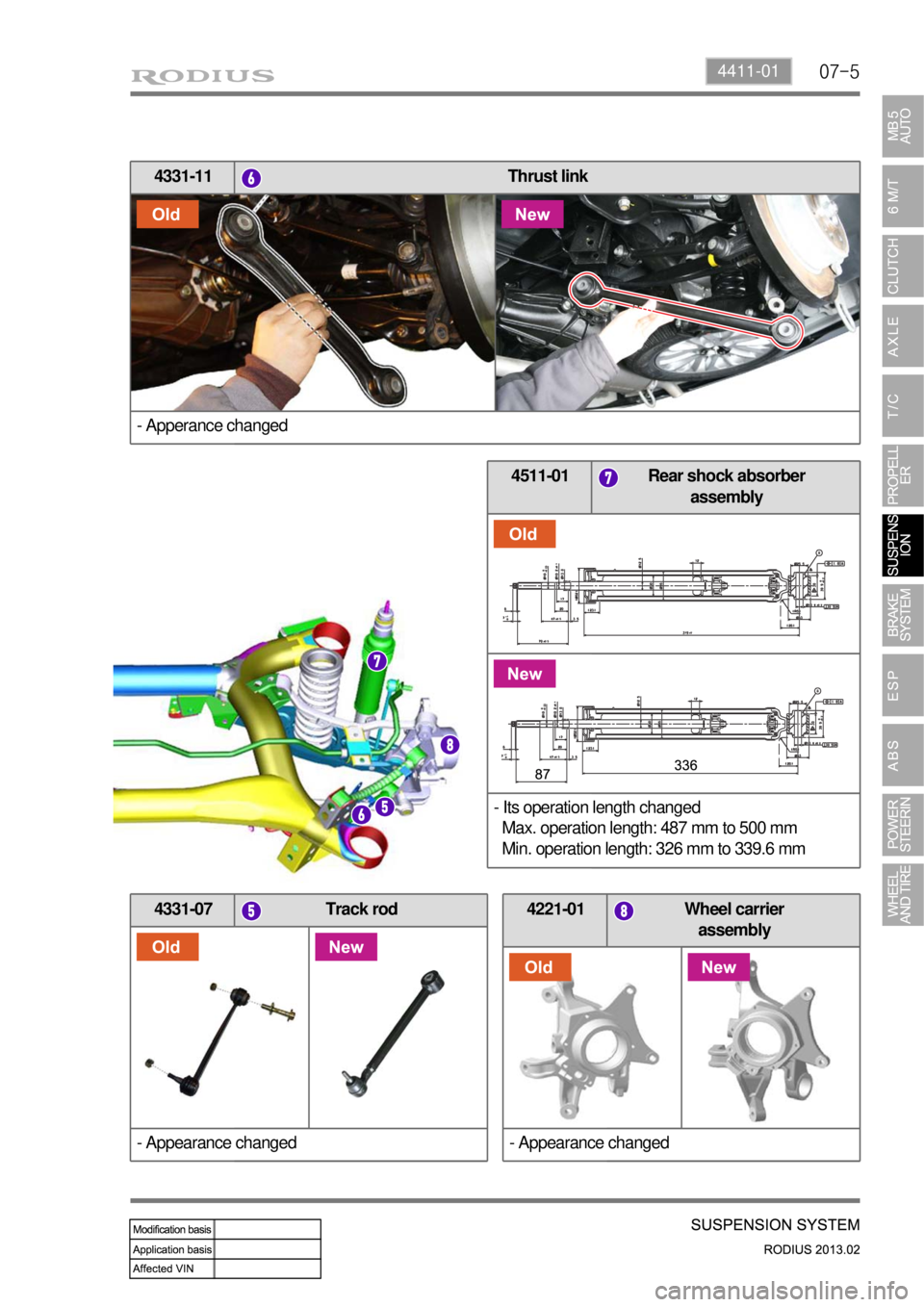
4331-07 Track rod
- Appearance changed4221-01 Wheel carrier
assembly
- Appearance changed
4331-11 Thrust link
- Apperance changed
4511-01 Rear shock absorber
assembly
- Its operation length changed
Max. operation length: 487 mm to 500 mm
Min. operation length: 326 mm to 339.6 mm