warning SUBARU BAJA 2003 1.G Owners Manual
[x] Cancel search | Manufacturer: SUBARU, Model Year: 2003, Model line: BAJA, Model: SUBARU BAJA 2003 1.GPages: 400, PDF Size: 3.97 MB
Page 345 of 400
Maintenance and service11-35
–
CONTINUED –
nParking brake lining
WARNING
A safe location and situation should be selected for break-in driv- ing.
CAUTION
Pulling the parking brake lever too forcefully may cause the rear
wheels to lock. To avoid this, be certain to pull the lever up slowly
and gently.
1. Drive the vehicle at a speed of about 22 mph (35 km/h).
2. With the parking brake release button pushed in, pull the parking
brake lever SLOWLY and GENTLY. (Pulling with a force of approxi-mately 33 lb [147 N, 15 kg].)
3. Drive the vehicle for about 220 yards (200 meters) in this condition.
4. Wait 5 to 10 minutes for the parking brake to cool down. Repeat
this procedure.
5. Check the parking brake stroke. If the parking brake stroke is out
of the specified range, adjust it by turning the adjusting nut located
on the parking brake lever.Parking brake stroke: 7 — 8 notches / 44 lb (196 N, 20 kg)
Parking brake stroke
Check the parking brake stroke according to the maintenance schedule in the “Warranty and Maintenance Booklet ”. When the parking brake is
properly adjusted, braking power is fully applied by pulling the lever up
seven to eight notches gently but firmly (about 44 lb, 196 N, 20 kg). If the
parking brake lever stroke is not within the specified range, have the
brake system checked and adjusted at your SUBARU dealer.
Page 348 of 400
11-38
HB8042BA
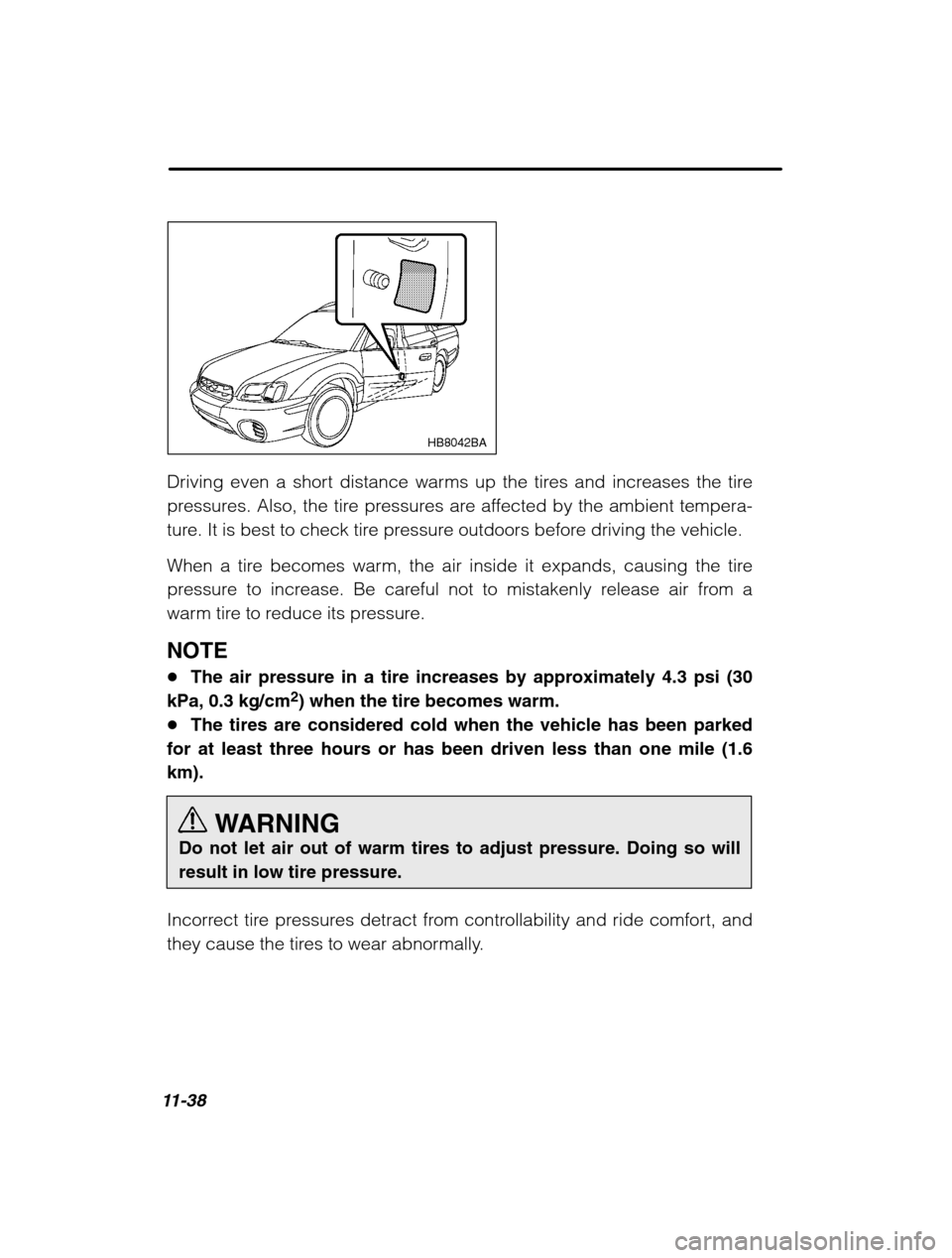
Driving even a short distance warms up the tires and increases the tire
pressures. Also, the tire pressures are affected by the ambient tempera-
ture. It is best to check tire pressure outdoors before driving the vehicle.
When a tire becomes warm, the air inside it expands, causing the tire
pressure to increase. Be careful not to mistakenly release air from a
warm tire to reduce its pressure. NOTE The air pressure in a tire increases by approximately 4.3 psi (30
kPa, 0.3 kg/cm 2
) when the tire becomes warm.
The tires are considered cold when the vehicle has been parked
for at least three hours or has been driven less than one mile (1.6 km).
WARNING
Do not let air out of warm tires to adjust pressure. Doing so willresult in low tire pressure.
Incorrect tire pressures detract from controllability and ride comfort, and
they cause the tires to wear abnormally.
Page 350 of 400
11-40
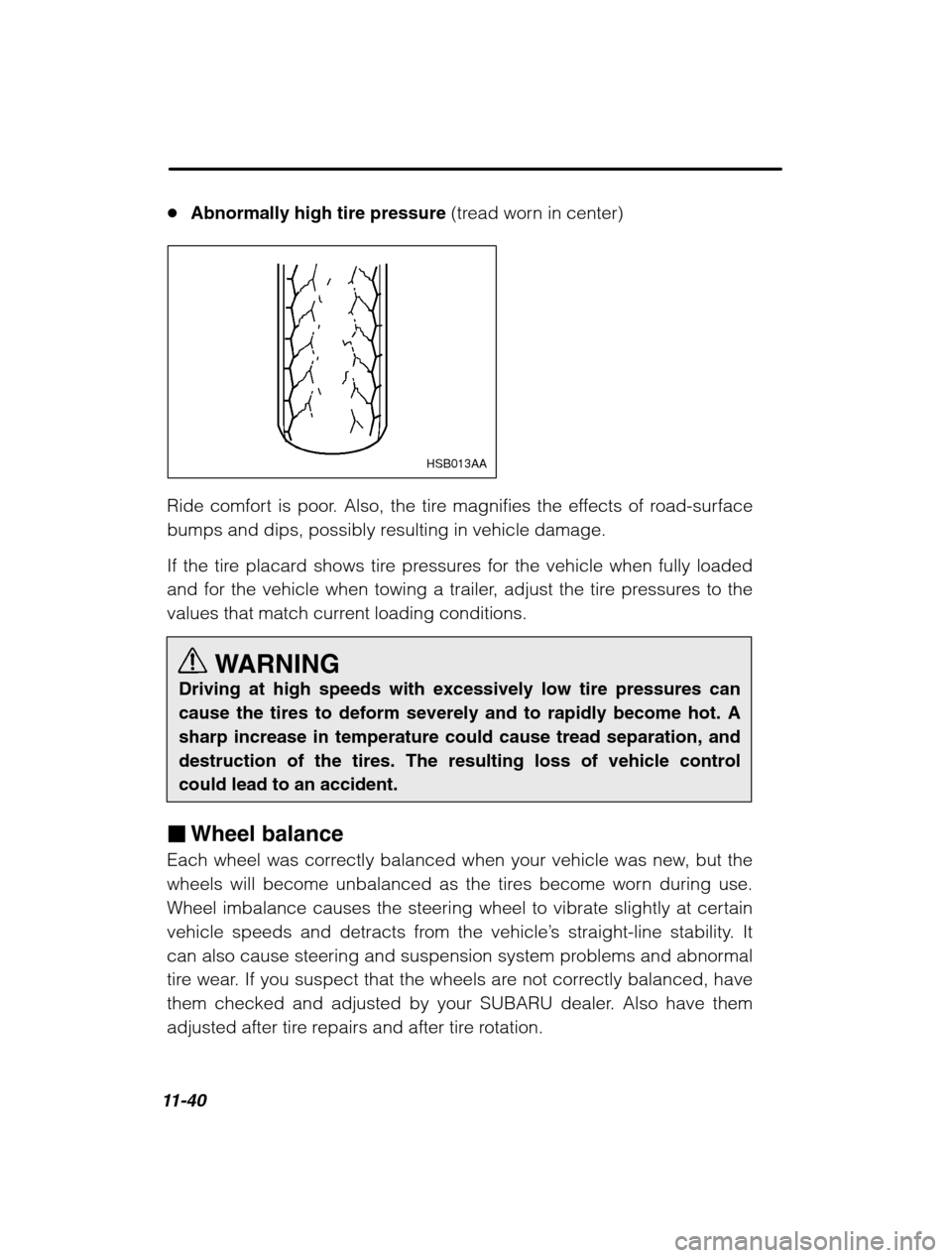
Abnormally high tire pressure (tread worn in center)
HSB013AA
Ride comfort is poor. Also, the tire magnifies the effects of road-surface
bumps and dips, possibly resulting in vehicle damage.
If the tire placard shows tire pressures for the vehicle when fully loaded
and for the vehicle when towing a trailer, adjust the tire pressures to the
values that match current loading conditions.
WARNING
Driving at high speeds with excessively low tire pressures can
cause the tires to deform severely and to rapidly become hot. Asharp increase in temperature could cause tread separation, and
destruction of the tires. The resulting loss of vehicle controlcould lead to an accident.
Wheel balance
Each wheel was correctly balanced when your vehicle was new, but the
wheels will become unbalanced as the tires become worn during use.
Wheel imbalance causes the steering wheel to vibrate slightly at certain
vehicle speeds and detracts from the vehicle ’s straight-line stability. It
can also cause steering and suspension system problems and abnormal
tire wear. If you suspect that the wheels are not correctly balanced, have
them checked and adjusted by your SUBARU dealer. Also have them
adjusted after tire repairs and after tire rotation.
Page 351 of 400
Maintenance and service11-41
–
CONTINUED –
NOTE Loss of correct wheel alignment* causes the tires to wear on one side and reduces the vehicle ’s running stability. Contact your
SUBARU dealer if you notice abnormal tire wear.
* : The suspension system is designed to hold each wheel at a certain alignment
(relative to the other wheels and to the road) for optimum straight-line stability and
cornering performance. Wear indicators
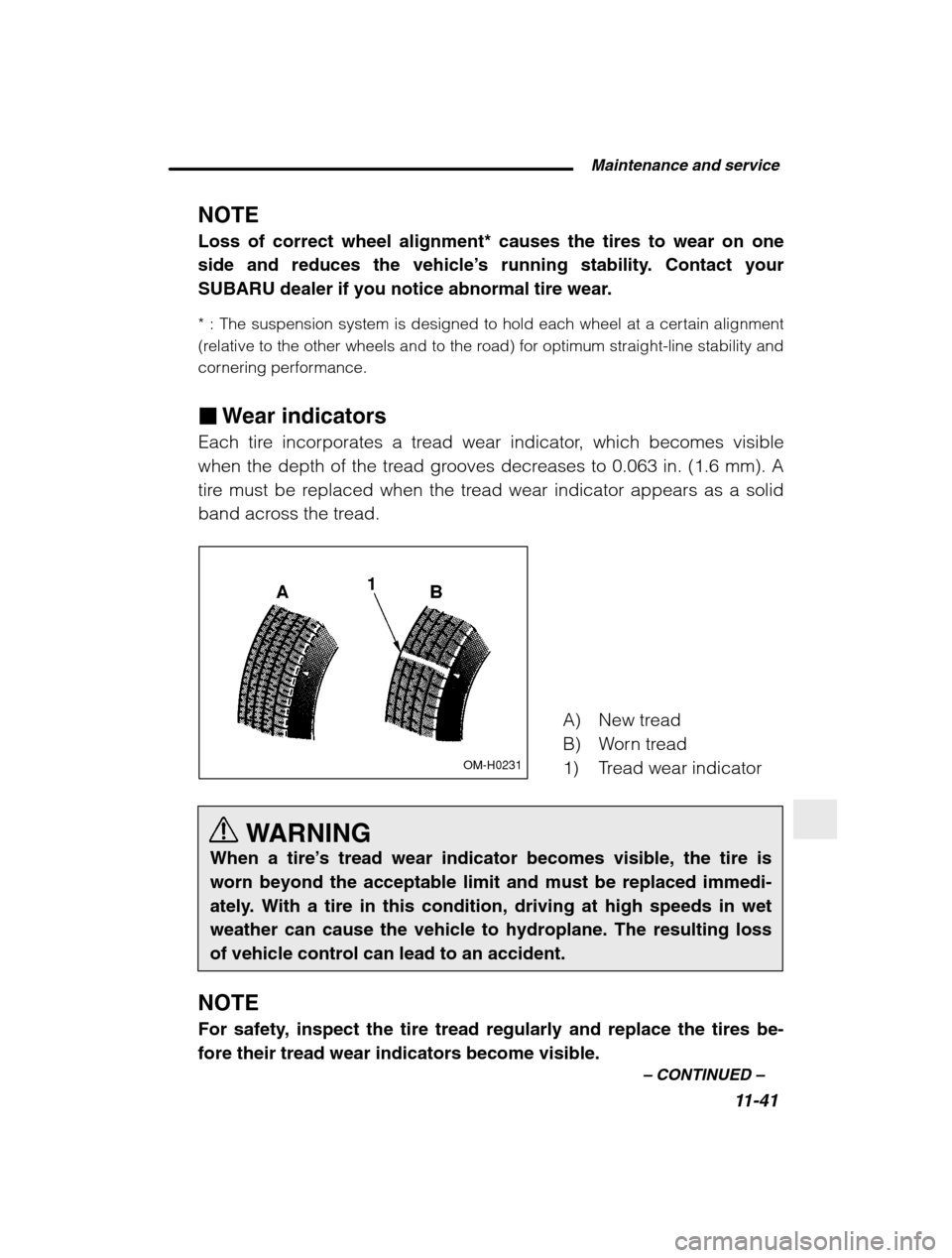
Each tire incorporates a tread wear indicator, which becomes visible
when the depth of the tread grooves decreases to 0.063 in. (1.6 mm). A
tire must be replaced when the tread wear indicator appears as a solid
band across the tread.
OM-H0231
WARNING
When a tire ’s tread wear indicator becomes visible, the tire is
worn beyond the acceptable limit and must be replaced immedi-
ately. With a tire in this condition, driving at high speeds in wetweather can cause the vehicle to hydroplane. The resulting lossof vehicle control can lead to an accident.
NOTE
For safety, inspect the tire tread regularly and replace the tires be- fore their tread wear indicators become visible. A) New tread
B) Worn tread
1) Tread wear indicator
Page 353 of 400
Maintenance and service11-43
–
CONTINUED –
racy. It also creates incorrect body-to-tire clearances and inappropriately changes the vehicle ’s ground clearance.
All four tires must be the same in terms of manufacturer, brand (tread
pattern), construction, and size. You are advised to replace the tires with
new ones that are identical to those fitted as standard equipment.
For safe vehicle operation, SUBARU recommends replacing all four tires at the same time.
WARNING
All four tires must be the same in terms of manufacturer, brand
(tread pattern), construction, degree of wear, speed symbol, loadindex and size. Mixing tires of different types, sizes or degrees ofwear can result in damage to the vehicle ’s power train. Use of dif-
ferent types or sizes of tires can also dangerously reduce con-trollability and braking performance and can lead to an accident. Use only radial tires. Do not use radial tires together with
belted bias tires and/or bias-ply tires. Doing so can dangerously
reduce controllability, resulting in an accident.
Wheel replacement
When replacing wheels due, for example, to damage, make sure the re-
placement wheels match the specifications of the wheels that are fitted
as standard equipment. Replacement wheels are available from
SUBARU dealers.
WARNING
Use only those wheels that are specified for your vehicle. Wheelsnot meeting specifications could interfere with brake caliper op-eration and may cause the tires to rub against the wheel wellhousing during turns. The resulting loss of vehicle control couldlead to an accident.
Page 358 of 400
11-48
BatteryWARNING
Before beginning work on or near any battery, be sure to extin-
guish all cigarettes, matches, and lighters. Never expose a bat- tery to an open flame or electric sparks. Batteries give off a gaswhich is highly flammable and explosive. For safety, in case an explosion does occur, wear eye protec-
tion or shield your eyes when working near any battery. Never
lean over a battery. Do not let battery fluid contact eyes, skin, fabrics, or paint be-
cause battery fluid is a corrosive acid. If battery fluid gets on yourskin or in your eyes, immediately flush the area with water thor-
oughly. Seek medical help immediately if acid has entered theeyes.If battery fluid is accidentally swallowed, immediately drink a
large amount of milk or water, and seek medical attention
immediately. To lessen the risk of sparks, remove rings, metal watchbands,
and other metal jewelry. Never allow metal tools to contact the
positive battery terminal and anything connected to it WHILE youare at the same time in contact with any other metallic portion ofthe vehicle because a short circuit will result. Keep everyone including children away from the battery.
Charge the battery in a well-ventilated area.
Battery posts terminals and related accessories contain lead
and lead compounds, chemicals known to the State of California
to case cancer and reproductive harm. Wash hands after han-dling.
CAUTION
Never use more than 10 amperes when charging the battery be-
cause it will shorten battery life.
Page 382 of 400

12-6
Fuse panel located in the engine compartment
HBC003BB
Fuse panelFuse ratingCircuit
120ARadiator cooling fan (Main)
220ARadiator cooling fan (Sub)
350AABS motor
420ARear window defogger
515AHazard warning flasher
Horn
615AMeter
SRS airbag system warning light
710AAutomatic transmission control unit
ABS UNIT
810AAlternator
915AHeadlight (right side)
1015AHeadlight (left side)
Page 387 of 400
Consumer information and Reporting safety defects13-3
–
CONTINUED –
phalt and concrete. A tire marked C may have poor traction perfor- mance.
WARNING
The traction grade assigned to this tire is based on straight-
ahead braking traction tests, and does not include acceleration,cornering, hydroplaning, or peak traction characteristics.
Temperature A, B, C
The temperature grades are A (the highest), B, and C, representing the
tire’ s resistance to the generation of heat and its ability to dissipate heat
when tested under controlled conditions on a specified indoor laboratory
test wheel. Sustained high temperature can cause the material of the tire
to degenerate and reduce tire life, and excessive temperature can lead
to sudden tire failure. The grade C corresponds to a level of perfor-
mance which all passenger car tires must meet under the Federal Motor
Vehicle Safety Standards No. 109. Grades B and A represent higher lev-
els of performance on the laboratory test wheel than the minimum re-
quired by law.
WARNING
The temperature grade for this tire is established for a tire that isproperly inflated and not overloaded. Excessive speed, under-inflation, or excessive loading, either separately or in combina-tion, can cause heat buildup and possible tire failure.
Page 390 of 400

14-2
A ABS (Anti-lock Brake System)7-24
. . . . . . . . . . . . . . . . . . . . . . . . . . . . . . . . . . . . . . . . . . . . . . . .
ABS warning light 3-13
. . . . . . . . . . . . . . . . . . . . . . . . . . . . . . . . . . . . . . . . . . . . . . . . . . . . . . . . . . . . . . . .
Air cleaner element 11-17
. . . . . . . . . . . . . . . . . . . . . . . . . . . . . . . . . . . . . . . . . . . . . . . . . . . . . . . . . . . . . .
Air conditioner operation 4-10
. . . . . . . . . . . . . . . . . . . . . . . . . . . . . . . . . . . . . . . . . . . . . . . . . . . . . . .
Air filtration system (if equipped) 4-13 . . . . . . . . . . . . . . . . . . . . . . . . . . . . . . . . . . . . . . . . . . . . .
Aluminum wheels (If equipped) 11-44 . . . . . . . . . . . . . . . . . . . . . . . . . . . . . . . . . . . . . . . . . . . . . .
AM/FM radio with CD player 5-4
. . . . . . . . . . . . . . . . . . . . . . . . . . . . . . . . . . . . . . . . . . . . . . . . . .
Antenna system 5-2
. . . . . . . . . . . . . . . . . . . . . . . . . . . . . . . . . . . . . . . . . . . . . . . . . . . . . . . . . . . . . . . . . . .
Ashtray 6-12
. . . . . . . . . . . . . . . . . . . . . . . . . . . . . . . . . . . . . . . . . . . . . . . . . . . . . . . . . . . . . . . . . . . . . . . . . . . . . .
AT OIL TEMPerature warning light (for AT vehicles) 3-13 . . . . . . . . . . . . . . . . . . . . .
Audio set 5-3
. . . . . . . . . . . . . . . . . . . . . . . . . . . . . . . . . . . . . . . . . . . . . . . . . . . . . . . . . . . . . . . . . . . . . . . . . . .
Automatic/Emergency Locking Retractor (A/ELR) 1-16 . . . . . . . . . . . . . . . . . . . . . . .
Automatic transmission 7-14
. . . . . . . . . . . . . . . . . . . . . . . . . . . . . . . . . . . . . . . . . . . . . . . . . . . . . . . . .
Automatic transmission fluid 11-22
. . . . . . . . . . . . . . . . . . . . . . . . . . . . . . . . . . . . . . . . . . . . . . . . . .
B
Battery 11-48
. . . . . . . . . . . . . . . . . . . . . . . . . . . . . . . . . . . . . . . . . . . . . . . . . . . . . . . . . . . . . . . . . . . . . . . . . . . . . .
Bed cover (if equipped) 6-21
. . . . . . . . . . . . . . . . . . . . . . . . . . . . . . . . . . . . . . . . . . . . . . . . . . . . . . . .
Bed extender (if equipped) 6-17
. . . . . . . . . . . . . . . . . . . . . . . . . . . . . . . . . . . . . . . . . . . . . . . . . . . .
Brake booster 11-31
. . . . . . . . . . . . . . . . . . . . . . . . . . . . . . . . . . . . . . . . . . . . . . . . . . . . . . . . . . . . . . . . . . . . .
Brake fluid 11-28
. . . . . . . . . . . . . . . . . . . . . . . . . . . . . . . . . . . . . . . . . . . . . . . . . . . . . . . . . . . . . . . . . . . . . . . . . .
Brake pedal 11-32
. . . . . . . . . . . . . . . . . . . . . . . . . . . . . . . . . . . . . . . . . . . . . . . . . . . . . . . . . . . . . . . . . . . . . . . .
Brake system 7-22
. . . . . . . . . . . . . . . . . . . . . . . . . . . . . . . . . . . . . . . . . . . . . . . . . . . . . . . . . . . . . . . . . . . . . .
Brake system warning light 3-14
. . . . . . . . . . . . . . . . . . . . . . . . . . . . . . . . . . . . . . . . . . . . . . . . . . . .
Braking 7-22
. . . . . . . . . . . . . . . . . . . . . . . . . . . . . . . . . . . . . . . . . . . . . . . . . . . . . . . . . . . . . . . . . . . . . . . . . . . . . .
Braking tips 7-22
. . . . . . . . . . . . . . . . . . . . . . . . . . . . . . . . . . . . . . . . . . . . . . . . . . . . . . . . . . . . . . . . . . . . . . . .
Bulb chart 12-7
. . . . . . . . . . . . . . . . . . . . . . . . . . . . . . . . . . . . . . . . . . . . . . . . . . . . . . . . . . . . . . . . . . . . . . . . . .
CCapacities 12-2
. . . . . . . . . . . . . . . . . . . . . . . . . . . . . . . . . . . . . . . . . . . . . . . . . . . . . . . . . . . . . . . . . . . . . . . . . .
Cargo bed 6-15
. . . . . . . . . . . . . . . . . . . . . . . . . . . . . . . . . . . . . . . . . . . . . . . . . . . . . . . . . . . . . . . . . . . . . . . . . .
Cargo lamp 6-20
. . . . . . . . . . . . . . . . . . . . . . . . . . . . . . . . . . . . . . . . . . . . . . . . . . . . . . . . . . . . . . . . . . . . . . . .
Cargo lamp indicator light 3-16
. . . . . . . . . . . . . . . . . . . . . . . . . . . . . . . . . . . . . . . . . . . . . . . . . . . . .
Cargo net hooks 6-13
. . . . . . . . . . . . . . . . . . . . . . . . . . . . . . . . . . . . . . . . . . . . . . . . . . . . . . . . . . . . . . . . . .
Cargo tie-down hooks 6-16
. . . . . . . . . . . . . . . . . . . . . . . . . . . . . . . . . . . . . . . . . . . . . . . . . . . . . . . . . . .
Page 391 of 400

Index14-3
Catalytic converter 8-4
. . . . . . . . . . . . . . . . . . . . . . . . . . . . . . . . . . . . . . . . . . . . . . . . . . . . . . . . . . . . . . .
Center console 6-5
. . . . . . . . . . . . . . . . . . . . . . . . . . . . . . . . . . . . . . . . . . . . . . . . . . . . . . . . . . . . . . . . . . . .
Changing a flat tire 9-11
. . . . . . . . . . . . . . . . . . . . . . . . . . . . . . . . . . . . . . . . . . . . . . . . . . . . . . . . . . . . . . .
Charge warning light 3-12
. . . . . . . . . . . . . . . . . . . . . . . . . . . . . . . . . . . . . . . . . . . . . . . . . . . . . . . . . . . .
CHECK ENGINE warning light/Malfunction indicator lamp 3-11 . . . . . . . . . . .
Child restraint systems 1-26
. . . . . . . . . . . . . . . . . . . . . . . . . . . . . . . . . . . . . . . . . . . . . . . . . . . . . . . . . .
Child safety locks 2-20
. . . . . . . . . . . . . . . . . . . . . . . . . . . . . . . . . . . . . . . . . . . . . . . . . . . . . . . . . . . . . . . .
Cigarette lighter socket 6-9
. . . . . . . . . . . . . . . . . . . . . . . . . . . . . . . . . . . . . . . . . . . . . . . . . . . . . . . . .
Cleaning aluminum wheels 10-4
. . . . . . . . . . . . . . . . . . . . . . . . . . . . . . . . . . . . . . . . . . . . . . . . . . . .
Cleaning fog light lens 10-4
. . . . . . . . . . . . . . . . . . . . . . . . . . . . . . . . . . . . . . . . . . . . . . . . . . . . . . . . . .
Cleaning the interior 10-6
. . . . . . . . . . . . . . . . . . . . . . . . . . . . . . . . . . . . . . . . . . . . . . . . . . . . . . . . . . . . .
Clock 3-17
. . . . . . . . . . . . . . . . . . . . . . . . . . . . . . . . . . . . . . . . . . . . . . . . . . . . . . . . . . . . . . . . . . . . . . . . . . . . . . . .
Clutch fluid (MT vehicles) 11-30
. . . . . . . . . . . . . . . . . . . . . . . . . . . . . . . . . . . . . . . . . . . . . . . . . . . . . .
Clutch pedal (Manual transmission vehicles) 11-33 . . . . . . . . . . . . . . . . . . . . . . . . . . . . .
Coat hook 6-12
. . . . . . . . . . . . . . . . . . . . . . . . . . . . . . . . . . . . . . . . . . . . . . . . . . . . . . . . . . . . . . . . . . . . . . . . . .
Coin compartment 6-6
. . . . . . . . . . . . . . . . . . . . . . . . . . . . . . . . . . . . . . . . . . . . . . . . . . . . . . . . . . . . . . .
Convenience hook 6-12
. . . . . . . . . . . . . . . . . . . . . . . . . . . . . . . . . . . . . . . . . . . . . . . . . . . . . . . . . . . . . . .
Convenient tie-down hooks (if equipped) 6-16 . . . . . . . . . . . . . . . . . . . . . . . . . . . . . . . . . .
Cooling system 11-13
. . . . . . . . . . . . . . . . . . . . . . . . . . . . . . . . . . . . . . . . . . . . . . . . . . . . . . . . . . . . . . . . . . .
Corrosion protection 10-5
. . . . . . . . . . . . . . . . . . . . . . . . . . . . . . . . . . . . . . . . . . . . . . . . . . . . . . . . . . . . .
Cruise control 7-28
. . . . . . . . . . . . . . . . . . . . . . . . . . . . . . . . . . . . . . . . . . . . . . . . . . . . . . . . . . . . . . . . . . . . .
Cup holder 6-7
. . . . . . . . . . . . . . . . . . . . . . . . . . . . . . . . . . . . . . . . . . . . . . . . . . . . . . . . . . . . . . . . . . . . . . . . .
D Daytime running light system 3-19
. . . . . . . . . . . . . . . . . . . . . . . . . . . . . . . . . . . . . . . . . . . . . . . . .
Dimensions 12-2
. . . . . . . . . . . . . . . . . . . . . . . . . . . . . . . . . . . . . . . . . . . . . . . . . . . . . . . . . . . . . . . . . . . . . . . .
Disc brake pad wear warning indicators 7-23 . . . . . . . . . . . . . . . . . . . . . . . . . . . . . . . . . . .
Dome light 6-2
. . . . . . . . . . . . . . . . . . . . . . . . . . . . . . . . . . . . . . . . . . . . . . . . . . . . . . . . . . . . . . . . . . . . . . . . . .
Door ajar warning lights 3-15
. . . . . . . . . . . . . . . . . . . . . . . . . . . . . . . . . . . . . . . . . . . . . . . . . . . . . . . .
Door locks 2-3
. . . . . . . . . . . . . . . . . . . . . . . . . . . . . . . . . . . . . . . . . . . . . . . . . . . . . . . . . . . . . . . . . . . . . . . . . .
Drive belts 11-20
. . . . . . . . . . . . . . . . . . . . . . . . . . . . . . . . . . . . . . . . . . . . . . . . . . . . . . . . . . . . . . . . . . . . . . . . . .
Driving in foreign countries 8-5
. . . . . . . . . . . . . . . . . . . . . . . . . . . . . . . . . . . . . . . . . . . . . . . . . . . .
Driving tips for AWD vehicles 8-6
. . . . . . . . . . . . . . . . . . . . . . . . . . . . . . . . . . . . . . . . . . . . . . . . .
E
Electrical system 12-2
. . . . . . . . . . . . . . . . . . . . . . . . . . . . . . . . . . . . . . . . . . . . . . . . . . . . . . . . . . . . . . . . .