check engine light SUBARU BAJA 2005 1.G User Guide
[x] Cancel search | Manufacturer: SUBARU, Model Year: 2005, Model line: BAJA, Model: SUBARU BAJA 2005 1.GPages: 469, PDF Size: 5.24 MB
Page 243 of 469

7-8
Starting and operating
jacked off the ground, nor should the driveshaft be dis-
connected for state emission testing.
The EPA has issued regulations for inspecting the On-
Board Diagnostic (OBD) system as part of the state
emissions inspection. The OBD system is designed to
detect engine and transmission problems that might
cause vehicle emissions to exceed allowable limits.
These inspections apply to all 1996 model year and
newer passenger cars and light trucks. y
The inspection of the OBD system consists of a vi-
sual operational check of the “CHECK ENGINE”
warning light/malfunction indicator lamp (MIL) and an
examination of the OBD system with an electronic
scan tool while the engine is running.y A vehicle passes the OBD system inspection if
proper the “CHECK ENGINE” warning light/MIL illu-
mination is observed, there is no stored diagnostic
trouble codes, and the OBD system readiness moni-
tors are complete. y A vehicle fails the OBD inspection if the “CHECK
ENGINE” warning light/MIL is not properly operating
or there is one or more diagnostic trouble codes stored
in vehicle’s computer with the “CHECK ENGINE”
warning light/MIL illuminated. y A state emission inspection may reject (not pass or
fail) a vehicle if the number of OBD system readiness monitors
“Not Ready” is greater than three. Under
this condition, the vehicle operator should be instruct- ed to drive his/her vehicle for a few days to set the
monitors and return for an emission re-inspection. y Owners of rejected or failing vehicles should contact
their SUBARU Dealer for service.
Page 244 of 469
7-9
Starting and operating
– CONTINUED –
Preparing to drive
You should perform the following checks and adjust-
ments every day before you start driving.
1. Check that all windows, mirrors, and lights are
clean and unobstructed.
2. Check the appearance and condition of the tires.
Also check tires for proper inflation.
3. Look under the vehicle for any sign of leaks.
4. Check that the hood is fully closed.
5. Check the adjustment of the seat.
6. Check the adjustment of the inside and outside mir-
rors.
7. Fasten your seatbelt. Check that your passengers
have fastened their seatbelts.
8. Check the operation of the warning and indicator
lights when the ignition switch is turned to the “ON” po-sition.
9. Check the gauges, indicator and warning lights af-
ter starting the engine.
NOTE
Engine oil, engine coolant, brake fluid, washer flu-
id and other fluid levels should be checked daily,
weekly or at fuel stops.
Starting the engine
Do not operate the starter motor continuously
for more than ten seconds. If the engine fails to
start after operating the starter for five to ten
seconds, wait for ten seconds or more before
trying again.
„ Manual transmission vehicle
1. Apply the parking brake.
2. Turn off unnecessary lights and accessories.
3. Press the clutch pedal to the floor and shift the shift
lever into neutral.
Hold the clutch pedal to the floor while starting the en-
gine. The starter motor will only operate when the
clutch pedal is pressed fully to the floor.
4. Turn the ignition switch to the “ON” position and
check the operation of the warning and indicator lights.
Refer to the “Warning and indicator lights” section(chapter 3).
5. Turn the ignition switch to the “START” position
without depressing the accelerator pedal. Release
the key immediately after the engine has started.
Page 245 of 469
7-10
Starting and operating
If the engine does not start, try the following:
1) Turn the ignition switch to the “OFF” position and
wait for at least 10 seconds. After checking that the
parking brake is firmly set, turn the ignition switch to
the “START” position while depressing the acceler-
ator pedal slightly (about a quarter of the full stroke).
Release the accelerator pedal as soon as the en-
gine starts.
2) If this fails to start the engine, turn the ignition
switch back to the “OFF” position and wait for at
least 10 seconds. Then fully depress the accelerator
pedal and turn the ignition switch to the “START”
position. If the engine starts, quickly release the ac-
celerator pedal.
3) If this fails to start the engine, turn the ignition
switch again to the “OFF” position. After waiting for
10 seconds or longer, turn the ignition switch to the
“START” position without depressing the accelera-
tor pedal.
4) If the engine still refuses to start, contact your
nearest SUBARU dealer for assistance.
6. Confirm that all warning and indicator lights have
gone off after the engine has started. The fuel injection
system automatically lowers the idle speed as the en-
gine warms up.
NOTE (Turbo models)
The engine may be difficult to start when the bat- tery has been disconnected and reconnected (for
maintenance or other purposes). This difficulty is
caused by the electronically controlled throttle’s
self-diagnosis function. To overcome it, keep the
ignition switch in the “ON” position for approxi-
mately 10 seconds before starting the engine. „
Automatic transmission vehicle
If you restart the engine while the vehicle is
moving, shift the selector lever into the “N” po-
sition. Do not attempt to place the selector lever
of a moving vehicle into the “P” position.
1. Apply the parking brake.
2. Turn off unnecessary lights and accessories.
3. Shift the selector lever to the “P” or “N” position
(preferably “P” position). The starter will only operate
when the select lever is at the “P” or “N” position.
4. Turn the ignition switch to the “ON” position and
check the operation of the warning and indicator lights.
Refer to the “Warning and indicator lights” section
(chapter 3).
5. Turn the ignition switch to the “START” position
Page 246 of 469
7-11
Starting and operating
– CONTINUED –
without depressing the accelerator pedal. Release
the key immediately after the engine has started.
If the engine does not start, try the following: 1) Turn the ignition switch to the “OFF” position and
wait for at least 10 seconds. After checking that the
parking brake is firmly set, turn the ignition switch to
the “START” position while depressing the acceler-
ator pedal slightly (about a quarter of the full stroke).
Release the accelerator pedal as soon as the en-
gine starts.
2) If this fails to start the engine, turn the ignition
switch back to the “OFF” position and wait for at
least 10 seconds. Then fully depress the accelerator
pedal and turn the ignition switch to the “START”
position. If the engine starts, quickly release the ac-
celerator pedal.
3) If this fails to start the engine, turn the ignition
switch again to the “OFF” position. After waiting for
10 seconds or longer, turn the ignition switch to the
“START” position without depressing the accelera-
tor pedal.
4) If the engine still refuses to start, contact your
nearest SUBARU dealer for assistance.
6. Confirm that all warning and indicator lights have
gone out after the engine has started. The fuel injec-
tion system automatically lowers the idle speed as the
engine warms up. While the engine is warming up, make sure that the
selector lever is at the “P” or “N” position and that the
parking brake is applied.
NOTE (Turbo models)
The engine may be difficult to start when the bat-
tery has been disconnected and reconnected (for
maintenance or other purposes). This difficulty is
caused by the electronically controlled throttle’s
self-diagnosis function. To overcome it, keep the
ignition switch in the “ON” position for approxi-
mately 10 seconds before starting the engine.
Page 269 of 469
7-34
Starting and operating
The ABS system prevents the lock-up of wheels which
may occur during sudden braking or braking on slip-
pery road surfaces. This helps prevent the loss of
steering control and directional stability caused by
wheel lock-up.
When the ABS system is operating, you may hear a
chattering noise or feel a slight vibration in the brake
pedal. This is normal when the ABS operates.
The ABS system will not operate when the vehicle
speed is below approximately 6 mph (10 km/h). „
ABS system self-check
You may feel a slight shock in the brake pedal and
hear the operating sound of ABS from the engine com-
partment just after the vehicle is started. This is
caused by an automatic functional test of the ABS sys-
tem being carried out and does not indicate any abnor-
mal condition. „
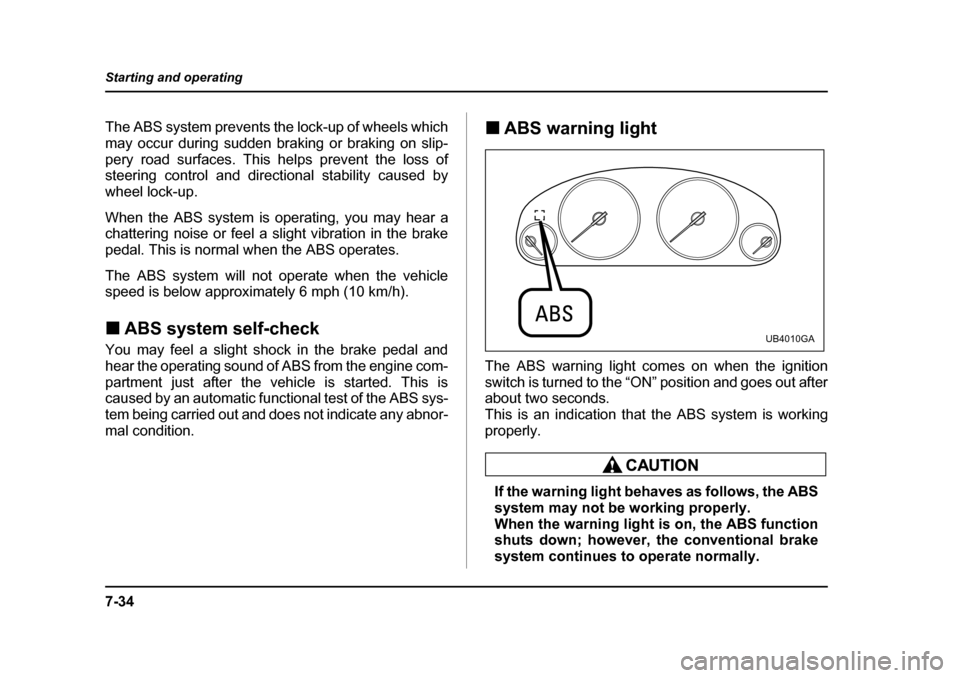
ABS warning light
The ABS warning light comes on when the ignition
switch is turned to the “ON” position and goes out after
about two seconds.
This is an indication that the ABS system is working
properly.
If the warning light behaves as follows, the ABS
system may not be working properly.
When the warning light is on, the ABS function
shuts down; however, the conventional brake
system continues to operate normally.
UB4010GA
Page 287 of 469

8-10
Driving tips
less of its depth, it can wash away the ground from un-
der your tires, resulting in possible loss of traction and
even vehicle rollover. y
Always check your brakes for effectiveness immedi-
ately after driving in sand, mud or water. Do this by
driving slowly and stepping on the brake pedal. Re-
peat that process several times to dry out the brake
discs and brake pads.y Do not drive or park over or near flammable materi-
als such as dry grass or fallen leaves, as they may
burn easily. The exhaust system is very hot while the
engine is running and right after engine stops. This
could create a fire hazard. y After driving through tall grass, mud, rocks, sand,
rivers, etc., check that there is no grass, bush, paper,
rags, stones, sand, etc. adhering to or trapped on the
underbody. Clear off any such matter from the under-
body. If the vehicle is used with these materials
trapped or adhering to the underbody, a mechanical
breakdown or fire could occur.y Secure all cargo carried inside the vehicle and make
certain that it is not piled higher than the seatbacks.
During sudden stops or jolts, unsecured cargo could
be thrown around in the vehicle and cause injury. y Do not pile heavy loads on the roof. Those loads
raise the vehicle’s center of gravity and make it more
prone to tip over. y
Cargo should be evenly distributed over the cargo
bed. Keep heavier items as low and far forward as
possible. Loading the vehicle improperly can deterio-
rate handling capability and contribute to loss of vehi-
cle control.y Be sure the cargo is secured properly. Unsecured
cargo in the cargo bed can be thrown around when
driving on off-road. To prevent loose cargo from enter-
ing the passenger compartment, always close the
switchback door while driving off-road. y Always close the tailgate while driving off-road. Also
remove the bed extender (if so equipped) to avoid
damage. y If you must rock the vehicle to free it from sand or
mud, depress the accelerator pedal slightly and move
the selector lever back and forth between “D” and “R”
repeatedly. Do not race the engine. For the best pos-
sible traction, avoid spinning the wheels when trying to
free the vehicle. y When the road surface is extremely slippery, you
can obtain better traction by starting the vehicle with
the transmission in 2nd than 1st (both for MT and AT). y Never equip your vehicle with tires larger than those
specified in this manual. y Wash the vehicle’s underbody after off-road driving.
Suspension components are particularly prone to dirt
buildup, so they need to be washed thoroughly.
Page 347 of 469
10-4
Appearance care
sion components. „
Cleaning aluminum wheels
y Promptly wipe the aluminum wheels clean of any
kind of grime or agent. If dirt is left on too long, it may
be difficult to clean off. y Do not use soap containing grit to clean the wheels.
Be sure to use a neutral cleaning agent, and later rinse
thoroughly with water. Do not clean the wheels with a
stiff brush or expose them to a high-speed washing
device.y Clean the vehicle (including the aluminum wheels)
with water as soon as possible when it has been
splashed with sea water, exposed to sea breezes, or
driven on roads treated with salt or other agents. „ Cleaning fog light lens
1. Stop the vehicle in a safe place.
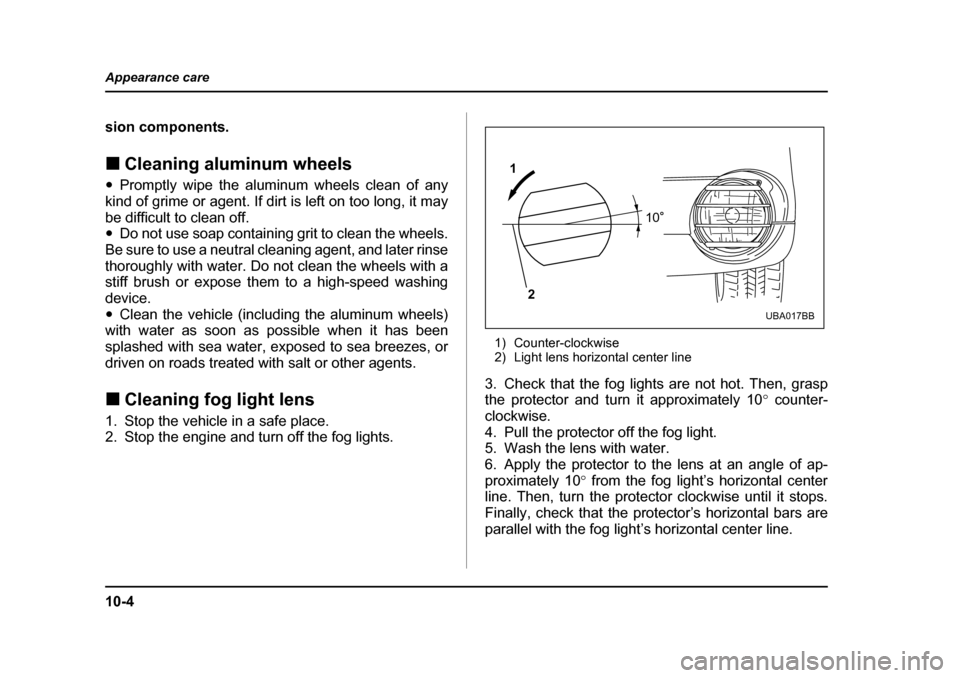
2. Stop the engine and turn off the fog lights. 1) Counter-clockwise
2) Light lens horizontal center line
3. Check that the fog lights are not hot. Then, grasp
the protector and turn it approximately 10 ° counter-
clockwise.
4. Pull the protector off the fog light.
5. Wash the lens with water.
6. Apply the protector to the lens at an angle of ap-
proximately 10 ° from the fog light’s horizontal center
line. Then, turn the protector clockwise until it stops.
Finally, check that the protector’s horizontal bars are
parallel with the fog light’s horizontal center line.
1
2 10
UBA017BB
Page 366 of 469
11 -1 5
Maintenance and service
– CONTINUED –
The oil quantity indicated above is only a guideline.
The necessary quantity of oil depends on the quantity
of oil that has been drained. The quantity of drained oil
differs slightly depending on the temperature of the oil
and the time the oil is left flowing out. After refilling the
engine with oil, therefore, you must use the dipstick to
confirm that the level is correct.
14.Start the engine and make sure that no oil leaks ap-
pear around the filter’s rubber seal and drain plug.
15.Run the engine until it reaches the normal operat-
ing temperature. Then stop the engine and wait a few
minutes to allow the oil drain back. Check the oil level
again and if necessary, add more engine oil. „Recommended grade and viscosity
Use only engine oil with the recommended
grade and viscosity.
Oil grade:
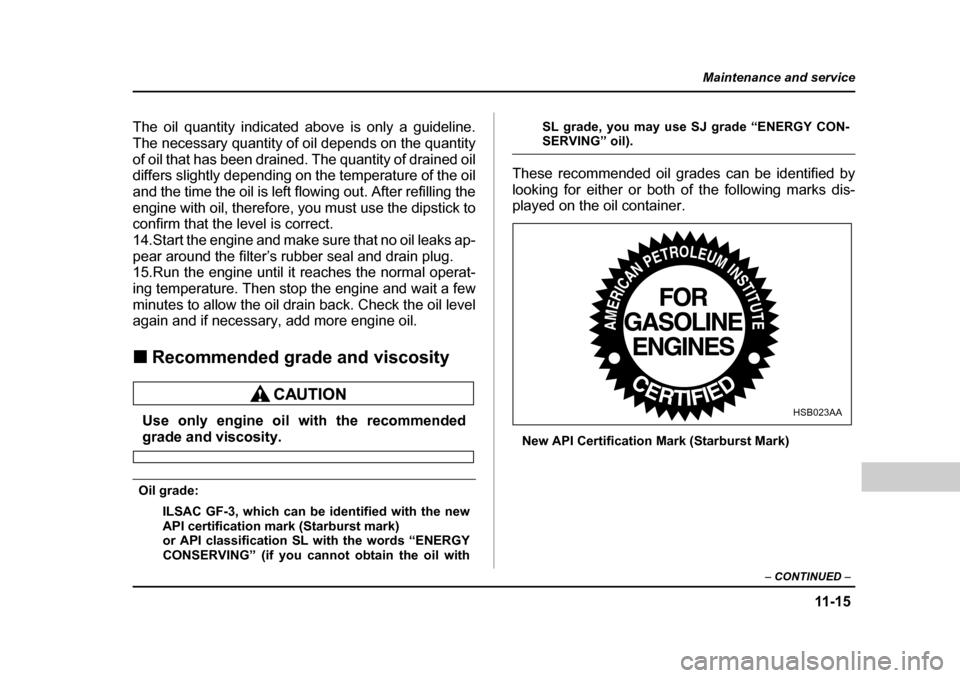
ILSAC GF-3, which can be identified with the new
API certification mark (Starburst mark)
or API classification SL with the words “ENERGY
CONSERVING” (if you cannot obtain the oil with SL grade, you may use SJ grade “ENERGY CON-
SERVING” oil).
These recommended oil grades can be identified by
looking for either or both of the following marks dis-
played on the oil container.
New API Certification Mark (Starburst Mark)
AMERICANPETROLEUMINSTITUTE
CERTIFIED
HSB023AA
Page 392 of 469
11 -4 1
Maintenance and service
– CONTINUED –
Brake booster
If the brake booster does not operate as described be-
low, have it checked by your SUBARU dealer.
1. With the engine off, depress the brake pedal sever-
al times, applying the same pedal force each time. The
distance the pedal travels should not vary.
2. With the brake pedal depressed, start the engine.
The pedal should move slightly down to the floor.
3. With the brake pedal depressed, stop the engine
and keep the pedal depressed for 30 seconds. The
pedal height should not change.
4. Start the engine again and run for about one minute
then turn it off. Depress the brake pedal several times
to check the brake booster. Brake booster operates
properly if the pedal stroke decreases with each de-pression.Brake pedal
Check the brake pedal free play and reserve distance
according to the maintenance schedule in the “War-
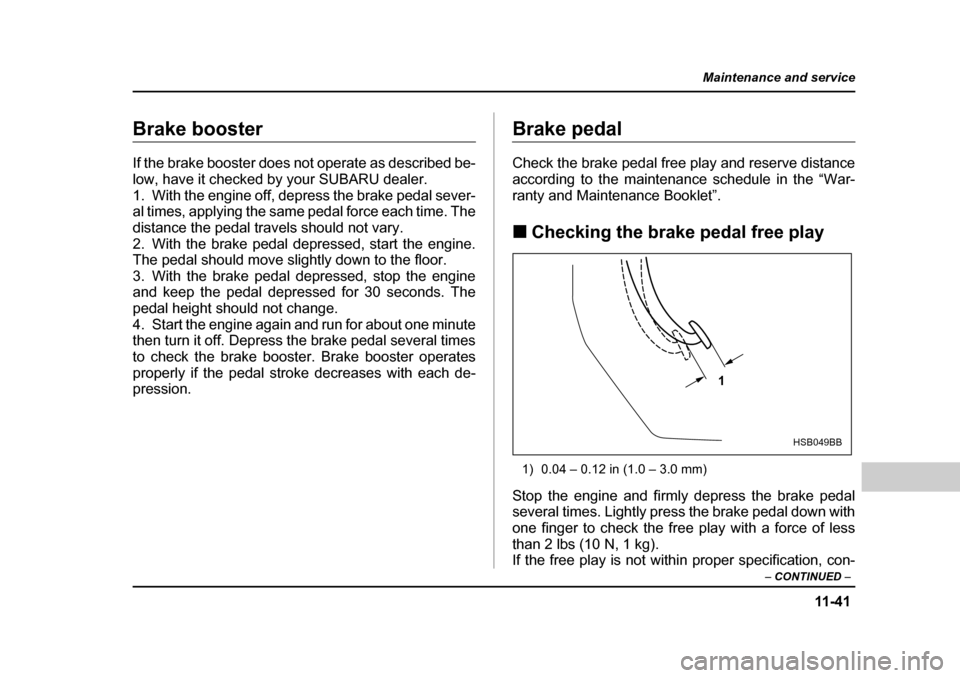
ranty and Maintenance Booklet”. „Checking the brake pedal free play
1) 0.04 – 0.12 in (1.0 – 3.0 mm)
Stop the engine and firmly depress the brake pedal
several times. Lightly press the brake pedal down with
one finger to check the free play with a force of less
than 2 lbs (10 N, 1 kg).
If the free play is not within proper specification, con-
1
HSB049BB
Page 460 of 469

14-3
Index
Cargo
Bed ............................................................... 6-16
Lamp ............................................................. 6-20
Lamp indicator light ...................................... 3-16
Net hooks ..................................................... 6-13
Tie-down hooks ............................................ 6-17
Catalytic converter ............................................... 8-4
Center
Console .......................................................... 6-5
Ventilators ....................................................... 4-2
Changing Flat tire .......................................................... 9-12
Oil and oil filter ............................................ 11-12
Charge warning light ......................................... 3-11 CHECK ENGINE warning light/ Malfunction indicator lamp ............................. 3-10
Checking
Brake pedal free play .................................. 11-41
Brake pedal reserve distance ..................... 11-42
Clutch function ............................................ 11-42
Clutch pedal free play ................................. 11-43
Engine oil level ........................................... 11-10
Fluid level ................. 11-29, 11-36, 11-38, 11-39
Gear oil level .................................... 11-27, 11-33
Child restraint systems ...................................... 1-28
Installation with seatbelt ............................... 1-32
Lower and tether anchorages ....................... 1-40 Child safety ............................................................. 5
Locks ............................................................ 2-21
Chime Key ................................................................. 3-4
Seatbelt ................................................. 1-17, 3-9
Cigarette lighter socket ........................................ 6-9
Cleaning Aluminum wheels ......................................... 10-4
Fog light lens ................................................ 10-4
Interior .......................................................... 10-6
Ventilator grille .............................................. 4-11
Clock ................................................................. 3-17
Clutch fluid ....................................................... 11-39
Clutch pedal .................................................... 11-42
Coat hook .......................................................... 6-13
Coin compartment ............................................... 6-6
Convenience hook ............................................. 6-13
Cooling system ................................................ 11-17
Corrosion protection .......................................... 10-5 Cover Soft bed ........................................................ 6-21
Cruise control .................................................... 7-38
Set indicator light .......................................... 3-16
Cup holder ........................................................... 6-7 D
Daytime running light system ............................ 3-20