light SUBARU BAJA 2006 1.G User Guide
[x] Cancel search | Manufacturer: SUBARU, Model Year: 2006, Model line: BAJA, Model: SUBARU BAJA 2006 1.GPages: 487, PDF Size: 5.55 MB
Page 33 of 487
1-8
Seat, seatbelt and SRS airbags
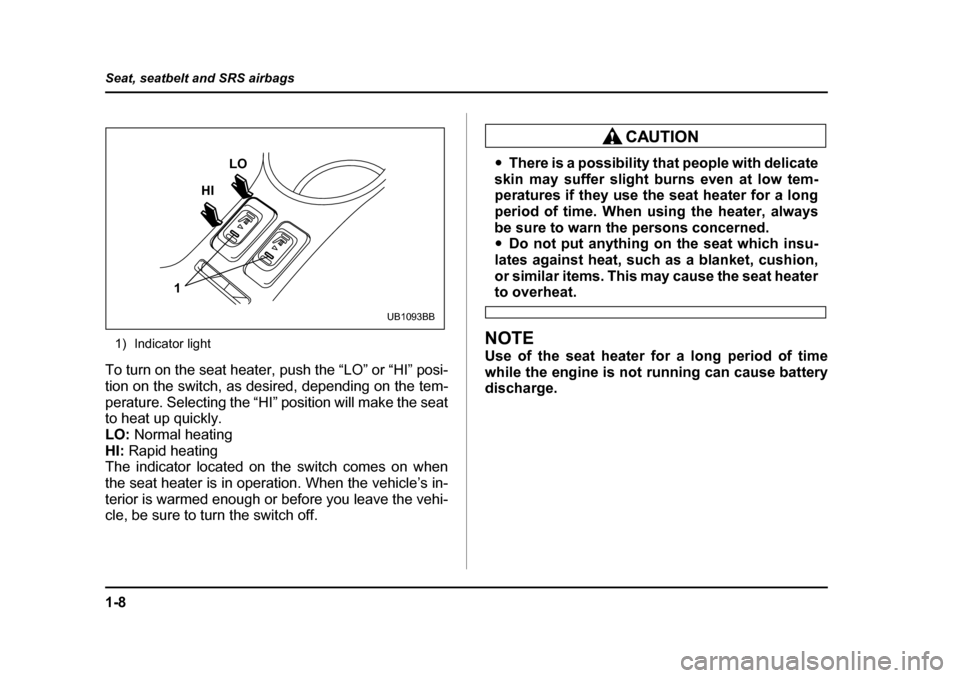
1) Indicator light
To turn on the seat heater, push the “LO” or “HI” posi-
tion on the switch, as desired, depending on the tem-
perature. Selecting the “HI” position will make the seat
to heat up quickly.
LO: Normal heating
HI: Rapid heating
The indicator located on the switch comes on when
the seat heater is in operation. When the vehicle’s in-
terior is warmed enough or before you leave the vehi-
cle, be sure to turn the switch off.
y There is a possibility that people with delicate
skin may suffer slight burns even at low tem-
peratures if they use the seat heater for a long
period of time. When using the heater, always
be sure to warn the persons concerned. y Do not put anything on the seat which insu-
lates against heat, such as a blanket, cushion,
or similar items. This may cause the seat heater
to overheat.
NOTE
Use of the seat heater for a long period of time
while the engine is not running can cause battery
discharge.
1 LO
HI
UB1093BB
Page 40 of 487
1-15
Seat, seatbelt and SRS airbags
– CONTINUED –
cially if they are 12 years of age and under and
are not restrained or improperly restrained. Be-
cause children are lighter and weaker than
adults, their risk of being injured from deploy-
ment is greater. Consequently, we strongly rec-
ommend that ALL children (including those in
child seats and those that have outgrown child
restraint devices) sit in the REAR seat properly
restrained at all times in a child restraint device
or in a seatbelt, whichever is appropriate for the
child’s height and weight.
Secure ALL types of child restraint devices (in-
cluding forward facing child seats) in the REAR
seats at all times.
NEVER INSTALL A RE ARWARD FACING CHILD
SEAT IN THE FRONT SEAT. DOING SO RISKS
SERIOUS INJURY OR DEATH TO THE CHILD
BY PLACING THE CHILD ’S HEAD TOO CLOSE
TO THE SRS AIRBAG.
According to accident statistics, children are
safer when properly restrained in the rear seat-
ing positions than in the front seating posi-
tions. For instructions and precautions con-
cerning the child restraint system, see the
“Child restraint systems” section in this chap-
ter. T
Infants or small children
Use a child restraint system that is suitable for your ve-
hicle. See information on “Child restraint systems”
section in this chapter. T Children
If a child is too big for a ch ild restraint system, the child
should sit in the rear seat and be restrained using the
seatbelts. According to acci dent statistics, children are
safer when properly restrained in the rear seating po-
sitions than in the front seating positions. Never allow
a child to stand up or kneel on the seat.
If the shoulder portion of the belt crosses the face or
neck, adjust the shoulder belt anchor height (window-
side seating positions only) and then if necessary
move the child closer to the belt buckle to help provide
a good shoulder belt fit. Care must be taken to secure-
ly place the lap belt as low as possible on the hips and
not on the child’s waist. If the shoulder portion of the
belt cannot be properly positioned, a child restraint
system should be used. Never place the shoulder belt
under the child’s arm or behind the child’s back.
Page 41 of 487
1-16
Seat, seatbelt and SRS airbags
T
Expectant mothers
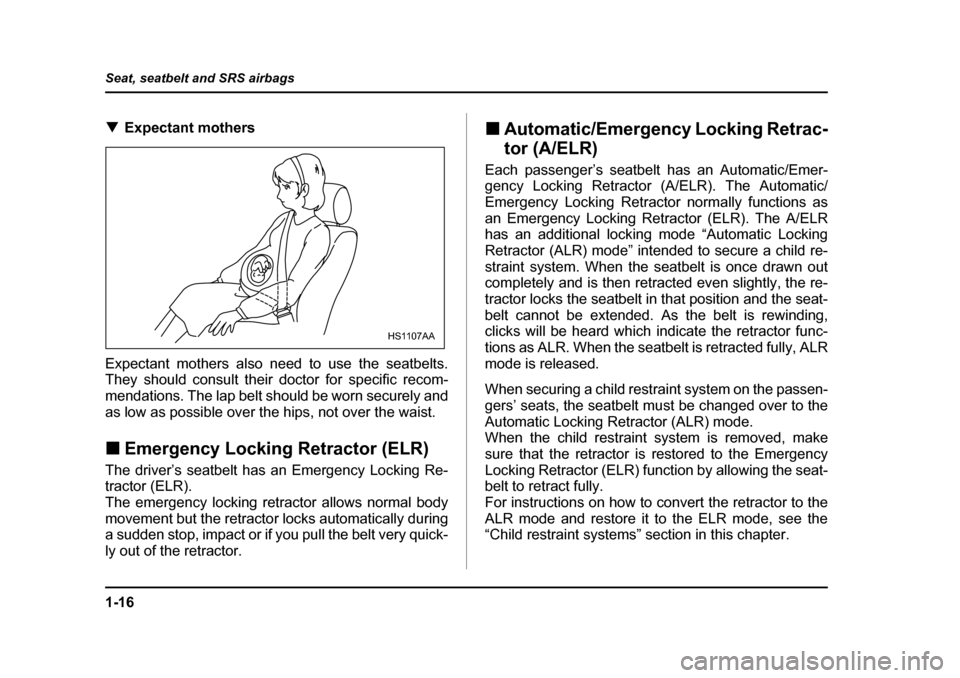
Expectant mothers also need to use the seatbelts.
They should consult their doctor for specific recom-
mendations. The lap belt should be worn securely and
as low as possible over the hips, not over the waist. „ Emergency Locking Retractor (ELR)
The driver’s seatbelt has an Emergency Locking Re-
tractor (ELR).
The emergency locking retractor allows normal bodymovement but the retracto r locks automatically during
a sudden stop, impact or if you pull the belt very quick-
ly out of the retractor. „
Automatic/Emergency Locking Retrac- tor (A/ELR)
Each passenger’s seatbelt has an Automatic/Emer-
gency Locking Retractor (A/ELR). The Automatic/
Emergency Locking Retractor normally functions as
an Emergency Locking Retractor (ELR). The A/ELR
has an additional locking mode “Automatic Locking
Retractor (ALR) mode” intended to secure a child re-
straint system. When the seat belt is once drawn out
completely and is then retracted even slightly, the re-
tractor locks the seatbelt in that position and the seat-
belt cannot be extended. As the belt is rewinding,
clicks will be heard which indicate the retractor func-
tions as ALR. When the seatbelt is retracted fully, ALR
mode is released. When securing a child rest raint system on the passen-
gers’ seats, the seatbelt mu st be changed over to the
Automatic Locking Retractor (ALR) mode.
When the child restraint system is removed, make
sure that the retractor is restored to the Emergency
Locking Retractor (ELR) function by allowing the seat-
belt to retract fully.
For instructions on how to convert the retractor to the
ALR mode and restore it to the ELR mode, see the “Child restraint systems” section in this chapter.
HS1107AA
Page 42 of 487
1-17
Seat, seatbelt and SRS airbags
– CONTINUED –
„Seatbelt warning light and chime
Your vehicle is equipped with a seatbelt warning de-
vice at the driver’s seat, as required by current safety
standards. There is a seatbe lt warning light in the
combination meter.
This device causes the seatbelt warning light on the
instrument panel to light up for approximately six sec-
onds when the ignition switch is turned to the “ON” po-
sition to remind the driver to wear the seatbelt. If the
driver’s seatbelt is not fastened, a warning chime
sounds at the same time. „ Fastening the seatbelt
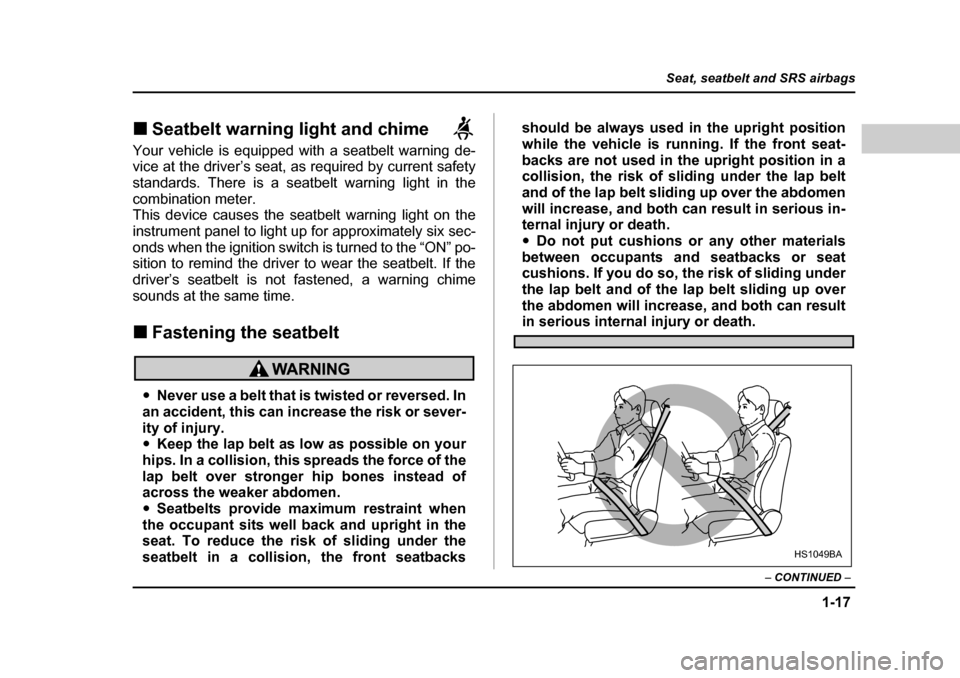
yNever use a belt that is twisted or reversed. In
an accident, this can increase the risk or sever-
ity of injury. y Keep the lap belt as low as possible on your
hips. In a collision, this spreads the force of the
lap belt over stronger hip bones instead of
across the weaker abdomen. y Seatbelts provide maximum restraint when
the occupant sits well back and upright in the
seat. To reduce the risk of sliding under the
seatbelt in a collision, the front seatbacks should be always used in the upright position
while the vehicle is running. If the front seat-
backs are not used in the upright position in a
collision, the risk of sliding under the lap belt
and of the lap belt sliding up over the abdomen
will increase, and both can result in serious in-
ternal injury or death. y
Do not put cushions or any other materials
between occupants and seatbacks or seat
cushions. If you do so, the risk of sliding under
the lap belt and of the lap belt sliding up over
the abdomen will increase, and both can result
in serious internal injury or death.
HS1049BA
Page 43 of 487
1-18
Seat, seatbelt and SRS airbags
Never place the shoulder belt under the arm or
behind the back. If an accident occurs, this can
increase the risk or severity of injury.
Metallic parts of the seatbelt can become very
hot in a vehicle that has been closed up in sun-
ny weather; they could burn an occupant. Do
not touch such hot parts until they cool.
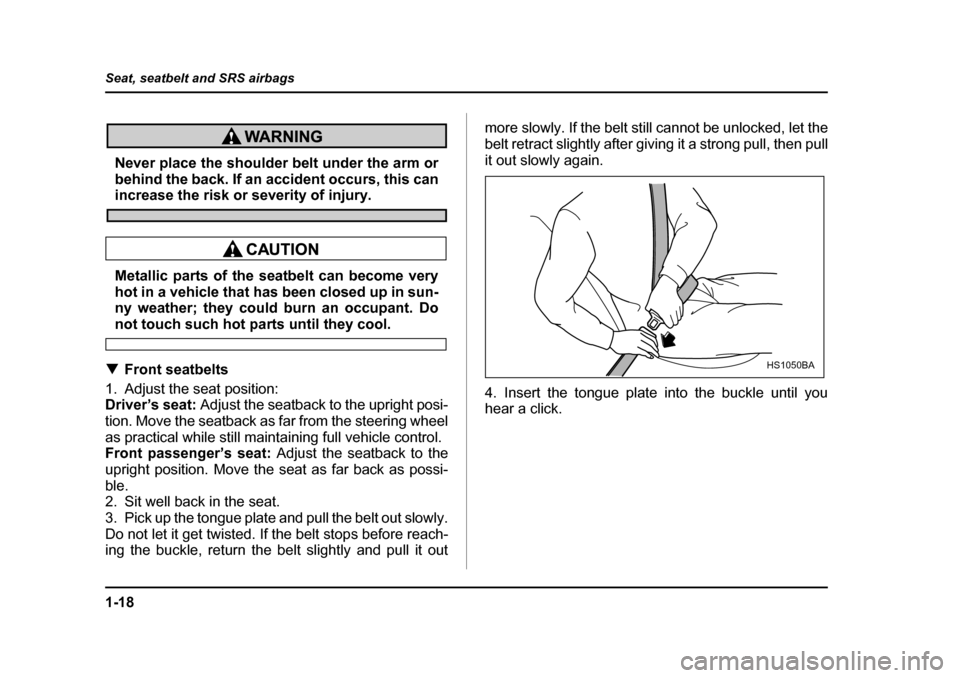
T Front seatbelts
1. Adjust the seat position:
Driver’s seat: Adjust the seatback to the upright posi-
tion. Move the seatback as far from the steering wheel
as practical while still maintaining full vehicle control.
Front passenger’s seat: Adjust the seatback to the
upright position. Move the seat as far back as possi-
ble.
2. Sit well back in the seat.
3. Pick up the tongue plate and pull the belt out slowly.
Do not let it get twisted. If the belt stops before reach-
ing the buckle, return the belt slightly and pull it out more slowly. If the belt still cannot be unlocked, let the
belt retract slightly after giving it a strong pull, then pull
it out slowly again.
4. Insert the tongue plate into the buckle until you
hear a click.
HS1050BA
Page 45 of 487
1-20
Seat, seatbelt and SRS airbags
When wearing the seatbelts, make sure the
shoulder portion of the webbing does not pass
over your neck. If it does, adjust the seatbelt an-
chor to a lower position. Placing the shoulder
belt over the neck may result in neck injury dur-
ing sudden braking or in a collision.
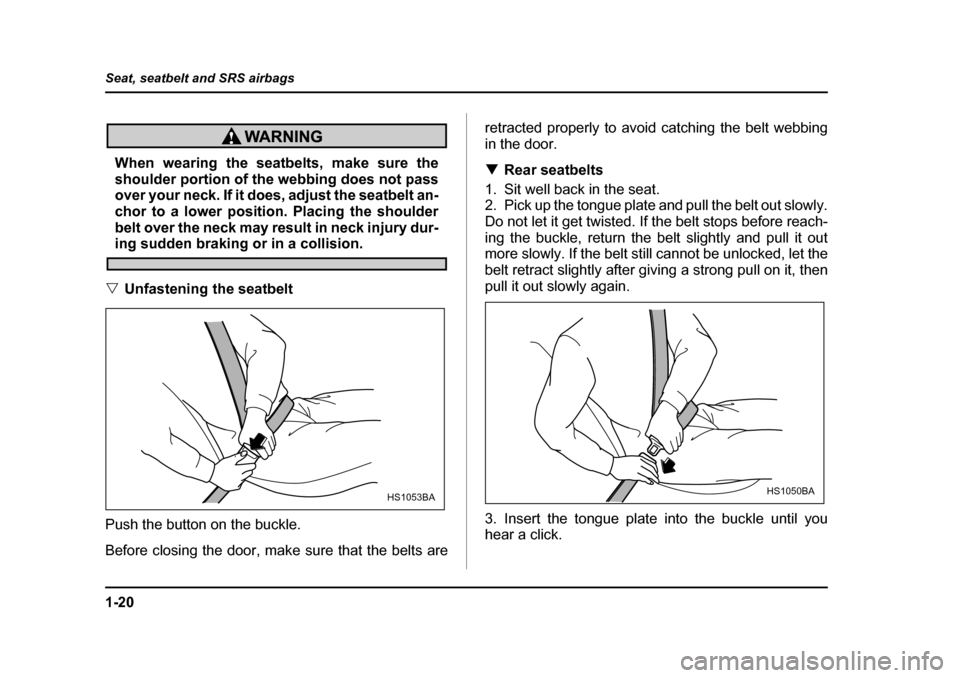
V Unfastening the seatbelt
Push the button on the buckle.
Before closing the door, make sure that the belts are retracted properly to avoid catching the belt webbing
in the door. T
Rear seatbelts
1. Sit well back in the seat.
2. Pick up the tongue plate and pull the belt out slowly.
Do not let it get twisted. If the belt stops before reach-
ing the buckle, return the belt slightly and pull it out
more slowly. If the belt still cannot be unlocked, let the
belt retract slightly after giving a strong pull on it, then
pull it out slowly again.
3. Insert the tongue plate into the buckle until you
hear a click.
HS1053BAHS1050BA
Page 50 of 487
1-25
Seat, seatbelt and SRS airbags
– CONTINUED –
yIf the front seatbelt retractor assembly or sur-
rounding area has been damaged, contact your
SUBARU dealer as so on as possible.
y When you sell your vehicle, we urge you to ex-
plain to the buyer that it has seatbelt pretension-
ers by alerting the buyer to the contents of this
section.
y To obtain maximum protection, occupants
should sit in an upright position with their seat-
belts properly fastened. Refer to “Seatbelts”
section in this chapter. y Do not modify, remove or strike the front
seatbelt retractor assemblies or surrounding
area. This could result in accidental activation
of the seatbelt pretensioners or could make the
system inoperative, possibly resulting in seri-
ous injury. Seatbelt pretensioners have no
user-serviceable parts. For required servicing
of front seatbelt retractors equipped with seat-
belt pretensioners, see your nearest SUBARU
dealer. y When discarding front seatbelt retractor as-
semblies or scrapping the entire vehicle due to
collision damage or for other reasons, consult
your SUBARU dealer.
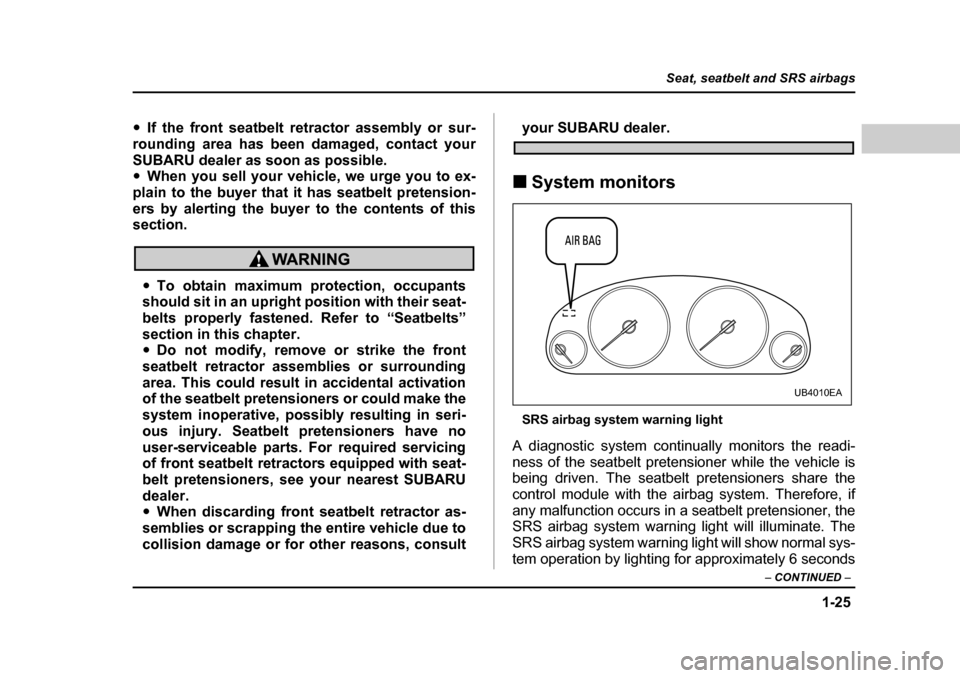
„ System monitors
SRS airbag system warning light
A diagnostic system continually monitors the readi-
ness of the seatbelt pretensioner while the vehicle is
being driven. The seatbelt pretensioners share the
control module with the ai rbag system. Therefore, if
any malfunction occurs in a seatbelt pretensioner, the
SRS airbag system warning light will illuminate. The
SRS airbag system warning lig ht will show normal sys-
tem operation by lighting for approximately 6 seconds
UB4010EA
Page 51 of 487
1-26
Seat, seatbelt and SRS airbags
when the ignition switch is turned to the “ON” position.
The following components are monitored by the indi- cator: y
Front sub sensor (Right-hand side)
y Front sub sensor (Left-hand side)
y Airbag control module (including impact sensors)
y Seatbelt pretensioner (Driver’s side)
y Seatbelt pretensioner (Passenger’s side)
y All related wiring
If the warning light exhibits any of the following
conditions, there may be a malfunction in the
seatbelt pretensioners and/or SRS airbag sys-
tem. Immediately take your vehicle to your
nearest SUBARU dealer to have the system
checked. Unless checked and properly re-
paired, the seatbelt pretensioners and/or SRS
airbag will not operate properly in the event of
a collision, which may increase the risk of inju-
ry. y Flashing or flickering of the warning light.
y No illumination of the warning light when the
ignition switch is first turned to the “ON” posi-
tion.y Continuous illumination of the warning light. y
Illumination of the warning light while driv-
ing.
„ System servicing
yWhen discarding a seatbelt retractor assem-
bly or scrapping the entire vehicle damaged by
a collision, consult your SUBARU dealer.y Tampering with or disconnecting the sys-
tem’s wiring could result in accidental activa-
tion of the seatbelt pretensioner and/or airbag
or could make the system inoperative, which
may result in serious injury. The wiring har-
nesses of the seatbelt pretensioner and SRS
airbag systems are covered with yellow insula-
tion and the connectors of the system are yel-
low for easy identification. Do not use electrical
test equipment on any circuit related to the
seatbelt pretensioner and airbag systems. For
required servicing of the seatbelt pretensioner,
see your nearest SUBARU dealer.
Page 55 of 487
1-30
Seat, seatbelt and SRS airbags
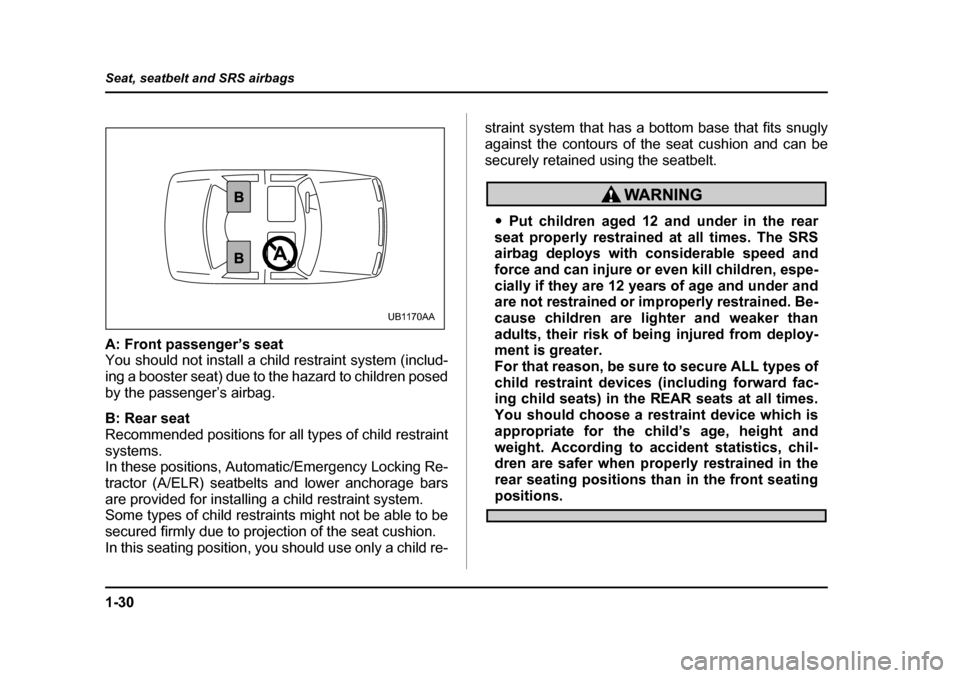
A: Front passenger’s seat
You should not install a child restraint system (includ-
ing a booster seat) due to the hazard to children posed
by the passenger’s airbag.
B: Rear seat
Recommended positions for all types of child restraint
systems.
In these positions, Automatic/Emergency Locking Re-
tractor (A/ELR) seatbelts and lower anchorage bars
are provided for installi
ng a child restraint system.
Some types of child restraints might not be able to be
secured firmly due to projection of the seat cushion.
In this seating position, you should use only a child re- straint system that has a bo
ttom base that fits snugly
against the contours of the seat cushion and can be
securely retained using the seatbelt.
y Put children aged 12 and under in the rear
seat properly restrained at all times. The SRS
airbag deploys with considerable speed and
force and can injure or even kill children, espe-
cially if they are 12 years of age and under and
are not restrained or improperly restrained. Be-
cause children are lighter and weaker than
adults, their risk of being injured from deploy-
ment is greater.
For that reason, be sure to secure ALL types of
child restraint devices (including forward fac-
ing child seats) in the REAR seats at all times.
You should choose a restraint device which is
appropriate for the child’s age, height and
weight. According to accident statistics, chil-
dren are safer when properly restrained in the
rear seating positions than in the front seating
positions.
UB1170AA
Page 74 of 487
1-49
Seat, seatbelt and SRS airbags
– CONTINUED –
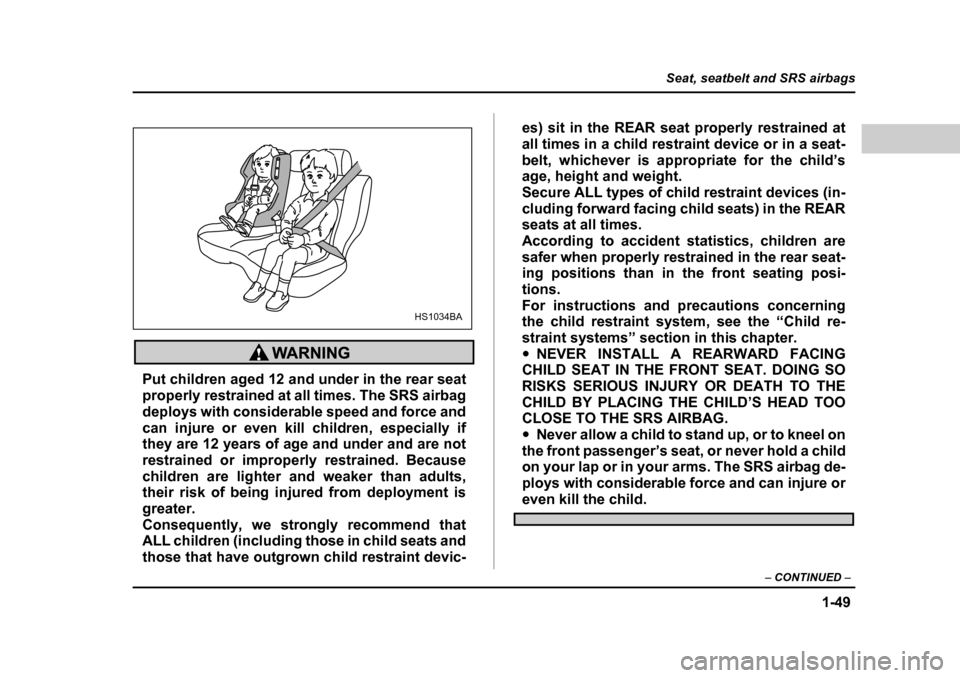
Put children aged 12 and under in the rear seat
properly restrained at all times. The SRS airbag
deploys with considerable speed and force and
can injure or even kill children, especially if
they are 12 years of age and under and are not
restrained or improperly restrained. Because
children are lighter and weaker than adults,
their risk of being injured from deployment is
greater.
Consequently, we strongly recommend that
ALL children (including those in child seats and
those that have outgrown child restraint devic- es) sit in the REAR seat properly restrained at
all times in a child restraint device or in a seat-
belt, whichever is appropriate for the child’s
age, height and weight.
Secure ALL types of child restraint devices (in-
cluding forward facing child seats) in the REAR
seats at all times.
According to accident st
atistics, children are
safer when properly restrained in the rear seat-
ing positions than in the front seating posi- tions.
For instructions and precautions concerning
the child restraint system, see the “Child re-
straint systems” section in this chapter.y NEVER INSTALL A REARWARD FACING
CHILD SEAT IN THE FRONT SEAT. DOING SO
RISKS SERIOUS INJURY OR DEATH TO THE
CHILD BY PLACING TH E CHILD’S HEAD TOO
CLOSE TO THE SRS AIRBAG.y Never allow a child to stand up, or to kneel on
the front passenger’s seat, or never hold a child
on your lap or in your arms. The SRS airbag de-
ploys with considerable force and can injure or
even kill the child.
HS1034BA