seats SUBARU BRZ 2013 1.G Owner's Guide
[x] Cancel search | Manufacturer: SUBARU, Model Year: 2013, Model line: BRZ, Model: SUBARU BRZ 2013 1.GPages: 484, PDF Size: 6.46 MB
Page 117 of 484
117
1-7. Safety information
1
Before driving
WARNING
■SRS airbag precautions
●The SRS front passenger airbag also deploys with considerable force, and
can cause death or serious injury especially if the front passenger is very
close to the airbag. The front passenger seat should be as far from the air-
bag as possible with the seatback adjusted, so the front passenger sits
upright.
●Improperly seated and/or restrained infants and children can be killed or
seriously injured by a deploying airbag. An infant or child who is too small
to use a seatbelt should be properly secured using a child restraint sys-
tem. SUBARU strongly recommends that all infants and children be placed
in the rear seats of the vehicle and pr operly restrained. The rear seats are
safer for infants and children than the front passenger seat. ( →P. 132)
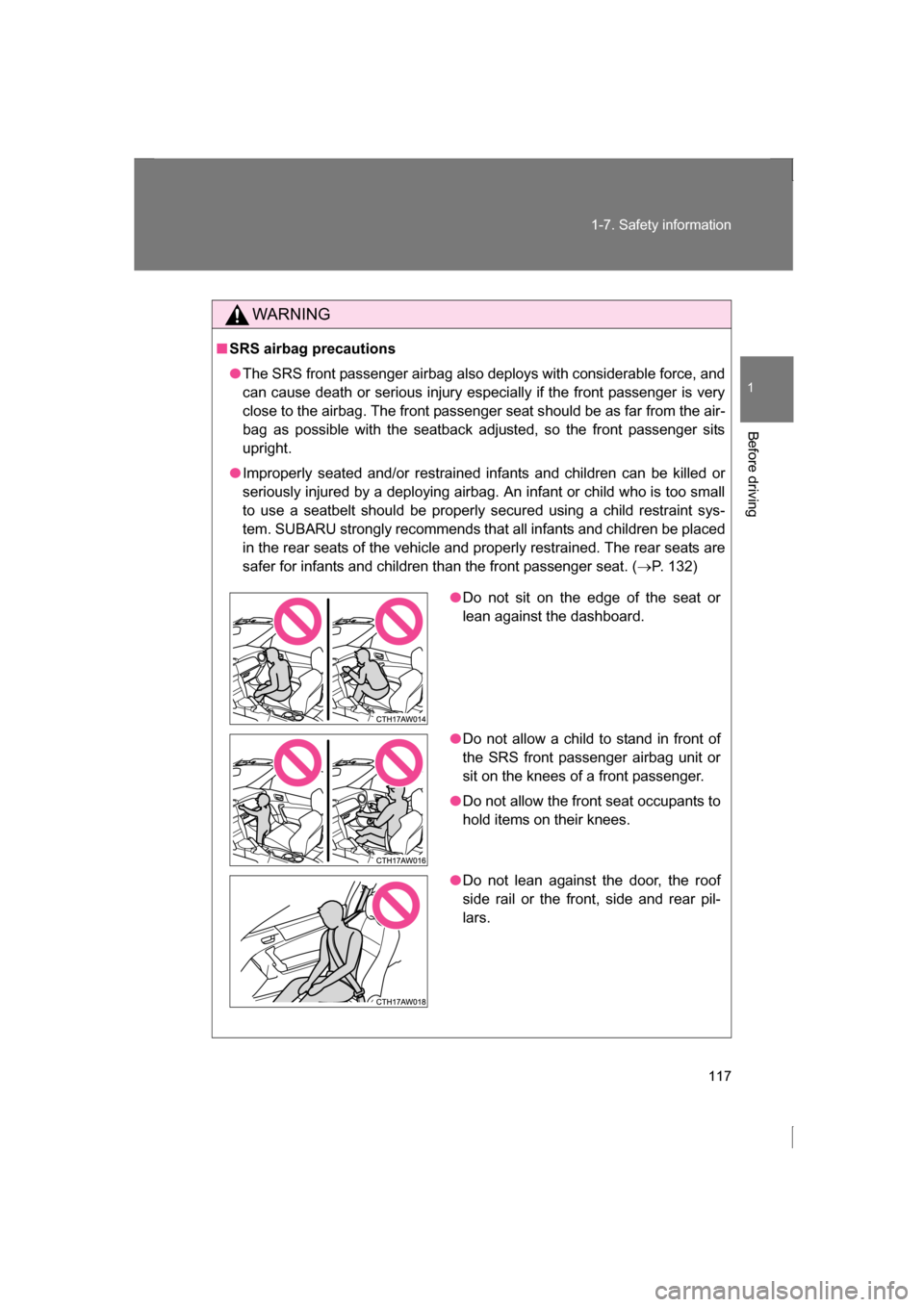
●Do not sit on the edge of the seat or
lean against the dashboard.
●Do not allow a child to stand in front of
the SRS front passenger airbag unit or
sit on the knees of a front passenger.
●Do not allow the front seat occupants to
hold items on their knees.
●Do not lean against the door, the roof
side rail or the front, side and rear pil-
lars.
Page 119 of 484
119
1-7. Safety information
1
Before driving
WARNING
■SRS airbag precautions
●Do not touch any of the component parts immediately after the SRS air-
bags have deployed (inflated) as they may be hot.
●If breathing becomes difficult after the SRS airbag has deployed, open a
door or window to allow fresh air in, or leave the vehicle if it is safe to do
so. Wash off any residue as soon as possible to prevent skin irritation.
●If the areas where the SRS airbags are stored, such as the steering wheel
pad and front and rear pillar garnishes, are damaged or cracked, have
them replaced by your SUBARU dealer.
■Modification and disposal of SRS airbag system components
Do not dispose of your vehicle or perfo rm any of the following modifications
without consulting your SUBARU dealer.
The SRS airbags may malfunction or deploy (inflate) accidentally, causing
death or serious injury.
●Installation, removal, disassembly and repair of the SRS airbags.
●Repairs, modifications, removal or replacement of the steering wheel,
instrument panel, dashboard, seats or seat upholstery, front, side and rear
pillars or roof side rails.
●Repairs or modifications of the front fender, front bumper, or side of the
occupant compartment.
●Installation of snow plows, winches, etc. to the front grille (bull bars, kan-
garoo bar etc.).
●Modifications to the vehicle's suspension system.
●Installation of electronic devices such as mobile two-way radios and CD
players.
●Modifications to your vehicle for a person with a physical disability.
Page 121 of 484
121
1-7. Safety information
1
Before driving
●Curtain airbag module (left-hand side)
● Satellite safing sensor (under the center of the rear seats)
● Seatbelt pretensioner (driver’s side)
● Seatbelt pretensioner (front passenger’s side)
● Seatbelt buckle switch (front passenger’s side)
● Front passenger’s occupant detection system sensor
● Front passenger’s occupant detection control module
● Front passenger’s frontal airbag ON and OFF indicator
● All related wiring
WARNING
■SRS warning light
If the warning light exhibits any of the following conditions, there may be a
malfunction in the seatbelt pretensioners and/or SRS airbag system. Imme-
diately take your vehicle to your nearest SUBARU dealer to have the system
checked. Unless checked and properly repaired, the seatbelt pretensioners
and/or SRS airbag will not operate properly in the event of a collision, which
may increase the risk of injury.
●Flashing or flickering of the warning light
●No illumination of the warning light when the ignition switch is first turned
to the “ON” position.
●Continuous illumination of the warning light
●Illumination of the warning light while driving
Page 131 of 484
131
1-7. Safety information
1
Before driving
WARNING
■Front passenger occupant detection system precautions
●Never install a rearward facing child seat in the front passenger’s seat
even if the front passenger’s SRS frontal airbag is deactivated. Be sure to
install it in the rear seat in a correct manner. Also, it is strongly recom-
mended that any forward facing child seat or booster seat be installed in
the rear seat, and that even children who have outgrown a child restraint
system be also seated in the rear seat. This is because children sitting in
the front passenger’s seat may be killed or severely injured should the
front passenger’s SRS frontal airbag deploy. SUBARU believes that the
rear seats are the safest place for children
●If luggage or electronic devices are placed on the front passenger seat,
the OFF indicator may turn off and the ON indicator may illuminate. If this
occurs, the front passenger’s airbag may deploy during a collision. If this is
not desirable, remove the luggage or el ectronic devices from the front pas-
senger seat.
●Modifications for persons with disabilities that may affect the front passen-
ger occupant detection system. (U.S. only) Removing, replacing or modify-
ing any parts of the front seats, seatbelts, front bumper, front side frame,
instrument panel, combination meter, steering wheel, steering column,
tires, suspension or floor panel can affect the operation of the SUBARU
front passenger occupant detection system.
Page 136 of 484
136
1-7. Safety information
Installing child restraints
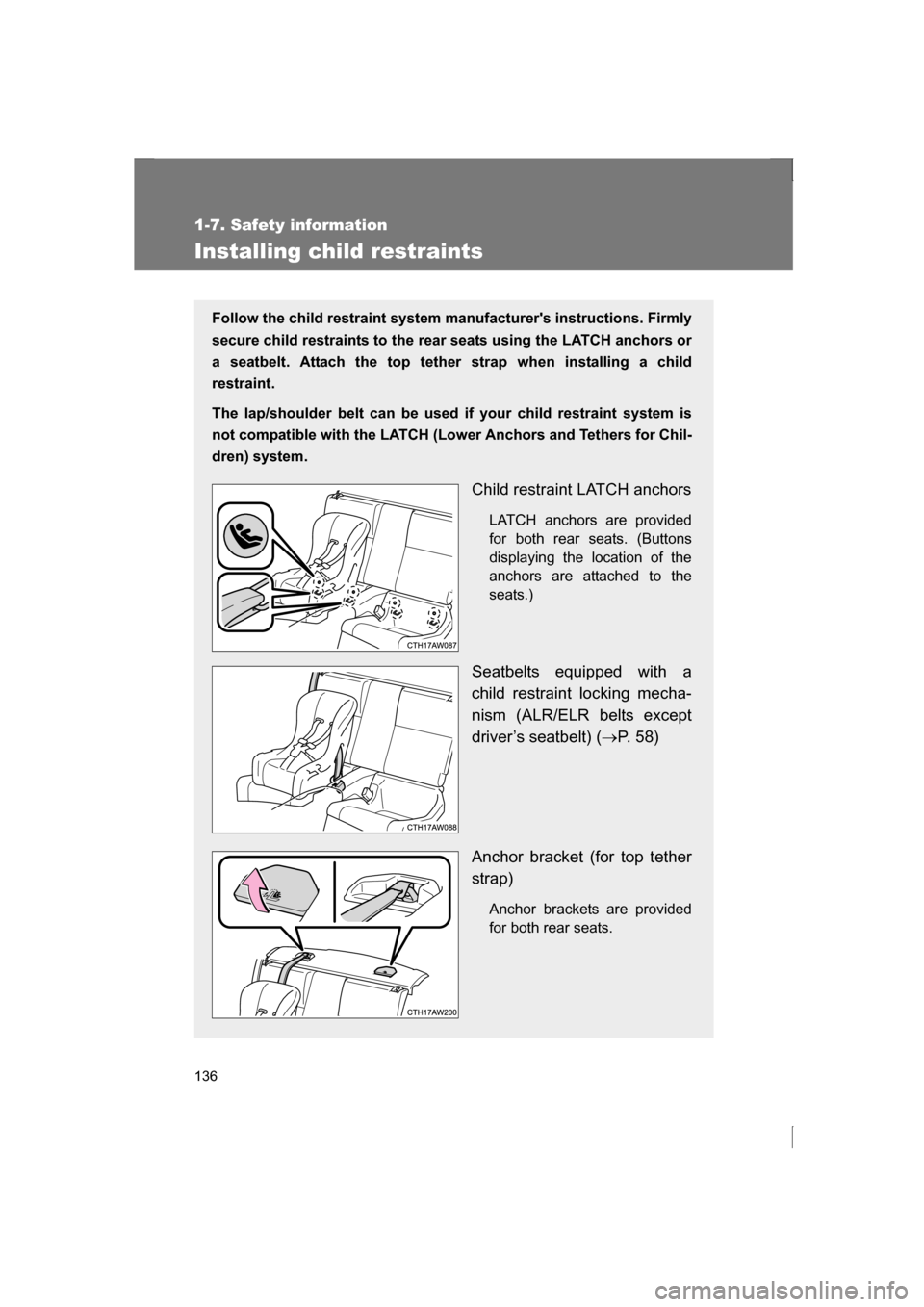
Follow the child restraint system manufacturer's instructions. Firmly
secure child restraints to the rear seats using the LATCH anchors or
a seatbelt. Attach the top tether strap when installing a child
restraint.
The lap/shoulder belt can be used if your child restraint system is
not compatible with the LATCH (Lower Anchors and Tethers for Chil-
dren) system.
Child restraint LATCH anchorsLATCH anchors are provided
for both rear seats. (Buttons
displaying the location of the
anchors are attached to the
seats.)
Seatbelts equipped with a
child restraint locking mecha-
nism (ALR/ELR belts except
driver’s seatbelt) ( →P. 5 8 )
Anchor bracket (for top tether
strap) Anchor brackets are provided
for both rear seats.
Page 202 of 484
202
2-3. Operating the lights and windshield wipers
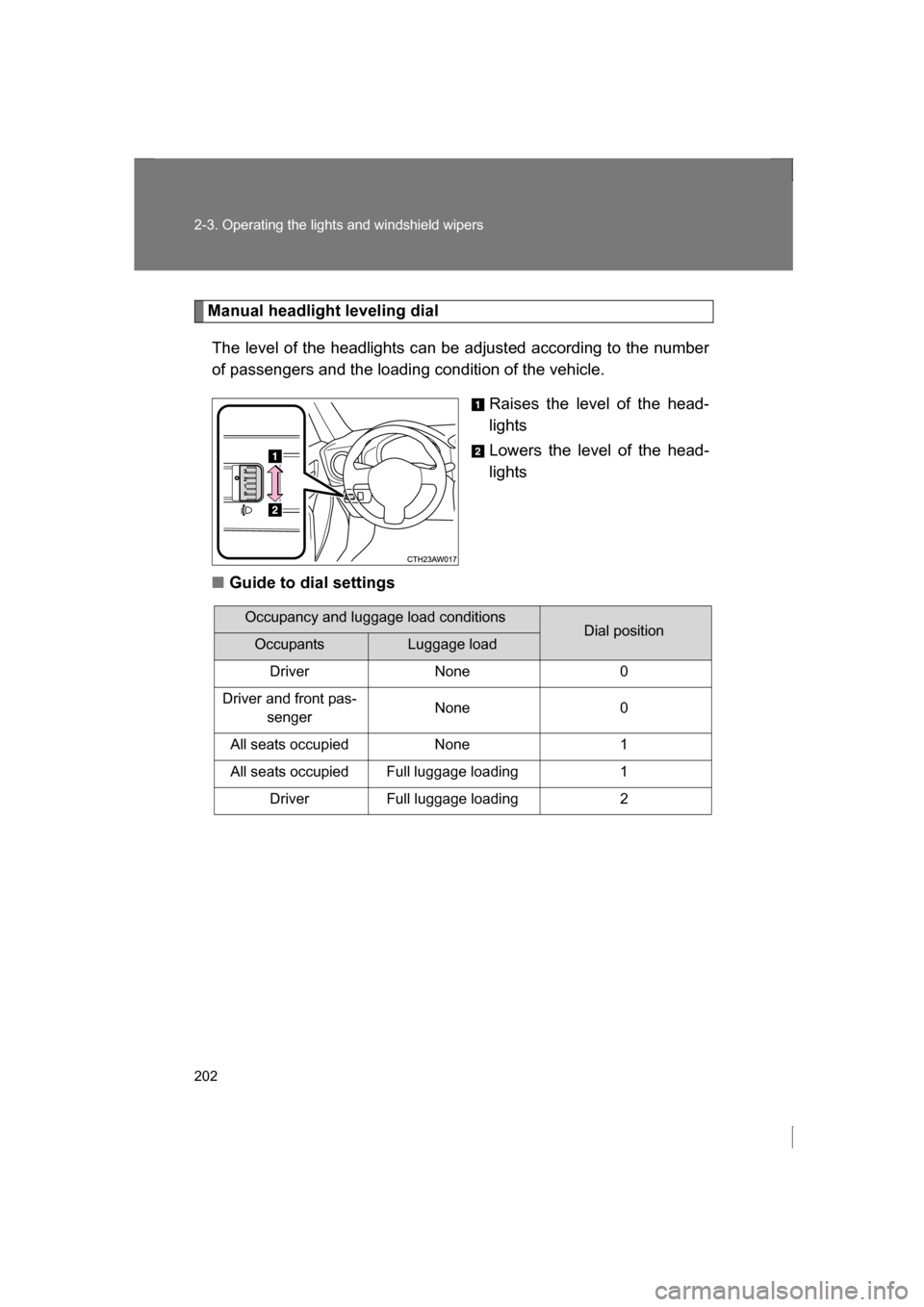
Manual headlight leveling dialThe level of the headlights can be adjusted according to the number
of passengers and the loading condition of the vehicle. Raises the level of the head-
lights
Lowers the level of the head-
lights
■Guide to dial settings
Occupancy and luggage load conditionsDial positionOccupantsLuggage load
Driver None 0
Driver and front pas- senger None 0
All seats occupied None 1
All seats occupied Full luggage loading 1 Driver Full luggage loading 2
Page 223 of 484
223
2-5. Driving information
2
When driving
WARNING
■Things that must not be carried in the trunk
The following things may cause a fire if loaded in the trunk:
●Receptacles containing gasoline
●Aerosol cans
■Storage precautions
Observe the following precautions.
Failure to do so may result in death or serious injury.
●Stow cargo and luggage in the trunk whenever possible.
●To prevent cargo and luggage from sliding forward during braking, do
not stack anything in the enlarged trunk. Keep cargo and luggage low,
as close to the floor as possible.
●When you fold down the rear seats, long items should not be placed
directly behind the front seats.
●Never allow anyone to ride in the enlarged trunk. It is not designed for
passengers. They should ride in their seats with their seatbelts prop-
erly fastened. Otherwise, they are much more likely to suffer death or
serious bodily injury, in the event of sudden braking, sudden swerving
or an accident.
●Do not place cargo or luggage in or on the following locations as the
item may get under the clutch, brake or accelerator pedal and prevent
the pedals from being depressed properly, block the driver’s vision, or
hit the driver or passengers, causing an accident:
Page 242 of 484
242
3-1. Using the air conditioning system and defogger
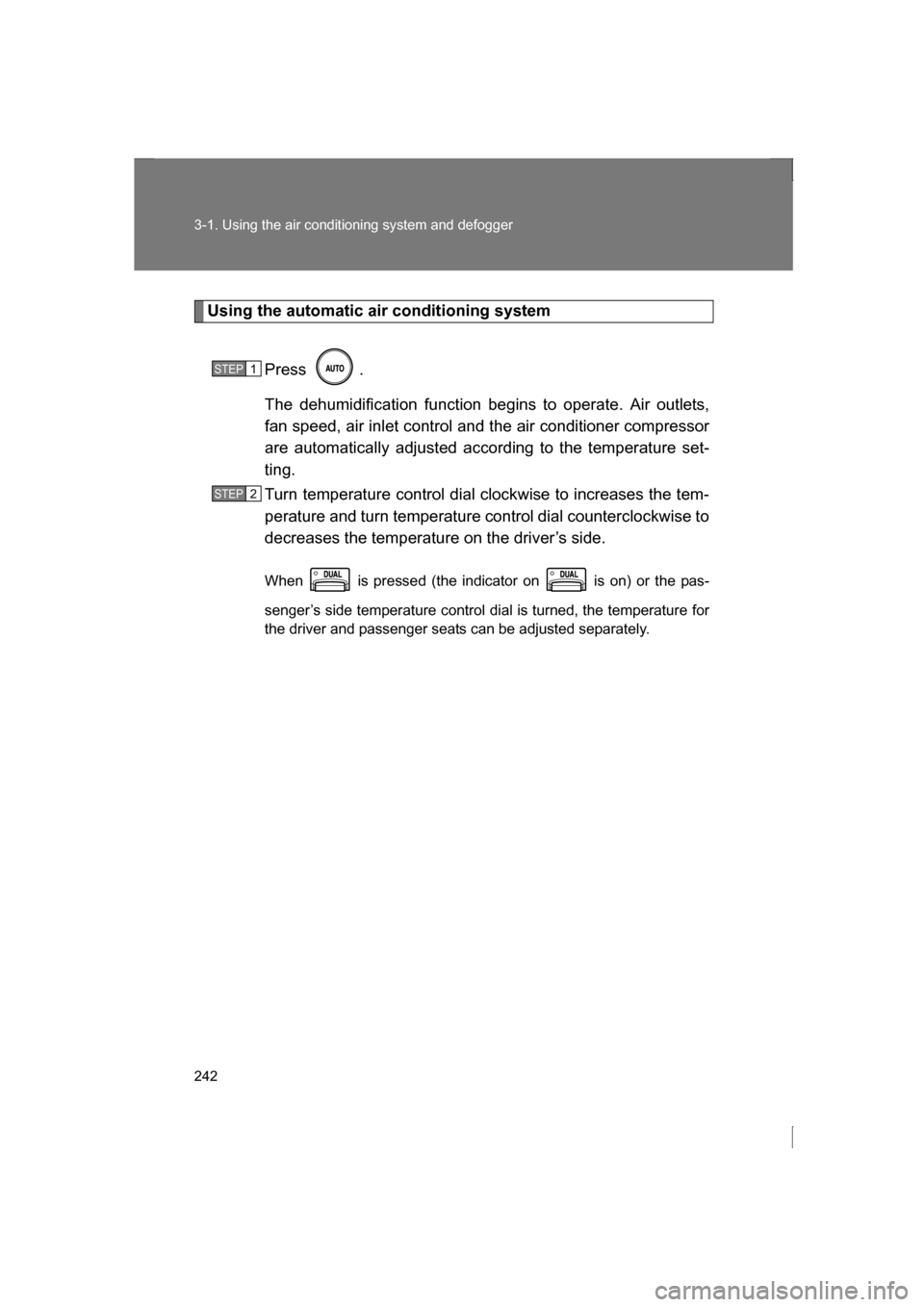
Using the automatic air conditioning systemPress .
The dehumidification function begins to operate. Air outlets,
fan speed, air inlet control and the air conditioner compressor
are automatically adjusted according to the temperature set-
ting.
Turn temperature control dial clockwise to increases the tem-
perature and turn temperature control dial counterclockwise to
decreases the temperature on the driver’s side.
When is pressed (the indicator on is on) or the pas-
senger’s side temperature control dial is turned, the temperature for
the driver and passenger seats can be adjusted separately.
STEP 1
STEP 2
Page 266 of 484
266
3-5. Other interior features
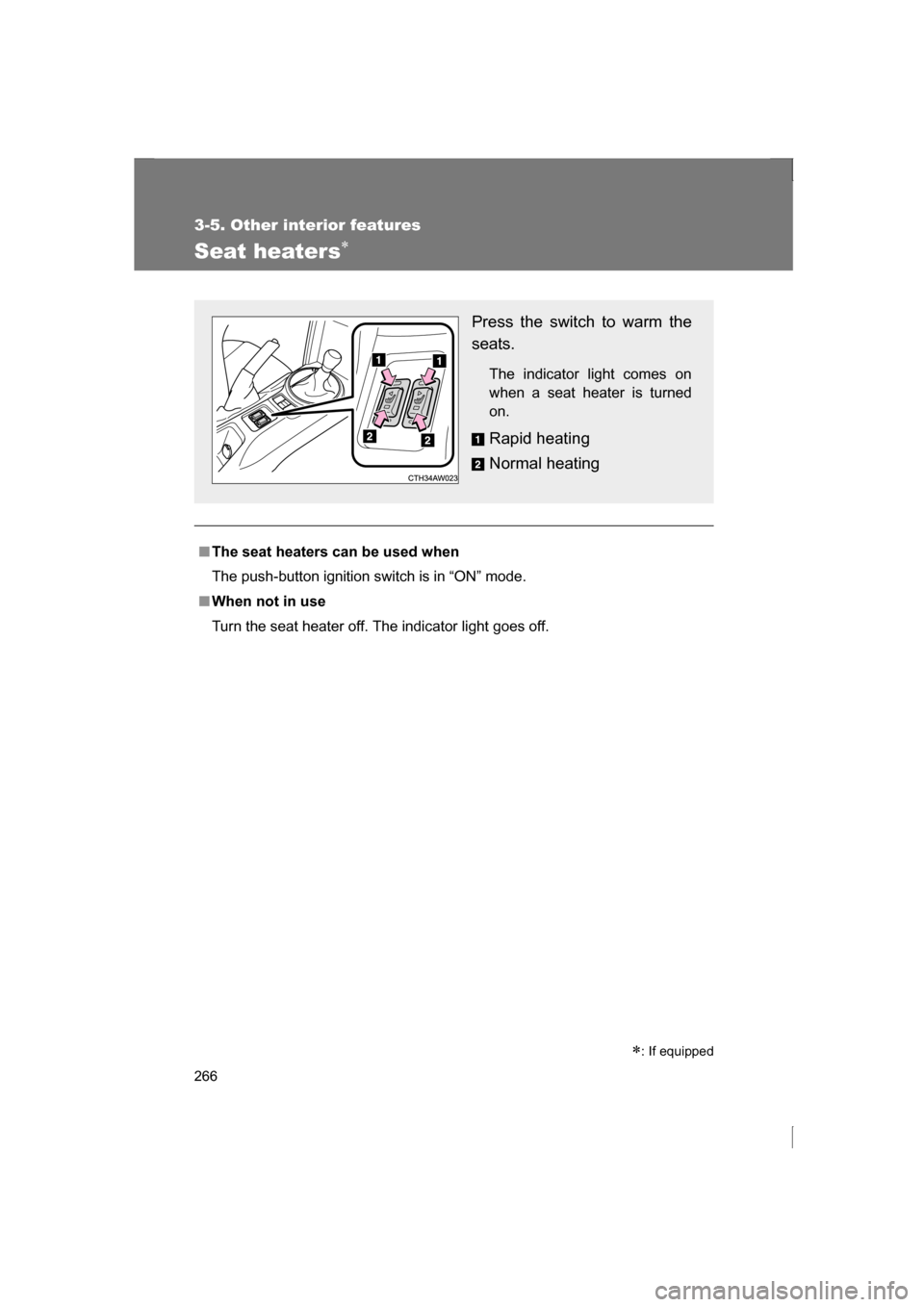
Seat heaters∗
■The seat heaters can be used when
The push-button ignition switch is in “ON” mode.
■When not in use
Turn the seat heater off. The indicator light goes off.
∗
: If equipped
Press the switch to warm the
seats.
The indicator light comes on
when a seat heater is turnedon.
Rapid heating
Normal heating
Page 432 of 484
432
6-1. Specifications
Warning: The temperature grades of a tire assume that it is properly
inflated and not overloaded.
Excessive speed, underinflation, or excessive loading, either sepa-
rately or in combination, can cause heat buildup and possible tire fail-
ure.
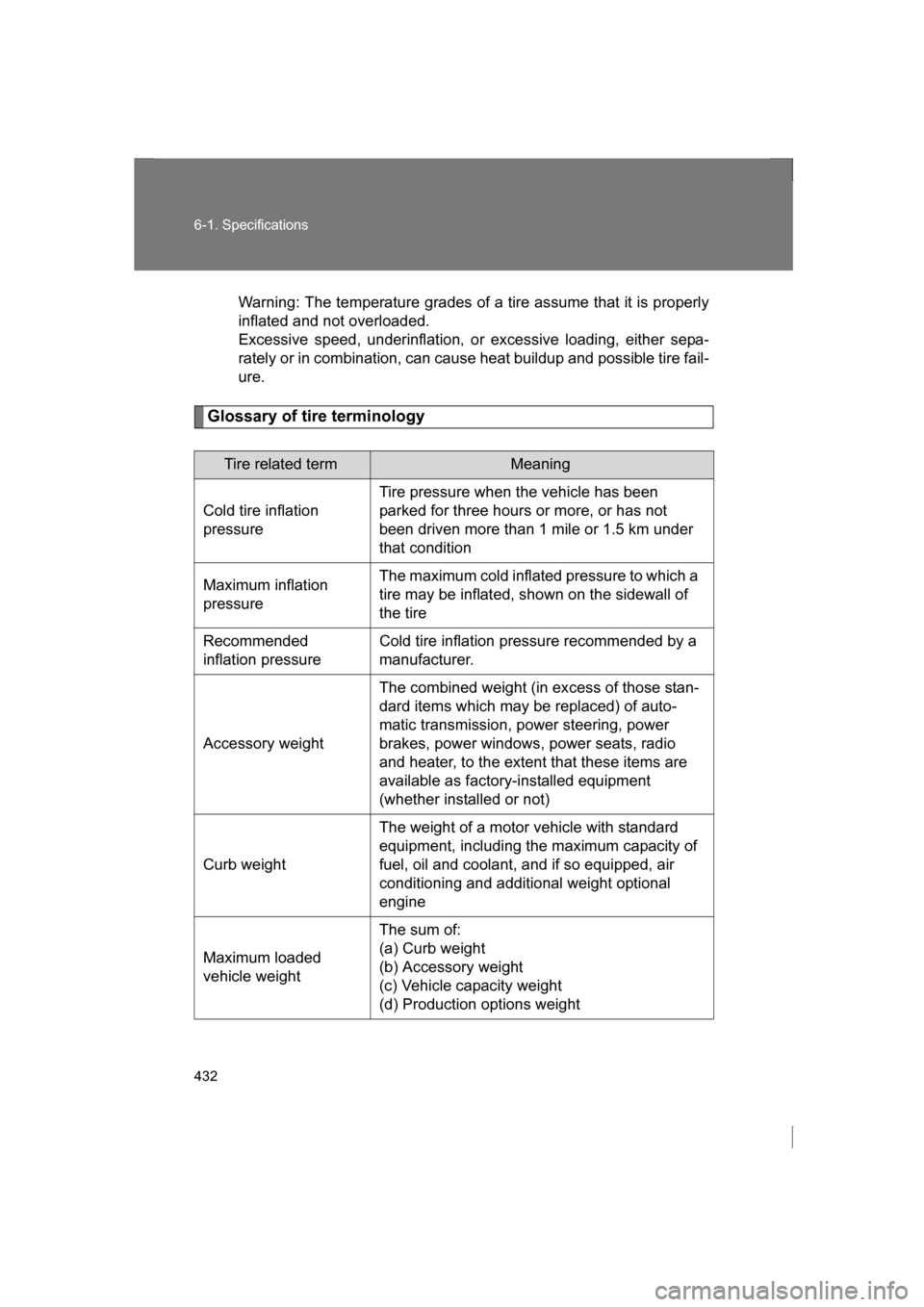
Glossary of tire terminology
Tire related termMeaning
Cold tire inflation
pressure Tire pressure when the vehicle has been
parked for three hours or more, or has not
been driven more than 1 mile or 1.5 km under
that condition
Maximum inflation
pressure The maximum cold inflated pressure to which a
tire may be inflated, shown on the sidewall of
the tire
Recommended
inflation pressure Cold tire inflation pressure recommended by a
manufacturer.
Accessory weight The combined weight (in excess of those stan-
dard items which may be replaced) of auto-
matic transmission, power steering, power
brakes, power windows, power seats, radio
and heater, to the extent that these items are
available as factory-installed equipment
(whether installed or not)
Curb weight The weight of a motor vehicle with standard
equipment, including the maximum capacity of
fuel, oil and coolant, and if so equipped, air
conditioning and additional weight optional
engine
Maximum loaded
vehicle weight The sum of:
(a) Curb weight
(b) Accessory weight
(c) Vehicle capacity weight
(d) Production options weight