stop start SUBARU BRZ 2016 1.G Owner's Manual
[x] Cancel search | Manufacturer: SUBARU, Model Year: 2016, Model line: BRZ, Model: SUBARU BRZ 2016 1.GPages: 490, PDF Size: 6.01 MB
Page 254 of 490
253 3-1. Using the air conditioning system and defogger
3
Interior features
■Ventilation and air conditioning odors
●To let fresh air in, set the air conditioning system to the outside air mode.
●During use, various odors from inside and outside the vehicle may enter
into and accumulate in the air conditioning system. This may then cause
odor to be emitted from the vents.
●To reduce potential odors from occurring:
• It is recommended that the air conditioning system be set to outside air
mode prior to turning the vehicle off.
• The start timing of the blower may be delayed for a short period of time
immediately after the air conditioning system is started in automatic
mode.
■Air conditioning filter
oP. 326
WARNING
■To prevent the windshield from fogging up
Do not use during cool air operation in extremely humid weather. The
difference between the temperature of the outside air and that of the wind-
shield can cause the outer surface of the windshield to fog up, blocking your
vision.
CAUTION
■To prevent battery discharge
Do not leave the air conditioning system on longer than necessary when the
engine is stopped.
Page 256 of 490
255 3-1. Using the air conditioning system and defogger
3
Interior features
■The defoggers can be operated when
Vehicles without a keyless access with push button start system
The engine switch is in the “ON” position.
Vehicles with a keyless access with push button start system
The push-button ignition switch is in “ON” mode.
■The outside rear view mirror defoggers (vehicles with outside rear view
mirror defoggers)
Turning the rear window defogger on will turn the outside rear view mirror
defoggers on.
■When continuous operation is set (vehicles with an automatic air con-
ditioning system)
During continuous operation, the defogger stops operating for 2 minutes
after every 15 minutes of continual operation. Even during the 2 minutes that
operation stops, the operating light remains illuminated. The rear window
defogger will continue to operate in this cycle until it is turned off.
■Customization that can be configured at SUBARU dealer (vehicles with
an automatic air conditioning system)
The rear window defogger can be set to 15-minute operation or continuous
operation. (Customizable features oP. 443)
WARNING
■When the outside rear view mirror defoggers are on (vehicles with out-
side rear view mirror defoggers)
Do not touch the outside surface of the rear view mirrors, as they can
become very hot and burn you.
CAUTION
■To prevent battery discharge
Do not leave the rear window defogger on longer than necessary when the
engine is stopped.
Page 269 of 490
268
3-5. Other interior features
Outside temperature display
■The outside temperature is displayed when
Vehicles without a keyless access with push button start system
The engine switch is in the “ON” position.
Vehicles with a keyless access with push button start system
The push-button ignition switch is in “ON” mode.
■Display
In the following situations, the correct outside temperature may not be dis-
played, or the display may take longer than normal to change:
●When the vehicle is stopped, or moving at low speeds (less than 12 mph
[20 km/h])
●When the outside temperature has changed suddenly (at the entrance/
exit of a garage, tunnel, etc.)
■When “- -” is displayed more than 1 minute or the outside temperature
is not displayed
The system may be malfunctioning. Take your vehicle to your SUBARU
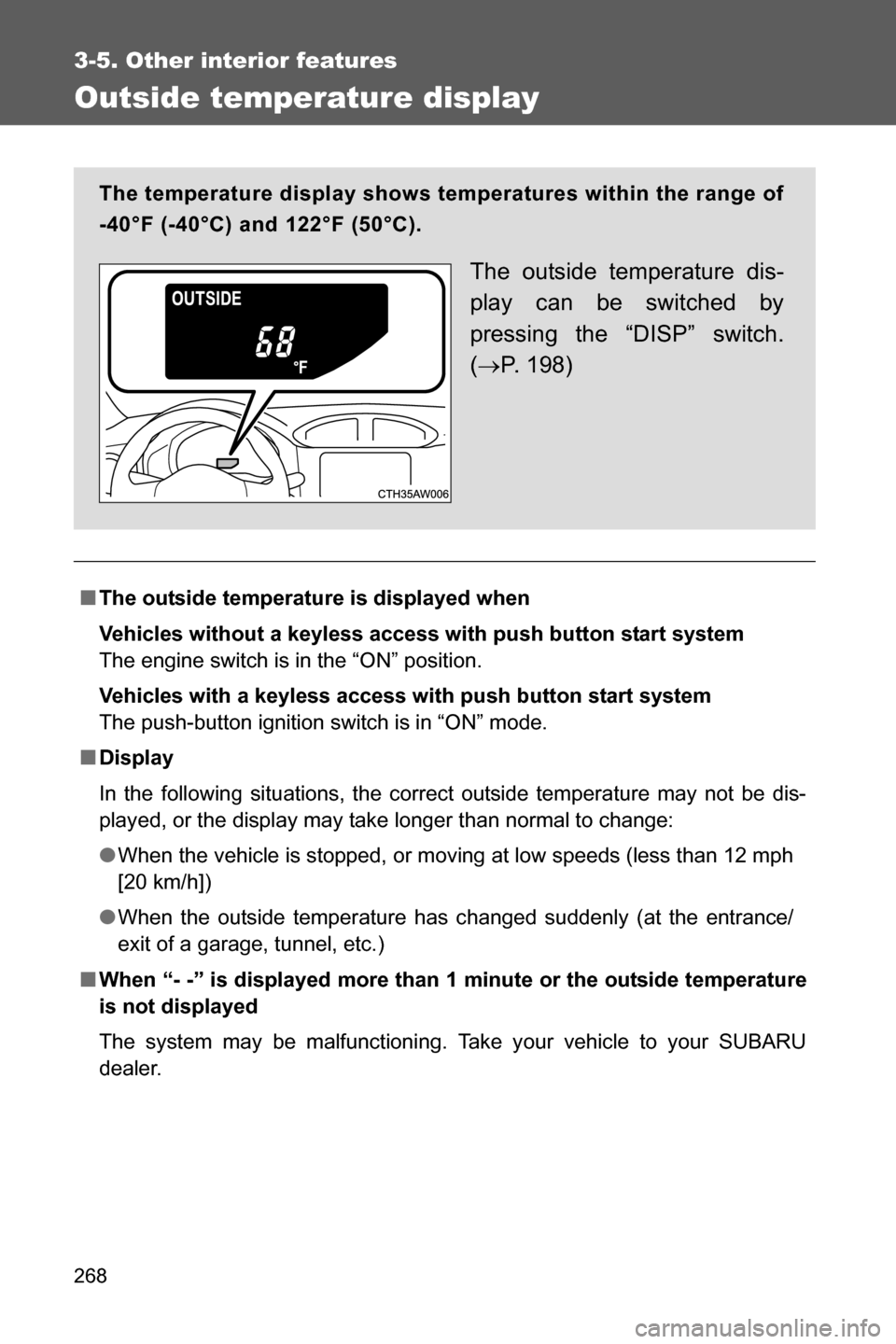
dealer. The temperature display shows temperatures within the range of
-40°F (-40°C) and 122°F (50°C).
The outside temperature dis-
play can be switched by
pressing the “DISP” switch.
(oP. 1 9 8 )
Page 341 of 490
340 4-3. Do-it-yourself maintenance
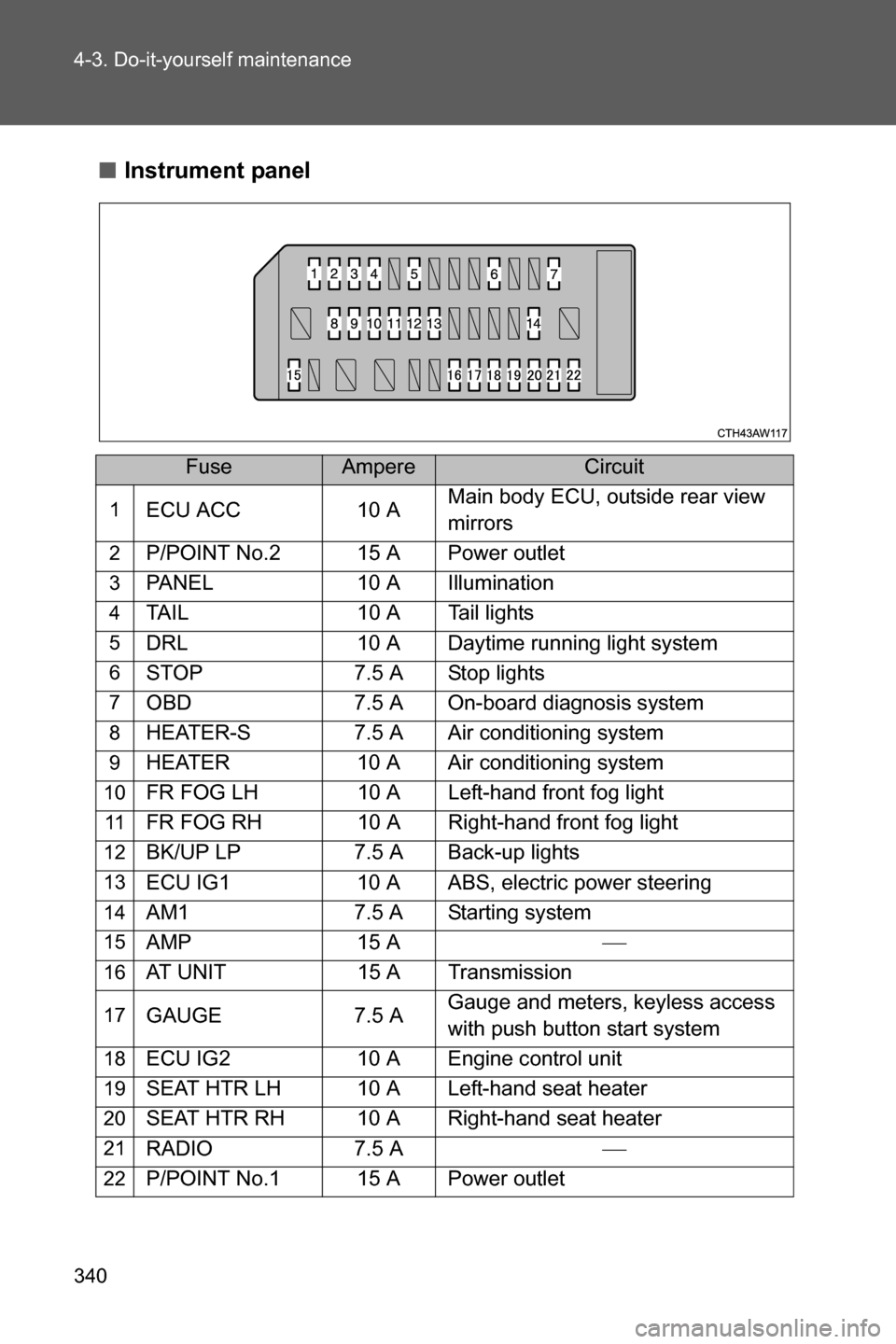
■Instrument panel
FuseAmpereCircuit
1ECU ACC 10 AMain body ECU, outside rear view
mirrors
2P/POINT No.2 15 A Power outlet
3PANEL 10 A Illumination
4TAIL 10 A Tail lights
5DRL 10 A Daytime running light system
6STOP 7.5 A Stop lights
7OBD 7.5 A On-board diagnosis system
8HEATER-S 7.5 A Air conditioning system
9HEATER 10 A Air conditioning system
10FR FOG LH 10 A Left-hand front fog light
11FR FOG RH 10 A Right-hand front fog light
12BK/UP LP 7.5 A Back-up lights
13ECU IG1 10 A ABS, electric power steering
14AM1 7.5 A Starting system
15AMP 15 A
16AT UNIT 15 A Transmission
17GAUGE 7.5 AGauge and meters, keyless access
with push button start system
18ECU IG2 10 A Engine control unit
19SEAT HTR LH 10 A Left-hand seat heater
20SEAT HTR RH 10 A Right-hand seat heater
21RADIO 7.5 A
22P/POINT No.1 15 A Power outlet
Page 368 of 490
5
When trouble arises
367
5-1. Essential information
Fuel pump shut off system
Follow the procedure below to restart the engine after the system is
activated.
Vehicles without a keyless access with push button start system
Turn the engine switch to the “ACC” or “LOCK” position.
Restart the engine.
Vehicles with a keyless access with push button start system
Turn the push-button ignition switch to “ACC” mode or turn it off.
Restart the engine.
CAUTION
■Before starting the engine
Inspect the ground under the vehicle.
If you find that fuel has leaked on to the ground, the fuel system has been
damaged and is in need of repair. Do not restart the engine.
To minimize the risk of fuel leakage when the engine stalls or an air-
bag inflates upon collision, the fuel pump shut off system stops sup-
plying fuel to the engine.
STEP 1
STEP 2
STEP 1
STEP 2
Page 373 of 490
372 5-2. Steps to take in an emergency
*1: Driver’s seatbelt buzzer:
Vehicles without a keyless access with push button start system
The driver’s seatbelt buzzer sounds to alert the driver that his or her seatbelt
is not fastened. Once the engine switch is turned to the “ON” position, the
buzzer sounds for 6 seconds. If the vehicle reaches a speed of 12 mph (20
km/h), the buzzer sounds once. If the seatbelt is still unfastened after 30
seconds, the buzzer will sound intermittently for 10 seconds. Then, if the
seatbelt is still unfastened, the buzzer will sound in a different tone for 20
more seconds.
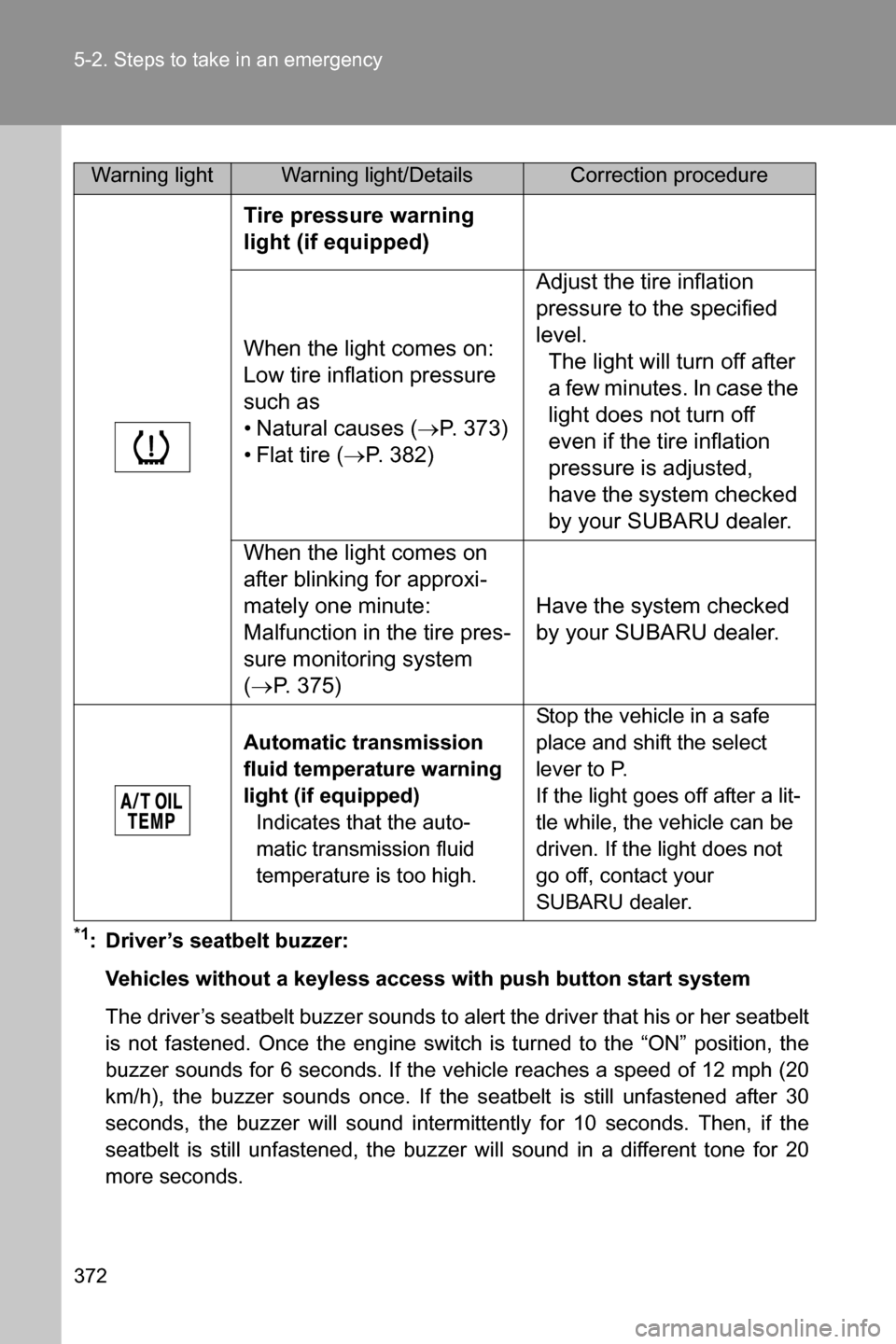
Tire pressure warning
light (if equipped)
When the light comes on:
Low tire inflation pressure
such as
• Natural causes (oP. 373)
•Flat tire (oP. 382)Adjust the tire inflation
pressure to the specified
level.
The light will turn off after
a few minutes. In case the
light does not turn off
even if the tire inflation
pressure is adjusted,
have the system checked
by your SUBARU dealer.
When the light comes on
after blinking for approxi-
mately one minute:
Malfunction in the tire pres-
sure monitoring system
(oP. 375)Have the system checked
by your SUBARU dealer.
Automatic transmission
fluid temperature warning
light (if equipped)
Indicates that the auto-
matic transmission fluid
temperature is too high.Stop the vehicle in a safe
place and shift the select
lever to P.
If the light goes off after a lit-
tle while, the vehicle can be
driven. If the light does not
go off, contact your
SUBARU dealer.
Warning lightWarning light/DetailsCorrection procedure
Page 376 of 490
5
When trouble arises
375 5-2. Steps to take in an emergency
■If the tire pressure warning light frequently comes on after blinking
for approximately one minute (if equipped)
If the tire pressure warning light frequently comes on after blinking for
approximately one minute when the push-button ignition switch is turned
to “ON” mode (vehicles with a keyless access with push button start sys-
tem) or the engine switch is turned to the “ON” position (vehicles without
a keyless access with push button start system), have it checked your
SUBARU dealer.
WARNING
■If the tire pressure warning light comes on (if equipped)
Be sure to observe the following precautions. Failure to do so could
cause loss of vehicle control and result in death or serious injury.
●Stop your vehicle in a safe place as soon as possible. Adjust the tire
inflation pressure immediately.
●If the tire pressure warning light comes on even after tire inflation pres-
sure adjustment, it is probable that you have a flat tire. Check the tires.
If the tire is flat, change to the spare tire and have the flat tire repaired
by the nearest SUBARU dealer.
●Avoid abrupt maneuvering and braking. If the vehicle tires deteriorate,
you could lose control of the steering wheel or the brakes.
■If a blowout or sudden air leakage should occur (vehicles with a tire
pressure monitoring system)
The tire pressure monitoring system may not activate immediately.
Page 377 of 490
376 5-2. Steps to take in an emergency
WARNING
■Maintenance of the tires (vehicles with a tire pressure monitoring
system)
Each tire, including the spare (if provided), should be checked monthly
when cold and inflated to the inflation pressure recommended by the
vehicle manufacturer on the vehicle placard or tire inflation pressure
label (tire and load information label). (If your vehicle has tires of a differ-
ent size than the size indicated on the vehicle placard or tire inflation
pressure label [tire and load information label], you should determine the
proper tire inflation pressure for those tires.)
As an added safety feature, your vehicle has been equipped with a tire
pressure monitoring system (TPMS) that illuminates a low tire pressure
telltale (tire pressure warning light) when one or more of your tires is sig-
nificantly under-inflated. Accordingly, when the low tire pressure telltale
(tire pressure warning light) illuminates, you should stop and check your
tires as soon as possible, and inflate them to the proper pressure. Driv-
ing on a significantly under-inflated tire causes the tire to overheat and
can lead to tire failure. Under-inflation also reduces fuel efficiency and
tire tread life, and may affect the vehicle's handling and stopping ability.
Please note that the TPMS is not a substitute for proper tire mainte-
nance, and it is the driver's responsibility to maintain correct tire pres-
sure, even if under-inflation has not reached the level to trigger
illumination of the TPMS low tire pressure telltale (tire pressure warning
light).
Your vehicle has also been equipped with a TPMS malfunction indicator
to indicate when the system is not operating properly. The TPMS mal-
function indicator is combined with the low tire pressure telltale (tire pres-
sure warning light). When the system detects a malfunction, the telltale
will flash for approximately one minute and then remain continuously illu-
minated. This sequence will continue upon subsequent vehicle start-ups
as long as the malfunction exists. When the malfunction indicator is illu-
minated, the system may not be able to detect or signal low tire pressure
as intended.
Page 402 of 490

5
When trouble arises
401 5-2. Steps to take in an emergency
■Stopping the engine
Vehicles with an automatic transmission: Shift the select lever to P and press
the push-button ignition switch as you normally do when stopping the
engine.
Vehicles with a manual transmission: Shift the shift lever to neutral and press
the push-button ignition switch as you normally do when stopping the
engine.
■Replacing the key battery
As the above procedure is a temporary measure, it is recommended that the
access key battery be replaced immediately when the battery depletes.
(oP. 329)
■Alarm (if equipped)
Using the mechanical key to lock the doors will not set the alarm system.
If a door is unlocked using the mechanical key when the alarm system is set,
the alarm may be triggered. (oP. 8 3 )
■If the doors cannot be locked or unlocked by the keyless access with
push button start system
Lock and unlock the doors by the mechanical key or remote keyless entry
system.
Page 408 of 490
5
When trouble arises
407
5-2. Steps to take in an emergency
If your vehicle overheats
If your engine overheats:
Stop the vehicle in a safe place and turn off the air condi-
tioning system.
Check to see if steam is coming out from under the engine
hood.
If you see steam:
Stop the engine. Carefully lift the engine hood after the
steam subsides and then restart the engine.
If you do not see steam:
Leave the engine running and carefully lift the engine hood.
Check to see if the cooling fan is operating.
If the fan is operating:
Wait until the temperature of the engine (shown on the
instrument cluster) begins to fall and then stop the engine.
If the fan is not operating:
Stop the engine and call your SUBARU dealer.
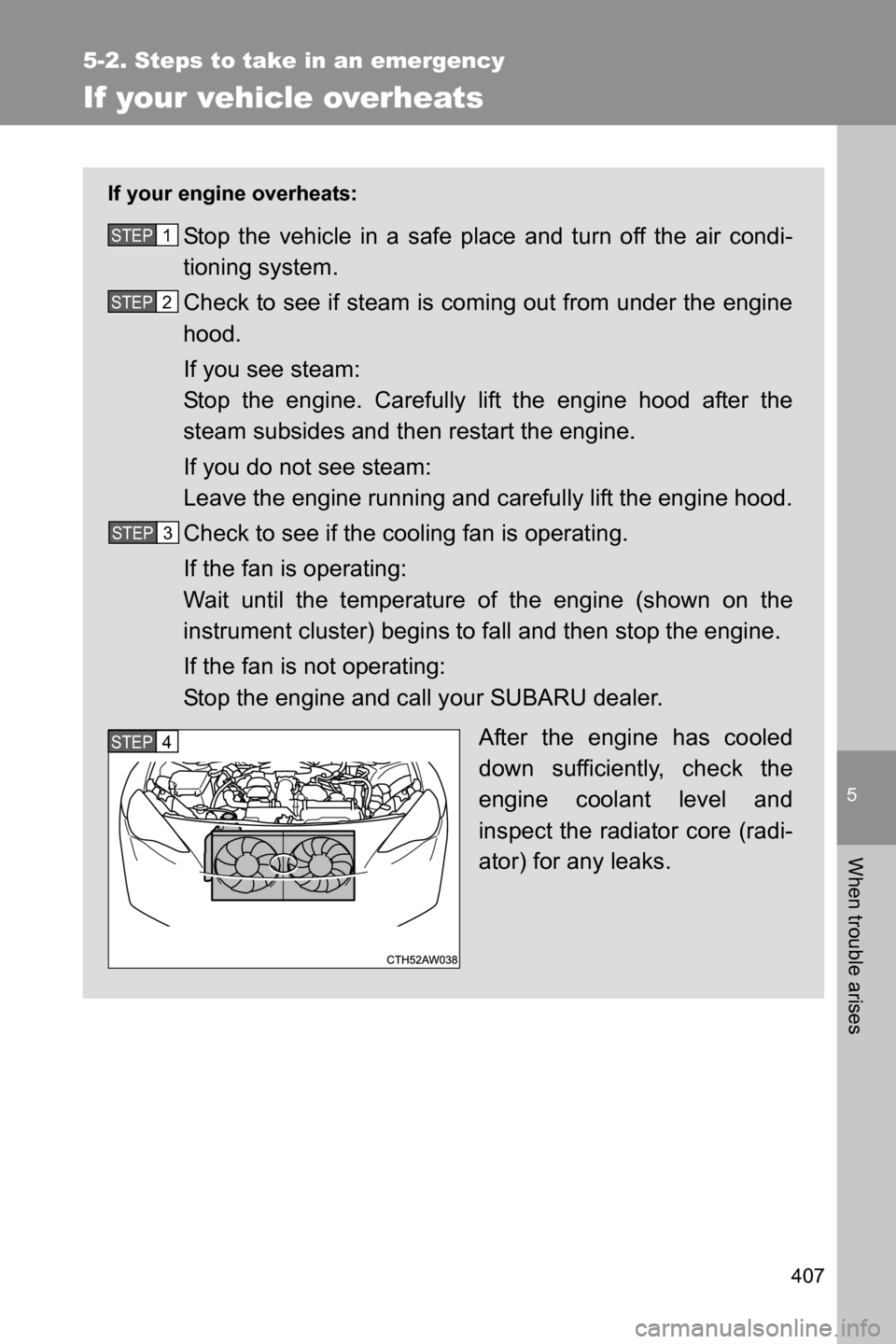
After the engine has cooled
down sufficiently, check the
engine coolant level and
inspect the radiator core (radi-
ator) for any leaks.STEP 1
STEP 2
STEP 3
STEP 4