tow SUBARU BRZ 2016 1.G Owner's Manual
[x] Cancel search | Manufacturer: SUBARU, Model Year: 2016, Model line: BRZ, Model: SUBARU BRZ 2016 1.GPages: 490, PDF Size: 6.01 MB
Page 251 of 490
250 3-1. Using the air conditioning system and defogger
Switching between outside air mode and recirculated air mode
Press .
The mode switches between outside air mode (indicator off) and recircu-
lated air mode (indicator on) each time is pressed.
Adjusting the position of the air outlets
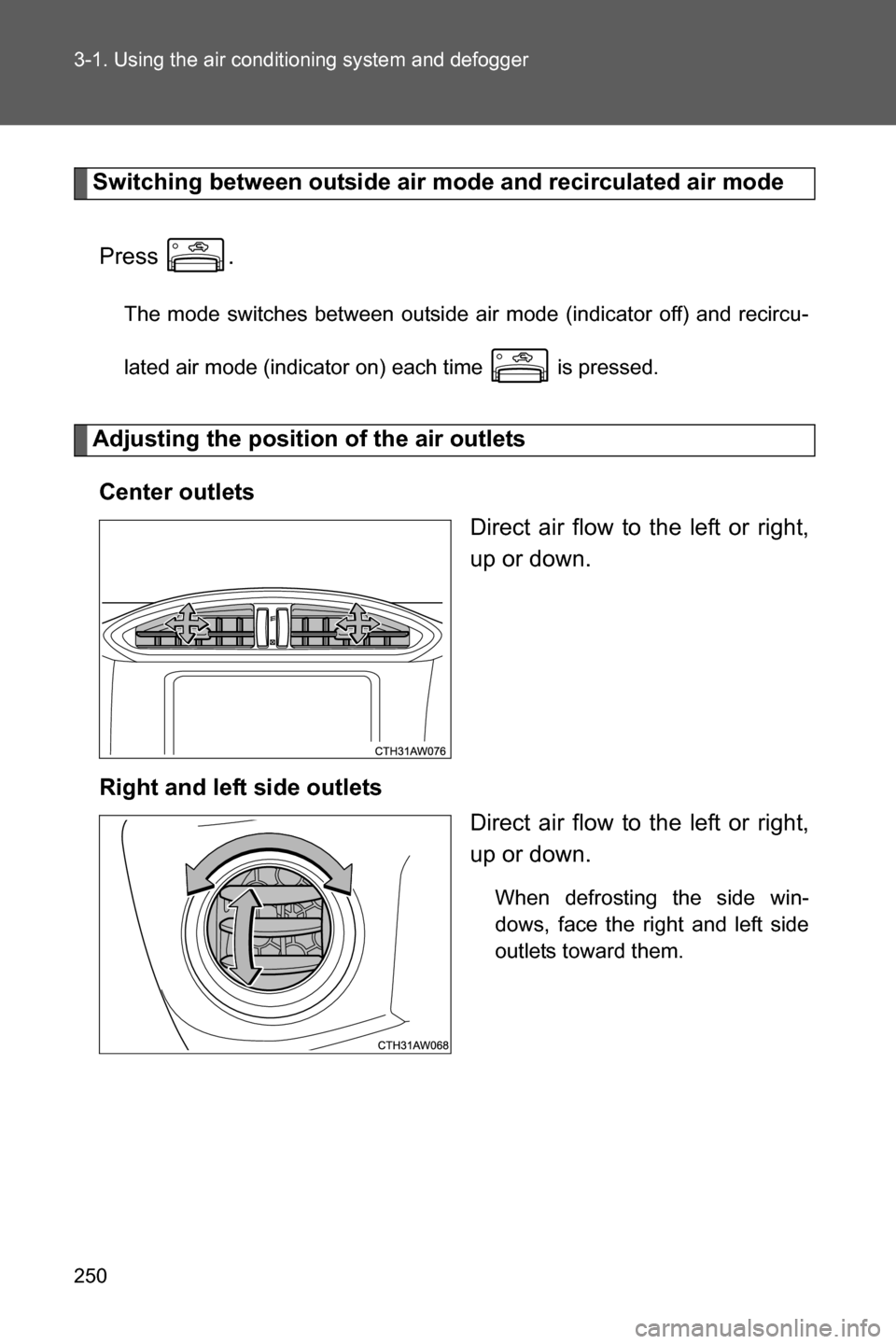
Center outlets
Direct air flow to the left or right,
up or down.
Right and left side outlets
Direct air flow to the left or right,
up or down.
When defrosting the side win-
dows, face the right and left side
outlets toward them.
Page 263 of 490
262 3-4. Using the storage features
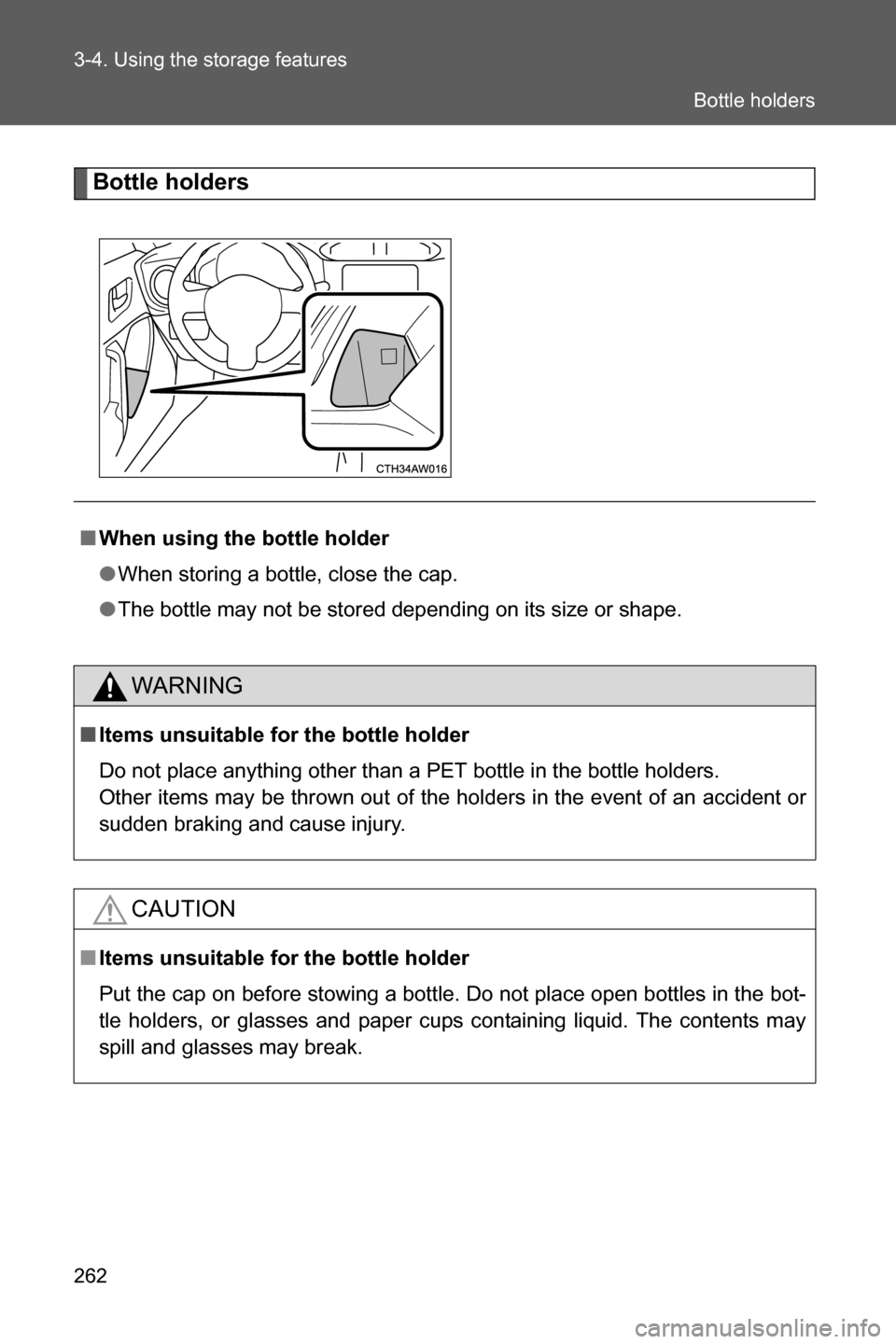
Bottle holders
■When using the bottle holder
●When storing a bottle, close the cap.
●The bottle may not be stored depending on its size or shape.
WARNING
■Items unsuitable for the bottle holder
Do not place anything other than a PET bottle in the bottle holders.
Other items may be thrown out of the holders in the event of an accident or
sudden braking and cause injury.
CAUTION
■Items unsuitable for the bottle holder
Put the cap on before stowing a bottle. Do not place open bottles in the bot-
tle holders, or glasses and paper cups containing liquid. The contents may
spill and glasses may break.
Bottle holders
Page 294 of 490
293
4
Maintenance and care
4-3. Do-it-yourself maintenance
Do-it-yourself ser vice precautions
If you perform maintenance yourself, be sure to follow the correct
procedure as given in these sections.
ItemsParts and tools
Battery condition (oP. 306)•Warm water
• Baking soda
• Grease
• Conventional wrench
(for terminal clamp bolts)
• Distilled water
Brake fluid level (oP. 304)• FMVSS No.116 fresh DOT 3 or
DOT 4 brake fluid
• Rag or paper towel
• Funnel (used only for adding
brake fluid)
Engine coolant level (oP. 302)• SUBARU Super Coolant or simi-
lar high-quality ethylene glycol-
based non-silicate, non-amine,
non-nitrite and non-borate coolant
with long-life hybrid organic acid
technology.
SUBARU Super Coolant is pre-
mixed with 50% coolant and
50% deionized water.
• Funnel (used only for adding
engine coolant)
Engine oil level (oP. 299)• SUBARU approved engine oil or
equivalent
• Rag or paper towel, funnel (used
only for adding engine oil)
Fuses (oP. 334)• Fuse with same amperage rating
as original
Page 302 of 490
301 4-3. Do-it-yourself maintenance
4
Maintenance and care
●When the engine is operated at high engine speeds
●When the engine is operated under heavy loads
●When towing a trailer
●When the engine idles for long periods of time
●When the vehicle is operated in stop and go and/or heavy traffic situa-
tions
●When the vehicle is used under severe thermal conditions
●When the vehicle accelerates and decelerates frequently
Under these or similar conditions, you should check your oil at least every
2nd fuel fill-up and change your engine oil more frequently. If your oil con-
sumption rate is greater than 1 quart every 1,200 miles or 1 liter every 2,000
kilometers, contact your SUBARU dealer who may perform a test under con-
trolled conditions.
WARNING
■Used engine oil
●Used engine oil contains potentially harmful contaminants which may
cause skin disorders such as inflammation or skin cancer, so care should
be taken to avoid prolonged and repeated contact. To remove used engine
oil from your skin, wash thoroughly with soap and water.
●Dispose of used oil and filters only in a safe and acceptable manner. Do
not dispose of used oil and filters in household trash, in sewers or onto the
ground.
Call your SUBARU dealer, service station or auto parts store for informa-
tion concerning recycling or disposal.
●Do not leave used engine oil within the reach of children.
Page 327 of 490
326
4-3. Do-it-yourself maintenance
Air conditioning filter
The air conditioning filter must be changed regularly to maintain air
conditioning efficiency.
■Removal method
Vehicles without a keyless access with push button
start system
Turn the engine switch off.
Vehicles with a keyless access with push button start
system
Turn the push-button ignition switch off.
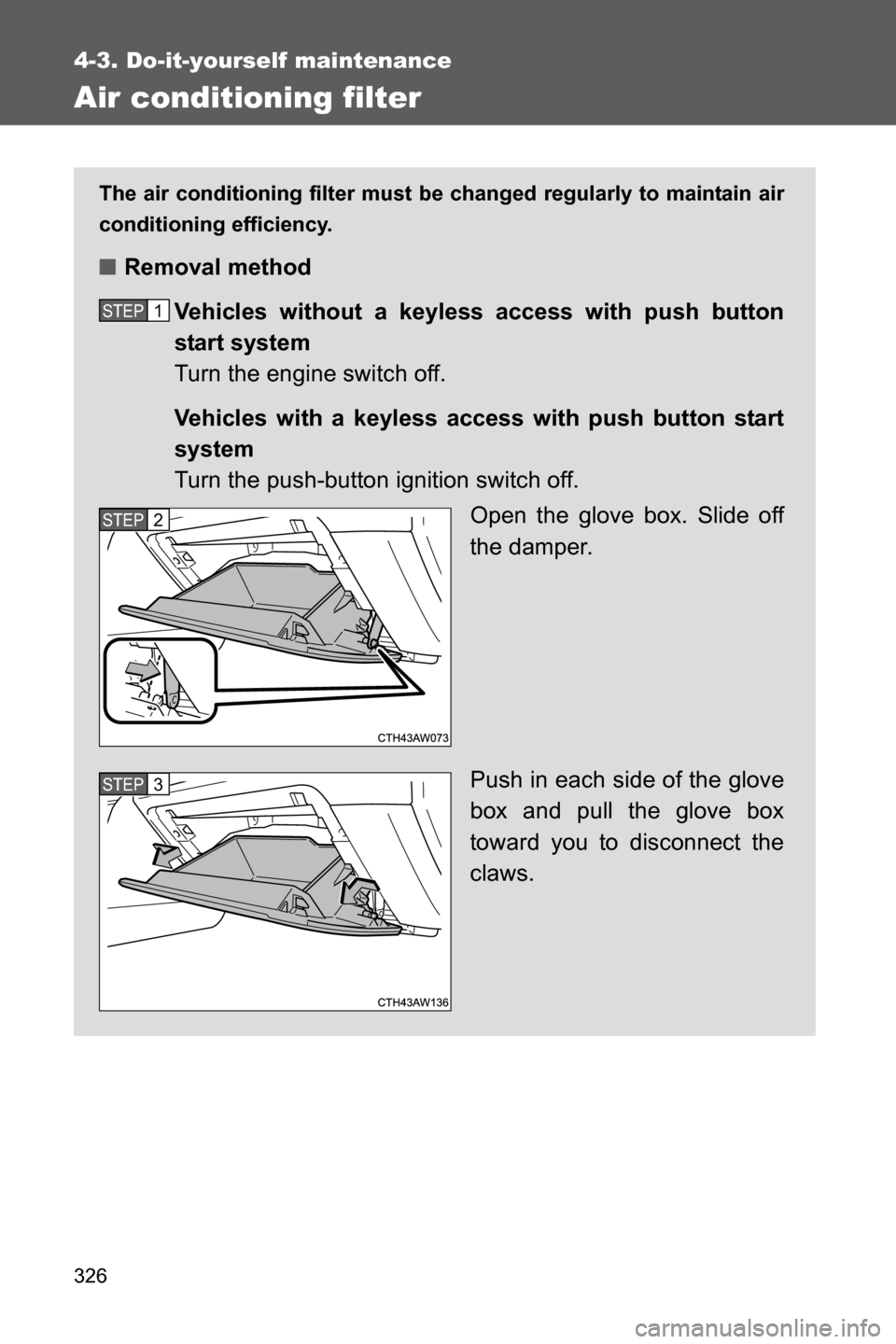
Open the glove box. Slide off
the damper.
Push in each side of the glove
box and pull the glove box
toward you to disconnect the
claws.
STEP 1
STEP 2
STEP 3
Page 346 of 490
345 4-3. Do-it-yourself maintenance
4
Maintenance and care
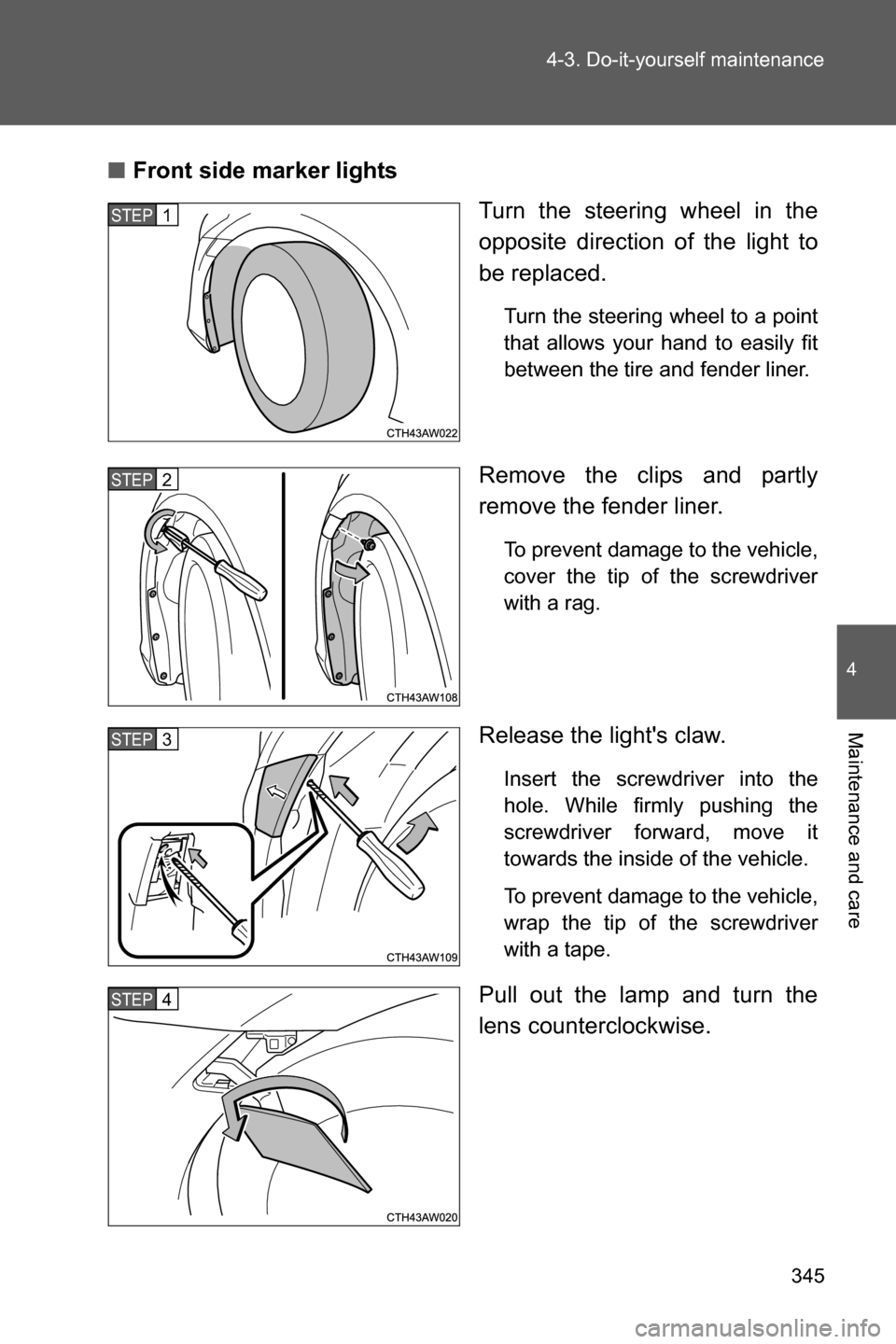
■Front side marker lights
Turn the steering wheel in the
opposite direction of the light to
be replaced.
Turn the steering wheel to a point
that allows your hand to easily fit
between the tire and fender liner.
Remove the clips and partly
remove the fender liner.
To prevent damage to the vehicle,
cover the tip of the screwdriver
with a rag.
Release the light's claw.
Insert the screwdriver into the
hole. While firmly pushing the
screwdriver forward, move it
towards the inside of the vehicle.
To prevent damage to the vehicle,
wrap the tip of the screwdriver
with a tape.
Pull out the lamp and turn the
lens counterclockwise.
STEP 1
STEP 2
STEP 3
STEP 4
Page 358 of 490
When trouble arises5
357
5-1. Essential information
Hazard warning
flashers .......................... 358
If your vehicle needs to
be towed ........................ 359
If you think something
is wrong ......................... 366
Fuel pump shut off
system ........................... 3675-2. Steps to take in an
emergency
If a warning light turns
on or a warning buzzer
sounds... ....................... 368
If you have a flat tire......... 382
If the engine will not
start ................................ 393
If the select lever cannot
be shifted from P ............ 396
If you lose your keys ........ 397
If the access key does not
operate properly ............. 398
If the battery is
discharged ..................... 402
If your vehicle
overheats ....................... 407
If the vehicle becomes
stuck .............................. 410
Page 360 of 490
5
When trouble arises
359
5-1. Essential information
If your vehicle needs to be towed
Emergency towing
If a tow truck is not available in an emergency, your vehicle may be
temporarily towed using a cable or chain secured to the emergency
towing eyelet to move the vehicle to a safe location or to free a stuck
vehicle from sand or snow. This should only be attempted on hard
surfaced roads for short distances at low speeds.
A driver must be in the vehicle to steer and operate the brakes. The
vehicle's wheels, drive train, axles, steering and brakes must be in
good condition.
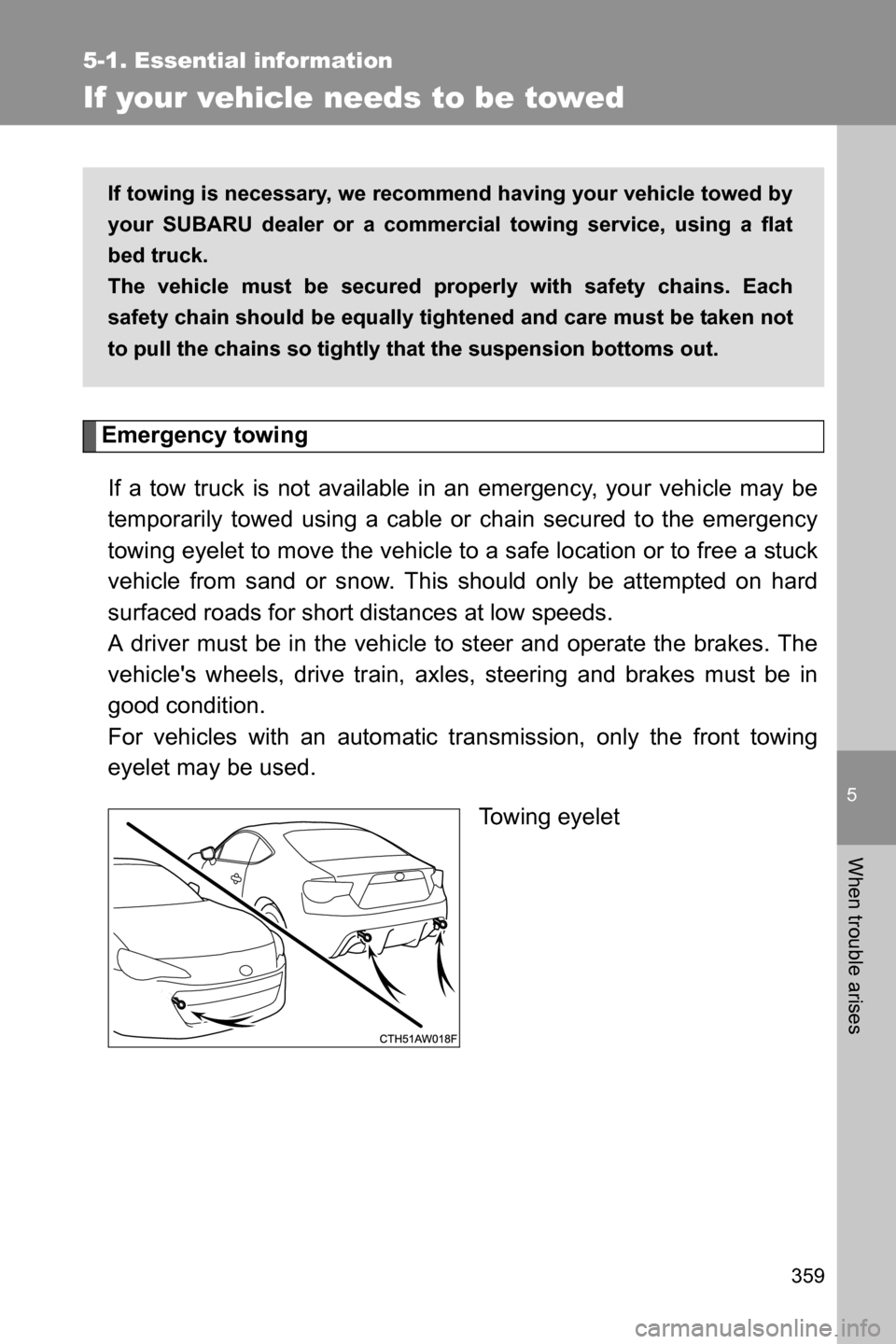
For vehicles with an automatic transmission, only the front towing
eyelet may be used.
Towing eyelet
If towing is necessary, we recommend having your vehicle towed by
your SUBARU dealer or a commercial towing service, using a flat
bed truck.
The vehicle must be secured properly with safety chains. Each
safety chain should be equally tightened and care must be taken not
to pull the chains so tightly that the suspension bottoms out.
Page 361 of 490
360 5-1. Essential information
■Before emergency towing
Release the parking brake.
Shift the select lever to N (vehicles with an automatic transmission)
or shift lever to neutral (vehicles with a manual transmission).
Vehicles without a keyless access with push button start system:
Turn the engine switch to the “ACC” (engine off) or “ON” (engine
running) position.
Vehicles with a keyless access with push button start system: Turn
the push-button ignition switch to “ACC” (engine off) or “ON”
(engine running) mode.
■If towing a vehicle
Do not tow another vehicle. If towing a vehicle that has broken down is
unavoidable, avoid towing a vehicle that is heavier than your vehicle. Also,
do not pull out a vehicle that has fallen into a ditch.
WARNING
■Caution while towing
●Use extreme caution when towing the vehicle.
Avoid sudden starts or erratic driving maneuvers which place excessive
stress on the emergency towing eyelets and the cables or chains. Always
be cautious of the surroundings and other vehicles while towing.
●If the engine is not running, the power assist for the brakes and steering
will not function, making steering and braking more difficult.
STEP 1
STEP 2
STEP 3
Page 362 of 490
5
When trouble arises
361 5-1. Essential information
Installing towing eyelet
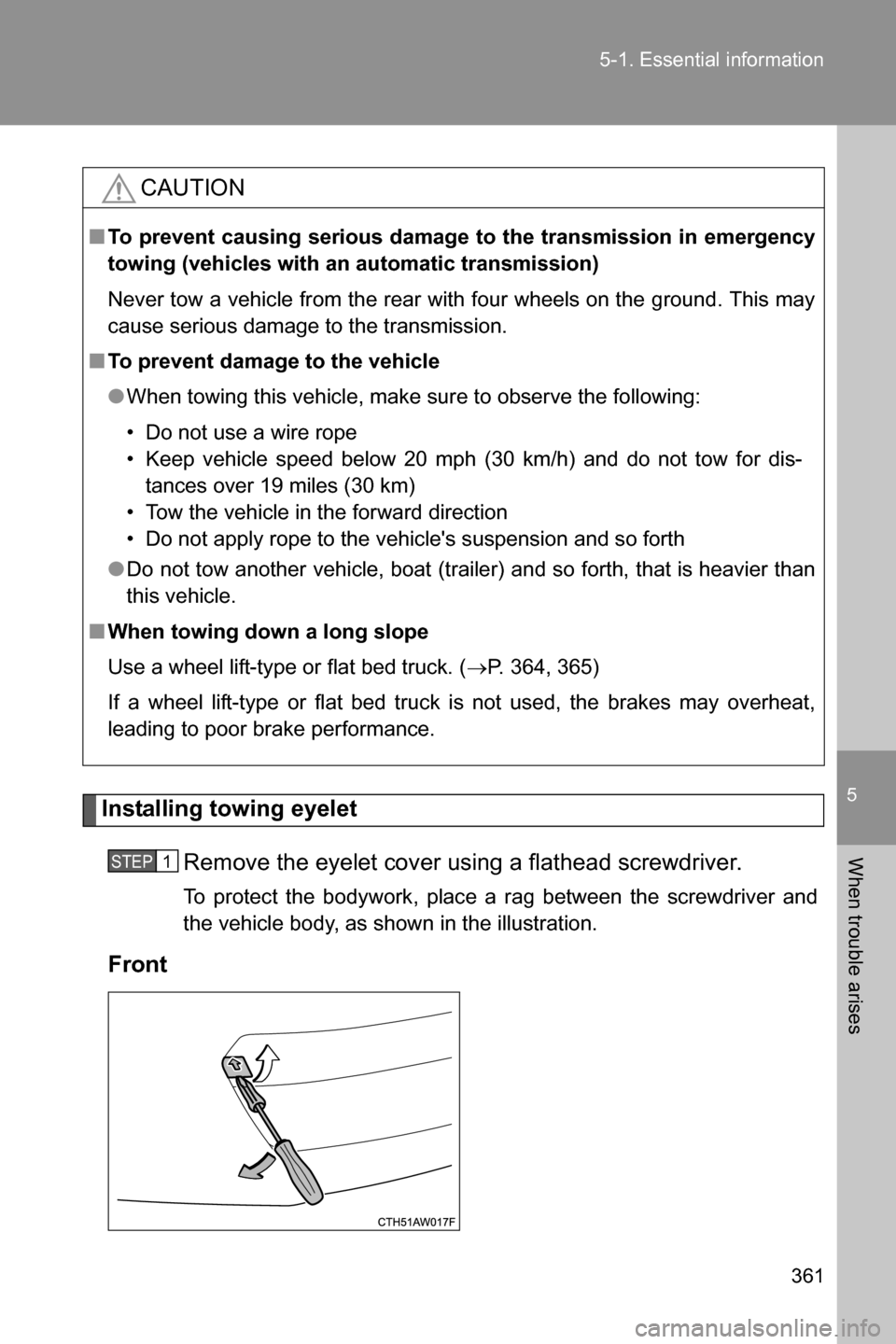
Remove the eyelet cover using a flathead screwdriver.
To protect the bodywork, place a rag between the screwdriver and
the vehicle body, as shown in the illustration.
Front
CAUTION
■To prevent causing serious damage to the transmission in emergency
towing (vehicles with an automatic transmission)
Never tow a vehicle from the rear with four wheels on the ground. This may
cause serious damage to the transmission.
■To prevent damage to the vehicle
●When towing this vehicle, make sure to observe the following:
• Do not use a wire rope
• Keep vehicle speed below 20 mph (30 km/h) and do not tow for dis-
tances over 19 miles (30 km)
• Tow the vehicle in the forward direction
• Do not apply rope to the vehicle's suspension and so forth
●Do not tow another vehicle, boat (trailer) and so forth, that is heavier than
this vehicle.
■When towing down a long slope
Use a wheel lift-type or flat bed truck. (oP. 364, 365)
If a wheel lift-type or flat bed truck is not used, the brakes may overheat,
leading to poor brake performance.
STEP 1