warning light SUBARU BRZ 2016 1.G Owner's Manual
[x] Cancel search | Manufacturer: SUBARU, Model Year: 2016, Model line: BRZ, Model: SUBARU BRZ 2016 1.GPages: 490, PDF Size: 6.01 MB
Page 128 of 490

127 1-7. Safety information
1
Before driving
■Child*5, *7
■Unoccupied
■There is a malfunction in the system
Indicator/
warning light“AIR BAG ON” and “AIR BAG OFF”
indicator lights“AIR BAG
OFF” or “AIR
BAG ON”*5
SRS airbag system warning light Off
Front passenger’s seatbelt reminder lightOff or
flashing
*3, *5
DevicesFront passenger airbag Off or on
*5
Front side airbag*4
On
Front curtain airbag*4
Front passenger’s seatbelt pretensioner*4
Indicator/
warning light“AIR BAG ON” and “AIR BAG OFF”
indicator lights“AIR BAG
OFF”
SRS airbag system warning light
Off
Front passenger’s seatbelt reminder light
DevicesFront passenger airbag Off
Front side airbag
*4
On
Front curtain airbag*4
Front passenger’s seatbelt pretensioner*4
Indicator/
warning light“AIR BAG ON” and “AIR BAG OFF”
indicator lights“AIR BAG
OFF”
SRS airbag system warning light On
Front passenger’s seatbelt reminder light Off
DevicesFront passenger airbag Off
Front side airbag
*4
On
Front curtain airbag*4
Front passenger’s seatbelt pretensioner*4
Page 133 of 490

132 1-7. Safety information
WARNING
■Front passenger occupant detection system precautions
Observe the following precautions regarding front passenger occupant
detection system.
Failure to do so may cause the occupant detection system to not function
correctly, resulting in death or serious injury.
●Wear the seatbelt properly.
●Do not apply excessive force to the seat.
●Do not put sharp object(s) on the seat or pierce the seat upholstery.
●Do not put objects under the front passenger seat.
●Do not use a seat accessory, such as a cushion or seat cover, that covers
the seat cushion surface.
●Do not spill liquid on the front passenger seat. If liquid is spilled, wipe it off
immediately and dry the seat. If the airbag warning light illuminates, dry
the seat until the warning light turns off. If the airbag warning light stays on
even when the seat has dried, do not allow anyone to sit on the front pas-
senger seat and have the system checked by your SUBARU dealer. If the
airbag warning light does not illuminate, check that the airbag ON/OFF
indicator light works properly. If the indicator light does not work properly,
do not allow anyone to sit in the front passenger’s seat and have the sys-
tem inspected by your SUBARU dealer.
●Do not remove or disassemble the front passenger seat. Also, do not
replace or modify the seat upholstery or foam inside the seat.
●Do not install any accessory (such as an audio amplifier) other than a gen-
uine SUBARU accessory under the front passenger’s seat.
●Do not place a magnetized items near the seatbelt buckle.
Page 137 of 490
136 1-7. Safety information
●Front passenger’s seat
Do not install a child restraint system (including a booster cushion) due to
the hazard to children posed by the passenger’s airbag.
●Rear seat seating positions
Recommended installing positions for the child restraint systems.
In these positions, the following equipment is provided for installing a child
restraint system.
• Automatic/Emergency Locking Retractor (ALR/ELR) seatbelts
• ISOFIX anchor bars
• Top tether anchorages
Some types of child restraints might not be able to be secured firmly due to
projection of the seat cushion.
In this seating position, you should use only a child restraint system that
has a bottom base that fits snugly against the contours of the seat cushion
and can be securely retained using the seatbelt.
WARNING
■Child restraint precautions
●For effective protection in automobile accidents and sudden stops, a child
must be properly restrained, using a seatbelt or child restraint system
depending on the age and size of the child. Holding a child in your arms is
not a substitute for a child restraint system. In an accident, the child can be
crushed against the windshield, or between you and the vehicle's interior.
●SUBARU strongly urges the use of a proper child restraint system that
conforms to the size of the child, installed on the rear seat. According to
accident statistics, the child is safer when properly restrained in the rear
seat than in the front seat.
●Never install a rear-facing child restraint system on the front passenger
seat even if the “AIR BAG OFF” indicator light is illuminated. In the event
of an accident, the force of the rapid inflation of the front passenger airbag
can cause death or serious injury to the child if the rear-facing child
restraint system is installed on the front passenger seat.
Page 148 of 490
When driving2
147
2-1. Driving procedures
Driving the vehicle............ 148
Push-button ignition
switch ............................. 162
Engine (ignition)
switch ............................. 171
Automatic
transmission................... 174
Manual Transmission ....... 181
Turn signal lever .............. 184
Parking brake ................... 185
Horn ................................. 186
2-2. Instrument cluster
Gauges and meters ......... 187
Indicators and warning
lights .............................. 192
Multi-information
display............................ 1972-3. Operating the lights and
windshield wipers
Headlight switch ............... 202
Fog light switch ................ 208
Windshield wipers and
washer ........................... 209
2-4. Using other driving
systems
Cruise control ................... 212
Driving assist systems ..... 217
2-5. Driving information
Cargo and luggage .......... 224
Vehicle load limits ............ 228
Winter driving tips ............ 229
Trailer towing ................... 234
Dinghy towing .................. 235
Page 154 of 490

153 2-1. Driving procedures
2
When driving
WARNING
■When starting the vehicle (vehicles with an automatic transmission)
●Always keep your foot on the brake pedal while stopped with the engine
running. This prevents the vehicle from creeping.
●Firmly depress the brake pedal because engine speed may increase
immediately after starting the engine, when the air conditioning system is
operating, when turning the steering wheel, etc., thereby causing creeping
to become stronger. Apply the parking brake as necessary.
■When driving the vehicle
●Do not drive if you are unfamiliar with the location of the brake and accel-
erator pedals to avoid depressing the wrong pedal.
• Accidentally depressing the accelerator pedal instead of the brake
pedal will result in sudden acceleration that may lead to an accident
that could result in death or serious injury.
• When backing up, you may twist your body around, leading to a diffi-
culty in operating the pedals. Make sure to operate the pedals properly.
• Make sure to keep a correct driving posture even when moving the
vehicle only slightly. This allows you to depress the brake and acceler-
ator pedals properly.
• Depress the brake pedal using your right foot. Depressing the brake
pedal using your left foot may delay response in an emergency, result-
ing in an accident.
●Do not drive the vehicle over or stop the vehicle near flammable materials.
The exhaust system and exhaust gases can be extremely hot. These hot
parts may cause a fire if there is any flammable material nearby.
●On vehicles with an automatic transmission, do not let the vehicle roll
backward while the select lever is in a driving position, or roll forward while
the select lever is in R.
Doing so may cause the engine to stall or lead to poor brake and steering
performance, resulting in an accident or damage to the vehicle.
●If the smell of exhaust is noticed inside the vehicle, open the windows and
check that the trunk lid is closed. Large amounts of exhaust in the vehicle
can cause driver drowsiness and an accident, resulting in death or a seri-
ous health hazard. Have the vehicle inspected by your SUBARU dealer
immediately.
Page 156 of 490

155 2-1. Driving procedures
2
When driving
WARNING
●Always check that all passengers' arms, heads or other parts of their body
are not outside the vehicle, as this may result in death or serious injury.
●Do not drive in excess of the speed limit. Even if the legal speed limit per-
mits it, do not drive over 85 mph (140 km/h) unless your vehicle has high-
speed capability tires. Driving over 85 mph (140 km/h) may result in tire
failure, loss of control and possible injury. Be sure to consult a tire dealer
to determine whether the tires on your vehicle are high-speed capability
tires or not before driving at such speeds.
■When driving on slippery road surfaces
●Sudden braking, acceleration and steering may cause tire slippage and
reduce your ability to control the vehicle, resulting in an accident.
●Sudden acceleration, engine braking due to shifting, or changes in engine
speed could cause the vehicle to skid, resulting in an accident.
●After driving through a puddle, lightly depress the brake pedal to make
sure that the brakes are functioning properly. Wet brake pads may prevent
the brakes from functioning properly. If the brakes on only one side are wet
and not functioning properly, steering control may be affected, resulting in
an accident.
■When shifting the select lever or shift lever
●On vehicles with an automatic transmission, be careful not to shift the
select lever with the accelerator pedal depressed. Shifting the select lever
to a gear other than P or N may lead to unexpected rapid acceleration of
the vehicle that may cause an accident and result in death or serious
injury.
●Do not place items in the select lever’s or shift lever’s surrounding area. It
may cause incorrect operation.
●If the select lever’s or shift lever’s boot is pulled out during cleaning, return
it to its previous position. If the select lever’s or shift lever’s boot is left
pulled out, the select lever or shift lever may become difficult to operate.
Page 158 of 490
157 2-1. Driving procedures
2
When driving
WARNING
■When the vehicle is parked
●Do not leave glasses, cigarette lighters, spray cans, or soft drink cans in
the vehicle when it is in the sun.
Doing so may result in the following:
• Gas may leak from a cigarette lighter or spray can, and may lead to a
fire.
• The temperature inside the vehicle may cause the plastic lenses and
plastic material of glasses to deform or crack.
• Soft drink cans may fracture, causing the contents to spray over the
interior of the vehicle, and may also cause a short circuit in the vehi-
cle's electrical components.
●Do not leave cigarette lighters in the vehicle. If a cigarette lighter is in a
place such as the glove box or on the floor, it may be lit accidentally when
luggage is loaded or the seat is adjusted, causing a fire.
●Do not attach suction cups to the windshield or windows. Do not place
containers such as air fresheners on the instrument panel or dashboard.
Suction cups or containers may act as lenses, causing a fire in the vehicle.
●Do not leave a door or window open if the curved glass is coated with a
metallized film such as a silver-colored one. Reflected sunlight may cause
the glass to act as a lens, causing a fire.
●Always apply the parking brake, shift the select lever to P (vehicles with an
automatic transmission only), stop the engine and lock the vehicle.
Do not leave the vehicle unattended while the engine is running.
●Do not touch the exhaust pipe while the engine is running or immediately
after turning the engine off.
Doing so may cause burns.
●Do not leave the engine running in an area with snow build-up, or where it
is snowing. If snowbanks build up around the vehicle while the engine is
running, exhaust gases may collect and enter the vehicle. This may lead
to death or a serious health hazard.
Page 166 of 490
165 2-1. Driving procedures
2
When driving
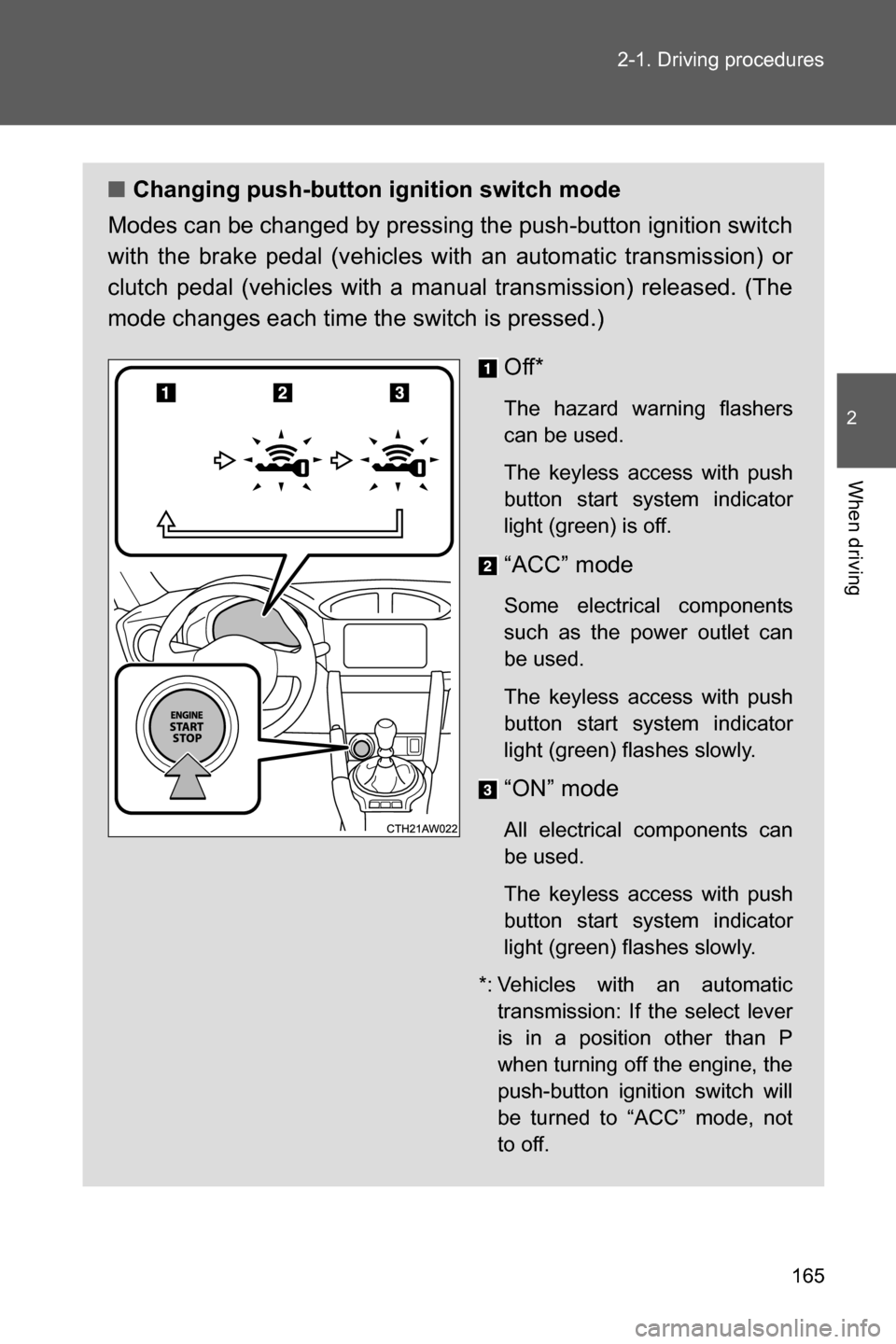
■Changing push-button ignition switch mode
Modes can be changed by pressing the push-button ignition switch
with the brake pedal (vehicles with an automatic transmission) or
clutch pedal (vehicles with a manual transmission) released. (The
mode changes each time the switch is pressed.)
Off*
The hazard warning flashers
can be used.
The keyless access with push
button start system indicator
light (green) is off.
“ACC” mode
Some electrical components
such as the power outlet can
be used.
The keyless access with push
button start system indicator
light (green) flashes slowly.
“ON” mode
All electrical components can
be used.
The keyless access with push
button start system indicator
light (green) flashes slowly.
*: Vehicles with an automatic
transmission: If the select lever
is in a position other than P
when turning off the engine, the
push-button ignition switch will
be turned to “ACC” mode, not
to off.
Page 170 of 490

169 2-1. Driving procedures
2
When driving
WARNING
■When starting the engine
●Always start the engine while sitting in the driver’s seat. Do not depress
the accelerator pedal while starting the engine under any circumstances.
Doing so may cause an accident resulting in death or serious injury.
●If the keyless access with push button start system indicator light flashes
in green after the engine has started, never drive the vehicle. The steering
wheel is still locked, and it may result in an accident.
■Caution while driving
If engine failure occurs while the vehicle is moving, do not lock or open the
doors until the vehicle reaches a safe and complete stop. Activation of the
steering lock in this circumstance may lead to an accident, resulting in death
or serious injury.
■Stopping the engine
Do not touch the push-button ignition switch during driving.
When the push-button ignition switch is pressed for 2 seconds or longer or
pressed 3 times successively, the engine will stop. When the engine stops,
the brake booster will not function. A greater foot pressure will be required
on the brake pedal.
The power steering system will not operate either. A greater force will be
required to steer, and it may result in an accident.
Page 193 of 490
192
2-2. Instrument cluster
Indicators and war ning lights
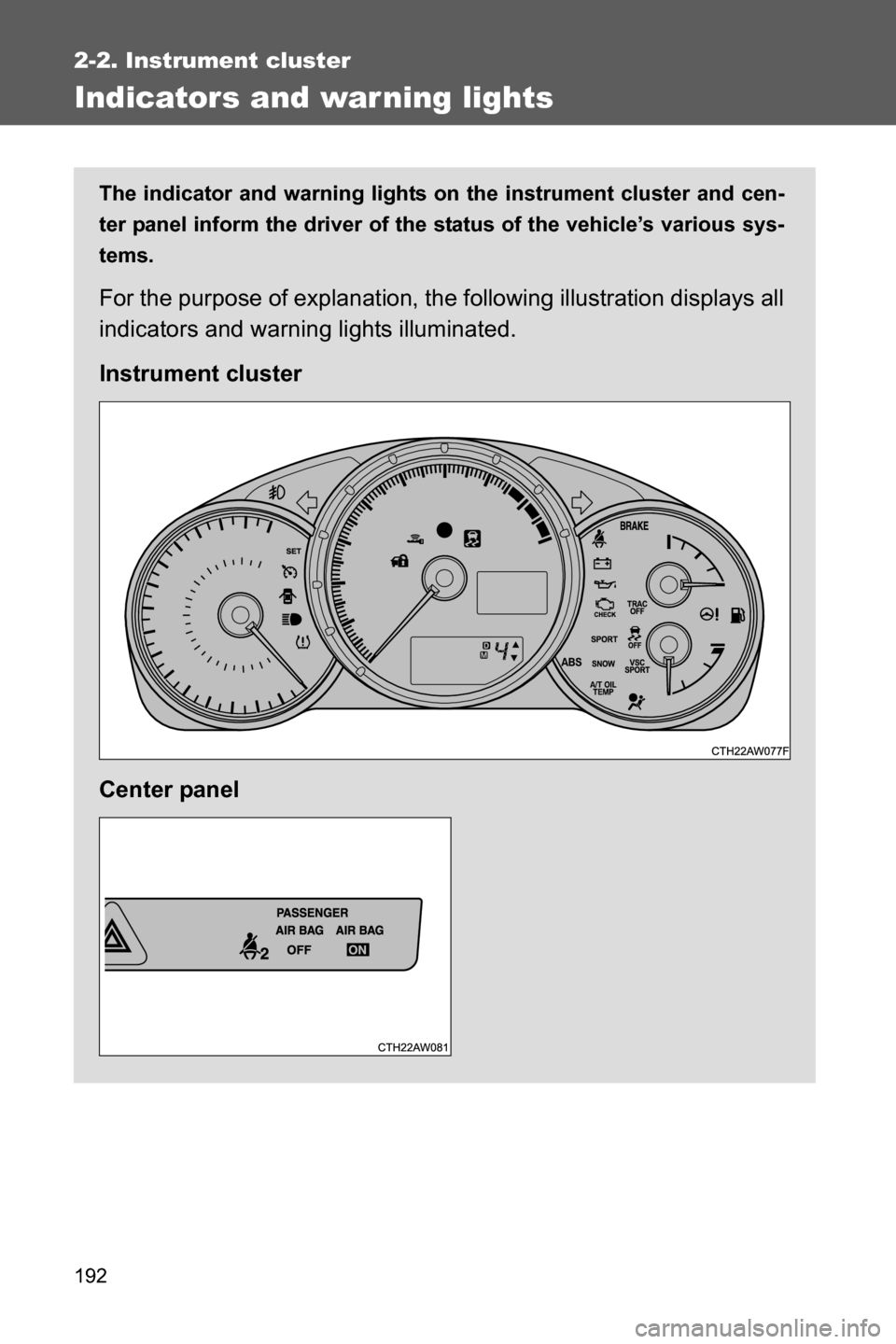
The indicator and warning lights on the instrument cluster and cen-
ter panel inform the driver of the status of the vehicle’s various sys-
tems.
For the purpose of explanation, the following illustration displays all
indicators and warning lights illuminated.
Instrument cluster
Center panel