alr SUBARU BRZ 2016 1.G Owners Manual
[x] Cancel search | Manufacturer: SUBARU, Model Year: 2016, Model line: BRZ, Model: SUBARU BRZ 2016 1.GPages: 490, PDF Size: 6.01 MB
Page 41 of 490
40 1-2. Opening, closing and locking the doors and trunk lid
■Conditions affecting operation
Vehicles without a keyless access with push button start system
The remote keyless entry system may not operate normally in the following
situations:
●When the transmitter battery is depleted
●Near a TV tower, electric power plant, gas station, radio station, large dis-
play, airport or other facility that generates strong radio waves or electri-
cal noise
●When carrying a portable radio, cellular phone or other wireless commu-
nication devices
●When the transmitter is in contact with, or is covered by a metallic object
●When other transmitters (that emit radio waves) are being used nearby
●If window tint with a metallic content or metallic objects are attached to
the rear window
Vehicles with a keyless access with push button start system
oP. 3 0
■If the remote keyless entry system does not operate properly (vehicles
with a keyless access with push button start system)
Locking and unlocking the doors, unlocking the trunk lid: Use the mechanical
key. (oP. 398)
■Key battery depletion
Vehicles without a keyless access with push button start system
If the remote keyless entry system does not operate, the battery may be
depleted. Replace the battery when necessary. (oP. 329)
Vehicles with a keyless access with push button start system
oP. 3 4
■When the access key battery is fully depleted
oP. 329
■Confirmation of the registered key number
The number of keys already registered to the vehicle can be confirmed. Ask
your SUBARU dealer for details.
■Customization that can be configured at your SUBARU dealer
Settings (e.g. remote keyless entry system) can be changed.
(Customizable features oP. 443)
Page 61 of 490
60 1-3. Adjustable components (seats, mirrors, steering wheel)
■Emergency locking retractor (ELR)
The retractor will lock the belt during a sudden stop or on impact. It may also
lock if you lean forward too quickly. A slow, easy motion will allow the belt to
extend so that you can move around fully.
■Automatic locking retractor (ALR)
When a passenger's shoulder belt is completely extended and then
retracted even slightly, the belt is locked in that position and cannot be
extended. This feature is used to hold the child restraint system (CRS) firmly.
To free the belt again, fully retract the belt and then pull the belt out once
more. (oP. 138)
■Child seatbelt usage
The seatbelts of your vehicle are principally designed for persons of adult
size.
●Use a child restraint system appropriate for the child, until the child
becomes large enough to properly wear the vehicle's seatbelt.
(oP. 134)
●When the child becomes large enough to properly wear the vehicle's
seatbelt, follow the instructions on P. 58 regarding seatbelt usage.
■Seatbelt pretensioners
●Seatbelt pretensioners are not designed to activate in minor frontal or
side impact, in rear impacts or in roll-over accidents.
●The following four components operate simultaneously when the vehicle
is subjected to a severe frontal collision.
• Seatbelt pretensioner for driver
• Seatbelt pretensioner for front passenger
• SRS front airbag for driver
• SRS front airbag for front passenger*
*: This does not operate while the occupant detection system determines to
deactivate the airbag operation. For details, refer to “Front passenger’s
SRS frontal airbag” (oP. 9 7 )
●The following two components operate simultaneously when the vehicle
is subjected to a severe collision on the driver’s seat side of the vehicle.
• Seatbelt pretensioner for driver
• Side airbag for driver
Page 137 of 490
136 1-7. Safety information
●Front passenger’s seat
Do not install a child restraint system (including a booster cushion) due to
the hazard to children posed by the passenger’s airbag.
●Rear seat seating positions
Recommended installing positions for the child restraint systems.
In these positions, the following equipment is provided for installing a child
restraint system.
• Automatic/Emergency Locking Retractor (ALR/ELR) seatbelts
• ISOFIX anchor bars
• Top tether anchorages
Some types of child restraints might not be able to be secured firmly due to
projection of the seat cushion.
In this seating position, you should use only a child restraint system that
has a bottom base that fits snugly against the contours of the seat cushion
and can be securely retained using the seatbelt.
WARNING
■Child restraint precautions
●For effective protection in automobile accidents and sudden stops, a child
must be properly restrained, using a seatbelt or child restraint system
depending on the age and size of the child. Holding a child in your arms is
not a substitute for a child restraint system. In an accident, the child can be
crushed against the windshield, or between you and the vehicle's interior.
●SUBARU strongly urges the use of a proper child restraint system that
conforms to the size of the child, installed on the rear seat. According to
accident statistics, the child is safer when properly restrained in the rear
seat than in the front seat.
●Never install a rear-facing child restraint system on the front passenger
seat even if the “AIR BAG OFF” indicator light is illuminated. In the event
of an accident, the force of the rapid inflation of the front passenger airbag
can cause death or serious injury to the child if the rear-facing child
restraint system is installed on the front passenger seat.
Page 139 of 490
138
1-7. Safety information
Installing child restraints
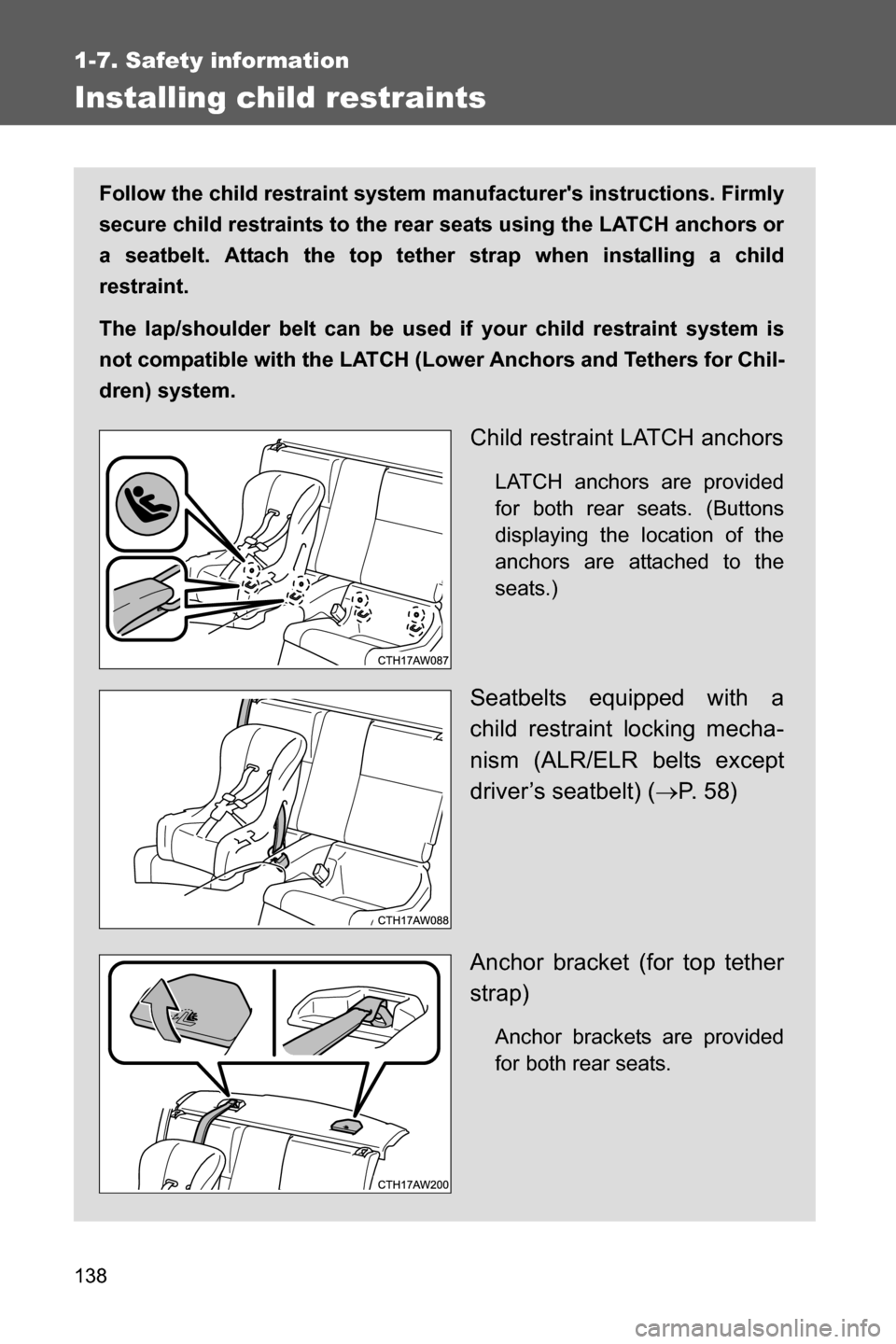
Follow the child restraint system manufacturer's instructions. Firmly
secure child restraints to the rear seats using the LATCH anchors or
a seatbelt. Attach the top tether strap when installing a child
restraint.
The lap/shoulder belt can be used if your child restraint system is
not compatible with the LATCH (Lower Anchors and Tethers for Chil-
dren) system.
Child restraint LATCH anchors
LATCH anchors are provided
for both rear seats. (Buttons
displaying the location of the
anchors are attached to the
seats.)
Seatbelts equipped with a
child restraint locking mecha-
nism (ALR/ELR belts except
driver’s seatbelt) (oP. 5 8 )
Anchor bracket (for top tether
strap)
Anchor brackets are provided
for both rear seats.
Page 146 of 490
145 1-7. Safety information
1
Before driving
■When installing a child restraint system with LATCH anchors and a top
tether strap
Depending on the child restraint system's size and shape, if the child
restraint system is installed to the LATCH anchors first, it may not be possi-
ble to attach the top tether strap to the anchor bracket.
In that case, first temporarily attach the top tether strap to the anchor
bracket, install the child restraint system using the lower anchors and then
tighten the top tether strap.
■Laws and regulations pertaining to anchorages
The LATCH system conforms to FMVSS225 or CMVSS210.2.
Child restraint systems conforming to FMVSS213 or CMVSS213 specifica-
tions can be used.
This vehicle is designed to conform to the SAE J1819.
WARNING
■When installing a booster seat
To prevent the belt from going into ALR lock mode, do not fully extend the
shoulder belt. ALR mode causes the belt to tighten only. This could cause
injury or discomfort to the child. (oP. 60)
■When installing a child restraint system
Follow the directions given in the child restraint system installation manual
and fix the child restraint system securely in place.
If the child restraint system is not correctly fixed in place, the child or other
passengers may be injured or even killed in the event of sudden braking,
sudden swerving or an accident.
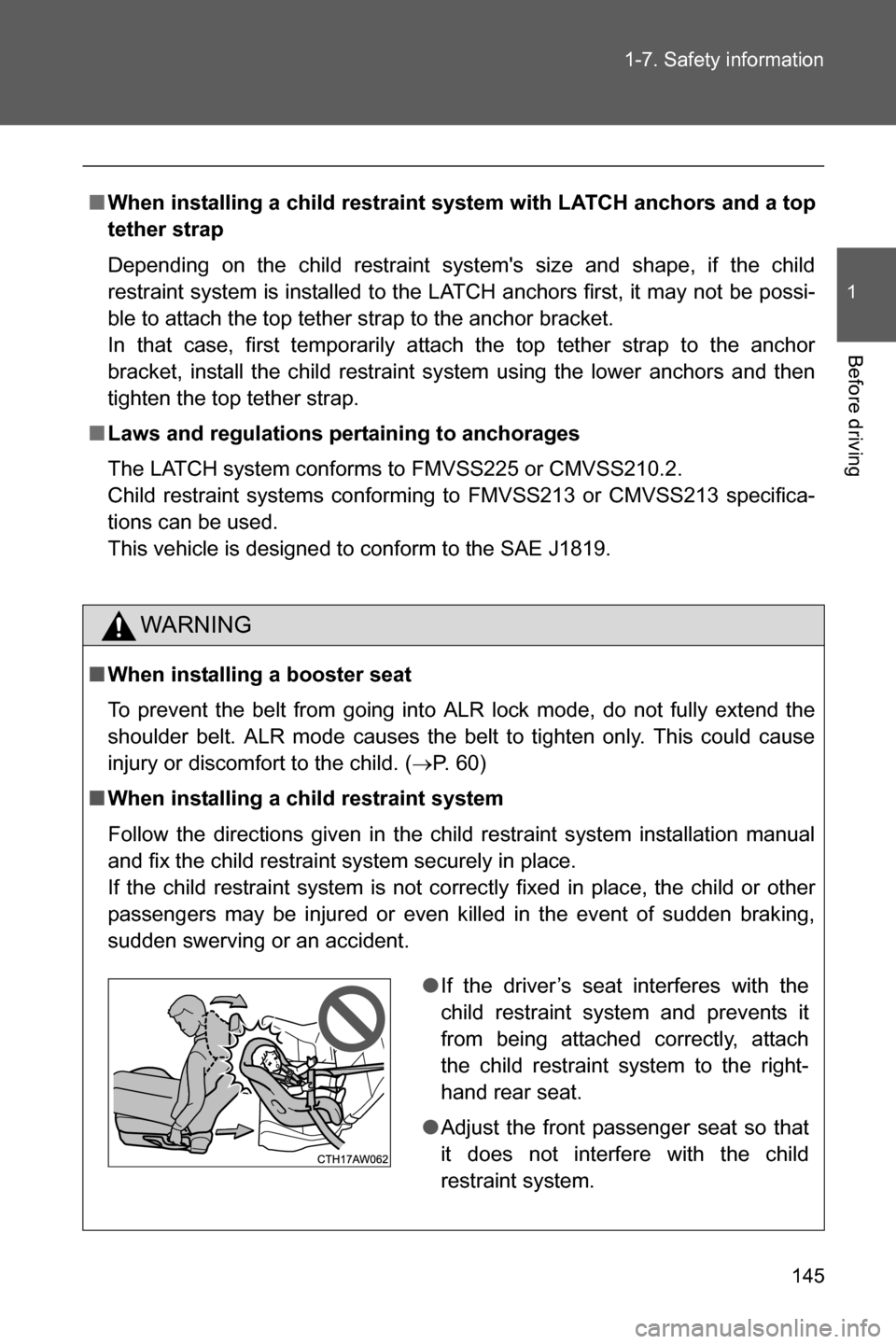
●If the driver’s seat interferes with the
child restraint system and prevents it
from being attached correctly, attach
the child restraint system to the right-
hand rear seat.
●Adjust the front passenger seat so that
it does not interfere with the child
restraint system.
Page 301 of 490
300 4-3. Do-it-yourself maintenance
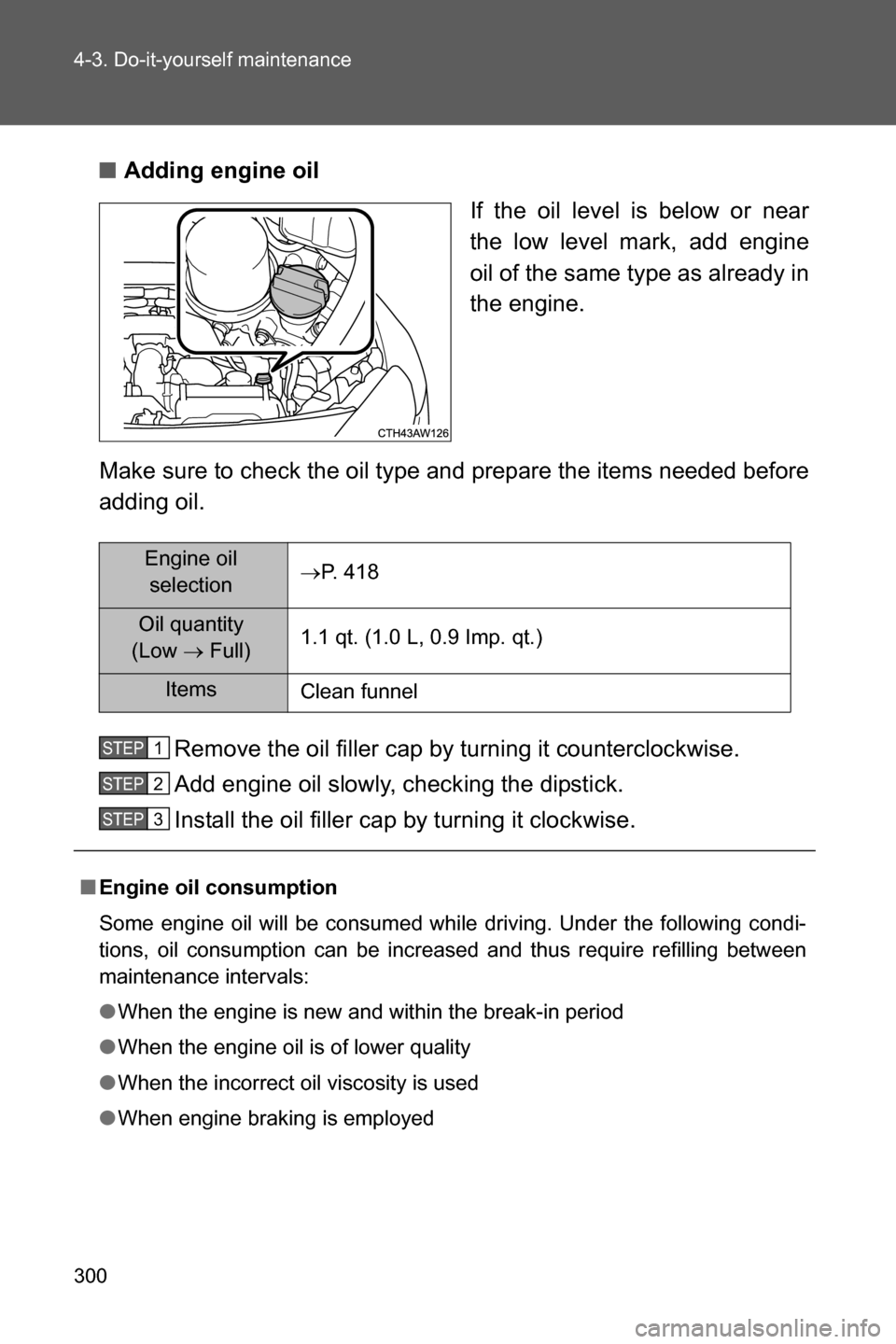
■Adding engine oil
If the oil level is below or near
the low level mark, add engine
oil of the same type as already in
the engine.
Make sure to check the oil type and prepare the items needed before
adding oil.
Remove the oil filler cap by turning it counterclockwise.
Add engine oil slowly, checking the dipstick.
Install the oil filler cap by turning it clockwise.
Engine oil
selectionoP. 418
Oil quantity
(Low o Full)1.1 qt. (1.0 L, 0.9 Imp. qt.)
Items
Clean funnel
■Engine oil consumption
Some engine oil will be consumed while driving. Under the following condi-
tions, oil consumption can be increased and thus require refilling between
maintenance intervals:
●When the engine is new and within the break-in period
●When the engine oil is of lower quality
●When the incorrect oil viscosity is used
●When engine braking is employed
STEP 1
STEP 2
STEP 3
Page 475 of 490

474
Abbreviation list
Abbreviation/Acronym list
ABBREVIATIONSMEANING
ABS Anti-lock Brake System
ACC Accessory
ALR Automatic Locking Retractor
CRS Child Restraint System
DISP Display
ECU Electronic Control Unit
EDR Event Data Recorder
ELR Emergency Locking Retractor
GAWR Gross Axle Weight Ratings
GVWR Gross Vehicle Weight Rating
I/M Emission inspection and maintenance
LATCH Lower Anchors and Tethers for Children
LED Light Emitting Diode
LSD Limited Slip Differential
M + S Mud and Snow
MMT Methylcyclopentadienyl Manganese Tricarbonyl
MTBE Methyl Tertiary Butyl Ether
OBD On Board Diagnostics
SRS Supplemental Restraint System
TIN Tire Identification Number
TPMS Tire Pressure Monitoring System
TRAC Traction Control
VIN Vehicle Identification Number
VSC Vehicle Stability Control
Page 482 of 490

481 Alphabetical index
Odometer ................................. 187
Oil
Engine oil.............................. 299
Opener
Engine hood ......................... 296
Fuel filler lid ............................ 74
Trunk lid.................................. 45
Outside rear view mirrors
Adjusting and folding .............. 67
Outside temperature
display ................................... 268
Overheating, Engine ............... 407
Parking brake .......................... 185
Parking lights
Switch ................................... 202
Power outlets........................... 269
Power windows ......................... 70
Radiator.................................... 304
Rear seats .................................. 54
Rear side marker lights
Replacing light bulbs ............ 342
Switch ................................... 202
Wattage ................................ 425
Rear turn signal lights
Replacing light bulbs ............ 342
Switch ................................... 184
Wattage ................................ 425
Rear window defogger............ 254
Replacing
Fuses.................................... 334
Key battery ........................... 329
Light bulbs ............................ 342
Tires ..................................... 382
Reporting safety defects
for U.S. owners ..................... 449
REV indicator........................... 152Seatbelts
Adjusting the seatbelt ..............58
Automatic Locking
Retractor (ALR).....................60
Child restraint system
installation ...........................138
Cleaning and maintaining
the seatbelts .......................281
Emergency Locking
Retractor (ELR).....................60
How to wear your seatbelt....... 58
How your child should
wear the seatbelt ..................60
Pregnant women,
proper seatbelt use ...............62
Reminder light .......................371
Seatbelt guide .........................59
Seatbelt pretensioners ............59
Seat heaters..............................271
Seating capacity.......................228
Seats
Adjustment ..............................51
Adjustment precautions...........52
Child seats/child restraint
system installation ..............138
Cleaning ................................280
Head restraint..........................56
Properly sitting in the seat .......87
Seat heaters ..........................271O
P
R
S