brake SUBARU BRZ 2017 1.G Service Manual
[x] Cancel search | Manufacturer: SUBARU, Model Year: 2017, Model line: BRZ, Model: SUBARU BRZ 2017 1.GPages: 540, PDF Size: 6.88 MB
Page 258 of 540
256 2-4. Using other driving systems
●Any of the following conditions may occur when the above systems are
operating. None of these indicates that a malfunction has occurred.
• Vibrations may be felt through the vehicle body and steering.
• A motor sound may be heard after the vehicle comes to a stop.
• The brake pedal may pulsate slightly after the ABS is activated.
• The brake pedal may move down slightly after the ABS is activated.
■Electric power steering operation sound
When the steering wheel is operated, a motor sound (whirring sound) may
be heard. This does not indicate a malfunction.
■Reduced effectiveness of the electric power steering system
The effectiveness of the electric power steering system is reduced to pre-
vent the system from overheating when there is frequent steering input over
an extended period of time. The steering wheel may feel heavy as a result.
Should this occur, refrain from excessive steering input or stop the vehicle
and turn the engine off. The electric power steering system should return to
normal after a little while.
WARNING
■The ABS does not operate effectively when
●Tires with inadequate gripping ability are used (such as excessively worn
tires on a snow covered road).
●The vehicle hydroplanes while driving at high speed on wet or slick roads.
■Stopping distance when the ABS is operating may exceed that of nor-
mal conditions
The ABS is not designed to shorten the vehicle’s stopping distance. Always
maintain a safe distance from the vehicle in front of you in the following situ-
ations:
●When driving on dirt, gravel or snow-covered roads
●When driving with tire chains
●When driving over bumps in the road
●When driving over roads with potholes or uneven surfaces
Page 259 of 540
257 2-4. Using other driving systems
2
When driving
WARNING
■TRAC may not operate effectively when
Directional control and power may not be achievable while driving on slip-
pery road surfaces, even if the TRAC system is operating.
Do not drive the vehicle in conditions where stability and power may be lost.
■When the Vehicle stability control (VSC) and/or brake LSD function is
activated
The slip indicator light flashes. Always drive carefully. Reckless driving may
cause an accident. Exercise particular care when the indicator light flashes.
■When the TRAC/Vehicle stability control (VSC) systems are turned off
Be especially careful and drive at a speed appropriate to the road condi-
tions. As these are the systems to help ensure vehicle stability and driving
force, do not turn the TRAC/Vehicle stability control (VSC) systems off
unless necessary.
■Replacing tires
Make sure that all tires are of the specified size, brand, tread pattern and
total load capacity. In addition, make sure that the tires are inflated to the
recommended tire inflation pressure level.
The ABS, TRAC and Vehicle stability control (VSC) systems will not function
correctly if different tires are installed on the vehicle.
Contact your SUBARU dealer for further information when replacing tires or
wheels.
■Handling of tires and suspension
Using tires with any kind of problem or modifying the suspension will affect
the driving assist systems, and may cause a system to malfunction.
Page 260 of 540
258
2-4. Using other driving systems
Hill star t assist
The hill start assist system helps to maintain braking force to assist
starting off forward while facing uphill or starting off backward while
facing downhill. As the hill start assist system is initially disabled,
enable the system to make it operable. The enabled/disabled setting
will be maintained the next time the engine is started.
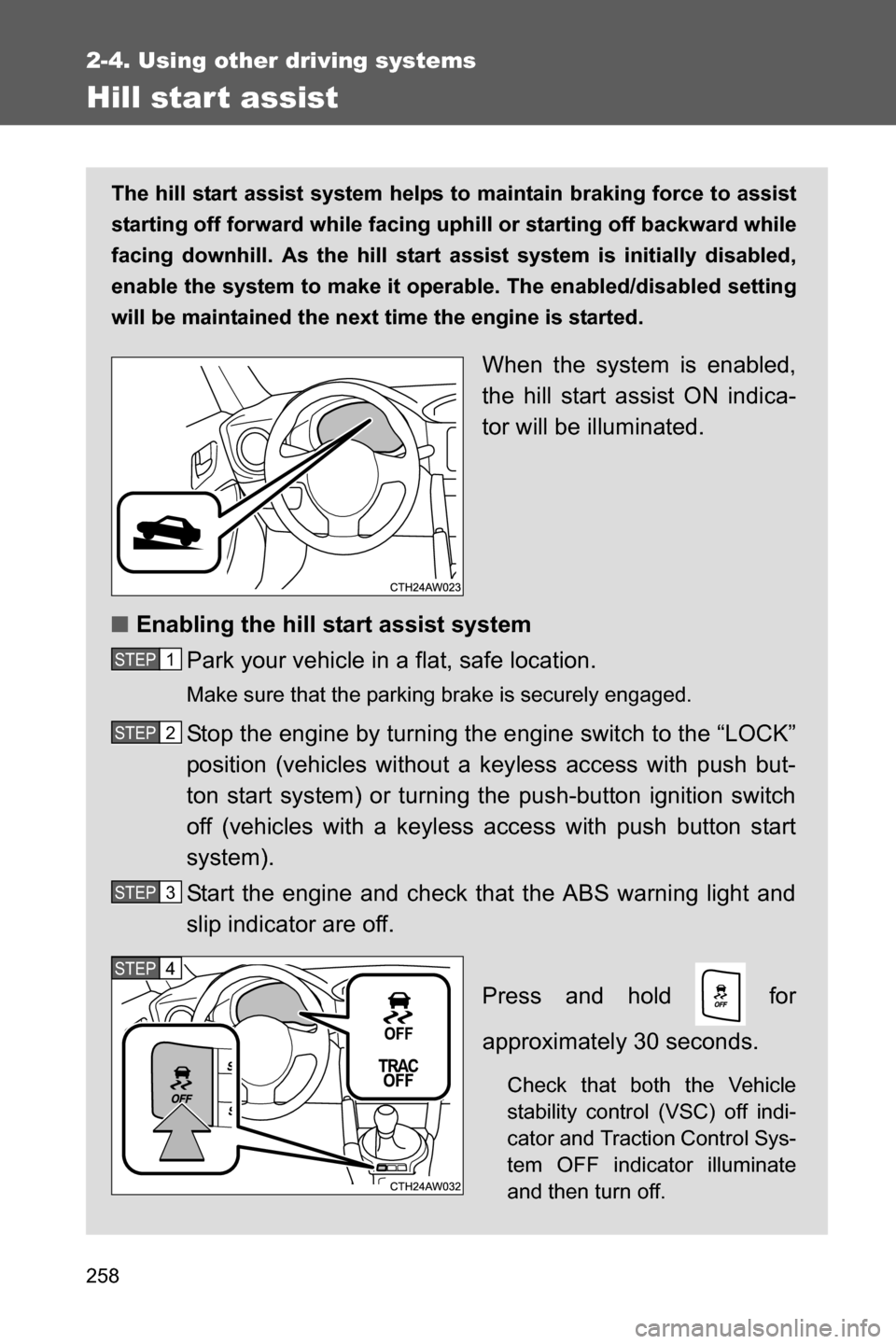
When the system is enabled,
the hill start assist ON indica-
tor will be illuminated.
■Enabling the hill start assist system
Park your vehicle in a flat, safe location.
Make sure that the parking brake is securely engaged.
Stop the engine by turning the engine switch to the “LOCK”
position (vehicles without a keyless access with push but-
ton start system) or turning the push-button ignition switch
off (vehicles with a keyless access with push button start
system).
Start the engine and check that the ABS warning light and
slip indicator are off.
Press and hold for
approximately 30 seconds.
Check that both the Vehicle
stability control (VSC) off indi-
cator and Traction Control Sys-
tem OFF indicator illuminate
and then turn off.
STEP 1
STEP 2
STEP 3
STEP 4
Page 262 of 540
260 2-4. Using other driving systems
■When enabling the hill start assist system
●If the hill start assist ON indicator does not illuminate or if an incorrect
operation is performed, turn the engine switch to the “LOCK” position
(vehicles without a keyless access with push button start system) or turn
the push-button ignition switch off (vehicles with a keyless access with
push button start system) and then restart the enabling procedure from
.
●If is pressed and held for approximately 30 seconds or more, the
Vehicle stability control (VSC) off indicator and Traction Control System
OFF indicator will turn off and subsequent operations of the switch will be
rejected. In this case, the Vehicle stability control (VSC) system will oper-
ate in normal mode. (oP. 254) To enable , turn the engine switch to
the “ACC” or “LOCK” position (vehicles without a keyless access with
push button start system) or turn the push-button ignition switch off (vehi-
cles with a keyless access with push button start system) and then
restart the engine.
■Operating conditions of the hill start assist system
When the following conditions are met, the hill start assist system will oper-
ate:
●Vehicles with an automatic transmission: The select lever is in D or M
(when starting off forward on while facing uphill) or in R (when starting off
backward while facing downhill).
●Vehicles with a manual transmission: The shift lever is in a position other
than R (when starting off forward while facing uphill) or in R (when start-
ing off backward while facing downhill).
●The vehicle is stopped.
●The accelerator pedal is not depressed.
●The parking brake is not engaged.
STEP 4
Page 263 of 540

261 2-4. Using other driving systems
2
When driving
■The hill start assist system will not operate when
The hill start assist system will not operate when any of the following condi-
tions are met:
●Vehicles with an automatic transmission: The select lever is in a position
other than D or M (when facing uphill) or in a position other than R (when
facing downhill).
●Vehicles with a manual transmission: The shift lever is in R (when facing
uphill) or in a position other than R (when facing downhill).
●Vehicles with an automatic transmission: The accelerator pedal is
depressed.
●The parking brake is applied.
●Vehicles with a manual transmission: The clutch is engaged.
●Approximately 2 seconds have elapsed since the brake pedal was
released.
●The hill start assist ON indicator is not illuminated.
●Vehicles without a keyless access with push button start system: The
engine switch is turned to the “ACC” or “LOCK” position.
●Vehicles with a keyless access with push button start system: The push-
button ignition switch is turned to “ACC” mode or turned off.
■Notes for the hill start assist system
●A slight jolt may be felt when starting off backward with the select lever in
R (vehicles with an automatic transmission) or the shift lever in R (vehi-
cles with a manual transmission) and then moving forward.
●If the braking power of the hill start assist system is insufficient, depress
the brake pedal.
●While the vehicle is stopped, make sure to depress the brake pedal.
■The system may be malfunctioning when
In the following situations, the system may be malfunctioning. Have the vehi-
cle inspected by your SUBARU dealer.
●The slip indicator is illuminated.
●The hill start assist ON indicator turns off and a buzzer sounds.
Page 264 of 540

262 2-4. Using other driving systems
WARNING
■Hill start assist system precautions
●Do not overly rely on the hill start assist system. The hill start assist system
may not operate effectively on steep inclines and roads covered with ice.
●Unlike the parking brake, the hill start assist system is not intended to hold
the vehicle stationary for an extended period of time. Do not attempt to use
the hill start assist system to hold the vehicle on an incline, as doing so
may lead to an accident.
●Do not stop the engine while the hill start assist system is operating, as the
hill start assist system will stop operating, possibly leading to an accident.
Page 267 of 540
265 2-5. Driving information
2
When driving
WARNING
■Things that must not be carried in the trunk
The following things may cause a fire if loaded in the trunk:
●Receptacles containing gasoline
●Aerosol cans
■Storage precautions
Observe the following precautions.
Failure to do so may result in death or serious injury.
●Stow cargo and luggage in the trunk whenever possible.
●To prevent cargo and luggage from sliding forward during braking, do
not stack anything in the enlarged trunk. Keep cargo and luggage low,
as close to the floor as possible.
●When you fold down the rear seats, long items should not be placed
directly behind the front seats.
●Never allow anyone to ride in the enlarged trunk. It is not designed for
passengers. They should ride in their seats with their seatbelts prop-
erly fastened. Otherwise, they are much more likely to suffer death or
serious bodily injury, in the event of sudden braking, sudden swerving
or an accident.
●Do not place cargo or luggage in or on the following locations as the
item may get under the clutch, brake or accelerator pedal and prevent
the pedals from being depressed properly, block the driver’s vision, or
hit the driver or passengers, causing an accident:
• At the feet of the driver
• On the front passenger or rear seats (when stacking items)
• On the rear shelf
• On the instrument panel
• On the dashboard
●Secure all items in the occupant compartment, as they may shift and
injure someone during sudden braking, sudden swerving or an acci-
dent.
Page 271 of 540
269 2-5. Driving information
2
When driving
●Check for and remove any excess ice or snow that may have
accumulated on the exterior lights, vehicle's roof, chassis,
around the tires or on the brakes.
●Remove any snow or mud from the bottom of your shoes
before getting in the vehicle.
●If a door is opened and closed when its side window is frozen,
the window safety device will operate and the side window
open/close function linked to door operation may not operate
correctly. If this occurs, perform the following after the ice has
melted.
Open the side window until it is approximately halfway open
with the door closed.
Fully close the window by pulling the switch up to the one-
touch closing position and continue holding the switch for 1
second or more after the window fully closes.
The window position is reset and the safety device operations will
be released.
■When driving the vehicle
Accelerate the vehicle slowly, keep a safe distance between you
and the vehicle ahead, and drive at a reduced speed suitable to
road conditions.
■When parking the vehicle (in the winter time or in the cold
latitudes)
Park the vehicle and move the select lever to P (automatic trans-
mission) or shift lever to 1 or R (manual transmission) without
setting the parking brake. The parking brake may freeze up, pre-
venting it from being released. If necessary, block the wheels to
prevent inadvertent sliding or creeping.
STEP 1
STEP 2
Page 318 of 540

316 4-1. Maintenance and care
WARNING
■When washing the vehicle
●Do not wash the engine compartment and area adjacent to it. If water
enters the engine air intake or electrical parts it will cause engine trouble or
a malfunction of the power steering.
●When washing the vehicle, the brakes may get wet. As a result, the brake
stopping distance will be longer. To dry the brakes, drive the vehicle at a
safe speed while lightly depressing the brake pedal to heat up the brakes.
●When washing inner fenders, underbody, bumpers and protruding objects
such as exhaust pipes and exhaust finishers, be careful to prevent injuries
from contacting sharp ends.
■Precautions regarding the exhaust pipes
Exhaust gasses cause the exhaust pipes and rear bumper diffusers to
become quite hot.
When washing the vehicle, be careful not to touch the pipes and diffusers
until they have cooled sufficiently, as touching hot exhaust pipes and rear
bumper diffusers can cause burns.
CAUTION
■To prevent paint deterioration and corrosion on the body and compo-
nents (aluminum wheels etc.)
●Wash the vehicle immediately in the following cases:
• After driving near the sea coast
• After driving on salted roads
• If you see coal tar or tree sap on the paint surface
• If you see dead insects, insect droppings or bird droppings on the paint
• After driving in an area contaminated with soot, oily smoke, mine dust,
iron powder or chemical substances
• If the vehicle becomes heavily soiled in dust or mud
• If liquids such as benzene and gasoline are spilled on the paint surface
●If the paint is chipped or scratched, have it repaired immediately.
●To prevent the wheels from corroding, remove any dirt and store in a place
with low humidity when storing the wheels.
Page 319 of 540

317 4-1. Maintenance and care
4
Maintenance and care
CAUTION
■Protective film for side sill plates
Make sure to remove the protective film. Failure to do so may cause rust,
depending on conditions.
■Cleaning the exterior lights
●Wash carefully. Do not use organic substances or scrub with a hard brush.
This may damage the surfaces of the lights.
●Do not apply wax on the surfaces of the lights.
Wax may cause damage to the lenses.
■To prevent damage to the windshield wiper arms
When lifting the wiper arms away from the windshield, pull the driver side
wiper arm upward first, and repeat for the passenger side. When returning
the wipers to their original position, do so from the passenger side first.
■When using a high pressure car wash
Do not bring the nozzle tip close to boots (rubber or resin manufactured
cover), connectors or the following parts. The parts may be damaged if they
come into contact with high-pressure water.
• Traction related parts
• Steering parts
• Suspension parts
• Brake parts