wheel SUBARU BRZ 2018 Owners Manual
[x] Cancel search | Manufacturer: SUBARU, Model Year: 2018, Model line: BRZ, Model: SUBARU BRZ 2018Pages: 568, PDF Size: 8.94 MB
Page 467 of 568
5
When trouble arises
467
5-2. Steps to take in an emergency
BRZ_U (A4450BE-A)
WARNING
■Replacing a flat tire
●Do not touch the disc wheels or the area around the brakes immedi-
ately after the vehicle has been driven.
After the vehicle has been driven the disc wheels and the area around
the brakes will be extremely hot. Touching these areas with hands, feet
or other body parts while changing a tire, etc. may result in burns.
●Do not attach a heavily damaged wheel ornament, as it may fly off the
wheel while the vehicle is moving.
●Failure to follow these precautions could cause the wheel nuts to
loosen and the tire to fall off, resulting in death or serious injury.
• Have the wheel nuts tightened with a torque wrench to 89 ft•lbf (120
N•m, 12.2 kgf•m) as soon as possible after changing wheels.
• When installing a tire, only use wheel nuts that have been specifi- cally designed for that wheel.
• If there are any cracks or deformations in the bolt screws, nut threads or bolt holes of the wheel, have the vehicle inspected by
your SUBARU dealer.
• When installing the wheel nuts, be sure to install them with the tapered ends facing inward. ( →P. 387)
Page 468 of 568
468 5-2. Steps to take in an emergency
BRZ_U (A4450BE-A)
WARNING
■When using the compact spare tire (vehicles with a compact spare
tire)
●Remember that your compact spare tire is specifically designed for
use with your vehicle. Do not use your compact spare tire on another
vehicle.
●Do not use two compact spare tires simultaneously.
●Replace the compact spare tire with a standard tire as soon as possi-
ble.
●Avoid sudden acceleration, abrupt steering, sudden braking and shift-
ing operations that cause sudden engine braking.
●Install the compact spare tire on a front wheel.
■When storing the compact spare tire (vehicles with a compact
spare tire)
Be careful not to catch fingers or other body parts between the compact
spare tire and the body of the vehicle.
■Speed limit when using the compact spare tire (vehicles with a
compact spare tire)
Do not drive at speeds in excess of 50 mph (80 km/h) when a compact
spare tire is installed on the vehicle.
The compact spare tire is not designed for driving at high speeds. Failing
to observe this precaution may lead to an accident causing death or seri-
ous injury.
Page 470 of 568
470 5-2. Steps to take in an emergency
BRZ_U (A4450BE-A)
CAUTION
■Do not drive the vehicle with a flat tire.
Do not continue driving with a flat tire.
Driving even a short distance with a flat tire can damage the tire and the
wheel beyond repair.
■Be careful when driving over bumps with the compact spare tire
installed on the vehicle (vehicles with a compact spare tire).
The vehicle becomes lower when driving with the compact spare tire
compared to when driving with standard tires. Be careful when driving
over uneven road surfaces.
■Driving with tire chains and the compact spare tire (vehicles with a
compact spare tire)
Do not fit tire chains to the compact spare tire.
Tire chains may damage the vehicle body and adversely affect driving
performance.
■When replacing the tires (vehicles with a tire pressure monitoring
system)
When removing or fitting the wheels, tires or the tire pressure warning
valve and transmitter, contact your SUBARU dealer as the tire pressure
warning valve and transmitter may be damaged if not handled correctly.
■To avoid damage to the tire pressure warning valves and transmit-
ters (vehicles with a tire pressure monitoring system)
When a tire is repaired with liquid sealants, the tire pressure warning
valve and transmitter may not operate properly. If a liquid sealant is
used, contact your SUBARU dealer or other qualified service shop as
soon as possible. Make sure to replace the tire pressure warning valve
and transmitter when replacing the tire. (→P. 375)
■Stowing the jack
When stowing the jack in the jack holder, make sure that the part that the
jack handle attaches to is pointing towards the inside of the trunk. Failure
to do so may damage the vehicle body.
Page 488 of 568
488
5-2. Steps to take in an emergency
BRZ_U (A4450BE-A)
If the vehicle becomes stuck
■When it is difficult to free the vehicle Carry out the following procedures if the tires spin or the vehicle
becomes stuck in mud, dirt, or snow:
Stop the engine. Set the parking brake and shift the select
lever to P (vehicles with an automatic transmission) or shift
lever to neutral (vehicles with a manual transmission).
Remove the mud, snow or sand from around the rear
wheels.
Place wood, stones or some other material under the rear
wheels to help provide traction.
Restart the engine.
Shift the select lever to the D or R position (vehicles with an
automatic transmission) or shift lever to 1 or R position
(vehicles with a manual transmission) and release the park-
ing brake. Then, while exercising caution, depress the
accelerator pedal.STEP 1
STEP 2
STEP 3
STEP 4
STEP 5
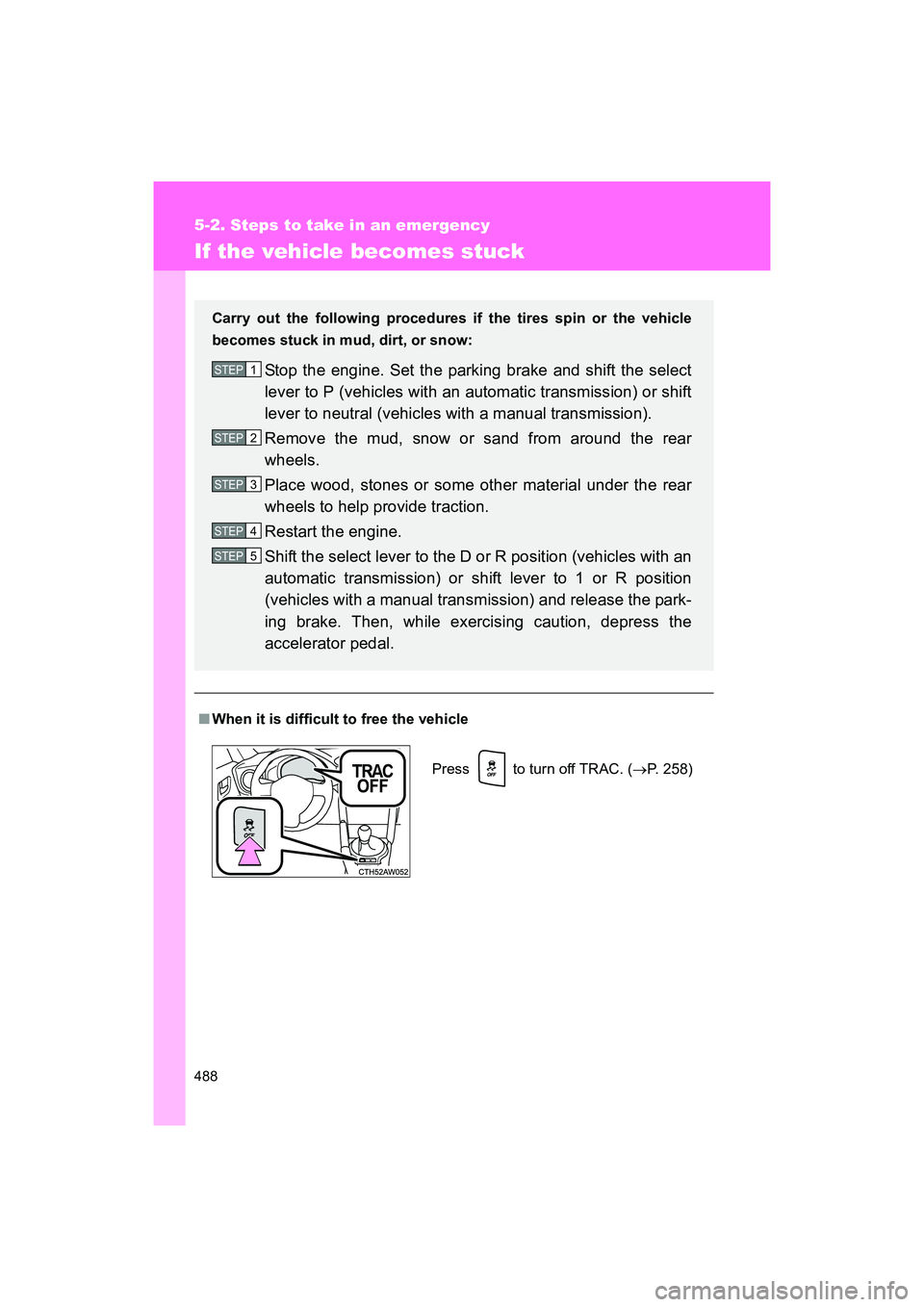
Press to turn off TRAC. ( →P. 258)
Page 489 of 568
5
When trouble arises
489
5-2. Steps to take in an emergency
BRZ_U (A4450BE-A)
WARNING
■
When attempting to free a stuck vehicle
If you choose to push the vehicle back and forth to free it, make sure the sur-
rounding area is clear to avoid striking other vehicles, objects or people. The
vehicle may also lunge forward or lunge back suddenly as it becomes free.
Use extreme caution.
■ When shifting the select lever
For vehicles with an automatic transmission, be careful not to shift the select
lever with the accelerator pedal depressed.
This may lead to unexpected rapid acceleration of the vehicle that may
cause an accident resulting in death or serious injury.
CAUTION
■To avoid damage to the transmission and other components
● Avoid spinning the rear wheels and depressing the accelerator pedal more
than necessary.
● If the vehicle remains stuck even after these procedures are performed,
the vehicle may require towing to be freed.
Page 492 of 568
492
BRZ_U (A4450BE-A)
6-1. Specifications
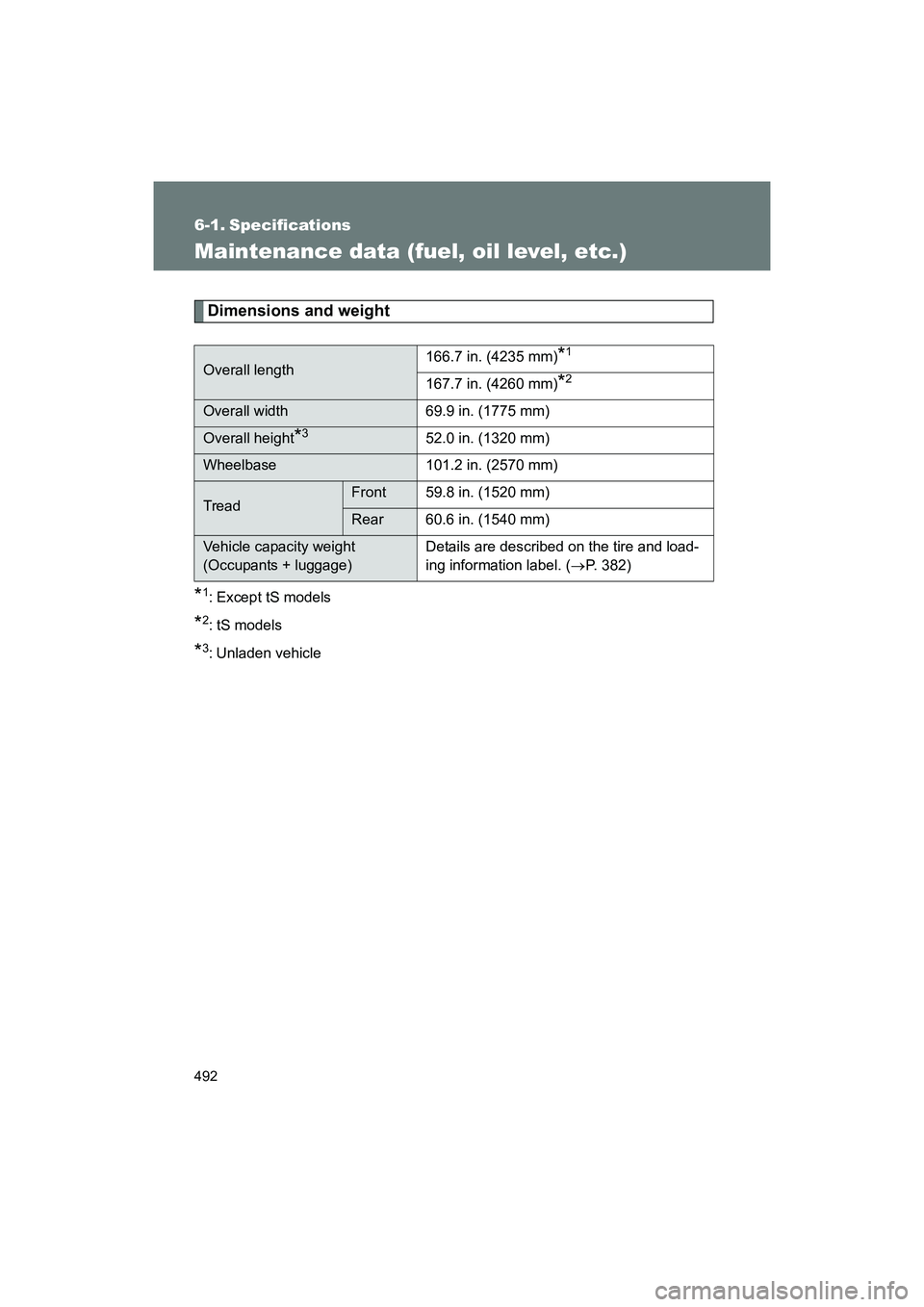
Maintenance data (fuel, oil level, etc.)
Dimensions and weight
*1: Except tS models
*2: tS models
*3: Unladen vehicle
Overall length166.7 in. (4235 mm)*1
167.7 in. (4260 mm)*2
Overall width 69.9 in. (1775 mm)
Overall height*352.0 in. (1320 mm)
Wheelbase 101.2 in. (2570 mm)
TreadFront 59.8 in. (1520 mm)
Rear 60.6 in. (1540 mm)
Vehicle capacity weight
(Occupants + luggage)Details are described on the tire and load-
ing information label. (
→P. 382)
Page 502 of 568
502 6-1. Specifications
BRZ_U (A4450BE-A)
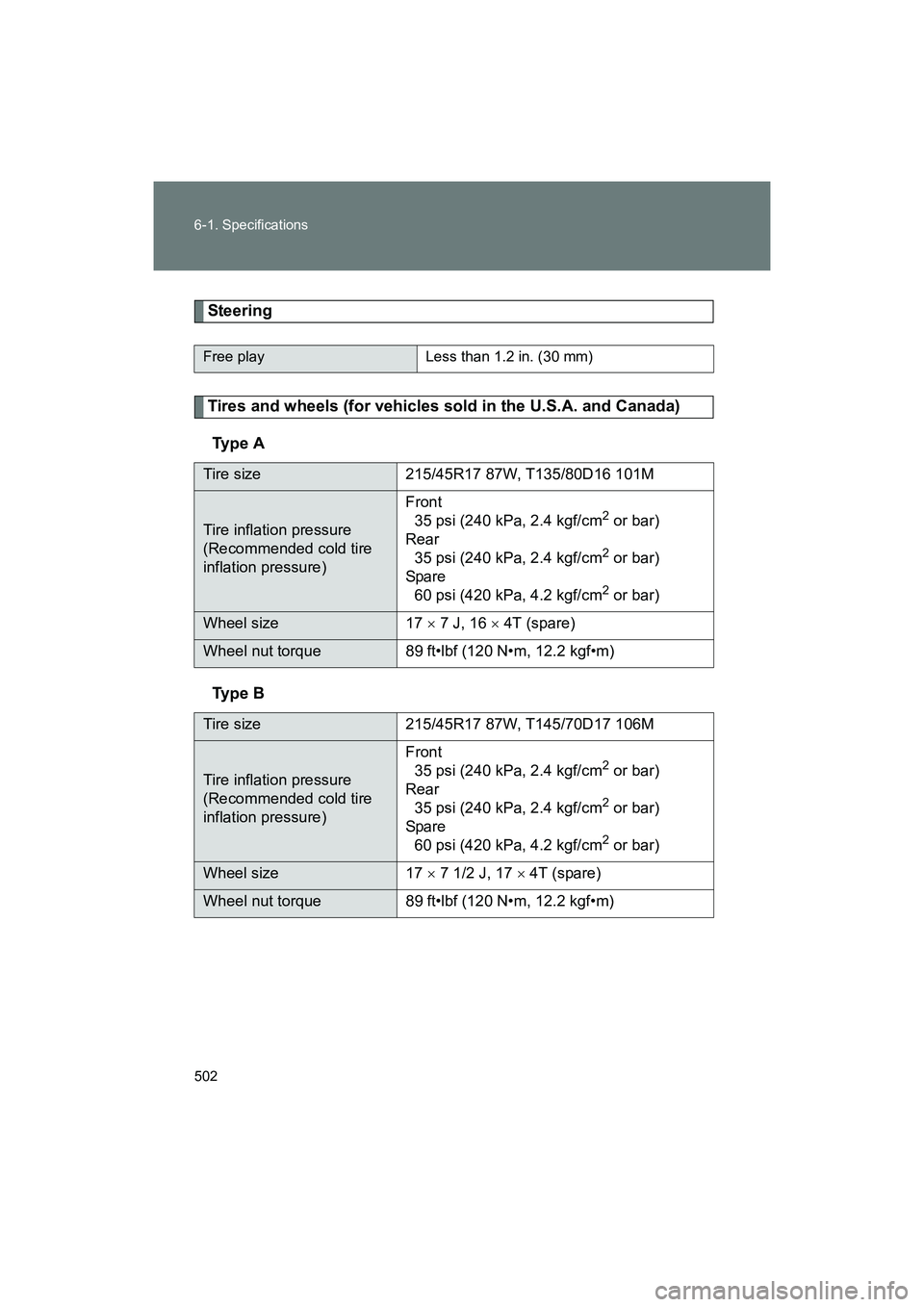
Steering
Tires and wheels (for vehicles sold in the U.S.A. and Canada)Ty p e A
Ty p e B
Free play Less than 1.2 in. (30 mm)
Tire size 215/45R17 87W, T135/80D16 101M
Tire inflation pressure
(Recommended cold tire
inflation pressure) Front
35 psi (240 kPa, 2.4 kgf/cm2 or bar)
Rear 35 psi (240 kPa, 2.4 kgf/cm
2 or bar)
Spare 60 psi (420 kPa, 4.2 kgf/cm
2 or bar)
Wheel size 17 × 7 J, 16 × 4T (spare)
Wheel nut torque 89 ft•lbf (120 N•m, 12.2 kgf•m)
Tire size 215/45R17 87W, T145/70D17 106M
Tire inflation pressure
(Recommended cold tire
inflation pressure)Front
35 psi (240 kPa, 2.4 kgf/cm
2 or bar)
Rear 35 psi (240 kPa, 2.4 kgf/cm
2 or bar)
Spare 60 psi (420 kPa, 4.2 kgf/cm
2 or bar)
Wheel size 17 × 7 1/2 J, 17 × 4T (spare)
Wheel nut torque 89 ft•lbf (120 N•m, 12.2 kgf•m)
Page 503 of 568
503
6-1. Specifications
6
Vehicle specifications
BRZ_U (A4450BE-A)
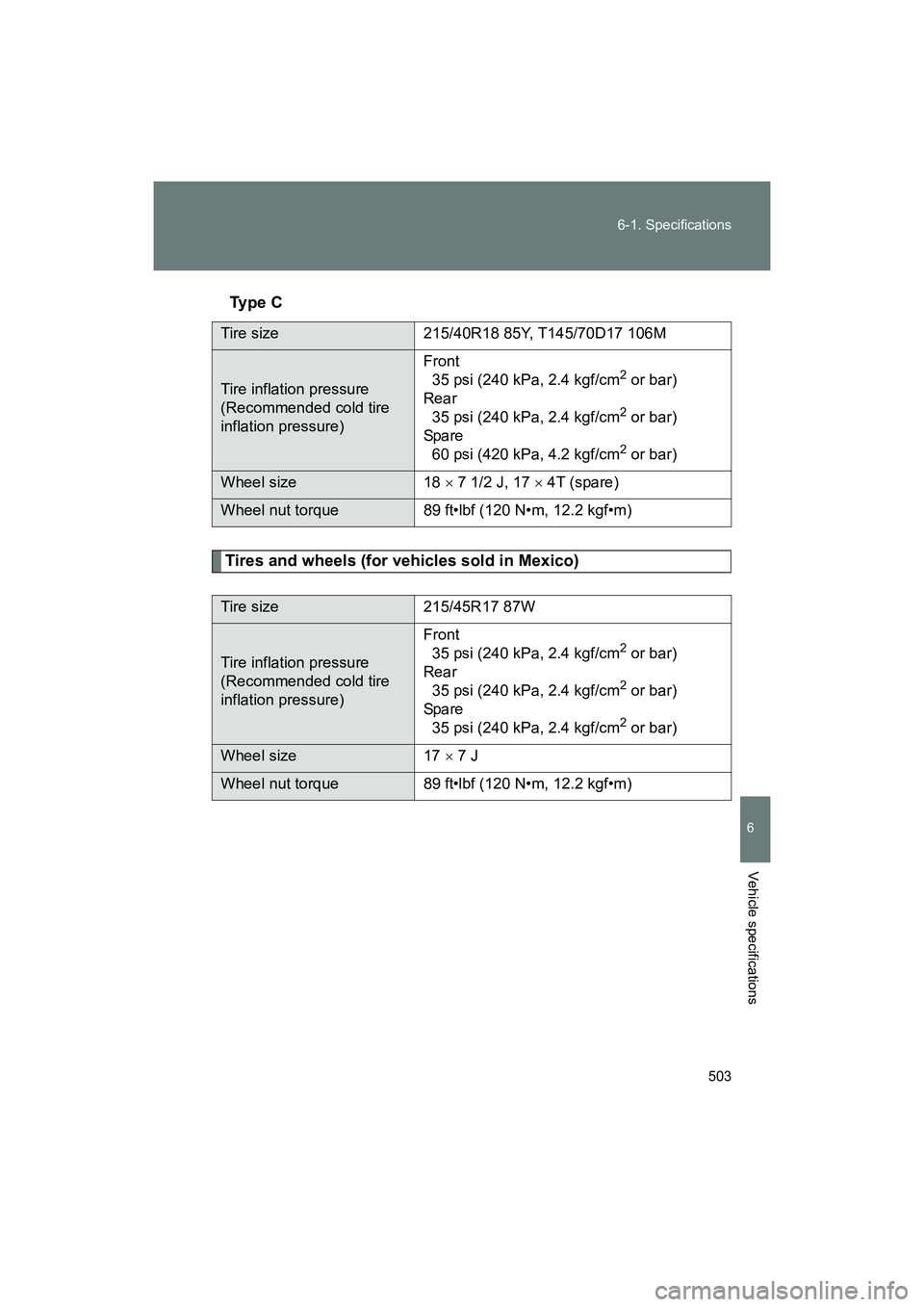
Ty p e C
Tires and wheels (for vehicles sold in Mexico)
Tire size 215/40R18 85Y, T145/70D17 106M
Tire inflation pressure
(Recommended cold tire
inflation pressure)
Front
35 psi (240 kPa, 2.4 kgf/cm2 or bar)
Rear 35 psi (240 kPa, 2.4 kgf/cm
2 or bar)
Spa re 60 psi (420 kPa, 4.2 kgf/cm
2 or bar)
Wheel size 18 × 7 1/2 J, 17 × 4T (spare)
Wheel nut torque 89 ft•lbf (120 N•m, 12.2 kgf•m)
Tire size 215/45R17 87W
Tire inflation pressure
(Recommended cold tire
inflation pressure) Front
35 psi (240 kPa, 2.4 kgf/cm
2 or bar)
Rear 35 psi (240 kPa, 2.4 kgf/cm
2 or bar)
Spa re 35 psi (240 kPa, 2.4 kgf/cm
2 or bar)
Wheel size 17 × 7 J
Wheel nut torque 89 ft•lbf (120 N•m, 12.2 kgf•m)
Page 512 of 568
512 6-1. Specifications
BRZ_U (A4450BE-A)
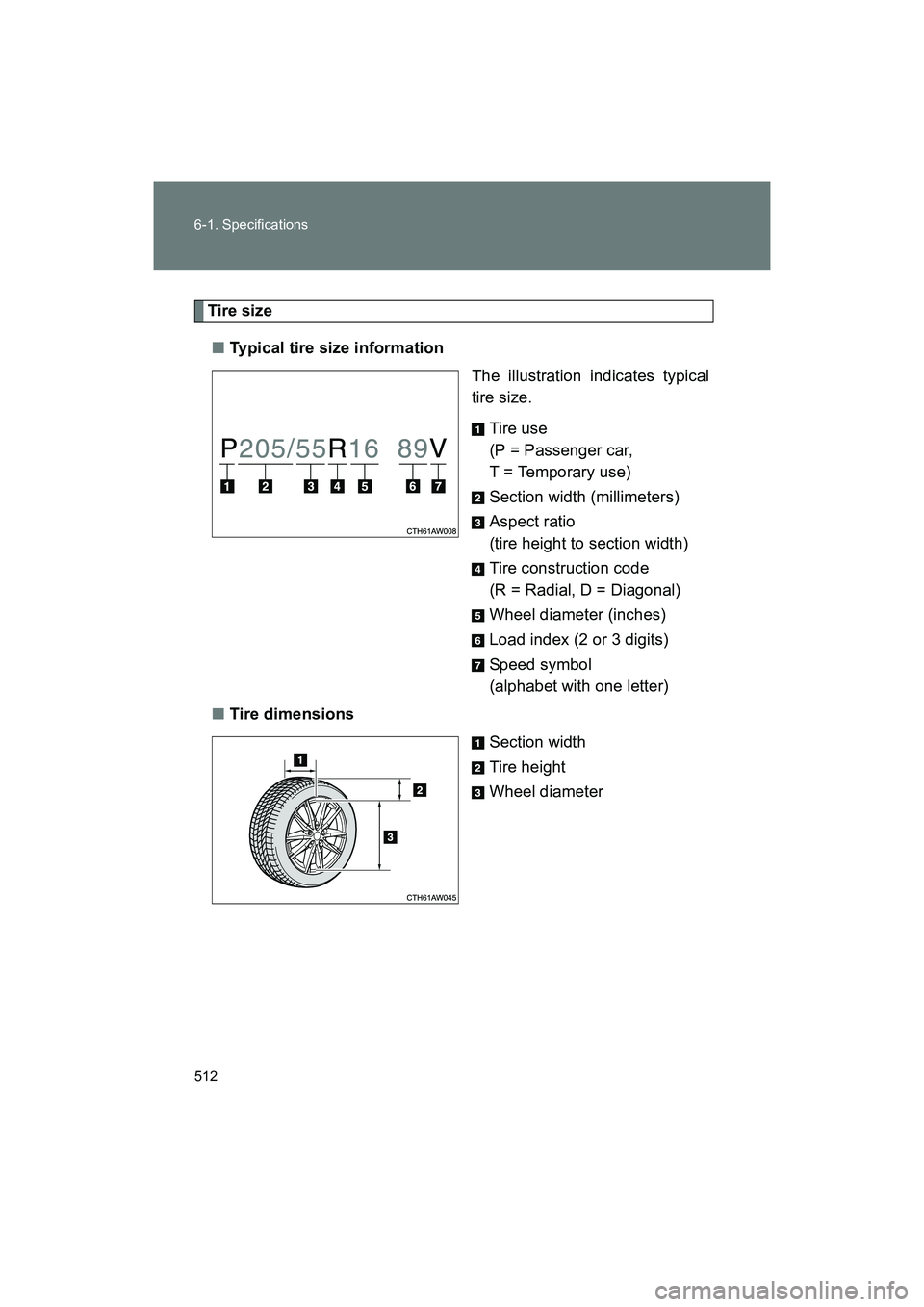
Tire size■ Typical tire size information
The illustration indicates typical
tire size.
Tire use
(P = Passenger car,
T = Temporary use)
Section width (millimeters)
Aspect ratio
(tire height to section width)
Tire construction code
(R = Radial, D = Diagonal)
Wheel diameter (inches)
Load index (2 or 3 digits)
Speed symbol
(alphabet with one letter)
■ Tire dimensions
Section width
Tire height
Wheel diameter
Page 514 of 568
514 6-1. Specifications
BRZ_U (A4450BE-A)■
Tre ad w ea r
The treadwear grade is a comparative rating based on the wear
rate of the tire when tested under controlled conditions on a speci-
fied government test course.
For example, a tire graded 150 would wear one and a half (1 - 1/2)
times as well on the government course as a tire graded 100.
The relative performance of tires depends upon the actual conditions
of their use. Performance may differ significantly from the norm due
to variations in driving habits, service practices and differences in
road characteristics and climate.
■Traction AA, A, B, C
The traction grades, from highest to lowest, are AA, A, B and C,
and they represent the tire’s ability to stop on wet pavement as
measured under controlled conditions on specified government
test surfaces of asphalt and concrete.
A tire marked C may have poor traction performance.
Warning: The traction grade assigned to this tire is based on braking
(straight ahead) traction tests and does not include cornering (turn-
ing) traction.
■Temperature A, B, C
The temperature grades are A (the highest), B, and C, represent-
ing the tire’s resistance to the generation of heat and its ability to
dissipate heat when tested under controlled conditions on a speci-
fied indoor laboratory test wheel.
Sustained high temperature can cause the material of the tire to
degenerate and reduce tire life, and excessive temperature can lead
to sudden tire failure.
Grade C corresponds to a level of performance which all passenger
car tires must meet under the Federal Motor Vehicle Safety Standard
No. 109.
Grades B and A represent higher levels of performance on the labo-
ratory test wheel than the minimum required by law.