reset SUBARU BRZ 2023 User Guide
[x] Cancel search | Manufacturer: SUBARU, Model Year: 2023, Model line: BRZ, Model: SUBARU BRZ 2023Pages: 432, PDF Size: 16.56 MB
Page 189 of 432
Wiper and Washer
183
Instruments and Controls3
– CONTINUED –
3-14. Wiper and Washer
NOTEThe windshield wiper motor is
protected against overloads by a
circuit breaker. If the motor operates
continuously under an unusually
heavy load, the circuit breaker may trip
to stop the motor temporarily. If this
happens, park your vehicle in a safe
location, turn off th e wiper switch, and
wait for approximately 10 minutes. The
circuit breaker will reset itself, and the
wipers will again operate normally.
Clean your blade rubbers and
window glass periodically with a
washer solution to prevent streaking,
WARNING
In freezing weather, do not use the
windshield washer until the wind-
shield is sufficiently warmed by the
defroster.Otherwise the washer fluid can
freeze on the windshield, blocking
your view.
CAUTION
Do not operate the washer contin-
uously for more than 10 seconds,
or when the washer fluid tank is
empty. This may cause over-
heating of the washer motor.
Check the washer fluid level
frequently, such as at fuel stops. Do not operate the wipers when
the windshield is dry. This may
scratch the glass, damage the
blade rubbers and cause the
wiper motor to bu rn out. Before
operating the wiper on a dry wind-
shield always use the windshield
washer.
In freezing weather, be sure that
the blade rubbers are not frozen
to the windshield before
switching on the wipers.
Attempting to op erate the wiper
with the blade rubbers frozen to
the window glass could cause not
only the blade rubbers to be
damaged but also might cause
the wiper motor to fail. If the blade
rubbers are frozen to the window
glass, be sure to operate the
defroster before turning on the
wiper. If the wipers stop during opera-
tion because of ice or some other
obstruction on the window, this
might cause the wiper motor to
fail even if the wiper switch is
turned off. If this occurs,
promptly stop the vehicle in a
safe location, turn the ignition
switch to the “OFF” position and
clean the window glass to allow
proper wiper operation.
Use clean water if windshield
washer fluid is unavailable. In
areas where water freezes in
winter, use SUBARU Windshield
Washer Fluid or the equivalent.
Refer to "Windshield Washer
Fluid" P366.
Also, when driving the vehicle
when there are freezing tempera-
tures, use non-freezing type
wiper blades. Do not clean the wiper blades
with gasoline or a solvent, such
as paint thinner or benzine. This
will cause deterioration of the
wiper blades.
BRZ_U.book 183 ページ 2022年3月29日 火曜日 午後3時59分
Page 227 of 432
Starting and Operating7
Starting and Operating
7-1. Fuel.......................................................................223
Fuel Requirements .......................................................223
Fuel Filler Lid and Cap .................................................224
7-2. State Emission Testing (U.S. Only) ...................227
7-3. Preparing to Drive ...............................................228
7-4. Starting and Stopping Engine ...........................229
Safety Precautions ............................................ ...........229
Operating Range for Push-Button Start System .......229
General Precautions When St arting Engine ..............229
Starting Engine .............................................................230
Stopping Engine ...........................................................232
When Access Key Fob Does Not Operate
Properly.......................................................................232
Steering Lock ................................................................232
7-5. Manual Transmission .........................................233
Shifting Speeds ............................................................234
Driving Tips ...................................................................235
7-6. Automatic Transmission ....................................235
Select Lever ..... .......................................... ...................236
Adaptive Control...........................................................237
Shift Lock Function ......................................................238
Selection of Manual Mode ...........................................239
Driving Tips ...................................................................240
7-7. Driving Mode Select Switch (If Equipped) ........241
Normal Mode .................................................................241
Sport Mode ....................................................................241
Snow Mode....................................................................241
Driving Mode Select Switch.........................................241
7-8. Active Sound Control .........................................242
7-9. Power Steering ....................................................242
7-10. Braking...............................................................243
Braking Tips ..................................................................243 Brake System ............................................................... 244
Disc Brake Pad Wear Warning Indicators ................. 245
7-11. ABS (Anti-Lock Brake System) ........................245
ABS Self-Check............................................................ 245
ABS Warning Light ...................................................... 245
7-12. Electronic Brake Force Distribution (EBD)
System ...............................................................246
EBD System Malfunctions .......................................... 246
7-13. Vehicle Stability Control (VSC)/TRAC
System ...............................................................247
Vehicle Stability Control (VSC) System ..................... 247
TRAC System ............................................................... 247
Vehicle Stability Control (VSC) System Monitor....... 248
Vehicle Stability Control (VSC) OFF Switch .............. 248
7-14. TRACK Mode .....................................................250
TRACK Mode ................................................................ 250
Selecting TRAC Mode and Ve hicle Stability Control
(VSC) Mode ............................................................... 251
7-15. Tire Pressure Monitoring System (TPMS)
(If Equipped) ......................................................251
Certification for the Transmitter ................................. 253
Certification for the Receiver...................................... 253
TPMS Screen ................................................................ 254
Initializing the Tire Pressure Monitoring System ..... 254
How to Initialize the Tire Pressure Monitoring
System (If Equipped) ................................................. 254
If You Press the Tire Pressure Monitoring Reset
Switch Accidentally................................................... 254
Initialization Procedure ............................................... 254
When Initialization of the Tire Pressure Monitoring System has Failed ..................................................... 255
Registering ID Codes .................................................. 255
BRZ_U.book 221 ページ 2022年3月29日 火曜日 午後3時59分
Page 234 of 432
Preparing to Drive
228have implemented emission inspection of
the OBDII system.
The inspection of the OBDII system
consists of a visual operational check of
the “ CHECK ENGINE ” warning light/
malfunction indicator light (MIL) and an
examination of the OBDII system with an
electronic scan tool.
A vehicle passes
the OBDII system
inspection if proper operation of the
“ CHECK ENGINE ” warning light is
observed, there are no stored diagnostic
trouble codes, and the OBDII readiness
monitors are all complete.
A vehicle fails
the OBDII inspection if
the “ CHECK ENGINE ” warning light is not
properly operating (light is illuminated or is
not working due to a burned out bulb) or
there is one or more diagnostic trouble
codes stored in the vehicle’s computer.
A state emission in spection may reject
(not pass or fail) a vehicle if the number of
OBDII system readiness monitors “ NOT
READY ” is greater than one. If the
vehicle’s battery has been recently
replaced or disconnected, the OBDII
system inspection may indicate that the
vehicle is not ready for the emission test.
Under this condition, the vehicle driver
should be instructed to drive his/her
vehicle for a few days to reset the readi-
ness monitors and return for an emission
re-inspection.
Owners of rejected or failing vehicles
should contact their SUBARU Dealer for
service.
7-3. Preparing to DriveYou should perform the following checks
and adjustments every day before you
start driving.
1. Check that all windows, mirrors, and
lights are clean and unobstructed.
2. Check the appearance and condition
of the tires. Also check tires for proper
inflation.
3. Look under the vehicle for any sign of
leaks.
4. Check that no small animals enter the
engine compartment.
5. Check that the hood and trunk are fully
closed.
6. Check the adjustment of the seat.
7. Check the adjustment of the inside
and outside mirrors.
8. Fasten your seatbelt. Check that your
passengers have fastened their seatbelts.
9. Check the operation of the warning
and indicator lights when the ignition
switch is turned to the “ON” position.
10. Check the gauges, indicator and
warning lights after starting the engine.
BRZ_U.book 228 ページ 2022年3月29日 火曜日 午後3時59分
Page 258 of 432
Tire Pressure Monitoring System (TPMS) (If Equipped)
252
WARNING
If the low tire pressure warning
light illuminates while driving,
never brake suddenly. Instead,
perform the following procedure.
Otherwise an accident involving
serious vehicle damage and
serious personal injury could
occur.
(1) Keep driving straight ahead
while gradually reducing
speed.(2) Slowly pull off the road to a
safe place.(3) Check the pressure for all
four tires and adjust the pres-
sure to the COLD tire pres-
sure shown on the tire
inflation pressure label on the
center pillar on the driver’s
side.
Even when the vehicle is driven a
very short distance, the tires get
warm and their pressures
increase accordingly. Be sure to
let the tires cool thoroughly
before adjusting their pressures
to the standard values shown on
the tire inflatio n pressure label.
Refer to "Tires and Wheels"
P358. The tire pressure moni-
toring system does not function
when the vehicle is stationary.
After adjusting the tire pressures,
increase the vehicle speed to at
least 25 mph (40 km/h) to start the
TPMS rechecking of the tire infla-
tion pressures. If the tire pres-
sures are now above the severe
low pressure threshold, the low
tire pressure warning light should
turn off a few minutes later.
If this light still illuminates while
driving after adjusting the tire
pressure, a tire may have signifi-
cant damage and a fast leak that
causes the tire to lose air rapidly.
For details, refer to "Flat Tires"
P303.
When a spare tire is mounted or a
wheel rim is replaced without the
original pressure sensor/trans-
mitter being transferred, the low
tire pressure warning light will
illuminate steadily after blinking
for approximately one minute.
This indicates the TPMS is unable
to monitor all fo ur road wheels.
Contact your SUBARU dealer as
soon as possible for tire and
sensor replacement and/or
system resetting.
BRZ_U.book 252 ページ 2022年3月29日 火曜日 午後3時59分
Page 260 of 432
Tire Pressure Monitoring System (TPMS) (If Equipped)
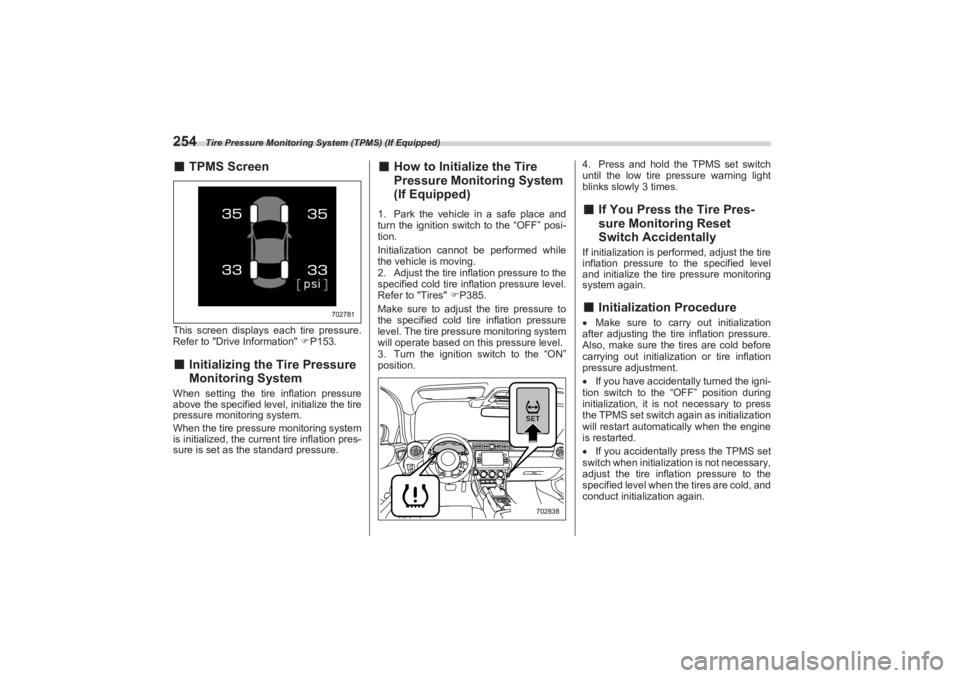
254■TPMS ScreenThis screen displays ea ch tire pressure.
Refer to "Drive Information" P153.■ Initializing the Tire Pressure
Monitoring SystemWhen setting the tire inflation pressure
above the specified level, initialize the tire
pressure monitoring system.
When the tire pressure monitoring system
is initialized, the current tire inflation pres-
sure is set as the standard pressure.
■ How to Initialize the Tire
Pressure Monitoring System
(If Equipped)1. Park the vehicle in a safe place and
turn the ignition switch to the “OFF” posi-
tion.
Initialization cannot be performed while
the vehicle is moving.
2. Adjust the tire infl ation pressure to the
specified cold tire inflation pressure level.
Refer to "Tires" P385.
Make sure to adjust the tire pressure to
the specified cold tire inflation pressure
level. The tire pre ssure monitoring system
will operate based on this pressure level.
3. Turn the ignition switch to the “ON”
position. 4. Press and hold the TPMS set switch
until the low tire pressure warning light
blinks slowly 3 times.
■ If You Press the Tire Pres -
sure Monitoring Reset
Switch AccidentallyIf initialization is perf ormed, adjust the tire
inflation pressure to the specified level
and initialize the tire pressure monitoring
system again.■ Initialization ProcedureMake sure to carry out initialization
after adjusting the tire inflation pressure.
Also, make sure the tires are cold before
carrying out initialization or tire inflation
pressure adjustment.
If you have accidentally turned the igni-
tion switch to the “OFF” position during
initialization, it is not necessary to press
the TPMS set switch again as initialization
will restart automatically when the engine
is restarted.
If you accidentally press the TPMS set
switch when initialization is not necessary,
adjust the tire inflation pressure to the
specified level when the tires are cold, and
conduct initialization again.
702781
702838
BRZ_U.book 254 ページ 2022年3月29日 火曜日 午後3時59分
Page 321 of 432
Flat Tires
315
In Case of Emergency9
– CONTINUED –
■Tire Pressure Monitoring
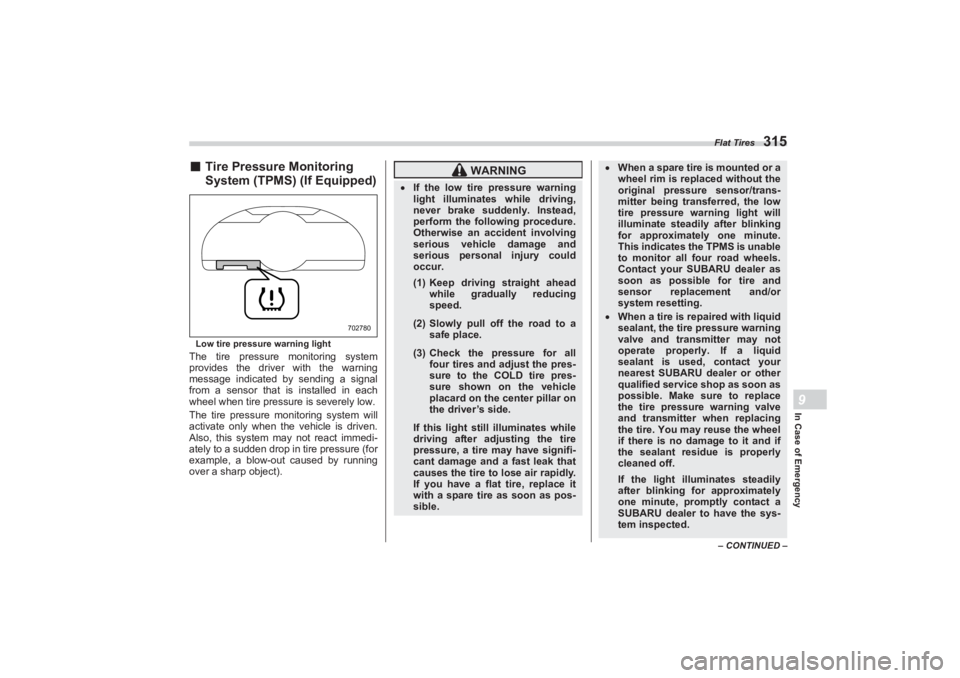
System (TPMS) (If Equipped)Low tire pressure warning lightThe tire pressure monitoring system
provides the driver with the warning
message indicated by sending a signal
from a sensor that is installed in each
wheel when tire pressure is severely low.
The tire pressure mo nitoring system will
activate only when the vehicle is driven.
Also, this system may not react immedi-
ately to a sudden drop in tire pressure (for
example, a blow-out caused by running
over a sharp object).
702780
WARNING
If the low tire pressure warning
light illuminates while driving,
never brake suddenly. Instead,
perform the following procedure.
Otherwise an accident involving
serious vehicle damage and
serious personal injury could
occur.
(1) Keep driving straight ahead
while gradually reducing
speed.(2) Slowly pull off the road to a
safe place.(3) Check the pressure for all
four tires and adjust the pres-
sure to the CO LD tire pres-
sure shown on the vehicle
placard on the center pillar on
the driver’s side.If this light still illuminates while
driving after adjusting the tire
pressure, a tire may have signifi-
cant damage and a fast leak that
causes the tire to lose air rapidly.
If you have a flat tire, replace it
with a spare tire as soon as pos-
sible.
When a spare tire is mounted or a
wheel rim is replaced without the
original pressure sensor/trans-
mitter being transferred, the low
tire pressure warning light will
illuminate steadily after blinking
for approximately one minute.
This indicates the TPMS is unable
to monitor all four road wheels.
Contact your SUBARU dealer as
soon as possible for tire and
sensor replacement and/or
system resetting. When a tire is repaired with liquid
sealant, the tire pressure warning
valve and transmitter may not
operate properly. If a liquid
sealant is used, contact your
nearest SUBARU dealer or other
qualified service shop as soon as
possible. Make sure to replace
the tire pressure warning valve
and transmitter when replacing
the tire. You may reuse the wheel
if there is no damage to it and if
the sealant residue is properly
cleaned off.
If the light illuminates steadily
after blinking for approximately
one minute, promptly contact a
SUBARU dealer to have the sys-
tem inspected.
BRZ_U.book 315 ページ 2022年3月29日 火曜日 午後3時59分
Page 365 of 432
Tires and Wheels
359
Maintenance and Service11
– CONTINUED –
(5.6°C) between the temperature in the
garage and the temperature outside. By
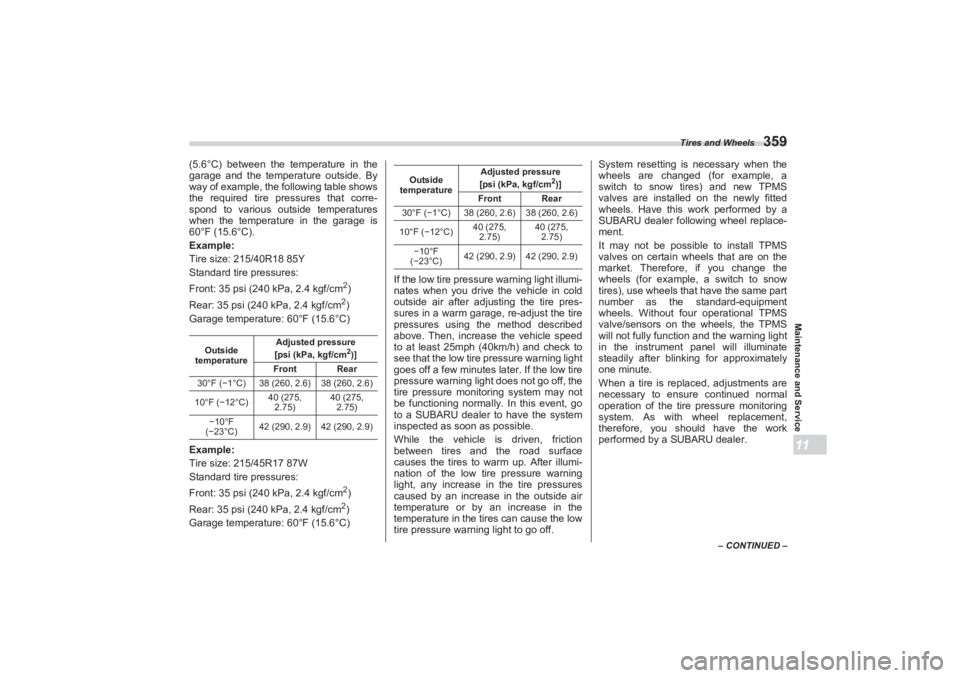
way of example, the following table shows
the required tire pressures that corre-
spond to various outside temperatures
when the temperature in the garage is
60°F (15.6°C).
Example:
Tire size: 215/40R18 85Y
Standard tire pressures:
Front: 35 psi (240 kPa, 2.4 kgf/cm
2)
Rear: 35 psi (240 kPa, 2.4 kgf/cm2)
Garage temperature: 60°F (15.6°C)
Example:
Tire size: 215/45R17 87W
Standard tire pressures:
Front: 35 psi (240 kPa, 2.4 kgf/cm2)
Rear: 35 psi (240 kPa, 2.4 kgf/cm2)
Garage temperature: 60°F (15.6°C) If the low tire pressure warning light illumi-
nates when you drive the vehicle in cold
outside air after adjusting the tire pres-
sures in a warm garage, re-adjust the tire
pressures using the method described
above. Then, increase the vehicle speed
to at least 25mph (40km/h) and check to
see that the low tire pressure warning light
goes off a few minutes later. If the low tire
pressure warning light does not go off, the
tire pressure monito ring system may not
be functioning normally. In this event, go
to a SUBARU dealer to have the system
inspected as soon as possible.
While the vehicle is driven, friction
between tires and the road surface
causes the tires to warm up. After illumi-
nation of the low tire pressure warning
light, any increase in the tire pressures
caused by an increase in the outside air
temperature or by an increase in the
temperature in the tires can cause the low
tire pressure warning light to go off. System resetting is
necessary when the
wheels are changed (for example, a
switch to snow tires) and new TPMS
valves are installed on the newly fitted
wheels. Have this work performed by a
SUBARU dealer following wheel replace-
ment.
It may not be possible to install TPMS
valves on certain wheels that are on the
market. Therefore, if you change the
wheels (for example, a switch to snow
tires), use wheels that have the same part
number as the standard-equipment
wheels. Without four operational TPMS
valve/sensors on the wheels, the TPMS
will not fully function and the warning light
in the instrument panel will illuminate
steadily after blinking for approximately
one minute.
When a tire is replaced, adjustments are
necessary to ensure continued normal
operation of the tire pressure monitoring
system. As with wheel replacement,
therefore, you s hould have the work
performed by a SUBARU dealer.
Outside
temperature Adjusted pressure
[psi (kPa, kgf/cm
2)]
Front Rear
30°F ( −1°C) 38 (260, 2.6) 38 (260, 2.6)
10°F ( −12°C) 40 (275,
2.75) 40 (275,
2.75)
− 10°F
( − 23°C) 42 (290, 2.9) 42 (290, 2.9)
Outside
temperature Adjusted pressure
[psi (kPa, kgf/cm
2)]
Front Rear
30°F ( −1°C) 38 (260, 2.6) 38 (260, 2.6)
10°F ( −12°C) 40 (275,
2.75) 40 (275,
2.75)
− 10°F
( − 23°C) 42 (290, 2.9) 42 (290, 2.9)
BRZ_U.book 359 ページ 2022年3月29日 火曜日 午後3時59分
Page 366 of 432
Tires and Wheels
360
■Tire InspectionCheck on a daily basis that the tires
are free from serious damage, nails,
and stones. At the same time, check
the tires for abnormal wear.
Contact your SUBARU dealer
immediately if you find any problem.NOTE When the wheels and tires
strike curbs or are subjected to
harsh treatment as when the
vehicle is driven on a rough surface, they can suffer damage
that cannot be seen with the
naked eye. This type of damage
does not become evident until
time has passed. Try not to drive
over curbs, potholes or on other
rough surfaces. If doing so is
unavoidable, keep the vehicle’s
speed down to a walking pace or
less, and approach the curbs as
squarely as possible. Also, make
sure the tires are not pressed
against the curb when you park
the vehicle.
If you feel unusual vibration
while driving or fi nd it difficult to
steer the vehicle in a straight line,
one of the tires and/or wheels
may be damaged. Drive slowly to
the nearest authorized SUBARU
dealer and have the vehicle
inspected.
Tires should be replaced if:
– You have tire damage such
as cuts, splits, cracks deep
enough to expose the fabric or
bulges indicating internal
damage
WARNING
If the low tire pressure warning light
does not illuminate briefly after the
ignition switch is turned ON or the
light illuminates steadily after blink-
ing for approximately one minute,
you should have your Tire Pressure
Monitoring System checked at a
SUBARU dealer as so on as possi-
ble.If this light illuminates while driving,
never brake suddenly. Instead, per-
form the following procedure. Oth-
erwise an accident involving
serious vehicle damage and serious
personal injury could occur.1) Keep driving straight ahead while
gradually reducing speed.2) Slowly pull off the road to a safe
place.If this light still illuminates while
driving after adjusting the tire pres-
sure, a tire may have significant
damage and a fast leak that causes
the tire to lose ai r rapidly. If you
have a flat tire, re fer to "Flat Tires"
P303.
When a spare tire is mounted or a
wheel rim is replaced without the
original pressure sensor/transmitter
being transferred, the low tire pres-
sure warning light will illuminate
steadily after blinking for approxi-
mately one minute. This indicates
the TPMS is unable to monitor all
four road wheels. Contact your
SUBARU dealer as soon as possi-
ble for tire and sensor replacement
and/or system resetting. If the light
illuminates steadily after blinking
for approximately one minute,
promptly contact a SUBARU dealer
to have the system inspected.
BRZ_U.book 360 ページ 2022年3月29日 火曜日 午後3時59分