tow SUBARU BRZ 2023 User Guide
[x] Cancel search | Manufacturer: SUBARU, Model Year: 2023, Model line: BRZ, Model: SUBARU BRZ 2023Pages: 432, PDF Size: 16.56 MB
Page 185 of 432
Light Control Switch
179
Instruments and Controls3
– CONTINUED –
- In bad weather (fog, snow, sand
storm, heavy rain, etc.).
- When the windshield glass is dirty or
fogged.
- When the windshield is cracked or
damaged.
- If there are lights similar to the head-
lights or the tail lights in the surrounding
area.
- When an oncoming vehicle or
vehicle ahead is driven without its
headlights and tail lights on.
- If the headlights of an oncoming
vehicle or the tail lights of a vehicle
ahead are dirty or discolored, or if the
light beams are not aimed correctly.
- When a rapid change of brightness
continues while driving.
- When driving on a road with many
ups and downs or uneven surfaces.
- When driving on a road with many
curves.
- When there are some objects that
reflect light strongly, such as a road
sign or a mirror in vehicle ahead.
- When the rear part of the vehicle
ahead, such as a container, reflects
light strongly.
- When the headlights of your vehicle
are damaged or dirty.
- When your vehicle is tilted, such as
in case the vehicle has a flat tire or is
being towed. - When the stereo camera is
deformed or the stereo camera lenses
are dirty.
- Immediately after the engine has
started.
In the following conditions, the head-
light mode will not be automatically
changed from the high beam to the low
beam.
- When your vehicle passes an
oncoming vehicle suddenly in a blind
curve.
- When another vehicle passes in
front of your vehicle.
- When an oncoming vehicle or
vehicle ahead comes in and out of view
because of continuous curves, median
strips, roadside trees, etc.
If the stereo camera detects the light of
the front fog lights of an oncoming vehicle,
the headlight mode may change from the
high beam to the low beam automatically.
The headlight mode may change from
the high beam to the low beam, or the low
beam mode may continue, when affected
by a street light, traffic signal, illumination
of an advertisement board, or a reflective
object such as a road sign and signboard.
The timing of the change of headlight
mode may differ due to the following
factors. - Color or brightness of the headlights
of an oncoming vehicle or the tail lights
of a vehicle ahead.
- The headlights of the oncoming
vehicle or the tail lights of the vehicle
ahead are covered with mud, snow,
etc.
- Movement and direction of an
oncoming vehicle or a vehicle ahead.
- When the headlights of an
oncoming vehicle or the tail lights of a
vehicle ahead illuminate on only one
side.
- When the oncoming vehicle or
vehicle ahead is a motorcycle.
- Conditions of a road (slope, curve,
road surface, etc.).
- Number of passengers and weight
of loaded cargo.
- Limitation of the detection ability of
the stereo camera.
BRZ_U.book 179 ページ 2022年3月29日 火曜日 午後3時59分
Page 191 of 432
Defogger
185
Instruments and Controls3
– CONTINUED –
interval can be adjusted in several steps
from the shortest interval to the longest.▼ Windshield washerTo wash the windshield, pull the wiper
control lever toward you. The washer fluid
sprays until you release the lever. The
wipers operate while you pull the lever.
3-15. Defogger1) Rear window defogger
2) Outside mirror defogger (if equipped)The defogger system is activated only
when the ignition switch is in the “ON”
position.
Rear window and outside mirror (if
equipped) defogger buttonTo activate the defogger system, press
the rear window and outside mirror
defogger button. The rear window
defogger and outside mirror defogger are
activated simultaneously. The indicator
light on the button illuminates while the
defogger system is activated.
To turn them off, press the button again.
They also turn off when the ignition switch
is turned to the “ACC” or “OFF” position.
The defogger system will automatically
shut off after approximately 15 minutes. If
the rear window and outside mirrors have
been cleared before that time, press the
button to turn them off. If defrosting or
defogging is not complete, you have to
press the button to turn them on again.
301725
1
2306818
306819
BRZ_U.book 185 ページ 2022年3月29日 火曜日 午後3時59分
Page 219 of 432
Sun Visors
213
Interior Equipment6
– CONTINUED –
6-2. Sun VisorsTo block out glare, swing down the visors.
To use the sun visor at a side window,
swing it down and move it sideways.■ Vanity Mirror with Light (If
Equipped)
To use the vanity mirror, swing down the
sun visor and open the vanity mirror
cover.
The lights beside the vanity mirror illumi-
nate when the mirror cover is opened.NOTEUse of the vanity mirror light for a long
period of time while the engine is not
running can cause battery discharge.
6-3. Storage Compartment
CAUTION
Keep the vanity mirror cover closed
while the car is being driven to
avoid being blinded by glare.
601182
602246
CAUTION
Keep the storage compartment
closed when it is not being used.
If left open, in the event of sudden
braking, etc., stowed items may
fly out, possibly leading to an
accident. Do not store the following items
in the storage compartment.
Otherwise, it may cause a fire or
accident.
- Spray cans, containers with
flammable or corrosive liquids
or any other dangerous items.- Plastic or other heat-vulner- able or flammable articles
such as a lighter.
BRZ_U.book 213 ページ 2022年3月29日 火曜日 午後3時59分
Page 245 of 432
Automatic Transmission
239
Starting and Operating7
– CONTINUED –
3. While depressing the brake pedal,
insert the screwdriver into the hole, press
the shift lock release portion using the
screwdriver, and then move the select
lever.
If the select lever does not move after
performing the above procedure, the shift
lock system may be malfunctioning.
Contact a SUBARU dealer for an inspec-
tion as soon as possible.■ Selection of Manual Mode▼ Selecting gears in manual modeShift the select lever to the “M” position to
change to manual mode.
When the upshift/downshift indicators are
illuminated, the vehicle can be driven in a
selected gear by shifti ng the select lever toward “-” or “+” or operating the “-” or “+”
shift paddle.
1) Upshift indicator
2) Downshift indicator
3) Upshift
4) Downshift
The gear changes once each time the
select lever or a shift paddle is operated.
The selected gear, from “M1” to “M6”, will
be displayed on the combination meter.
When in manual mode, the gear will not
change unless the select lever or a shift
paddle is operated, except in the following
situations.
When the vehicle speed drops
(downshift only)
When the engine oil temperature is
high and the engine speed approaches
close to the red zone
If an upshift is atte mpted while the vehicle
speed is low, the gear will not be changed.NOTE If a downshift is attempted at a
vehicle speed where a downshift is not
possible (when the engine speed
would enter the red zone if a downshift
is performed), the downshift warning
buzzer will sound to inform the driver
that a downshift cannot be performed.
You can perform a skip-shift (for
example, from 4th to 2nd) by operating
702770
13
4
2
3
4702773
CAUTION
Do not place or hang anything on
the shift paddles. Doing so may
result in accidental gear shifting.
BRZ_U.book 239 ページ 2022年3月29日 火曜日 午後3時59分
Page 252 of 432
Electronic Brake Force Distribution (EBD) System
2467-12. Electronic Brake Force Distribution (EBD) SystemThe EBD system maximizes the effective-
ness of the brakes by allowing the rear
brakes to supply a greater proportion of
the braking force. It functions by adjusting
the distribution of braking force to the rear
wheels in accordance with the vehicle’s
loading condition and speed.
The EBD system is an in tegral part of the
ABS and uses some of the ABS compo-
nents to perform its function of optimizing
the distribution of braking force. If any of
the ABS components used by the EBD
function fails, the EBD system also stops
working.
When the EBD system is operating, you
may hear a chattering noise or feel a slight
vibration in the brake pedal. This is normal
and does not indicate a malfunction.
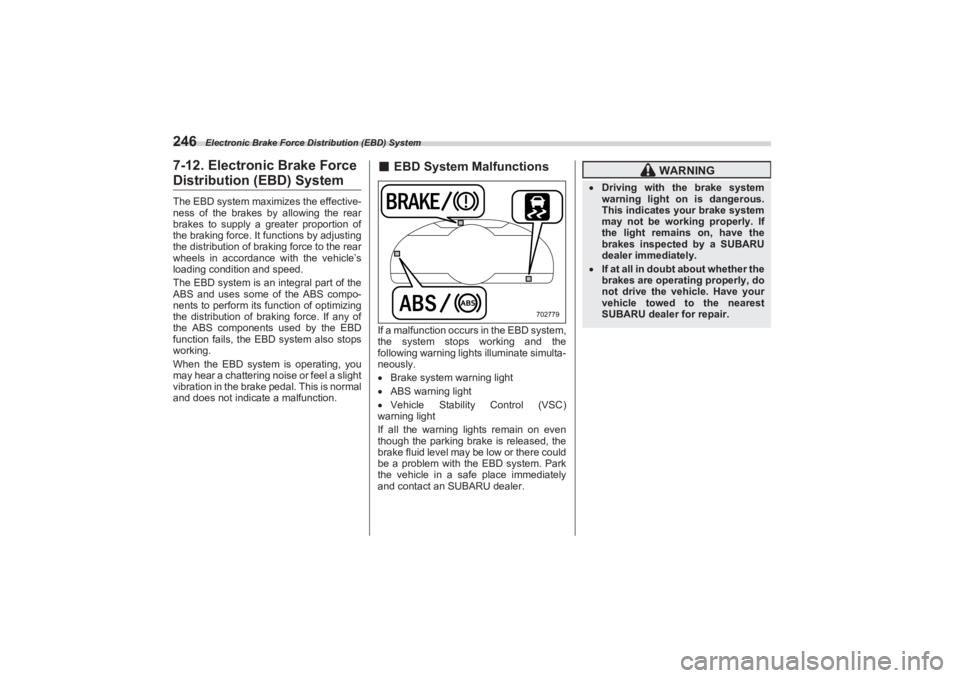
■ EBD System MalfunctionsIf a malfunction occurs in the EBD system,
the system stops working and the
following warning lights illuminate simulta-
neously.
Brake system warning light
ABS warning light
Vehicle Stability Control (VSC)
warning light
If all the warning lights remain on even
though the parking brake is released, the
brake fluid level may be low or there could
be a problem with the EBD system. Park
the vehicle in a safe place immediately
and contact an SUBARU dealer.
702779
WARNING
Driving with the brake system
warning light on is dangerous.
This indicates your brake system
may not be working properly. If
the light remains on, have the
brakes inspected by a SUBARU
dealer immediately. If at all in doubt about whether the
brakes are operating properly, do
not drive the vehicle. Have your
vehicle towed to the nearest
SUBARU dealer for repair.
BRZ_U.book 246 ページ 2022年3月29日 火曜日 午後3時59分
Page 266 of 432
Cruise Control (Models without the EyeSight system)
2607-18. Cruise Control (Models without the EyeSight system)NOTEFor models with the EyeSight system:
Refer to the Owner’s Manual supple-
ment for the EyeSight system.
Cruise control enables you to maintain a
constant vehicle speed without holding
your foot on the accelerator pedal and it is
operative when the vehicle speed is 20
mph (30 km/h) or more.
NOTEMake sure the cruise control system is
turned off when the cruise control is
not in use to avoid unintentionally set-
ting of the cruise control.■ To Set Cruise Control
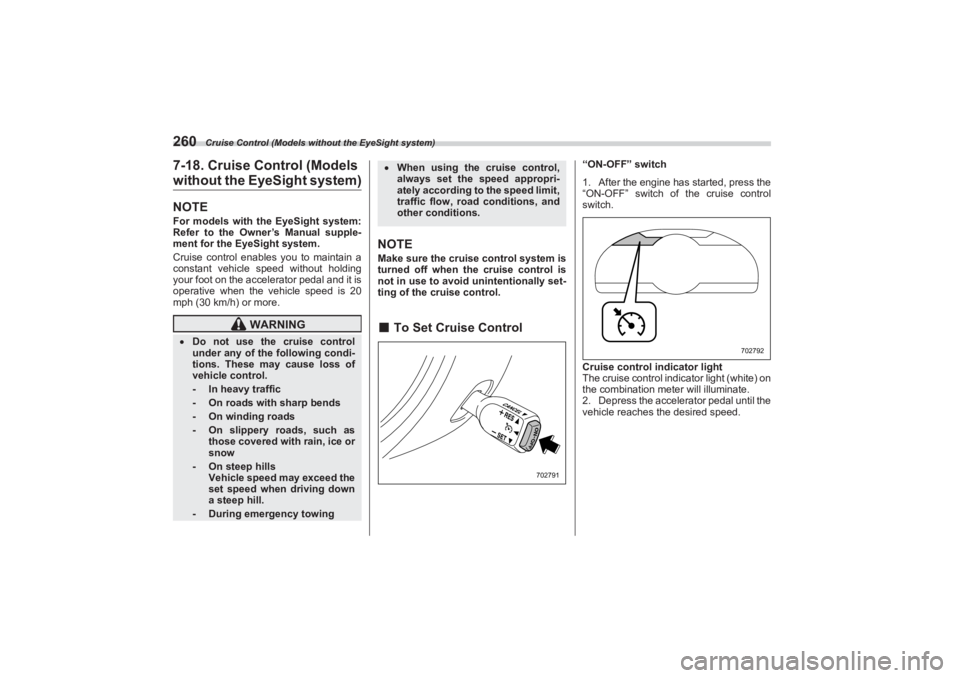
“ON-OFF” switch
1. After the engine has started, press the
“ON-OFF” switch of the cruise control
switch.
Cruise control indicator light
The cruise control indicator light (white) on
the combination meter will illuminate.
2. Depress the accelerator pedal until the
vehicle reaches the desired speed.
WARNING
Do not use the cruise control
under any of the following condi-
tions. These may cause loss of
vehicle control.
- In heavy traffic- On roads with sharp bends- On winding roads- On slippery roads, such as
those covered with rain, ice or
snow- On steep hills
Vehicle speed may exceed the
set speed when driving down
a steep hill.- During emergency towing
When using the cruise control,
always set the speed appropri-
ately according to the speed limit,
traffic flow, road conditions, and
other conditions.
702791
702792
BRZ_U.book 260 ページ 2022年3月29日 火曜日 午後3時59分
Page 278 of 432
BSD/RCTA (If Equipped)
272It is mounted on each side of the outside
mirrors.
The indicator light will illuminate
when a
vehicle approaching from behind is
detected.
The indicator light will flash
to warn the
driver of dangers under the following
conditions.
While the indicator light is illuminating,
if the turn signal lever is operated toward
the side in which this light turned on
When reversing the vehicle while the
system detects a vehicle approaching
from either side
▽ BSD/RCTA approach indicator
light dimming function
When the headlights are turned on, the
brightness of the BSD/RCTA approach
indicator light will be reduced.
NOTE You may have difficulty seeing the
BSD/RCTA approach indicator light
under the following conditions. - When sunlight shines directly on
it
- When the headlight beams from
a vehicle traveling behind shines
directly on it
While the illumination brightness
control dial is in the fully upward posi- tion, even if the headlights are turned
on, the brightness of the BSD/RCTA
approach indicator light will not be
reduced. For details about the illumina-
tion brightness control dial, refer to
"Illumination Brightness Control"
P130.
▼ BSD/RCTA approach warning
buzzer (only when reversing)
A warning buzzer sounds along with
flashing of the BSD/RCTA approach indi-
cator light to warn the driver of dangers.
The setting of the warning buzzer volume
can be changed by operating the center
information display. For details, refer to
"Car settings" P165.
▼ Safety tips regarding the BSD/
RCTA approach indicator light/
warning buzzer
In the following cases, operation of the
BSD/RCTA approach indicator light and
the warning buzzer may be delayed or the
system may fail to issue these warnings.
- When a vehicle moves to the neigh-
boring lane from a lane next to the
neighboring lane
- When driving on a steep incline or
on repeated sharp uphill and downhill
grades
- When going beyond a pass - When both your vehicle and a
vehicle driving on a neighboring lane
are driving on the far side of each lane.
- When several narrowly-spaced
vehicles are approaching in a row
- In low radius bends (tight bends or
when making turns at an intersection)
- When there is a difference in height
between your lane and the neighboring
lane
- Immediately after the BSD/RCTA is
activated by touching “BSD/RCTA”
- Immediately after the shift lever/
select lever is shifted to the “R” position
- When extremely heavy cargo is
loaded in the trunk
During reversing, operation of the BSD/
RCTA approach indicator light and the
warning buzzer may be delayed or the
system may fail to issue these warnings
under the following conditions.
- When backing out of an angled
parking space
- When a large-sized vehicle is
parked next to your vehicle (That
vehicle prevents the propagation of
radar waves.)
- When reversing on sloped roads
- When reversing at a high speedBRZ_U.book 272 ページ 2022年3月29日 火曜日 午後3時59分
Page 283 of 432
Reverse Automatic Braking (RAB) System (If Equipped)
277
Starting and Operating7
– CONTINUED –
7-21. Reverse Automatic
Braking (RAB) System (If Equipped)Reverse Automatic Braking (RAB) is a
system designed to help avoid collisions
or reduce collision damage when
reversing the vehicle. If a wall or an
obstacle is detected in the reversing direc-
tion, the system will notify the driver with a
warning sound and may activate the
vehicle’s brakes automatically.
NOTEThe Reverse Automatic Braking (RAB)
system records and stores the follow-
ing data when automatic braking oper-
ates. It does not record conversations,
personal information or other audio
data.
Distance from the object
Vehicle speed
Accelerator pedal operation status
Brake pedal operation status
Select lever position
Outside temperature
The sensitivity setting of the sonar
sensors
SUBARU and third parties contracted
by SUBARU may acquire and use the
recorded data for the purpose of vehi-
cle research and development.
SUBARU and third parties contracted
by SUBARU will not disclose or pro-
vide the acquired data to any other
third party except under the following
conditions.
The vehicle owner has given his/her
consent.
The disclosure/provision is based
on a court order or other legally
enforceable request.
Data that has been modified so that
the user and vehicle cannot be identi-
fied is provided to a research institu-
WARNING
Reverse Automatic Braking
(RAB) is not a system intended to
replace the driver’s responsibility
to check their surroundings for
vehicles or obstacles to avoid a
collision. The driver is responsible for
driving safely. Before reversing,
be sure to first depress the brake
pedal and visually check the
surroundings.
There are some cases in which
the vehicle cannot avoid colli-
sion, because the system opera-
tion has limitations. The warning
sound or automatic braking may
be delayed or may not operate at
all even when an obstacle is
present. Make sure to set the Automatic
Braking to OFF when the vehicle
is on the free roller or on the
chassis dynamometer. Other-
wise, the vehicle may move and it
may cause an accident. Make sure to set the Automatic
Braking to OFF when towing the
vehicle. Otherwis e, the vehicle
may move and it may cause an
accident. The system is not designed to
detect people (including chil-
dren), animals or other moving
objects. Depending on the vehicle condi-
tion or the surrounding environ-
ment, the sonar sensor’s ability
to detect objects may become
unstable.
BRZ_U.book 277 ページ 2022年3月29日 火曜日 午後3時59分
Page 286 of 432
Reverse Automatic Braking (RAB) System (If Equipped)
280
- The rear bumper is exposed to
strong impact, or the rear bumper is
deformed.
On a steep hill, the system’s auto-
matic braking ability will be reduced.
The system is designed to avoid
collisions by automatic hard braking
when the vehicle’s reversing speed is
less than approximately 3 mph (5 km/
h). However, the system does not guar-
antee that the vehicle will be able to
avoid collisions in any situation.
If the vehicle is reversed at an
extremely slow speed, the driver’s
operation may be prioritized. In this
case, automatic braking will not
operate.
The system may not be able to
detect and apply the brake with the
following objects. - Sharp or thin objects such as
poles, fences and ropes which may
not reflect the s ound wave emitted
from the sonar sensor.
- Objects that are too close to the
rear bumper when the select lever is
set to the “R” position.
- Objects with a surface which
may not reflect the sound wave
emitted from the sonar sensor such
as a chain link fence.
Objects the system is not designed
to detect and apply brake. -Pedestrians.
- Moving objects including
moving vehicles.
- Objects which absorbs sound
waves such as cloth or snow.
- Objects whose surface has a
diagonal angle.
- Objects that are low to the
ground such as parking blocks.
- Objects that are high above the
ground such as objects hanging
from above.
- Objects that are out of range of
the center of the vehicle in the hori-
zontal direction.
- Objects that are not perpendic-
ular to the ground.
- The surface of the object is
uneven or wavy.
When reversing the vehicle, the
functions may not be able to work
properly or may cause a system
malfunction if the following conditions
exist.
High frequency sound from other
sources are nearby:
- Horn sound from another
vehicle.
- Engine sound from other vehi-
cles.
- Sound of an air brake.
- Vehicle detection equipment or a
sonar from another vehicle. - A sound wave with a frequency
similar to the vehicle’s system is
transmitted near by.
- A vehicle equipped with the
same system is reversing toward
your reversing direction.
Weather conditions:
- Extremely high or extremely low
temperatures in which the area near
the sonar sensor becomes too hot
or too cold to operate.
- The sonar sensors or the rear
bumper near the sonar sensors are
exposed to heavy rain or a signifi-
cant amount of water.
- Fog, snow or sandstorm, etc.
- Air is moving rapidly such as
when a strong wind is blowing.
Parts attached to the rear bumper
near the sonar sensor:
- Commercial electr onic parts (fog
light, fender pole, radio antenna) or
commercial attachment parts (trailer
hitch, bicycle carrier, bumper guard)
are attached.
- Parts that emit high frequency
sound, such as a horn or speaker,
are attached.
Vehicle conditions:
- Ice, snow or mud is adhered to
the sonar sensors or the rear
bumper near the sonar sensor.
BRZ_U.book 280 ページ 2022年3月29日 火曜日 午後3時59分
Page 295 of 432
Driving Tips8
Driving Tips
8-1. New Vehicle Break-In Driving – the First
1,000 miles (1,600 km) ......................................290
8-2. Fuel Economy Hints ...................... .....................290
8-3. Engine Exhaust Gas (Carbon Monoxide) .........290
8-4. Catalytic Converter .............................................291
8-5. Periodic Inspections ...........................................292
8-6. Driving in Foreign Coun tries .............................292
8-7. Driving Tips .........................................................292
8-8. Winter Driving .....................................................293
Operation during Cold Weather ..................................293 Driving on Snowy and Icy Roads ............................... 295
Corrosion Protection ................................................... 296
Snow Tires.................................................................... 296
Tire Chains ................................................................... 297
Rocking the Vehicle..................................................... 297
8-9. Loading Your Vehicle .........................................297
Vehicle Capacity Weight ............................................. 298
GVWR and GAWR (Gross Vehicle Weight Rating
and Gross Axle Weight Rating) ................................ 299
8-10. Trailer Towing ...................................................299
BRZ_U.book 289 ページ 2022年3月29日 火曜日 午後3時59分