brake SUBARU BRZ 2023 Owner's Manual
[x] Cancel search | Manufacturer: SUBARU, Model Year: 2023, Model line: BRZ, Model: SUBARU BRZ 2023Pages: 432, PDF Size: 16.56 MB
Page 237 of 432
Starting and Stopping Engine
231
Starting and Operating7
– CONTINUED –
After the engine starts, the engine
speed will be kept high.
Do not shift the select lever (AT
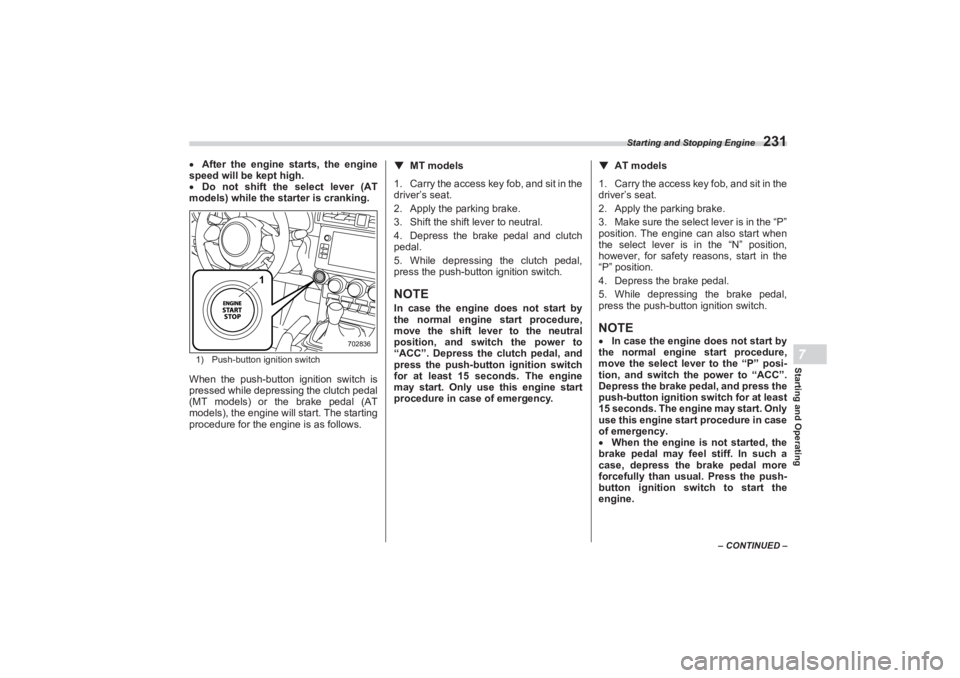
models) while the starter is cranking.1) Push-button ignition switchWhen the push-button ignition switch is
pressed while depressing the clutch pedal
(MT models) or the brake pedal (AT
models), the engine will start. The starting
procedure for the engine is as follows.
▼ MT models
1. Carry the access key fob, and sit in the
driver’s seat.
2. Apply the parking brake.
3. Shift the shift lever to neutral.
4. Depress the brake pedal and clutch
pedal.
5. While depressing the clutch pedal,
press the push-button ignition switch.NOTEIn case the engine does not start by
the normal engine start procedure,
move the shift lever to the neutral
position, and switch the power to
“ACC”. Depress the clutch pedal, and
press the push-butto n ignition switch
for at least 15 seconds. The engine
may start. Only use this engine start
procedure in case of emergency. ▼
AT models
1. Carry the access key fob, and sit in the
driver’s seat.
2. Apply the parking brake.
3. Make sure the select lever is in the “P”
position. The engine can also start when
the select lever is in the “N” position,
however, for safety reasons, start in the
“P” position.
4. Depress the brake pedal.
5. While depressing the brake pedal,
press the push-button ignition switch.NOTE In case the engine does not start by
the normal engine start procedure,
move the select lever to the “P” posi-
tion, and switch th e power to “ACC”.
Depress the brake pedal, and press the
push-button ignition switch for at least
15 seconds. The engine may start. Only
use this engine start procedure in case
of emergency.
When the engine is not started, the
brake pedal may feel stiff. In such a
case, depress the brake pedal more
forcefully than usual. Press the push-
button ignition switch to start the
engine.
1
702836
BRZ_U.book 231 ページ 2022年3月29日 火曜日 午後3時59分
Page 238 of 432
Starting and Stopping Engine
232■Stopping Engine1. Stop the vehicle completely.
2. Move the shift lever to neutral (MT
models) or select leve r to the “P” position
(AT models).
3. Press the push-button ignition switch.
The engine will stop, and the power will be
switched off.
NOTEAlthough you can stop the engine by
operating the push -button ignition
switch, do not stop the engine during
driving except in an emergency.■ When Access Key Fob Does
Not Operate ProperlyRefer to "Access Key Fob – If Access Key
Fob Does Not Operate Properly" P325.■ Steering LockAfter stopping the engine and any door is
opened, the steering wheel will be locked
due to the steering lock function.
When the engine is restarted, the steering
lock will be automatically released.
WARNING
Do not touch the push-button
ignition switch during driving.
When the push-button ignition
switch is operated as follows, the
engine will stop.–The switch is pressed and held
for 2 seconds or longer.–The switch is pressed briefly 3
times or more in succession.When the engine stops, the brake
booster will not function. A
greater foot pressure will be
required on the brake pedal.The power steering system will
not operate either. A greater
force will be required to steer,
and it may result in an accident.
If the engine stops during driving,
do not operate the push-button
ignition switch or open any of the
doors until the vehicle is stopped
in a safe location. It is dangerous
because the steering lock may be
activated. Stop the vehicle in a
safe place, and contact a
SUBARU dealer immediately.
CAUTION
For AT models:Do not stop the engine while the
select lever is in a position other
than the “P” position. If the engine is stopped while the
select lever is in a position other
than the “P” position, the power
will be in “ACC”. If the vehicle is
left in this cond ition, the battery
may be discharged.
BRZ_U.book 232 ページ 2022年3月29日 火曜日 午後3時59分
Page 239 of 432
Manual Transmission
233
Starting and Operating7
– CONTINUED –
▼When the steering lock cannot be
released1) Push-button ignition switchWhen you cannot restart the engine due
to the steering lock, check the status of
operation indicator and perform the
following steps.
▽How to released steering lock
1. Check that the shift lever is set in
neutral (MT models) or select lever is set
in the “P” position (AT models).
2. Depress the brake pedal and keep it.
3. Press the push-button ignition switch
while turning the steering wheel left and
right. ▽
When the display of warning
messages
There may be a malfunction in the
steering lock function. Immediately
contact your nearest SUBARU dealer.
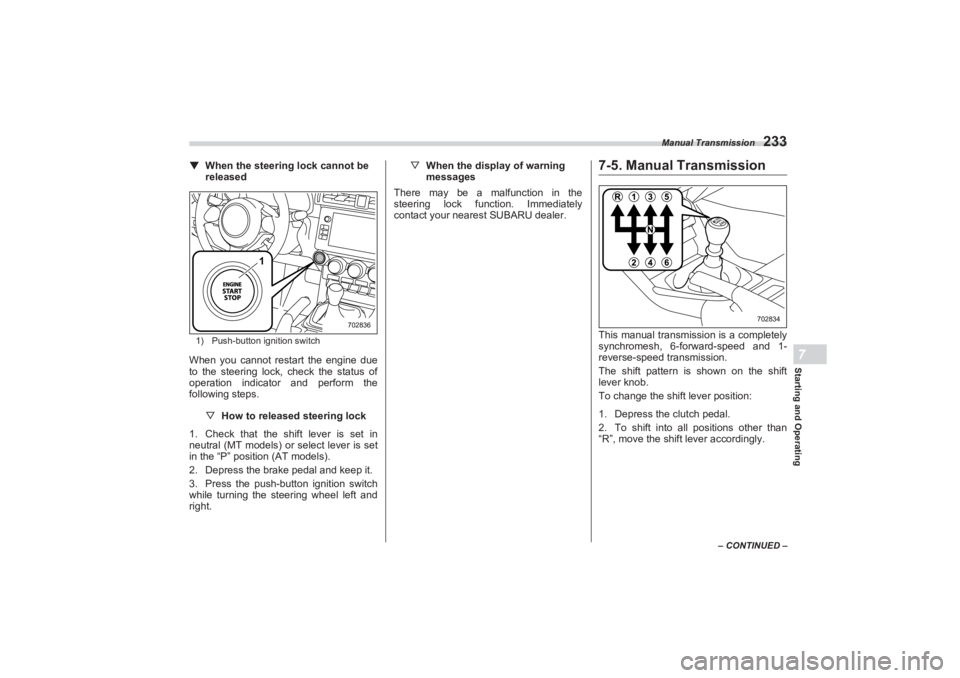
7-5. Manual TransmissionThis manual transmission is a completely
synchromesh, 6-forward-speed and 1-
reverse-speed transmission.
The shift pattern is shown on the shift
lever knob.
To change the shift lever position:
1. Depress the clutch pedal.
2. To shift into all positions other than
“R”, move the shi ft lever accordingly.
1
702836
702834
BRZ_U.book 233 ページ 2022年3月29日 火曜日 午後3時59分
Page 241 of 432
Automatic Transmission
235
Starting and Operating7
– CONTINUED –
■Driving TipsNOTEIf the accelerator and brake pedals are
depressed at the same time, driving
torque may be restrained. This is not a
malfunction.
Do not drive with your foot resting on the
clutch pedal and do not use the clutch to
hold your vehicle at a standstill on an
upgrade. Either of those actions may
cause clutch damage.
Do not drive with your hand resting on the
shift lever. This may cause wear on the
transmission components. When it is necessary to reduce vehicle
speed due to slow traffic, turning corners,
or driving up steep hills, downshift to a
lower gear before the engine starts to
labor.
On steep downgrades, downshift the
transmission to 5th, 4th, 3rd or 2nd gear
as necessary; this helps to maintain a safe
speed and to extend brake pad life.
In this way, the engine provides a braking
effect. Remember, if you “ride” (over use)
the brakes while descending a hill, they
may overheat and not work properly.
The engine may, on rare occasions, knock
when the vehicle rapidly accelerates or
rapidly pulls away from a standstill. This
phenomenon is not an indication of a
problem in your vehicle.
With the exception of cases where sudden
acceleration is required, do not drive the
vehicle with the pointer of the tachometer
inside the red area. Failure to observe this
precaution can lead to excessive engine
wear and poor fuel economy.
7-6. Automatic TransmissionThe automatic transmission is electroni-
cally controlled and provides 6 forward
speeds and 1 reverse speed. It also has a
manual mode.
WARNING
When shifting down a gear, ensure
that the engine speed does not
enter the red zone. Failure to
observe this precaution can lead to
engine over-revving and this in turn
can result in engine damage.In addition, sudden application of
engine brakes when the vehicle is
travelling on a slippery surface can
lead to wheel locking; as a conse-
quence, control of the vehicle may
be lost and the risk of an accident
increased.
WARNING
Do not shift from the “P” or “N”
position into the “D” or “R” position
while depressing the accelerator
pedal. This may cause the vehicle to
lurch forward or backward.
CAUTION
Observe the following precau-
tions. Failure to observe these
precautions could cause damage
to the transmission.
- Shift into the “P” or “R” posi- tion only after the vehicle has
completely stopped.- Do not shift from the “D” posi- tion into the “R” position or
vice versa until the vehicle
has completely stopped.
BRZ_U.book 235 ページ 2022年3月29日 火曜日 午後3時59分
Page 242 of 432
Automatic Transmission
236NOTEWhen the engine coolant tempera-
ture is still low, the transmission will
shift at higher engine speeds than
when the coolant temperature is suffi-
ciently high in order to shorten the
warm-up time and improve driveability.
The gearshift timing will automatically shift to the normal
timing after the
engine has warmed up.
Immediately after transmission fluid
is replaced, you may feel that the trans-
mission operation is somewhat
unusual. This results from invalidation
of data which the on-board computer
has collected and stored in memory to
allow the transmission to shift at the
most appropriate times for the current
condition of your vehicle. Optimized
shifting will be restored as the vehicle
continues to be driven for a while.
Place the shift boot to the original
position after it is lifted. If the shift lever
is operated with the shift boot in the
rolled up position, the shift boot may
have tension and it may disturb the
shift lever operation.
When the vehicle is idling at high
rpm in order to warm up, and the
vehicle is on a slippery road, the trans-
mission may automatically shift to 2nd
gear for stopping and starting off.
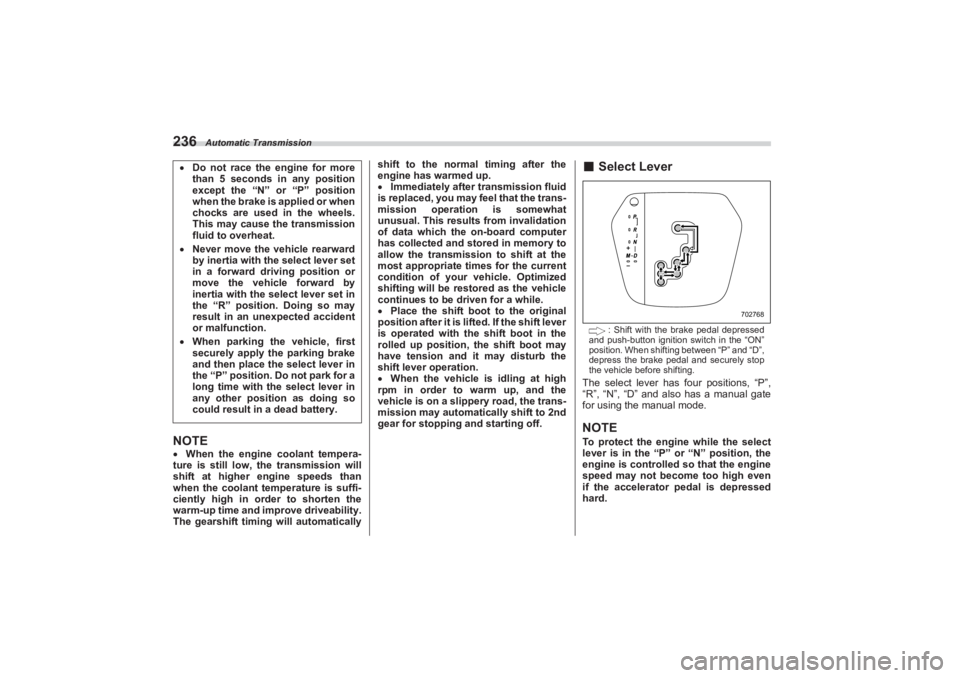
■ Select Lever
: Shift with the brake pedal depressed
and push-button ignition switch in the “ON”
position. When shifting between “P” and “D”,
depress the brake pedal and securely stop
the vehicle before shifting.
The select lever has four positions, “P”,
“R”, “N”, “D” and also has a manual gate
for using the manual mode.NOTETo protect the engine while the select
lever is in the “P” or “N” position, the
engine is controlled so that the engine
speed may not become too high even
if the accelerator pedal is depressed
hard.
Do not race the engine for more
than 5 seconds in any position
except the “N” or “P” position
when the brake is applied or when
chocks are used in the wheels.
This may cause the transmission
fluid to overheat. Never move the vehicle rearward
by inertia with the select lever set
in a forward driving position or
move the vehicle forward by
inertia with the select lever set in
the “R” position. Doing so may
result in an unexpected accident
or malfunction. When parking the vehicle, first
securely apply the parking brake
and then place the select lever in
the “P” position. Do not park for a
long time with the select lever in
any other position as doing so
could result in a dead battery.
702768
BRZ_U.book 236 ページ 2022年3月29日 火曜日 午後3時59分
Page 243 of 432
Automatic Transmission
237
Starting and Operating7
– CONTINUED –
▼P (Park)
This position is for parking the vehicle and
starting the engine. In this position, the
transmission is mechanically locked to
prevent the vehicle from rolling freely.
When you park the vehicle, first apply the
parking brake, then shift into the “P” posi-
tion. Do not hold the vehicle with only the
mechanical friction of the transmission.
To shift the select lever from the “P” to any
other position, you should depress the
brake pedal fully then move the select
lever. This prevents the vehicle from
lurching when it is started.
▼ R (Reverse)
This position is for backing the vehicle. To
shift from the “N” to “R” position, stop the
vehicle completely th en move the lever to
the “R” position.
▼ N (Neutral)
This position is for restarting a stalled
engine. In this position, the transmission is
neutral, meaning that the wheels and
transmission are not locked. Therefore,
the vehicle will roll freely, even on the
slightest incline unless the parking brake
or foot brake is applied. ▼
D (Drive)
This position is for normal driving. The
transmission shifts automatically into a
suitable gear according to the vehicle
speed and the acceleration you require.
Also, while driving up and down a hill, the
transmission assists and controls the
driving performance and engine braking
while corresponding to the road grade.
When more acceleration is required in “D”
position, depress the accelerator pedal
fully to the floor and hold that position. The
transmission will auto matically downshift.
When you release the pedal, the transmis-
sion will return to the original gear posi-
tion.
To use the manual mode, move the lever
from this position into the manual gate.
If one of the shift paddles behind the
steering wheel is operated while driving in
the “D” position, the transmission will
temporarily switch to the manual mode. In
this mode, you can shift into any gear position using the shift paddles. For
details about the manual mode, refer to
"Selection of Manual Mode" P239.
Once the vehicle speed stabilizes, the
transmission will switch from the manual
mode back to the “D” position for normal
driving.
▽ While climbing a grade
When driving up a hill, undesired upshift is
prevented from taking place when the
accelerator is releas ed. This minimizes
the chance of subsequent downshifting to
a lower gear when accelerating again.
This prevents repeated upshifting and
downshifting resulting in a smoother oper-
ation of the vehicle.
NOTEThe transmission may downshift,
depending on the way the accelerator
pedal is depressed to accelerate the
vehicle again.■ Adaptive ControlIn order to realize smoother driving while
driving in “D” position, an appropriate gear
is automatically selected by limiting
upshifting and performing downshifting
operations according to driver operations
and driving conditions.
WARNING
Do not drive the vehicle with the
select lever in the “N” (neutral)
position. Engine braking has no
effect in this co ndition and the risk
of an accident is consequently
increased.
BRZ_U.book 237 ページ 2022年3月29日 火曜日 午後3時59分
Page 244 of 432
Automatic Transmission
238When driving uphill, prevents unneces-
sary upshifting and downshifting.
When driving downhill, downshifting is
performed at engine speeds higher than
usual.
When driving on curves, prevents
upshifting even when accelerating.
When the brake pedal is depressed
firmly, downshifting is automatically
performed, fully utilizing engine braking.
When the accelerator pedal is
suddenly released, prevents upshifting.NOTEAdaptive control operates automati-
cally when the select lever is in the “D”
position. The function is canceled
when the paddle shift levers are oper-
ated or the select lever is shifted to the
“M” position.■ Shift Lock FunctionThe shift lock function helps prevent the
improper operation of the select lever.
The select lever cannot be operated
unless the ignition switch is turned to the
“ON” position and the brake pedal is
depressed.
The select lever cannot be moved from
the “P” position to any other position
before the brake pedal is depressed. Depress the brake pedal first, and then
operate the select lever.
Only the “P” position allows you to turn
the push-button ignition switch to the
“OFF” position.
▼ Shift lock release
If the select lever cannot be operated, turn
the ignition switch back to the “ON” posi-
tion then move the select lever to the “P”
position with the brake pedal depressed.
If the select lever does not move after
performing the above procedure, refer to
"Shift lock release using the shift lock
release portion" P238. ▼
Shift lock release using the shift
lock release portion
Perform the following procedure to
release the shift lock.
1. Apply the parking brake and stop the
engine.
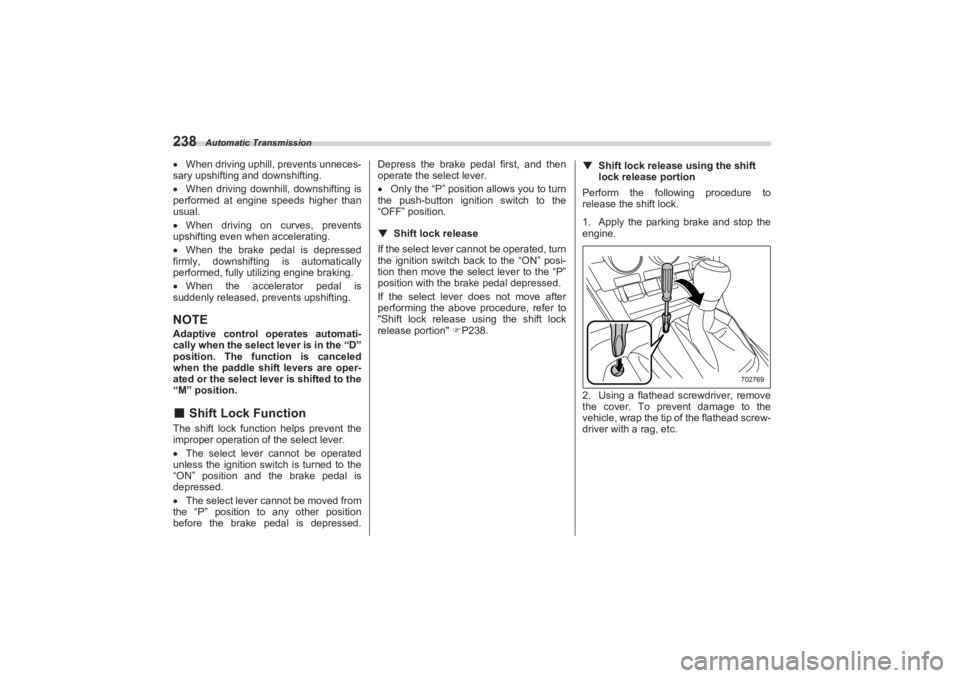
2. Using a flathead screwdriver, remove
the cover. To prevent damage to the
vehicle, wrap the tip of the flathead screw-
driver with a rag, etc.
702769
BRZ_U.book 238 ページ 2022年3月29日 火曜日 午後3時59分
Page 245 of 432
Automatic Transmission
239
Starting and Operating7
– CONTINUED –
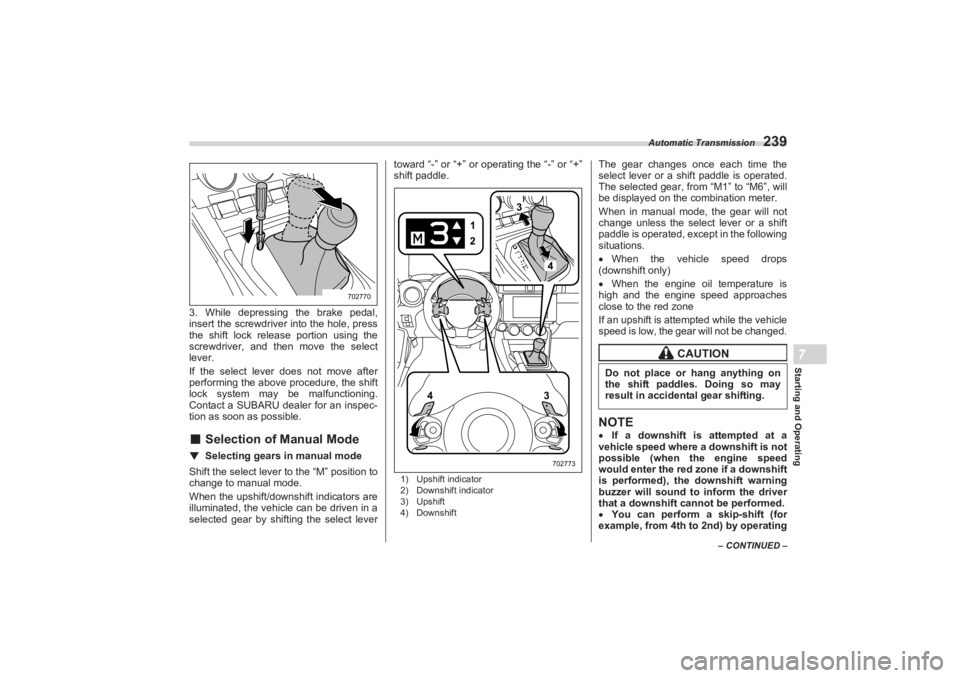
3. While depressing the brake pedal,
insert the screwdriver into the hole, press
the shift lock release portion using the
screwdriver, and then move the select
lever.
If the select lever does not move after
performing the above procedure, the shift
lock system may be malfunctioning.
Contact a SUBARU dealer for an inspec-
tion as soon as possible.■ Selection of Manual Mode▼ Selecting gears in manual modeShift the select lever to the “M” position to
change to manual mode.
When the upshift/downshift indicators are
illuminated, the vehicle can be driven in a
selected gear by shifti ng the select lever toward “-” or “+” or operating the “-” or “+”
shift paddle.
1) Upshift indicator
2) Downshift indicator
3) Upshift
4) Downshift
The gear changes once each time the
select lever or a shift paddle is operated.
The selected gear, from “M1” to “M6”, will
be displayed on the combination meter.
When in manual mode, the gear will not
change unless the select lever or a shift
paddle is operated, except in the following
situations.
When the vehicle speed drops
(downshift only)
When the engine oil temperature is
high and the engine speed approaches
close to the red zone
If an upshift is atte mpted while the vehicle
speed is low, the gear will not be changed.NOTE If a downshift is attempted at a
vehicle speed where a downshift is not
possible (when the engine speed
would enter the red zone if a downshift
is performed), the downshift warning
buzzer will sound to inform the driver
that a downshift cannot be performed.
You can perform a skip-shift (for
example, from 4th to 2nd) by operating
702770
13
4
2
3
4702773
CAUTION
Do not place or hang anything on
the shift paddles. Doing so may
result in accidental gear shifting.
BRZ_U.book 239 ページ 2022年3月29日 火曜日 午後3時59分
Page 246 of 432
Automatic Transmission
240the shift paddle twice in rapid succes-
sion.
If the temperature of the transmis-
sion fluid becomes too high, the “AT
OIL TEMP” warning light will illumi-
nate. Immediately stop the vehicle in a
safe place and let the engine idle until
the warning light turns off.▼ Temporary manual mode driving
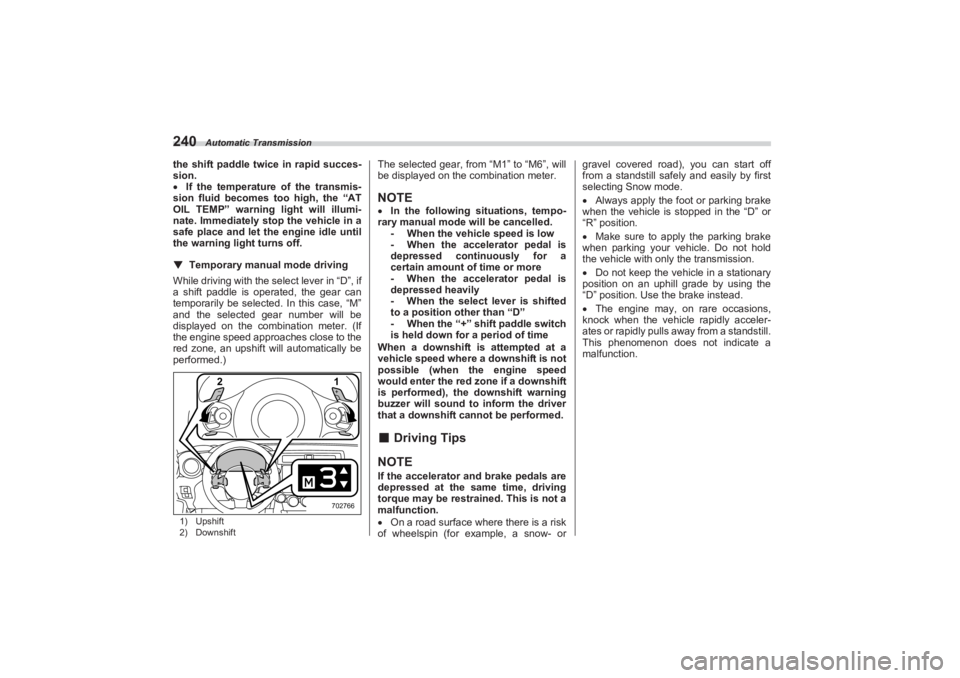
While driving with the select lever in “D”, if
a shift paddle is operated, the gear can
temporarily be selected. In this case, “M”
and the selected gear number will be
displayed on the combination meter. (If
the engine speed approaches close to the
red zone, an upshift will automatically be
performed.)1) Upshift
2) Downshift
The selected gear, from “M1” to “M6”, will
be displayed on the combination meter.NOTE In the following situations, tempo-
rary manual mode will be cancelled. - When the vehicle speed is low
- When the accelerator pedal is
depressed continuously for a
certain amount of time or more
- When the accelerator pedal is
depressed heavily
- When the select lever is shifted
to a position other than “D”
- When the “+” shift paddle switch
is held down for a period of time
When a downshift is attempted at a
vehicle speed where a downshift is not
possible (when the engine speed
would enter the red zone if a downshift
is performed), the downshift warning
buzzer will sound to inform the driver
that a downshift cannot be performed.■ Driving TipsNOTEIf the accelerator and brake pedals are
depressed at the same time, driving
torque may be restrained. This is not a
malfunction.
On a road surface where there is a risk
of wheelspin (for example, a snow- or gravel covered road), you can start off
from a standstill safely and easily by first
selecting Snow mode.
Always apply the foot or parking brake
when the vehicle is stopped in the “D” or
“R” position.
Make sure to apply the parking brake
when parking your vehicle. Do not hold
the vehicle with only the transmission.
Do not keep the vehicle in a stationary
position on an uphill grade by using the
“D” position. Use the brake instead.
The engine may, on rare occasions,
knock when the vehicle rapidly acceler-
ates or rapidly pulls away from a standstill.
This phenomenon does not indicate a
malfunction.
1
2702766
BRZ_U.book 240 ページ 2022年3月29日 火曜日 午後3時59分
Page 249 of 432
Braking
243
Starting and Operating7
– CONTINUED –
NOTEIf the steering wheel is operated in the
following ways, the power steering
control system may temporarily limit
the power assist in order to prevent
the system components, such as the
control computer and drive motor,
from overheating.
The steering wheel is operated
frequently and turned sharply while the
vehicle is maneuvered at extremely low
speeds, such as while frequently
turning the steering wheel during
parallel parking.
The steering wheel remains in the
fully turned position for a long period
of time.
At this time, there will be more resis-
tance when steering. However this is
not a malfunction. Normal steering
force will be restored after the steering
wheel is not operated for a while and the power steering control system has
an opportunity to cool down. However,
if the power steering is operated in a
non-standard way which causes
power assist limitation to occur too
frequently, this may result in a mal-
function of the power steering control
system.
7-10. Braking■ Braking Tips▼ When the brakes get wet
When driving in rain or after washing the
vehicle, the brakes may get wet. As a
result, brake stopping distance will be
longer. To dry the brakes, drive the
vehicle at a safe speed while lightly
depressing the brake pedal to heat up the
brakes.
▼ Use of engine brakingRemember to make use of engine braking
in addition to foot braking. When
descending a grade, if only the foot brake
is used, the brakes may start working
improperly because of brake fluid over-
heating, caused by overheated brake
pads. To help prevent this, shift into a
lower gear to get stronger engine braking.
CAUTION
While the power steering warning
light is illuminated, there may be
more resistance when the steering
wheel is operated. Drive carefully to
the nearest SUBARU dealer and
have the vehicle inspected immedi-
ately.
WARNING
Never rest your foot on the brake
pedal while driving. This can cause
dangerous overheating of the
brakes and needless wear on the
brake pads.
BRZ_U.book 243 ページ 2022年3月29日 火曜日 午後3時59分