seats SUBARU BRZ 2023 Owner's Manual
[x] Cancel search | Manufacturer: SUBARU, Model Year: 2023, Model line: BRZ, Model: SUBARU BRZ 2023Pages: 432, PDF Size: 16.56 MB
Page 137 of 432
Warning and Indicator Lights
131
Instruments and Controls3
– CONTINUED –
NOTEWhen the control dial is turned fully
upward, the illumination brightness
becomes the maximum and the auto-
matic dimming function does not work
at all.
The brightness setting is not
canceled even when the ignition switch
is turned to th e “OFF” position.■Auto Dimmer Cancel Func -
tionWhen the ambient light is bright, the illumi-
nation brightness is set to the maximum
regardless of the position of the control
dial. In this case, you cannot adjust the
illumination brightness by using the
control dial. When the ambient light is
dark, you can dim the illumination bright-
ness as described above.
The operational/non-operational setting
and sensitivity of the auto dimmer cancel
function can be changed by your
SUBARU dealer. Contact your SUBARU
dealer for details.
3-6. Warning and Indicator LightsSeveral of the warning and indicator lights
illuminate momentarily and then go out
when the ignition switch is initially turned
to the “ON” position. This permits
checking the operation of the bulbs.
Apply the parking brake and turn the igni-
tion switch to the “ON” position. For the
system check, the following lights illumi-
nate and turn off after several seconds or
after the engine has started:
: Seatbelt warning light (The seatbelt
warning light turns off only when the
driver fastens the seatbelt.)
: Front passenger’s seatbelt warning
light (The seatbelt warning light turns
off only when the front seat passenger
fastens the seatbelt.)
: Rear passenger’s seatbelt warning
light (The seatbelt warning light turns
off only when the rear seat
passenger fastens the seatbelt.)
: SRS airbag system warning light
: Front passenger’s frontal airbag ON
indicator light
: Front passenger’s frontal airbag OFF
indicator light
/ : CHECK ENGINE warning light/ Malfunction indicator light : Coolant temperature high warning
light (red)
: Charge warning light : Oil pressure warning light
/ :ABS warning light
: Vehicle Stability Control (VSC)
warning light/Vehicle Stability
Control (VSC) operation indicator
light
: Vehicle Stability Control (VSC) OFF
indicator light
: TRAC OFF indicator light / :Brake system warning light (red)
:Power steering warning light
: Low tire pressure warning light (if
equipped)
: Low fuel warning light :Master warning light
If any lights fail to i lluminate, it indicates a
burned-out bulb or a malfunction of the
corresponding system.
Consult your authorized SUBARU dealer
for repair.
■ Seatbelt Warning Light
and ChimeYour vehicle is equipped with a seatbelt
warning device at the driver’s and
passenger’s seats, as required by current
safety standards.
BRZ_U.book 131 ページ 2022年3月29日 火曜日 午後3時59分
Page 138 of 432
Warning and Indicator Lights
132▼Driver’s and front passenger’s
seats
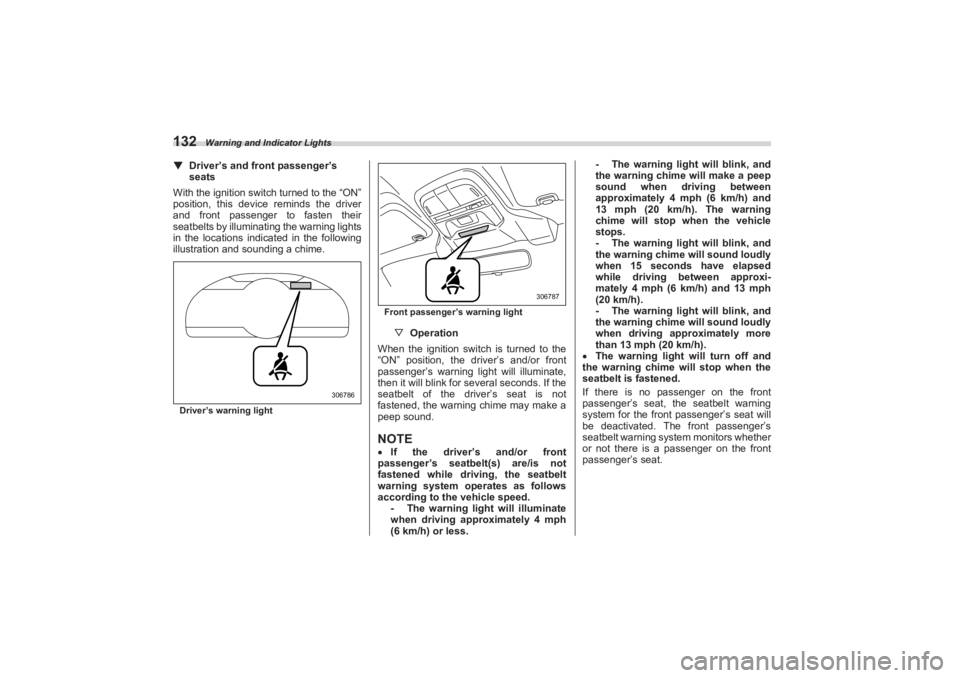
With the ignition switch turned to the “ON”
position, this device reminds the driver
and front passenger to fasten their
seatbelts by illuminating the warning lights
in the locations indicated in the following
illustration and sounding a chime.Driver’s warning light Front passenger’s warning light
▽
Operation
When the ignition switch is turned to the
“ON” position, the dr iver’s and/or front
passenger’s warning light will illuminate,
then it will blink for several seconds. If the
seatbelt of the driver’s seat is not
fastened, the warning chime may make a
peep sound.NOTE If the driver’s and/or front
passenger’s seatbelt(s) are/is not
fastened while driving, the seatbelt
warning system operates as follows
according to the vehicle speed. - The warning light will illuminate
when driving approximately 4 mph
(6 km/h) or less. - The warning light will blink, and
the warning chime will make a peep
sound when driving between
approximately 4 mph (6 km/h) and
13 mph (20 km/h). The warning
chime will stop when the vehicle
stops.
- The warning light will blink, and
the warning chime will sound loudly
when 15 seconds have elapsed
while driving between approxi-
mately 4 mph (6 km/h) and 13 mph
(20 km/h).
- The warning light will blink, and
the warning chime will sound loudly
when driving approximately more
than 13 mph (20 km/h).
The warning light will turn off and
the warning chime will stop when the
seatbelt is fastened.
If there is no passenger on the front
passenger’s seat, the seatbelt warning
system for the front passenger’s seat will
be deactivated. The front passenger’s
seatbelt warning system monitors whether
or not there is a passenger on the front
passenger’s seat.
306786
306787
BRZ_U.book 132 ページ 2022年3月29日 火曜日 午後3時59分
Page 139 of 432
Warning and Indicator Lights
133
Instruments and Controls3
– CONTINUED –
If the seatbelt warning system for the front
passenger’s seat does not function
correctly (e.g., it is activated even when
the front passenger’s seat is empty or it is
deactivated even when the front
passenger has not fastened his/her
seatbelt), take the following actions.
Ensure that no article is placed on the
seat other than a ch ild restraint system
and its child occupant, although we
strongly recommend th at all children sit in
the rear seat properly restrained.
Ensure that the backward-forward
position and seatback of front passenger’s
seat are locked into place securely by
moving the seat back and forth.
If still the s eatbelt warning system for front
passenger’s seat does not function
correctly after taking relevant corrective
actions described above, immediately
contact your SUBARU dealer for an
inspection.
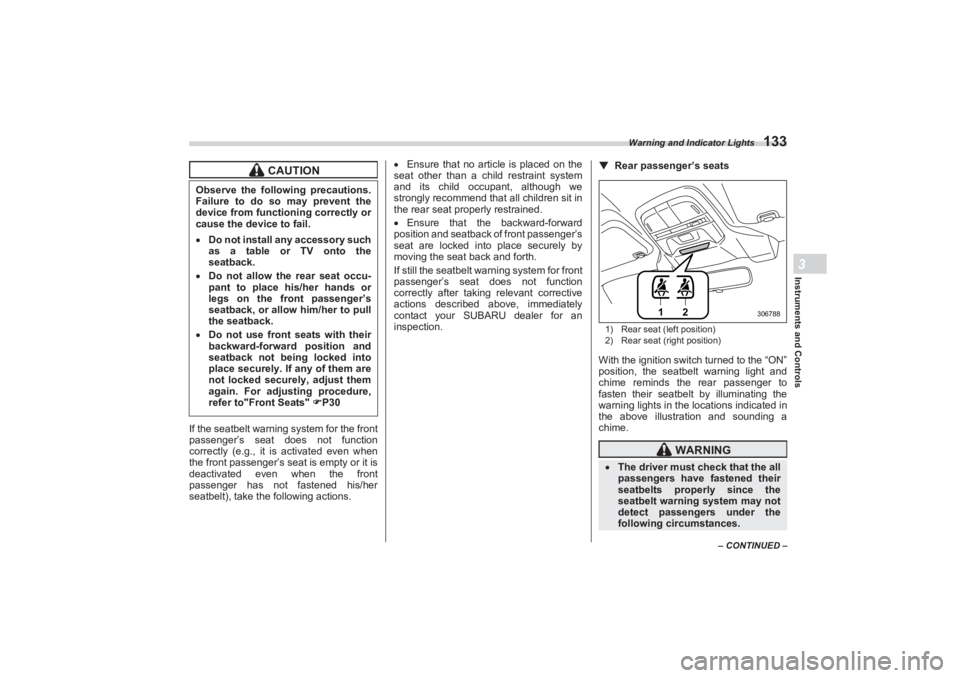
▼ Rear passenger’s seats1) Rear seat (left position)
2) Rear seat (right position)With the ignition switch turned to the “ON”
position, the seatbelt warning light and
chime reminds the rear passenger to
fasten their seatbelt by illuminating the
warning lights in the locations indicated in
the above illustration and sounding a
chime.
CAUTION
Observe the following precautions.
Failure to do so may prevent the
device from functioning correctly or
cause the device to fail. Do not install any accessory such
as a table or TV onto the
seatback. Do not allow the rear seat occu-
pant to place his/her hands or
legs on the front passenger’s
seatback, or allow him/her to pull
the seatback. Do not use front seats with their
backward-forward position and
seatback not being locked into
place securely. If any of them are
not locked securely, adjust them
again. For adjusting procedure,
refer to"Front Seats" P30
WARNING
The driver must check that the all
passengers have fastened their
seatbelts properly since the
seatbelt warning system may not
detect passengers under the
following circumstances.
2
1
306788
BRZ_U.book 133 ページ 2022年3月29日 火曜日 午後3時59分
Page 140 of 432
Warning and Indicator Lights
134NOTEThe seatbelt warning system of the
rear seat detects if the seat is occupied
by a passenger. Heavy cargo or large
pets on the rear seat may result in the
activation of the passenger seatbelt
warning light and chime. Fastening the
rear seatbelt prior to loading cargo or
large pets will avoid activating the
passenger seatbelt warning light and
chime.
When folding the rear seat, ensure
that the seat is empty prior to folding. Items caught between the seat bottom
and seatback, when folded, may
damage the seat surface or activate the
passenger seatbelt warning light and
chime.
▽ Operation
If passengers in the rear seats do not
fasten their seatbelts while the ignition
switch is turned to the “ON” position, the
seatbelt warning lights will illuminate or
blink to indicate that their seatbelts are not
fastened.NOTE If the rear passenger’s seatbelt(s)
are/is still not fast ened while driving,
the seatbelt warning system operates
as follows according to the vehicle
speed. - The warning light will illuminate
when driving approximately 4 mph
(6 km/h) or less.
- When driving approximately
between 4 mph (6 km/h) and 13 mph
(20 km/h), if the seatbelts are not
fastened for 50 seconds, the
seatbelt warning lights will blink and
a warning chime will sound.
The chime will make a peep sound
for 15 seconds, and it then will
become louder and continue for 35
seconds. The warning light will blink for 50 seconds, then it will illuminate
steadily and the chime will stop.
- When driving more than approxi-
mately 13 mph (20 km/h), if seatbelts
are not fastened for 35 seconds, the
warning lights of the unfastened
seatbelts will blink and a chime will
sound loudly. If the rear seatbelts
are not fastened after 35 seconds,
the blinking warning light will illumi-
nate steadily and the chime will
stop. The warning lights will
continue to illuminate until their
seatbelts are fastened.
The warning light will turn off and
the warning chime will stop when the
seatbelt is fastened.
- When cushions or child
restraint systems, etc., are
used.- When a child or small adult is
sitting in the seat.
Observe the following precau-
tions
- Do not apply any strong
impact to the rear seat.- Do not fold the seatback
forward when objects are on
the seat.- Do not spill liquid on the rear
seat. If liquid is spilled, wipe it
off immediately.- Do not remove or disassemble
the rear seat.
BRZ_U.book 134 ページ 2022年3月29日 火曜日 午後3時59分
Page 201 of 432
Tilt/Telescopic Steering Wheel
195
Instruments and Controls3
3-17. Tilt/Telescopic SteeringWheel
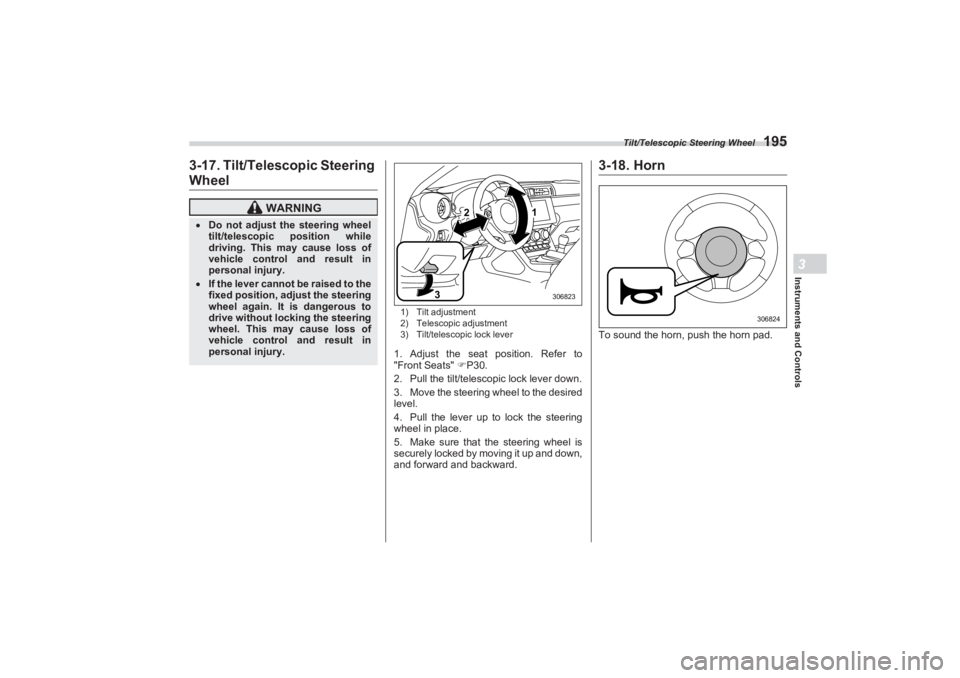
1) Tilt adjustment
2) Telescopic adjustment
3) Tilt/telescopic lock lever1. Adjust the seat position. Refer to
"Front Seats" P30.
2. Pull the tilt/telescopic lock lever down.
3. Move the steering wheel to the desired
level.
4. Pull the lever up to lock the steering
wheel in place.
5. Make sure that the steering wheel is
securely locked by moving it up and down,
and forward and backward.
3-18. HornTo sound the horn, push the horn pad.
WARNING
Do not adjust the steering wheel
tilt/telescopic position while
driving. This may cause loss of
vehicle control and result in
personal injury. If the lever cannot be raised to the
fixed position, adjust the steering
wheel again. It is dangerous to
drive without locking the steering
wheel. This may cause loss of
vehicle control and result in
personal injury.
2
3
1
306823
306824
BRZ_U.book 195 ページ 2022年3月29日 火曜日 午後3時59分
Page 304 of 432
Loading Your Vehicle
298
NOTEFor better fuel economy, do not carry
unneeded cargo.
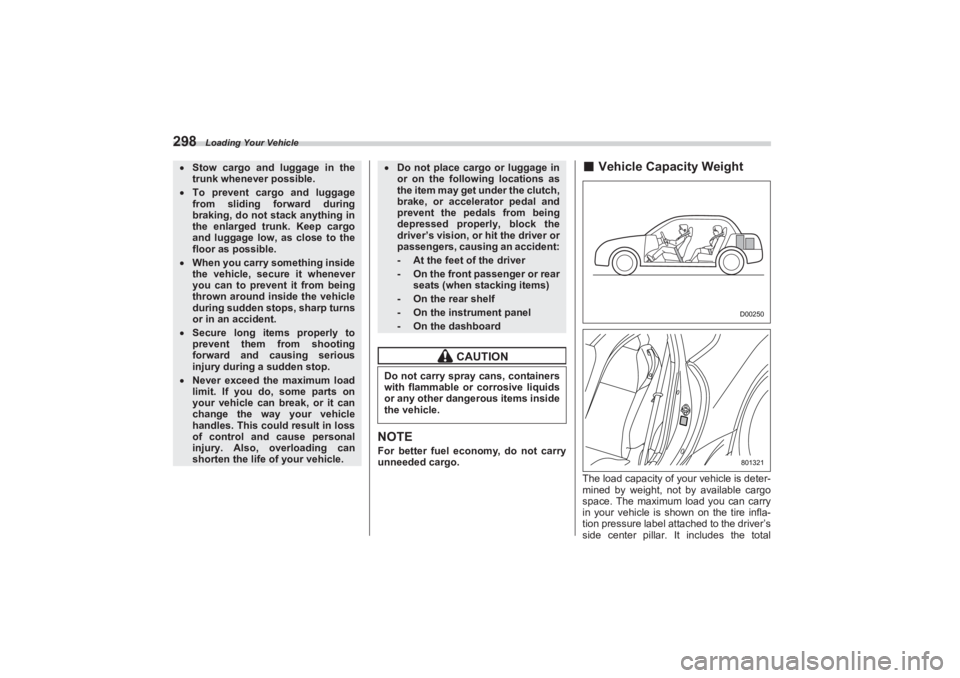
■ Vehicle Capacity WeightThe load capacity of your vehicle is deter-
mined by weight, not by available cargo
space. The maximum load you can carry
in your vehicle is shown on the tire infla-
tion pressure label attached to the driver’s
side center pillar. It includes the total
Stow cargo and luggage in the
trunk whenever possible. To prevent cargo and luggage
from sliding forward during
braking, do not stack anything in
the enlarged trunk. Keep cargo
and luggage low, as close to the
floor as possible. When you carry something inside
the vehicle, secure it whenever
you can to prevent it from being
thrown around inside the vehicle
during sudden stops, sharp turns
or in an accident. Secure long items properly to
prevent them from shooting
forward and causing serious
injury during a sudden stop. Never exceed the maximum load
limit. If you do, some parts on
your vehicle can break, or it can
change the way your vehicle
handles. This could result in loss
of control and cause personal
injury. Also, overloading can
shorten the life of your vehicle.
Do not place cargo or luggage in
or on the following locations as
the item may get under the clutch,
brake, or accelerator pedal and
prevent the pedals from being
depressed properly, block the
driver’s vision, or hit the driver or
passengers, causing an accident:
- At the feet of the driver- On the front passenger or rear
seats (when stacking items)- On the rear shelf- On the instrument panel- On the dashboard
CAUTION
Do not carry spray cans, containers
with flammable or corrosive liquids
or any other dangerous items inside
the vehicle.
D00250801321
BRZ_U.book 298 ページ 2022年3月29日 火曜日 午後3時59分
Page 342 of 432
Cleaning the Interior
336If your SUBARU is to be parked for a long
time in bright sunlight, it is recommended
that the seats and headrests be covered,
or the windows shaded, to prevent fading
or shrinkage.
You will discover that each leather seat
section will develop so ft folds or wrinkles,
which is characteristic of genuine leather.■ Synthetic Leather UpholsteryThe synthetic leather material used on the
SUBARU may be cleaned using mild soap
or detergent and water, after first vacu-
uming or brushing away loose dirt. Allow
the soap to soak in for a few minutes and
wipe off with a clean, damp cloth.
Commercial foam-type cleaners suitable
for synthetic leather materials may be
used when necessary.
■ Instrument Panel, Console
Panel, Switches, Combina -
tion Meter, and Other Plastic
SurfaceUse a soft, damp cloth to clean the instru-
ment panel, center console, combination
meter panel, and switches.■ Center Information DisplayTo clean the center information display,
wipe it with a silicone cloth or with a soft
cloth. If the monitor is extremely dirty,
clean it with a soft cloth moistened with
neutral detergent then carefully wipe off
any remaining detergent.
CAUTION
Strong cleaning agents such as sol-
vents, paint thinners, window
cleaner or gasoline must never be
used on leather or synthetic interior
materials. Doing so could damage
the surface and cause the color to
deteriorate.
CAUTION
Do not use organic solvents such
as paint thinners or gasoline, or
strong cleaning agents that
contain those solvents. Doing so
could damage the surface and
cause the color to deteriorate. Do not use chemical solvents that
contain silicone on the vehicle
audio system, electrical compo-
nents of the air-conditioner or
any switches. If silicone adheres
to these parts, it may cause
damage to electrical compo-
nents.
CAUTION
Do not spray neutral detergent
directly onto the monitor. Doing
so could damage the monitor’s
components. Do not wipe the monitor with a
hard cloth. Doing so could
scratch the monitor. Do not use cleaning fluid that
contains thinner, fuel, or any
other volatile substance. Such
cleaning fluid could erase the
lettering on the switches at the
bottom of the monitor.
BRZ_U.book 336 ページ 2022年3月29日 火曜日 午後3時59分
Page 403 of 432
Tire Information
397
Consumer Information and Reporting Safety Defects13
– CONTINUED –
The vehicle placard shows original
tire size, recommended cold tire
inflation pressure on each tire at
maximum loaded vehicle weight,
seating capacity and loading infor-
mation.▼ Adverse safety consequences
of under-inflation
Driving at high speeds with exces-
sively low tire pressures can cause
the tires to flex severely and to
rapidly become hot. A sharp
increase in temperature could
cause tread separation, and failure
of the tire(s). Possible resulting loss
of vehicle control could lead to an
accident.
▼ Measuring and adjusting air
pressure to achieve proper
inflation
Check and, if necessary, adjust the
pressure of each tire (including the
spare) at least once a month and
before any long journey. Check the
tire pressures when the tires are
cold. Use a pressure gauge to adjust the tire pressures to the
specific values. Driving even a short
distance warms up the tires and
increases the tire pressures. Also,
the tire pressures are affected by
the outside temperature. It is best to
check tire pressure outdoors before
driving the vehicle. When a tire
becomes warm, t he air inside it
expands, causing the tire pressure
to increase. Be careful not to
mistakenly release air from a warm
tire to reduce its pressure.
■ Glossary of Tire TerminologyAccessory weight
The combined weight (in excess of
those standard items which may be
replaced) of automatic transmis-
sion, power steering, power brakes,
power windows, power seats, radio,
and heater, to the extent that these
items are available as factory-
installed equipment (whether
installed or not).
Bead
The part of the tire that is made of
steel wires, wrapped or reinforced by ply cords and that is shaped to fit
the rim.
Bead separation
A breakdown of the bond between
components in the bead.
Bias ply tire
A pneumatic tire in which the ply
cords that extend to the beads are
laid at alternate an gles substantially
less than 90 degrees to the
centerline of the tread.
Carcass
The tire structure, except tread and
sidewall rubber which, when
inflated, bears the load.
Chunking
The breaking away of pieces of the
tread or sidewall.
Cold tire pressure
The pressure in a tire that has been
driven less than 1 mile or has been
standing for three hours or more.
Cord
The strands forming the plies in the
tire.
BRZ_U.book 397 ページ 2022年3月29日 火曜日 午後3時59分
Page 419 of 432
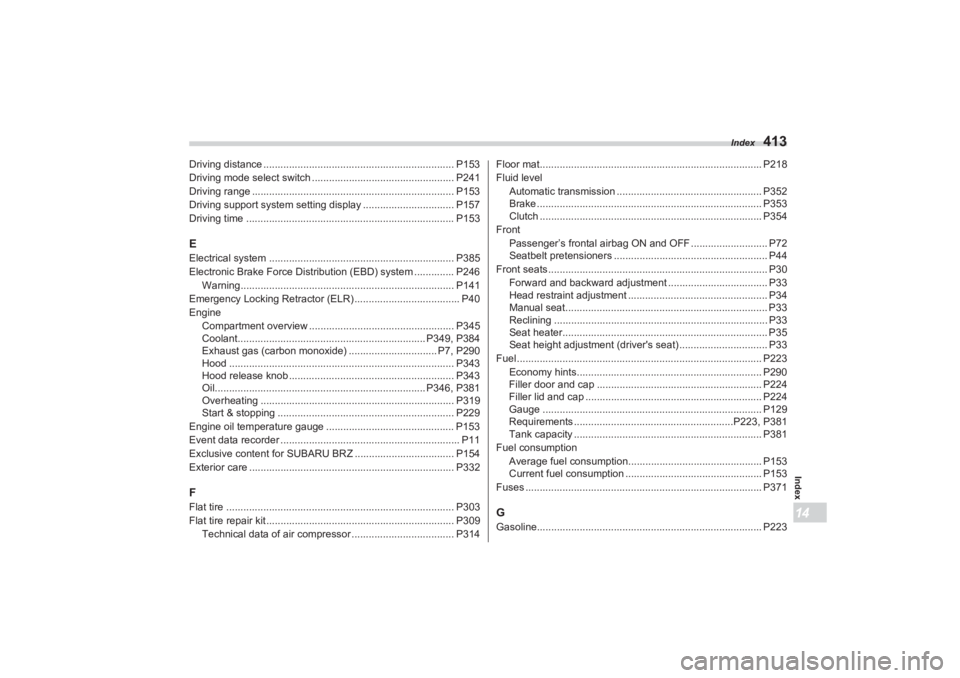
Index
413
Index14
Driving distance ................................................................... P153
Driving mode select switch .................................................. P241
Driving range ....................................................................... P153
Driving support system setting display ................................ P157
Driving time ......................................................................... P153EElectrical system ................................................................. P385
Electronic Brake Force Distribution (EBD) system .............. P246
Warning........................................................................... P141
Emergency Locking Retractor (ELR ) ..................................... P40
Engine
Compartment overview ................................................... P345
Coolant............ .......................................... ............ P349, P384
Exhaust gas (carbon monoxide) . .............................. P7, P290
Hood ............................................................................... P343
Hood release knob ........ .......................................... ........ P343
Oil............................ ..................................... ......... P346, P381
Overheating .................................................................... P319
Start & stopping ......... ................................................ ..... P229
Engine oil temperature gauge ............................................. P153
Event data recorder ............................................................... P11
Exclusive content for SUBARU BRZ ................................... P154
Exterior care ........................................................................ P332FFlat tire ................................................................................ P303
Flat tire repair kit .................................................................. P309 Technical data of air compressor .................................... P314 Floor mat.............................................................................. P218
Fluid level
Automatic transmission .............. ..................................... P352
Brake ............................................................................... P353
Clutch .............................................................................. P354
Front
Passenger’s frontal airbag ON and OFF ........................... P72
Seatbelt pretensioners ...................................................... P44
Front seats ............................................................................. P30 Forward and backward adjustment ................................... P33
Head restraint adjustment .......... ....................................... P34
Manual seat............... ........................................................ P33
Reclining ........................................................................... P33
Seat heater.......... ........................................................ ...... P35
Seat height adjustment (driver's seat) ............................... P33
Fuel ...................................................................................... P223 Economy hints.............. .................................... ............... P290
Filler door and cap .......................................................... P224
Filler lid and cap .............................................................. P224
Gauge ............................................................................. P129
Requirements .......................... ..............................P223, P381
Tank capacity .................................................................. P381
Fuel consumption Average fuel consumption............................................... P153
Current fuel consumption ................................................ P153
Fuses ................................................................................... P371
GGasoline............................................................................... P223
BRZ_U.book 413 ページ 2022年3月29日 火曜日 午後3時59分