check engine SUBARU BRZ 2023 Owner's Guide
[x] Cancel search | Manufacturer: SUBARU, Model Year: 2023, Model line: BRZ, Model: SUBARU BRZ 2023Pages: 432, PDF Size: 16.56 MB
Page 330 of 432
Towing
324holes, return the plugs to their original
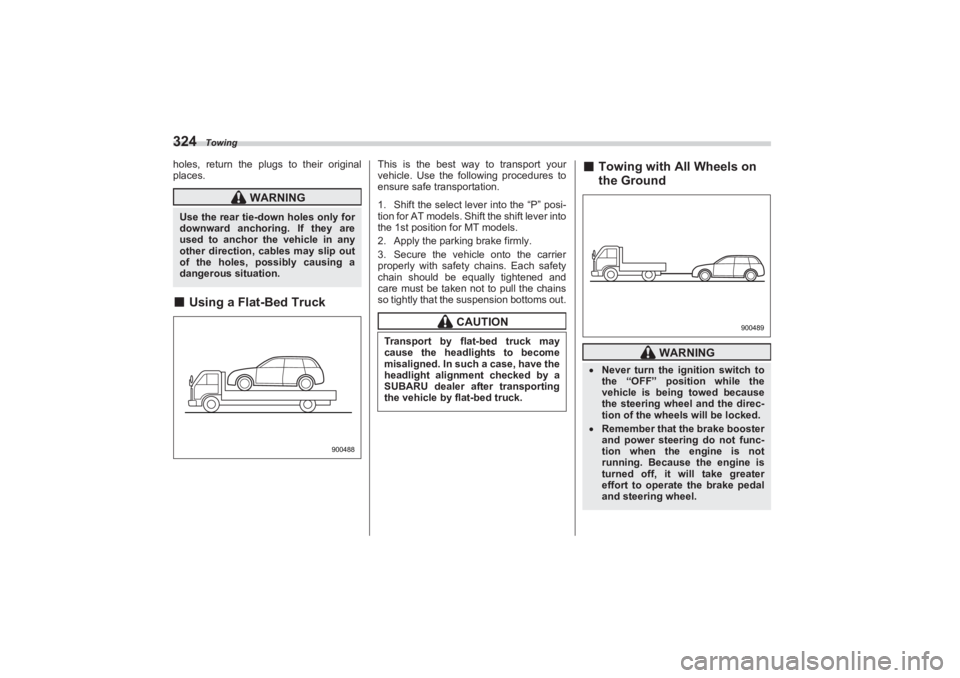
places.■Using a Flat-Bed Truck
This is the best way to transport your
vehicle. Use the following procedures to
ensure safe transportation.
1. Shift the select lever into the “P” posi-
tion for AT models. Sh ift the shift lever into
the 1st position for MT models.
2. Apply the parking brake firmly.
3. Secure the vehicle onto the carrier
properly with safety chains. Each safety
chain should be equally tightened and
care must be taken not to pull the chains
so tightly that the suspension bottoms out.
■ Towing with All Wheels on
the Ground
WARNING
Use the rear tie-down holes only for
downward anchoring. If they are
used to anchor the vehicle in any
other direction, cables may slip out
of the holes, possibly causing a
dangerous situation.
900488
CAUTION
Transport by flat -bed truck may
cause the headlights to become
misaligned. In such a case, have the
headlight alignment checked by a
SUBARU dealer after transporting
the vehicle by flat-bed truck.
WARNING
Never turn the ignition switch to
the “OFF” position while the
vehicle is being towed because
the steering wheel and the direc-
tion of the wheels will be locked. Remember that the brake booster
and power steering do not func-
tion when the engine is not
running. Because the engine is
turned off, it w ill take greater
effort to operate the brake pedal
and steering wheel.
900489
BRZ_U.book 324 ページ 2022年3月29日 火曜日 午後3時59分
Page 343 of 432
Maintenance and Service11
Maintenance and Service
11-1. Maintenance Schedule .....................................339
11-2. Maintenance Precautions.................................339
Before Checking or Servicing in the Engine
Compartment ..............................................................340
When Checking or Servicing in the Engine Compartment ..............................................................340
When Checking or Servicing in the Engine Compartment While the Engine Is Running ............341
11-3. Maintenance Tips ..............................................341
Removing and Reinstalling Clips................................341
11-4. Engine Hood ......................................................343
11-5. Engine Compartment Overview.......................345
11-6. Engine Oil ..........................................................346
Engine Oil Consumption..............................................346
Checking the Oil Level .................................................346
Changing the Oil and Oil Filter ....................................347
Recommended Grade and Viscosity ..........................347
Synthetic Oil..................................................................348
11-7. Cooling System .................................................348
Cooling Fan, Hose and Connections ..........................348
Engine Coolant .............................................................349
11-8. Air Cleaner Element ..........................................350
Replacing the Air Cleaner Element .............................350
11-9. Spark Plugs .......................................................352
Recommended Spark Plugs ........................................352
11-10. Drive Belt .........................................................352
11-11. Automatic Transmission Fluid ......................352
Recommended Grade and Viscosity ..........................352
11-12. Differential Gear Oil ........................................353
Recommended Grade and Viscosity ..........................353
11-13. Manual Transmission Oil ...............................353
Recommended Grade and Viscosity ..........................353
11-14. Brake Fluid ......................................................353
Checking the Fluid Level ............................................ 353
Recommended Brake Fluid ........................................ 354
11-15. Clutch Fluid (MT models) ...............................354
Checking the Fluid Level ............................................ 354
Recommended Clutch Fluid ....................................... 355
11-16. Brake Booster .................................................355
11-17. Brake Pedal .....................................................356
11-18. Clutch Pedal (MT models) ..............................356
11-19. Replacement of Brake Pad and Lining..........356
Breaking-in of New Brake Pads and Linings ............ 357
11-20. Parking Brake Stroke ......................................357
11-21. Tires and Wheels ............................................358
Types of Tires .............................................................. 358
Tire Pressure Monito ring System (TPMS)
(If Equipped)............................................................... 358
Tire Inspection ............................................................. 360
Tire Pressures and Wear............................................. 361
Wheel Balance ............................................................. 363
Wear Indicators ............................................................ 363
Rotational Direction of Tires....................................... 364
Tire Rotation................................................................. 364
Tire Replacement ...... ............................. ...................... 365
Wheel Replacement ..................................................... 365
11-22. Alloy Wheels ....................................................366
11-23. Windshield Washer Fluid ...............................366
11-24. Replacement of Wiper Blades........................367
Windshield Wiper Blade Assembly ............................ 368
Windshield Wiper Blade Rubber ................................ 369
11-25. Battery ..............................................................370
11-26. Fuses ................................................................371
11-27. Installation of Acce ssories ............................373
BRZ_U.book 337 ページ 2022年3月29日 火曜日 午後3時59分
Page 346 of 432
Maintenance Precautions
340NOTESUBARU does not endorse the use of
non-SUBARU approved flushing sys-
tems and strongly advises against per-
forming these services on a SUBARU
vehicle. Non-SUBARU approved flush-
ing systems use chemicals and/or sol-
vents which have not been tested or
approved by SUBARU. SUBARU war-
ranties do not cover any part of the
vehicle which is damaged by adding or
applying chemicals and/or solvents
other than those approved or recom-
mended by SUBARU.
■ Before Checking or
Servicing in the Engine
Compartment
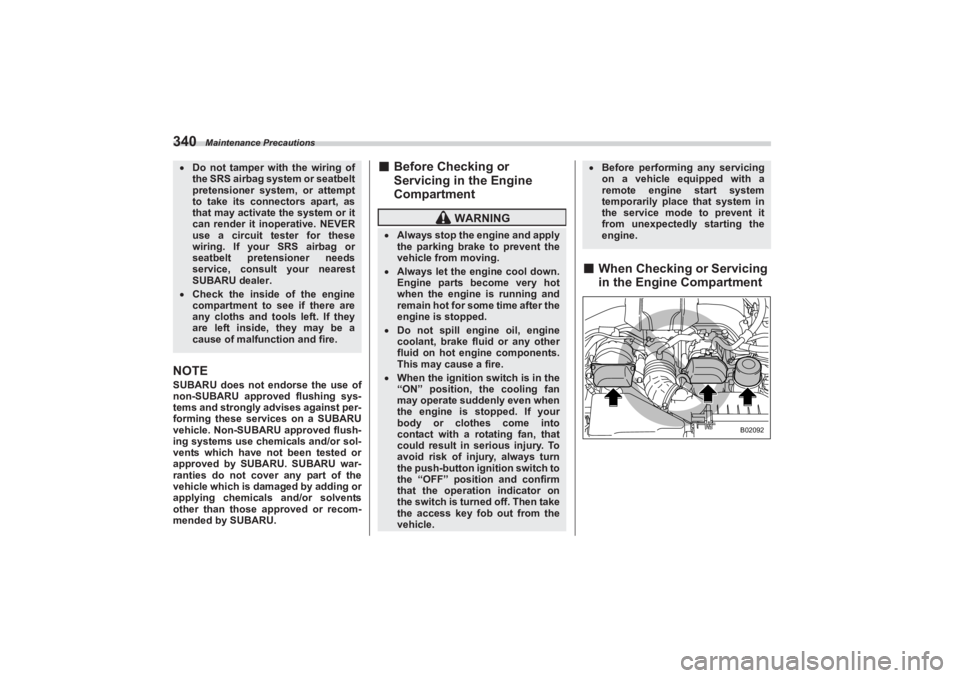
■When Checking or Servicing
in the Engine Compartment
Do not tamper wi th the wiring of
the SRS airbag system or seatbelt
pretensioner system, or attempt
to take its connectors apart, as
that may activate the system or it
can render it inoperative. NEVER
use a circuit tester for these
wiring. If your SRS airbag or
seatbelt pretensioner needs
service, consult your nearest
SUBARU dealer. Check the inside of the engine
compartment to see if there are
any cloths and tools left. If they
are left inside, they may be a
cause of malfunction and fire.
WARNING
Always stop the engine and apply
the parking brake to prevent the
vehicle from moving. Always let the engine cool down.
Engine parts become very hot
when the engine is running and
remain hot for some time after the
engine is stopped. Do not spill engine oil, engine
coolant, brake fluid or any other
fluid on hot engine components.
This may cause a fire. When the ignition switch is in the
“ON” position, the cooling fan
may operate suddenly even when
the engine is stopped. If your
body or clothes come into
contact with a rotating fan, that
could result in serious injury. To
avoid risk of injury, always turn
the push-button i gnition switch to
the “OFF” position and confirm
that the operation indicator on
the switch is turn ed off. Then take
the access key fob out from the
vehicle.
Before performing any servicing
on a vehicle equipped with a
remote engine start system
temporarily place that system in
the service mode to prevent it
from unexpectedly starting the
engine.
B02092
BRZ_U.book 340 ページ 2022年3月29日 火曜日 午後3時59分
Page 347 of 432
Maintenance Tips
341
Maintenance and Service11
– CONTINUED –
■When Checking or Servicing
in the Engine Compartment
While the Engine Is Running
11-3. Maintenance TipsSome clips and fender linings must be
removed before replacing the air cleaner
element or specific bulbs.■ Removing and Reinstalling
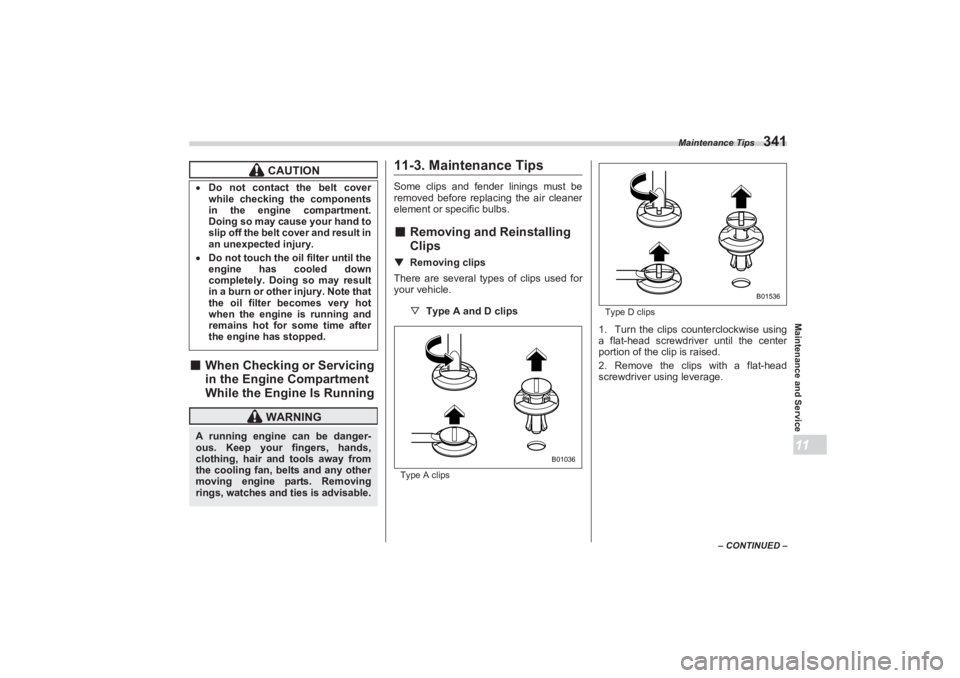
Clips▼ Removing clips
There are several types of clips used for
your vehicle.
▽Type A and D clipsType A clips Type D clips
1. Turn the clips co
unterclockwise using
a flat-head screwdriver until the center
portion of the clip is raised.
2. Remove the clips with a flat-head
screwdriver using leverage.
CAUTION
Do not contact the belt cover
while checking the components
in the engine compartment.
Doing so may cause your hand to
slip off the belt cover and result in
an unexpected injury. Do not touch the o il filter until the
engine has cooled down
completely. Doing so may result
in a burn or other injury. Note that
the oil filter becomes very hot
when the engine is running and
remains hot for so me time after
the engine has stopped.
WARNING
A running engine can be danger-
ous. Keep your fingers, hands,
clothing, hair and tools away from
the cooling fan, belts and any other
moving engine parts. Removing
rings, watches and ties is advisable.
B01036
B01536
BRZ_U.book 341 ページ 2022年3月29日 火曜日 午後3時59分
Page 349 of 432
Engine Hood
343
Maintenance and Service11
– CONTINUED –
Type C clips
Type D clips
Insert the clip without the center portion
first and then push the center portion of
the clip into the hole.
11-4. Engine Hood
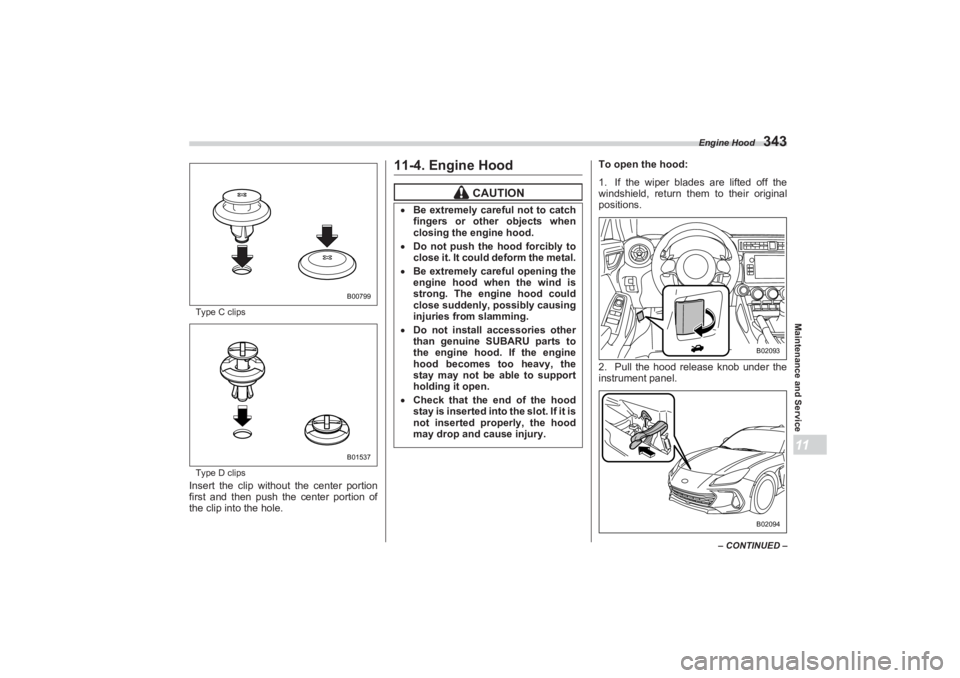
To open the hood:
1. If the wiper blades are lifted off the
windshield, return them to their original
positions.
2. Pull the hood release knob under the
instrument panel.
B00799B01537
CAUTION
Be extremely careful not to catch
fingers or other objects when
closing the engine hood. Do not push the hood forcibly to
close it. It could deform the metal. Be extremely careful opening the
engine hood when the wind is
strong. The engine hood could
close suddenly, possibly causing
injuries from slamming. Do not install accessories other
than genuine SUBARU parts to
the engine hood. If the engine
hood becomes too heavy, the
stay may not be able to support
holding it open. Check that the end of the hood
stay is inserted into the slot. If it is
not inserted properly, the hood
may drop and cause injury.
B02093B02094
BRZ_U.book 343 ページ 2022年3月29日 火曜日 午後3時59分
Page 350 of 432
Engine Hood
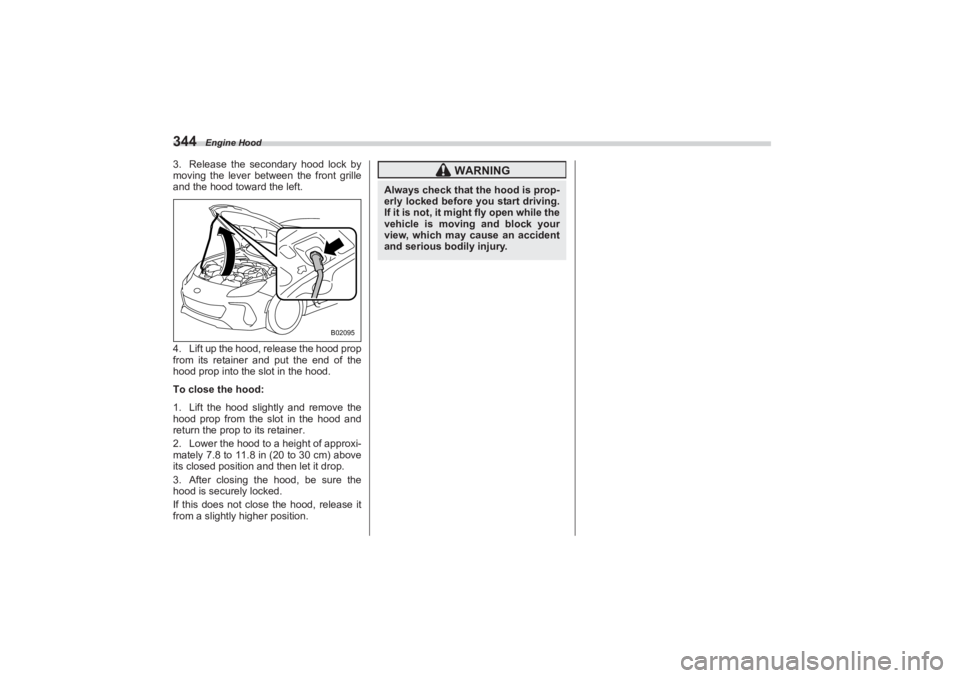
3443. Release the secondary hood lock by
moving the lever between the front grille
and the hood toward the left.
4. Lift up the hood, release the hood prop
from its retainer and put the end of the
hood prop into the slot in the hood.
To close the hood:
1. Lift the hood slightly and remove the
hood prop from the slot in the hood and
return the prop to its retainer.
2. Lower the hood to a height of approxi-
mately 7.8 to 11.8 in (20 to 30 cm) above
its closed position and then let it drop.
3. After closing the hood, be sure the
hood is securely locked.
If this does not close the hood, release it
from a slightly higher position.
B02095
WARNING
Always check that the hood is prop-
erly locked before you start driving.
If it is not, it might fly open while the
vehicle is moving and block your
view, which may cause an accident
and serious bodily injury.
BRZ_U.book 344 ページ 2022年3月29日 火曜日 午後3時59分
Page 352 of 432
Engine Oil
34611-6. Engine Oil■Engine Oil ConsumptionSome engine oil will be consumed while
driving. The rate of consumption can be
affected by such factors as transmission
type, driving style, terrain and tempera-
ture. Under the followi ng conditions, oil
consumption can be increased and thus
require refilling between maintenance
intervals:
When the engine is new and within the
break-in period
When the engine oil is of lower quality
When the incorrect oil viscosity is used
When engine braking is employed
(repeatedly)
When the engine is operated at high
engine speeds (for extended periods of
time)
When the engine is operated under
heavy loads (for extended periods of time)
When the engine idles for extended
periods of time
When the vehicle is operated in stop
and go and/or heavy traffic situations
When the vehicle is used under severe
thermal conditions
When the vehicle accelerates and
decelerates frequently
Under these or similar conditions, you
should check your oil at least every 2nd
fuel fill-up and change your engine oil
more frequently. Different drivers in the
same car may experience different
results. If your oil consumption rate is
greater than expected, contact your
authorized SUBARU retailer who may
perform a test under controlled conditions.
■ Checking the Oil Level1. Park the vehicle on a level surface and
stop the engine. If you check the oil level
just after stopping the engine, wait for at least 5 minutes for the oil to drain back into
the oil pan before checking the level.
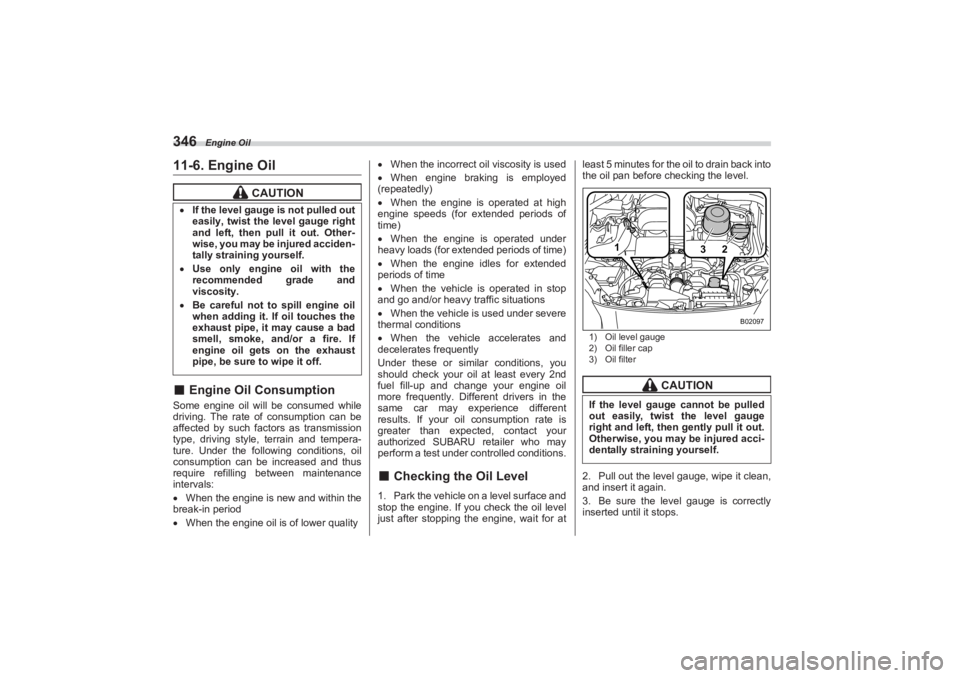
1) Oil level gauge
2) Oil filler cap
3) Oil filter2. Pull out the level gauge, wipe it clean,
and insert it again.
3. Be sure the level gauge is correctly
inserted until it stops.
CAUTION
If the level gauge is not pulled out
easily, twist the level gauge right
and left, then pull it out. Other-
wise, you may be injured acciden-
tally straining yourself. Use only engine oil with the
recommended grade and
viscosity. Be careful not to spill engine oil
when adding it. If oil touches the
exhaust pipe, it may cause a bad
smell, smoke, and/or a fire. If
engine oil gets on the exhaust
pipe, be sure to wipe it off.
CAUTION
If the level gauge cannot be pulled
out easily, twist the level gauge
right and left, then gently pull it out.
Otherwise, you may be injured acci-
dentally straining yourself.
1
3
2
B02097
BRZ_U.book 346 ページ 2022年3月29日 火曜日 午後3時59分
Page 353 of 432
Engine Oil
347
Maintenance and Service11
– CONTINUED –
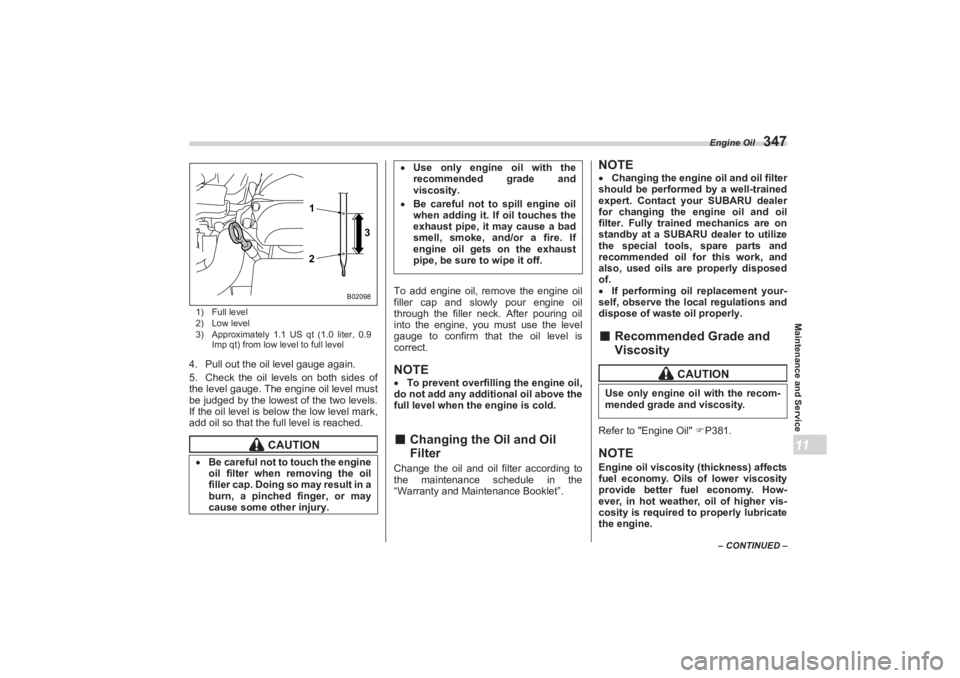
1) Full level
2) Low level
3) Approximately 1.1 US qt (1.0 liter, 0.9
Imp qt) from low level to full level
4. Pull out the oil level gauge again.
5. Check the oil levels on both sides of
the level gauge. The engine oil level must
be judged by the lowest of the two levels.
If the oil level is below the low level mark,
add oil so that the full level is reached. To add engine oil, remove the engine oil
filler cap and slowly pour engine oil
through the filler neck. After pouring oil
into the engine, you must use the level
gauge to confirm that the oil level is
correct.
NOTE To prevent overfilling the engine oil,
do not add any additional oil above the
full level when the engine is cold.
■ Changing the Oil and Oil
FilterChange the oil and oil filter according to
the maintenance schedule in the
“Warranty and Maintenance Booklet”.
NOTE Changing the engine oil and oil filter
should be performed by a well-trained
expert. Contact your SUBARU dealer
for changing the engine oil and oil
filter. Fully trained mechanics are on
standby at a SUBARU dealer to utilize
the special tools, spare parts and
recommended oil for this work, and
also, used oils are properly disposed
of.
If performing oil replacement your-
self, observe the local regulations and
dispose of waste oil properly.■ Recommended Grade and
ViscosityRefer to "Engine Oil" P381.NOTEEngine oil viscosity (thickness) affects
fuel economy. Oils of lower viscosity
provide better fuel economy. How-
ever, in hot weather, oil of higher vis-
cosity is required to properly lubricate
the engine.
CAUTION
Be careful not to touch the engine
oil filter when removing the oil
filler cap. Doing so may result in a
burn, a pinched finger, or may
cause some other injury.
1
2 3
B02098
Use only engine oil with the
recommended grade and
viscosity. Be careful not to spill engine oil
when adding it. If oil touches the
exhaust pipe, it may cause a bad
smell, smoke, and/or a fire. If
engine oil gets on the exhaust
pipe, be sure to wipe it off.
CAUTION
Use only engine oil with the recom-
mended grade and viscosity.
BRZ_U.book 347 ページ 2022年3月29日 火曜日 午後3時59分
Page 355 of 432
Cooling System
349
Maintenance and Service11
– CONTINUED –
Check the fuse and replace it if necessary.
Refer to "Fuses" P371. If the fuse is not
blown, have the cooling system checked
by your SUBARU dealer.
If the frequent addition of coolant is neces-
sary between vehicle service visits, it is
recommended that you have your vehicle
inspected by an authorized SUBARU
dealer to check for leaks, damage, or
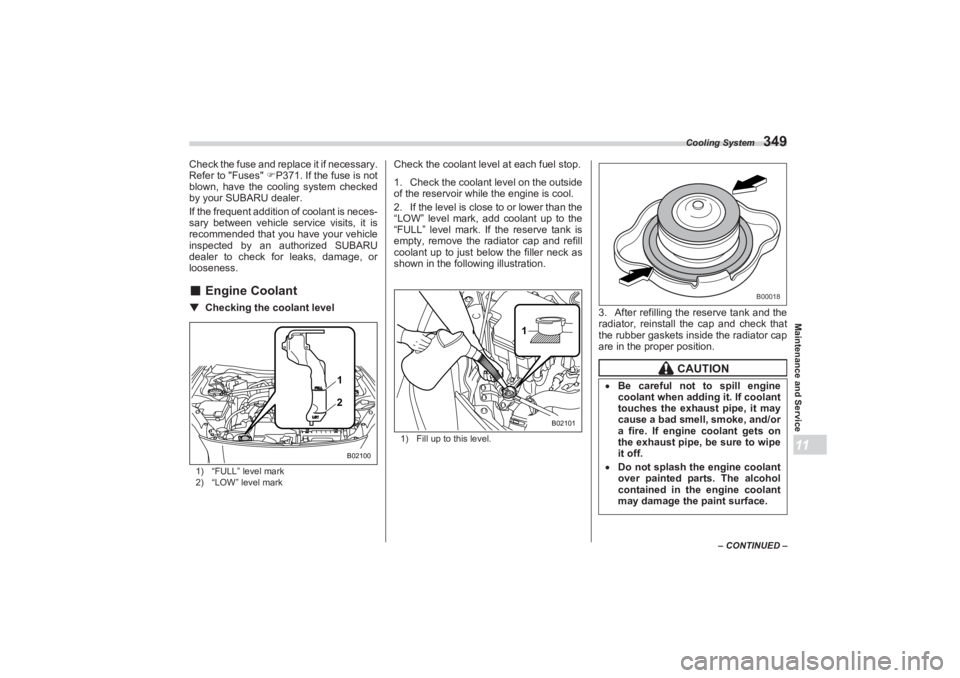
looseness.■ Engine Coolant▼ Checking the coolant level1) “FULL” level mark
2) “LOW” level mark
Check the coolant level at each fuel stop.
1. Check the coolant level on the outside
of the reservoir while the engine is cool.
2. If the level is close to or lower than the
“LOW” level mark, add coolant up to the
“FULL” level mark. If the reserve tank is
empty, remove the radiator cap and refill
coolant up to just below the filler neck as
shown in the following illustration.
1) Fill up to this level.
3. After refilling the reserve tank and the
radiator, reinstall t he cap and check that
the rubber gaskets in side the radiator cap
are in the proper position.
12B02100
1
B02101
CAUTION
Be careful not to spill engine
coolant when adding it. If coolant
touches the exhaust pipe, it may
cause a bad smell, smoke, and/or
a fire. If engine coolant gets on
the exhaust pipe, be sure to wipe
it off. Do not splash the engine coolant
over painted parts. The alcohol
contained in the engine coolant
may damage the paint surface.
B00018
BRZ_U.book 349 ページ 2022年3月29日 火曜日 午後3時59分
Page 358 of 432
Spark Plugs
35211-9. Spark PlugsIt may be difficult to replace the spark
plugs. It is recommended that you have
the spark plugs replaced by your
SUBARU dealer.
The spark plugs should be replaced
according to the maintenance schedule in
the “Warranty and Maintenance Booklet”.■ Recommended Spark PlugsRefer to "Electrical System" P385.
11-10. Drive BeltIt is unnecessary to check the deflection of
the drive belt periodically because your
engine is equipped with an automatic belt
tension adjuster. However, replacement
of the belt should be done according to the
maintenance schedule in the “Warranty
and Maintenance Booklet”. Consult your
SUBARU dealer for replacement.
If the belt is loose, cracked or worn, we
recommend that contact your SUBARU
dealer.
11-11. Automatic Transmis -sion FluidIt is not necessary to check the transmis-
sion oil level. Check that there are no
cracks, damage or leakage. However,
have the oil inspected by your SUBARU
dealer according to the maintenance
schedule in the “Warranty and Mainte-
nance Booklet”. Consult your SUBARU
dealer for details.■ Recommended Grade and
ViscosityEach oil manufacturer has its own base
oils and additives. Never use different
brands together. For details, refer to
"Fluids" P383.
BRZ_U.book 352 ページ 2022年3月29日 火曜日 午後3時59分