check engine SUBARU BRZ 2023 Owner's Manual
[x] Cancel search | Manufacturer: SUBARU, Model Year: 2023, Model line: BRZ, Model: SUBARU BRZ 2023Pages: 432, PDF Size: 16.56 MB
Page 234 of 432
Preparing to Drive
228have implemented emission inspection of
the OBDII system.
The inspection of the OBDII system
consists of a visual operational check of
the “ CHECK ENGINE ” warning light/
malfunction indicator light (MIL) and an
examination of the OBDII system with an
electronic scan tool.
A vehicle passes
the OBDII system
inspection if proper operation of the
“ CHECK ENGINE ” warning light is
observed, there are no stored diagnostic
trouble codes, and the OBDII readiness
monitors are all complete.
A vehicle fails
the OBDII inspection if
the “ CHECK ENGINE ” warning light is not
properly operating (light is illuminated or is
not working due to a burned out bulb) or
there is one or more diagnostic trouble
codes stored in the vehicle’s computer.
A state emission in spection may reject
(not pass or fail) a vehicle if the number of
OBDII system readiness monitors “ NOT
READY ” is greater than one. If the
vehicle’s battery has been recently
replaced or disconnected, the OBDII
system inspection may indicate that the
vehicle is not ready for the emission test.
Under this condition, the vehicle driver
should be instructed to drive his/her
vehicle for a few days to reset the readi-
ness monitors and return for an emission
re-inspection.
Owners of rejected or failing vehicles
should contact their SUBARU Dealer for
service.
7-3. Preparing to DriveYou should perform the following checks
and adjustments every day before you
start driving.
1. Check that all windows, mirrors, and
lights are clean and unobstructed.
2. Check the appearance and condition
of the tires. Also check tires for proper
inflation.
3. Look under the vehicle for any sign of
leaks.
4. Check that no small animals enter the
engine compartment.
5. Check that the hood and trunk are fully
closed.
6. Check the adjustment of the seat.
7. Check the adjustment of the inside
and outside mirrors.
8. Fasten your seatbelt. Check that your
passengers have fastened their seatbelts.
9. Check the operation of the warning
and indicator lights when the ignition
switch is turned to the “ON” position.
10. Check the gauges, indicator and
warning lights after starting the engine.
BRZ_U.book 228 ページ 2022年3月29日 火曜日 午後3時59分
Page 235 of 432
Starting and Stopping Engine
229
Starting and Operating7
– CONTINUED –
NOTEEngine oil, engine coolant, brake fluid,
washer fluid and other fluid levels
should be checked daily, weekly or at
fuel stops.
7-4. Starting and Stopping Engine■Safety PrecautionsRefer to "Safety Precautions" P94.■Operating Range for Push-
Button Start SystemRefer to "Operating Range for Push-
Button Start System" P125.■ General Precautions When
Starting Engine
NOTEIt may be difficult to start the engine
when the battery has been discon-
nected and reconnected (for mainte-
nance or other purposes). This
difficulty is caused by the electroni-
cally controlled throttle’s self-diag-
nosis function. To overcome it, keep
the ignition switch in the “ON” position
for approximately 10 seconds before
starting the engine.
Avoid rapid racing and rapid accel-
eration immediately after the engine
has started.
After the engine starts, the engine
speed will be kept high.
CAUTION
Small animals trapped in the cool-
ing fan and belt of the engine may
result in a malfunction. Check that
no small animal enters the engine
compartment and under the vehicle
before starting the engine.
WARNING
Never start the engine from
outside the vehicle. It may result
in an accident. Do not leave the engine running
in locations with poor ventilation,
such as a garage and indoors.
The exhaust gas may enter the
vehicle or indoors, and it may
result in carbon monoxide
poisoning.
Do not start the engine near dry
foliage, paper, or other flammable
substances. The exhaust pipe
and exhaust emissions can
create a fire hazard at high
temperatures.
CAUTION
If the engine is stopped during
driving, the catalyst may overheat
and burn. When starting the engine, be sure
to sit in the driver’s seat.
BRZ_U.book 229 ページ 2022年3月29日 火曜日 午後3時59分
Page 236 of 432
Starting and Stopping Engine
230On rare occasions, it may be difficult
to start the engine depending on the
fuel and the usage condition (repeated
driving of a distance in which the
engine has not warmed up suffi-
ciently). In such a case, it is recom-
mended that you change to a different
brand of fuel.
On rare occasions, transient
knocking may be heard from the
engine when the accelerator is oper-
ated rapidly such as a rapid start-up
and a rapid acceleration. This is not a
malfunction.
The engine starts more easily when
the headlights, air conditioner and rear
window defogger are turned off.■ Starting Engine
NOTEWhen pressing the push-button
ignition switch while depressing the
clutch pedal (MT models) or the brake
pedal (AT models): - The engine starter operates for a
maximum of 10 seconds and after
starting the engine, the starter stops
automatically.
- The engine can be started
regardless of the power status.
If the engine does not start, check
the security indicator light. Then press
the push-button ignition switch
without depressing the clutch pedal
(MT models) or the brake pedal (AT
models) to switch the power to “OFF”. - If the light had illuminated, try to
start the engine again.
- If the light had been off, press the
push-button ignition switch while
depressing the clutch pedal (MT
models) or the brake pedal (AT
models) more forcefully.
The engine start procedures may
not function depending on the radio
wave conditions around the vehicle. In
such a case, refer to "Starting Engine"
P326.
If the vehicle battery is discharged,
the steering cannot be unlocked.
Charge the battery.
WARNING
There are some general precau-
tions when starting the engine.
Carefully read the precautions
described in "General Precau-
tions When Starting Engine"
P229. If the steering lock cannot be
released after the engine has
started, never drive the vehicle.
The steering is still locked, and it
may result in an accident.
CAUTION
If a system malfunction warning
message is displayed on the
combination meter, there may be
a malfunction with the vehicle.
Contact a SUBARU dealer imme-
diately. If a steering lock warning
message is displayed on the
combination me ter after the
engine has started, it means that
the steering is still locked. While
moving the steering wheel right
and left, depress the brake pedal,
and press the push-button igni-
tion switch. Do not continue pressing the
push-button ignition switch for
more than 10 seconds. Doing so
could cause a malfunction. If the
engine does not start, stop
pressing the push -button ignition
switch. Instead, press the push-
button ignition switch without
depressing the clutch pedal (MT
models) or the brake pedal (AT
models) to switch the power
status to “OFF”. Wait 10 seconds,
and then press the push-button
ignition switch to start the
engine.
BRZ_U.book 230 ページ 2022年3月29日 火曜日 午後3時59分
Page 239 of 432
Manual Transmission
233
Starting and Operating7
– CONTINUED –
▼When the steering lock cannot be
released1) Push-button ignition switchWhen you cannot restart the engine due
to the steering lock, check the status of
operation indicator and perform the
following steps.
▽How to released steering lock
1. Check that the shift lever is set in
neutral (MT models) or select lever is set
in the “P” position (AT models).
2. Depress the brake pedal and keep it.
3. Press the push-button ignition switch
while turning the steering wheel left and
right. ▽
When the display of warning
messages
There may be a malfunction in the
steering lock function. Immediately
contact your nearest SUBARU dealer.
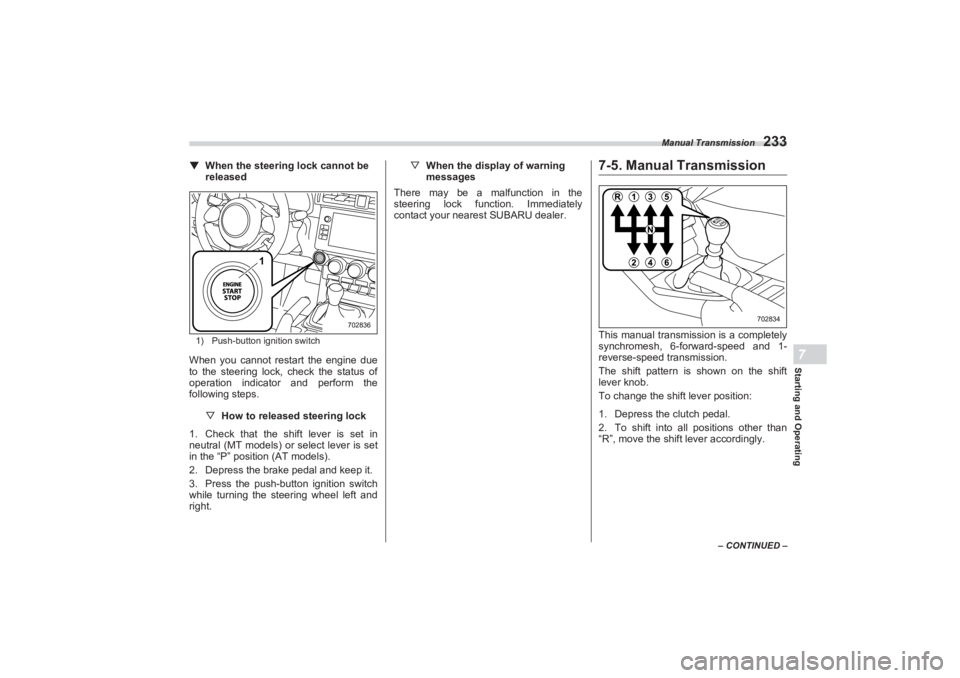
7-5. Manual TransmissionThis manual transmission is a completely
synchromesh, 6-forward-speed and 1-
reverse-speed transmission.
The shift pattern is shown on the shift
lever knob.
To change the shift lever position:
1. Depress the clutch pedal.
2. To shift into all positions other than
“R”, move the shi ft lever accordingly.
1
702836
702834
BRZ_U.book 233 ページ 2022年3月29日 火曜日 午後3時59分
Page 251 of 432
ABS (Anti-Lock Brake System)
245
Starting and Operating7
■Disc Brake Pad Wear
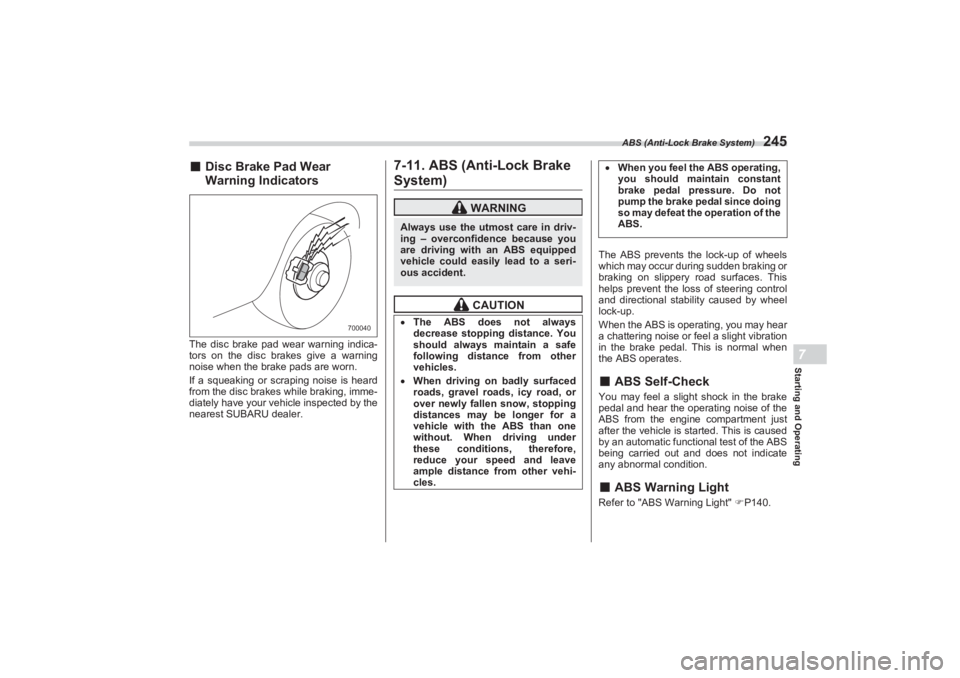
Wa rning IndicatorsThe disc brake pad wear warning indica-
tors on the disc brakes give a warning
noise when the brake pads are worn.
If a squeaking or scraping noise is heard
from the disc brakes while braking, imme-
diately have your vehicle inspected by the
nearest SUBARU dealer.
7-11. ABS (Anti-Lock BrakeSystem)
The ABS prevents the lock-up of wheels
which may occur during sudden braking or
braking on slippery road surfaces. This
helps prevent the loss of steering control
and directional stability caused by wheel
lock-up.
When the ABS is operating, you may hear
a chattering noise or f eel a slight vibration
in the brake pedal. This is normal when
the ABS operates.■ ABS Self-CheckYou may feel a slight shock in the brake
pedal and hear the operating noise of the
ABS from the engine compartment just
after the vehicle is started. This is caused
by an automatic functional test of the ABS
being carried out and does not indicate
any abnormal condition.■ ABS Warning LightRefer to "ABS Warning Light" P140.
700040
WARNING
Always use the utmost care in driv-
ing – overconfidence because you
are driving with an ABS equipped
vehicle could easily lead to a seri-
ous accident.
CAUTION
The ABS does not always
decrease stopping distance. You
should always maintain a safe
following distance from other
vehicles. When driving on badly surfaced
roads, gravel roads, icy road, or
over newly fallen snow, stopping
distances may be longer for a
vehicle with the ABS than one
without. When driving under
these conditions, therefore,
reduce your speed and leave
ample distance from other vehi-
cles.
When you feel the ABS operating,
you should maintain constant
brake pedal pressure. Do not
pump the brake pedal since doing
so may defeat the operation of the
ABS.
BRZ_U.book 245 ページ 2022年3月29日 火曜日 午後3時59分
Page 261 of 432
Parking Your Vehicle
255
Starting and Operating7
– CONTINUED –
■When Initialization of the Tire
Pressure Monitoring System
has FailedInitialization can be completed in a few
minutes. However, in the following case,
the settings have not been recorded and
the system will not o perate properly. If
repeated attempts to record tire inflation
pressure settings ar e unsuccessful, have
the vehicle checked at your SUBARU
dealer.
When operating the TPMS set switch,
low tire pressure warning light does not
blink 3 times.
After carrying out the initialization
procedure, the low tire pressure warning
light blinks for 1 minute then stays on after
driving for 20 minutes.
■ Registering ID CodesEvery tire pressure warning valve and
transmitter has a unique ID code. In addi-
tion to the set of tire pressure monitoring
system sensor ID code s initially registered
to the vehicle, a second set of ID codes
can be registered.
A second set of tire pressure monitoring
system sensor ID codes can be registered
at your SUBARU dealer. When 2 sets of
ID codes have been registered, either ID
code set can be selected.■ Changing the ID code set1. Park the vehicle in a safe place and
turn the ignition swit ch to the “ON” posi-
tion.
2. Press the TPMS set switch 3 times
within 3 seconds.
3. The low tire pressure warning light will
illuminate for 3 seconds and then blink 3
times.
4. The low tire pressure warning light will
blink for 1 minute and then illuminate.
5. When the ID code change has
completed, the tire pressure monitoring
light will turn off.
Check that tire pressures are displayed on
the TPMS screen.
7-16. Parking Your Vehicle■ Parking BrakeTo set the parking brake, depress the
brake pedal firmly and hold it down until
the parking brake lever is fully pulled up.
WARNING
Do not operate the TPMS set switch
without first adjust ing the tire infla-
tion pressure to the specified level.
Otherwise, the low tire pressure
warning light may not come on even
if the tire inflation pressure is low,
or it may come on when the tire
inflation pressure is actually nor-
mal.
WARNING
Never leave unattended children
or pets in the vehicle. They could
accidentally injure themselves or
others through inadvertent oper-
ation of the vehicle. Also, on hot
or sunny days, the temperature in
a closed vehicle could quickly
become high enough to cause
severe or possibly fatal injuries to
people. Do not park the vehicle over flam-
mable materials such as dry
grass, waste paper or rags, as
they may burn easily if they come
near hot engine or exhaust
system parts. Be sure to stop the engine if you
take a nap in the vehicle. If engine
exhaust gas enters the passenger
compartment, occupants in the
vehicle could die from carbon
monoxide (CO) contained in the
exhaust gas.
BRZ_U.book 255 ページ 2022年3月29日 火曜日 午後3時59分
Page 297 of 432
Catalytic Converter
291
Driving Tips8
NOTEDue to the expansion and contraction
of the metals used in the manufacture
of the exhaust system, you may hear a
crackling sound coming from the
exhaust system for a short time after
the engine has been shut off. This
sound is normal.
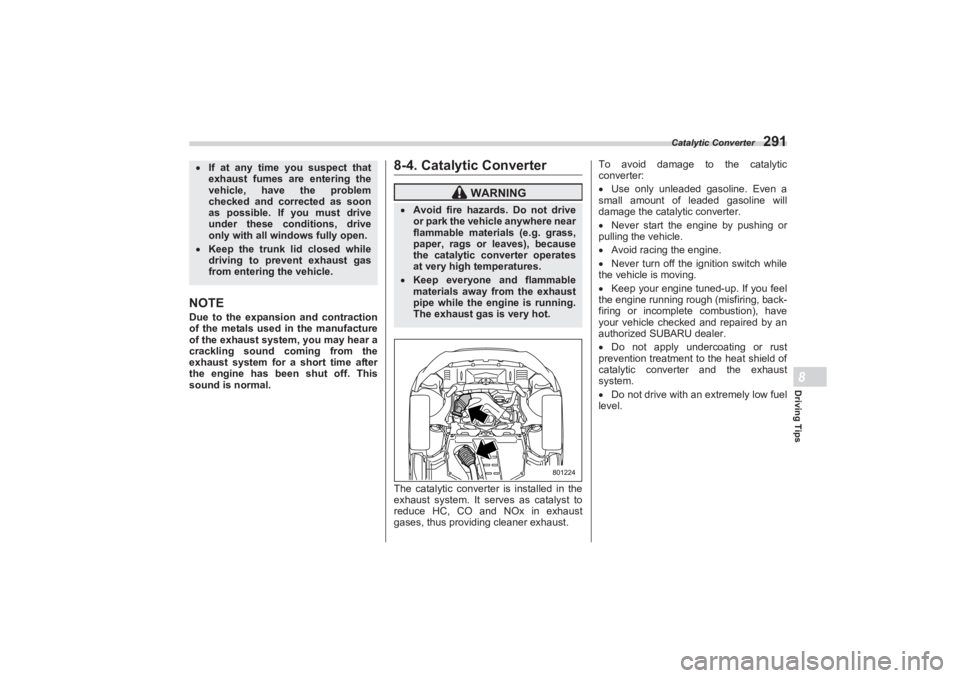
8-4. Catalytic ConverterThe catalytic converter is installed in the
exhaust system. It serves as catalyst to
reduce HC, CO and NOx in exhaust
gases, thus providing cleaner exhaust. To avoid damage to the catalytic
converter:
Use only unleaded gasoline. Even a
small amount of leaded gasoline will
damage the catalytic converter.
Never start the engine by pushing or
pulling the vehicle.
Avoid racing the engine.
Never turn off the ig nition switch while
the vehicle is moving.
Keep your engine tuned-up. If you feel
the engine running rough (misfiring, back-
firing or incomplete combustion), have
your vehicle checked and repaired by an
authorized SUBARU dealer.
Do not apply undercoating or rust
prevention treatment to the heat shield of
catalytic converter and the exhaust
system.
Do not drive with an extremely low fuel
level.
If at any time you suspect that
exhaust fumes are entering the
vehicle, have the problem
checked and corrected as soon
as possible. If you must drive
under these conditions, drive
only with all windows fully open. Keep the trunk lid closed while
driving to prevent exhaust gas
from entering the vehicle.
WARNING
Avoid fire hazards. Do not drive
or park the vehicle anywhere near
flammable materi als (e.g. grass,
paper, rags or leaves), because
the catalytic converter operates
at very high temperatures. Keep everyone and flammable
materials away from the exhaust
pipe while the engine is running.
The exhaust gas is very hot.
801224
BRZ_U.book 291 ページ 2022年3月29日 火曜日 午後3時59分
Page 299 of 432
Winter Driving
293
Driving Tips8
– CONTINUED –
8-8. Winter Driving■Operation during Cold
WeatherCarry some emergency equipment, such
as a window scraper, a bag of sand,
flares, a small shovel and jumper cables.
Check the battery and cables. Cold
temperatures reduce battery capacity.
The battery must be in good condition to
provide enough power for cold winter
starts.
It normally takes longer to start the engine
in very cold weather conditions. Use an
engine oil of a proper grade and viscosity
for cold weather. Using heavy summer oil
will make it harder to start the engine.
Keep the door locks from freezing by
squirting them with deicer or glycerin.
Forcing a frozen door open may damage
or separate the rubber weather strips
around the door. If the door is frozen, use
hot water to melt the ice, and afterwards
thoroughly wipe the water away.
Use a windshield washer fluid that
contains an antifr eeze solution. Do not
use engine antifreeze or other substitutes
because they may damage the paint of
the vehicle.
If you fill the windshield washer tank with
a fluid with a different concentration from
If all four tires are not the same in
items (a) to (h), serious mechani-
cal damage could be caused to
the drivetrain of the car, and
affect the followings.-Ride-Handling- Braking- Speedometer/Odometer cali-
bration- Clearance between the body
and the tires
It also may be dangerous and
lead to loss of vehicle control,
and it can lead to an accident.
In a rollover crash, an unbelted
person is significantly more likely
to die than a person wearing a
seat belt. The driver and all your
passengers should fasten their
seatbelts before st arting to drive
in order to minimize the chance of
serious injury or death. Do not make sharp turns or quick
maneuvers unless absolutely
unavoidable. Such actions are
dangerous as you may lose
control, possibly resulting in a
rollover which could cause death
or serious injury.
Whenever strong crosswinds are
present, slow do wn sufficiently to
maintain control of your vehicle. Never to drive through pools and
puddles, or roads flooded with
water. Water entering the engine
air intake or the exhaust pipe or
water splashing onto electrical
parts may damage your vehicle
and may cause it to stall. In this
case, contact your SUBARU
dealer immediat ely. Regardless
of its depth, it can wash away the
ground from under your tires,
resulting in possible loss of trac-
tion and even vehicle rollover.
CAUTION
After driving on gravel roads or
rough roads, check the undercar-
riage of the vehicle body for any
damage, deformation, or paint
removal. If you notice any irregulari-
ties, contact a SUBARU dealer for
an inspection as soon as possible.
BRZ_U.book 293 ページ 2022年3月29日 火曜日 午後3時59分
Page 300 of 432
Winter Driving
294the one used previously, purge the old
fluid from the piping between the wind-
shield washer tank and washer nozzles by
operating the washer for a certain period
of time. Otherwise, if the concentration of
the fluid remaining in the piping is too low
for the outside temperature, it may freeze
and block the nozzles.
▼ Before driving your vehicle
Before entering the vehicle, remove any
snow or ice from your shoes because that
could make the pedals slippery and
driving dangerous.
While warming up the vehicle before
driving, check that the accelerator pedal,
brake pedal, and all other controls operate
smoothly.
Clear away ice and snow that has accu-
mulated under the fenders to avoid
making steering difficult. During severe
winter driving, stop when and where it is
safe to do so and check under the fenders
periodically.
▼ Parking in cold weather
CAUTION
Adjust the washer fluid concen-
tration appropriately for the
outside temperature. If the
concentration is inappropriate,
sprayed washer fluid may freeze
on the windshield and obstruct
your view, and the fluid may
freeze in the windshield washer
tank. State or local regulations on vola-
tile organic compounds may
restrict the use of methanol, a
common windshield washer anti-
freeze additive. Washer fluids
containing non-methanol anti-
freeze agents should be used
only if they provide cold weather
protection without damaging
your vehicle’s paint, wiper blades
or washer system.
WARNING
Snow can trap dangerous exhaust
gases under your vehicle. Keep
snow clear of the exhaust pipe and
from around your vehicle if you
park the vehicle in snow with the
engine running.
CAUTION
Do not use the parking brake
when parking for long periods in
cold weather since it could freeze
in that position. When the vehicle is parked in
snow or when it snows, raise the
wiper blades off the glass to
prevent damage to them. Under either of the following
conditions, icing may develop on
the brake system, which could
cause poor braking action.
- When the vehicle has been left
parked after use on roads
heavily covered with snow- When the vehicle has been left
parked during a snowstormCheck for snow or ice buildup on
the suspension, disc brakes and
brake hoses underneath the vehi-
cle. If there is caked snow or ice,
remove it, being careful not to
damage the disc brakes and
brake hoses and ABS harness.
BRZ_U.book 294 ページ 2022年3月29日 火曜日 午後3時59分
Page 325 of 432
Engine Overheating
319
In Case of Emergency9
– CONTINUED –
9-5. Engine Overheating■If Steam Is Coming from the
Engine CompartmentTurn off the engine and get everyone
away from the vehicle until it cools down.
■ If No Steam Is Coming from
the Engine Compartment1. Keep the engine running at idling
speed.
2. Open the hood to ventilate the engine
compartment. Refer to "Engine Hood"
P343.
Confirm that the cooling fan is turning. If
the fan is not turning, immediately turn off
the engine and contact your authorized
dealer for repair.
3. After the engine coolant temperature
has dropped, turn off the engine.
If the temperature gauge stays in the over-
heated zone, turn off the engine.
4. After the engine has fully cooled down,
check the coolant level in the reserve
tank.
If the coolant level is below the “LOW”
mark, add coolant up to the “FULL” mark.NOTEFor details about how to check the
coolant level or how to add coolant,
refer to "Eng ine Coolant" P349.
5. If there is no coolant in the reserve
tank, add coolant to the reserve tank.
Then remove the radiator cap and fill the
radiator with coolant.
If you remove the radiator cap from a hot
radiator, first wrap a thick cloth around the radiator cap, then turn the cap
counterclockwise slowly without pressing
down until it stops. Release the pressure
from the radiator. After the pressure has
been fully released, remove the cap by
pressing down and turning it.
WARNING
Never remove the radiator cap until
the engine has been shut off and
has fully cooled down. When the
engine is hot, the coolant is under
pressure. Removing the cap while
the engine is still hot could release
a spray of boiling hot coolant,
which could burn you very seri-
ously.
CAUTION
If the engine overheats, the engine
speed or the vehicle speed may be
reduced. Stop the vehicle in a safe
place immediately.
BRZ_U.book 319 ページ 2022年3月29日 火曜日 午後3時59分