engine SUBARU BRZ 2023 Workshop Manual
[x] Cancel search | Manufacturer: SUBARU, Model Year: 2023, Model line: BRZ, Model: SUBARU BRZ 2023Pages: 432, PDF Size: 16.56 MB
Page 208 of 432
Manual Climate Control
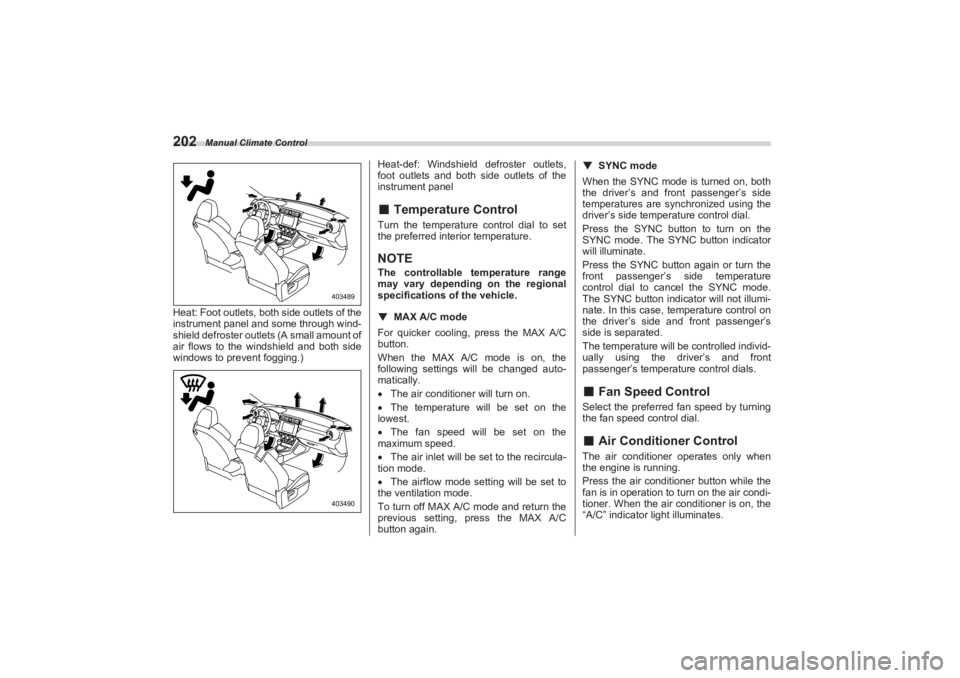
202Heat: Foot outlets, both side outlets of the
instrument panel and some through wind-
shield defroster outlets (A small amount of
air flows to the windshield and both side
windows to prevent fogging.) Heat-def: Windshield defroster outlets,
foot outlets and both side outlets of the
instrument panel
■ Temperature ControlTurn the temperature control dial to set
the preferred interior temperature.NOTEThe controllable temperature range
may vary depending on the regional
specifications of the vehicle.
▼ MAX A/C mode
For quicker cooling, press the MAX A/C
button.
When the MAX A/C mode is on, the
following settings will be changed auto-
matically.
The air conditioner will turn on.
The temperature will be set on the
lowest.
The fan speed will be set on the
maximum speed.
The air inlet will be set to the recircula-
tion mode.
The airflow mode setting will be set to
the ventilation mode.
To turn off MAX A/C mode and return the
previous setting, press the MAX A/C
button again. ▼
SYNC mode
When the SYNC mode is turned on, both
the driver’s and front passenger’s side
temperatures are synchronized using the
driver’s side temperature control dial.
Press the SYNC button to turn on the
SYNC mode. The SYNC button indicator
will illuminate.
Press the SYNC button again or turn the
front passenger’s side temperature
control dial to cancel the SYNC mode.
The SYNC button indicator will not illumi-
nate. In this case, temperature control on
the driver’s side and front passenger’s
side is separated.
The temperature will be controlled individ-
ually using the driver’s and front
passenger’s temperature control dials.
■ Fan Speed ControlSelect the preferred fan speed by turning
the fan speed control dial.■ Air Conditioner ControlThe air conditioner operates only when
the engine is running.
Press the air conditioner button while the
fan is in operation to turn on the air condi-
tioner. When the air conditioner is on, the
“A/C” indicator light illuminates.
403489403490
BRZ_U.book 202 ページ 2022年3月29日 火曜日 午後3時59分
Page 210 of 432
Operating Tips for Heater and Air Conditioner
204system to the setting that had been
selected before the defroster was acti-
vated.
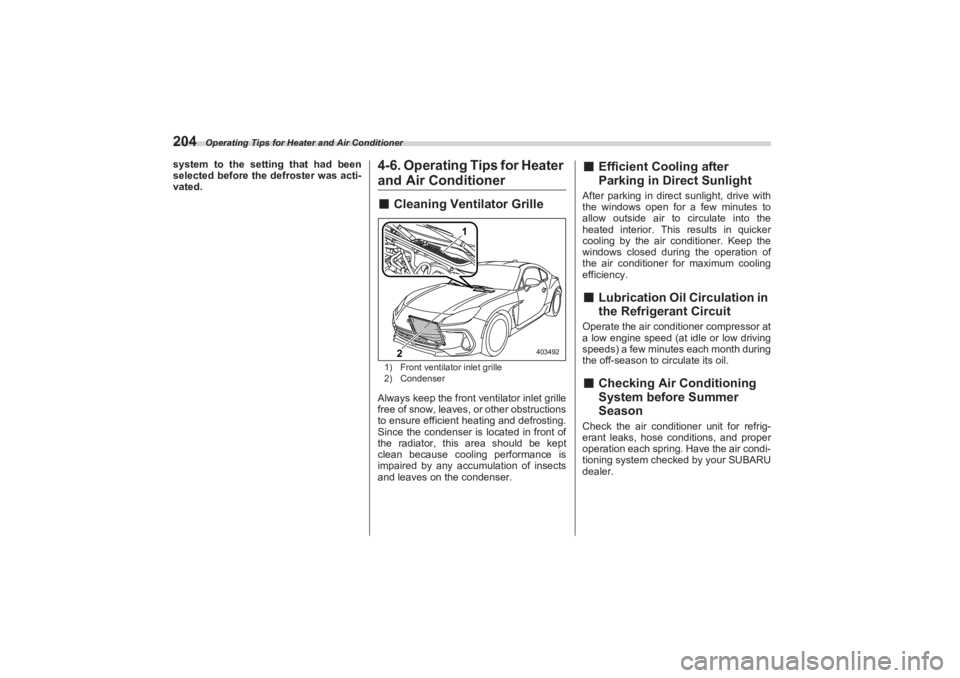
4-6. Operating Tips for Heater and Air Conditioner■ Cleaning Ventilator Grille1) Front ventilator inlet grille
2) CondenserAlways keep the front ventilator inlet grille
free of snow, leaves, or other obstructions
to ensure efficient heating and defrosting.
Since the condenser is located in front of
the radiator, this area should be kept
clean because cooling performance is
impaired by any accu mulation of insects
and leaves on the condenser.
■ Efficient Cooling after
Parking in Direct SunlightAfter parking in direct sunlight, drive with
the windows open for a few minutes to
allow outside air to circulate into the
heated interior. This results in quicker
cooling by the air conditioner. Keep the
windows closed during the operation of
the air conditioner for maximum cooling
efficiency.■ Lubrication Oil Circulation in
the Refrigerant CircuitOperate the air conditioner compressor at
a low engine speed (at idle or low driving
speeds) a few minutes each month during
the off-season to circulate its oil.■ Checking Air Conditioning
System before Summer
SeasonCheck the air conditioner unit for refrig-
erant leaks, hose conditions, and proper
operation each spring. Have the air condi-
tioning system checked by your SUBARU
dealer.
2
1
403492
BRZ_U.book 204 ページ 2022年3月29日 火曜日 午後3時59分
Page 211 of 432
Air Filtration System
205
Climate Control4
– CONTINUED –
■Cooling and Dehumidifying
in High Humidity and Low
Te mperature Weather Condi -
tionUnder certain weather conditions (high
relative humidity, lo w temperatures, etc.)
a small amount of water vapor emission
from the air outlets may be noticed. This
condition is normal and does not indicate
any problem with the air conditioning
system.■ Air Conditioner Compressor
Shut-Off Whe n Engine Is
Heavily LoadedTo improve acceleration and gas mileage,
the air conditio ner compressor is
designed to temporarily shut off during air
conditioner operation whenever the accel-
erator is fully depressed such as during
rapid acceleration or when driving on a
steep upgrade.
■ Refrigerant for Your Climate
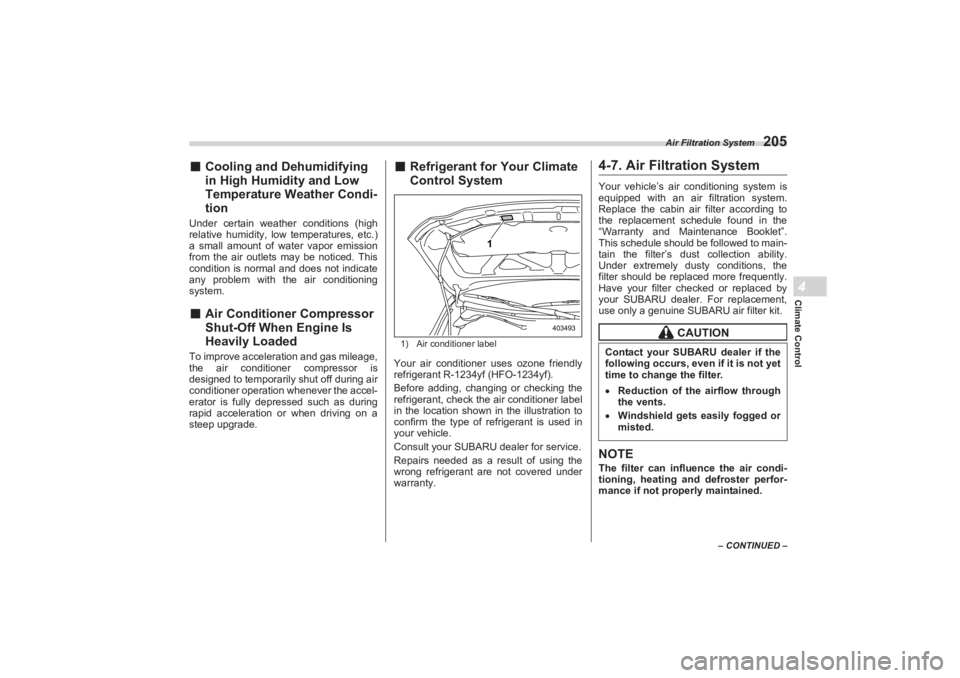
Control Syste m1) Air conditioner labelYour air conditioner uses ozone friendly
refrigerant R-1234yf (HFO-1234yf).
Before adding, changing or checking the
refrigerant, check the air conditioner label
in the location shown in the illustration to
confirm the type of refrigerant is used in
your vehicle.
Consult your SUBARU dealer for service.
Repairs needed as a result of using the
wrong refrigerant are not covered under
warranty.
4-7. Air Filtration SystemYour vehicle’s air conditioning system is
equipped with an air filtration system.
Replace the cabin air filter according to
the replacement schedule found in the
“Warranty and Maintenance Booklet”.
This schedule should be followed to main-
tain the filter’s dust collection ability.
Under extremely dusty conditions, the
filter should be replaced more frequently.
Have your filter checked or replaced by
your SUBARU dealer. For replacement,
use only a genuine SUBARU air filter kit.NOTEThe filter can influence the air condi-
tioning, heating and defroster perfor-
mance if not properly maintained.
1
403493
CAUTION
Contact your SUBARU dealer if the
following occurs, even if it is not yet
time to change the filter. Reduction of the airflow through
the vents. Windshield gets easily fogged or
misted.
BRZ_U.book 205 ページ 2022年3月29日 火曜日 午後3時59分
Page 219 of 432
Sun Visors
213
Interior Equipment6
– CONTINUED –
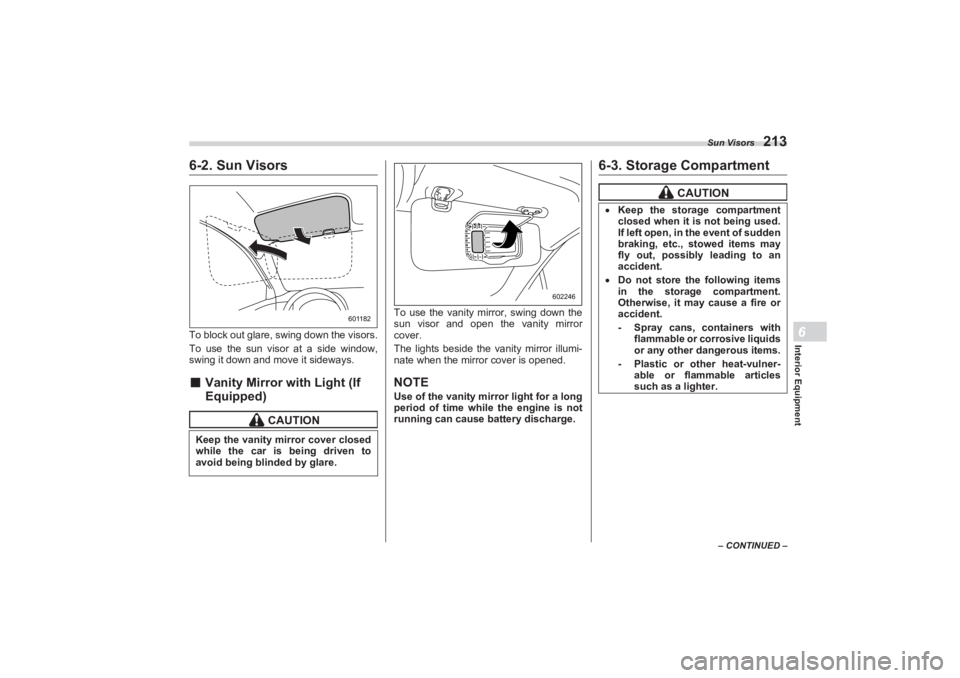
6-2. Sun VisorsTo block out glare, swing down the visors.
To use the sun visor at a side window,
swing it down and move it sideways.■ Vanity Mirror with Light (If
Equipped)
To use the vanity mirror, swing down the
sun visor and open the vanity mirror
cover.
The lights beside the vanity mirror illumi-
nate when the mirror cover is opened.NOTEUse of the vanity mirror light for a long
period of time while the engine is not
running can cause battery discharge.
6-3. Storage Compartment
CAUTION
Keep the vanity mirror cover closed
while the car is being driven to
avoid being blinded by glare.
601182
602246
CAUTION
Keep the storage compartment
closed when it is not being used.
If left open, in the event of sudden
braking, etc., stowed items may
fly out, possibly leading to an
accident. Do not store the following items
in the storage compartment.
Otherwise, it may cause a fire or
accident.
- Spray cans, containers with
flammable or corrosive liquids
or any other dangerous items.- Plastic or other heat-vulner- able or flammable articles
such as a lighter.
BRZ_U.book 213 ページ 2022年3月29日 火曜日 午後3時59分
Page 222 of 432
USB Power Supply
216
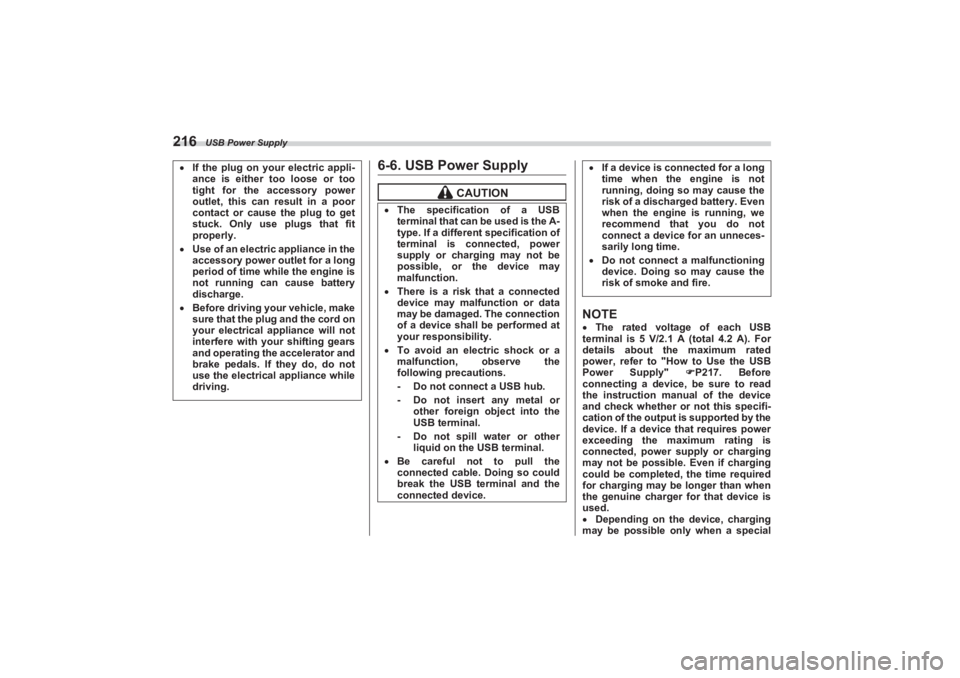
6-6. USB Power Supply
NOTEThe rated voltage of each USB
terminal is 5 V/2.1 A (total 4.2 A). For
details about the maximum rated
power, refer to "How to Use the USB
Power Supply" P217. Before
connecting a device, be sure to read
the instruction manual of the device
and check whether or not this specifi-
cation of the output is supported by the
device. If a device that requires power
exceeding the maximum rating is
connected, power supply or charging
may not be possible. Even if charging
could be completed, the time required
for charging may be longer than when
the genuine charger for that device is
used.
Depending on the device, charging
may be possible only when a special
If the plug on your electric appli-
ance is either too loose or too
tight for the accessory power
outlet, this can result in a poor
contact or cause the plug to get
stuck. Only use plugs that fit
properly. Use of an electric appliance in the
accessory power outlet for a long
period of time while the engine is
not running can cause battery
discharge. Before driving your vehicle, make
sure that the plug and the cord on
your electrical appliance will not
interfere with your shifting gears
and operating the accelerator and
brake pedals. If they do, do not
use the electrical appliance while
driving.
CAUTION
The specification of a USB
terminal that can be used is the A-
type. If a different specification of
terminal is connected, power
supply or charging may not be
possible, or the device may
malfunction. There is a risk that a connected
device may malfunction or data
may be damaged. The connection
of a device shall be performed at
your responsibility. To avoid an electric shock or a
malfunction, observe the
following precautions.
- Do not connect a USB hub.- Do not insert any metal or
other foreign object into the
USB terminal.- Do not spill water or other
liquid on the USB terminal.
Be careful not to pull the
connected cable. Doing so could
break the USB terminal and the
connected device.
If a device is connected for a long
time when the engine is not
running, doing so may cause the
risk of a discharged battery. Even
when the engine is running, we
recommend that you do not
connect a device for an unneces-
sarily long time. Do not connect a malfunctioning
device. Doing so may cause the
risk of smoke and fire.
BRZ_U.book 216 ページ 2022年3月29日 火曜日 午後3時59分
Page 227 of 432
Starting and Operating7
Starting and Operating
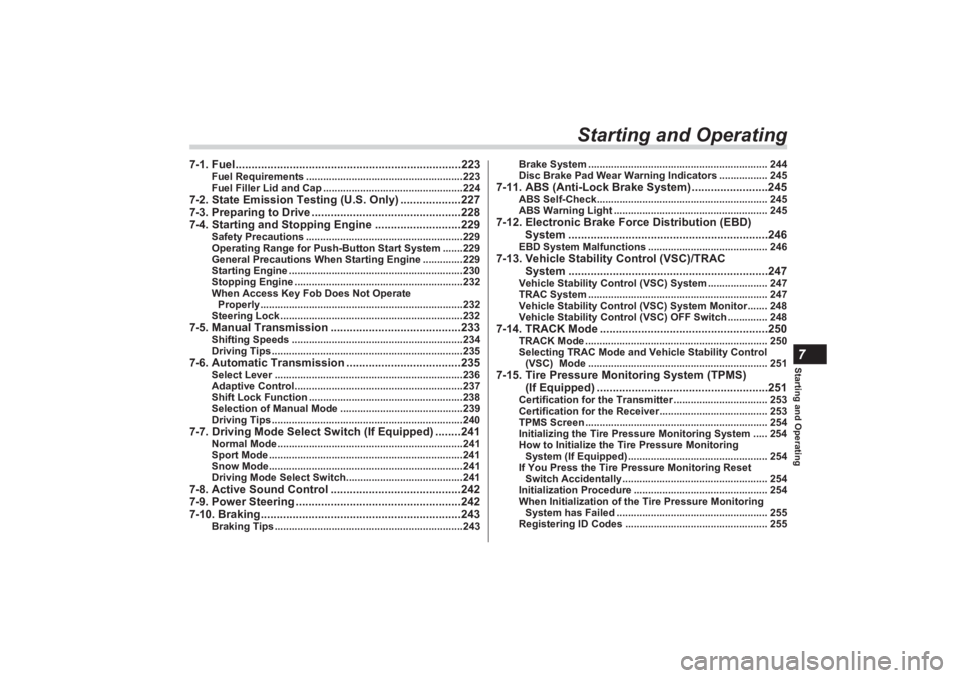
7-1. Fuel.......................................................................223
Fuel Requirements .......................................................223
Fuel Filler Lid and Cap .................................................224
7-2. State Emission Testing (U.S. Only) ...................227
7-3. Preparing to Drive ...............................................228
7-4. Starting and Stopping Engine ...........................229
Safety Precautions ............................................ ...........229
Operating Range for Push-Button Start System .......229
General Precautions When St arting Engine ..............229
Starting Engine .............................................................230
Stopping Engine ...........................................................232
When Access Key Fob Does Not Operate
Properly.......................................................................232
Steering Lock ................................................................232
7-5. Manual Transmission .........................................233
Shifting Speeds ............................................................234
Driving Tips ...................................................................235
7-6. Automatic Transmission ....................................235
Select Lever ..... .......................................... ...................236
Adaptive Control...........................................................237
Shift Lock Function ......................................................238
Selection of Manual Mode ...........................................239
Driving Tips ...................................................................240
7-7. Driving Mode Select Switch (If Equipped) ........241
Normal Mode .................................................................241
Sport Mode ....................................................................241
Snow Mode....................................................................241
Driving Mode Select Switch.........................................241
7-8. Active Sound Control .........................................242
7-9. Power Steering ....................................................242
7-10. Braking...............................................................243
Braking Tips ..................................................................243 Brake System ............................................................... 244
Disc Brake Pad Wear Warning Indicators ................. 245
7-11. ABS (Anti-Lock Brake System) ........................245
ABS Self-Check............................................................ 245
ABS Warning Light ...................................................... 245
7-12. Electronic Brake Force Distribution (EBD)
System ...............................................................246
EBD System Malfunctions .......................................... 246
7-13. Vehicle Stability Control (VSC)/TRAC
System ...............................................................247
Vehicle Stability Control (VSC) System ..................... 247
TRAC System ............................................................... 247
Vehicle Stability Control (VSC) System Monitor....... 248
Vehicle Stability Control (VSC) OFF Switch .............. 248
7-14. TRACK Mode .....................................................250
TRACK Mode ................................................................ 250
Selecting TRAC Mode and Ve hicle Stability Control
(VSC) Mode ............................................................... 251
7-15. Tire Pressure Monitoring System (TPMS)
(If Equipped) ......................................................251
Certification for the Transmitter ................................. 253
Certification for the Receiver...................................... 253
TPMS Screen ................................................................ 254
Initializing the Tire Pressure Monitoring System ..... 254
How to Initialize the Tire Pressure Monitoring
System (If Equipped) ................................................. 254
If You Press the Tire Pressure Monitoring Reset
Switch Accidentally................................................... 254
Initialization Procedure ............................................... 254
When Initialization of the Tire Pressure Monitoring System has Failed ..................................................... 255
Registering ID Codes .................................................. 255
BRZ_U.book 221 ページ 2022年3月29日 火曜日 午後3時59分
Page 229 of 432
Fuel
223
Starting and Operating7
– CONTINUED –
7-1. Fuel■Fuel RequirementsThe engine is designed to operate using
unleaded gasoline with an octane rating
of 93 AKI (98 RON) or higher .
If unleaded gasoline with an octane
rating of 93 AKI (98 RON) is not available,
unleaded gasoline with an octane rating of
91 AKI (95 RON) may be used with no
detriment to engine durability or
driveability.
However, you may notice a slight
decrease in maximum engine perfor-
mance and you may hear some knocking
(pinging) from the engine while using 91
AKI (95 RON) fuel. Use of 91 AKI (95 RON)
fuel will not affect your warranty
coverage.
▼ Fuel octane rating
Using a gasoline with a lower octane
rating can cause persistent and heavy
knocking, which can damage the engine.
Do not be concerned if your vehicle some-
times knocks lightly when you drive up a
hill or when you accelerate. See your
dealer or a qualified service technician if
you use a fuel with the specified octane
rating and your vehi cle knocks heavily or
persistently.
▽RON
This octane rating is the Research Octane
Number.
▽AKI
This octane rating is the average of the
Research Octane and Motor Octane
numbers and is commonly referred to as
the Anti Knock Index (AKI).
▼ Unleaded gasoline
The neck of the fuel filler pipe is designed
to accept only an unleaded gasoline filler
nozzle. Under no circumstances should
leaded gasoline be used because it will
damage the emission control system and
may impair driveability and fuel economy. ▼
Reformulated gasoline
SUBARU supports the use of reformu-
lated gasoline when available. Reformu-
lated gasoline has been blended to burn
more cleanly and reduce vehicle emis-
sions.
▼ MMT
Some gasoline contains an octane-
enhancing additive called MMT (Methylcy-
clopentadienyl Manganese Tricarbonyl). If
you use such fuels, your emission control
system performance may deteriorate and
the CHECK ENGINE warning light/
malfunction indicator light may turn on. If
this happens, return to your authorized
SUBARU Dealer for service. If it is deter-
mined that the condition is caused by the
type of fuel used, repairs may not be
covered by your warranty.
▼ Gasoline for cleaner air
Your use of gasoline with detergent addi-
tives will help prevent deposits from
forming in your engi ne and fuel system.
This helps keep your engine in tune and
your emission cont rol system working
properly, and is a way of doing your part
for cleaner air. If you continuously use a
high quality fuel with the proper detergent
and other additives, you should never
CAUTION
Use of a fuel which is low in
quality or use of an inappropriate
fuel additive may cause damage
to the engine and/or fuel system. Some gas stations, particularly
those in high altitude areas, offer
fuels posted as regular octane
gasoline with an octane rating
below 93 AKI (98 RON). Use of
those fuels are not recom-
mended.
BRZ_U.book 223 ページ 2022年3月29日 火曜日 午後3時59分
Page 232 of 432
Fuel
2266. Stop filling the tank after the fuel filler
pump automatically stops. Do not add any
more fuel.
7. Put the cap back on and turn it clock-
wise until you hear a clicking noise. Be
certain not to catch the tether under the
cap while tightening.
8. Close the fuel filler lid completely.
NOTE You will see the “ ” sign in the
fuel gauge. This indicates that the fuel
filler lid is located on the right side of
the vehicle.
If the fuel filler cap is not tightened
until it clicks or if the tether is caught
under the cap, the CHECK ENGINE
warning light/malfunction indicator
light may illuminate. Refer to "CHECK
ENGINE Warning Light/Malfunction
Indicator Light" P136.
To lock the fuel filler lid, perform one
of the operations below. However if
these operations are performed when
the fuel filler lid is open, the fuel filler
lid will not lock when it is subsequently
closed. - Press the “ ” button on the key
fob.
- Press the lock side of the power
door locking switch.
WARNING
When refueling, insert the fuel
nozzle securely into the fuel filler
pipe. If the nozzle is lifted or not
fully inserted, its automatic stop-
ping mechanism may not func-
tion, causing fuel to overflow the
tank and creating a fire hazard. Stop refueling when the auto-
matic stop mechanism on the fuel
nozzle activates. If you continue
to add fuel, temperature changes
or other conditions may cause
fuel to overflow from the tank and
create a fire hazard.
CAUTION
Make sure that the cap is tightened
until it clicks to prevent fuel spillage
in the event of an accident.
CAUTION
Do not let fuel sp ill on the exterior
surfaces of the vehicle. Because
fuel may damage th e paint, be sure
to wipe off any spilled fuel quickly.
Paint damage caused by spilled fuel
is not covered under the SUBARU
Limited Warranty.
CAUTION
Never add any cleaning agents to
the fuel tank. Th e addition of a
cleaning agent may cause
damage to the fuel system. After refuelin g, turn the cap to the
right until it clicks to ensure that it
is fully tightened. If the cap is not
securely tightened, fuel may leak
out while the vehicle is being
driven or fuel spillage could
occur in the event of an accident,
creating a fire hazard. Do not let fuel spill on the exterior
surfaces of the vehicle. Because
fuel may damage the paint, be
sure to wipe off any spilled fuel
quickly. Paint damage caused by
spilled fuel is not covered under
the SUBARU Limited Warranty. Always use a genuine SUBARU
fuel filler cap. If you use the
wrong cap, it may not fit or have
proper venting and your fuel tank
and emission control system may
be damaged. It could also lead to
fuel spillage and a fire.
BRZ_U.book 226 ページ 2022年3月29日 火曜日 午後3時59分
Page 233 of 432
State Emission Testing (U.S. Only)
227
Starting and Operating7
– CONTINUED –
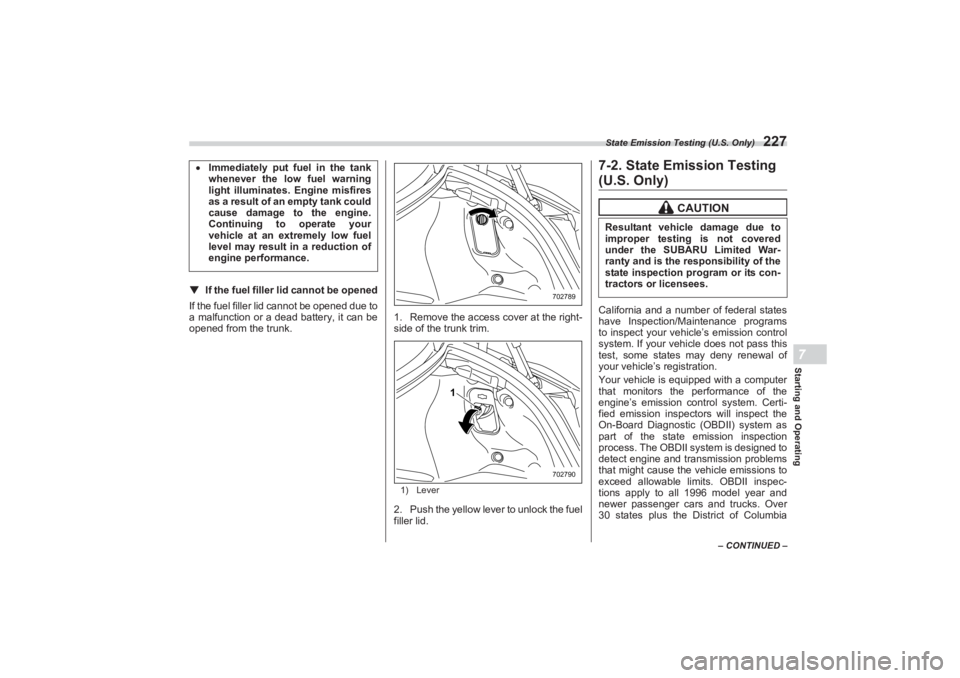
▼If the fuel filler lid cannot be opened
If the fuel filler lid cannot be opened due to
a malfunction or a dead battery, it can be
opened from the trunk. 1. Remove the access cover at the right-
side of the trunk trim.
1) Lever2. Push the yellow lever to unlock the fuel
filler lid.
7-2. State Emission Testing (U.S. Only)California and a number of federal states
have Inspection/Maintenance programs
to inspect your vehicle’s emission control
system. If your vehicle does not pass this
test, some states may deny renewal of
your vehicle’s registration.
Your vehicle is equipped with a computer
that monitors the performance of the
engine’s emission control system. Certi-
fied emission inspectors will inspect the
On-Board Diagnostic (OBDII) system as
part of the state emission inspection
process. The OBDII system is designed to
detect engine and transmission problems
that might cause the vehicle emissions to
exceed allowable limits. OBDII inspec-
tions apply to all 1996 model year and
newer passenger cars and trucks. Over
30 states plus the District of Columbia
Immediately put fuel in the tank
whenever the low fuel warning
light illuminates. Engine misfires
as a result of an empty tank could
cause damage to the engine.
Continuing to operate your
vehicle at an extremely low fuel
level may result in a reduction of
engine performance.
702789
1
702790
CAUTION
Resultant vehicle damage due to
improper testing is not covered
under the SUBARU Limited War-
ranty and is the responsibility of the
state inspection program or its con-
tractors or licensees.
BRZ_U.book 227 ページ 2022年3月29日 火曜日 午後3時59分
Page 234 of 432
Preparing to Drive
228have implemented emission inspection of
the OBDII system.
The inspection of the OBDII system
consists of a visual operational check of
the “ CHECK ENGINE ” warning light/
malfunction indicator light (MIL) and an
examination of the OBDII system with an
electronic scan tool.
A vehicle passes
the OBDII system
inspection if proper operation of the
“ CHECK ENGINE ” warning light is
observed, there are no stored diagnostic
trouble codes, and the OBDII readiness
monitors are all complete.
A vehicle fails
the OBDII inspection if
the “ CHECK ENGINE ” warning light is not
properly operating (light is illuminated or is
not working due to a burned out bulb) or
there is one or more diagnostic trouble
codes stored in the vehicle’s computer.
A state emission in spection may reject
(not pass or fail) a vehicle if the number of
OBDII system readiness monitors “ NOT
READY ” is greater than one. If the
vehicle’s battery has been recently
replaced or disconnected, the OBDII
system inspection may indicate that the
vehicle is not ready for the emission test.
Under this condition, the vehicle driver
should be instructed to drive his/her
vehicle for a few days to reset the readi-
ness monitors and return for an emission
re-inspection.
Owners of rejected or failing vehicles
should contact their SUBARU Dealer for
service.
7-3. Preparing to DriveYou should perform the following checks
and adjustments every day before you
start driving.
1. Check that all windows, mirrors, and
lights are clean and unobstructed.
2. Check the appearance and condition
of the tires. Also check tires for proper
inflation.
3. Look under the vehicle for any sign of
leaks.
4. Check that no small animals enter the
engine compartment.
5. Check that the hood and trunk are fully
closed.
6. Check the adjustment of the seat.
7. Check the adjustment of the inside
and outside mirrors.
8. Fasten your seatbelt. Check that your
passengers have fastened their seatbelts.
9. Check the operation of the warning
and indicator lights when the ignition
switch is turned to the “ON” position.
10. Check the gauges, indicator and
warning lights after starting the engine.
BRZ_U.book 228 ページ 2022年3月29日 火曜日 午後3時59分