brake sensor SUBARU BRZ 2023 Owners Manual
[x] Cancel search | Manufacturer: SUBARU, Model Year: 2023, Model line: BRZ, Model: SUBARU BRZ 2023Pages: 432, PDF Size: 16.56 MB
Page 145 of 432
Warning and Indicator Lights
139
Instruments and Controls3
– CONTINUED –
If this light illuminates while driving,
never brake suddenly. Instead, per-
form the following procedure. Oth-
erwise an accident involving
serious vehicle damage and serious
personal injury could occur.1) Keep driving straight ahead while
gradually reducing speed.2) Slowly pull off the road to a safe
place.If this light still illuminates while
driving after adjusting the tire pres-
sure, a tire may have significant
damage and a fast leak that causes
the tire to lose air rapidly. If you
have a flat tire, replace it with a
spare tire as soon as possible.
When a spare tire is mounted or a
wheel rim is replaced without the
original pressure sensor/transmitter
being transferred, the Low tire pres-
sure warning light will illuminate
steadily after blinking for approxi-
mately one minute. This indicates
the TPMS is unable to monitor all
four road wheels. Contact your
SUBARU dealer as soon as possi-
ble for tire and sensor replacement
and/or system resetting. If the light
illuminates steadily after blinking
for approximately one minute,
promptly contact a SUBARU dealer
to have the system inspected.
CAUTION
The tire pressure monitoring sys-
tem is NOT a substitute for manu-
ally checking tire pressure. The tire
pressure should be checked period-
ically (at least monthly) using a tire
gauge. After any change to tire
pressure(s), the tire pressure moni-
toring system will not re-check tire
inflation pressures until the vehicle
is first driven mo re than 25 mph (40
km/h). After adjusting the tire pres-
sures, increase the vehicle speed to
at least 25 mph (40 km/h) to start the
TPMS re-checking of the tire infla-
tion pressures. If the tire pressures
are now above the severe low pres-
sure threshold, the low tire pres-
sure warning light should turn off a
few minutes later. Therefore, be
sure to install the specified size for
the front and rear tires.
BRZ_U.book 139 ページ 2022年3月29日 火曜日 午後3時59分
Page 147 of 432
Warning and Indicator Lights
141
Instruments and Controls3
– CONTINUED –
If the brake system warning light should
illuminate while driving (with the parking
brake fully released and with the ignition
switch positioned in “ON”), it could be an
indication of leaking of brake fluid or worn
brake pads. If this occurs, immediately
stop the vehicle at the nearest safe place
and check the brake fluid level. If the fluid
level is below the “MIN” mark in the reser-
voir, do not drive the vehicle. Have the
vehicle towed to the nearest SUBARU
dealer for repair.▼ Electronic Brake Force Distribution
(EBD) system warning
If the warning light remains on even
though the parking brake is released, the
brake fluid level may be low or there could
be a problem with the EBD system. Park
the vehicle in a safe place immediately
and contact a SUBARU dealer.
▼ Vacuum pressure system warning
The brake system warning light will illumi-
nate when the vacuum pressure sensor is
malfunctioning or brake booster pressure
is decreasing. If the light continues to illu-
minate for several minutes after starting
the engine, there may be a malfunction in
the vacuum system. In this case, drive the
vehicle carefully and have the system
inspected by a SUBARU dealer.
■ Low Fuel Warning LightThe low fuel warning light illuminates
when the tank is nearly empty approxi-
mately 1.8 US gal (7.0 liters, or 1.5 Imp
gal). It only operates when the ignition
switch is in the “ON” position.■ Door Open IndicatorWhen any of the doors or the trunk lid is
not fully closed, the door open indicator
appears. This function is effective even if
the ignition switch is in the “OFF” or “ACC”
position.
The open door is indicated by the corre-
sponding part of the door open indicator.
Always make sure this indicator does not
appear before you start to drive.■ Power Steering
Warning LightWhile the engine is running, a warning
light illuminates and a buzzer sounds if a malfunction is detected in the electric
power steering system.
NOTEIf the steering wheel is operated in the
following ways, the power steering
control system may temporarily limit
the power assist in order to prevent
the system components, such as the
control computer and drive motor,
from overheating.
The steering wheel is operated
frequently and turned sharply while the
vehicle is maneuvered at extremely low
speeds, such as while frequently
turning the steering wheel during
parallel parking.
The steering wheel remains in the
fully turned position for a long period
of time.
At this time, there will be more resis-
tance when steering. However this is
not a malfunction. Normal steering
CAUTION
Promptly put fuel in the tank when-
ever the low fuel warning light illu-
minates. Engine misfires as a result
of an empty tank could cause dam-
age to the engine.
CAUTION
When the power steering warning
light is illuminated, there may be
more resistance when the steering
wheel is operated. Drive carefully to
the nearest SUBARU dealer and
have the vehicle inspected immedi-
ately.
BRZ_U.book 141 ページ 2022年3月29日 火曜日 午後3時59分
Page 228 of 432
Starting and Operating
Changing the ID code set ............................................ 255
7-16. Parking Your Vehicle ........................................255
Parking Brake ............................................................... 255
Parking Tips.................................................................. 256
7-17. Hill Start Assist System ....................................257
To Activate/Deactivate the Hill Start Assist
System ........................................................................ 258
Hill Start Assist Indicator Light................................... 259
7-18. Cruise Control (Models without the
EyeSight system) ..............................................260
To Set Cruise Control .................................................. 260
To Temporarily Cancel the Cr uise Control ................ 261
To Turn Off the Cruise Control ................................... 262
To Change the Cruising Speed ................................... 262
Cruise Control Indicator Light .................................... 263
7-19. Rear View Camera .............................................263
How to Use the Rear View Camera ............................. 264
Viewing Range on the Screen ..................................... 265
Help Lines ..................................................................... 266
7-20. BSD/RCTA (If Equipped)...................................268
System Features .......................................................... 268 System Operation......................................................... 270
BSD/RCTA Approach Indi
cator Light/Warning
Buzzer ......................................................................... 271
BSD/RCTA OFF Indicator ............................................ 273
BSD/RCTA Warning Indicator ..................................... 274
To Turn On/Off the BSD/RCTA .................................... 274
Certification for the BSD/RCTA................................... 274
Handling of Radar Sensors ......................................... 276
7-21. Reverse Automatic Braking (RAB) System
(If Equipped) ..................................................... 277
Reverse Automatic Braking (RAB) System
Overview ..................................................................... 278
Operating Conditions................................................... 279
Sonar Audible Alarm .................................................... 282
Automatic Braking Operation ..................................... 284
Canceling the Reverse Au tomatic Braking (RAB)
System Operation ...................................................... 285
Reverse Automatic Braking (RAB) System
ON/OFF Setting .......................................................... 286
RAB Warning Indicator ................................................ 286
Handling of the Sonar Sensors ................................... 286
BRZ_U.book 222 ページ 2022年3月29日 火曜日 午後3時59分
Page 257 of 432
Tire Pressure Monitoring System (TPMS) (If Equipped)
251
– CONTINUED –
Starting and Operating7
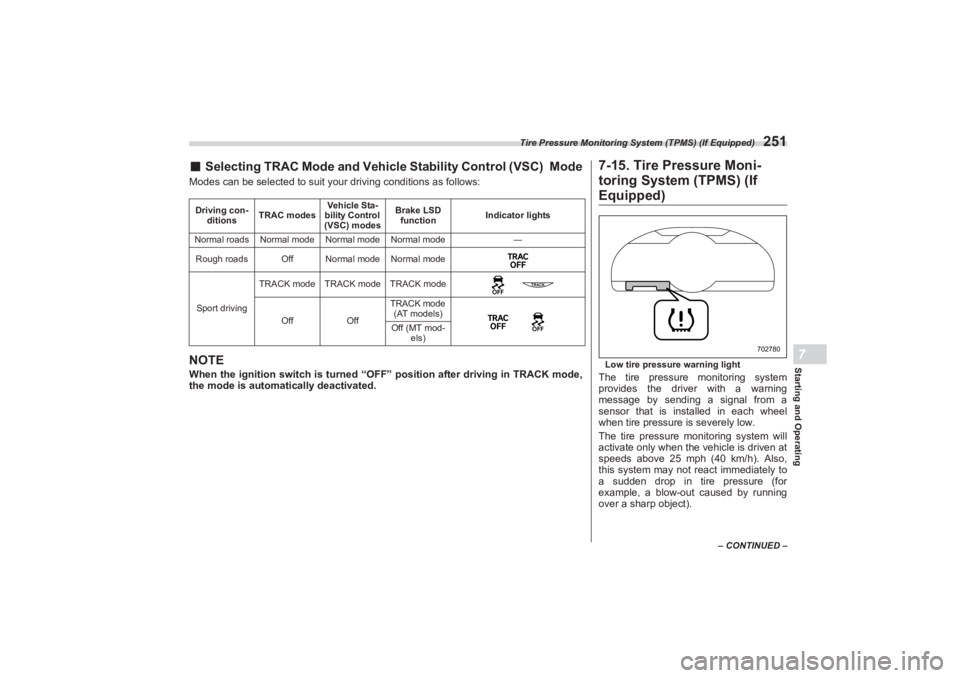
■Selecting TRAC Mode and Vehicle Stability Control (VSC) ModeModes can be selected to suit your driving conditions as follows:NOTEWhen the ignition switch is turned “OFF” position af ter driving in TRACK mode,
the mode is automa tically deactivated.Driving con-
ditions TRAC modes Vehicle Sta-
bility Control
(VSC) modes Brake LSD
function Indicator lights
Normal roads Normal mode Normal mode Normal mode ―
Rough roads Off Normal mode Normal mode
Sport driving TRACK mode TRACK mode TRACK mode
Off OffTRACK mode
(AT models)
Off (MT mod-
els)
7-15. Tire Pressure Moni -
toring System (TPMS) (If Equipped)Low tire pressure warning lightThe tire pressure monitoring system
provides the driver with a warning
message by sending a signal from a
sensor that is installed in each wheel
when tire pressure is severely low.
The tire pressure monitoring system will
activate only when the vehicle is driven at
speeds above 25 mph (40 km/h). Also,
this system may not react immediately to
a sudden drop in tire pressure (for
example, a blow-out caused by running
over a sharp object).
702780
BRZ_U.book 251 ページ 2022年3月29日 火曜日 午後3時59分
Page 258 of 432
Tire Pressure Monitoring System (TPMS) (If Equipped)
252
WARNING
If the low tire pressure warning
light illuminates while driving,
never brake suddenly. Instead,
perform the following procedure.
Otherwise an accident involving
serious vehicle damage and
serious personal injury could
occur.
(1) Keep driving straight ahead
while gradually reducing
speed.(2) Slowly pull off the road to a
safe place.(3) Check the pressure for all
four tires and adjust the pres-
sure to the COLD tire pres-
sure shown on the tire
inflation pressure label on the
center pillar on the driver’s
side.
Even when the vehicle is driven a
very short distance, the tires get
warm and their pressures
increase accordingly. Be sure to
let the tires cool thoroughly
before adjusting their pressures
to the standard values shown on
the tire inflatio n pressure label.
Refer to "Tires and Wheels"
P358. The tire pressure moni-
toring system does not function
when the vehicle is stationary.
After adjusting the tire pressures,
increase the vehicle speed to at
least 25 mph (40 km/h) to start the
TPMS rechecking of the tire infla-
tion pressures. If the tire pres-
sures are now above the severe
low pressure threshold, the low
tire pressure warning light should
turn off a few minutes later.
If this light still illuminates while
driving after adjusting the tire
pressure, a tire may have signifi-
cant damage and a fast leak that
causes the tire to lose air rapidly.
For details, refer to "Flat Tires"
P303.
When a spare tire is mounted or a
wheel rim is replaced without the
original pressure sensor/trans-
mitter being transferred, the low
tire pressure warning light will
illuminate steadily after blinking
for approximately one minute.
This indicates the TPMS is unable
to monitor all fo ur road wheels.
Contact your SUBARU dealer as
soon as possible for tire and
sensor replacement and/or
system resetting.
BRZ_U.book 252 ページ 2022年3月29日 火曜日 午後3時59分
Page 261 of 432
Parking Your Vehicle
255
Starting and Operating7
– CONTINUED –
■When Initialization of the Tire
Pressure Monitoring System
has FailedInitialization can be completed in a few
minutes. However, in the following case,
the settings have not been recorded and
the system will not o perate properly. If
repeated attempts to record tire inflation
pressure settings ar e unsuccessful, have
the vehicle checked at your SUBARU
dealer.
When operating the TPMS set switch,
low tire pressure warning light does not
blink 3 times.
After carrying out the initialization
procedure, the low tire pressure warning
light blinks for 1 minute then stays on after
driving for 20 minutes.
■ Registering ID CodesEvery tire pressure warning valve and
transmitter has a unique ID code. In addi-
tion to the set of tire pressure monitoring
system sensor ID code s initially registered
to the vehicle, a second set of ID codes
can be registered.
A second set of tire pressure monitoring
system sensor ID codes can be registered
at your SUBARU dealer. When 2 sets of
ID codes have been registered, either ID
code set can be selected.■ Changing the ID code set1. Park the vehicle in a safe place and
turn the ignition swit ch to the “ON” posi-
tion.
2. Press the TPMS set switch 3 times
within 3 seconds.
3. The low tire pressure warning light will
illuminate for 3 seconds and then blink 3
times.
4. The low tire pressure warning light will
blink for 1 minute and then illuminate.
5. When the ID code change has
completed, the tire pressure monitoring
light will turn off.
Check that tire pressures are displayed on
the TPMS screen.
7-16. Parking Your Vehicle■ Parking BrakeTo set the parking brake, depress the
brake pedal firmly and hold it down until
the parking brake lever is fully pulled up.
WARNING
Do not operate the TPMS set switch
without first adjust ing the tire infla-
tion pressure to the specified level.
Otherwise, the low tire pressure
warning light may not come on even
if the tire inflation pressure is low,
or it may come on when the tire
inflation pressure is actually nor-
mal.
WARNING
Never leave unattended children
or pets in the vehicle. They could
accidentally injure themselves or
others through inadvertent oper-
ation of the vehicle. Also, on hot
or sunny days, the temperature in
a closed vehicle could quickly
become high enough to cause
severe or possibly fatal injuries to
people. Do not park the vehicle over flam-
mable materials such as dry
grass, waste paper or rags, as
they may burn easily if they come
near hot engine or exhaust
system parts. Be sure to stop the engine if you
take a nap in the vehicle. If engine
exhaust gas enters the passenger
compartment, occupants in the
vehicle could die from carbon
monoxide (CO) contained in the
exhaust gas.
BRZ_U.book 255 ページ 2022年3月29日 火曜日 午後3時59分
Page 283 of 432
Reverse Automatic Braking (RAB) System (If Equipped)
277
Starting and Operating7
– CONTINUED –
7-21. Reverse Automatic
Braking (RAB) System (If Equipped)Reverse Automatic Braking (RAB) is a
system designed to help avoid collisions
or reduce collision damage when
reversing the vehicle. If a wall or an
obstacle is detected in the reversing direc-
tion, the system will notify the driver with a
warning sound and may activate the
vehicle’s brakes automatically.
NOTEThe Reverse Automatic Braking (RAB)
system records and stores the follow-
ing data when automatic braking oper-
ates. It does not record conversations,
personal information or other audio
data.
Distance from the object
Vehicle speed
Accelerator pedal operation status
Brake pedal operation status
Select lever position
Outside temperature
The sensitivity setting of the sonar
sensors
SUBARU and third parties contracted
by SUBARU may acquire and use the
recorded data for the purpose of vehi-
cle research and development.
SUBARU and third parties contracted
by SUBARU will not disclose or pro-
vide the acquired data to any other
third party except under the following
conditions.
The vehicle owner has given his/her
consent.
The disclosure/provision is based
on a court order or other legally
enforceable request.
Data that has been modified so that
the user and vehicle cannot be identi-
fied is provided to a research institu-
WARNING
Reverse Automatic Braking
(RAB) is not a system intended to
replace the driver’s responsibility
to check their surroundings for
vehicles or obstacles to avoid a
collision. The driver is responsible for
driving safely. Before reversing,
be sure to first depress the brake
pedal and visually check the
surroundings.
There are some cases in which
the vehicle cannot avoid colli-
sion, because the system opera-
tion has limitations. The warning
sound or automatic braking may
be delayed or may not operate at
all even when an obstacle is
present. Make sure to set the Automatic
Braking to OFF when the vehicle
is on the free roller or on the
chassis dynamometer. Other-
wise, the vehicle may move and it
may cause an accident. Make sure to set the Automatic
Braking to OFF when towing the
vehicle. Otherwis e, the vehicle
may move and it may cause an
accident. The system is not designed to
detect people (including chil-
dren), animals or other moving
objects. Depending on the vehicle condi-
tion or the surrounding environ-
ment, the sonar sensor’s ability
to detect objects may become
unstable.
BRZ_U.book 277 ページ 2022年3月29日 火曜日 午後3時59分
Page 284 of 432
Reverse Automatic Braking (RAB) System (If Equipped)
278tion for statistical processing or similar
purposes.■ Reverse Automatic Braking
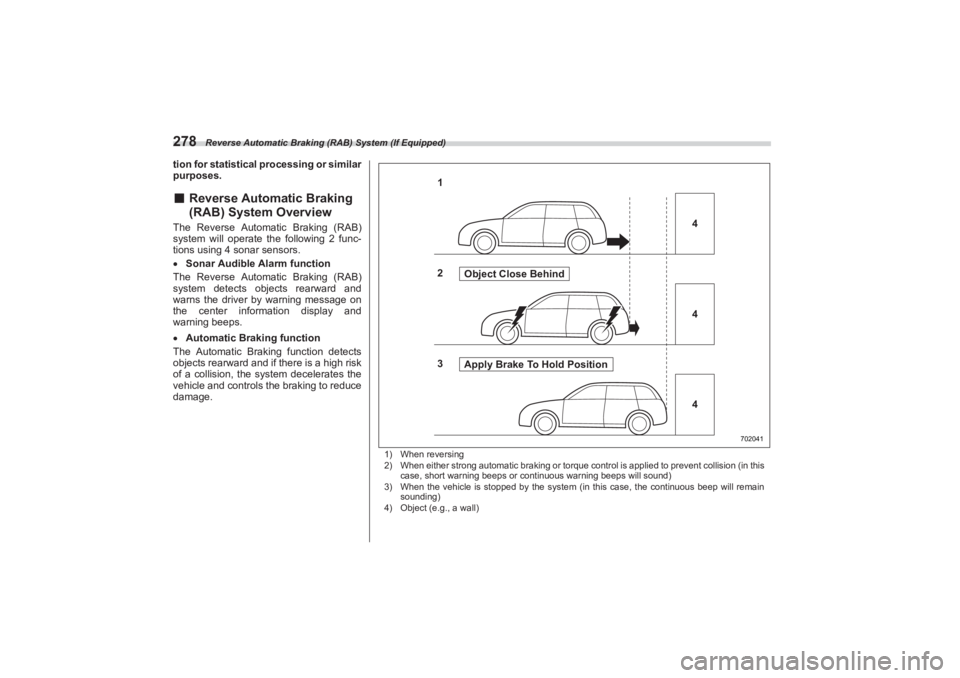
(RAB) System OverviewThe Reverse Automatic Braking (RAB)
system will operate th e following 2 func-
tions using 4 sonar sensors.
Sonar Audible Alarm function
The Reverse Automatic Braking (RAB)
system detects objects rearward and
warns the driver by warning message on
the center information display and
warning beeps.
Automatic Braking function
The Automatic Braking function detects
objects rearward and if there is a high risk
of a collision, the system de celerates the
vehicle and controls the braking to reduce
damage.
1) When reversing
2) When either strong automatic br aking or torque control is applied to prevent collision (in this
case, short warning beeps or continuous warning beeps will sound)
3) When the vehicle is stopped by the system (in this case, the continuous beep will remain
sounding)
4) Object (e.g., a wall)
702041
1
4
2 Object Close Behind
3 Apply Brake To Hold Position 4
4
BRZ_U.book 278 ページ 2022年3月29日 火曜日 午後3時59分
Page 285 of 432
Reverse Automatic Braking (RAB) System (If Equipped)
279
Starting and Operating7
– CONTINUED –
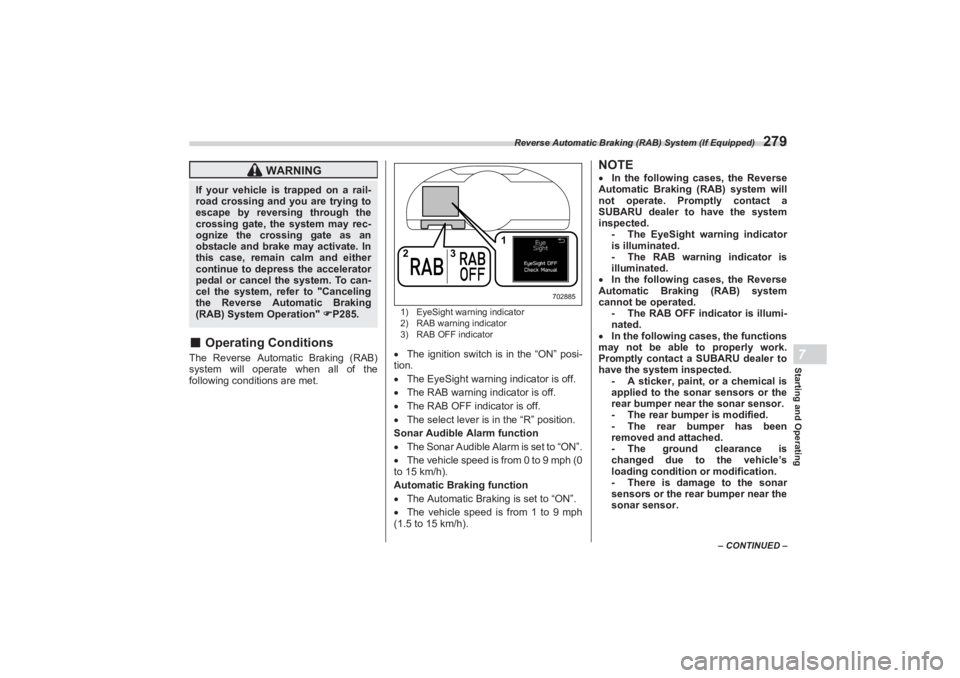
■Operating ConditionsThe Reverse Automatic Braking (RAB)
system will operat e when all of the
following conditions are met.
1) EyeSight warning indicator
2) RAB warning indicator
3) RAB OFF indicator The ignition switch is in the “ON” posi-
tion.
The EyeSight warning indicator is off.
The RAB warning indicator is off.
The RAB OFF indicator is off.
The select lever is in the “R” position.
Sonar Audible Alarm function
The Sonar Audible Alarm is set to “ON”.
The vehicle speed is from 0 to 9 mph (0
to 15 km/h).
Automatic Brak ing function
The Automatic Braking is set to “ON”.
The vehicle speed is from 1 to 9 mph
(1.5 to 15 km/h).
NOTE In the following cases, the Reverse
Automatic Braking (RAB) system will
not operate. Promptly contact a
SUBARU dealer to have the system
inspected. - The EyeSight warning indicator
is illuminated.
- The RAB warning indicator is
illuminated.
In the following cases, the Reverse
Automatic Braking (RAB) system
cannot be operated. - The RAB OFF indicator is illumi-
nated.
In the following ca ses, the functions
may not be able to properly work.
Promptly contact a SUBARU dealer to
have the system inspected. - A sticker, paint, or a chemical is
applied to the sonar sensors or the
rear bumper near the sonar sensor.
- The rear bumper is modified.
- The rear bumper has been
removed and attached.
- The ground clearance is
changed due to the vehicle’s
loading condition or modification.
- There is damage to the sonar
sensors or the rear bumper near the
sonar sensor.
WARNING
If your vehicle is trapped on a rail-
road crossing and you are trying to
escape by reversing through the
crossing gate, the system may rec-
ognize the crossing gate as an
obstacle and brake may activate. In
this case, remain calm and either
continue to depress the accelerator
pedal or cancel the system. To can-
cel the system, refer to "Canceling
the Reverse Automatic Braking
(RAB) System Operation" P285.
3 1
2
702885
BRZ_U.book 279 ページ 2022年3月29日 火曜日 午後3時59分
Page 286 of 432
Reverse Automatic Braking (RAB) System (If Equipped)
280
- The rear bumper is exposed to
strong impact, or the rear bumper is
deformed.
On a steep hill, the system’s auto-
matic braking ability will be reduced.
The system is designed to avoid
collisions by automatic hard braking
when the vehicle’s reversing speed is
less than approximately 3 mph (5 km/
h). However, the system does not guar-
antee that the vehicle will be able to
avoid collisions in any situation.
If the vehicle is reversed at an
extremely slow speed, the driver’s
operation may be prioritized. In this
case, automatic braking will not
operate.
The system may not be able to
detect and apply the brake with the
following objects. - Sharp or thin objects such as
poles, fences and ropes which may
not reflect the s ound wave emitted
from the sonar sensor.
- Objects that are too close to the
rear bumper when the select lever is
set to the “R” position.
- Objects with a surface which
may not reflect the sound wave
emitted from the sonar sensor such
as a chain link fence.
Objects the system is not designed
to detect and apply brake. -Pedestrians.
- Moving objects including
moving vehicles.
- Objects which absorbs sound
waves such as cloth or snow.
- Objects whose surface has a
diagonal angle.
- Objects that are low to the
ground such as parking blocks.
- Objects that are high above the
ground such as objects hanging
from above.
- Objects that are out of range of
the center of the vehicle in the hori-
zontal direction.
- Objects that are not perpendic-
ular to the ground.
- The surface of the object is
uneven or wavy.
When reversing the vehicle, the
functions may not be able to work
properly or may cause a system
malfunction if the following conditions
exist.
High frequency sound from other
sources are nearby:
- Horn sound from another
vehicle.
- Engine sound from other vehi-
cles.
- Sound of an air brake.
- Vehicle detection equipment or a
sonar from another vehicle. - A sound wave with a frequency
similar to the vehicle’s system is
transmitted near by.
- A vehicle equipped with the
same system is reversing toward
your reversing direction.
Weather conditions:
- Extremely high or extremely low
temperatures in which the area near
the sonar sensor becomes too hot
or too cold to operate.
- The sonar sensors or the rear
bumper near the sonar sensors are
exposed to heavy rain or a signifi-
cant amount of water.
- Fog, snow or sandstorm, etc.
- Air is moving rapidly such as
when a strong wind is blowing.
Parts attached to the rear bumper
near the sonar sensor:
- Commercial electr onic parts (fog
light, fender pole, radio antenna) or
commercial attachment parts (trailer
hitch, bicycle carrier, bumper guard)
are attached.
- Parts that emit high frequency
sound, such as a horn or speaker,
are attached.
Vehicle conditions:
- Ice, snow or mud is adhered to
the sonar sensors or the rear
bumper near the sonar sensor.
BRZ_U.book 280 ページ 2022年3月29日 火曜日 午後3時59分