lock SUBARU CROSSTREK 2018 Owners Manual
[x] Cancel search | Manufacturer: SUBARU, Model Year: 2018, Model line: CROSSTREK, Model: SUBARU CROSSTREK 2018Pages: 474, PDF Size: 20.76 MB
Page 336 of 474
(347,1)
北米Model "A1320BE-C" EDITED: 2017/ 10/ 10
icing may develop on the brake
system, which could cause poor
braking action. Check for snow or
ice buildup on the suspension,
disc brakes and brake hoses
underneath the vehicle. If there
is caked snow or ice, remove it,
being careful not to damage the
disc brakes and brake hoses and
ABS harness.
When parking for long periods in cold
weather, you should observe the following
tips.
1. For MT models, place the shift lever in
the“1”or“R”position. For CVT models,
place the select lever in the“P”position.
2. Use tire stops under the tires to prevent
the vehicle from moving.
!Refueling in cold weather
To help prevent moisture from forming in
the fuel system and the risk of its freezing,
use of an antifreeze additive in the fuel
tank is recommended during cold weather.
Use only additives that are specifically
designed for this purpose. When an anti-
freeze additive is used, its effect lasts
longer if the tank is refilled whenever the
fuel level reaches half empty.
If your SUBARU is not going to be used foran extended period, it is best to have the
fuel tank filled to capacity.
&Driving on snowy and icy
roadsTo prevent skidding and slipping, avoid
sudden braking, abrupt acceleration, high-
speed driving, and sharp turning when
driving on snowy or icy roads.
Always maintain ample distance between
your vehicle and the vehicle ahead of you
to avoid the need for sudden braking.
To supplement the foot brake, use the
engine brake effectively to control the
vehicle speed. (Shift into a lower gear
when necessary.)
Avoid shifting down abruptly. Such beha-
vior can cause the wheels to lock, possibly
leading to loss of vehicle control.
An anti-lock brake system (ABS) en-
hances your vehicle’s braking perfor-
mance on snowy and icy roads. For
information on braking on slippery sur-
faces, refer to“ABS (Anti-lock Brake
System)”F7-33 and“Vehicle Dynamics
Control system”F7-35.
WARNING
For models with cruise control:
Do not use the cruise control on
slippery roads such as snowy or icyroads. This may cause loss of vehi-
cle control.
CAUTION
Avoid prolonged continuous driving
in snowstorms. Snow will enter the
engine’s intake system and may
hinder the airflow, which could re-
sult in engine shutdown or even
breakdown.
!Wiper operation when snowing
Before driving in cold weather, make sure
the wiper blade rubbers are not frozen to
the windshield or rear window.
If the wiper blade rubbers are frozen to the
windshield or rear window, perform the
following procedure.
.To thaw the windshield wiper blade
rubbers, use the defroster with the airflow
selection in“
”and the temperature set
for maximum warmth until the wiper blade
rubbers are completely thawed. Refer to
“Climate control”F4-1.
.If your vehicle is equipped with a wiper
deicer, use it. It is helpful to thaw the
windshield wiper blade rubbers. Refer to
“Defogger and deicer”F3-89.
.To thaw the rear wiper blade rubbers,
–CONTINUED–
Driving tips/Winter driving
8-9
8
Page 341 of 474
(352,1)
北米Model "A1320BE-C" EDITED: 2017/ 10/ 10
does not exceed 150 lbs (68 kg).
Overloading may cause damage
to the vehicle.
.For cargo carrying purposes, the
roof rails must be used together
with the crossbars and any ap-
propriate carrying attachment
that may be needed. The roof
rails must never be used alone
to carry cargo. Otherwise, da-
mage to the roof or paint, or a
dangerous road hazard due to
loss of cargo could result.
NOTERemember that the vehicle’s center of
gravity is altered with the weight of the
load on the roof, thus affecting driving
characteristics.
Drive carefully. Avoid rapid starts, hard
cornering and abrupt stops. Crosswind
effects will be increased.
Trailer hitch (dealer option)
WARNING
.Never exceed the maximum
weight specified for the trailer
hitch. Exceeding the maximum
weight could cause an accident
resulting in serious personal in-
juries. Permissible trailer weight
changes depending on the situa-
tion. For possible recommenda-
tions and limitations, refer to
“Trailer towing”F8-16.
.Trailer brakes are required when
the towing load exceeds 1,000 lbs
(453 kg). Be sure your trailer has
safety chains and that each chain
will hold the trailer’s maximum
gross weight. Towing trailers
without safety chains could cre-
ate a traffic safety hazard if the
trailer separates from the hitch
due to coupling damage or hitch
ball damage.
.Be sure to check the hitch pin and
safety pin for positive locking
placement before towing a trailer.
If the ball mount comes off the
hitch receiver, the trailer could
get loose and create a trafficsafety hazard.
.Although towing regulations for
trailer or caravan vehicles vary
by state/region, all regulations
agree that specifications such
as the maximum gross trailer
weight must not exceed the les-
ser of the following:
–Maximum gross trailer weight
–Maximum gross tongue
weight
–GVWR
–GAWR
.Failure to comply with the proce-
dures set forth will not only
compromise your safety, but will
also negate your insurance cov-
erage and/or may violate the state
road and traffic acts and regula-
tions.
.Use only the ball mount supplied
with this hitch. Use the hitch only
as a weight carrying hitch. Do not
use with any type of weight dis-
tributing hitch.
.The standard bumper beam must
be installed after you remove the
trailer hitch. Consult a SUBARU
dealer for purchase of a standard
bumper beam if you do not have
Driving tips/Trailer hitch (dealer option)
8-14
Page 349 of 474
(360,1)
北米Model "A1320BE-C" EDITED: 2017/ 10/ 10
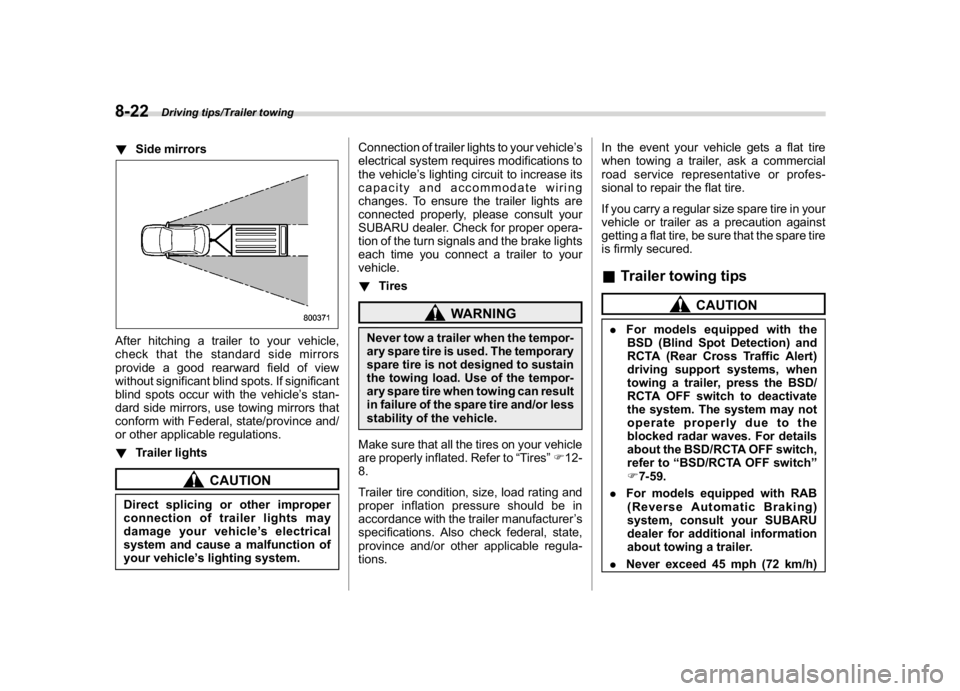
!Side mirrorsAfter hitching a trailer to your vehicle,
check that the standard side mirrors
provide a good rearward field of view
without significant blind spots. If significant
blind spots occur with the vehicle’s stan-
dard side mirrors, use towing mirrors that
conform with Federal, state/province and/
or other applicable regulations.
!Trailer lights
CAUTION
Direct splicing or other improper
connection of trailer lights may
damage your vehicle’s electrical
system and cause a malfunction of
your vehicle’s lighting system.Connection of trailer lights to your vehicle’s
electrical system requires modifications to
the vehicle’s lighting circuit to increase its
capacity and accommodate wiring
changes. To ensure the trailer lights are
connected properly, please consult your
SUBARU dealer. Check for proper opera-
tion of the turn signals and the brake lights
each time you connect a trailer to your
vehicle.
!Tires
WARNING
Never tow a trailer when the tempor-
ary spare tire is used. The temporary
spare tire is not designed to sustain
the towing load. Use of the tempor-
ary spare tire when towing can result
in failure of the spare tire and/or less
stability of the vehicle.
Make sure that all the tires on your vehicle
are properly inflated. Refer to“Tires”F12-
8.
Trailer tire condition, size, load rating and
proper inflation pressure should be in
accordance with the trailer manufacturer’s
specifications. Also check federal, state,
province and/or other applicable regula-
tions.In the event your vehicle gets a flat tire
when towing a trailer, ask a commercial
road service representative or profes-
sional to repair the flat tire.
If you carry a regular size spare tire in your
vehicle or trailer as a precaution against
getting a flat tire, be sure that the spare tire
is firmly secured.
&Trailer towing tips
CAUTION
.For models equipped with the
BSD (Blind Spot Detection) and
RCTA (Rear Cross Traffic Alert)
driving support systems, when
towing a trailer, press the BSD/
RCTA OFF switch to deactivate
the system. The system may not
operate properly due to the
blocked radar waves. For details
about the BSD/RCTA OFF switch,
refer to“BSD/RCTA OFF switch”
F7-59.
.For models equipped with RAB
(Reverse Automatic Braking)
system, consult your SUBARU
dealer for additional information
about towing a trailer.
.Never exceed 45 mph (72 km/h)
Driving tips/Trailer towing
8-22
Page 352 of 474

(363,1)
北米Model "A1320BE-C" EDITED: 2017/ 10/ 10
!Parking on a grade
Always block the wheels under both
vehicle and trailer when parking. Apply
the parking brake firmly. You should not
park on a hill or slope. If parking on a hill or
slope cannot be avoided, you should take
the following steps:
1. Apply the brakes and hold the pedal
down.
2. Have someone place wheel blocks
under both the vehicle and trailer wheels.
3. When the wheel blocks are in place,
release the regular brakes slowly until the
blocks absorb the load.
4. Apply the regular brakes and then
apply the parking brake; slowly release
the regular brakes.
5. Shift into 1st or reverse gear (MT
models) or“P”position (CVT models)
and shut off the engine.
Driving tips/Trailer towing
8-25
8
Page 354 of 474

(365,1)
北米Model "A1320BE-C" EDITED: 2017/ 10/ 10
If you park your vehicle in case of an
emergency............................................................9-2
Temporary sparetire..............................................9-2
Maintenance tools...................................................9-3
Tool locations........................................................ 9-4
Using the jack........................................................ 9-4
Flat tires...................................................................9-5
Changing a flat tire................................................ 9-5
Tire pressure monitoring system (TPMS)
(U.S.-spec. models).............................................. 9-8
Jump starting..........................................................9-9
How to jump start.................................................9-10
Engine overheating...............................................9-12
If steam is coming from the engine
compartment......................................................9-12If no steam is coming from the engine
compartment.....................................................9-12
Towing...................................................................9-13
Towing hooks and tie-down hooks/holes...............9-13
Using a flat-bed truck...........................................9-15
Towing with all wheels on the ground...................9-16
Access key fob–if access key fob does not
operate properly................................................9-17
Locking and unlocking.........................................9-17
Switching power status........................................9-17
Starting engine.....................................................9-18
Rear gate–if the rear gate cannot be opened .. 9-19
Moonroof (if equipped)–if the moonroof
does not close...................................................9-19
If your vehicle is involvedin an accident...........9-20
In case of emergency
9
Page 357 of 474
(368,1)
北米Model "A1320BE-C" EDITED: 2017/ 10/ 10
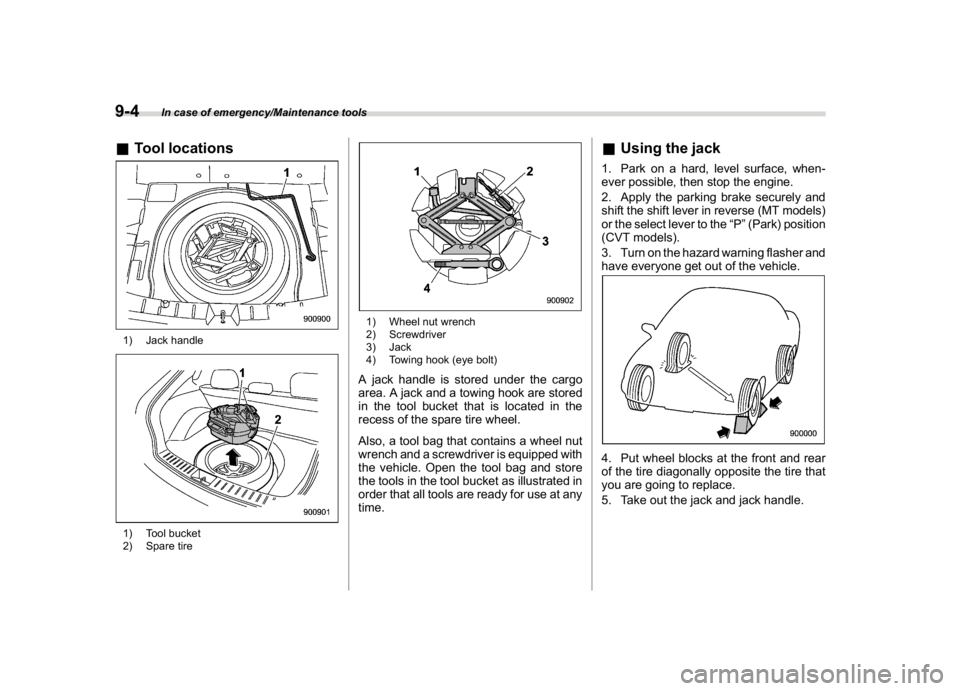
&Tool locations1) Jack handle1) Tool bucket
2) Spare tire
1) Wheel nut wrench
2) Screwdriver
3) Jack
4) Towing hook (eye bolt)A jack handle is stored under the cargo
area. A jack and a towing hook are stored
in the tool bucket that is located in the
recess of the spare tire wheel.
Also, a tool bag that contains a wheel nut
wrench and a screwdriver is equipped with
the vehicle. Open the tool bag and store
the tools in the tool bucket as illustrated in
order that all tools are ready for use at any
time.
&Using the jack1. Park on a hard, level surface, when-
ever possible, then stop the engine.
2. Apply the parking brake securely and
shift the shift lever in reverse (MT models)
or the select lever to the“P”(Park) position
(CVT models).
3. Turn on the hazard warning flasher and
have everyone get out of the vehicle.4. Put wheel blocks at the front and rear
of the tire diagonally opposite the tire that
you are going to replace.
5. Take out the jack and jack handle.
In case of emergency/Maintenance tools
9-4
Page 359 of 474
(370,1)
北米Model "A1320BE-C" EDITED: 2017/ 10/ 10
dent.
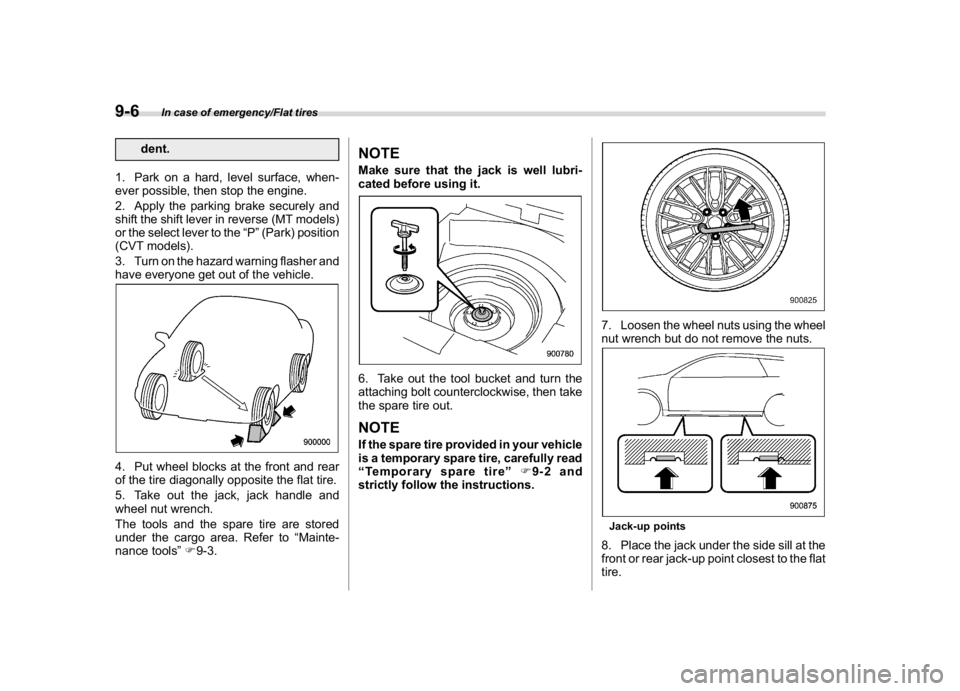
1. Park on a hard, level surface, when-
ever possible, then stop the engine.
2. Apply the parking brake securely and
shift the shift lever in reverse (MT models)
or the select lever to the“P”(Park) position
(CVT models).
3. Turn on the hazard warning flasher and
have everyone get out of the vehicle.
4. Put wheel blocks at the front and rear
of the tire diagonally opposite the flat tire.
5. Take out the jack, jack handle and
wheel nut wrench.
The tools and the spare tire are stored
under the cargo area. Refer to“Mainte-
nance tools”F9-3.
NOTEMake sure that the jack is well lubri-
cated before using it.6. Take out the tool bucket and turn the
attaching bolt counterclockwise, then take
the spare tire out.NOTEIf the spare tire provided in your vehicle
is a temporary spare tire, carefully read
“Temporary spare tire”F9-2 and
strictly follow the instructions.
7. Loosen the wheel nuts using the wheel
nut wrench but do not remove the nuts.Jack-up points8. Place the jack under the side sill at the
front or rear jack-up point closest to the flat
tire.
In case of emergency/Flat tires
9-6
Page 360 of 474
(371,1)
北米Model "A1320BE-C" EDITED: 2017/ 10/ 10
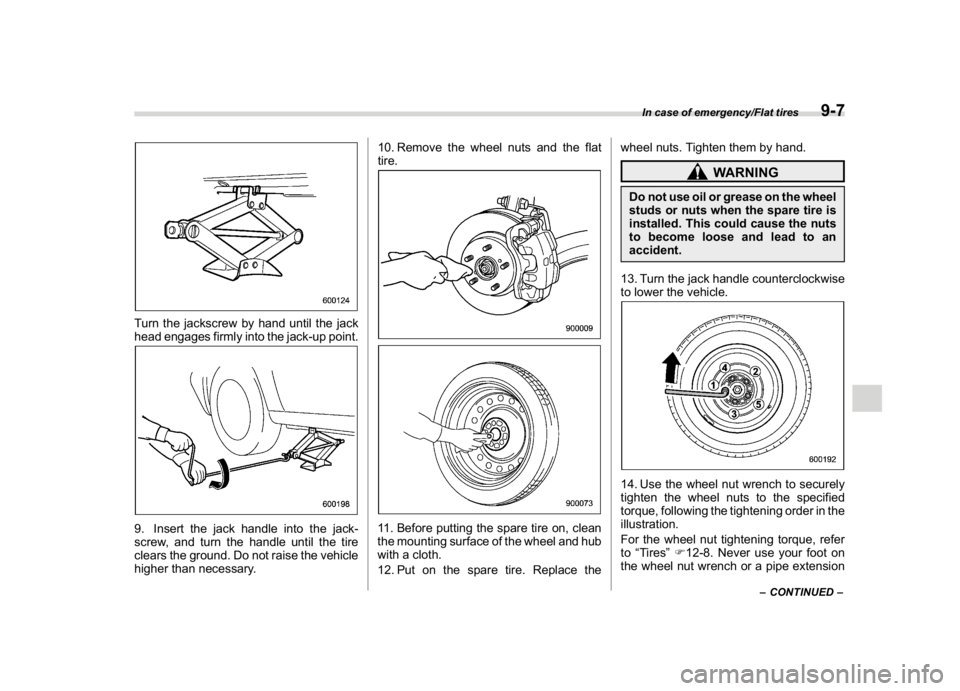
Turn the jackscrew by hand until the jack
head engages firmly into the jack-up point.9. Insert the jack handle into the jack-
screw, and turn the handle until the tire
clears the ground. Do not raise the vehicle
higher than necessary.10. Remove the wheel nuts and the flat
tire.
11. Before putting the spare tire on, clean
the mounting surface of the wheel and hub
with a cloth.
12. Put on the spare tire. Replace thewheel nuts. Tighten them by hand.
WARNING
Do not use oil or grease on the wheel
studs or nuts when the spare tire is
installed. This could cause the nuts
to become loose and lead to an
accident.
13. Turn the jack handle counterclockwise
to lower the vehicle.14. Use the wheel nut wrench to securely
tighten the wheel nuts to the specified
torque, following the tightening order in the
illustration.
For the wheel nut tightening torque, refer
to“Tires”F12-8. Never use your foot on
the wheel nut wrench or a pipe extension
–CONTINUED–
In case of emergency/Flat tires
9-7
9
Page 365 of 474
(376,1)
北米Model "A1320BE-C" EDITED: 2017/ 10/ 10
Engine overheating
WARNING
Never attempt to remove the radiator
cap until the engine has been shut
off and has fully cooled down. When
the engine is hot, the coolant is
under pressure. Removing the cap
while the engine is still hot could
release a spray of boiling hot cool-
ant, which could burn you very
seriously.
If the engine overheats, safely pull off the
road and stop the vehicle in a safe
location.&If steam is coming from the
engine compartment.Turn the ignition switch to the“LOCK”/
“OFF”position and get everyone away
from the vehicle until it cools down.
.Contact an authorized SUBARU deal-
er.&If no steam is coming from the
engine compartment1. Keep the engine running at idling
speed.2. Open the engine hood to ventilate the
engine compartment. Refer to“Engine
hood”F11-5.
Confirm that the cooling fan is turning. If
the fan is not turning, immediately turn off
the engine and contact an authorized
SUBARU dealer for repair.
3. After the coolant temperature high
warning light that has blinked or illumi-
nated inREDturns off, turn off the engine.
For details about the warning light, refer to
“Coolant temperature low indicator light/
Coolant temperature high warning light”
F3-16.
4. After the engine has fully cooled down,
check the coolant level in the reserve tank.
If the coolant level is below the“LOW”
mark, add coolant up to the“FULL”mark.
NOTEFor details about how to check the
coolant level or how to add coolant,
refer to“Engine coolant”F11-11.
5. If there is no coolant in the reserve
tank, add coolant to the reserve tank. Then
remove the radiator cap and fill the radiator
with coolant.
If you remove the radiator cap from a hot
radiator, first wrap a thick cloth around the
radiator cap, then turn the cap counter-
clockwise slowly without pressing downuntil it stops. Release the pressure from
the radiator. After the pressure has been
fully released, remove the cap by pressing
down and turning it.
In case of emergency/Engine overheating
9-12
Page 369 of 474
(380,1)
北米Model "A1320BE-C" EDITED: 2017/ 10/ 10
2. Pull up the parking brake lever firmly.
3. Secure the vehicle onto the carrier
properly with safety chains. Each safety
chain should be equally tightened and care
must be taken not to pull the chains so
tightly that the suspension bottoms out.
CAUTION
If your vehicle has a bumper under
guard (optional), be careful not to
scrape it when placing the vehicle
on the carrier and when removing
the vehicle from the carrier.
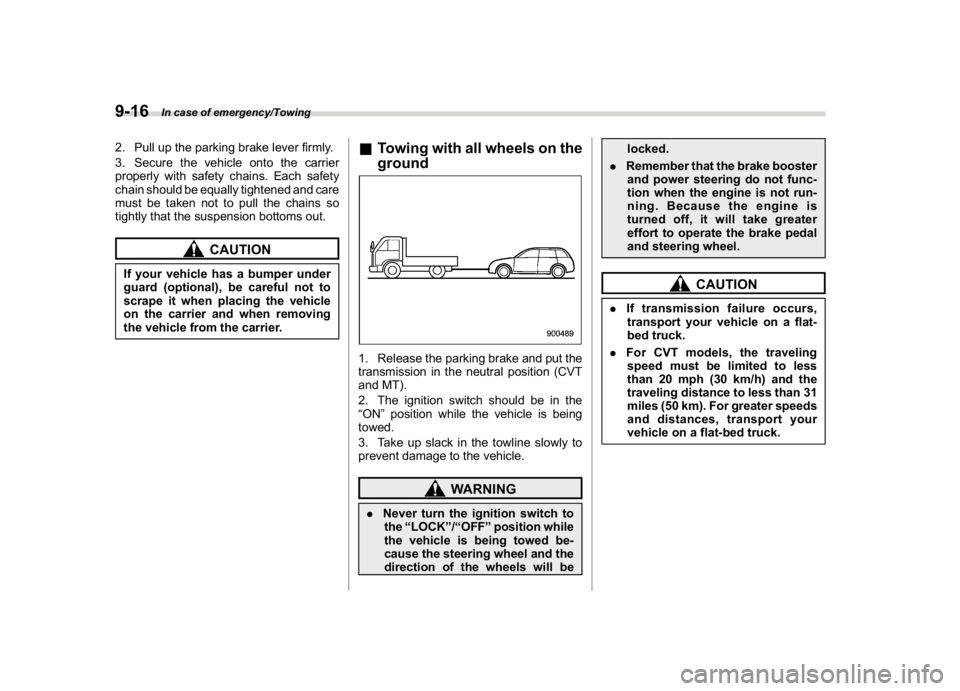
&Towing with all wheels on the
ground1. Release the parking brake and put the
transmission in the neutral position (CVT
and MT).
2. The ignition switch should be in the
“ON”position while the vehicle is being
towed.
3. Take up slack in the towline slowly to
prevent damage to the vehicle.
WARNING
.Never turn the ignition switch to
the“LOCK”/“OFF”position while
the vehicle is being towed be-
cause the steering wheel and the
direction of the wheels will belocked.
.Remember that the brake booster
and power steering do not func-
tion when the engine is not run-
ning. Because the engine is
turned off, it will take greater
effort to operate the brake pedal
and steering wheel.
CAUTION
.If transmission failure occurs,
transport your vehicle on a flat-
bed truck.
.For CVT models, the traveling
speed must be limited to less
than 20 mph (30 km/h) and the
traveling distance to less than 31
miles (50 km). For greater speeds
and distances, transport your
vehicle on a flat-bed truck.
In case of emergency/Towing
9-16