lock SUBARU CROSSTREK 2018 Owners Manual
[x] Cancel search | Manufacturer: SUBARU, Model Year: 2018, Model line: CROSSTREK, Model: SUBARU CROSSTREK 2018Pages: 474, PDF Size: 20.76 MB
Page 302 of 474
(311,1)
北米Model "A1320BE-C" EDITED: 2017/ 10/ 10
Hill start assist system
WARNING
.The Hill start assist system is a
device only for helping the driver
to START the vehicle on an uphill
grade. To prevent accidents
when the vehicle is parked on a
slope, be sure to firmly set the
parking brake. When setting the
parking brake, make sure that the
vehicle remains stationary when
the clutch pedal (MT models) and
brake pedal (both MT and CVT
models) are released.
.Do not turn the ignition switch to
the“LOCK”/“OFF”position while
the Hill start assist system is
operating. The Hill start assist
system will be deactivated and
may lead to an accident.
The Hill start assist system is a device to
make the following vehicle operations
easier.
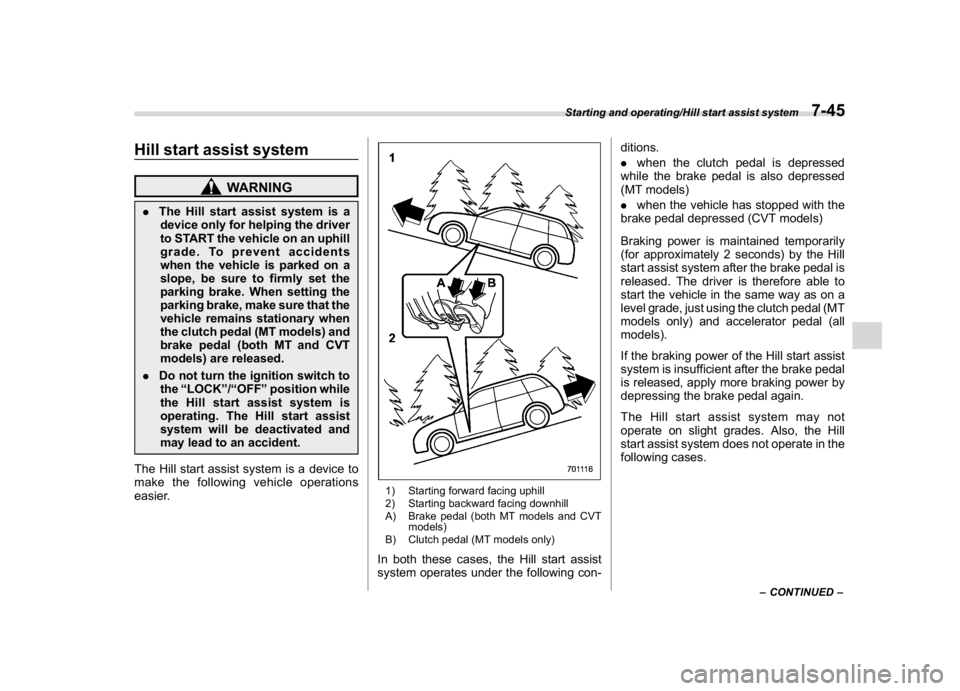
1) Starting forward facing uphill
2) Starting backward facing downhill
A) Brake pedal (both MT models and CVT
models)
B) Clutch pedal (MT models only)In both these cases, the Hill start assist
system operates under the following con-ditions.
.when the clutch pedal is depressed
while the brake pedal is also depressed
(MT models)
.when the vehicle has stopped with the
brake pedal depressed (CVT models)
Braking power is maintained temporarily
(for approximately 2 seconds) by the Hill
start assist system after the brake pedal is
released. The driver is therefore able to
start the vehicle in the same way as on a
level grade, just using the clutch pedal (MT
models only) and accelerator pedal (all
models).
If the braking power of the Hill start assist
system is insufficient after the brake pedal
is released, apply more braking power by
depressing the brake pedal again.
The Hill start assist system may not
operate on slight grades. Also, the Hill
start assist system does not operate in the
following cases.
–CONTINUED–
Starting and operating/Hill start assist system
7-45
7
Page 303 of 474
(312,1)
北米Model "A1320BE-C" EDITED: 2017/ 10/ 10
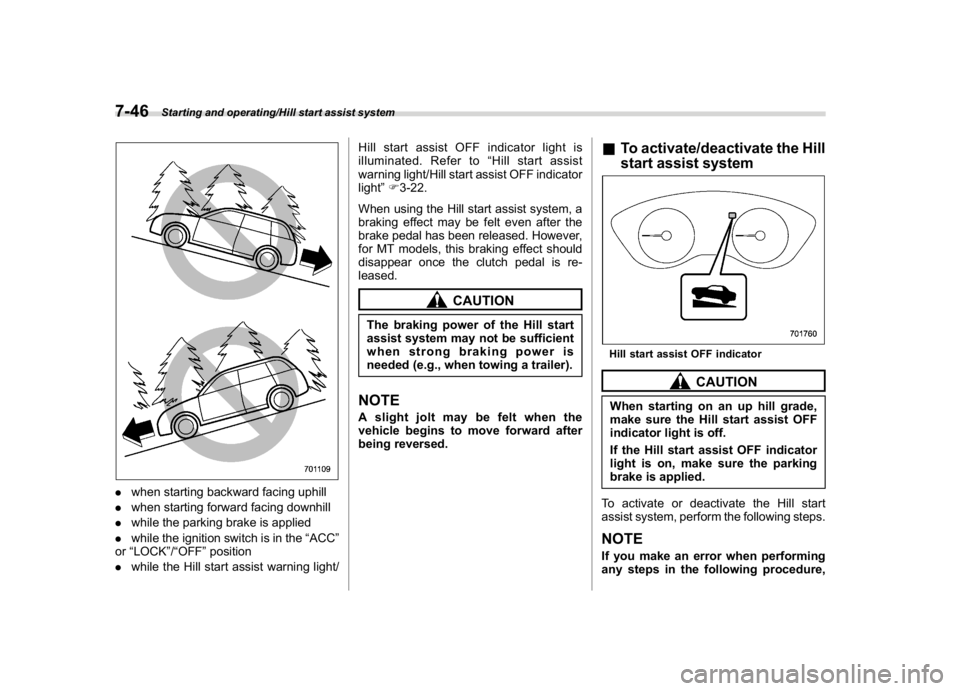
.when starting backward facing uphill
.when starting forward facing downhill
.while the parking brake is applied
.while the ignition switch is in the“ACC”
or“LOCK”/“OFF”position
.while the Hill start assist warning light/Hill start assist OFF indicator light is
illuminated. Refer to“Hill start assist
warning light/Hill start assist OFF indicator
light”F3-22.
When using the Hill start assist system, a
braking effect may be felt even after the
brake pedal has been released. However,
for MT models, this braking effect should
disappear once the clutch pedal is re-
leased.
CAUTION
The braking power of the Hill start
assist system may not be sufficient
when strong braking power is
needed (e.g., when towing a trailer).NOTEA slight jolt may be felt when the
vehicle begins to move forward after
being reversed.
&To activate/deactivate the Hill
start assist systemHill start assist OFF indicator
CAUTION
When starting on an up hill grade,
make sure the Hill start assist OFF
indicator light is off.
If the Hill start assist OFF indicator
light is on, make sure the parking
brake is applied.
To activate or deactivate the Hill start
assist system, perform the following steps.NOTEIf you make an error when performing
any steps in the following procedure,
Starting and operating/Hill start assist system
7-46
Page 304 of 474
(313,1)
北米Model "A1320BE-C" EDITED: 2017/ 10/ 10
place the ignition switch in the“LOCK”/
“OFF”position once and then start
over again.
!To deactivate
1. Park your vehicle in a flat and safe
location and apply the parking brake.
2. Turn the ignition switch to the“LOCK”/
“OFF”position.
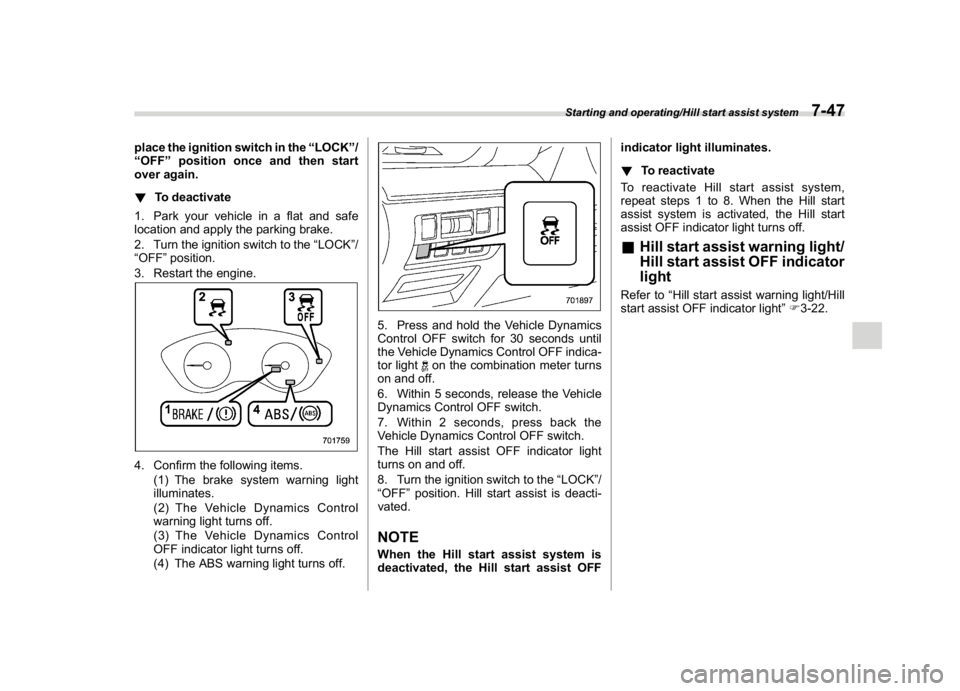
3. Restart the engine.4. Confirm the following items.
(1) The brake system warning light
illuminates.
(2) The Vehicle Dynamics Control
warning light turns off.
(3) The Vehicle Dynamics Control
OFF indicator light turns off.
(4) The ABS warning light turns off.
5. Press and hold the Vehicle Dynamics
Control OFF switch for 30 seconds until
the Vehicle Dynamics Control OFF indica-
tor light
on the combination meter turns
on and off.
6. Within 5 seconds, release the Vehicle
Dynamics Control OFF switch.
7. Within 2 seconds, press back the
Vehicle Dynamics Control OFF switch.
The Hill start assist OFF indicator light
turns on and off.
8. Turn the ignition switch to the“LOCK”/
“OFF”position. Hill start assist is deacti-
vated.
NOTEWhen the Hill start assist system is
deactivated, the Hill start assist OFFindicator light illuminates.
!To reactivate
To reactivate Hill start assist system,
repeat steps 1 to 8. When the Hill start
assist system is activated, the Hill start
assist OFF indicator light turns off.
&Hill start assist warning light/
Hill start assist OFF indicator
lightRefer to“Hill start assist warning light/Hill
start assist OFF indicator light”F3-22.
Starting and operating/Hill start assist system
7-47
7
Page 307 of 474
(316,1)
北米Model "A1320BE-C" EDITED: 2017/ 10/ 10
WARNING
For CVT models, you can cancel the
cruise control by shifting the select
lever into the“N”position. However,
do not shift the lever into the“N”
position while driving except in case
of emergency. If the select lever is
shifted into the“N”position, the
engine brake will no longer work.
This could result in an accident.
The cruise control set indicator light in the
combination meter turns off when the
cruise control is canceled.To resume the cruise control after it has
been temporarily canceled and with vehi-
cle speed of approximately 20 mph (30
km/h) or more, press the“RES/SET”switch to the“RES”side to return to the
original cruising speed automatically.
The cruise control set indicator light in the
combination meter will automatically illu-
minate at this time.
&To turn off the cruise controlThere are two ways to turn off the cruise
control:
.Press the cruise control main button
again.
.Turn the ignition switch to the“ACC”or
“LOCK”/“OFF”position (but only when the
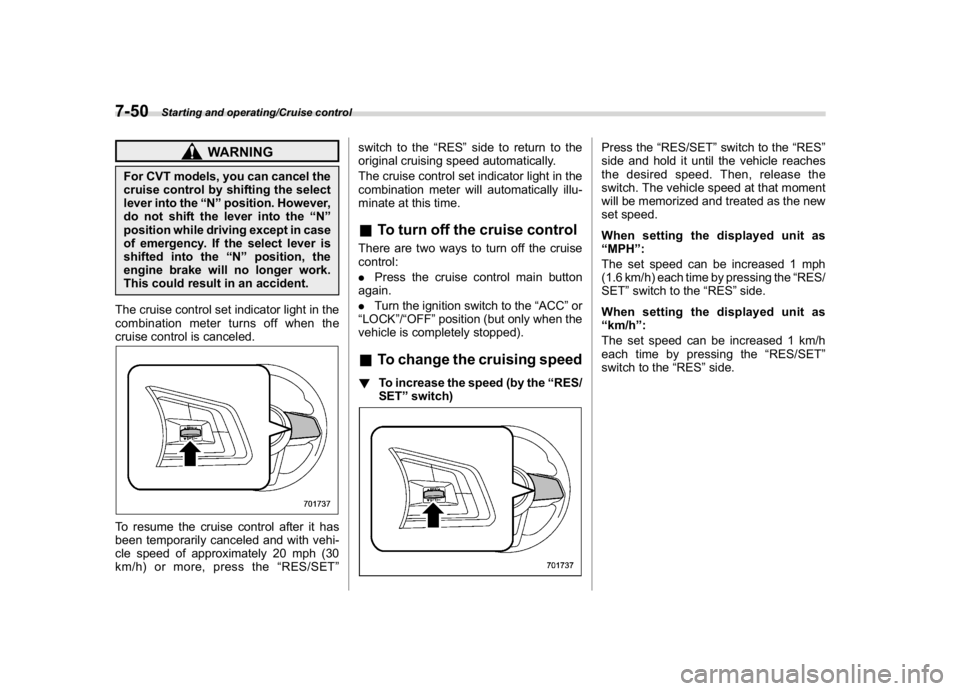
vehicle is completely stopped).&To change the cruising speed!To increase the speed (by the“RES/
SET”switch)
Press the“RES/SET”switch to the“RES”
side and hold it until the vehicle reaches
the desired speed. Then, release the
switch. The vehicle speed at that moment
will be memorized and treated as the new
set speed.
When setting the displayed unit as
“MPH”:
The set speed can be increased 1 mph
(1.6 km/h) each time by pressing the“RES/
SET”switch to the“RES”side.
When setting the displayed unit as
“km/h”:
The set speed can be increased 1 km/h
each time by pressing the“RES/SET”
switch to the“RES”side.
Starting and operating/Cruise control
7-50
Page 316 of 474
(325,1)
北米Model "A1320BE-C" EDITED: 2017/ 10/ 10
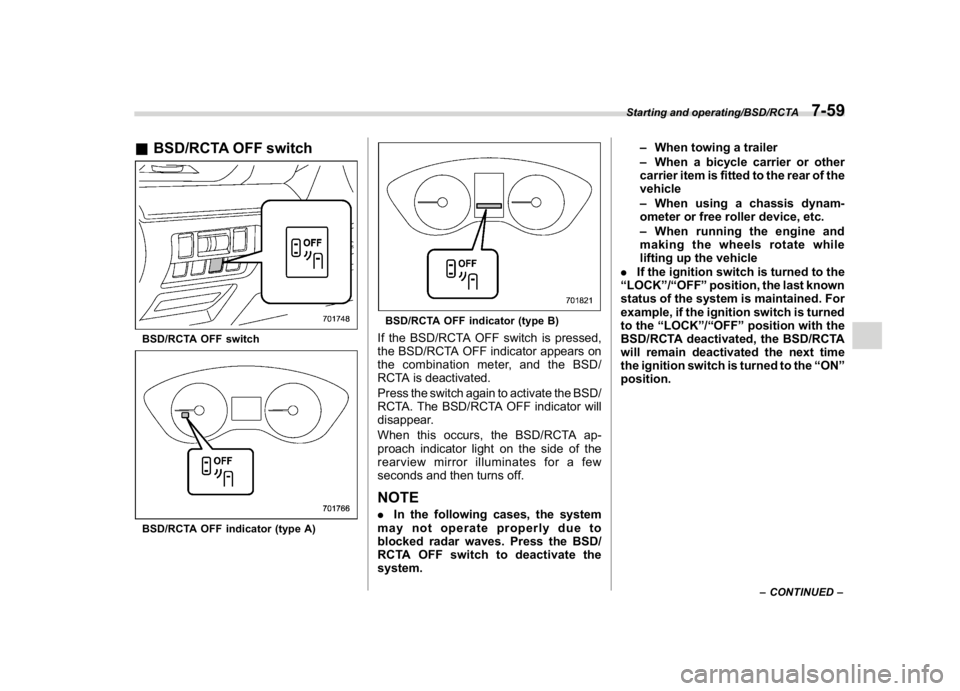
&BSD/RCTA OFF switchBSD/RCTA OFF switchBSD/RCTA OFF indicator (type A)
BSD/RCTA OFF indicator (type B)If the BSD/RCTA OFF switch is pressed,
the BSD/RCTA OFF indicator appears on
the combination meter, and the BSD/
RCTA is deactivated.
Press the switch again to activate the BSD/
RCTA. The BSD/RCTA OFF indicator will
disappear.
When this occurs, the BSD/RCTA ap-
proach indicator light on the side of the
rearview mirror illuminates for a few
seconds and then turns off.NOTE.In the following cases, the system
may not operate properly due to
blocked radar waves. Press the BSD/
RCTA OFF switch to deactivate the
system.–When towing a trailer
–When a bicycle carrier or other
carrier item is fitted to the rear of the
vehicle
–When using a chassis dynam-
ometer or free roller device, etc.
–When running the engine and
making the wheels rotate while
lifting up the vehicle
.If the ignition switch is turned to the
“LOCK”/“OFF”position, the last known
status of the system is maintained. For
example, if the ignition switch is turned
to the“LOCK”/“OFF”position with the
BSD/RCTA deactivated, the BSD/RCTA
will remain deactivated the next time
the ignition switch is turned to the“ON”
position.
–CONTINUED–
Starting and operating/BSD/RCTA
7-59
7
Page 320 of 474

(329,1)
北米Model "A1320BE-C" EDITED: 2017/ 10/ 10
tem is set to on
.The select lever is in the“R”position
.The vehicle speed is between 1 to 9
mph (1.5 to 15 km/h)NOTE.In the following cases, the Reverse
Automatic braking system will not
operate. Promptly contact a SUBARU
dealer to have the system inspected.
–The EyeSight warning indicator
is illuminated
–The Reverse Automatic Braking
fail indicator is illuminated
.When the Reverse Automatic Brak-
ing system OFF indicator is illumi-
nated, the Reverse Automatic braking
system cannot be operated.
.In the following cases, the system
may not be able to properly detect an
obstacle. Promptly contact a SUBARU
dealer to have the system inspected.
–A sticker, paint, or a chemical is
applied to the rear bumper near the
sonar sensor
–The rear bumper is modified
–The rear bumper has been re-
moved and reattached
–The ground clearance is changed
due to the vehicle’s loading condi-
tion or modification
–Ice, snow or mud is adhered tothe rear bumper near the sonar
sensor
–The rear bumper is exposed to
strong impact, or the rear bumper is
deformed
.When the 8-inch audio/navigation
system is performing a software up-
date, the Reverse Automatic Braking
System may not display the following
items on the audio/navigation screen
until the update is complete.
–Display Icon on/off Function
–Distance Indicator Image
–Warning Message
.On a steep hill, the system’s auto-
matic braking ability will be reduced.
.The system is designed to avoid
collisions by automatic hard braking
when the vehicle’s reversing speed is
less than approximately 3 mph (5 km/h).
However, the system does not guaran-
tee that the vehicle will be able to avoid
collisions in any situation.
.If the vehicle is reversed at an
extremely slow speed, the driver’s
operation may be prioritized. In this
case, automatic braking will not oper-
ate.
.The system may not be able to detect
the following objects
–Sharp or thin objects such as
poles, fences and ropes which maynot reflect the sound wave emitted
from the sonar sensor
–Objects that are too close to the
rear bumper when the select lever is
set to the“R”position
–Objects with a surface which may
not reflect the sound wave emitted
from the sonar sensor such as a
chain link fence.
.Objects the system is not designed
to detect
–Pedestrians
–Moving objects including moving
vehicles
–Objects which absorb sound
waves such as cloth or snow
–Objects whose surface has a
diagonal angle
–Objects that are low to the ground
such as parking blocks
–Objects that are high above the
ground such as objects hanging
from above
.The system may not be able to
properly detect objects or may cause
a system malfunction when the follow-
ing conditions exist
High frequency sound from other
sources are nearby
–Horn sound from another vehicle
–Engine sound from other vehi-
–CONTINUED–
Starting and operating/Reverse Automatic Braking System
7-63
7
Page 325 of 474
(334,1)
北米Model "A1320BE-C" EDITED: 2017/ 10/ 10
&Reverse Automatic Braking
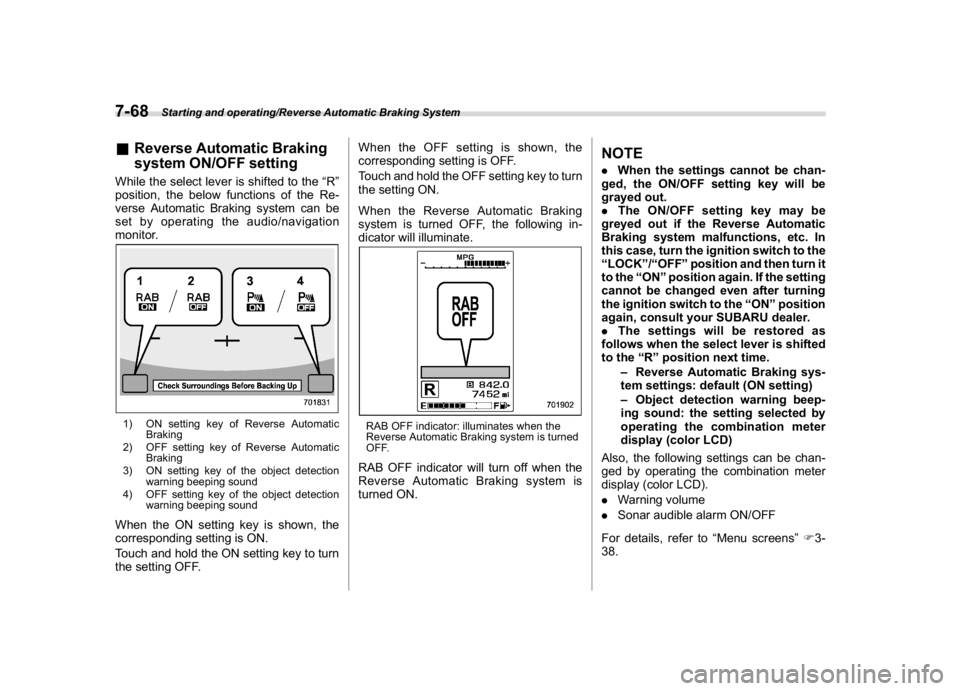
system ON/OFF settingWhile the select lever is shifted to the“R”
position, the below functions of the Re-
verse Automatic Braking system can be
set by operating the audio/navigation
monitor.1) ON setting key of Reverse Automatic
Braking
2) OFF setting key of Reverse Automatic
Braking
3) ON setting key of the object detection
warning beeping sound
4) OFF setting key of the object detection
warning beeping soundWhen the ON setting key is shown, the
corresponding setting is ON.
Touch and hold the ON setting key to turn
the setting OFF.When the OFF setting is shown, the
corresponding setting is OFF.
Touch and hold the OFF setting key to turn
the setting ON.
When the Reverse Automatic Braking
system is turned OFF, the following in-
dicator will illuminate.
RAB OFF indicator: illuminates when the
Reverse Automatic Braking system is turned
OFF.RAB OFF indicator will turn off when the
Reverse Automatic Braking system is
turned ON.
NOTE.When the settings cannot be chan-
ged, the ON/OFF setting key will be
grayed out.
.The ON/OFF setting key may be
greyed out if the Reverse Automatic
Braking system malfunctions, etc. In
this case, turn the ignition switch to the
“LOCK”/“OFF”position and then turn it
to the“ON”position again. If the setting
cannot be changed even after turning
the ignition switch to the“ON”position
again, consult your SUBARU dealer.
.The settings will be restored as
follows when the select lever is shifted
to the“R”position next time.
–Reverse Automatic Braking sys-
tem settings: default (ON setting)
–Object detection warning beep-
ing sound: the setting selected by
operating the combination meter
display (color LCD)
Also, the following settings can be chan-
ged by operating the combination meter
display (color LCD).
.Warning volume
.Sonar audible alarm ON/OFF
For details, refer to“Menu screens”F3-
38.
Starting and operating/Reverse Automatic Braking System
7-68
Page 333 of 474
(344,1)
北米Model "A1320BE-C" EDITED: 2017/ 10/ 10
Off road driving
WARNING
.Always maintain a safe driving
speed according to the road and
weather conditions in order to
avoid having an accident on a
sharp turn, during sudden brak-
ing or under other similar condi-
tions.
.Always use the utmost care in
driving–overconfidence be-
cause you are driving an All-
Wheel Drive model could easily
lead to a serious accident.
CAUTION
Frequent driving of an AWD model
under hard-driving conditions such
as rough roads or off roads will
necessitate more frequent replace-
ment of the following items than that
specified in the maintenance sche-
dule described in the“Warranty and
Maintenance Booklet”.
.Engine oil
.Brake fluid
Remember that damage done toyour SUBARU while operating it off-
road and not using common sense
precautions such as those listed
here is not eligible for warranty
coverage.
Because of the AWD feature and higher
ground clearance, you can drive your
SUBARU on ordinary roads or off-road.
But please keep in mind that an AWD
SUBARU is a passenger car and is neither
a conventional off-road vehicle nor an all-
terrain vehicle. If you do take your
SUBARU off-road, certain common sense
precautions such as those in the following
list should be taken.
&Before driving.Make certain that you and all of your
passengers are wearing seatbelts.
.Carry some emergency equipment,
such as a towing rope or chain, a shovel,
wheel blocks, first aid kit and cell phone or
citizens band radio.
.Secure all cargo carried inside the
vehicle and make certain that it is not piled
higher than the seatbacks. During sudden
stops or jolts, unsecured cargo could be
thrown around in the vehicle and cause
injury. Do not pile heavy loads on the roof.
Those loads raise the vehicle’s center of
gravity and make it more prone to tip over..Never equip your vehicle with tires
larger than those specified in this manual.
&During drivingGeneral precautions:
.Drive carefully. Do not take unneces-
sary risks by driving in dangerous areas or
over rough terrain.
.Slow down and employ extra caution at
all times. When driving off-road, you will
not have the benefit of marked traffic
lanes, banked curves, traffic signs and
the like.
.Do not drive across steep slopes.
Instead, drive either straight up or straight
down the slopes. A vehicle can much more
easily tip over sideways than it can end
over end. Avoid driving straight up or down
slopes that are too steep.
.Avoid sharp turning maneuvers, espe-
cially at higher speeds.
.Do not grip the inside or spokes of the
steering wheel. A bad bump could jerk the
wheel and injure your hands. Instead,
drive with your fingers and thumbs on the
outside of the rim.
.Do not drive or park over or near
flammable materials such as dry grass or
fallen leaves, as they may burn easily. The
exhaust system is very hot while the
engine is running and right after the engine
Driving tips/Off road driving
8-6
Page 334 of 474

(345,1)
北米Model "A1320BE-C" EDITED: 2017/ 10/ 10
stops. This could create a fire hazard.
Precautions when driving under espe-
cially dangerous situations:
.If driving through water, such as when
crossing shallow streams, first check the
depth of the water and the bottom of the
stream bed for firmness and ensure that
the bed of the stream is flat. Drive slowly
and cross the stream without stopping.
The water should be shallow enough that it
does not reach the vehicle’s undercar-
riage. Water entering the engine air intake
or the exhaust pipe or water splashing onto
electrical parts may damage your vehicle
and may cause it to stall. Never attempt to
drive through rushing water; regardless of
its depth, it can wash away the ground
from under your tires, resulting in possible
loss of traction and even vehicle rollover.
.If you must rock the vehicle to free it
from sand or mud, depress the accelerator
pedal slightly and move the shift lever/
select lever back and forth between“1”/“D”
and“R”repeatedly. Do not race the
engine. For the best possible traction,
avoid spinning the wheels when trying to
free the vehicle.
.When the road surface is extremely
slippery, you can obtain better traction by
starting the vehicle with the transmission in
2nd than 1st (both for MT and CVT). For
CVT models, refer to“Selection of manualmode”F7-26.
&After driving.Always check your brakes for effective-
ness immediately after driving in sand,
mud or water. Do this by driving slowly and
stepping on the brake pedal. Repeat that
process several times to dry out the brake
discs and brake pads.
.After driving through tall grass, mud,
rocks, sand, rivers, etc., check that there is
no grass, bush, paper, rags, stones, sand,
etc. adhering to or trapped on the under-
body. Clear off any such matter from the
underbody. If the vehicle is used with these
materials trapped or adhering to the
underbody, a mechanical breakdown or
fire could occur.
.Wash the vehicle’s underbody after off-
road driving. Suspension components are
particularly prone to dirt buildup, so they
need to be washed thoroughly.
Winter driving&Operation during cold weath-
er!Maintenance
Carry some emergency equipment, such
as a window scraper, a bag of sand, flares,
a small shovel and jumper cables.
Check the battery and cables. Cold tem-
peratures reduce battery capacity. The
battery must be in good condition to
provide enough power for cold winter
starts.
It normally takes longer to start the engine
in very cold weather conditions. Use an
engine oil of a proper grade and viscosity
for cold weather. Using heavy summer oil
will make it harder to start the engine.
Keep the door locks from freezing by
squirting them with deicer or glycerin.
Forcing a frozen door open may damage
or separate the rubber weather strips
around the door. If the door is frozen, use
hot water to melt the ice, and afterwards
thoroughly wipe the water away.
Use a windshield washer fluid that con-
tains an antifreeze solution. Do not use
engine antifreeze or other substitutes
because they may damage the paint of
–CONTINUED–
Driving tips/Winter driving
8-7
8
Page 335 of 474
(346,1)
北米Model "A1320BE-C" EDITED: 2017/ 10/ 10
the vehicle.
SUBARU Windshield Washer Fluid con-
tains 58.5% methyl alcohol and 41.5%
surfactant, by volume. Its freezing tem-
perature varies according to how much it is
diluted, as indicated in the following table.Washer Fluid Con-
centrationFreezing Temperature
30% 10.48F(128C)
50%48F(208C)
100%498F(458C)In order to prevent freezing of washer fluid,
check the freezing temperatures in the
table above when adjusting the fluid
concentration to the outside temperature.
If you fill the reservoir tank with a fluid with
a different concentration from the one
used previously, purge the old fluid from
the piping between the reservoir tank and
washer nozzles by operating the washer
for a certain period of time. Otherwise, if
the concentration of the fluid remaining in
the piping is too low for the outside
temperature, it may freeze and block the
nozzles.
CAUTION
.Adjust the washer fluid concen-
tration appropriately for the out-
side temperature. If the concen-
tration is inappropriate, sprayed
washer fluid may freeze on the
windshield and obstruct your
view, and the fluid may freeze in
the reservoir tank.
.State or local regulations on
volatile organic compounds may
restrict the use of methanol, a
common windshield washer anti-
freeze additive. Washer fluids
containing non-methanol anti-
freeze agents should be used
only if they provide cold weather
protection without damaging
your vehicle’s paint, wiper blades
or washer system.
!Before driving your vehicle
Before entering the vehicle, remove any
snow or ice from your shoes because that
could make the pedals slippery and driving
dangerous.
While warming up the vehicle before
driving, check that the accelerator pedal,
brake pedal, and all other controls operate
smoothly.Clear away ice and snow that has accu-
mulated under the fenders to avoid making
steering difficult. During severe winter
driving, stop when and where it is safe to
do so and check under the fenders
periodically.
!Parking in cold weather
WARNING
Snow can trap dangerous exhaust
gases under your vehicle. Keep
snow clear of the exhaust pipe and
from around your vehicle if you park
the vehicle in snow with the engine
running.
CAUTION
.Do not use the parking brake
when parking for long periods in
cold weather since it could freeze
in that position.
.When the vehicle is parked in
snow or when it snows, raise the
wiper blades off the glass to
prevent damage to them.
.When the vehicle has been left
parked after use on roads heavily
covered with snow, or has been
left parked during a snowstorm,
Driving tips/Winter driving
8-8