trailer SUBARU CROSSTREK 2018 Owner's Manual
[x] Cancel search | Manufacturer: SUBARU, Model Year: 2018, Model line: CROSSTREK, Model: SUBARU CROSSTREK 2018Pages: 474, PDF Size: 20.76 MB
Page 350 of 474

(361,1)
北米Model "A1320BE-C" EDITED: 2017/ 10/ 10
when towing a trailer in hilly
country on hot days.
.When towing a trailer, steering,
stability, stopping distance and
braking performance will be dif-
ferent when compared to normal
operation. For safety’s sake, you
should employ extra caution
when towing a trailer and you
should never drive at excessive
speeds. You should also keep the
following tips in mind:
.The braking power of the parking
brake may not be sufficient when
stronger braking power is
needed (e.g., when parking on a
steep slope while towing a trai-
ler).
!Before starting out on a trip
.Check the towing regulations for trailer
or caravan vehicles that vary by state/
region. Failure to comply with the proce-
dures set forth will not only compromise
your safety, but will also negate your
insurance coverage and/or may violate
the state road and traffic acts and regula-
tions.
.Check that the vehicle and vehicle-to-
hitch mounting are in good condition. If any
problems are apparent, do not tow thetrailer.
.Check that the vehicle rests horizon-
tally with the trailer attached. If the vehicle
is tipped sharply up at the front and down
at the rear, check the total trailer weight,
GVW, GAWs and tongue load again, then
confirm that the load and its distribution are
acceptable.
.Check that the tire rating and pressures
are correct.
.Check that the vehicle and trailer are
connected properly. Confirm that:
–the trailer tongue is connected
properly to the hitch ball.
–the trailer lights connector is con-
nected properly and trailer’sbrake
lights illuminate when the vehicle’s
brake pedal is pressed, and that the
trailer’s turn signal lights flash when
the vehicle’s turn signal lever is oper-
ated.
–the safety chains are connected
properly.
–all cargo in the trailer is secured
safely in position.
–the side mirrors provide a good
rearward field of view without a sig-
nificant blind spot.
.Sufficient time should be taken to learn
the“feel”of the vehicle/trailer combination
before starting out on a trip. In an area free
of traffic, practice turning, stopping andbacking up.
!Driving with a trailer
.You should allow for considerably more
stopping distance when towing a trailer.
Avoid sudden braking because it may
result in skidding or jackknifing and loss
of control.
.Avoid abrupt starts and sudden accel-
erations. If your vehicle has a manual
transmission, always start out in first gear
and release the clutch at moderate engine
revolution.
.Avoid uneven steering, sharp turns and
rapid lane changes.
.Slow down before turning. Make a
longer than normal turning radius because
the trailer wheels will be closer than the
vehicle wheels to the inside of the turn. In a
tight turn, the trailer could hit your vehicle.
.Crosswinds will adversely affect the
handling of your vehicle and trailer, caus-
ingsway.Crosswindscanbedueto
weather conditions or the passing of large
trucks or buses. If swaying occurs, firmly
grip the steering wheel and promptly begin
decelerating your vehicle at a gradual
pace.
.When passing other vehicles, consider-
able distance is required because of the
added weight and length caused by
attaching the trailer to your vehicle.
–CONTINUED–
Driving tips/Trailer towing
8-23
8
Page 351 of 474

(362,1)
北米Model "A1320BE-C" EDITED: 2017/ 10/ 10
.Reversing the vehicle with a trailer can
be difficult and requires experience. Never
accelerate or steer rapidly, and grip the
bottom of the steering wheel with one
hand.To reverse around a corner, perform thefollowing procedure.
1. Reverse slowly and steer in the oppo-
site direction to the way you want to turn.
2. Once the trailer begins to swing
around, straighten the steering wheel.
3. Turn the wheel in the opposite direc-
tion.
4. Steer the vehicle around to be in line
with the trailer, then straighten the steering
again.
.If the ABS warning light illuminates
while the vehicle is in motion, stop towing
the trailer and have repairs performed
immediately by your nearest SUBARU
dealer.
!Driving on grades
.Before going down a steep hill, slow
down and shift into lower gear (if neces-
sary, use 1st gear) in order to utilize the
engine braking effect and prevent over-
heating of your vehicle’s brakes. Do not
make sudden downshifts.
.When driving uphill in hot weather, the
air conditioner may turn off automatically
to protect the engine from overheating.
.When driving uphill in hot weather, pay
attention to the following indicators be-
cause the engine and transmission are
relatively prone to overheating.
: Coolant temperature high warning light
: AT OIL TEMP warning light
(CVT models)
If the coolant temperature high warning
light and/or the AT OIL TEMP warning light
illuminates, immediately turn off the air
conditioner and stop the vehicle in the
nearest safe location. For further instruc-
tions and additional information, refer to
the following sections.
–“If you park your vehicle in case of
an emergency”F9-2
–“Engine overheating”F9-12
–“Coolant temperature low indicator
light/Coolant temperature high warn-
ing light”F3-16
–“AT OIL TEMP warning light (CVT
models)”F3-18
.For CVT models, avoid using the
accelerator pedal to stay stationary on an
uphill slope instead of using the parking
brake or foot brake. That may cause the
transmission fluid to overheat.
Driving tips/Trailer towing
8-24
Page 352 of 474

(363,1)
北米Model "A1320BE-C" EDITED: 2017/ 10/ 10
!Parking on a grade
Always block the wheels under both
vehicle and trailer when parking. Apply
the parking brake firmly. You should not
park on a hill or slope. If parking on a hill or
slope cannot be avoided, you should take
the following steps:
1. Apply the brakes and hold the pedal
down.
2. Have someone place wheel blocks
under both the vehicle and trailer wheels.
3. When the wheel blocks are in place,
release the regular brakes slowly until the
blocks absorb the load.
4. Apply the regular brakes and then
apply the parking brake; slowly release
the regular brakes.
5. Shift into 1st or reverse gear (MT
models) or“P”position (CVT models)
and shut off the engine.
Driving tips/Trailer towing
8-25
8
Page 355 of 474
(366,1)
北米Model "A1320BE-C" EDITED: 2017/ 10/ 10
If you park your vehicle in
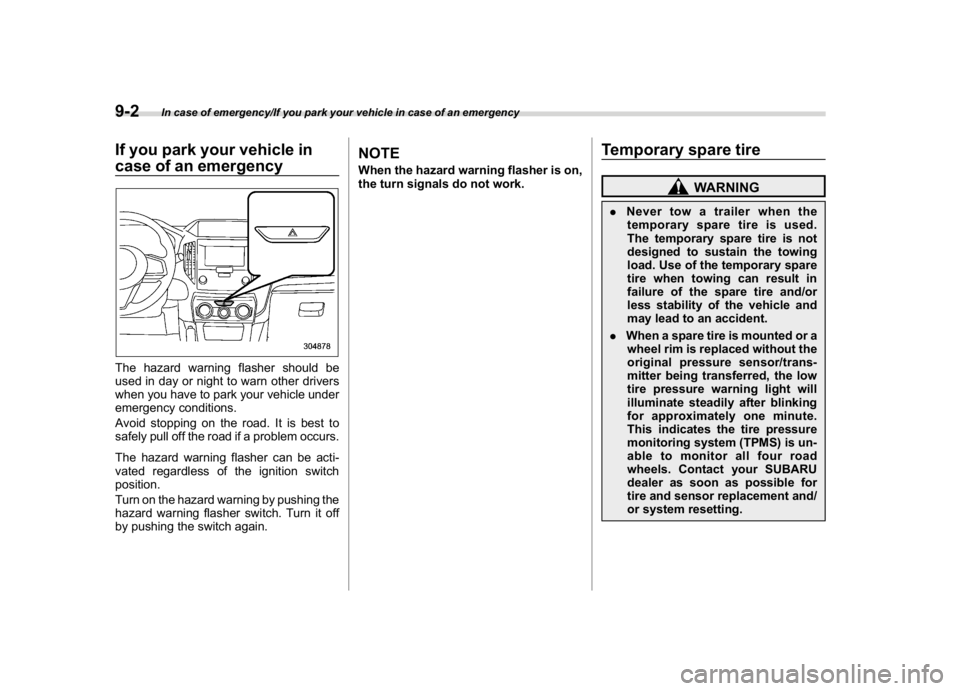
case of an emergencyThe hazard warning flasher should be
used in day or night to warn other drivers
when you have to park your vehicle under
emergency conditions.
Avoid stopping on the road. It is best to
safely pull off the road if a problem occurs.
The hazard warning flasher can be acti-
vated regardless of the ignition switch
position.
Turn on the hazard warning by pushing the
hazard warning flasher switch. Turn it off
by pushing the switch again.
NOTEWhen the hazard warning flasher is on,
the turn signals do not work.
Temporary spare tire
WARNING
.Never tow a trailer when the
temporary spare tire is used.
The temporary spare tire is not
designed to sustain the towing
load. Use of the temporary spare
tire when towing can result in
failure of the spare tire and/or
less stability of the vehicle and
may lead to an accident.
.When a spare tire is mounted or a
wheel rim is replaced without the
original pressure sensor/trans-
mitter being transferred, the low
tire pressure warning light will
illuminate steadily after blinking
for approximately one minute.
This indicates the tire pressure
monitoring system (TPMS) is un-
able to monitor all four road
wheels. Contact your SUBARU
dealer as soon as possible for
tire and sensor replacement and/
or system resetting.
In case of emergency/If you park your vehicle in case of an emergency
9-2
Page 389 of 474
(402,1)
北米Model "A1320BE-C" EDITED: 2017/ 10/ 10
Engine oil
CAUTION
.If the level gauge cannot be
pulled out easily, twist the level
gauge right and left, then gently
pull it out. Otherwise, you may be
injured accidentally straining
yourself.
.Use only engine oil with the
recommended grade and vis-
cosity.
.Be careful not to spill engine oil
when adding it. If oil touches the
exhaust pipe, it may cause a bad
smell, smoke, and/or a fire. If
engine oil gets on the exhaust
pipe, be sure to wipe it off.&Engine oil consumptionSome engine oil will be consumed while
driving. The rate of consumption can be
affected by such factors as transmission
type, driving style, terrain and tempera-
ture. Under the following conditions, oil
consumption can be increased and thus
require refilling between maintenance in-
tervals:
.When the engine is new and within thebreak-in period
.When the engine oil is of lower quality
.When the incorrect oil viscosity is used
.When engine braking is employed
(repeatedly)
.When the engine is operated at high
engine speeds (for extended periods of
time)
.When the engine is operated under
heavy loads (for extended periods of time)
.When towing a trailer
.When the engine idles for extended
periods of time
.When the vehicle is operated in stop
and go and/or heavy traffic situations
.When the vehicle is used under severe
thermal conditions
.When the vehicle accelerates and
decelerates frequently
Under these or similar conditions, you
should check your oil at least every 2nd
fuel fill-up and change your engine oil more
frequently. Different drivers in the same
car may experience different results. If
your oil consumption rate is greater than
expected, contact your authorized
SUBARU retailer who may perform a test
under controlled conditions.
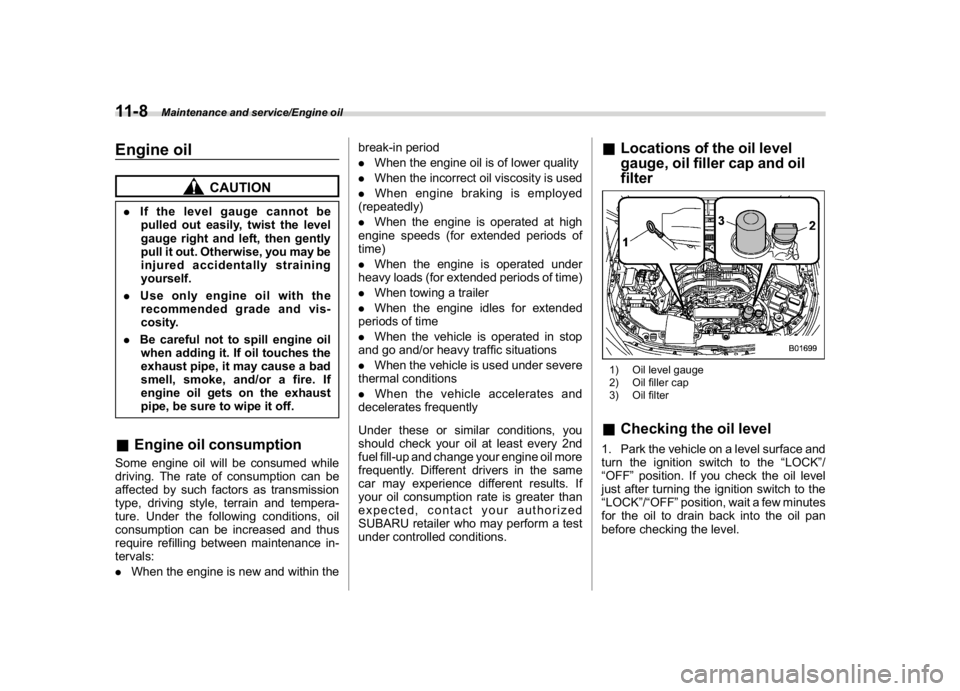
&Locations of the oil level
gauge, oil filler cap and oil
filter1) Oil level gauge
2) Oil filler cap
3) Oil filter&Checking the oil level1. Park the vehicle on a level surface and
turn the ignition switch to the“LOCK”/
“OFF”position. If you check the oil level
just after turning the ignition switch to the
“LOCK”/“OFF”position, wait a few minutes
for the oil to drain back into the oil pan
before checking the level.
Maintenance and service/Engine oil
11-8
Page 454 of 474

(471,1)
北米Model "A1320BE-C" EDITED: 2017/ 10/ 10
loads could increase the risk of
rollover..
Stopping distance will increase.
.
Brakes could overheat and fail.
.
Suspension, bearings, axles and
other body parts could break or
experience accelerated wear that
will shorten vehicle life.
.
Tires could fail.
.
Tread separation could occur.
.
Tire could separate from its rim.
&Steps for Determining Cor-
rect Load Limit1.
Locate the statement“The com-
bined weight of occupants and
cargo should never exceed XXX
kg or XXX lbs.”on your vehicle’s
placard.
2.
Determine the combined weight
of the driver and passengers that
will be riding in your vehicle.
3.
Subtract the combined weight of
the driver and passengers from
XXX kg or XXX lbs.
4.
The resulting figure equals the
available amount of cargo andluggage load capacity. For exam-
ple, if the“XXX”amount equals
1400 lbs. and there will be five 150
lb passengers in your vehicle, the
amount of available cargo and
luggage load capacity is 650 lbs.
(1400750 (56150) = 650 lbs.)
5.
Determine the combined weight
of luggage and cargo being loaded
on the vehicle. That weight may not
safely exceed the available cargo
and luggage load capacity calcu-
lated in Step 4.
6.
If your vehicle will be towing a
trailer, load from your trailer will be
transferred to your vehicle. Consult
this manual to determine how this
reduces the available cargo and
luggage load capacity of your ve-
hicle.
Vehicle load limit–how to
determineThe load capacity of your vehicle is
determined by weight, not by avail-
able cargo space. The load limit of
your vehicle is shown on the vehicle
placard attached to the driver’s side
door pillar. Locate the statement
“The combined weight of occupants
and cargo should never exceed
XXX kg or XXX lbs”on your
vehicle’s placard.
The vehicle placard also shows
seating capacity of your vehicle.
The total load capacity includes the
total weight of driver and all pas-
sengers and their belongings, any
cargo, any optional equipment such
as a trailer hitch, roof rack or bike
carrier, etc., and the tongue load of
a trailer. Therefore cargo capacity
can be calculated by the following
method.
Cargo capacity = Load limit(total
weight of occupants + total weight
–CONTINUED–
Consumer information and Reporting safety defects/Vehicle load limit–how to determine
13-11
13
Page 455 of 474
(472,1)
北米Model "A1320BE-C" EDITED: 2017/ 10/ 10
of optional equipment + tongue load
of a trailer (if applicable))
For information about vehicle load-
ing, refer to“
Loading your vehicle”
F8-11.
&Calculating total and load
capacities varying seating
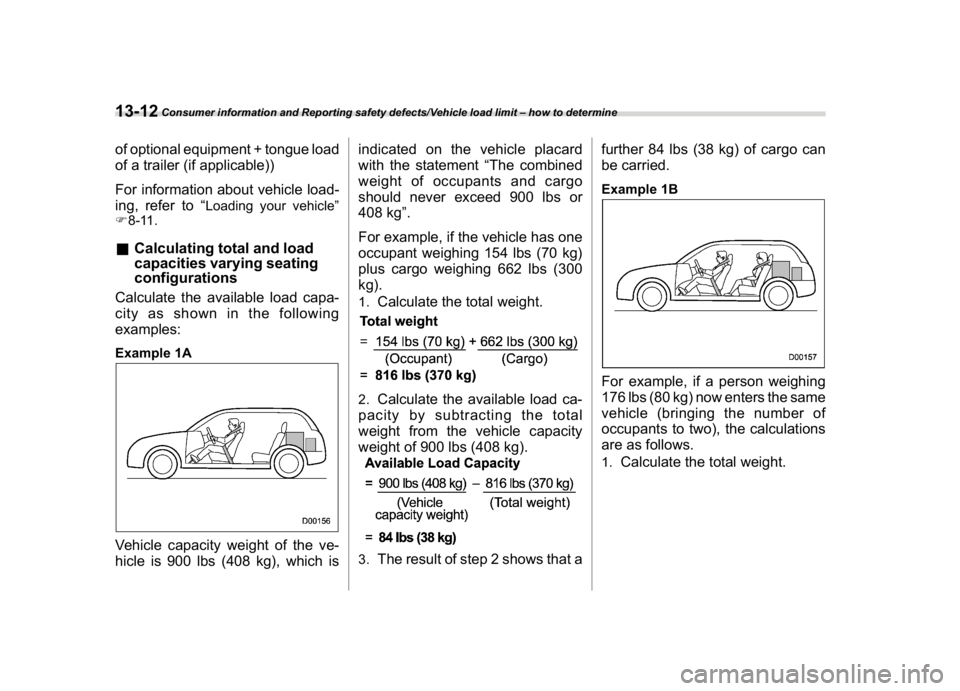
configurationsCalculate the available load capa-
city as shown in the following
examples:Example 1AVehicle capacity weight of the ve-
hicle is 900 lbs (408 kg), which isindicated on the vehicle placard
with the statement“The combined
weight of occupants and cargo
should never exceed 900 lbs or
408 kg”.
For example, if the vehicle has one
occupant weighing 154 lbs (70 kg)
plus cargo weighing 662 lbs (300
kg).
1.
Calculate the total weight.
2.
Calculate the available load ca-
pacity by subtracting the total
weight from the vehicle capacity
weight of 900 lbs (408 kg).
3.
The result of step 2 shows that afurther 84 lbs (38 kg) of cargo can
be carried.
Example 1BFor example, if a person weighing
176 lbs (80 kg) now enters the same
vehicle (bringing the number of
occupants to two), the calculations
are as follows.1.
Calculate the total weight.
Consumer information and Reporting safety defects/Vehicle load limit–how to determine
13-12
Page 456 of 474
(473,1)
北米Model "A1320BE-C" EDITED: 2017/ 10/ 10
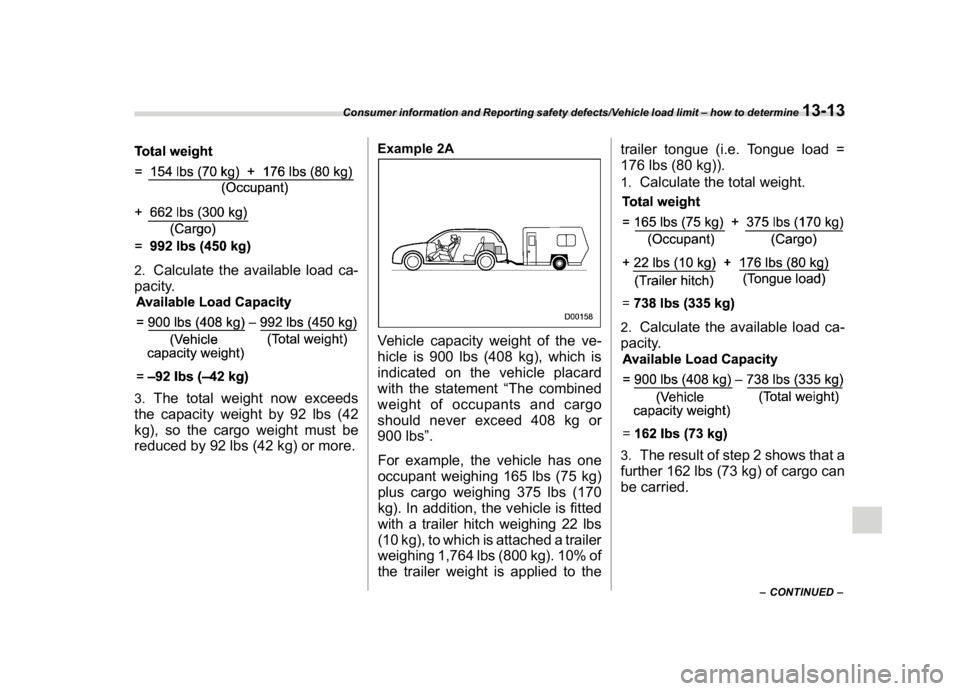
2.
Calculate the available load ca-
pacity.
3.
The total weight now exceeds
the capacity weight by 92 lbs (42
kg), so the cargo weight must be
reduced by 92 lbs (42 kg) or more.
Example 2AVehicle capacity weight of the ve-
hicle is 900 lbs (408 kg), which is
indicated on the vehicle placard
with the statement“The combined
weight of occupants and cargo
should never exceed 408 kg or
900 lbs”.
For example, the vehicle has one
occupant weighing 165 lbs (75 kg)
plus cargo weighing 375 lbs (170
kg). In addition, the vehicle is fitted
with a trailer hitch weighing 22 lbs
(10 kg), to which is attached a trailer
weighing 1,764 lbs (800 kg). 10% of
the trailer weight is applied to thetrailer tongue (i.e. Tongue load =
176 lbs (80 kg)).
1.
Calculate the total weight.
2.
Calculate the available load ca-
pacity.
3.
The result of step 2 shows that a
further 162 lbs (73 kg) of cargo can
be carried.
–CONTINUED–
Consumer information and Reporting safety defects/Vehicle load limit–how to determine
13-13
13