tow SUBARU CROSSTREK 2018 Owner's Guide
[x] Cancel search | Manufacturer: SUBARU, Model Year: 2018, Model line: CROSSTREK, Model: SUBARU CROSSTREK 2018Pages: 474, PDF Size: 20.76 MB
Page 305 of 474
(314,1)
北米Model "A1320BE-C" EDITED: 2017/ 10/ 10
Cruise control (if equipped)NOTEFor models with EyeSight system:
Refer to the Owner’s Manual supple-
ment for the EyeSight system.
Cruise control enables you to maintain a
constant vehicle speed without holding
your foot on the accelerator pedal and it is
operative when the vehicle speed is 20
mph (30 km/h) or more.
WARNING
Do not use the cruise control under
any of the following conditions.
These may cause loss of vehicle
control.
.driving up or down a steep grade
.driving on slippery or winding
roads
.driving in heavy traffic
.towing a trailerNOTEMake sure the cruise control system is
turned off when the cruise control is not
in use to avoid unintentionally setting
of the cruise control.
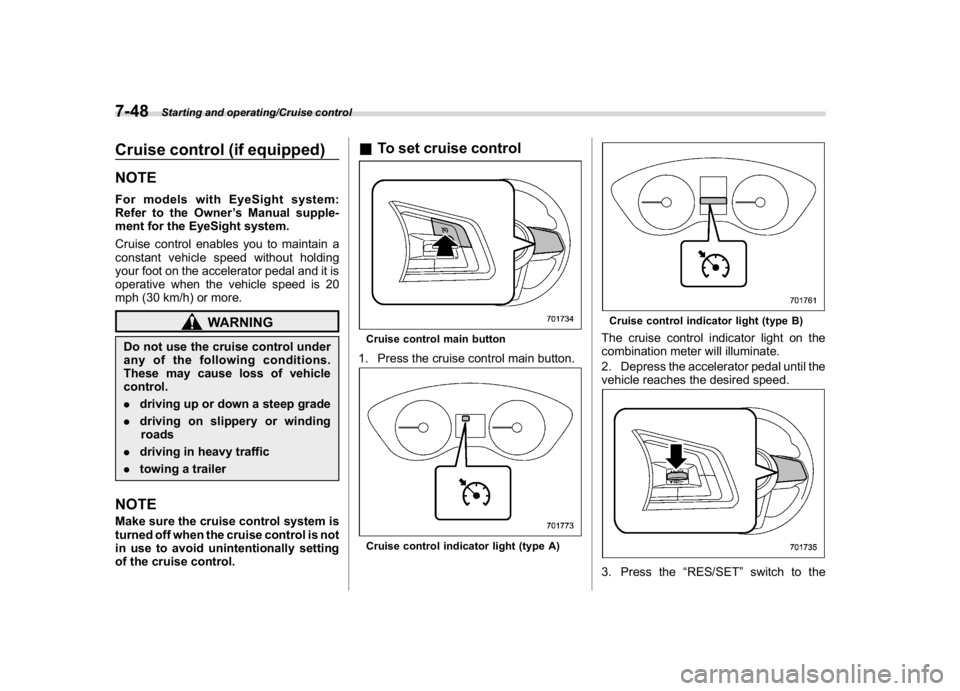
&To set cruise controlCruise control main button1. Press the cruise control main button.Cruise control indicator light (type A)
Cruise control indicator light (type B)The cruise control indicator light on the
combination meter will illuminate.
2. Depress the accelerator pedal until the
vehicle reaches the desired speed.3. Press the“RES/SET”switch to the
Starting and operating/Cruise control
7-48
Page 313 of 474
(322,1)
北米Model "A1320BE-C" EDITED: 2017/ 10/ 10
with a low body height such as
sports cars or a trailer with no
cargo)
–Vehicles that are not approaching
your vehicle even though they are in
the detection area (either on a
neighboring lane to the rear or be-
side your vehicle when reversing)
(The system determines the pre-
sence of approaching vehicles
based on data detected by the radar
sensors.)
–Vehicles traveling at significantly
different speeds
–Vehicles driving in parallel at al-
most the same speed as your vehi-
cle for a prolonged time
–Oncoming vehicles
–Vehicles in a lane beyond the
neighboring lane
–Vehicles travelling at a signifi-
cantly lower speed that you are
trying to overtake
.On a road with extremely narrow
lanes, the system may detect vehicles
driving in a lane next to the neighboring
lane.
.When the 8-inch audio/navigation
system is performing a software up-
date, the RCTA warning icons may not
be displayed on the audio/navigation
screen until the update is complete.
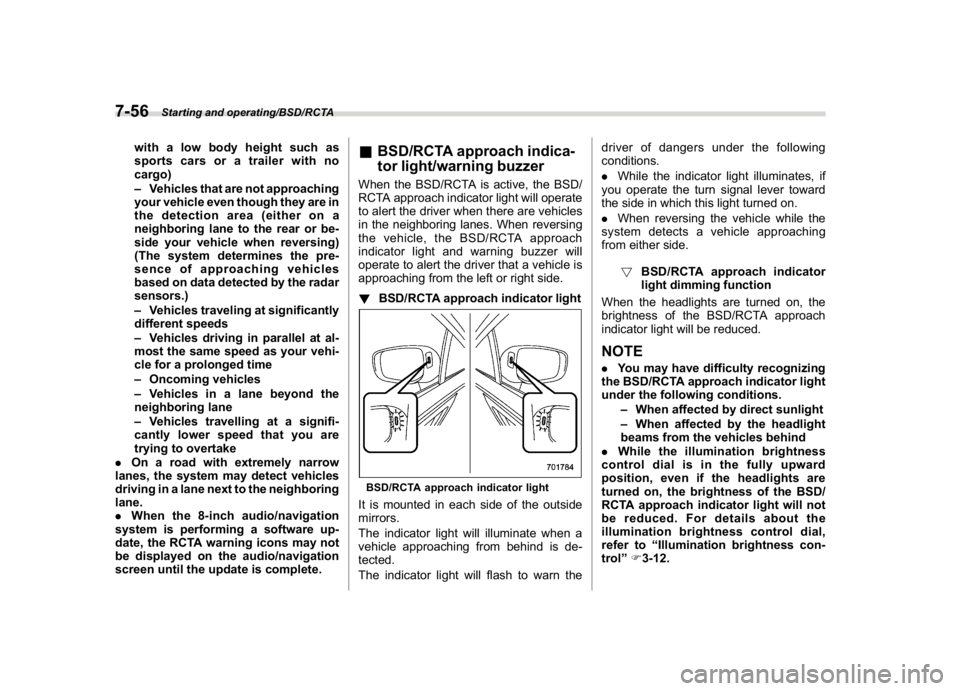
&BSD/RCTA approach indica-
tor light/warning buzzerWhen the BSD/RCTA is active, the BSD/
RCTA approach indicator light will operate
to alert the driver when there are vehicles
in the neighboring lanes. When reversing
the vehicle, the BSD/RCTA approach
indicator light and warning buzzer will
operate to alert the driver that a vehicle is
approaching from the left or right side.
!BSD/RCTA approach indicator lightBSD/RCTA approach indicator lightIt is mounted in each side of the outside
mirrors.
The indicator light will illuminate when a
vehicle approaching from behind is de-
tected.
The indicator light will flash to warn thedriver of dangers under the following
conditions.
.While the indicator light illuminates, if
you operate the turn signal lever toward
the side in which this light turned on.
.When reversing the vehicle while the
system detects a vehicle approaching
from either side.
!BSD/RCTA approach indicator
light dimming function
When the headlights are turned on, the
brightness of the BSD/RCTA approach
indicator light will be reduced.
NOTE.You may have difficulty recognizing
the BSD/RCTA approach indicator light
under the following conditions.
–When affected by direct sunlight
–When affected by the headlight
beams from the vehicles behind
.While the illumination brightness
control dial is in the fully upward
position, even if the headlights are
turned on, the brightness of the BSD/
RCTA approach indicator light will not
be reduced. For details about the
illumination brightness control dial,
refer to“Illumination brightness con-
trol”F3-12.
Starting and operating/BSD/RCTA
7-56
Page 316 of 474
(325,1)
北米Model "A1320BE-C" EDITED: 2017/ 10/ 10
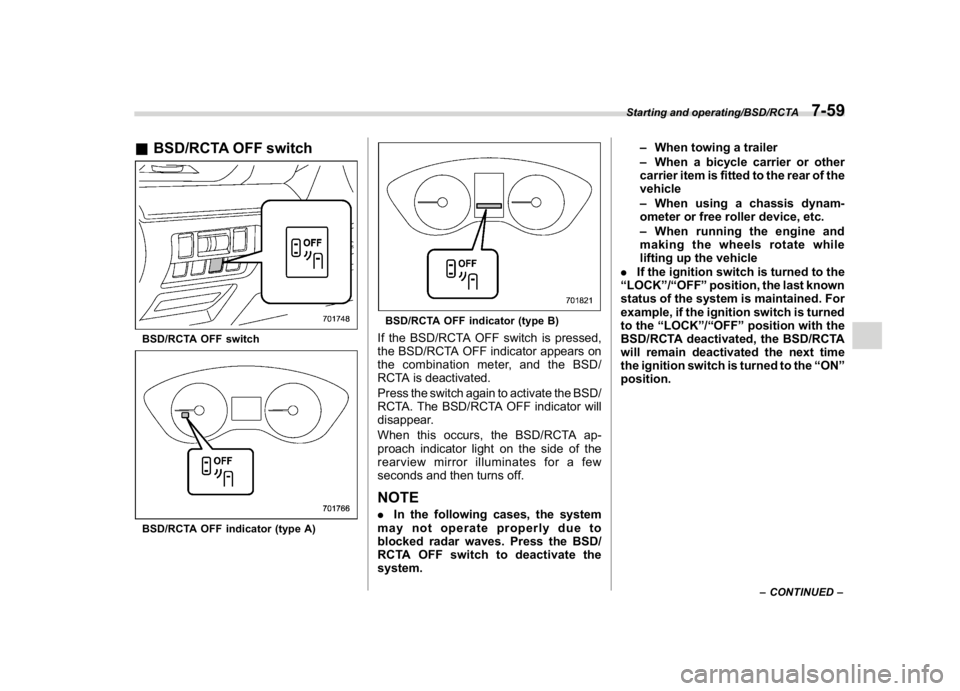
&BSD/RCTA OFF switchBSD/RCTA OFF switchBSD/RCTA OFF indicator (type A)
BSD/RCTA OFF indicator (type B)If the BSD/RCTA OFF switch is pressed,
the BSD/RCTA OFF indicator appears on
the combination meter, and the BSD/
RCTA is deactivated.
Press the switch again to activate the BSD/
RCTA. The BSD/RCTA OFF indicator will
disappear.
When this occurs, the BSD/RCTA ap-
proach indicator light on the side of the
rearview mirror illuminates for a few
seconds and then turns off.NOTE.In the following cases, the system
may not operate properly due to
blocked radar waves. Press the BSD/
RCTA OFF switch to deactivate the
system.–When towing a trailer
–When a bicycle carrier or other
carrier item is fitted to the rear of the
vehicle
–When using a chassis dynam-
ometer or free roller device, etc.
–When running the engine and
making the wheels rotate while
lifting up the vehicle
.If the ignition switch is turned to the
“LOCK”/“OFF”position, the last known
status of the system is maintained. For
example, if the ignition switch is turned
to the“LOCK”/“OFF”position with the
BSD/RCTA deactivated, the BSD/RCTA
will remain deactivated the next time
the ignition switch is turned to the“ON”
position.
–CONTINUED–
Starting and operating/BSD/RCTA
7-59
7
Page 321 of 474
(330,1)
北米Model "A1320BE-C" EDITED: 2017/ 10/ 10
cles
–Sound of an air brake
–Vehicle detection equipment or a
sonar from another vehicle
–A sound wave with a frequency
similar to the vehicle’s system is
transmitted nearby
–A vehicle equipped with the same
system is reversing toward your
reversing direction
Weather conditions
–Extremely high or extremely low
temperatures in which the area near
the sonar sensor becomes too hot
or too cold to operate
–The rear bumper near the sonar
sensors is exposed to heavy rain or
a significant amount of water
–Fog, snow or sandstorm, etc.
–Air is moving rapidly such as
when a strong wind is blowing
Parts attached to the rear bumper
near the sonar sensor
–Commercial electronic parts (fog
light, fender pole, radio antenna) or
commercial attachment parts (trai-
ler hitch, bicycle carrier, bumper
guard) are attached
–Parts that emit high frequency
sound, such as a horn or speaker,are attached
Vehicle conditions
–The vehicle is significantly in-
clined
–The ground clearance is signifi-
cantly reduced due to the vehicle’s
loading condition, etc.
–When the sonar sensor is mis-
aligned due to a collision or an
accident
Surrounding environment
–A cloth banner, flag, hanging
branch or railroad crossing bars
are present in the reversing direc-
tion
–When reversing on a gravel or
grassy area
–When reversing in an area where
objects or walls are adjacent to the
vehicle such as narrow tunnels,
narrow bridges, narrow roads or
narrow garages
–Wheel tracks or a hole is present
in the ground of the reversing
direction
–When reversing over a drainage
cover (grate cover)
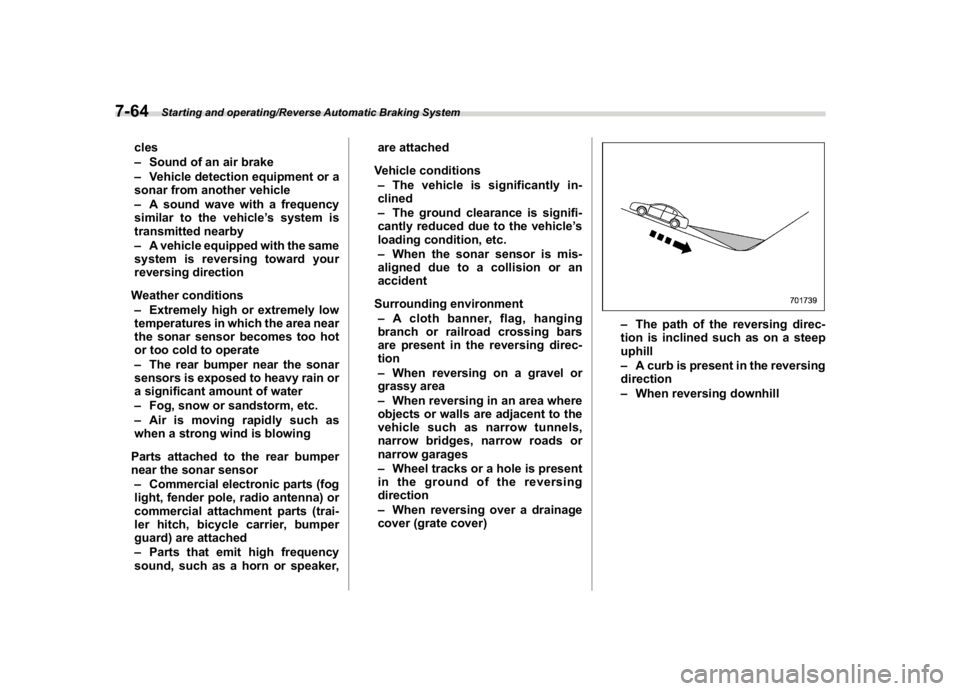
–The path of the reversing direc-
tion is inclined such as on a steep
uphill
–A curb is present in the reversing
direction
–When reversing downhill
Starting and operating/Reverse Automatic Braking System
7-64
Page 328 of 474
(339,1)
北米Model "A1320BE-C" EDITED: 2017/ 10/ 10
New vehicle break-in driving–the first 1,000
miles (1,600 km)...................................................8-2
Fuel economy hints................................................8-2
Engine exhaust gas (carbonmonoxide)............... 8-2
Catalytic converter..................................................8-3
Periodic inspections...............................................8-4
Driving in foreigncountries...................................8-4
Driving tips for AWD models.................................8-4
Off road driving.......................................................8-6
Before driving........................................................ 8-6
During driving........................................................ 8-6
After driving........................................................... 8-7
Winter driving..........................................................8-7
Operation during cold weather............................... 8-7
Driving on snowy and icy roads............................. 8-9
Corrosion protection.............................................8-10
Snow tires............................................................8-10Tire chains........................................................... 8-11
Rocking the vehicle.............................................. 8-11
Loading your vehicle.............................................8-11
Vehicle capacity weight........................................8-12
GVWR and GAWR (Gross Vehicle Weight
Rating and Gross Axle Weight Rating)...............8-13
Roof rail...............................................................8-13
Trailer hitch (dealeroption).................................8-14
Connecting a trailer..............................................8-15
If not towing a trailer............................................8-16
Trailer towing........................................................8-16
Warranties and maintenance.................................8-17
Maximum load limits.............................................8-17
Trailer Hitches......................................................8-20
When you do not tow a trailer ...............................8-21
Connecting a trailer..............................................8-21
Trailer towing tips.................................................8-22
Driving tips
8
Page 332 of 474
(343,1)
北米Model "A1320BE-C" EDITED: 2017/ 10/ 10
printed on the tire placard. The
tire placard is located on the
driver’s door pillar.
If all of four tires are not the same
for items (a) to (h), serious me-
chanical damage could occur to
the drive train of your car, and
affect the following.
—Ride
—Handling
—Braking
—Speedometer/Odometer
calibration
—Clearance between the body
and tires
It also may be dangerous and
lead to loss of vehicle control,
and it can lead to an accident.
CAUTION
If you use a temporary spare tire to
replace a flat tire, be sure to use the
original temporary spare tire stored
in the vehicle. Using other sizes may
result in severe mechanical damage
to the drive train of your vehicle.
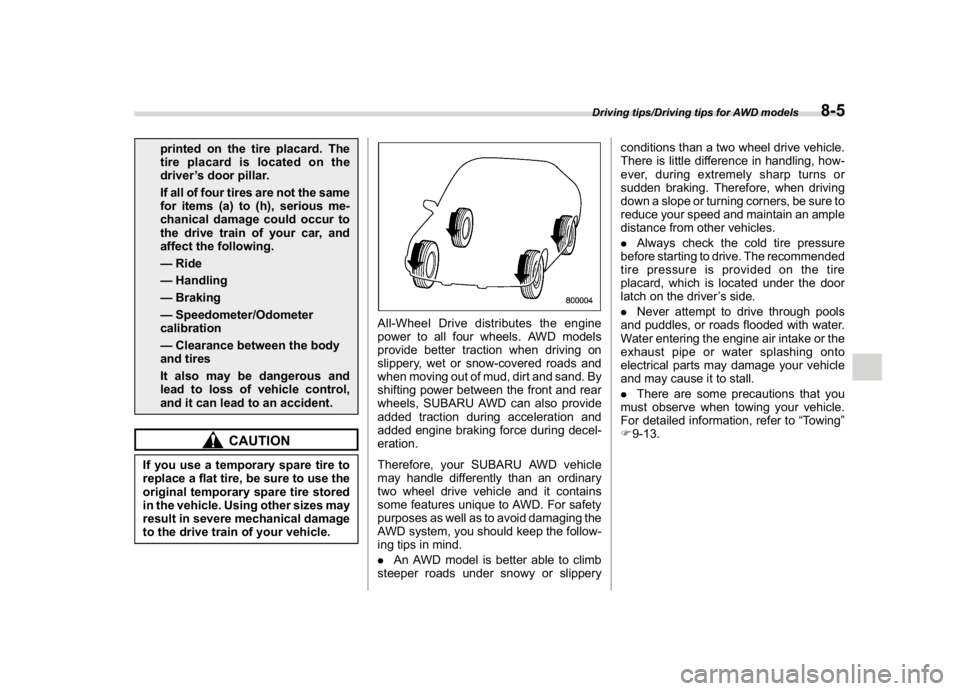
All-Wheel Drive distributes the engine
power to all four wheels. AWD models
provide better traction when driving on
slippery, wet or snow-covered roads and
when moving out of mud, dirt and sand. By
shifting power between the front and rear
wheels, SUBARU AWD can also provide
added traction during acceleration and
added engine braking force during decel-
eration.
Therefore, your SUBARU AWD vehicle
may handle differently than an ordinary
two wheel drive vehicle and it contains
some features unique to AWD. For safety
purposes as well as to avoid damaging the
AWD system, you should keep the follow-
ing tips in mind.
.An AWD model is better able to climb
steeper roads under snowy or slipperyconditions than a two wheel drive vehicle.
There is little difference in handling, how-
ever, during extremely sharp turns or
sudden braking. Therefore, when driving
down a slope or turning corners, be sure to
reduce your speed and maintain an ample
distance from other vehicles.
.Always check the cold tire pressure
before starting to drive. The recommended
tire pressure is provided on the tire
placard, which is located under the door
latch on the driver’s side.
.Never attempt to drive through pools
and puddles, or roads flooded with water.
Water entering the engine air intake or the
exhaust pipe or water splashing onto
electrical parts may damage your vehicle
and may cause it to stall.
.There are some precautions that you
must observe when towing your vehicle.
For detailed information, refer to“Towing”
F9-13.
Driving tips/Driving tips for AWD models
8-5
8
Page 333 of 474
(344,1)
北米Model "A1320BE-C" EDITED: 2017/ 10/ 10
Off road driving
WARNING
.Always maintain a safe driving
speed according to the road and
weather conditions in order to
avoid having an accident on a
sharp turn, during sudden brak-
ing or under other similar condi-
tions.
.Always use the utmost care in
driving–overconfidence be-
cause you are driving an All-
Wheel Drive model could easily
lead to a serious accident.
CAUTION
Frequent driving of an AWD model
under hard-driving conditions such
as rough roads or off roads will
necessitate more frequent replace-
ment of the following items than that
specified in the maintenance sche-
dule described in the“Warranty and
Maintenance Booklet”.
.Engine oil
.Brake fluid
Remember that damage done toyour SUBARU while operating it off-
road and not using common sense
precautions such as those listed
here is not eligible for warranty
coverage.
Because of the AWD feature and higher
ground clearance, you can drive your
SUBARU on ordinary roads or off-road.
But please keep in mind that an AWD
SUBARU is a passenger car and is neither
a conventional off-road vehicle nor an all-
terrain vehicle. If you do take your
SUBARU off-road, certain common sense
precautions such as those in the following
list should be taken.
&Before driving.Make certain that you and all of your
passengers are wearing seatbelts.
.Carry some emergency equipment,
such as a towing rope or chain, a shovel,
wheel blocks, first aid kit and cell phone or
citizens band radio.
.Secure all cargo carried inside the
vehicle and make certain that it is not piled
higher than the seatbacks. During sudden
stops or jolts, unsecured cargo could be
thrown around in the vehicle and cause
injury. Do not pile heavy loads on the roof.
Those loads raise the vehicle’s center of
gravity and make it more prone to tip over..Never equip your vehicle with tires
larger than those specified in this manual.
&During drivingGeneral precautions:
.Drive carefully. Do not take unneces-
sary risks by driving in dangerous areas or
over rough terrain.
.Slow down and employ extra caution at
all times. When driving off-road, you will
not have the benefit of marked traffic
lanes, banked curves, traffic signs and
the like.
.Do not drive across steep slopes.
Instead, drive either straight up or straight
down the slopes. A vehicle can much more
easily tip over sideways than it can end
over end. Avoid driving straight up or down
slopes that are too steep.
.Avoid sharp turning maneuvers, espe-
cially at higher speeds.
.Do not grip the inside or spokes of the
steering wheel. A bad bump could jerk the
wheel and injure your hands. Instead,
drive with your fingers and thumbs on the
outside of the rim.
.Do not drive or park over or near
flammable materials such as dry grass or
fallen leaves, as they may burn easily. The
exhaust system is very hot while the
engine is running and right after the engine
Driving tips/Off road driving
8-6
Page 341 of 474
(352,1)
北米Model "A1320BE-C" EDITED: 2017/ 10/ 10
does not exceed 150 lbs (68 kg).
Overloading may cause damage
to the vehicle.
.For cargo carrying purposes, the
roof rails must be used together
with the crossbars and any ap-
propriate carrying attachment
that may be needed. The roof
rails must never be used alone
to carry cargo. Otherwise, da-
mage to the roof or paint, or a
dangerous road hazard due to
loss of cargo could result.
NOTERemember that the vehicle’s center of
gravity is altered with the weight of the
load on the roof, thus affecting driving
characteristics.
Drive carefully. Avoid rapid starts, hard
cornering and abrupt stops. Crosswind
effects will be increased.
Trailer hitch (dealer option)
WARNING
.Never exceed the maximum
weight specified for the trailer
hitch. Exceeding the maximum
weight could cause an accident
resulting in serious personal in-
juries. Permissible trailer weight
changes depending on the situa-
tion. For possible recommenda-
tions and limitations, refer to
“Trailer towing”F8-16.
.Trailer brakes are required when
the towing load exceeds 1,000 lbs
(453 kg). Be sure your trailer has
safety chains and that each chain
will hold the trailer’s maximum
gross weight. Towing trailers
without safety chains could cre-
ate a traffic safety hazard if the
trailer separates from the hitch
due to coupling damage or hitch
ball damage.
.Be sure to check the hitch pin and
safety pin for positive locking
placement before towing a trailer.
If the ball mount comes off the
hitch receiver, the trailer could
get loose and create a trafficsafety hazard.
.Although towing regulations for
trailer or caravan vehicles vary
by state/region, all regulations
agree that specifications such
as the maximum gross trailer
weight must not exceed the les-
ser of the following:
–Maximum gross trailer weight
–Maximum gross tongue
weight
–GVWR
–GAWR
.Failure to comply with the proce-
dures set forth will not only
compromise your safety, but will
also negate your insurance cov-
erage and/or may violate the state
road and traffic acts and regula-
tions.
.Use only the ball mount supplied
with this hitch. Use the hitch only
as a weight carrying hitch. Do not
use with any type of weight dis-
tributing hitch.
.The standard bumper beam must
be installed after you remove the
trailer hitch. Consult a SUBARU
dealer for purchase of a standard
bumper beam if you do not have
Driving tips/Trailer hitch (dealer option)
8-14
Page 342 of 474
(353,1)
北米Model "A1320BE-C" EDITED: 2017/ 10/ 10
the original.
.Safety performance is decreased
and there is increased risk of
injury to passengers in the case
of an accident if the trailer hitch
or a standard bumper beam is not
installed. One of them must al-
ways be installed on the vehicle.
.If a trailer hitch is installed, it is
not possible to install the rear
towing hook.
The maximum gross trailer weight and
maximum gross tongue weight are indi-
cated in the following table.
Maximum gross trai-
ler weightMaximum gross ton-
gue weight
1,500 lbs (680 kg)200 lbs
(90 kg)When towing a trailer, refer to“Trailer
towing”F8-16.
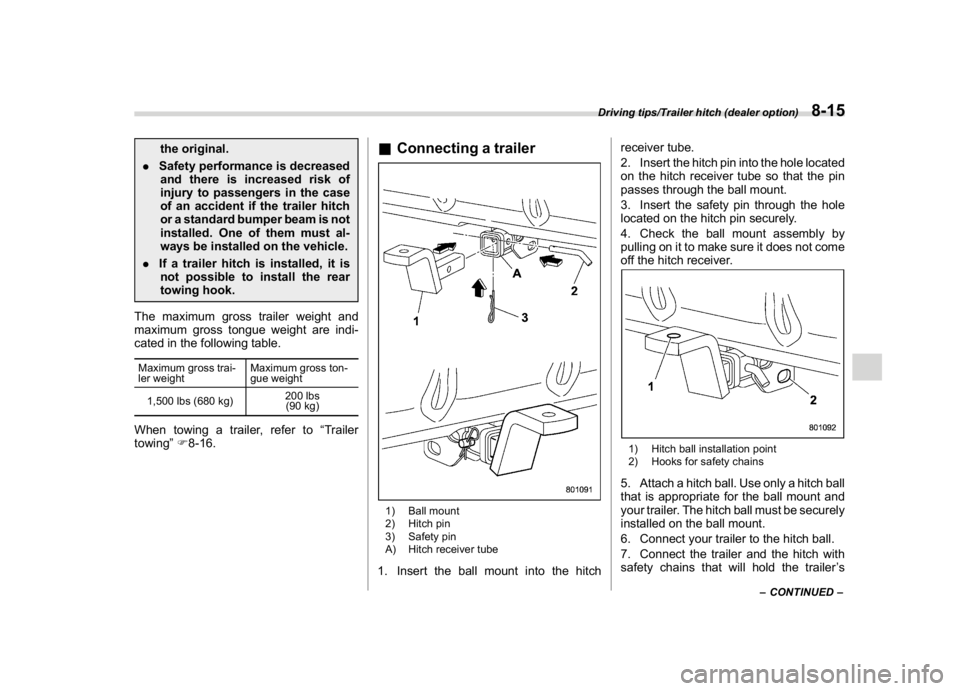
&Connecting a trailer1) Ball mount
2) Hitch pin
3) Safety pin
A) Hitch receiver tube1. Insert the ball mount into the hitchreceiver tube.
2. Insert the hitch pin into the hole located
on the hitch receiver tube so that the pin
passes through the ball mount.
3. Insert the safety pin through the hole
located on the hitch pin securely.
4. Check the ball mount assembly by
pulling on it to make sure it does not come
off the hitch receiver.
1) Hitch ball installation point
2) Hooks for safety chains5. Attach a hitch ball. Use only a hitch ball
that is appropriate for the ball mount and
your trailer. The hitch ball must be securely
installed on the ball mount.
6. Connect your trailer to the hitch ball.
7. Connect the trailer and the hitch with
safety chains that will hold the trailer’s
–CONTINUED–
Driving tips/Trailer hitch (dealer option)
8-15
8
Page 343 of 474
(354,1)
北米Model "A1320BE-C" EDITED: 2017/ 10/ 10
maximum gross weight. The chains should
cross under the trailer tongue to prevent
the tongue from dropping onto the ground
in case it should disconnect from the hitch
ball. Allow sufficient slack in the chains
taking tight turn situations into account;
however, be careful not to let them drag on
the ground.
WARNING
Do not connect safety chains to any
part of the vehicle other than the
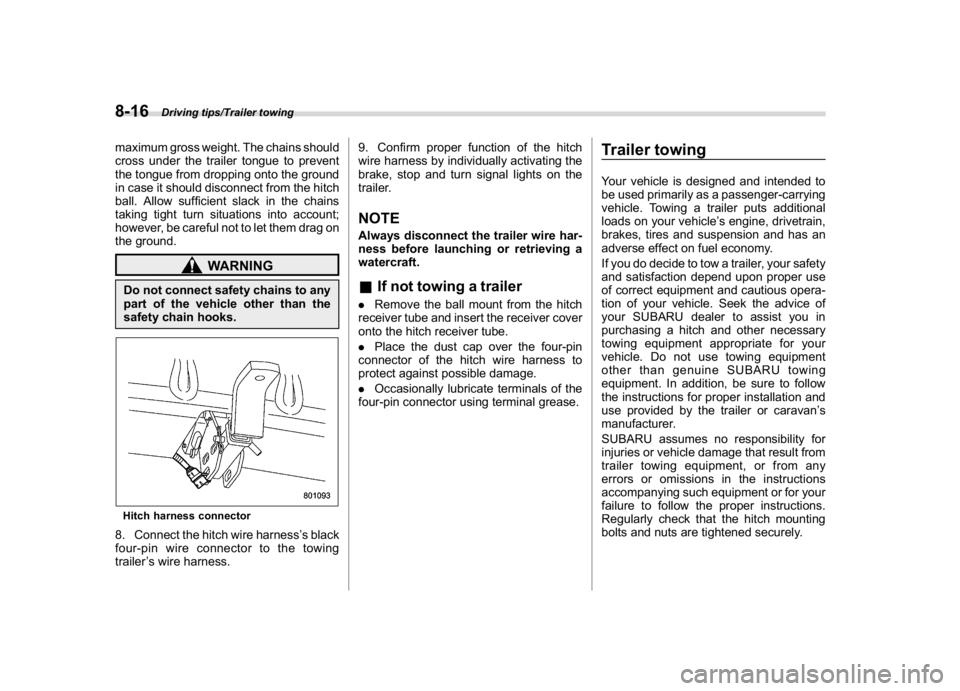
safety chain hooks.Hitch harness connector8. Connect the hitch wire harness’s black
four-pin wire connector to the towing
trailer’s wire harness.9. Confirm proper function of the hitch
wire harness by individually activating the
brake, stop and turn signal lights on the
trailer.
NOTEAlways disconnect the trailer wire har-
ness before launching or retrieving a
watercraft.&If not towing a trailer.Remove the ball mount from the hitch
receiver tube and insert the receiver cover
onto the hitch receiver tube.
.Place the dust cap over the four-pin
connector of the hitch wire harness to
protect against possible damage.
.Occasionally lubricate terminals of the
four-pin connector using terminal grease.
Trailer towingYour vehicle is designed and intended to
be used primarily as a passenger-carrying
vehicle. Towing a trailer puts additional
loads on your vehicle’s engine, drivetrain,
brakes, tires and suspension and has an
adverse effect on fuel economy.
If you do decide to tow a trailer, your safety
and satisfaction depend upon proper use
of correct equipment and cautious opera-
tion of your vehicle. Seek the advice of
your SUBARU dealer to assist you in
purchasing a hitch and other necessary
towing equipment appropriate for your
vehicle. Do not use towing equipment
other than genuine SUBARU towing
equipment. In addition, be sure to follow
the instructions for proper installation and
use provided by the trailer or caravan’s
manufacturer.
SUBARU assumes no responsibility for
injuries or vehicle damage that result from
trailer towing equipment, or from any
errors or omissions in the instructions
accompanying such equipment or for your
failure to follow the proper instructions.
Regularly check that the hitch mounting
bolts and nuts are tightened securely.
Driving tips/Trailer towing
8-16