fuel type SUBARU CROSSTREK 2018 Owners Manual
[x] Cancel search | Manufacturer: SUBARU, Model Year: 2018, Model line: CROSSTREK, Model: SUBARU CROSSTREK 2018Pages: 474, PDF Size: 20.76 MB
Page 12 of 474

(11,1)
北米Model "A1320BE-C" EDITED: 2017/ 10/ 10
&Noise from under the vehicle
NOTEYou may hear a noise from under the
vehicle approximately 5 to 10 hours
after the ignition switch is turned to the
“LOCK”/“OFF”position. However, this
does not indicate a malfunction. This
noise is caused by the operation of the
fuel evaporation leakage checking sys-
tem and the operation is normal. The
noise will stop after approximately 15
minutes.&Event data recorderThis vehicle is equipped with an event data
recorder (EDR). The main purpose of an
EDR is to record, in certain crash or near
crash-like situations, such as an air bag
deployment or hitting a road obstacle, data
that will assist in understanding how a
vehicle’s systems performed. The EDR is
designed to record data related to vehicle
dynamics and safety systems for a short
period of time, typically 30 seconds or less.
The EDR in this vehicle is designed to
record such data as:
.How various systems in your vehicle
were operating;
.Whether or not the driver and passen-
ger safety belts were buckled/fastened;
.Howfar(ifatall)thedriverwasdepressing the accelerator and/or brake
pedal; and,
.How fast the vehicle was traveling.
These data can help provide a better
understanding of the circumstances in
which crashes and injuries occur. NOTE:
EDR data are recorded by your vehicle
only if a non-trivial crash situation occurs;
no data are recorded by the EDR under
normal driving conditions and no personal
data (e.g., name, gender, age, and crash
location) are recorded. However, other
parties, such as law enforcement, could
combine the EDR data with the type of
personally identifying data routinely ac-
quired during a crash investigation.
To read data recorded by an EDR, special
equipment is required, and access to the
vehicle or the EDR is needed. In addition
to the vehicle manufacturer, other parties,
such as law enforcement, that have the
special equipment, can read the informa-
tion if they have access to the vehicle or
the EDR.
9
0
Page 22 of 474

(21,1)
北米Model "A1320BE-C" EDITED: 2017/ 10/ 10
&Combination meter!U.S.-spec. models (type A)The illustration above is a typical example. For some models, the combination meter may
be slightly different than that shown in the illustration.
1) Tachometer (page 3-8)
2) Select lever/gear position indicator
(page 3-30)
3) Trip meter and odometer (page 3-9)
4) Speedometer (page 3-8)
5) ECO gauge (page 3-10)
6) Fuel gauge (page 3-10)
–CONTINUED–
19
0
Page 23 of 474

(22,1)
北米Model "A1320BE-C" EDITED: 2017/ 10/ 10
!U.S.-spec. models (type B)The illustration above is a typical example. For some models, the combination meter may
be slightly different than that shown in the illustration.
1) Tachometer (page 3-8)
2) Select lever/gear position indicator
(page 3-30)
3) Combination meter display (color LCD)
(page 3-33)
4) Trip meter and odometer (page 3-9)
5) Speedometer (page 3-8)
6) Fuel gauge (page 3-10)
20
Page 24 of 474

(23,1)
北米Model "A1320BE-C" EDITED: 2017/ 10/ 10
!Except U.S.-spec. models (type A)The illustration above is a typical example. For some models, the combination meter may
be slightly different than that shown in the illustration.
1) Tachometer (page 3-8)
2) Select lever/gear position indicator
(page 3-30)
3) Trip meter and odometer (page 3-9)
4) Speedometer (page 3-8)
5) ECO gauge (page 3-10)
6) Fuel gauge (page 3-10)
–CONTINUED–
21
0
Page 25 of 474

(24,1)
北米Model "A1320BE-C" EDITED: 2017/ 10/ 10
!Except U.S.-spec. models (type B)The illustration above is a typical example. For some models, the combination meter may
be slightly different than that shown in the illustration.
1) Tachometer (page 3-8)
2) Select lever/gear position indicator
(page 3-30)
3) Combination meter display (color LCD)
(page 3-33)
4) Trip meter and odometer (page 3-9)
5) Speedometer (page 3-8)
6) Fuel gauge (page 3-10)
22
Page 143 of 474
(148,1)
北米Model "A1320BE-C" EDITED: 2017/ 10/ 10
NOTE.If the connection between the com-
bination meter and battery is broken for
any reason such as vehicle mainte-
nance or fuse replacement, the data
recorded on the trip meter will be lost.
.If you press the TRIP RESET switch
when the ignition switch is in the
“LOCK”/“OFF”or“ACC”position, the
odometer/trip meter will light up. It is
possible to switch between the A trip
meter and B trip meter indications while
the odometer/trip meter is lit up.
In addition, it is possible to reset the trip
meter by pressing and holding the TRIP
RESET switch.
The indicators will turn off when:
–The TRIP RESET switch is not
operated for approximately 10 sec-
onds.
–The driver’s door is opened and
then closed.
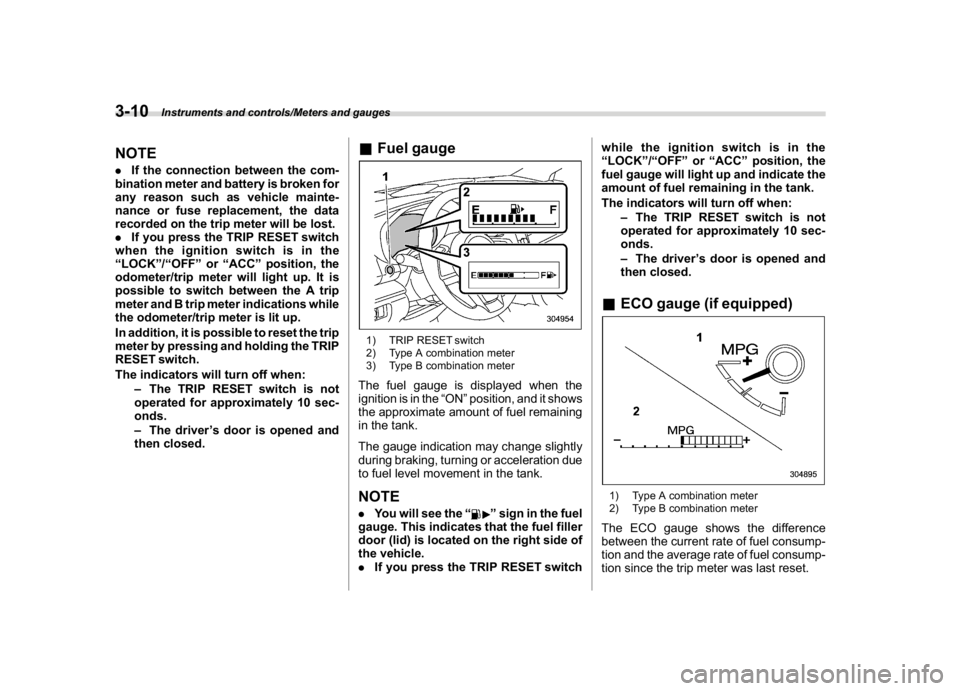
&Fuel gauge1) TRIP RESET switch
2) Type A combination meter
3) Type B combination meterThe fuel gauge is displayed when the
ignition is in the“ON”position, and it shows
the approximate amount of fuel remaining
in the tank.
The gauge indication may change slightly
during braking, turning or acceleration due
to fuel level movement in the tank.NOTE.You will see the“
”sign in the fuel
gauge. This indicates that the fuel filler
door (lid) is located on the right side of
the vehicle.
.If you press the TRIP RESET switchwhile the ignition switch is in the
“LOCK”/“OFF”or“ACC”position, the
fuel gauge will light up and indicate the
amount of fuel remaining in the tank.
The indicators will turn off when:
–The TRIP RESET switch is not
operated for approximately 10 sec-
onds.
–The driver’s door is opened and
then closed.
&ECO gauge (if equipped)1) Type A combination meter
2) Type B combination meterThe ECO gauge shows the difference
between the current rate of fuel consump-
tion and the average rate of fuel consump-
tion since the trip meter was last reset.
Instruments and controls/Meters and gauges
3-10
Page 144 of 474
(149,1)
北米Model "A1320BE-C" EDITED: 2017/ 10/ 10
If the ECO gauge moves towards the +
side, this indicates better fuel efficiency.NOTE.The ECO gauge shows only an
approximate indication of fuel effi-
ciency.
.After resetting the trip meter, the
average rate of fuel consumption is not
shown until you have driven for 1 mile
(or 1 km). Before that time, the ECO
gauge does not operate.&Combination meter settingsMeter and vehicle settings can be set on
the combination meter.
!Type A combination meter
Various adjustments can be made, such
as switching units shown on the combina-
tion meter and adjusting the warning tone
volume.
While the ignition switch is in the“OFF”
position, each press of TRIP RESET
switch results in items shown in the table
below being switched.
ItemCombination
meter displayPossible
settings
A trip
—
B trip—
Gauge
needle
sweep
function
On/Off
Changing
the unit*mile/km
Warning
volume*Lv. 1/Lv. 2/Lv. 3
*: if available
NOTE.If you switch the units on the combi-
nation meter, the units on the multi-
function display (black and white) also
switches accordingly.
.If either of the following conditions
is met, the combination meter setting
mode will be canceled.
–The driver’s door is opened.
–The TRIP RESET switch is not
operated for approximately 10 sec-
onds or more.!Switching method
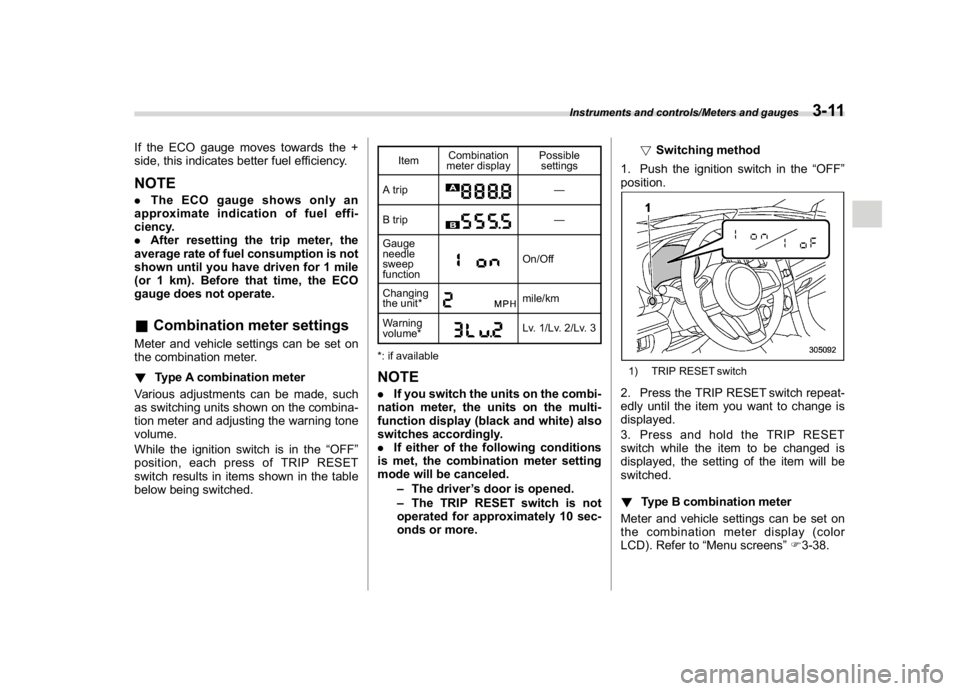
1. Push the ignition switch in the“OFF”
position.
1) TRIP RESET switch2. Press the TRIP RESET switch repeat-
edly until the item you want to change is
displayed.
3. Press and hold the TRIP RESET
switch while the item to be changed is
displayed, the setting of the item will be
switched.
!Type B combination meter
Meter and vehicle settings can be set on
the combination meter display (color
LCD). Refer to“Menu screens”F3-38.
Instruments and controls/Meters and gauges
3-11
3
Page 260 of 474

(269,1)
北米Model "A1320BE-C" EDITED: 2017/ 10/ 10
Fuel
CAUTION
Use of a fuel which is low in quality
or use of an inappropriate fuel
additive may cause damage to the
engine and/or fuel system.&Fuel requirementsThe engine is designed to operate using
unleaded gasolinewith an octane rating
of87 AKI (90 RON) or higher.
!Mexico only
Add a bottle of genuine SUBARU fuel
additive to the fuel every 15,000 km (9,000
miles). Refer to an authorized SUBARU
dealer for details.
!Fuel octane rating
Using a gasoline with a lower octane rating
can cause persistent and heavy knocking,
which can damage the engine. Do not be
concerned if your vehicle sometimes
knocks lightly when you drive up a hill or
when you accelerate. Contact your
SUBARU dealer if you use a fuel with the
specified octane rating and your vehicle
knocks heavily or persistently.!RON
This octane rating is the Research Octane
Number.
!AKI
This octane rating is the average of the
Research Octane and Motor Octane num-
bers and is commonly referred to as the
Anti Knock Index (AKI).
!Unleaded gasoline
The neck of the fuel filler pipe is designed
to accept only an unleaded gasoline filler
nozzle. Under no circumstances should
leaded gasoline be used because it will
damage the emission control system and
may impair driveability and fuel economy.
!Gasoline for California-certified
LEV
If your vehicle was certified to California’s
low emission vehicle (LEV) standards as
indicated on the underhood tune-up label,
it is designed to optimize engine and
emission performance with gasoline that
meets the clean burning low-sulfur Cali-
fornia gasoline specifications. If you live in
any other state than California, your
vehicle will operate on gasoline meeting
Federal specifications. Gasoline sold out-
side California is permitted to have higher
sulfur levels, which may affect the perfor-
mance of your vehicle’s catalytic converterand may produce a sulfur exhaust odor or
smell. SUBARU recommends that you try
a different brand of unleaded gasoline
having lower sulfur to determine if the
problem is fuel related before returning
your vehicle to an authorized dealer for
service.
!MMT
Some gasoline contains an octane-enhan-
cing additive called MMT (Methylcyclo-
pentadienyl Manganese Tricarbonyl). If
you use such fuels, your emission control
system performance may deteriorate and
the CHECK ENGINE warning light/Mal-
function indicator light may turn on. If this
happens, return to your authorized
SUBARU Dealer for service. If it is
determined that the condition is caused
by the type of fuel used, repairs may not be
covered by your warranty.
!Gasoline for cleaner air
Your use of gasoline with detergent ad-
ditives will help prevent deposits from
forming in your engine and fuel system.
This helps keep your engine in tune and
your emission control system working
properly, and is a way of doing your part
for cleaner air. If you continuously use a
high quality fuel with the proper detergent
and other additives, you should never
need to add any fuel system cleaning
–CONTINUED–
Starting and operating/Fuel
7-3
7
Page 282 of 474
(291,1)
北米Model "A1320BE-C" EDITED: 2017/ 10/ 10
.The continuously variable transmis-
sion is a chain type system that pro-
vides superior transmission efficiency
for maximum fuel economy. At times,
depending on varying driving condi-
tions, a chain operating sound may be
heard that is characteristic of this type
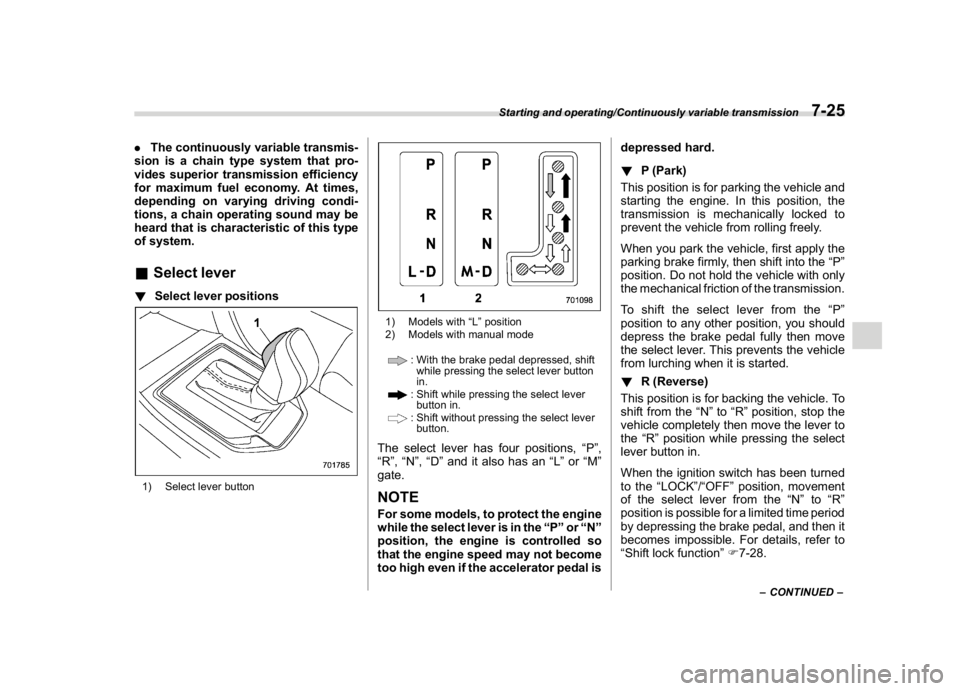
of system.&Select lever!Select lever positions1) Select lever button
1) Models with“L”position
2) Models with manual mode
: With the brake pedal depressed, shift
while pressing the select lever button
in.: Shift while pressing the select lever
button in.: Shift without pressing the select lever
button.
The select lever has four positions,“P”,
“R”,“N”,“D”and it also has an“L”or“M”
gate.NOTEFor some models, to protect the engine
while the select lever is in the“P”or“N”
position, the engine is controlled so
that the engine speed may not become
too high even if the accelerator pedal isdepressed hard.
!P (Park)
This position is for parking the vehicle and
starting the engine. In this position, the
transmission is mechanically locked to
prevent the vehicle from rolling freely.
When you park the vehicle, first apply the
parking brake firmly, then shift into the“P”
position. Do not hold the vehicle with only
the mechanical friction of the transmission.
To shift the select lever from the“P”
position to any other position, you should
depress the brake pedal fully then move
the select lever. This prevents the vehicle
from lurching when it is started.
!R (Reverse)
This position is for backing the vehicle. To
shift from the“N”to“R”position, stop the
vehicle completely then move the lever to
the“R”position while pressing the select
lever button in.
When the ignition switch has been turned
to the“LOCK”/“OFF”position, movement
of the select lever from the“N”to“R”
position is possible for a limited time period
by depressing the brake pedal, and then it
becomes impossible. For details, refer to
“Shift lock function”F7-28.
–CONTINUED–
Starting and operating/Continuously variable transmission
7-25
7
Page 376 of 474

(389,1)
北米Model "A1320BE-C" EDITED: 2017/ 10/ 10
!Washing the underbody
Chemicals, salts and gravel used for
deicing road surfaces are extremely cor-
rosive, accelerating the corrosion of un-
derbody components, such as the exhaust
system, fuel and brake lines, brake cables,
floor pan and fenders, and suspension.
Thoroughly flush the underbody and inside
of the fenders with lukewarm or cold water
at frequent intervals to reduce the harmful
effects of such agents.
Mud and sand adhering to the underbody
components may accelerate their corro-
sion.
After driving off-road or on muddy or sandy
roads, wash the mud and sand off the
underbody. Carefully flush the suspension
and axle parts, as they are particularly
prone to mud and sand buildup. Do not use
a sharp-edged tool to remove caked mud.
CAUTION
.Be careful not to damage brake
hoses, sensor harnesses, and
other parts when washing sus-
pension components.
.Be careful not to flush the engine
bottom for a long time. It may
cause damage of some electrical
parts.
!Using a warm water washer
.Keep a good distance of 12 in (30 cm)
or more between the washer nozzle and
the vehicle.
.Do not wash the same area continu-
ously.
.If a stain will not come out easily, wash
by hand. Some warm water washers are of
the high temperature, high pressure type,
and they can damage or deform the resin
parts such as moldings, or cause water to
leak into the vehicle.
&Waxing and polishingAlways wash and dry the vehicle before
waxing and polishing.
Use a good quality polish and wax and
apply them according to the manufac-
turer’s instructions. Wax or polish when
the painted surface is cool.
Be sure to polish and wax the chrome trim,
as well as the painted surfaces. Loss of
wax on a painted surface leads to loss of
the original luster and also quickens the
deterioration of the surface. It is recom-
mended that a coat of wax be applied at
least once a month, or whenever the
surface no longer repels water.
If the appearance of the paint has dimin-
ished to the point where the luster or tone
cannot be restored, lightly polish the sur-
face with a fine-grained compound. Never
polish just the affected area, but include
the surrounding area as well. Always
polish in only one direction. A No. 2000
grain compound is recommended. Never
use a coarse-grained compound. Coarse-
grained compounds have a smaller grain-
size number and could damage the paint.
After polishing with a compound, coat with
wax to restore the original luster. Frequent
polishing with a compound or an incorrect
polishing technique will result in removing
the paint layer and exposing the under-
–CONTINUED–
Appearance care/Exterior care
10-3
10