fuel type SUBARU CROSSTREK 2018 User Guide
[x] Cancel search | Manufacturer: SUBARU, Model Year: 2018, Model line: CROSSTREK, Model: SUBARU CROSSTREK 2018Pages: 474, PDF Size: 20.76 MB
Page 379 of 474
(392,1)
北米Model "A1320BE-C" EDITED: 2017/ 10/ 10
make sure it does not affect the fabric
adversely. Use the cleaner according to its
instructions.
CAUTION
When cleaning the seat, do not use
benzine, paint thinner, or any similar
materials. Doing so could damage
the surface and cause the color to
deteriorate.&Leather seat materialsThe leather used by SUBARU is a high
quality natural product which will retain its
distinctive appearance and feel for many
years with proper care.
Allowing dust or road dirt to build up on the
surface can cause the material to become
brittle and to wear prematurely. Regular
cleaning with a soft, moist, natural fiber
cloth should be performed monthly, taking
care not to soak the leather or allow water
to penetrate the stitched seams.
A mild detergent suitable for cleaning
woolen fabrics may be used to remove
difficult dirt spots, rubbing with a soft, dry
cloth afterwards to restore the luster. If
your SUBARU is to be parked for a long
time in bright sunlight, it is recommended
that the seats and head restraints becovered, or the windows shaded, to pre-
vent fading or shrinkage.
Minor surface blemishes or bald patches
may be treated with a commercial leather
spray lacquer. You will discover that each
leather seat section will develop soft folds
or wrinkles, which is characteristic of
genuine leather.
&Synthetic leather upholsteryThe synthetic leather material used on the
SUBARU may be cleaned using mild soap
or detergent and water, after first vacuum-
ing or brushing away loose dirt. Allow the
soap to soak in for a few minutes and wipe
off with a clean, damp cloth. Commercial
foam-type cleaners suitable for synthetic
leather materials may be used when
necessary.
CAUTION
Strong cleaning agents such as
solvents, paint thinners, window
cleaner or fuel must never be used
on leather or synthetic interior ma-
terials. Doing so could damage the
surface and cause the color to
deteriorate.
&SeatbeltFor details about how to clean the seatbelt,
refer to“Seatbelt maintenance”F1-20.&Climate control panel, audio
panel, instrument panel, con-
sole panel, and switchesUse a soft, damp cloth to clean the climate
control panel, audio equipment, instru-
ment panel, center console, combination
meter panel, and switches.
CAUTION
.Do not use organic solvents such
as paint thinners or fuel, or
strong cleaning agents that con-
tain those solvents. Doing so
could damage the surface and
cause the color to deteriorate.
.Do not use chemical solvents that
contain silicone on the vehicle
audio system, electrical compo-
nents of the air-conditioner or
any switches. If silicone adheres
to these parts, it may cause
damage to electrical compo-
nents.
Appearance care/Cleaning the interior
10-6
Page 389 of 474
(402,1)
北米Model "A1320BE-C" EDITED: 2017/ 10/ 10
Engine oil
CAUTION
.If the level gauge cannot be
pulled out easily, twist the level
gauge right and left, then gently
pull it out. Otherwise, you may be
injured accidentally straining
yourself.
.Use only engine oil with the
recommended grade and vis-
cosity.
.Be careful not to spill engine oil
when adding it. If oil touches the
exhaust pipe, it may cause a bad
smell, smoke, and/or a fire. If
engine oil gets on the exhaust
pipe, be sure to wipe it off.&Engine oil consumptionSome engine oil will be consumed while
driving. The rate of consumption can be
affected by such factors as transmission
type, driving style, terrain and tempera-
ture. Under the following conditions, oil
consumption can be increased and thus
require refilling between maintenance in-
tervals:
.When the engine is new and within thebreak-in period
.When the engine oil is of lower quality
.When the incorrect oil viscosity is used
.When engine braking is employed
(repeatedly)
.When the engine is operated at high
engine speeds (for extended periods of
time)
.When the engine is operated under
heavy loads (for extended periods of time)
.When towing a trailer
.When the engine idles for extended
periods of time
.When the vehicle is operated in stop
and go and/or heavy traffic situations
.When the vehicle is used under severe
thermal conditions
.When the vehicle accelerates and
decelerates frequently
Under these or similar conditions, you
should check your oil at least every 2nd
fuel fill-up and change your engine oil more
frequently. Different drivers in the same
car may experience different results. If
your oil consumption rate is greater than
expected, contact your authorized
SUBARU retailer who may perform a test
under controlled conditions.
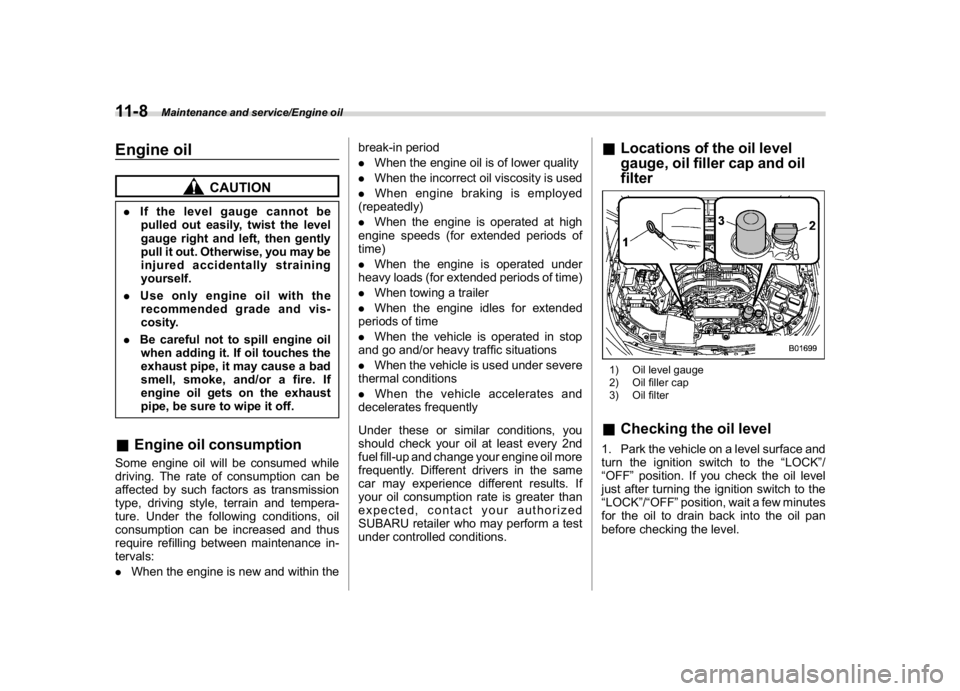
&Locations of the oil level
gauge, oil filler cap and oil
filter1) Oil level gauge
2) Oil filler cap
3) Oil filter&Checking the oil level1. Park the vehicle on a level surface and
turn the ignition switch to the“LOCK”/
“OFF”position. If you check the oil level
just after turning the ignition switch to the
“LOCK”/“OFF”position, wait a few minutes
for the oil to drain back into the oil pan
before checking the level.
Maintenance and service/Engine oil
11-8
Page 391 of 474
(404,1)
北米Model "A1320BE-C" EDITED: 2017/ 10/ 10
self, observe the local regulations and
dispose of waste oil properly.&Recommended grade and
viscosity
CAUTION
Use only engine oil with the recom-
mended grade and viscosity.
Refer to“Engine oil”F12-4.NOTEEngine oil viscosity (thickness) affects
fuel economy. Oils of lower viscosity
provide better fuel economy. However,
in hot weather, oil of higher viscosity is
required to properly lubricate the en-
gine.&Synthetic oilYou should use synthetic engine oil that
meets the same requirements given for
conventional engine oil. When using syn-
thetic oil, you must use oil of the same
classification, viscosity and grade shown
in this Owner’s Manual. Refer to“Engine
oil”F12-4. Also, you must follow the oil
and filter changing intervals shown in the
Warranty and Maintenance booklet.
NOTESynthetic oil of the grade and viscosity
noted in chapter 12 is the recom-
mended engine oil for optimum engine
performance. Conventional oil may be
used if synthetic oil is unavailable.
Cooling system&Safety precautions
WARNING
Never attempt to remove the radiator
cap until the engine has been shut
off and has cooled down completely.
Since the coolant is under pressure,
you may suffer serious burns from a
spray of boiling hot coolant when
the cap is removed.
CAUTION
.Vehicles are filled at the factory
with SUBARU Super Coolant that
does not require the first change
for 11 years/137,500 miles (11
years/220,000 km). This coolant
should not be mixed with any
other brand or type of coolant
during this period. Mixing with a
different coolant will reduce the
life of the coolant. Should it be
necessary to top up the coolant
for any reason, use only SUBARU
Super Coolant.
If the SUBARU Super Coolant is
diluted with another brand or
Maintenance and service/Cooling system
11-10
Page 392 of 474
(405,1)
北米Model "A1320BE-C" EDITED: 2017/ 10/ 10
type, the maintenance interval is
shortened to that of the mixing
coolant.
.Do not splash the engine coolant
over painted parts. The alcohol
contained in the engine coolant
may damage the paint surface.
&Cooling fan, hose and con-
nectionsYour vehicle employs an electric cooling
fan which is thermostatically controlled to
operate when the engine coolant reaches
a specific temperature.
If the radiator cooling fan does not operate
even when the coolant temperature high
warning light blinks or illuminates inRED,
the cooling fan circuit may be defective.
Refer to“Coolant temperature low indica-
tor light/Coolant temperature high warning
light”F3-16.
Check the fuse and replace it if necessary.
Refer to“Fuses”F11-34 and“Fuse panel
located in the engine compartment”F12-
12.
If the fuse is not blown, have the cooling
system checked by your SUBARU dealer.
If frequent addition of coolant is necessary,
there may be a leak in the engine coolingsystem. It is recommended that the cooling
system and connections be checked for
leaks, damage, or looseness.
&Engine coolant!Checking the coolant level
WARNING
Never attempt to remove the radiator
cap until the engine has been shut
off and has cooled down completely.
Since the coolant is under pressure,
you may suffer serious burns from a
spray of boiling hot coolant when
the cap is removed.
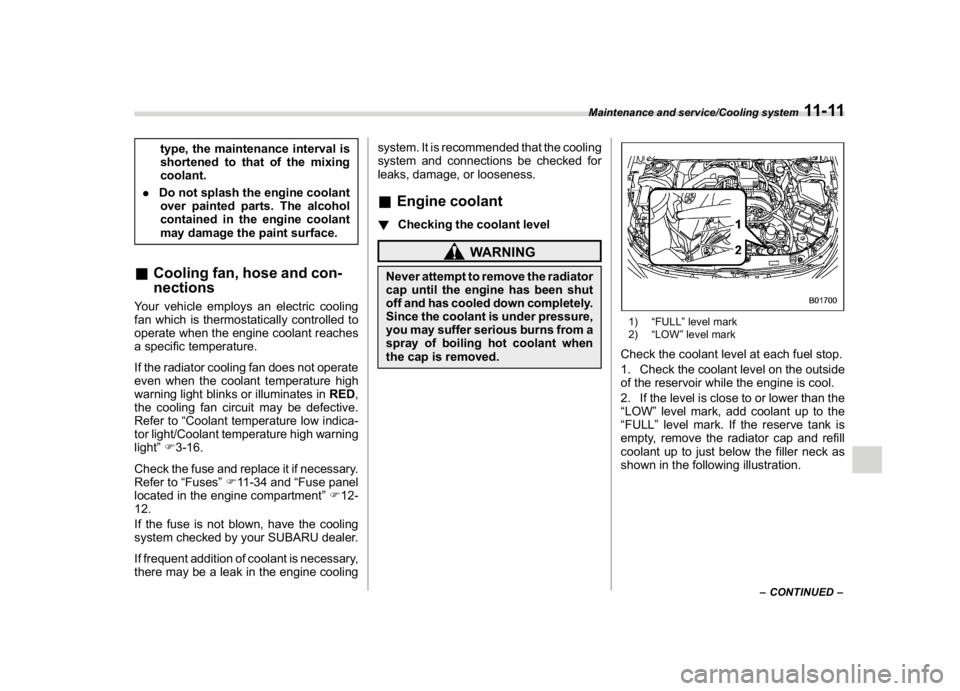
1)“FULL”level mark
2)“LOW”level markCheck the coolant level at each fuel stop.
1. Check the coolant level on the outside
of the reservoir while the engine is cool.
2. If the level is close to or lower than the
“LOW”level mark, add coolant up to the
“FULL”level mark. If the reserve tank is
empty, remove the radiator cap and refill
coolant up to just below the filler neck as
shown in the following illustration.
–CONTINUED–
Maintenance and service/Cooling system
11-11
11
Page 404 of 474
(417,1)
北米Model "A1320BE-C" EDITED: 2017/ 10/ 10
that cannot be seen with the naked eye.
This type of damage does not become
evident until time has passed. Try not to
drive over curbs, potholes or on other
rough surfaces. If doing so is unavoid-
able, keep the vehicle’s speed down to
a walking pace or less, and approach
the curbs as squarely as possible. Also,
make sure the tires are not pressed
against the curb when you park the
vehicle.
.If you feel unusual vibration while
driving or find it difficult to steer the
vehicle in a straight line, one of the tires
and/or wheels may be damaged. Drive
slowly to the nearest authorized
SUBARU dealer and have the vehicle
inspected.&Tire pressures and wearMaintaining the correct tire pressures
helps to maximize the tires’service lives
and is essential for good running perfor-
mance. Check and, if necessary, adjust
the pressure of each tire (including the
spare - if equipped) at least once a month
(for example, during a fuel stop) and
before any long journey.
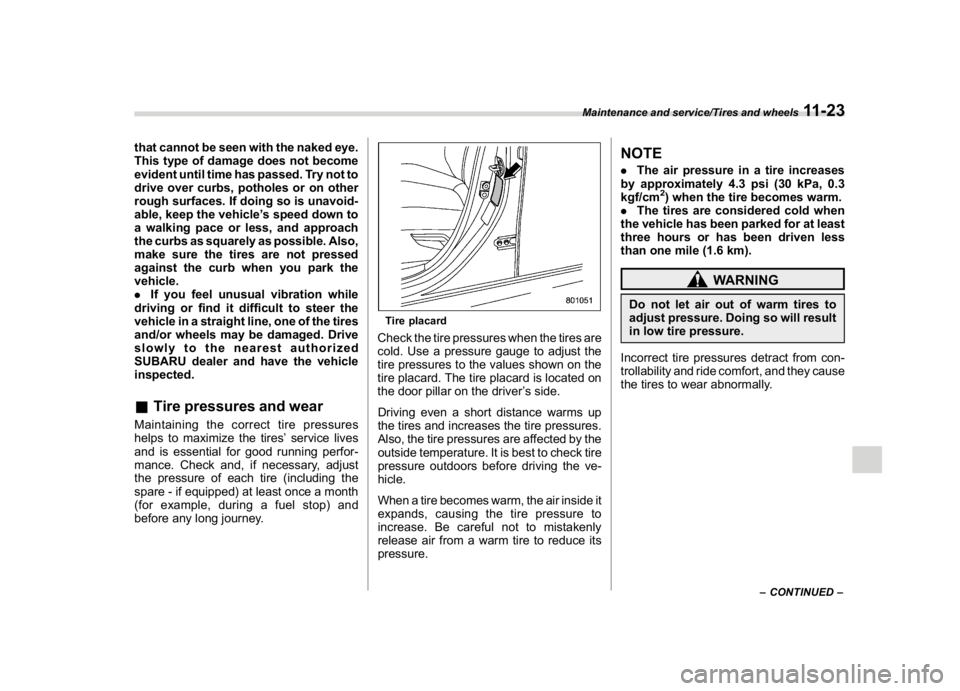
Tire placardCheck the tire pressures when the tires are
cold. Use a pressure gauge to adjust the
tire pressures to the values shown on the
tire placard. The tire placard is located on
the door pillar on the driver’s side.
Driving even a short distance warms up
the tires and increases the tire pressures.
Also, the tire pressures are affected by the
outside temperature. It is best to check tire
pressure outdoors before driving the ve-
hicle.
When a tire becomes warm, the air inside it
expands, causing the tire pressure to
increase. Be careful not to mistakenly
release air from a warm tire to reduce its
pressure.
NOTE.The air pressure in a tire increases
by approximately 4.3 psi (30 kPa, 0.3
kgf/cm
2) when the tire becomes warm.
.The tires are considered cold when
the vehicle has been parked for at least
three hours or has been driven less
than one mile (1.6 km).
WARNING
Do not let air out of warm tires to
adjust pressure. Doing so will result
in low tire pressure.
Incorrect tire pressures detract from con-
trollability and ride comfort, and they cause
the tires to wear abnormally.
–CONTINUED–
Maintenance and service/Tires and wheels
11-23
11
Page 428 of 474

(443,1)
北米Model "A1320BE-C" EDITED: 2017/ 10/ 10
&EngineEngine model
FB20
(2.0 L, DOHC, non-turbo)
Engine type Horizontally opposed, liquid cooled 4 cylinder, 4-stroke direct injection gasoline engine
Displacement cu-in (cc) 121.7 (1,995)
Bore6Stroke in (mm) 3.3163.54 (84.0690.0)
Compression ratio12.5 : 1
Firing order1–3–2–4&Fuel
Fuel requirement Fuel tank capacity
Unleaded gasoline with 87 AKI (90 RON) or higher16.6 US gal (63 liters, 13.9 Imp gal)
For more details, refer to“Fuel”F7-3.
–CONTINUED–
Specifications/Specifications
12-3
12
Page 431 of 474
(446,1)
北米Model "A1320BE-C" EDITED: 2017/ 10/ 10
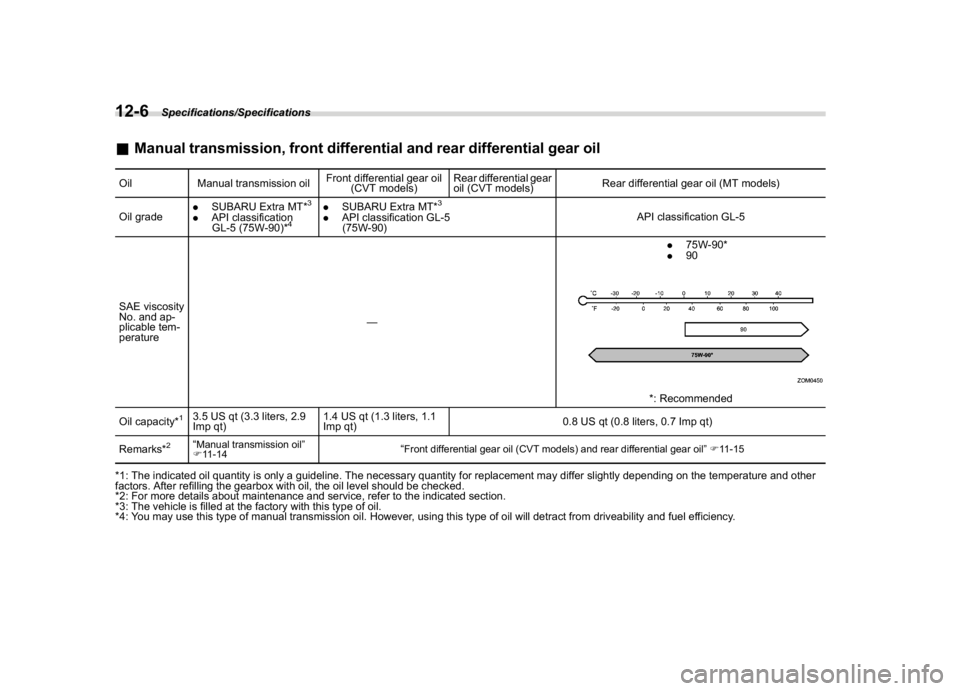
&Manual transmission, front differential and rear differential gear oilOil Manual transmission oilFront differential gear oil
(CVT models)Rear differential gear
oil (CVT models)Rear differential gear oil (MT models)
Oil grade.SUBARU Extra MT*
3
.API classification
GL-5 (75W-90)*
4
.SUBARU Extra MT*
3
.API classification GL-5
(75W-90)API classification GL-5
SAE viscosity
No. and ap-
plicable tem-
perature—.75W-90*
.90
*: Recommended
Oil capacity*
1
3.5 US qt (3.3 liters, 2.9
Imp qt)1.4 US qt (1.3 liters, 1.1
Imp qt)0.8 US qt (0.8 liters, 0.7 Imp qt)
Remarks*
2
“Manual transmission oil”
F11-14
“Front differential gear oil (CVT models) and rear differential gear oil”F11-15
*1: The indicated oil quantity is only a guideline. The necessary quantity for replacement may differ slightly depending on the temperature and other
factors. After refilling the gearbox with oil, the oil level should be checked.
*2: For more details about maintenance and service, refer to the indicated section.
*3: The vehicle is filled at the factory with this type of oil.
*4: You may use this type of manual transmission oil. However, using this type of oil will detract from driveability and fuel efficiency.
Specifications/Specifications
12-6