warning SUBARU FORESTER 1999 Service Owner's Manual
[x] Cancel search | Manufacturer: SUBARU, Model Year: 1999, Model line: FORESTER, Model: SUBARU FORESTER 1999Pages: 345, PDF Size: 5.6 MB
Page 60 of 345
3) Conduct appearance inspection on parts
selected.
NOTE:
Also check connector terminals, wiring harness,
case, etc. for damage.
:Is there anything unusual about the
appearance of airbag component
parts?
: Replace faulty airbag component parts.
: Go to step5X2.
5X2 : AIRBAG COMPONENT PARTS
VIBRATION INSPECTION
1) Gently shake check parts (to determine faults.).
2) To check airbag module or roll connector, turn
and tilt steering wheel.
CAUTION:
Do not shake or vibrate airbag control module.
:Does the component malfunction
again when shaking?
: Replace faulty airbag component parts.
: Go to step5X3.
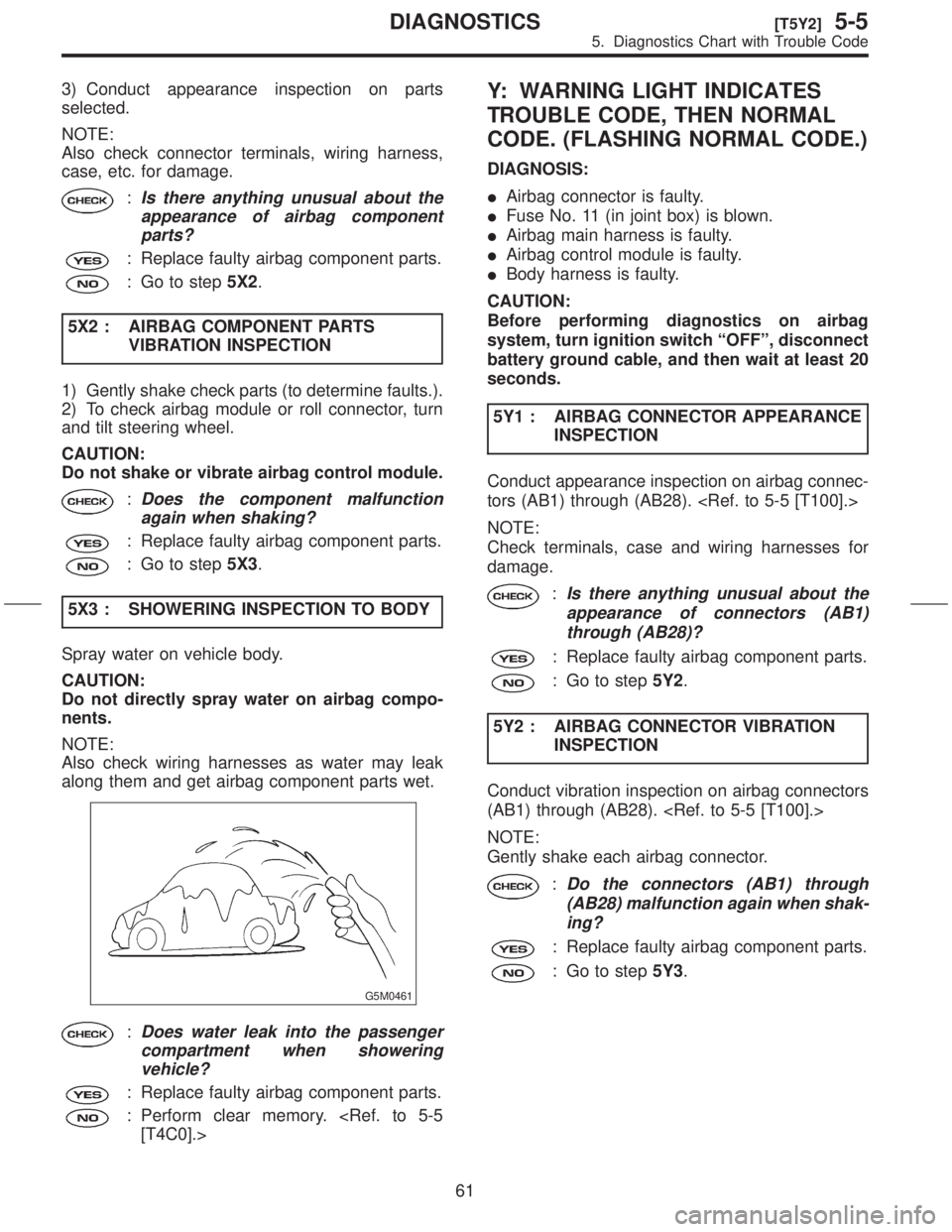
5X3 : SHOWERING INSPECTION TO BODY
Spray water on vehicle body.
CAUTION:
Do not directly spray water on airbag compo-
nents.
NOTE:
Also check wiring harnesses as water may leak
along them and get airbag component parts wet.
G5M0461
:Does water leak into the passenger
compartment when showering
vehicle?
: Replace faulty airbag component parts.
: Perform clear memory.
Y: WARNING LIGHT INDICATES
TROUBLE CODE, THEN NORMAL
CODE. (FLASHING NORMAL CODE.)
DIAGNOSIS:
IAirbag connector is faulty.
IFuse No. 11 (in joint box) is blown.
IAirbag main harness is faulty.
IAirbag control module is faulty.
IBody harness is faulty.
CAUTION:
Before performing diagnostics on airbag
system, turn ignition switch ªOFFº, disconnect
battery ground cable, and then wait at least 20
seconds.
5Y1 : AIRBAG CONNECTOR APPEARANCE
INSPECTION
Conduct appearance inspection on airbag connec-
tors (AB1) through (AB28).
NOTE:
Check terminals, case and wiring harnesses for
damage.
:Is there anything unusual about the
appearance of connectors (AB1)
through (AB28)?
: Replace faulty airbag component parts.
: Go to step5Y2.
5Y2 : AIRBAG CONNECTOR VIBRATION
INSPECTION
Conduct vibration inspection on airbag connectors
(AB1) through (AB28).
NOTE:
Gently shake each airbag connector.
:Do the connectors (AB1) through
(AB28) malfunction again when shak-
ing?
: Replace faulty airbag component parts.
: Go to step5Y3.
61
[T5Y2]5-5DIAGNOSTICS
5. Diagnostics Chart with Trouble Code
Page 62 of 345
5Y7 : WARNING LIGHT ILLUMINATION
CHECK
Turn ignition switch ªONº (engine off) and observe
airbag warning light.
:Does the airbag warning light come
on for about 7 seconds, then go out
and stay out?
: Perform clear memory.
: Go to ªDIAGNOSTICS PROCEDUREº.
63
[T5Y7]5-5DIAGNOSTICS
5. Diagnostics Chart with Trouble Code
Page 66 of 345
1A8 : CHECK VEHICLE SPEED SENSOR.
1) Connect connector to vehicle speed sensor.
2) Set the vehicle on a free roller, or lift-up the
vehicle and support with safety stands.
WARNING:
Be careful not to get caught in the rotating
wheels.
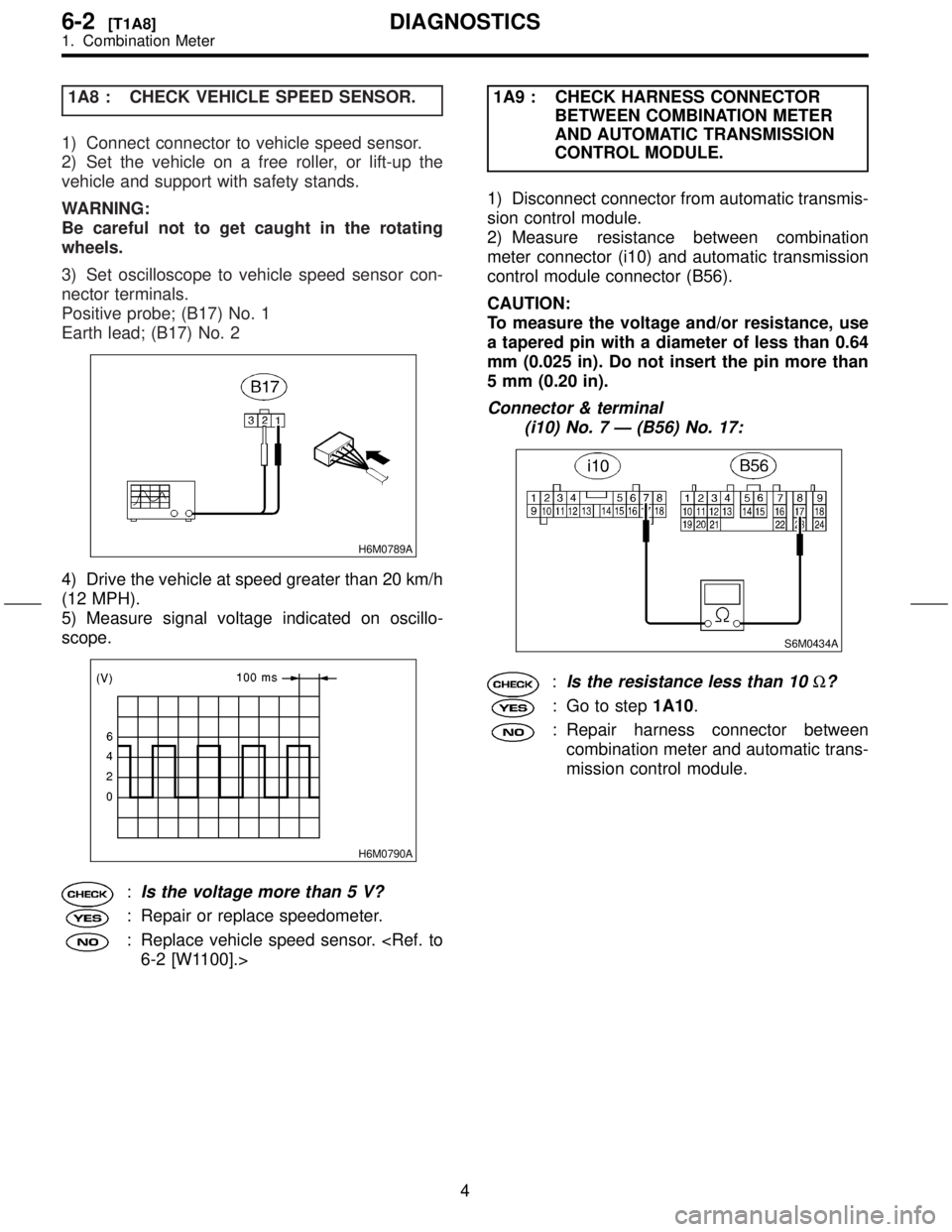
3) Set oscilloscope to vehicle speed sensor con-
nector terminals.
Positive probe; (B17) No. 1
Earth lead; (B17) No. 2
H6M0789A
4) Drive the vehicle at speed greater than 20 km/h
(12 MPH).
5) Measure signal voltage indicated on oscillo-
scope.
H6M0790A
:Is the voltage more than 5 V?
: Repair or replace speedometer.
: Replace vehicle speed sensor.
BETWEEN COMBINATION METER
AND AUTOMATIC TRANSMISSION
CONTROL MODULE.
1) Disconnect connector from automatic transmis-
sion control module.
2) Measure resistance between combination
meter connector (i10) and automatic transmission
control module connector (B56).
CAUTION:
To measure the voltage and/or resistance, use
a tapered pin with a diameter of less than 0.64
mm (0.025 in). Do not insert the pin more than
5 mm (0.20 in).
Connector & terminal
(i10) No. 7 Ð (B56) No. 17:
S6M0434A
:Is the resistance less than 10W?
: Go to step1A10.
: Repair harness connector between
combination meter and automatic trans-
mission control module.
4
6-2[T1A8]DIAGNOSTICS
1. Combination Meter
Page 67 of 345
1A10 : CHECK AUTOMATIC TRANSMIS-
SION CONTROL MODULE.
1) Connect connector to automatic transmission
control module.
2) Set the vehicle on a free roller, or lift-up the
vehicle and support with safety stands.
WARNING:
Be careful not to get caught in the rotating
wheels.
3) Drive the vehicle faster than 10 km/h (6 MPH).
4) Measure voltage between automatic transmis-
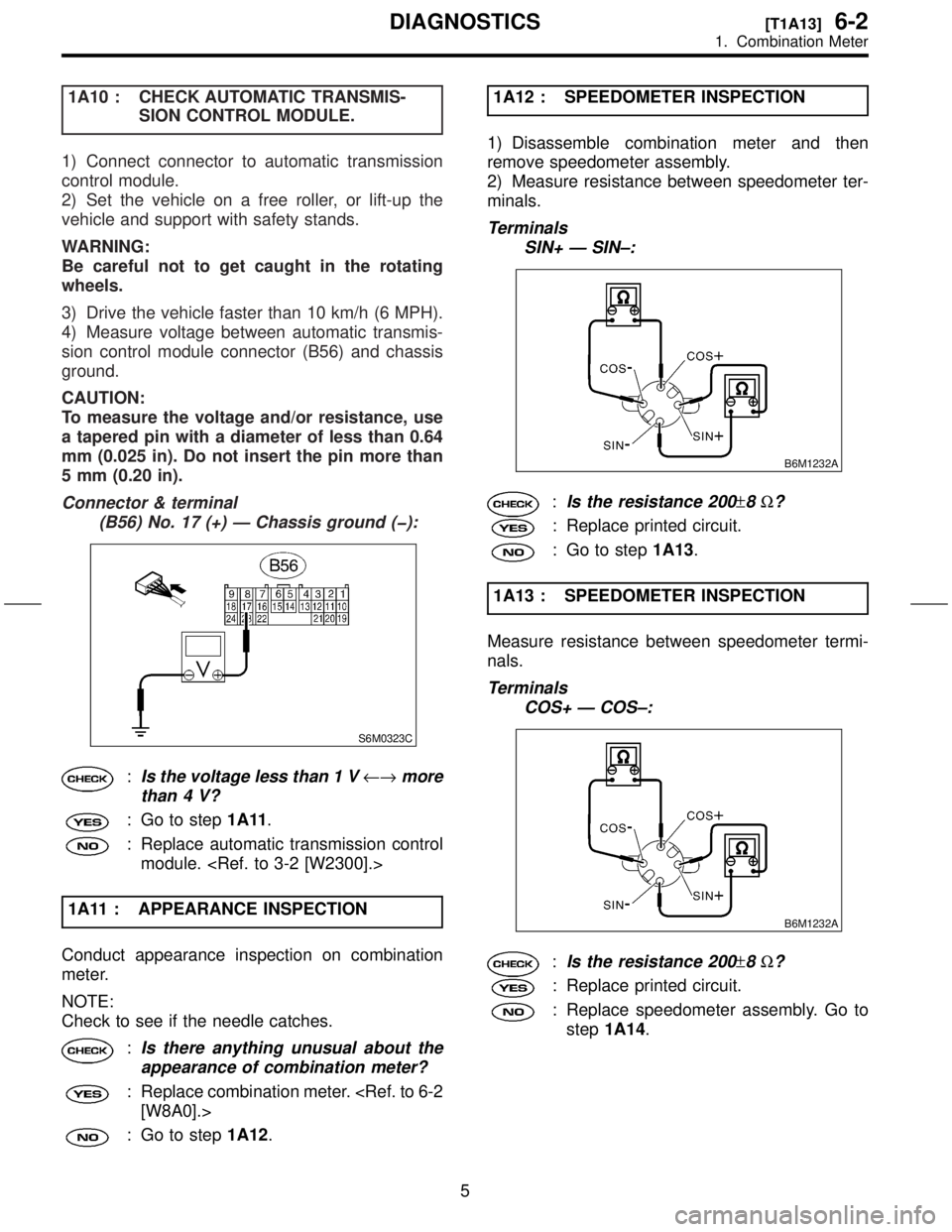
sion control module connector (B56) and chassis
ground.
CAUTION:
To measure the voltage and/or resistance, use
a tapered pin with a diameter of less than 0.64
mm (0.025 in). Do not insert the pin more than
5 mm (0.20 in).
Connector & terminal
(B56) No. 17 (+) Ð Chassis ground (þ):
S6M0323C
:Is the voltage less than 1 V¨more
than 4 V?
: Go to step1A11.
: Replace automatic transmission control
module.
1A11 : APPEARANCE INSPECTION
Conduct appearance inspection on combination
meter.
NOTE:
Check to see if the needle catches.
:Is there anything unusual about the
appearance of combination meter?
: Replace combination meter.
: Go to step1A12.1A12 : SPEEDOMETER INSPECTION
1) Disassemble combination meter and then
remove speedometer assembly.
2) Measure resistance between speedometer ter-
minals.
Terminals
SIN+ Ð SIN±:
B6M1232A
:Is the resistance 200±8W?
: Replace printed circuit.
: Go to step1A13.
1A13 : SPEEDOMETER INSPECTION
Measure resistance between speedometer termi-
nals.
Terminals
COS+ Ð COS±:
B6M1232A
:Is the resistance 200±8W?
: Replace printed circuit.
: Replace speedometer assembly. Go to
step1A14.
5
[T1A13]6-2DIAGNOSTICS
1. Combination Meter
Page 102 of 345
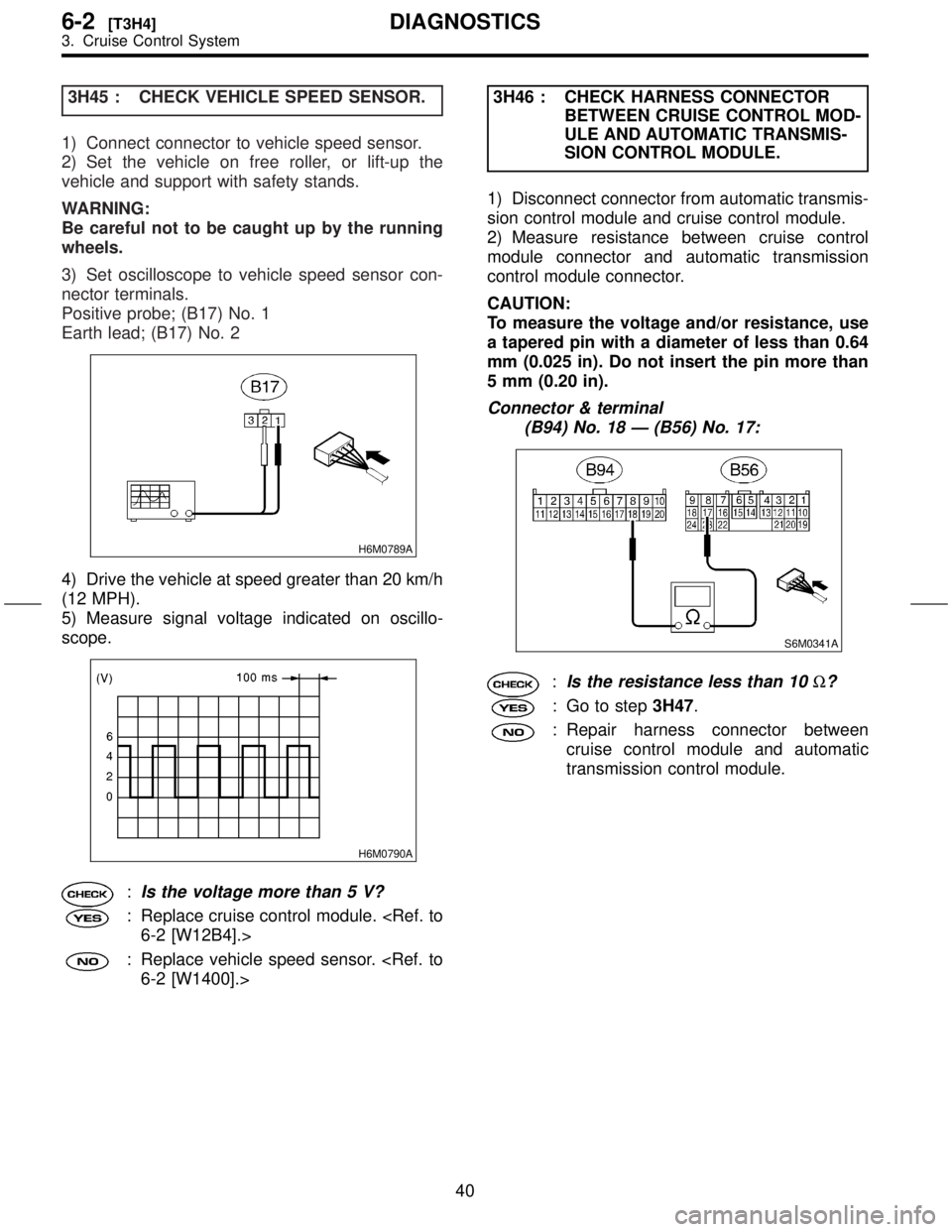
3H45 : CHECK VEHICLE SPEED SENSOR.
1) Connect connector to vehicle speed sensor.
2) Set the vehicle on free roller, or lift-up the
vehicle and support with safety stands.
WARNING:
Be careful not to be caught up by the running
wheels.
3) Set oscilloscope to vehicle speed sensor con-
nector terminals.
Positive probe; (B17) No. 1
Earth lead; (B17) No. 2
H6M0789A
4) Drive the vehicle at speed greater than 20 km/h
(12 MPH).
5) Measure signal voltage indicated on oscillo-
scope.
H6M0790A
:Is the voltage more than 5 V?
: Replace cruise control module.
: Replace vehicle speed sensor.
BETWEEN CRUISE CONTROL MOD-
ULE AND AUTOMATIC TRANSMIS-
SION CONTROL MODULE.
1) Disconnect connector from automatic transmis-
sion control module and cruise control module.
2) Measure resistance between cruise control
module connector and automatic transmission
control module connector.
CAUTION:
To measure the voltage and/or resistance, use
a tapered pin with a diameter of less than 0.64
mm (0.025 in). Do not insert the pin more than
5 mm (0.20 in).
Connector & terminal
(B94) No. 18 Ð (B56) No. 17:
S6M0341A
:Is the resistance less than 10W?
: Go to step3H47.
: Repair harness connector between
cruise control module and automatic
transmission control module.
40
6-2[T3H4]DIAGNOSTICS
3. Cruise Control System
Page 103 of 345
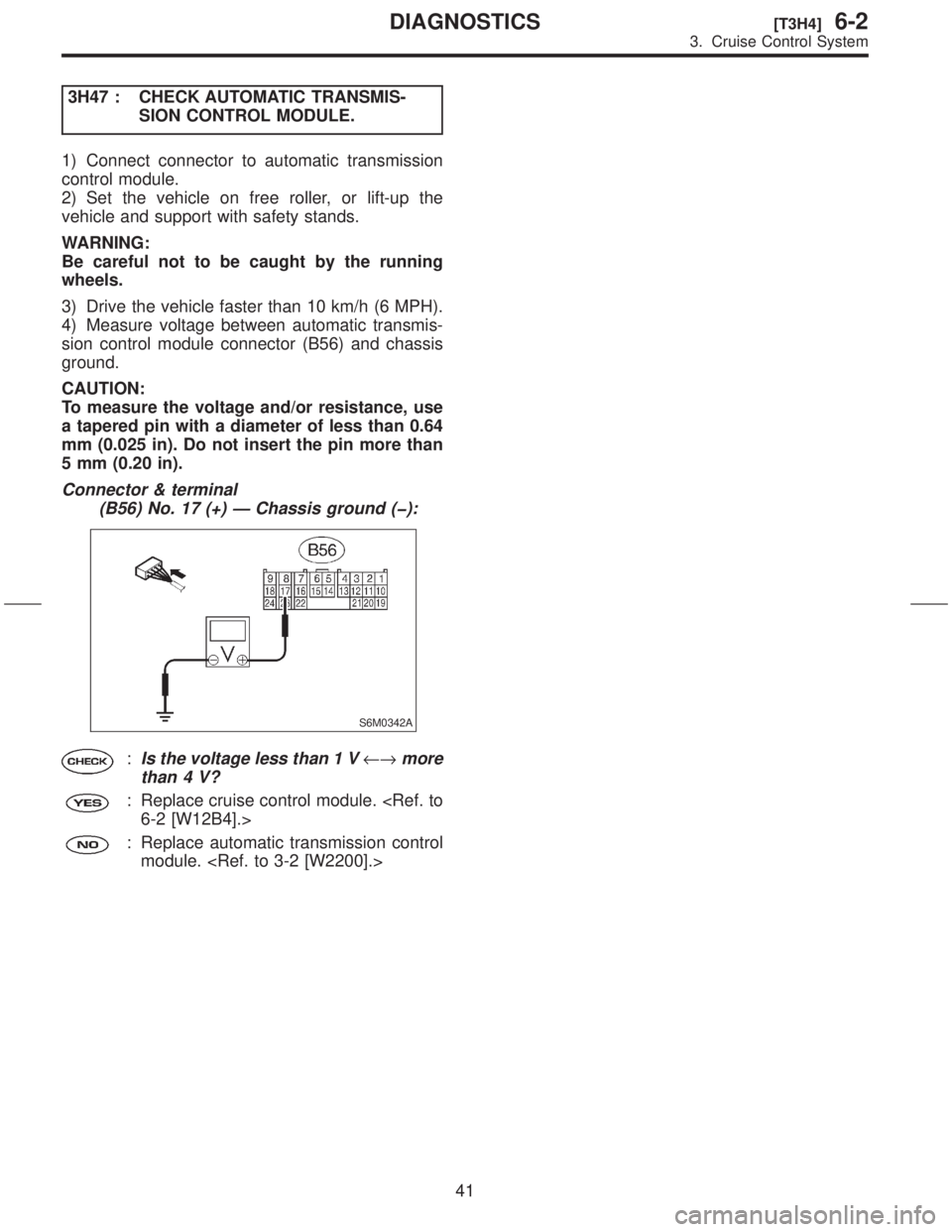
3H47 : CHECK AUTOMATIC TRANSMIS-
SION CONTROL MODULE.
1) Connect connector to automatic transmission
control module.
2) Set the vehicle on free roller, or lift-up the
vehicle and support with safety stands.
WARNING:
Be careful not to be caught by the running
wheels.
3) Drive the vehicle faster than 10 km/h (6 MPH).
4) Measure voltage between automatic transmis-
sion control module connector (B56) and chassis
ground.
CAUTION:
To measure the voltage and/or resistance, use
a tapered pin with a diameter of less than 0.64
mm (0.025 in). Do not insert the pin more than
5 mm (0.20 in).
Connector & terminal
(B56) No. 17 (+) Ð Chassis ground (þ):
S6M0342A
:Is the voltage less than 1 V¨more
than 4 V?
: Replace cruise control module.
: Replace automatic transmission control
module.
41
[T3H4]6-2DIAGNOSTICS
3. Cruise Control System
Page 122 of 345
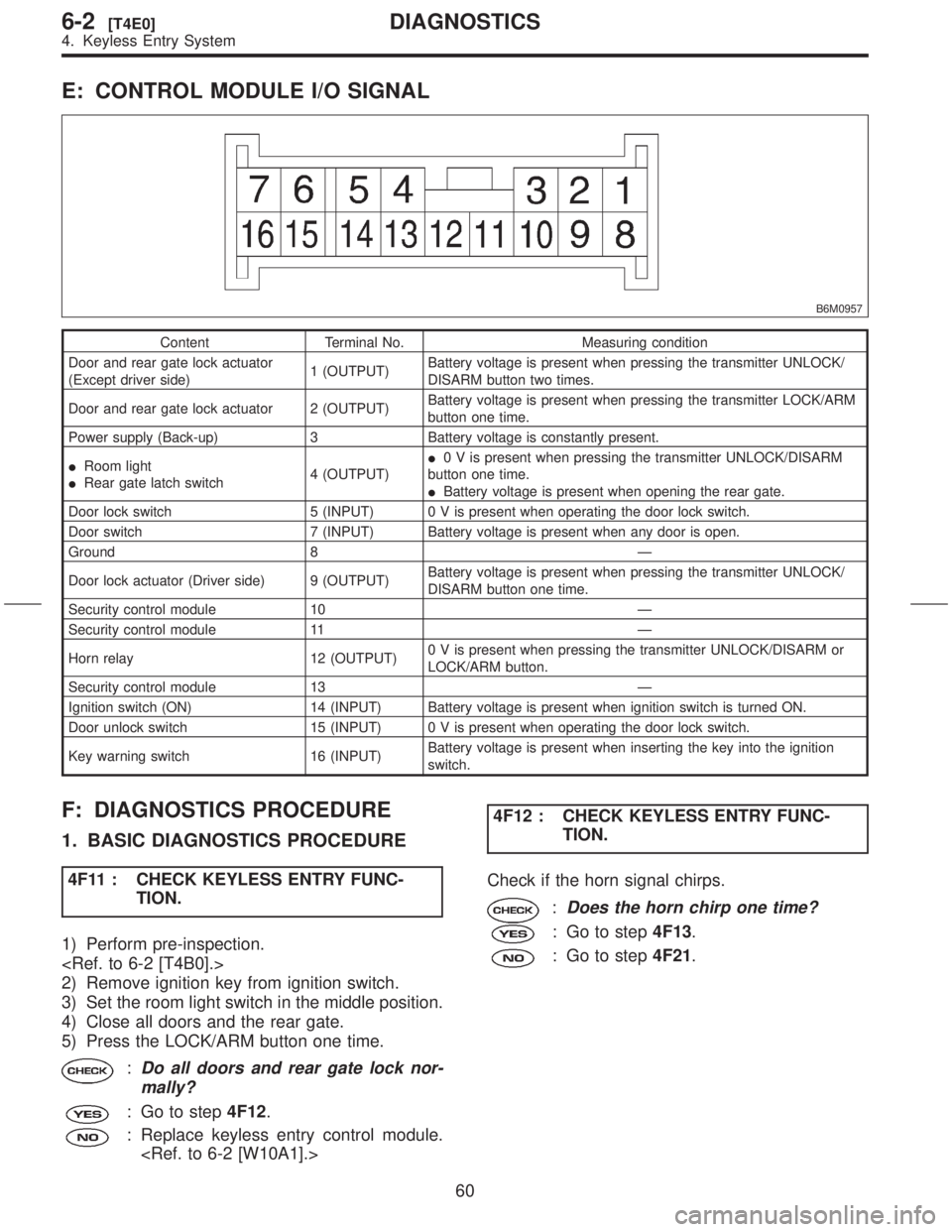
E: CONTROL MODULE I/O SIGNAL
B6M0957
Content Terminal No. Measuring condition
Door and rear gate lock actuator
(Except driver side)1 (OUTPUT)Battery voltage is present when pressing the transmitter UNLOCK/
DISARM button two times.
Door and rear gate lock actuator 2 (OUTPUT)Battery voltage is present when pressing the transmitter LOCK/ARM
button one time.
Power supply (Back-up) 3 Battery voltage is constantly present.
IRoom light
IRear gate latch switch4 (OUTPUT)I0 V is present when pressing the transmitter UNLOCK/DISARM
button one time.
IBattery voltage is present when opening the rear gate.
Door lock switch 5 (INPUT) 0 V is present when operating the door lock switch.
Door switch 7 (INPUT) Battery voltage is present when any door is open.
Ground 8 Ð
Door lock actuator (Driver side) 9 (OUTPUT)Battery voltage is present when pressing the transmitter UNLOCK/
DISARM button one time.
Security control module 10 Ð
Security control module 11 Ð
Horn relay 12 (OUTPUT)0 V is present when pressing the transmitter UNLOCK/DISARM or
LOCK/ARM button.
Security control module 13 Ð
Ignition switch (ON) 14 (INPUT) Battery voltage is present when ignition switch is turned ON.
Door unlock switch 15 (INPUT) 0 V is present when operating the door lock switch.
Key warning switch 16 (INPUT)Battery voltage is present when inserting the key into the ignition
switch.
F: DIAGNOSTICS PROCEDURE
1. BASIC DIAGNOSTICS PROCEDURE
4F11 : CHECK KEYLESS ENTRY FUNC-
TION.
1) Perform pre-inspection.
2) Remove ignition key from ignition switch.
3) Set the room light switch in the middle position.
4) Close all doors and the rear gate.
5) Press the LOCK/ARM button one time.
:Do all doors and rear gate lock nor-
mally?
: Go to step4F12.
: Replace keyless entry control module.
TION.
Check if the horn signal chirps.
:Does the horn chirp one time?
: Go to step4F13.
: Go to step4F21.
60
6-2[T4E0]DIAGNOSTICS
4. Keyless Entry System
Page 130 of 345
6. DIAGNOSTICS ITEM 5
4F61 : CHECK FUSE.
Remove and visually check the fuse No. 6 (in main
fuse box).
:Is fuse No. 6 blown?
: Replace fuse (15 A).
: Go to step4F62.
4F62 : CHECK KEYLESS ENTRY CONTROL
MODULE.
1) Disconnect connector from keyless entry con-
trol module.
2) Insert the key to ignition switch (LOCK posi-
tion).
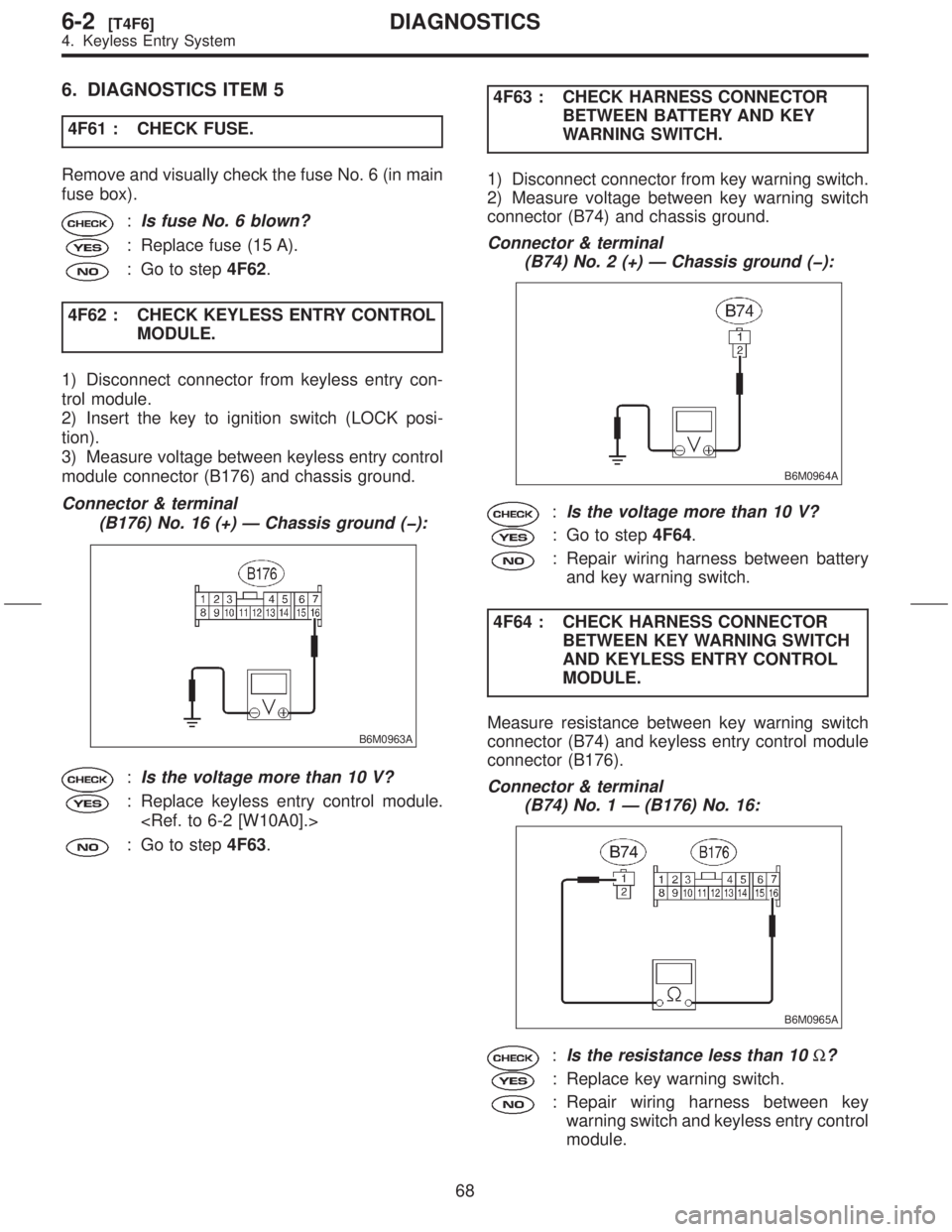
3) Measure voltage between keyless entry control
module connector (B176) and chassis ground.
Connector & terminal
(B176) No. 16 (+) Ð Chassis ground (þ):
B6M0963A
:Is the voltage more than 10 V?
: Replace keyless entry control module.
: Go to step4F63.4F63 : CHECK HARNESS CONNECTOR
BETWEEN BATTERY AND KEY
WARNING SWITCH.
1) Disconnect connector from key warning switch.
2) Measure voltage between key warning switch
connector (B74) and chassis ground.
Connector & terminal
(B74) No. 2 (+) Ð Chassis ground (þ):
B6M0964A
:Is the voltage more than 10 V?
: Go to step4F64.
: Repair wiring harness between battery
and key warning switch.
4F64 : CHECK HARNESS CONNECTOR
BETWEEN KEY WARNING SWITCH
AND KEYLESS ENTRY CONTROL
MODULE.
Measure resistance between key warning switch
connector (B74) and keyless entry control module
connector (B176).
Connector & terminal
(B74) No. 1 Ð (B176) No. 16:
B6M0965A
:Is the resistance less than 10W?
: Replace key warning switch.
: Repair wiring harness between key
warning switch and keyless entry control
module.
68
6-2[T4F6]DIAGNOSTICS
4. Keyless Entry System
Page 259 of 345
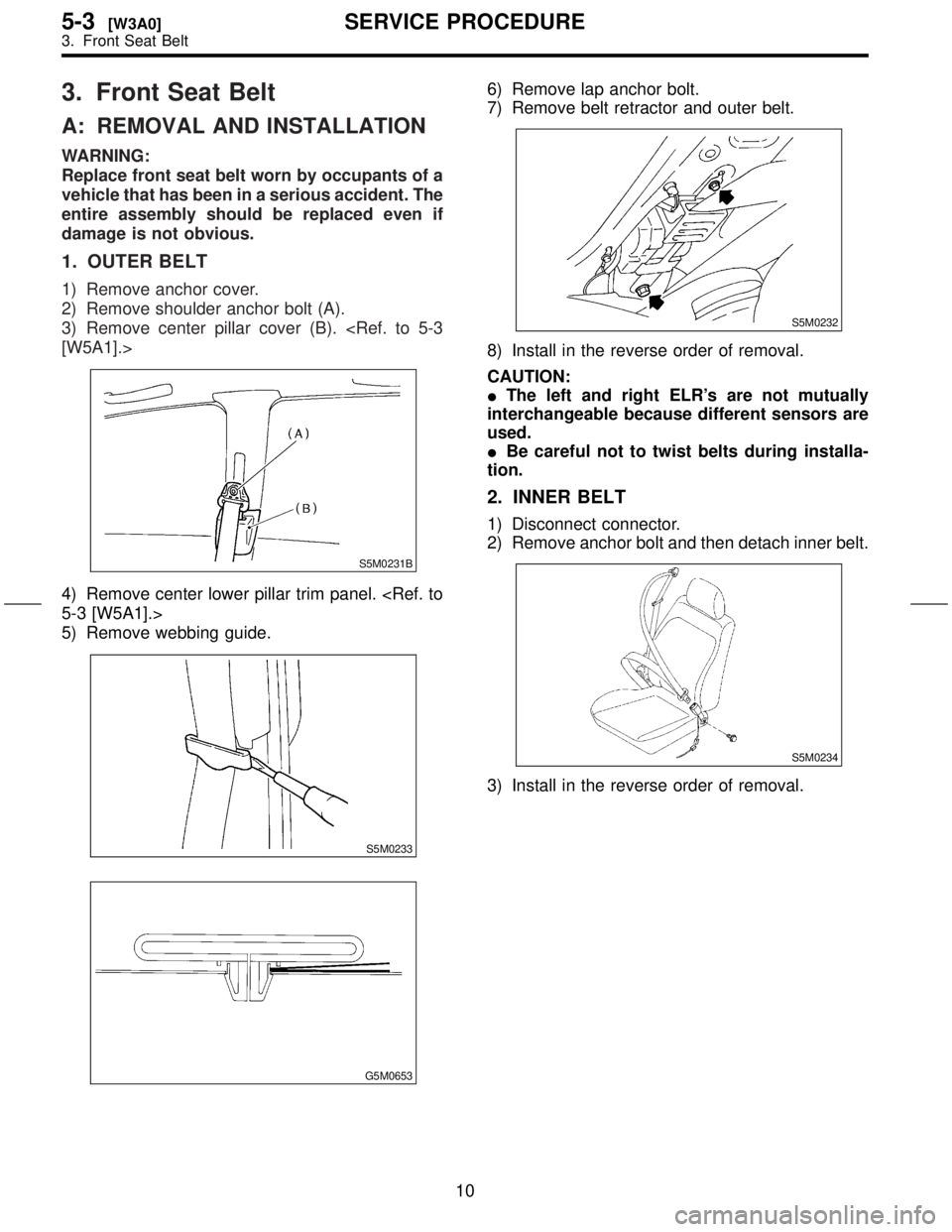
3. Front Seat Belt
A: REMOVAL AND INSTALLATION
WARNING:
Replace front seat belt worn by occupants of a
vehicle that has been in a serious accident. The
entire assembly should be replaced even if
damage is not obvious.
1. OUTER BELT
1) Remove anchor cover.
2) Remove shoulder anchor bolt (A).
3) Remove center pillar cover (B).
S5M0231B
4) Remove center lower pillar trim panel.
5) Remove webbing guide.
S5M0233
G5M0653
6) Remove lap anchor bolt.
7) Remove belt retractor and outer belt.
S5M0232
8) Install in the reverse order of removal.
CAUTION:
IThe left and right ELR's are not mutually
interchangeable because different sensors are
used.
IBe careful not to twist belts during installa-
tion.
2. INNER BELT
1) Disconnect connector.
2) Remove anchor bolt and then detach inner belt.
S5M0234
3) Install in the reverse order of removal.
10
5-3[W3A0]SERVICE PROCEDURE
3. Front Seat Belt
Page 260 of 345
![SUBARU FORESTER 1999 Service Owners Manual 3. ADJUSTABLE SHOULDER ANCHOR
1) Remove shoulder anchor bolt. <Ref. to 5-3
[W3A1].>
2) Remove center pillar cover. <Ref. to 5-3
[W5A1].>
3) Remove center pillar upper trim. <Ref. to 5-3
[W5A1].>
4) Re](/img/17/57427/w960_57427-259.png "SUBARU FORESTER 1999 Service Owners Manual 3. ADJUSTABLE SHOULDER ANCHOR
1) Remove shoulder anchor bolt. <Ref. to 5-3
[W3A1].>
2) Remove center pillar cover. <Ref. to 5-3
[W5A1].>
3) Remove center pillar upper trim. <Ref. to 5-3
[W5A1].>
4) Re")
3. ADJUSTABLE SHOULDER ANCHOR
1) Remove shoulder anchor bolt.
2) Remove center pillar cover.
3) Remove center pillar upper trim.
4) Remove adjustable shoulder anchor assembly.
S5M0235
5) Install in the reverse order of removal.
4. Rear Seat Belt
A: REMOVAL AND INSTALLATION
WARNING:
Replace rear seat belt worn by occupants of a
vehicle that has been in a serious accident. The
entire assembly should be replaced even if
damage is not obvious.
1. OUTER BELT (OUTSIDE)
1) Remove rear cushion.
2) Remove rear backrest.
3) Remove rear quarter upper trim and rear quar-
ter lower trim.
4) Remove anchor cover and then remove anchor
bolt.
5) Remove bolt and nut and then detach outer belt
assembly.
S5M0236
6) Install in the reverse order of removal.
NOTE:
Ensure that seat belt is properly reeled on and off
after installation of ELR.
CAUTION:
IBe extremely careful not to confuse center
seat anchor plate with outer seat anchor plate
during installation.
IEnsure that seat belts are free from twisting
after installation.
IEnsure that tongues, buckles and belts are
properly placed on seat.
11
[W4A1]5-3SERVICE PROCEDURE
4. Rear Seat Belt