ignition SUBARU FORESTER 1999 Service Owner's Guide
[x] Cancel search | Manufacturer: SUBARU, Model Year: 1999, Model line: FORESTER, Model: SUBARU FORESTER 1999Pages: 345, PDF Size: 5.6 MB
Page 58 of 345
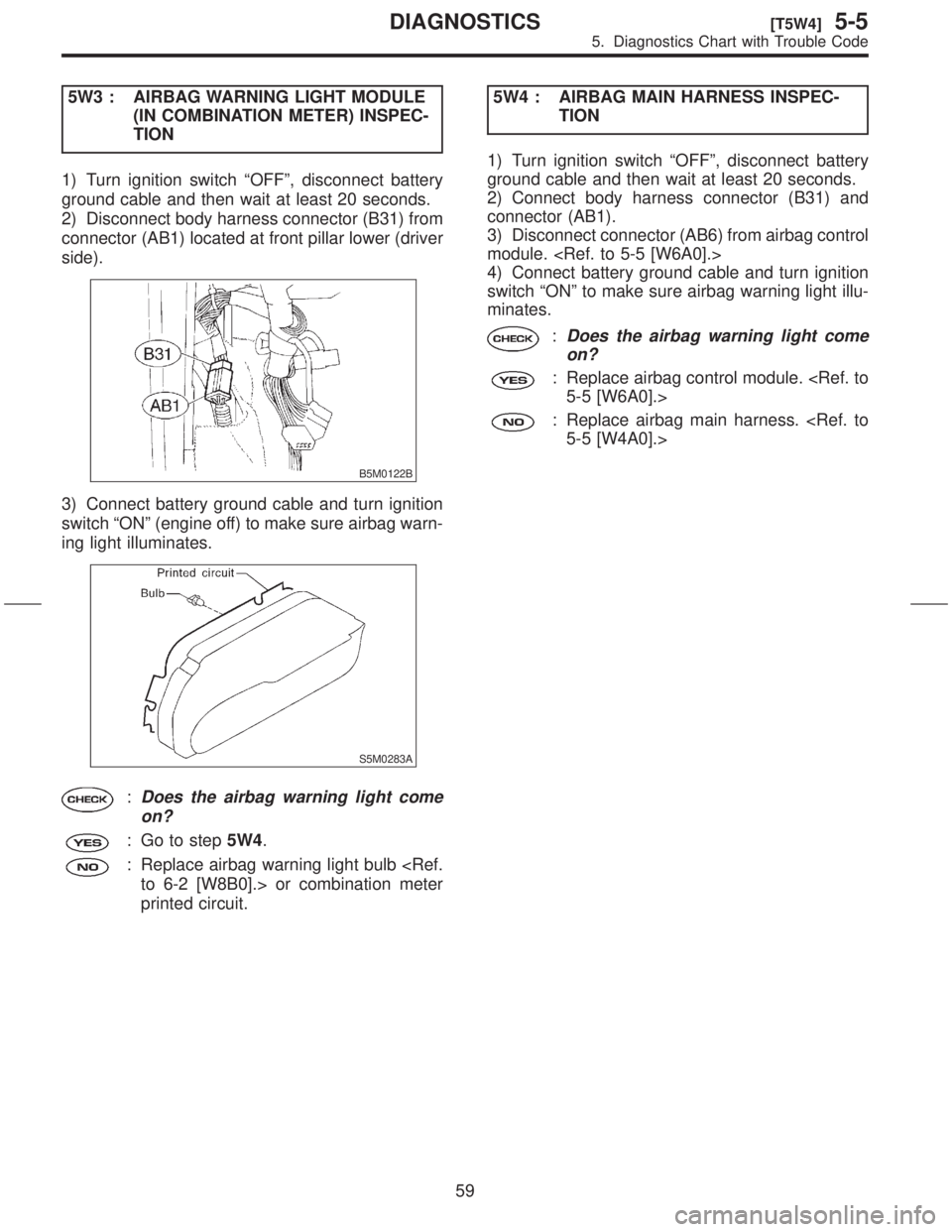
5W3 : AIRBAG WARNING LIGHT MODULE
(IN COMBINATION METER) INSPEC-
TION
1) Turn ignition switch ªOFFº, disconnect battery
ground cable and then wait at least 20 seconds.
2) Disconnect body harness connector (B31) from
connector (AB1) located at front pillar lower (driver
side).
B5M0122B
3) Connect battery ground cable and turn ignition
switch ªONº (engine off) to make sure airbag warn-
ing light illuminates.
S5M0283A
:Does the airbag warning light come
on?
: Go to step5W4.
: Replace airbag warning light bulb
printed circuit.5W4 : AIRBAG MAIN HARNESS INSPEC-
TION
1) Turn ignition switch ªOFFº, disconnect battery
ground cable and then wait at least 20 seconds.
2) Connect body harness connector (B31) and
connector (AB1).
3) Disconnect connector (AB6) from airbag control
module.
4) Connect battery ground cable and turn ignition
switch ªONº to make sure airbag warning light illu-
minates.
:Does the airbag warning light come
on?
: Replace airbag control module.
: Replace airbag main harness.
59
[T5W4]5-5DIAGNOSTICS
5. Diagnostics Chart with Trouble Code
Page 59 of 345
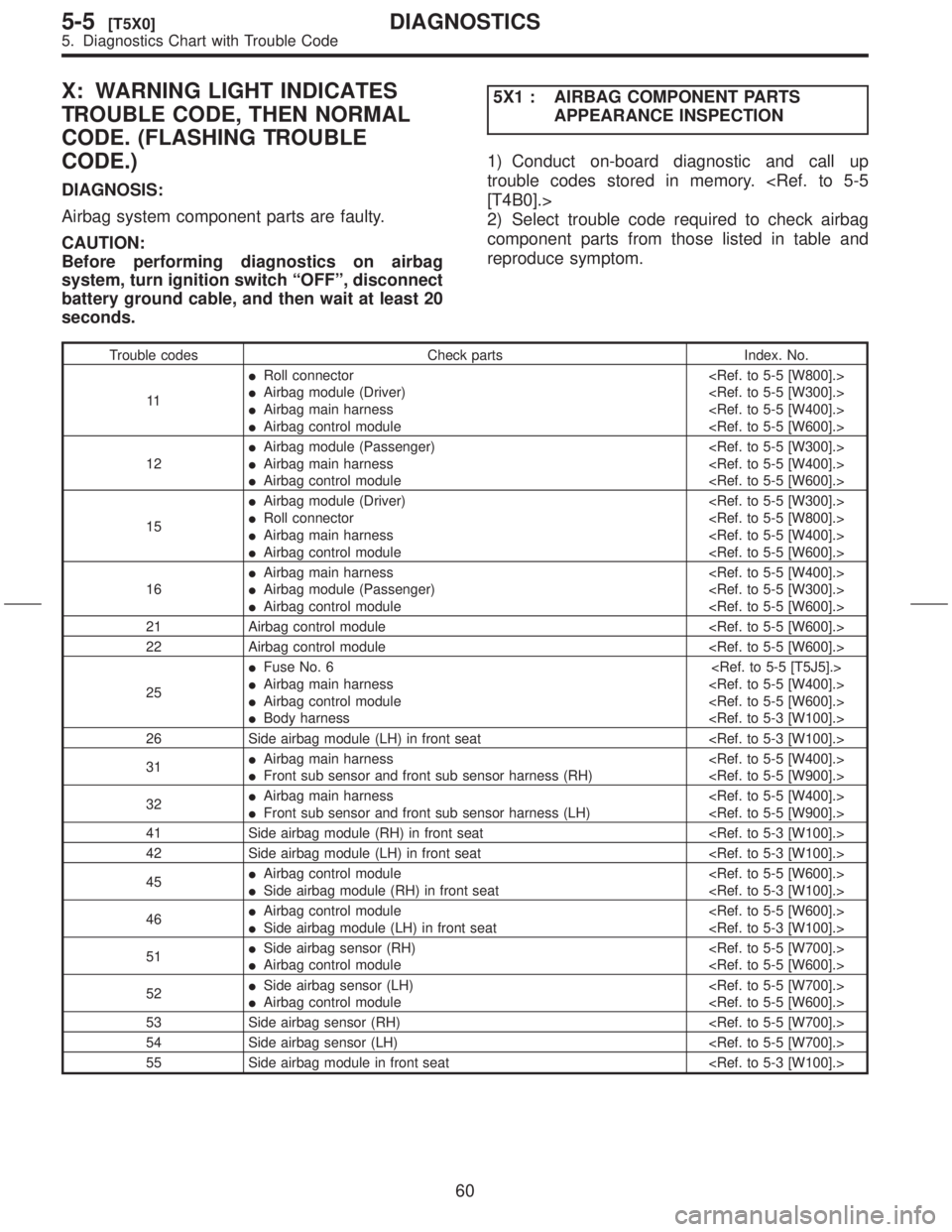
X: WARNING LIGHT INDICATES
TROUBLE CODE, THEN NORMAL
CODE. (FLASHING TROUBLE
CODE.)
DIAGNOSIS:
Airbag system component parts are faulty.
CAUTION:
Before performing diagnostics on airbag
system, turn ignition switch ªOFFº, disconnect
battery ground cable, and then wait at least 20
seconds.5X1 : AIRBAG COMPONENT PARTS
APPEARANCE INSPECTION
1) Conduct on-board diagnostic and call up
trouble codes stored in memory.
2) Select trouble code required to check airbag
component parts from those listed in table and
reproduce symptom.
Trouble codes Check parts Index. No.
11IRoll connector
IAirbag module (Driver)
IAirbag main harness
IAirbag control module
12IAirbag module (Passenger)
IAirbag main harness
IAirbag control module
15IAirbag module (Driver)
IRoll connector
IAirbag main harness
IAirbag control module
16IAirbag main harness
IAirbag module (Passenger)
IAirbag control module
21 Airbag control module
22 Airbag control module
25IFuse No. 6
IAirbag main harness
IAirbag control module
IBody harness
26 Side airbag module (LH) in front seat
31IAirbag main harness
IFront sub sensor and front sub sensor harness (RH)
32IAirbag main harness
IFront sub sensor and front sub sensor harness (LH)
41 Side airbag module (RH) in front seat
42 Side airbag module (LH) in front seat
45IAirbag control module
ISide airbag module (RH) in front seat
46IAirbag control module
ISide airbag module (LH) in front seat
51ISide airbag sensor (RH)
IAirbag control module
52ISide airbag sensor (LH)
IAirbag control module
53 Side airbag sensor (RH)
54 Side airbag sensor (LH)
55 Side airbag module in front seat
60
5-5[T5X0]DIAGNOSTICS
5. Diagnostics Chart with Trouble Code
Page 60 of 345
3) Conduct appearance inspection on parts
selected.
NOTE:
Also check connector terminals, wiring harness,
case, etc. for damage.
:Is there anything unusual about the
appearance of airbag component
parts?
: Replace faulty airbag component parts.
: Go to step5X2.
5X2 : AIRBAG COMPONENT PARTS
VIBRATION INSPECTION
1) Gently shake check parts (to determine faults.).
2) To check airbag module or roll connector, turn
and tilt steering wheel.
CAUTION:
Do not shake or vibrate airbag control module.
:Does the component malfunction
again when shaking?
: Replace faulty airbag component parts.
: Go to step5X3.
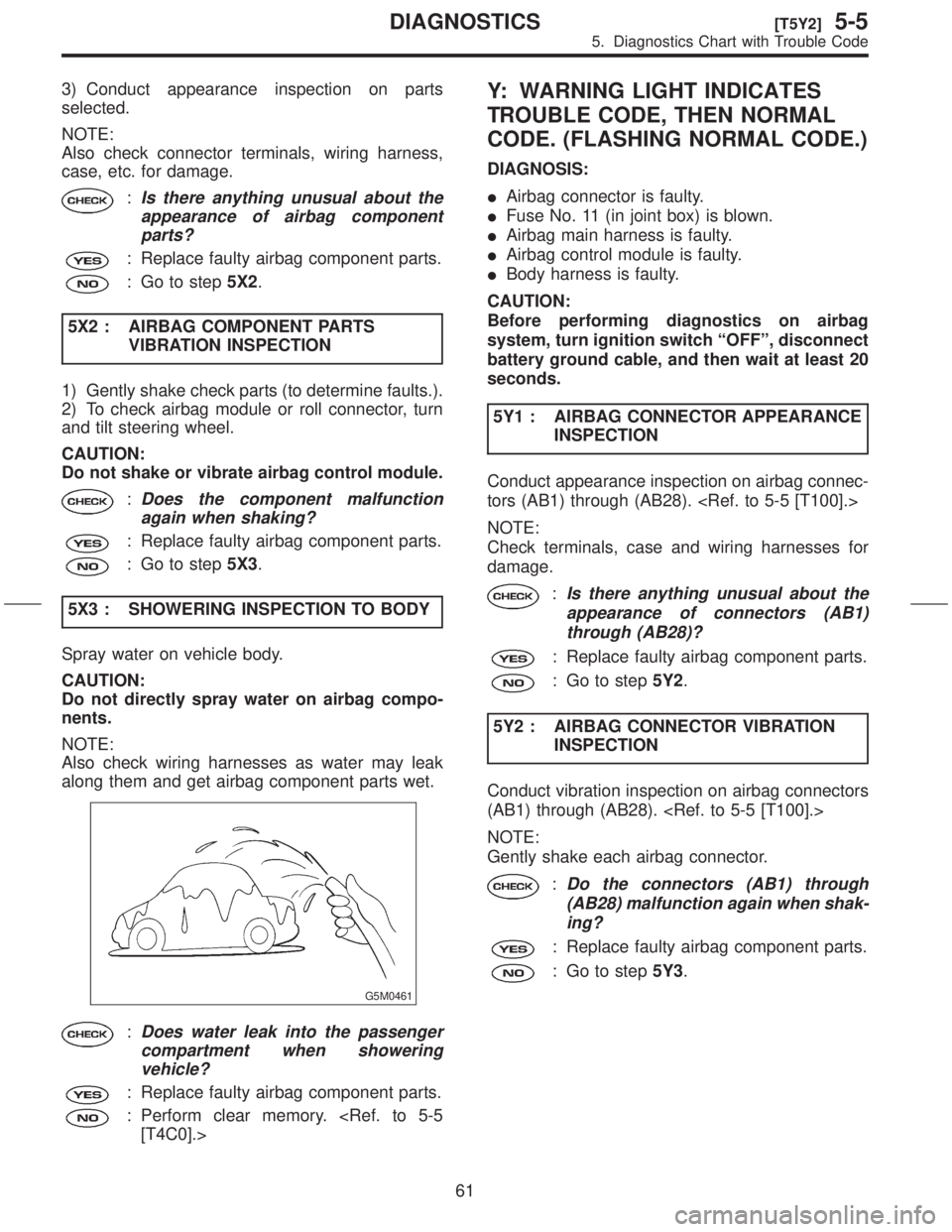
5X3 : SHOWERING INSPECTION TO BODY
Spray water on vehicle body.
CAUTION:
Do not directly spray water on airbag compo-
nents.
NOTE:
Also check wiring harnesses as water may leak
along them and get airbag component parts wet.
G5M0461
:Does water leak into the passenger
compartment when showering
vehicle?
: Replace faulty airbag component parts.
: Perform clear memory.
Y: WARNING LIGHT INDICATES
TROUBLE CODE, THEN NORMAL
CODE. (FLASHING NORMAL CODE.)
DIAGNOSIS:
IAirbag connector is faulty.
IFuse No. 11 (in joint box) is blown.
IAirbag main harness is faulty.
IAirbag control module is faulty.
IBody harness is faulty.
CAUTION:
Before performing diagnostics on airbag
system, turn ignition switch ªOFFº, disconnect
battery ground cable, and then wait at least 20
seconds.
5Y1 : AIRBAG CONNECTOR APPEARANCE
INSPECTION
Conduct appearance inspection on airbag connec-
tors (AB1) through (AB28).
NOTE:
Check terminals, case and wiring harnesses for
damage.
:Is there anything unusual about the
appearance of connectors (AB1)
through (AB28)?
: Replace faulty airbag component parts.
: Go to step5Y2.
5Y2 : AIRBAG CONNECTOR VIBRATION
INSPECTION
Conduct vibration inspection on airbag connectors
(AB1) through (AB28).
NOTE:
Gently shake each airbag connector.
:Do the connectors (AB1) through
(AB28) malfunction again when shak-
ing?
: Replace faulty airbag component parts.
: Go to step5Y3.
61
[T5Y2]5-5DIAGNOSTICS
5. Diagnostics Chart with Trouble Code
Page 62 of 345
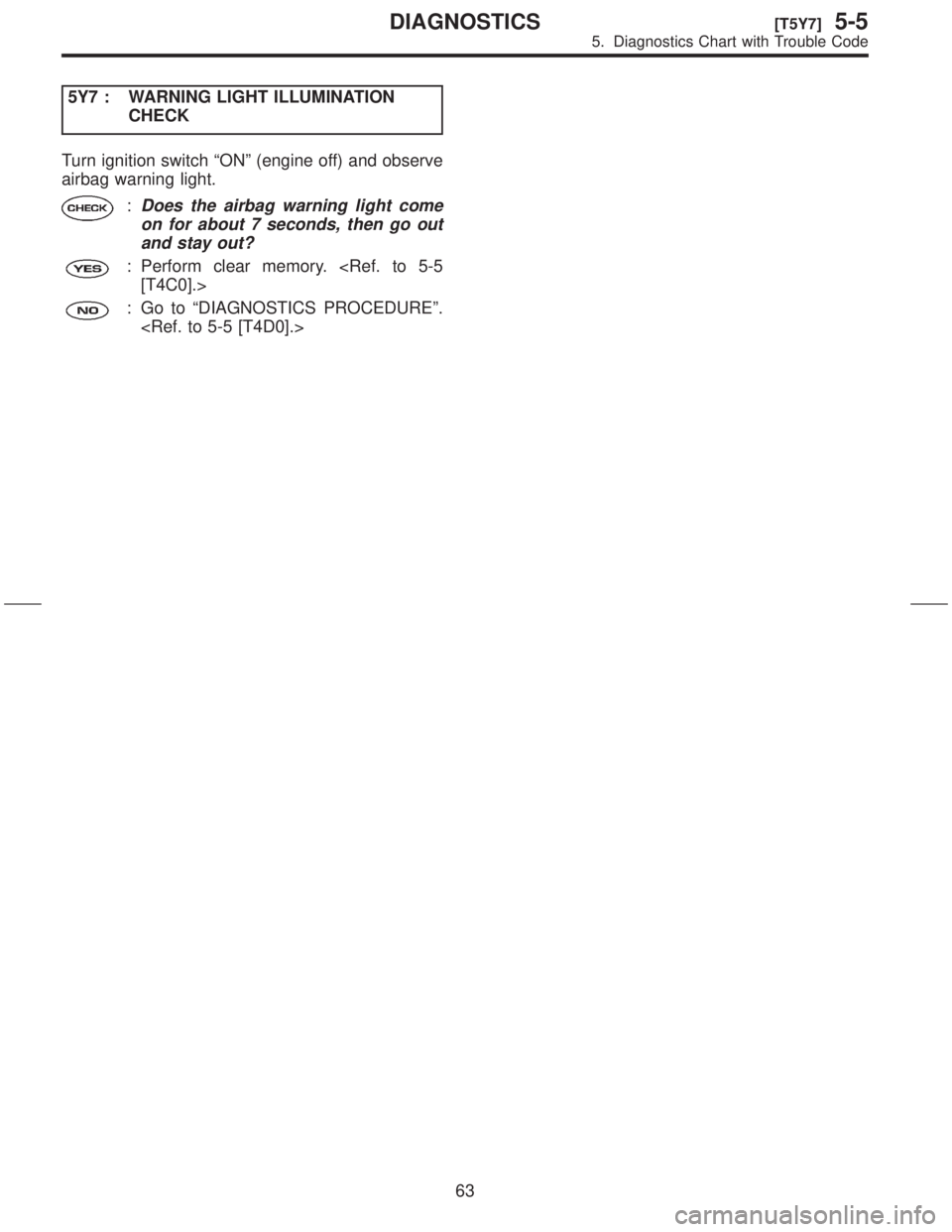
5Y7 : WARNING LIGHT ILLUMINATION
CHECK
Turn ignition switch ªONº (engine off) and observe
airbag warning light.
:Does the airbag warning light come
on for about 7 seconds, then go out
and stay out?
: Perform clear memory.
: Go to ªDIAGNOSTICS PROCEDUREº.
63
[T5Y7]5-5DIAGNOSTICS
5. Diagnostics Chart with Trouble Code
Page 64 of 345
1. Combination Meter
A: DIAGNOSTICS PROCEDURE
If speedometer does not operate, or operates
abnormally, check combination meter circuit.
CAUTION:
Make sure that trouble code of vehicle speed
sensor system appears in electrical system on-
board diagnosis.
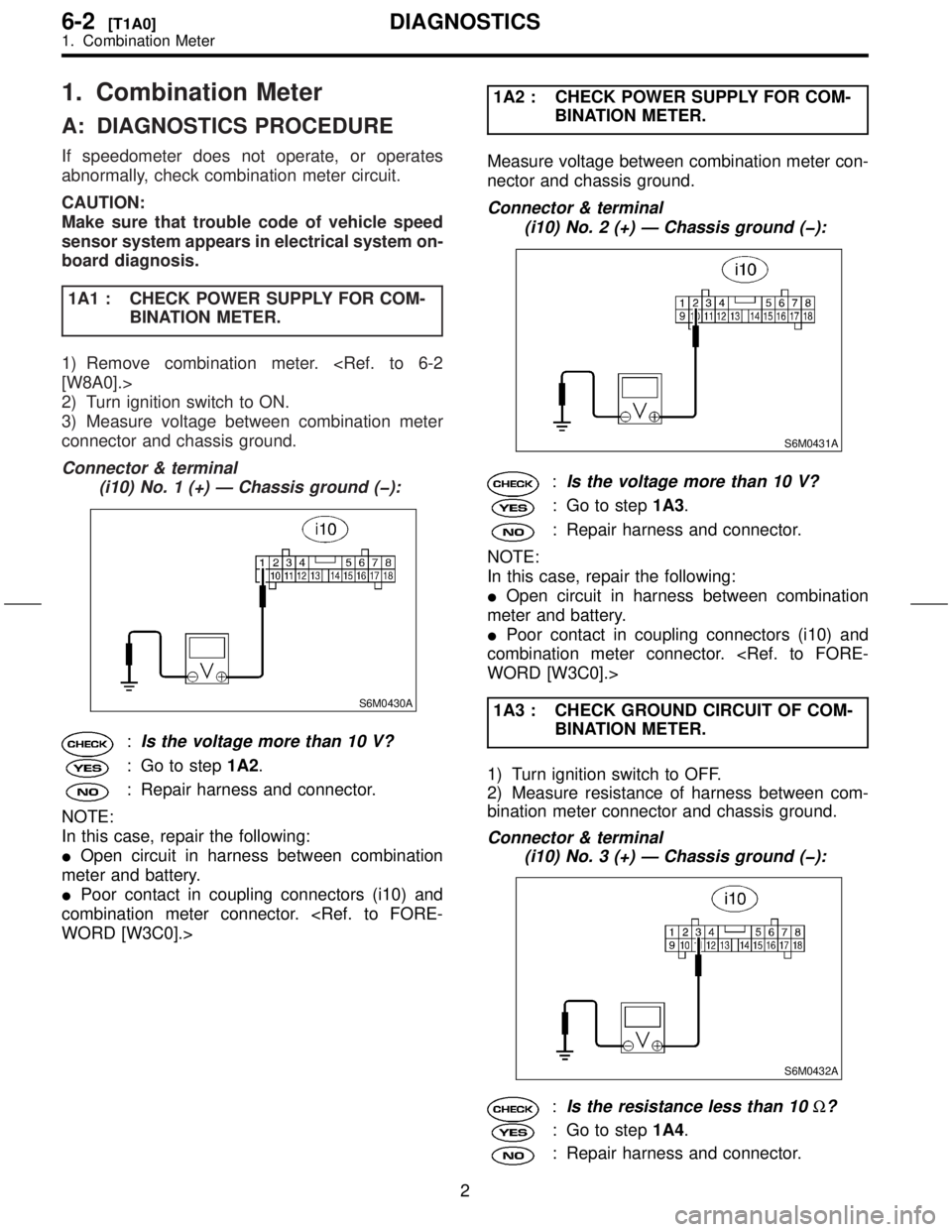
1A1 : CHECK POWER SUPPLY FOR COM-
BINATION METER.
1) Remove combination meter.
2) Turn ignition switch to ON.
3) Measure voltage between combination meter
connector and chassis ground.
Connector & terminal
(i10) No. 1 (+) Ð Chassis ground (þ):
S6M0430A
:Is the voltage more than 10 V?
: Go to step1A2.
: Repair harness and connector.
NOTE:
In this case, repair the following:
IOpen circuit in harness between combination
meter and battery.
IPoor contact in coupling connectors (i10) and
combination meter connector.
BINATION METER.
Measure voltage between combination meter con-
nector and chassis ground.
Connector & terminal
(i10) No. 2 (+) Ð Chassis ground (þ):
S6M0431A
:Is the voltage more than 10 V?
: Go to step1A3.
: Repair harness and connector.
NOTE:
In this case, repair the following:
IOpen circuit in harness between combination
meter and battery.
IPoor contact in coupling connectors (i10) and
combination meter connector.
1A3 : CHECK GROUND CIRCUIT OF COM-
BINATION METER.
1) Turn ignition switch to OFF.
2) Measure resistance of harness between com-
bination meter connector and chassis ground.
Connector & terminal
(i10) No. 3 (+) Ð Chassis ground (þ):
S6M0432A
:Is the resistance less than 10W?
: Go to step1A4.
: Repair harness and connector.
2
6-2[T1A0]DIAGNOSTICS
1. Combination Meter
Page 65 of 345
1A4 : CHECK TRANSMISSION TYPE.
:Is the transmission type MT?
: Go to step1A5.
: Go to step1A9.
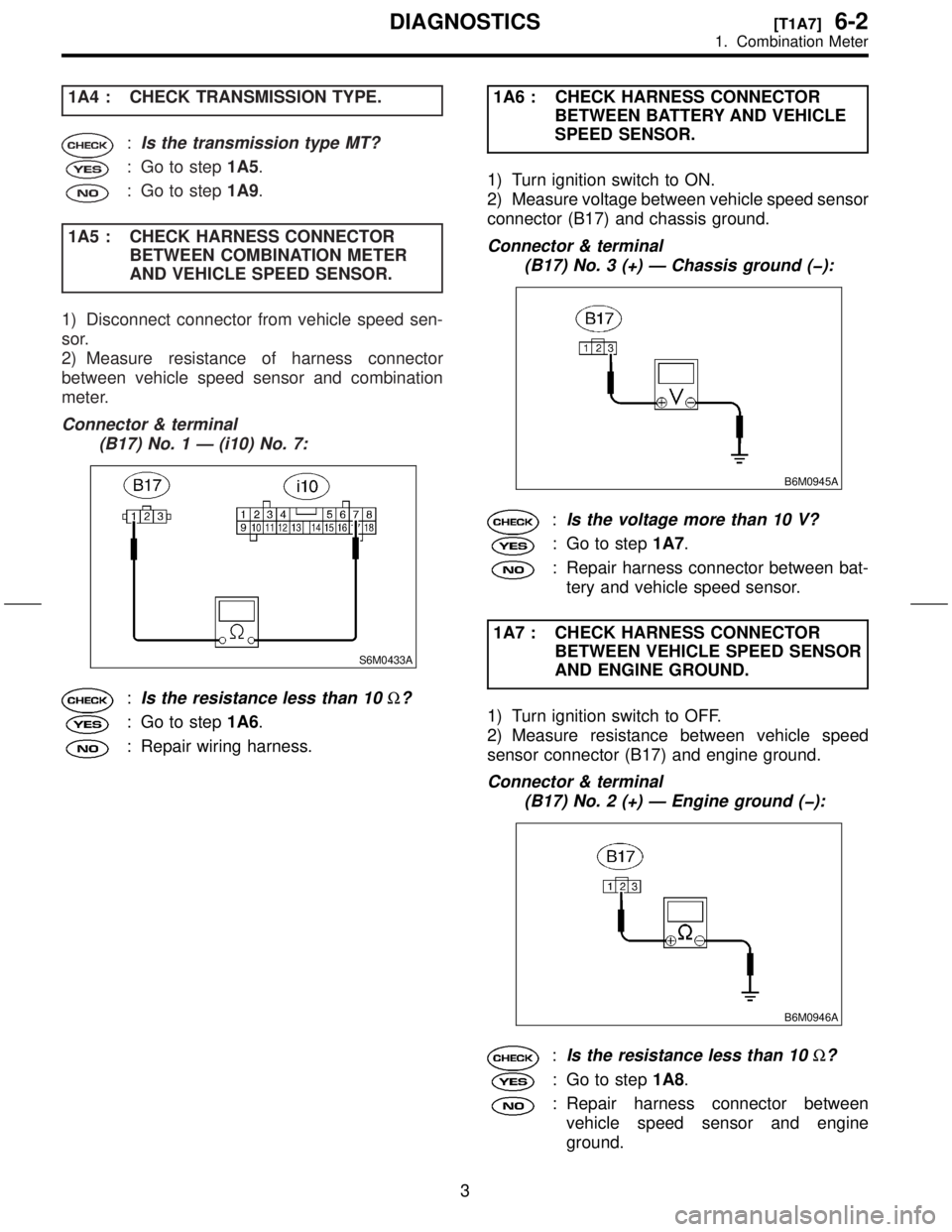
1A5 : CHECK HARNESS CONNECTOR
BETWEEN COMBINATION METER
AND VEHICLE SPEED SENSOR.
1) Disconnect connector from vehicle speed sen-
sor.
2) Measure resistance of harness connector
between vehicle speed sensor and combination
meter.
Connector & terminal
(B17) No. 1 Ð (i10) No. 7:
S6M0433A
:Is the resistance less than 10W?
: Go to step1A6.
: Repair wiring harness.1A6 : CHECK HARNESS CONNECTOR
BETWEEN BATTERY AND VEHICLE
SPEED SENSOR.
1) Turn ignition switch to ON.
2) Measure voltage between vehicle speed sensor
connector (B17) and chassis ground.
Connector & terminal
(B17) No. 3 (+) Ð Chassis ground (þ):
B6M0945A
:Is the voltage more than 10 V?
: Go to step1A7.
: Repair harness connector between bat-
tery and vehicle speed sensor.
1A7 : CHECK HARNESS CONNECTOR
BETWEEN VEHICLE SPEED SENSOR
AND ENGINE GROUND.
1) Turn ignition switch to OFF.
2) Measure resistance between vehicle speed
sensor connector (B17) and engine ground.
Connector & terminal
(B17) No. 2 (+) Ð Engine ground (þ):
B6M0946A
:Is the resistance less than 10W?
: Go to step1A8.
: Repair harness connector between
vehicle speed sensor and engine
ground.
3
[T1A7]6-2DIAGNOSTICS
1. Combination Meter
Page 75 of 345
3. Cruise Control System
A: PRECAUTION
1. SUPPLEMENTAL RESTRAINT SYSTEM
ªAIRBAGº
Airbag system wiring harness is routed near the
cruise control module and cruise control command
switch.
CAUTION:
IAll airbag system wiring harness and con-
nectors are yellow. Do not use electrical test
equipment on these circuits.
IBe careful not to damage airbag system wir-
ing harness when servicing the cruise control
module and cruise control command switch.
B: PRE-INSPECTION
1. FUNCTION TESTS
Conduct road tests by selecting a smooth, flat road
or use free rollers for road test simulation.
ICruise Control Main Switch
1) Turn ignition switch to ON.
2) Check that cruise control main switch indicator
light comes on when main switch is pressed (ON).
3) Check that main switch indicator light goes out
when main switch is pressed again (OFF).
4) Turn ignition switch to OFF with main switch ON
(indicated by illumination). Turn ignition switch ON
again to ensure that main switch indicator light
remains OFF.
ICruise Control Command Switch
1) Check that cruise control command switch is
properly set in ªSET/COASTº, ªRESUME/ACCELº,
or ªCANCELº mode.
2) Also check that command switch returns to the
original position when released.
IConstant Speed Test
1) Turn cruise control main switch to ON.
2) Drive the vehicle at a speed greater than 40
km/h (25 MPH).
3) Press command switch to set in ªSET/COASTº
mode.
4) Ensure that vehicle is maintained at the speed
set when command switch was pressed.
IAcceleration Test
1) Set vehicle speed at a speed greater that 40
km/h (25 MPH).
2) Ensure that vehicle continues to accelerate
while holding command switch in ªRESUME/
ACCELº mode, and that vehicle maintains that
optional speed when command switch is released.
IDeceleration Test
1) Set vehicle speed at an optional speed greater
than 40 km/h (25 MPH).
2) Ensure that vehicle continues to decelerate
while holding command switch in ªSET/COASTº
mode, and that it maintains that optional speed
when command switch is released.
NOTE:
When vehicle speed reaches the lower speed limit
of 30 km/h (19 MPH) during deceleration, cruise
control will be released.
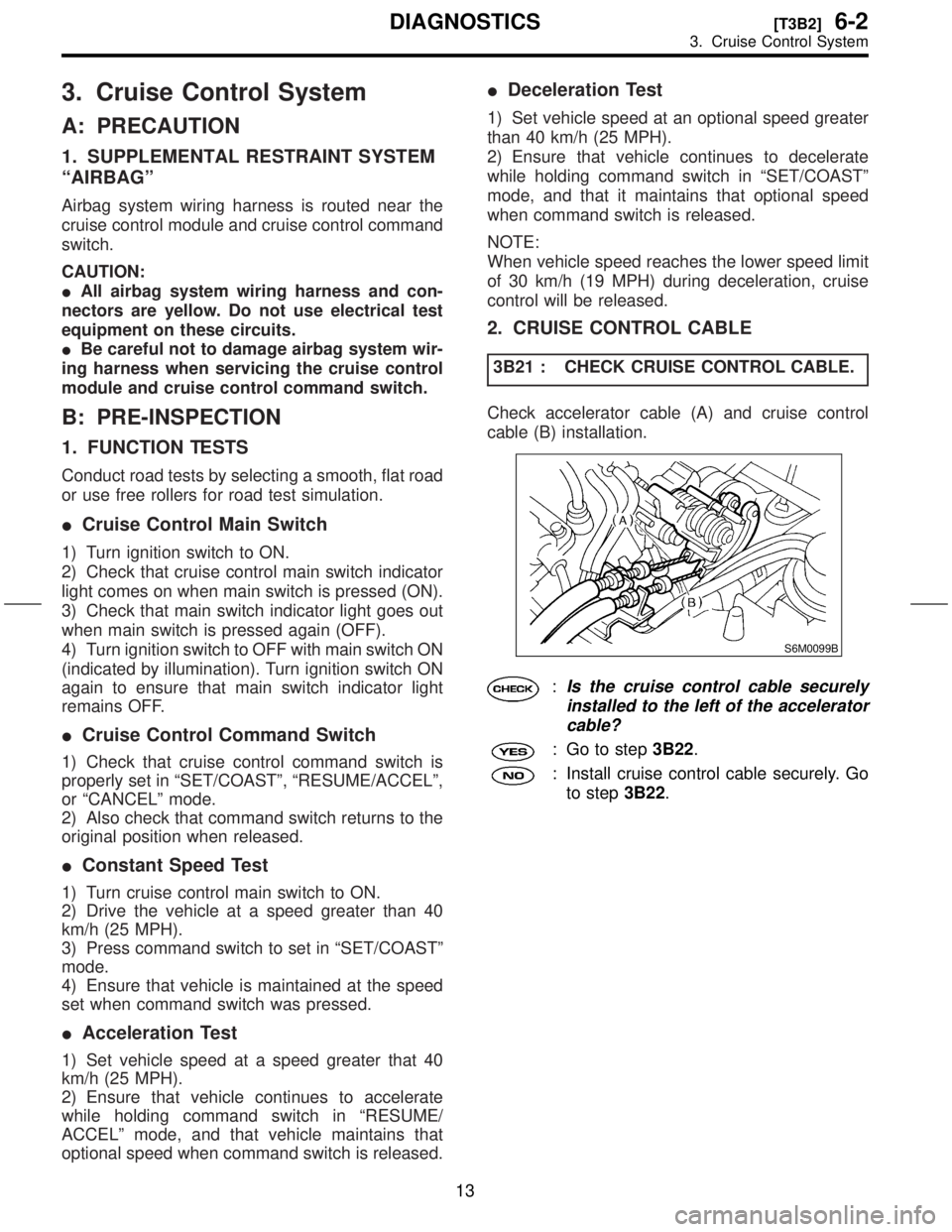
2. CRUISE CONTROL CABLE
3B21 : CHECK CRUISE CONTROL CABLE.
Check accelerator cable (A) and cruise control
cable (B) installation.
S6M0099B
:Is the cruise control cable securely
installed to the left of the accelerator
cable?
: Go to step3B22.
: Install cruise control cable securely. Go
to step3B22.
13
[T3B2]6-2DIAGNOSTICS
3. Cruise Control System
Page 82 of 345
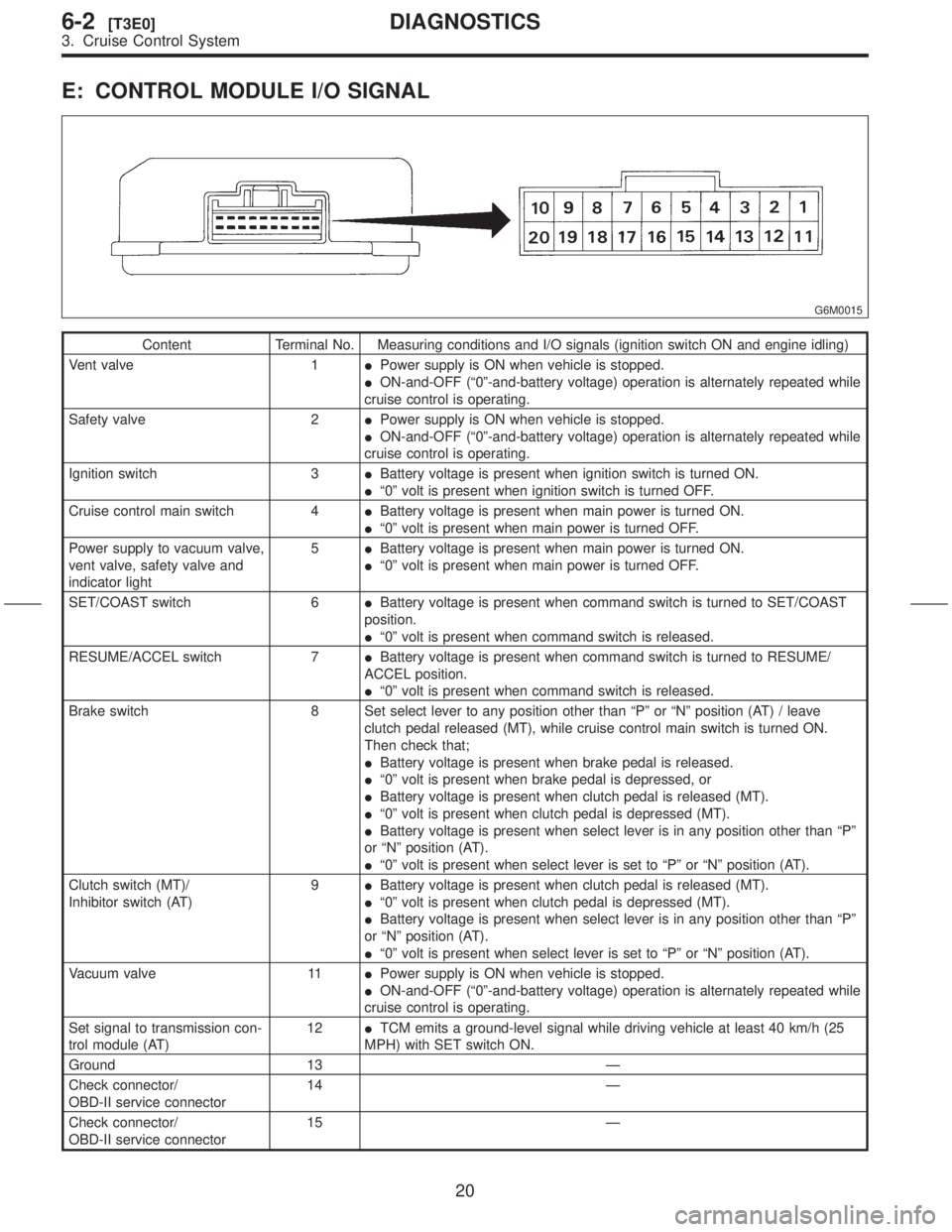
E: CONTROL MODULE I/O SIGNAL
G6M0015
Content Terminal No. Measuring conditions and I/O signals (ignition switch ON and engine idling)
Vent valve 1IPower supply is ON when vehicle is stopped.
ION-and-OFF (ª0º-and-battery voltage) operation is alternately repeated while
cruise control is operating.
Safety valve 2IPower supply is ON when vehicle is stopped.
ION-and-OFF (ª0º-and-battery voltage) operation is alternately repeated while
cruise control is operating.
Ignition switch 3IBattery voltage is present when ignition switch is turned ON.
Iª0º volt is present when ignition switch is turned OFF.
Cruise control main switch 4IBattery voltage is present when main power is turned ON.
Iª0º volt is present when main power is turned OFF.
Power supply to vacuum valve,
vent valve, safety valve and
indicator light5IBattery voltage is present when main power is turned ON.
Iª0º volt is present when main power is turned OFF.
SET/COAST switch 6IBattery voltage is present when command switch is turned to SET/COAST
position.
Iª0º volt is present when command switch is released.
RESUME/ACCEL switch 7IBattery voltage is present when command switch is turned to RESUME/
ACCEL position.
Iª0º volt is present when command switch is released.
Brake switch 8 Set select lever to any position other than ªPº or ªNº position (AT) / leave
clutch pedal released (MT), while cruise control main switch is turned ON.
Then check that;
IBattery voltage is present when brake pedal is released.
Iª0º volt is present when brake pedal is depressed, or
IBattery voltage is present when clutch pedal is released (MT).
Iª0º volt is present when clutch pedal is depressed (MT).
IBattery voltage is present when select lever is in any position other than ªPº
or ªNº position (AT).
Iª0º volt is present when select lever is set to ªPº or ªNº position (AT).
Clutch switch (MT)/
Inhibitor switch (AT)9IBattery voltage is present when clutch pedal is released (MT).
Iª0º volt is present when clutch pedal is depressed (MT).
IBattery voltage is present when select lever is in any position other than ªPº
or ªNº position (AT).
Iª0º volt is present when select lever is set to ªPº or ªNº position (AT).
Vacuum valve 11IPower supply is ON when vehicle is stopped.
ION-and-OFF (ª0º-and-battery voltage) operation is alternately repeated while
cruise control is operating.
Set signal to transmission con-
trol module (AT)12ITCM emits a ground-level signal while driving vehicle at least 40 km/h (25
MPH) with SET switch ON.
Ground 13 Ð
Check connector/
OBD-II service connector14 Ð
Check connector/
OBD-II service connector15 Ð
20
6-2[T3E0]DIAGNOSTICS
3. Cruise Control System
Page 83 of 345
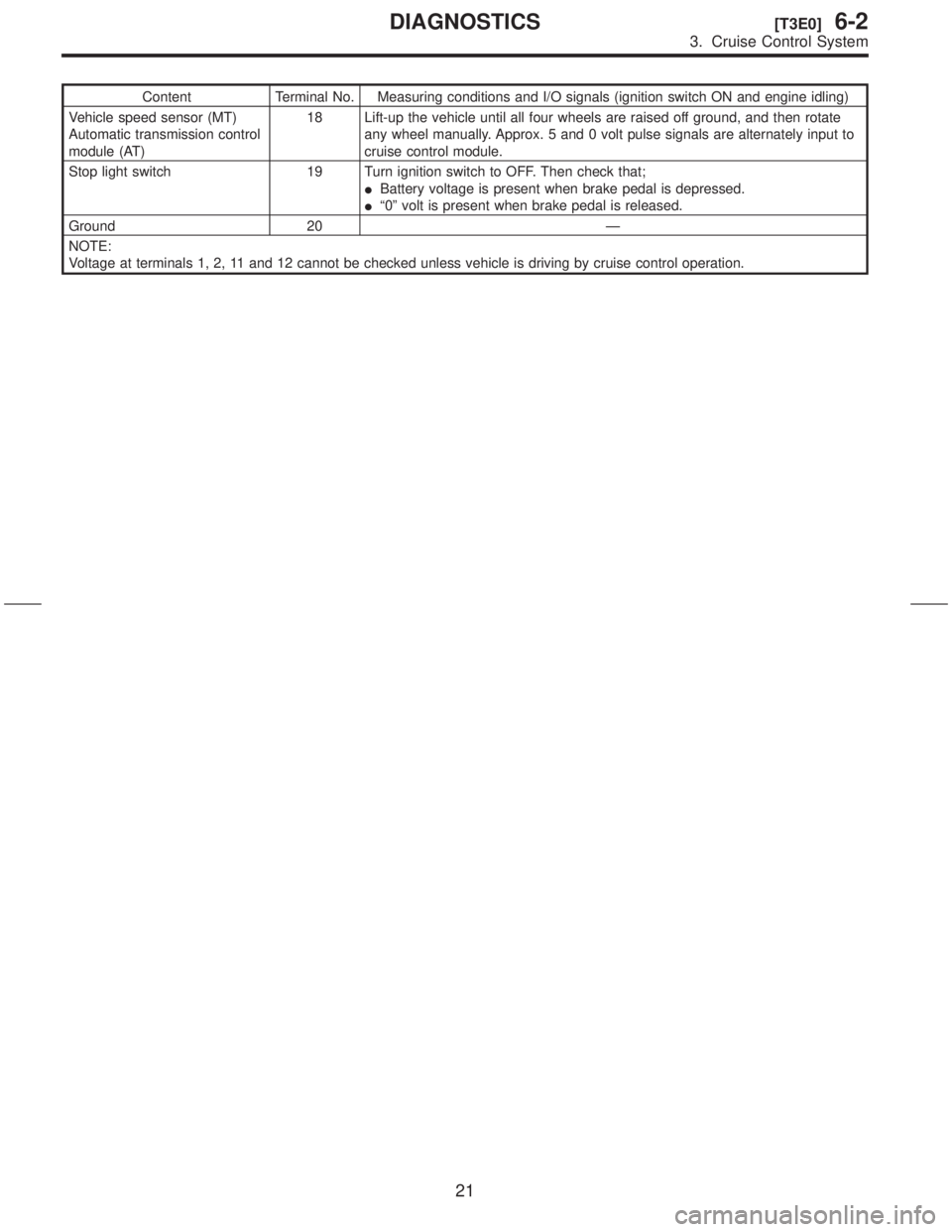
Content Terminal No. Measuring conditions and I/O signals (ignition switch ON and engine idling)
Vehicle speed sensor (MT)
Automatic transmission control
module (AT)18 Lift-up the vehicle until all four wheels are raised off ground, and then rotate
any wheel manually. Approx. 5 and 0 volt pulse signals are alternately input to
cruise control module.
Stop light switch 19 Turn ignition switch to OFF. Then check that;
IBattery voltage is present when brake pedal is depressed.
Iª0º volt is present when brake pedal is released.
Ground 20 Ð
NOTE:
Voltage at terminals 1, 2, 11 and 12 cannot be checked unless vehicle is driving by cruise control operation.
21
[T3E0]6-2DIAGNOSTICS
3. Cruise Control System
Page 85 of 345
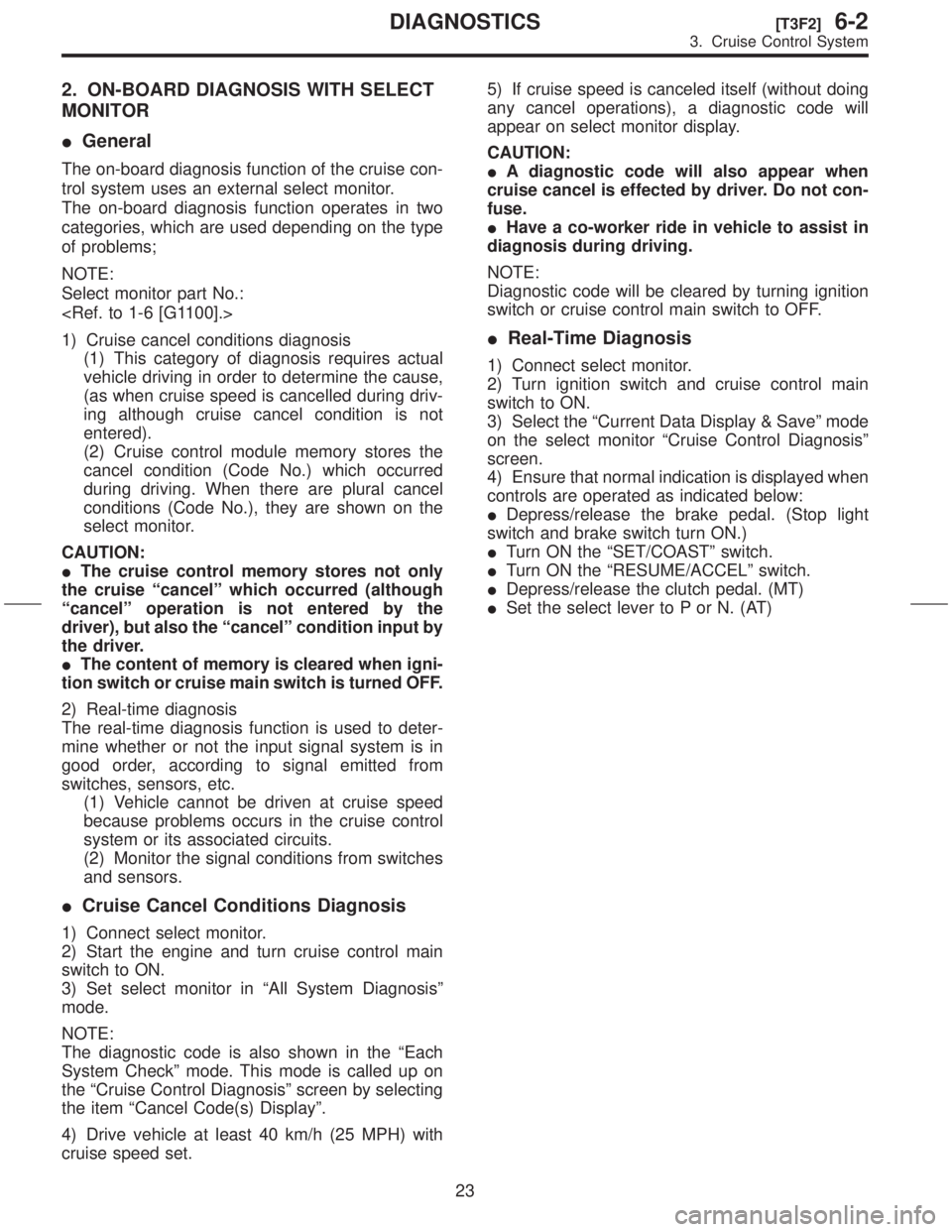
2. ON-BOARD DIAGNOSIS WITH SELECT
MONITOR
IGeneral
The on-board diagnosis function of the cruise con-
trol system uses an external select monitor.
The on-board diagnosis function operates in two
categories, which are used depending on the type
of problems;
NOTE:
Select monitor part No.:
1) Cruise cancel conditions diagnosis
(1) This category of diagnosis requires actual
vehicle driving in order to determine the cause,
(as when cruise speed is cancelled during driv-
ing although cruise cancel condition is not
entered).
(2) Cruise control module memory stores the
cancel condition (Code No.) which occurred
during driving. When there are plural cancel
conditions (Code No.), they are shown on the
select monitor.
CAUTION:
IThe cruise control memory stores not only
the cruise ªcancelº which occurred (although
ªcancelº operation is not entered by the
driver), but also the ªcancelº condition input by
the driver.
IThe content of memory is cleared when igni-
tion switch or cruise main switch is turned OFF.
2) Real-time diagnosis
The real-time diagnosis function is used to deter-
mine whether or not the input signal system is in
good order, according to signal emitted from
switches, sensors, etc.
(1) Vehicle cannot be driven at cruise speed
because problems occurs in the cruise control
system or its associated circuits.
(2) Monitor the signal conditions from switches
and sensors.
ICruise Cancel Conditions Diagnosis
1) Connect select monitor.
2) Start the engine and turn cruise control main
switch to ON.
3) Set select monitor in ªAll System Diagnosisº
mode.
NOTE:
The diagnostic code is also shown in the ªEach
System Checkº mode. This mode is called up on
the ªCruise Control Diagnosisº screen by selecting
the item ªCancel Code(s) Displayº.
4) Drive vehicle at least 40 km/h (25 MPH) with
cruise speed set.5) If cruise speed is canceled itself (without doing
any cancel operations), a diagnostic code will
appear on select monitor display.
CAUTION:
IA diagnostic code will also appear when
cruise cancel is effected by driver. Do not con-
fuse.
IHave a co-worker ride in vehicle to assist in
diagnosis during driving.
NOTE:
Diagnostic code will be cleared by turning ignition
switch or cruise control main switch to OFF.
IReal-Time Diagnosis
1) Connect select monitor.
2) Turn ignition switch and cruise control main
switch to ON.
3) Select the ªCurrent Data Display & Saveº mode
on the select monitor ªCruise Control Diagnosisº
screen.
4) Ensure that normal indication is displayed when
controls are operated as indicated below:
IDepress/release the brake pedal. (Stop light
switch and brake switch turn ON.)
ITurn ON the ªSET/COASTº switch.
ITurn ON the ªRESUME/ACCELº switch.
IDepress/release the clutch pedal. (MT)
ISet the select lever to P or N. (AT)
23
[T3F2]6-2DIAGNOSTICS
3. Cruise Control System