Bar SUBARU FORESTER 2003 SG / 2.G User Guide
[x] Cancel search | Manufacturer: SUBARU, Model Year: 2003, Model line: FORESTER, Model: SUBARU FORESTER 2003 SG / 2.GPages: 420, PDF Size: 4.4 MB
Page 64 of 420
1-37
Seat, seatbelt and SRS airbags
–CONTINUED –
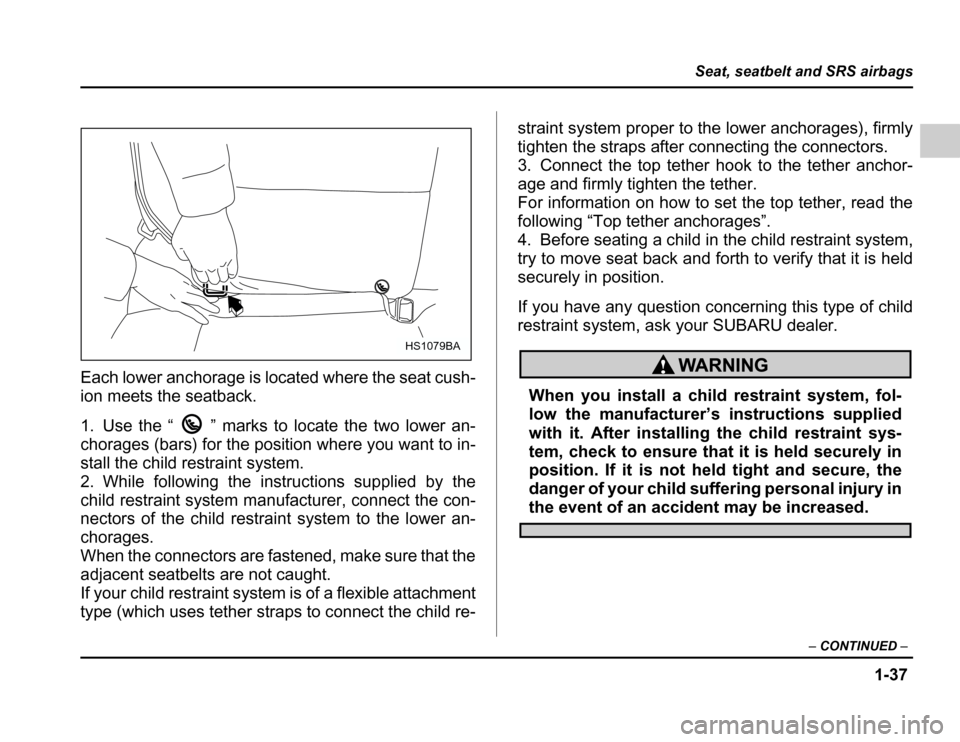
Each lower anchorage is located where the seat cush-
ion meets the seatback.
1. Use the “ ” marks to locate the two lower an-
chorages (bars) for the position where you want to in-
stall the child restraint system.
2. While following the instructions supplied by the
child restraint system manufacturer, connect the con-
nectors of the child restraint system to the lower an-
chorages.
When the connectors are fastened, make sure that the
adjacent seatbelts are not caught.
If your child restraint system is of a flexible attachment
type (which uses tether straps to connect the child re- straint system proper to the lower anchorages), firmly
tighten the straps after connecting the connectors.
3. Connect the top tether hook to the tether anchor-
age and firmly tighten the tether.
For information on how to set the top tether, read the
following “Top tether anchorages”.
4. Before seating a child in the child restraint system,
try to move seat back and forth to verify that it is held
securely in position.
If you have any question concerning this type of child
restraint system, ask your SUBARU dealer.
When you install a child restraint system, fol-
low the manufacturer
Page 75 of 420
1-48
Seat, seatbelt and SRS airbags
The SRS airbag can function only when the ignition
switch is in the “ON” position.
If the sensors detect a certain predetermined amount
of force during a frontal collision, the control module
sends signals to the frontal airbag modules instructing
them to inflate the SRS frontal airbags. Then both air-
bag modules produce gas, which instantly inflates
driver’s and passenger’s SRS frontal airbags. After the
deployment, the SRS airbags immediately start to de-
flate so that the driver’s vision is not obstructed. The
time required from detecting impact to the deflation of
the SRS airbag after deployment is shorter than the
blink of an eye.
The front passenger’s SRS frontal airbag deploys to-
gether with driver’s SRS frontal airbag even when no
one occupies the front passenger’s seat.
Although it is highly unlikely that the SRS airbag would
activate in a non-accident situation, should it occur,
the SRS airbag will deflate quickly, not obscuring vi-
sion and will not interfere with the driver’s ability to
maintain control of the vehicle.
When the SRS airbag deploys, a sudden, fairly loud
inflation noise will be heard and some smoke will be
released. These occurrences are normal result of the
deployment. This smoke does not indicate a fire in the
vehicle.
Do not touch the SRS airbag system compo-
nents around the steering wheel and dash-
board with bare hands right after deployment.
Doing so can cause burns because the compo-
nents can be very hot as a result of deployment.
TheSRSfrontalairbagisdesignedtodeployinthe
event of an accident involving a moderate to severe
frontal collision. It is basically not designed to deploy
in lesser frontal impacts because the necessary pro-
tection can be achieved by the seatbelt alone. Also, it
is basically not designed to deploy in side or rear im-
pacts or in roll-over accidents because deployment of
the SRS frontal airbag would not help the occupant in
those situations. The SRS airbag is designed to func-
tion on a one-time-only basis.
SRS airbag deployment depends on the level of force
experienced in the passenger compartment during a
collision. That level differs from one type of collision to
another, and it may have no bearing on the visible
damage done to the vehicle itself.
Page 83 of 420
1-56
Seat, seatbelt and SRS airbags
and chest.
C) After deployment, SRS side airbag starts to deflate im- mediately.
The SRS side airbag can function only when the igni-
tion switch is in the “ON” position.
The driver’s and front passenger’s SRS side airbags
deploy independently of each other since each has its
own impact sensor. Also, the SRS side airbag deploys
independently of the frontal airbags in the steering
wheel and instrument panel.
An impact sensor is incorporated into each of the ve-
hicle’s center pillars. If either sensor detects a certain
predetermined amount of force during a side impact
collision, the control module sends a signal to the side
airbag module on the impacted side of the vehicle, in-
structing it to inflate the SRS side airbag. Then the
side airbag module produces gas, which instantly in-
flates the SRS side airbag. After the deployment, the
SRS side airbag immediately starts to deflate. The
time required from detecting impact to the deflation of
the SRS side airbag after deployment is shorter than
the blink of an eye.
The SRS side airbag deploys even when no one occu-
pies the seat on the side on which an impact is ap-
plied. When the SRS side airbag deploys, a sudden, fairly
loud inflation noise will be heard and some smoke will
be released. These occurrences are normal result of
the deployment. This smoke does not indicate a fire in
the vehicle.
Do not touch the SRS side airbag system com-
ponents around the
front seatback with bare
hands right after deployment. Doing so can
cause burns because the components can be
very hot as a result of deployment.
The SRS side airbag is designed to deploy in the event
of an accident involving a moderate to severe side im-
pact collision. It is basically not designed to deploy in
lesser side impact. Also, it is basically not designed to
deploy in frontal or rear impacts because SRS side air-
bag deployment would not help the occupant in those
situations.
Each SRS side airbag is designed to function on a
one-time-only basis.
SRS side airbag deployment depends on the level of
force experienced in the passenger compartment dur-
ing a side impact collision. That level differs from one
Page 88 of 420
1-61
Seat, seatbelt and SRS airbags
–CONTINUED –
Airbag control module (including impact sensors)
Frontal airbag module (Driver’s side)
Frontal airbag module (Passenger’s side)
Side airbag sensor (Driver’s side – if equipped)
Side airbag sensor (Passenger’s side – if equipped)
Side airbag module (Driver’s side – if equipped)
Side airbag module (Passenger’s side – if
equipped) Seatbelt pretensioner (Driver’s side)
Seatbelt pretensioner (Passenger’s side)
All related wiring
In the event of a malfunction indicated by any of follow-
ing, the vehicle should be taken promptly to your near-
est SUBARU dealer to have the system checked.
Unless checked and repaired, the SRS airbags will not
function reliably: Flashing or flickering of the indicator light.
No illumination of the warning light when the ignition
switch is first turned to the “ON” position. Continuous illumination of the warning light.
Illumination of the warning light while driving.
SRS airbag system servicing
When discarding an airbag module or scrap- ping the entire car damaged by a collision, con-
sult your SUBARU dealer.
The SRS airbag has no user-serviceable
parts. Do not use electrical test equipment on
any circuit related to the SRS airbag system.
For required servicing of the SRS airbag, see
your nearest SUBARU dealer. Tampering with
or disconnecting the system
Page 89 of 420
1-62
Seat, seatbelt and SRS airbags
side and nearby areas
Each front seat and nearby area (for vehicles
with SRS side airbags only)
Inside each center pillar
In the event that the SRS airbag is deployed, re-
placement of the system should be performed
only by an authorized SUBARU dealer. When the
components of the SRS airbag system are re-
placed, use only genuine SUBARU parts.
To ensure their long-term reliability, the SRS airbags
must be inspected by a SU BARU dealer ten years af-
ter the date of manufacture, which is shown on the cer-
tification plate attached to the driver’s door jamb.
NOTE
In the following cases, contact your SUBARU deal-
er as soon as possible. The front part of the vehicle was involved in an
accident in which the SRS frontal airbags did not
deploy. The pad section of the steering wheel or front
passenger
Page 90 of 420
1-63
Seat, seatbelt and SRS airbags
–CONTINUED –
airbags only)
Installation of additional electrical/electronic
equipment such as a mobile two-way radio on
or near the SRS airbag system components
and/or wiring is not advisable. This could inter-
fere with proper operation of the SRS airbag
system.
Do not perform any of the following modifica-
tions. Such modifications can interfere with
proper operation of the SRS airbag system. Attachment of any equipment (brush bar,
winches, snow plow, skid plate, etc.) other than
SUBARU genuine accessory parts to the front
end. Modification of the suspension system or
front end structure. Installation of a tire of different size and con-
struction from the tires specified on the tire
placard attached to the driver
Page 123 of 420
3-4
Instruments and controls
opens and the key is in the “LOCK” or “ACC” positions.
The chime stops when the key is removed from the ig-
nition switch.
Key interlock release (AT vehicles only)
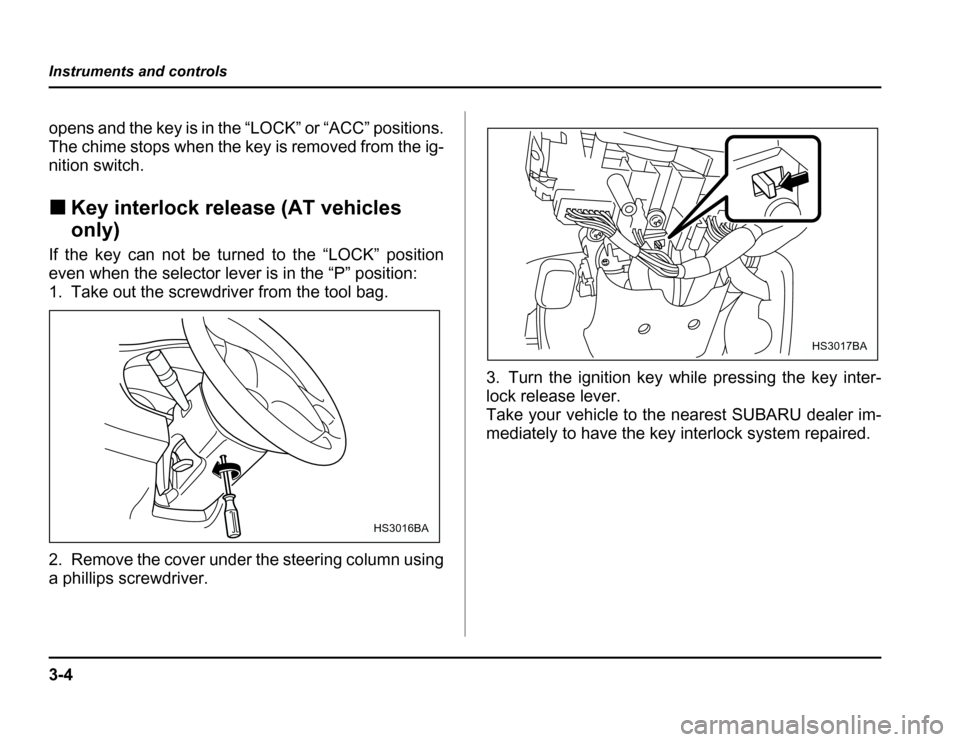
If the key can not be turned to the “LOCK” position
even when the selector lever is in the “P” position:
1. Take out the screwdriver from the tool bag.
2. Remove the cover under the steering column using
a phillips screwdriver. 3. Turn the ignition key while pressing the key inter-
lock release lever.
Take your vehicle to the nearest SUBARU dealer im-
mediately to have the key interlock system repaired.
HS3016BA
HS3017BA
Page 128 of 420
3-9
Instruments and controls
–CONTINUED –
Ambient temperature gauge
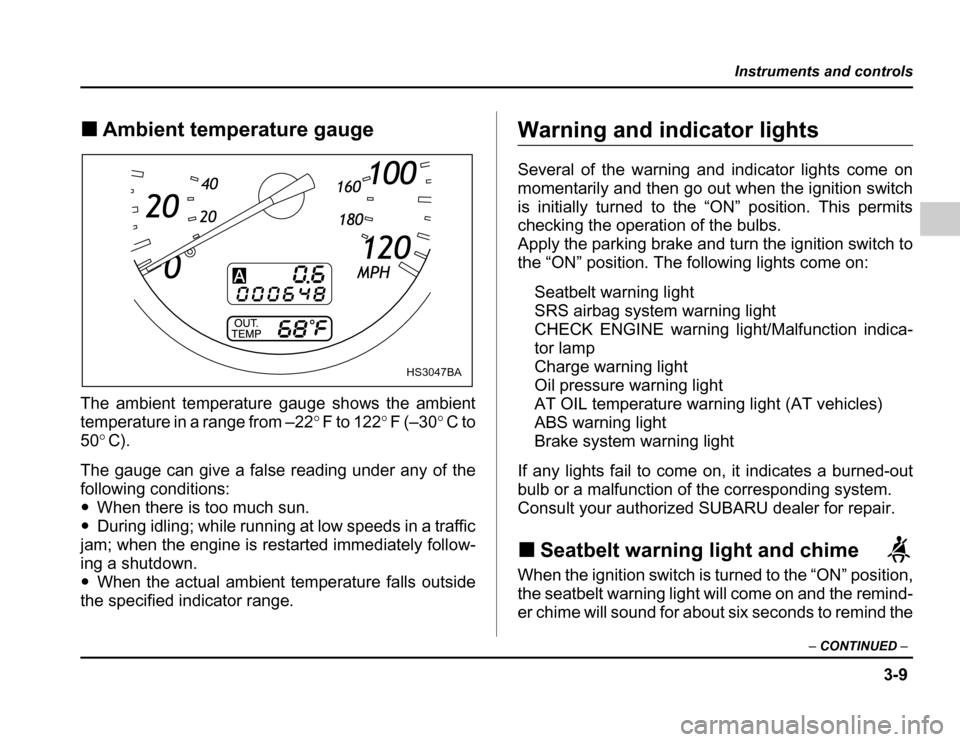
The ambient temperature gauge shows the ambient
temperature in a range from –22 °Fto122 °F(–30 °Cto
50 °C).
The gauge can give a false reading under any of the
following conditions: When there is too much sun.
During idling; while running at low speeds in a traffic
jam; when the engine is restarted immediately follow-
ing a shutdown. When the actual ambient temperature falls outside
the specified indicator range.Warning and indicator lights
Several of the warning and indicator lights come on
momentarily and then go out when the ignition switch
is initially turned to the “ON” position. This permits
checking the operation of the bulbs.
Apply the parking brake and turn the ignition switch to
the “ON” position. The following lights come on:
Seatbelt warning light
SRS airbag system warning light
CHECK ENGINE warning light/Malfunction indica-
tor lamp
Charge warning light
Oil pressure warning light
AT OIL temperature warning light (AT vehicles)
ABS warning light
Brake system warning light
If any lights fail to come on, it indicates a burned-out
bulb or a malfunction of the corresponding system.
Consult your authorized SUBARU dealer for repair. Seatbelt warning light and chime
When the ignition switch is turned to the “ON” position,
the seatbelt warning light will come on and the remind-
er chime will sound for about six seconds to remind the
HS3047BA
Page 129 of 420
3-10
Instruments and controls
driver to fasten the seatbelt.
The seatbelt warning light remains on for about six
seconds and turns off automatically after six seconds.
The seatbelt reminder chime will turn off by bucking
the driver’s side seatbelt or turn off automatically after
six seconds.
SRS airbag system warning light
When the ignition switch is turned to the “ON” position,
the SRS airbag system warning light will come on for
about six seconds and go out. This shows the SRS air-
bag and SRS side airbag (if equipped) and seatbelt
pretensioners are in normal operation.
If this light comes on while driving or remains illuminat-
ed even after a period of about 6 seconds from when
the ignition has been turned on, it may indicate that the
SRS airbag system or SRS side airbag system (if
equipped) or seatbelt pretensioner system is not work-
ing properly. Contact your nearest SUBARU dealer
immediately.
CHECK ENGINE warning light/
Malfunction indicator lamp
If the CHECK ENGINE light comes on while you
are driving, have your vehicle checked/repaired
by your SUBARU dealer as soon as possible.
Continued vehicle operation without having the
emission control system checked and repaired
as necessary could cause serious damage,
which may not be covered by your vehicle
Page 130 of 420
3-11
Instruments and controls
–CONTINUED –
NOTE
This light also comes on when the fuel filler cap is
not tightened until it clicks.
If you have recently refueled your vehicle, the cause of
the CHECK ENGINE warning light/malfunction indica-
tor lamp coming on could be a loose or missing fuel fill-
er cap. Remove the cap and retighten it until it clicks.
Make sure nothing is interfering with the sealing of the
cap. Tightening the cap will not make the CHECK EN-
GINE warning light turn off immediately. It may take
several driving trips. If the light does not go out, take
your vehicle to your authorized SUBARU dealer im-
mediately. If the light is blinking:
If the light is blinking while driving, an engine misfire
condition has been detected which may damage the
emission control system.
To prevent serious damage to the emission control
system, you should do the following: Reduce vehicle speed.
Avoid hard acceleration.
Avoid steep uphill grades.
Reduce the amount of cargo, if possible.
Stop towing a trailer as soon as possible.
The CHECK ENGINE warning light may stop blinking and come on steadily after several driving trips. You
should have your vehicle checked by an authorized
SUBARU dealer immediately.
Charge warning light
If this light comes on when the engine is run-
ning, it may indicate that the charging system is not
working properly.
If the light comes on while driving or does not go out
after the engine starts, stop the engine at the first safe
opportunity and check the alternator belt. If the belt is
loose, broken or if the belt is in good condition but the
light remains on, contact your nearest SUBARU deal-
er immediately. Oil pressure warning light
If this light comes on when the engine is run-
ning, it may indicate that the engine oil pressure is low
and the lubricating system is not working properly.
If the light comes on while driving or does not go out
after the engine starts, stop the engine at the first safe
opportunity and check the engine oil level. If the oil lev-
el is low, add oil immediately. If the engine oil is at the
proper level but the light remains on, contact your
nearest SUBARU dealer immediately.