tires SUBARU FORESTER 2003 SG / 2.G User Guide
[x] Cancel search | Manufacturer: SUBARU, Model Year: 2003, Model line: FORESTER, Model: SUBARU FORESTER 2003 SG / 2.GPages: 420, PDF Size: 4.4 MB
Page 279 of 420

8-10
Driving tips
starting.
Keep the door locks from freezing by squirting them
with deicer or glycerin.
Forcing a frozen door open may damage or separate
the rubber weather strips around the door. If the door
is frozen, use hot water to melt the ice, and afterwards
thoroughly wipe the water away.
Use a windshield washer fluid that contains an anti-
freeze solution. Do not use engine antifreeze or other
substitutes because they may damage the paint of the
vehicle.
Before driving your vehicle
Before entering the vehicle, remove any snow or ice
from your shoes because that could make the pedals
slippery and dangerous.
While warming up the vehicle before driving, check
that the accelerator pedal, brake pedal, and all other
controls operate smoothly.
Clear away ice and snow that has accumulated under
the fenders to avoid making steering difficult. During
severe winter driving, stop when and where it is safe
to do so and check under the fenders periodically.
Parkingincoldweather
Do not use the parking brake when parking for long
periods in cold weather since it could freeze in that po-
sition. Instead, observe the following:
1. Place the shift lever in “1” or “R” for manual trans-
mission vehicles, and in “P” for automatic transmission
vehicles.
2. Use tire stops under the tires to prevent the vehicle
from moving.
When the vehicle is parked in snow or when it snows,
raise the wiper blades off the glass to prevent damage
to them.
When the vehicle has been left parked after use on
roads heavily covered with snow, or has been left
parked during a snowstorm, icing may develop on the
brake system, which could cause poor braking action.
Check for snow or ice buildup on the suspension, disc
brakes and brake hoses underneath the vehicle.
If there is caked snow or ice, remove it, being careful
not to damage the disc brakes and brake hoses and
ABS harness.
Snow can trap dangerous exhaust gases under
your vehicle. Keep snow clear of the exhaust
Page 281 of 420
8-12
Driving tips
rear window defogger.
When driving in snow, if frozen snow starts to stick on
the surface of the windshield despite wiper operation,
use the defroster with the airflow control button/dial in
“ ” and the temperature control dial set for maximum
warmth. After the windshield gets warmed enough to
melt the frozen snow on it, wash it away using the
windshield washer.
Snow stuck on the wiper arm prevents the wiper from
working effectively. If snow is stuck on the wiper arm,
pull off the road to a safe place, then remove it. If you
stop the car at road side, use the hazard warning
flasher to alert other drivers.
We recommend use of non-freezing type wiper blades
(winter blades) during the seasons you could have
snow and sub-zero temperatures. Blades of this type
give superior wiping performance in snowy conditions.
Be sure to use blades that are suitable for your vehi- cle.
Corrosion protection
Refer to the “Corrosion protection” section (chapter
10).
Snow tires
When replacing original tires with winter
(snow) tires, make sure you use only the same
size, construction and load range as the origi-
nal tires listed on the tire placard. Using other
sizes and construction may affect speedome-
ter/odometer calibration and clearance be-
tween the body and tires. It also may be
dangerous and lead to loss of vehicle control. You must install four winter tires that are of
the same size, construction, brand, and load
range. Mixing other sizes or constructions may
result in severe mechanical damage to the drive
train of your vehicle and may affect ride, han-
dling, braking and speedometer/odometer cali-
bration. It also may be dangerous and lead to
loss of vehicle control. Do not use a combination of radial, belted
bias or bias tires since it may cause dangerous
handling characteristics and lead to an acci-
dent.
Your vehicle is equipped with “all season tires” as orig-
inal equipment, which are designed to provide an ad-
Page 282 of 420

8-13
Driving tips
– CONTINUED –
equate measure of traction, handling and braking
performance in year-round driving. In winter, it may be
possible to enhance performance through use of tires
designed specifically for winter driving conditions.
When you choose to install winter tires on your vehi-
cle, be sure to use the correct tire size and type. You
must install four winter tires that are of the same size,
construction, brand and load range and you should
never mix radial, belted bias or bias tires since this
may result in dangerous handling characteristics.
When you choose a tire, make sure that there is
enough clearance between the tire and vehicle body.
Remember to drive with care at all times regardless of
the type of tires on your vehicle. Tire chains
Driving on snowy grades or icy roads may require the
use of tire chains, in which case put the chains on the
front wheels only. Use only SAE class S type chains
that are of the correct size for your tires so as not to
damage the vehicle body or suspension.
When driving with tire chains, drive at speeds below
19 mph (30 km/h).
Always use the utmost care when driving with tire
chains — overconfidence because you are driving
with tire chains could easily lead to a serious accident.
Rocking the vehicle
If you must rock the vehicle to free it from snow, sand,
or mud, depress the accelerator pedal slightly and
move the selector lever back and forth between “D”
and “R” repeatedly. Do not race the engine. For the
best possible traction, avoid spinning the wheels when
trying to free the vehicle.
When the road surface is extremely slippery, you can
obtain better traction by starting the vehicle with the
transmission in 2nd than 1st (both for MT and AT).
Refer to the “Automatic transmission” section in chap-
ter 7 for information on holding the transmission in 2nd
position.
Page 285 of 420
8-16
Driving tips
The load capacity of your vehicle is determined by
weight, not by available cargo space. The maximum
load you can carry in your vehicle is shown as the Ve-
hicle Capacity Weight on the tire information label at-
tached to the driver’s side door jamb. It includes the
total weight of driver and all passengers and their be-
longings, any optional equipment such as a trailer
hitch, roof rack or bike carrier, etc., and the tongue
load of a trailer.
The tire information label also shows recommended
tire inflation pressure under full loading and trailer tow-
ing conditions. Adjust tire inflation pressures accord-
ing to the loading conditions. For the tire inflation
pressures, refer to the “Tires and wheels” section in
Chapter 11.
GVWR and GAWR (Gross Vehicle
Weight Rating and Gross Axle Weight
Rating)
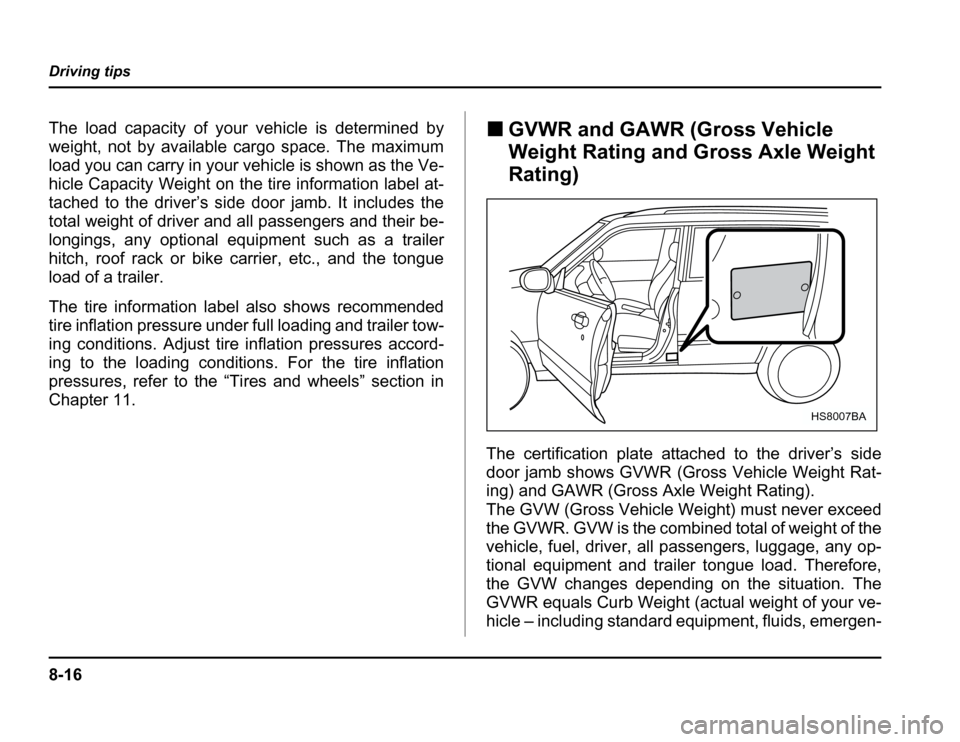
The certification plate attached to the driver’s side
door jamb shows GVWR (Gross Vehicle Weight Rat-
ing) and GAWR (Gross Axle Weight Rating).
The GVW (Gross Vehicle Weight) must never exceed
the GVWR. GVW is the combined total of weight of the
vehicle, fuel, driver, all passengers, luggage, any op-
tional equipment and trailer tongue load. Therefore,
the GVW changes depending on the situation. The
GVWR equals Curb Weight (actual weight of your ve-
hicle – including standard equipment, fluids, emergen-
HS8007BA
Page 286 of 420
8-17
Driving tips
– CONTINUED –
cy tools and spare tire assembly) plus the vehicle
capacity weight.
In addition, the total weight applied to each axle
(GAW) must never exceed the GAWR. The front and
rear GAWs can be adjusted by relocating luggage in-
side the vehicle.
Even if the total weight of your luggage is lower than
the vehicle capacity weight, either front or rear GAW
may exceed the GAWR, depending on the distribution
of the luggage.
If you carry heavy loads in the vehicle, you should con-
firm that GVW and front and rear GAWs are within the
GVWR and GAWR by putting your vehicle on a vehi-
cle scale, found at a commercial weighing station.
Do not use replacement tires with a lower load range
than the originals because they may lower the GVWR
and GAWR limitations. Replacement tires with a high-
er load range than the originals do not increase the
GVWR and GAWR limitations. Roof rail and crossbar (if equipped)
The roof rail is not designed to carry cargo by itself.
Cargo can be carried after securing the roof crossbar
kit to the roof rail and installing the appropriate carry-
ing attachment. When installing the roof crossbar kit,
follow the manufacturer’s instructions. When you carry cargo on the roof using the roof cross-
bar kit and a carrying attachment, never exceed the
maximum load limit explained below. You should also
be careful that your vehicle does not exceed the Gross
Vehicle Weight Rating (GVWR) and front and rear
Gross Axle Weight Rating (GAWR). See the “Loading
your vehicle” section in this chapter for information on
loading cargo into or onto your vehicle. The maximum
load limit of the cargo, crossbars and carrying attach-
ment must not exceed
150 lb. (68 kg). Place the
heaviest load at the bottom, nearest the roof, and
evenly distribute the cargo. Always properly secure all cargo.
For cargo carrying purposes, the roof rail
must be used together with a roof crossbar kit
and the appropriate carrying attachment. The
roof rail must never be used alone to carry car-
go. Otherwise, damage to the roof or paint or a
dangerous road hazard due to loss of cargo
could result. When using the roof crossbar kit, make sure
that the total weight of the crossbars, carrying
attachment and cargo does not exceed the
maximum load limit. Overloading may cause
damage to the vehicle and create a safety haz-
Page 294 of 420
8-25
Driving tips
– CONTINUED –
Trailer towing
Your car is designed and intended to be used primarily
as a passenger-carrying vehicle. Towing a trailer puts
additional loads on your car’s engine, drivetrain,
brakes, tires and suspension and has an adverse ef-
fect on fuel economy.
If you do decide to tow a trailer, your safety and satis-
faction depend upon proper use of correct equipment
and cautious operation of your vehicle. Seek the ad-
vice of your SUBARU dealer to assist you in purchas-
ing a hitch and other necessary towing equipment
appropriate for your vehicle. In addition, be sure to fol-
low the instructions on correct installation and use pro-
vided by the trailer and other towing equipment manufacturers.
SUBARU assumes no responsibility for injuries or ve-
hicle damage that result from trailer towing equipment,
or from any errors or omissions in the instructions ac-
companying such equipment or for your failure to fol-
low the proper instructions. Warranties and maintenance
SUBARU warranties do not apply to vehicle damage
or malfunction caused by trailer towing. If you use your
vehicle to tow a trailer, more frequent maintenance will
be required due to the additional load. (Refer to “Main- tenance schedule under severe driving conditions” in
the “Warranty and Maintenance Booklet”.)
Under no circumstances should a trailer be towed with
a new vehicle or a vehicle with any new powertrain
component (engine, transmission, differential, wheel
bearings, etc.) for the first 1,000 miles (1,600 km) of
driving.
Maximum load limits
Never exceed the maximum load limits ex-
plained below. Exceeding the maximum load
limits could cause personal injury and/or vehi-
cle damage.
Adequate size trailer brakes are required
when the trailer and its cargo exceed 1,000 lbs
(453 kg) total weight. Before towing a trailer, check the trailer total
weight, GVW, GAWs and tongue load. Make
sure the load and its distribution in your vehicle
Page 306 of 420

9-1
9
In case of emergency
If you park your vehicle in case of an
emergency .................................................... 9-2
Flat tires ........................................................ 9-3 Changing a flat tire ......................................... 9-3
Jump starting ............................................... 9-9 How to jump start ........................................... 9-10
Engine overheating ...................................... 9-12 If steam is coming from the engine
compartment ................................................... 9-12
If no steam is coming from the engine
compartment ................................................... 9-12
Towing .......................................................... 9-13 Towing and tie-down hooks .......................... 9-13
Using a flat-bed truck ..................................... 9-15
Towing with all wheels on the ground .......... 9-15
Rear gate — if the rear gate cannot be
unlocked ....................................................... 9-17
Moonroof – if the moonroof cannot be
closed ............................................................ 9-18
Maintenance tools ........................................ 9-19 Jack and jack handle ...................................... 9-19
Page 308 of 420
9-3
In case of emergency
–CONTINUED –
Flat tires
If you have a flat tire while driving, never brake sud-
denly; keep driving straight ahead while gradually re-
ducing speed. Then slowly pull off the road to a safe
place. Changing a flat tire
Do not jack up the vehicle on an incline or a
loose road surface. The jack can come out of
the jacking point or sink into the ground and
this can result in a severe accident. Use only the jack provided with your vehicle.
The jack supplied with the vehicle is designed
only for changing a tire. Never get under the ve-
hicle while supporting the vehicle with this jack. Always turn the engine off before raising the
flat tire off the ground using the jack. Never
swing or push the vehicle supported with the
jack. The jack can come out of the jacking point
due to a jolt and this can result in a severe acci-
dent. 1. Park on a hard, level surface, whenever possible,
then stop the engine.
2. Set the parking brake securely and shift a manual
transmission vehicle in reverse or an automatic trans-
mission vehicle in the “P” (Park) position.
3. Turn on the hazard warning flasher and have ev-
eryone get out of the vehicle.
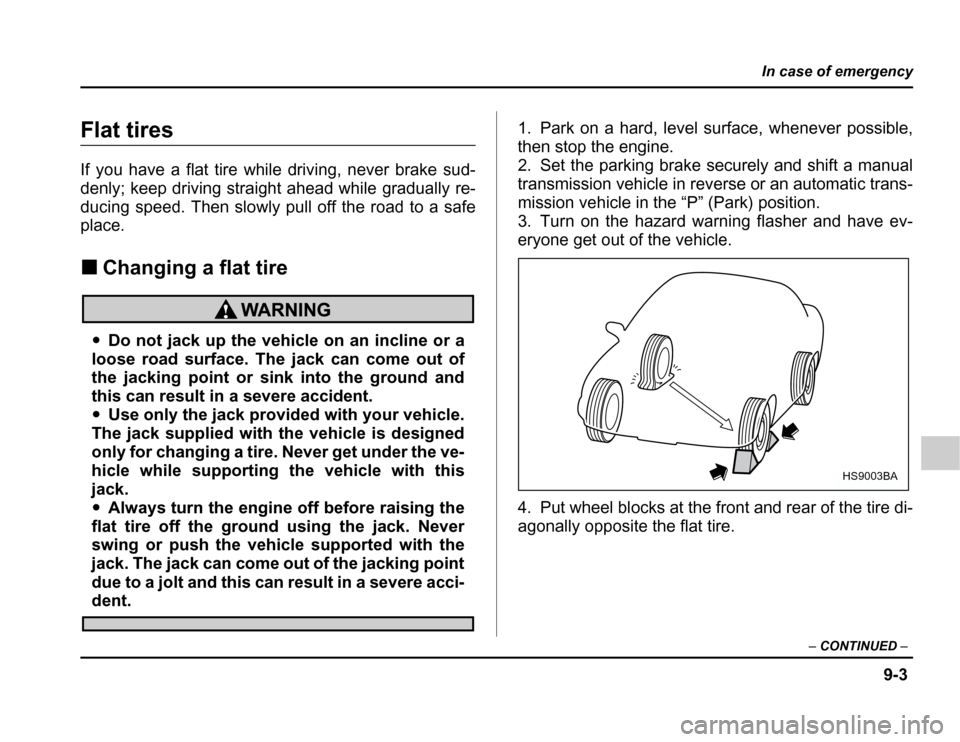
4. Put wheel blocks at the front and rear of the tire di-
agonally opposite the flat tire.
HS9003BA
Page 325 of 420
9-20
In case of emergency
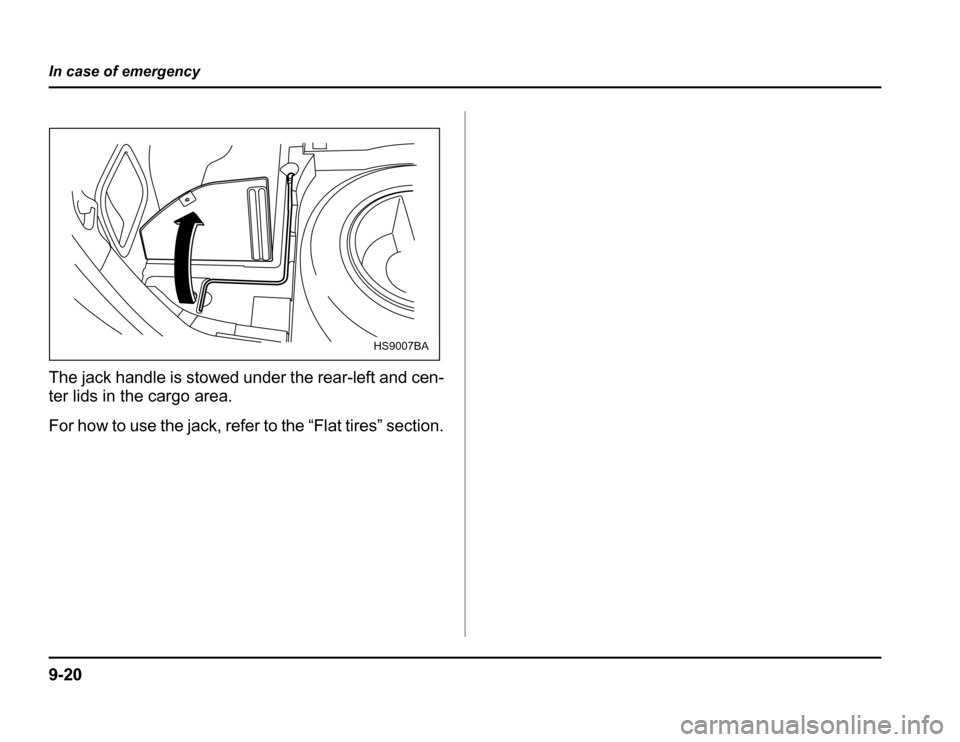
The jack handle is stowed under the rear-left and cen-
ter lids in the cargo area.
For how to use the jack, refer to the “Flat tires” section.
HS9007BA
Page 332 of 420

11 - 1
11
Maintenance and service
Maintenance schedule ................................ 11-3
Maintenance precautions ........................... 11-3 Before checking or servicing in the engine
compartment ................................................... 11-4
When you do checking or servicing in the
engine compartment while the engine is
running ............................................................. 11-5
Engine hood ................................................. 11-5
Engine compartment overview .................. 11-8
Engine oil ..................................................... 11-9 Checking the oil level ..................................... 11-9
Changing the oil and oil filter ........................ 11-10
Recommended grade and viscosity .............. 11-12
Recommended grade and viscosity under
severe driving conditions .............................. 11-14
Synthetic oil ..................................................... 11-14
Cooling system ............................................ 11-14 Cooling fan, hose and connections .............. 11-15
Engine coolant ................................................ 11-15
Air cleaner element ..................................... 11-19 Replacing the air cleaner element ................. 11-19
Spark plugs .................................................. 11-20 Recommended spark plugs ........................... 11-21
Drive belts .................................................... 11-21
Manual transmission oil .............................. 11-22 Checking the oil level ..................................... 11-22
Recommended grade and viscosity .............. 11-23
Automatic transmission fluid ..................... 11-24 Checking the fluid level .................................. 11-24 Recommended fluid ....................................... 11-25
Front differential gear oil (AT vehicles) ..... 11-26 Checking the oil level ..................................... 11-26
Recommended grade and viscosity ............. 11-26
Rear differential gear oil .............................. 11-27 Checking the gear oil level ............................ 11-27
Recommended grade and viscosity ............. 11-28
Power steering fluid ..................................... 11-29 Checking the fluid level .................................. 11-29
Recommended fluid ....................................... 11-30
Brake fluid .................................................... 11-30 Checking the fluid level .................................. 11-30
Recommended brake fluid ............................. 11-31
Clutch fluid (MT vehicles) ........................... 11-31 Checking the fluid level .................................. 11-31
Recommended clutch fluid ............................ 11-32
Brake booster ............................................... 11-32
Brake pedal ................................................... 11-33 Checking the brake pedal free play .............. 11-33
Checking the brake pedal reserve distance . 11-33
Clutch pedal (MT vehicles) .......................... 11-34 Checking the clutch function ........................ 11-34
Checking the clutch pedal free play ............. 11-34
Hill holder (MT vehicles — if equipped) ..... 11-35
Replacement of brake pad and lining ........ 11-35 Breaking-in of new brake pads and linings .. 11-36
Parking brake stroke ................................... 11-37
Tires and wheels .......................................... 11-37 Types of tires .................................................. 11-37