Arm SUBARU FORESTER 2003 SG / 2.G Owner's Guide
[x] Cancel search | Manufacturer: SUBARU, Model Year: 2003, Model line: FORESTER, Model: SUBARU FORESTER 2003 SG / 2.GPages: 420, PDF Size: 4.4 MB
Page 243 of 420

7-10
Starting and operating
half way down.
6. Confirm that all warning and indicator lights have
gone out after the engine has started. The fuel injec-
tion system automatically lowers the idle speed as the
engine warms up.
While the engine is warming up, make sure that the
selector lever is at the “P” or “N” position and that the
parking brake is applied.
If you restart the engine while the vehicle is
moving, shift the selector lever into the “N” po-
sition. Do not attempt to place the selector lever
of a moving vehicle into the “P” position.
Starting the engine during cold weath-
er below –4 °F(–20 °C)
If the engine is difficult to start using the normal meth-
od (without depressing the accelerator pedal), turn the
ignition switch to the “START” position while slightly
depressing the accelerator pedal.
Starting a flooded engine
If the engine does not start, it may be flooded (exces-
sive fuel in the engine).
In case of a flooded engine, turn the starter motor for
five seconds with the accelerator pedal fully de-
pressed. Repeat this two or three times until the en-
gine starts. Release the ignition switch and
accelerator pedal as soon as the engine starts.
Page 253 of 420

7-20
Starting and operating
Rear viscous limited slip differential
(LSD) (if equipped)
The LSD provides optimum distribution of power ac-
cording to the difference in revolutions between the
right and left rear wheels that may be caused by cer-
tain driving conditions, thereby improving driving sta-
bility on snow-covered, muddy or other slippery roads.
Never start the engine while a tire on one side
is jacked up, as the vehicle may move. If one rear tire is spinning in mud, avoid con-
tinued spinning at high speed as this could ad-
versely affect the LSD. If a different size rear tire is temporarily used
(as in an emergency), it will adversely affect the
LSD. Always replace it with a regular size tire as
soon as possible.
Power steering
The power steering system operates only when the
engine is running.
If you lose power steering assist because the engine
stops or the system fails to function, you can steer but
it will take much more effort.
NOTE
Right after the engine has been started and before
it has warmed up, you may hear a noise coming
from areas adjacent to the power steering pump
which is located at the right-front area of the en-
gine compartment. This noise is normal. It does
not indicate power steering system trouble.
Do not hold the steering wheel at the fully
locked position left or right for more than five
seconds. This may damage the power steering
pump.
Page 279 of 420

8-10
Driving tips
starting.
Keep the door locks from freezing by squirting them
with deicer or glycerin.
Forcing a frozen door open may damage or separate
the rubber weather strips around the door. If the door
is frozen, use hot water to melt the ice, and afterwards
thoroughly wipe the water away.
Use a windshield washer fluid that contains an anti-
freeze solution. Do not use engine antifreeze or other
substitutes because they may damage the paint of the
vehicle.
Before driving your vehicle
Before entering the vehicle, remove any snow or ice
from your shoes because that could make the pedals
slippery and dangerous.
While warming up the vehicle before driving, check
that the accelerator pedal, brake pedal, and all other
controls operate smoothly.
Clear away ice and snow that has accumulated under
the fenders to avoid making steering difficult. During
severe winter driving, stop when and where it is safe
to do so and check under the fenders periodically.
Parkingincoldweather
Do not use the parking brake when parking for long
periods in cold weather since it could freeze in that po-
sition. Instead, observe the following:
1. Place the shift lever in “1” or “R” for manual trans-
mission vehicles, and in “P” for automatic transmission
vehicles.
2. Use tire stops under the tires to prevent the vehicle
from moving.
When the vehicle is parked in snow or when it snows,
raise the wiper blades off the glass to prevent damage
to them.
When the vehicle has been left parked after use on
roads heavily covered with snow, or has been left
parked during a snowstorm, icing may develop on the
brake system, which could cause poor braking action.
Check for snow or ice buildup on the suspension, disc
brakes and brake hoses underneath the vehicle.
If there is caked snow or ice, remove it, being careful
not to damage the disc brakes and brake hoses and
ABS harness.
Snow can trap dangerous exhaust gases under
your vehicle. Keep snow clear of the exhaust
Page 280 of 420

8-11
Driving tips
– CONTINUED –
pipe and from around your vehicle if you park
the vehicle in snow with the engine running.
Refuelingincoldweather
To help prevent moisture from forming in the fuel sys-
tem and the risk of its freezing, use of an antifreeze ad-
ditive in the fuel tank is recommended during cold
weather.
Use only additives that are specifically designed for
this purpose. When an antifreeze additive is used, its
effect lasts longer if the tank is refilled whenever the
fuel level reaches half empty.
If your SUBARU is not going to be used for an extend-
ed period, it is best to have the fuel tank filled to capac-
ity. Drivingonsnowyandicyroads
To prevent skidding and slipping, avoid sudden brak-
ing, abrupt acceleration, high-speed driving, and
sharp turning when driving on snowy or icy roads.
Always maintain ample distance between your vehicle
and the vehicle ahead of you to avoid the need for sud-
den braking.
To supplement the foot brake, use the engine brake
effectively to control the vehicle speed. (Shift into a lower gear when necessary.)
Avoid shifting down abruptly. Such behavior can
cause the wheels to lock, possibly leading to loss of
vehicle control.
An anti-lock brake system (ABS) enhances your vehi-
cle’s braking performance on snowy and icy roads.
Refer to the “ABS (Anti-lock Brake System)” section in
chapter 7 for information on braking on slippery sur-
faces.
Do not use the cruise control on slippery roads
such as snowy or icy roads. This may cause
loss of vehicle control.
Wiper operation when snowing
Before driving in cold weather, make sure the wiper
blades are not frozen to the windshield or rear window.
If the wiper blades are frozen to the windshield or rear
window, use the defroster with the airflow control but-
ton/dial in the “ ” position and the temperature con-
trol dial set for maximum warmth until the wiper blades
are completely thawed out. If your vehicle is equipped
with a wiper deicer, it is helpful to thaw the windshield
wiper blades. To thaw out the rear wiper blade, use the
Page 281 of 420

8-12
Driving tips
rear window defogger.
When driving in snow, if frozen snow starts to stick on
the surface of the windshield despite wiper operation,
use the defroster with the airflow control button/dial in
“ ” and the temperature control dial set for maximum
warmth. After the windshield gets warmed enough to
melt the frozen snow on it, wash it away using the
windshield washer.
Snow stuck on the wiper arm prevents the wiper from
working effectively. If snow is stuck on the wiper arm,
pull off the road to a safe place, then remove it. If you
stop the car at road side, use the hazard warning
flasher to alert other drivers.
We recommend use of non-freezing type wiper blades
(winter blades) during the seasons you could have
snow and sub-zero temperatures. Blades of this type
give superior wiping performance in snowy conditions.
Be sure to use blades that are suitable for your vehi- cle.
Corrosion protection
Refer to the “Corrosion protection” section (chapter
10).
Snow tires
When replacing original tires with winter
(snow) tires, make sure you use only the same
size, construction and load range as the origi-
nal tires listed on the tire placard. Using other
sizes and construction may affect speedome-
ter/odometer calibration and clearance be-
tween the body and tires. It also may be
dangerous and lead to loss of vehicle control. You must install four winter tires that are of
the same size, construction, brand, and load
range. Mixing other sizes or constructions may
result in severe mechanical damage to the drive
train of your vehicle and may affect ride, han-
dling, braking and speedometer/odometer cali-
bration. It also may be dangerous and lead to
loss of vehicle control. Do not use a combination of radial, belted
bias or bias tires since it may cause dangerous
handling characteristics and lead to an acci-
dent.
Your vehicle is equipped with “all season tires” as orig-
inal equipment, which are designed to provide an ad-
Page 327 of 420
10-2
Appearance care
Appearance care
Exterior care
Washing
The best way to preserve your vehicle’s beauty is fre-
quent washing. Wash the vehicle at least once a
month to avoid contamination by road grime.
Wash dirt off with a wet sponge and plenty of luke-
warm or cold water. Do not wash the vehicle with hot
water and in direct sunlight.
Salt, chemicals, insects, tar, soot and bird droppings
should be washed off by using a light detergent, as re-
quired. If you use a light detergent, make certain that
it is a neutral detergent. Do not use strong soap or
chemical detergents. All cleaning agents should be
promptly flushed from the surface and not allowed to
dry there. Rinse the vehicle thoroughly with plenty of
lukewarm water. Wipe the remaining water off with a
chamois or soft cloth.
When washing the vehicle, the brakes may
get wet. As a result, the brake stopping dis-
tance will be longer. To dry the brakes, drive the
vehicle at a safe speed while lightly pressing
the brake pedal to heat up the brakes.
Do not wash the engine compartment and
area adjacent to it. If water enters the engine air
intake, electrical parts or the power steering flu-
id reservoir, it will cause engine trouble or
faulty power steering respectively.
NOTE
When having your vehicle washed in an automatic
car wash, make sure beforehand that the car wash
is of suitable type. Automatic car wash brushes or
other equipment may damage the rear wiper and
roof spoiler (if equipped). Washing the underbody
Chemicals, salts and gravel used for deicing road sur-
faces are extremely corrosive, accelerating the corro-
sion of underbody components, such as the exhaust
system, fuel and brake lines, brake cables, floor pan
and fenders, and suspension.
Thoroughly flush the underbody and inside of the
fenders with lukewarm or cold water at frequent inter-
vals to reduce the harmful effects of such agents. Using a warm water washer
Keepagooddistanceof12in(30cm)ormorebe-
tween the washer nozzle and the vehicle. Do not wash the same area continuously.
Page 328 of 420

10-3
Appearance care
–CONTINUED –
If a stain will not come out easily, wash by hand.
Some warm water washers are of the high tempera-
ture, high pressure type, and they can damage or de-
form the resin parts such as mouldings, or cause
water to leak into the vehicle. Waxing and polishing
Always wash and dry the vehicle before waxing and
polishing.
Use a good quality polish and wax and apply them ac-
cording to the manufacturer’s instructions. Wax or pol-
ish when the painted surface is cool.
Be sure to polish and wax the chrome trim, as well as
the painted surfaces. Loss of wax on a painted surface
leads to loss of the original luster and also quickens
the deterioration of the surface. It is recommended
that a coat of wax be applied at least once a month, or
whenever the surface no longer repels water.
If the appearance of the paint has diminished to the
point where the luster or tone cannot be restored,
lightly polish the surface with a fine-grained com-
pound. Never polish just the affected area, but include
the surrounding area as well. Always polish in only
one direction. A No. 2000 grain compound is recom-
mended. Never use a coarse-grained compound.
Coarser grained compounds have a smaller grain-size number and could damage the paint. After polishing
with a compound, coat with wax to restore the original
luster. Frequent polishing with a compound or an in-
correct polishing technique will result in removing the
paint layer and exposing the undercoat. When in
doubt, it is always best to contact your SUBARU deal-
er or an auto paint specialist.
NOTE
Be careful not to block the windshield washer noz-
zles with wax when waxing the vehicle.
Cleaning aluminum wheels
Promptly wipe the aluminum wheels clean of any
kind of grime or agent. If dirt is left on too long, it may
be difficult to clean off. Do not use soap containing grit to clean the wheels.
Be sure to use a neutral cleaning agent, and later rinse
thoroughly with water. Do not clean the wheels with a
stiff brush or expose them to a high-speed washing
device. Clean the vehicle (including the aluminum wheels)
with water as soon as possible when it has been
splashed with sea water, exposed to sea breezes, or
driven on roads treated with salt or other agents.
Page 330 of 420

10-5
Appearance care
–CONTINUED –
damp, poorly ventilated garage. In such a garage, cor-
rosion can be caused by dampness. If you wash the
vehicle in the garage or put the vehicle into the garage
when wet or covered with snow, that can cause damp- ness.
If your vehicle is operated in cold weather and/or in ar-
eas where road salts and other corrosive materials are
used, the door hinges and locks, trunk lid lock, and
hood latch should be inspected and lubricated period-
ically.Cleaning the interior
Use a vacuum cleaner to get rid of the dust and dirt.
Wipe the vinyl areas with a clean, damp cloth. Seat fabric
Remove loose dirt, dust or debris with a vacuum
cleaner. If the dirt is caked on the fabric or hard to re-
move with a vacuum cleaner, use a soft blush then
vacuum it.
Wipe the fabric surface with a tightly wrung cloth and
dry the seat fabric thoroughly. If the fabric is still dirty,
wipe using a solution of mild soap and lukewarm water
then dry thoroughly.
If the stain does not come out, try a commercially-
available fabric cleaner. Use the cleaner on a hidden
place and make sure it does not affect the fabric ad-
versely. Use the cleaner according to its instructions. Leather seat materials
The leather used by SUBARU is a high quality natural
product which will retain its distinctive appearance and
feel for many years with proper care.
Allowing dust or road dirt to build up on the surface can
cause the material to become brittle and to wear pre-
Page 341 of 420
11 - 1 0
Maintenance and service
a bad smell, smoke, and/or a fire.
If you check the oil level just after stopping the engine,
wait a few minutes for the oil to drain back into the oil
pan before checking the level.
Just after driving or while the engine is warm, the en-
gine oil level reading may be in a range between the
upper level and the notch mark. This is caused by ther-
mal expansion of the engine oil.
To prevent overfilling the engine oil, do not add any
additional oil above the upper level when the engine is
cold. Changing the oil and oil filter
Change the oil and oil filter according to the mainte-
nance schedule in the “Warranty and Maintenance
Booklet”.
The engine oil and oil filter must be changed more fre-
quently than listed in the maintenance schedule when
driving on dusty roads, when short trips are frequently
made, when towing a trailer, or when driving in ex-
tremely cold whether.
1. Warm up the engine by letting the engine idle for
about 10 minutes to ease draining the engine oil.
2. Park the vehicle on a level surface and stop the en- gine.
3. Remove the oil filler cap.
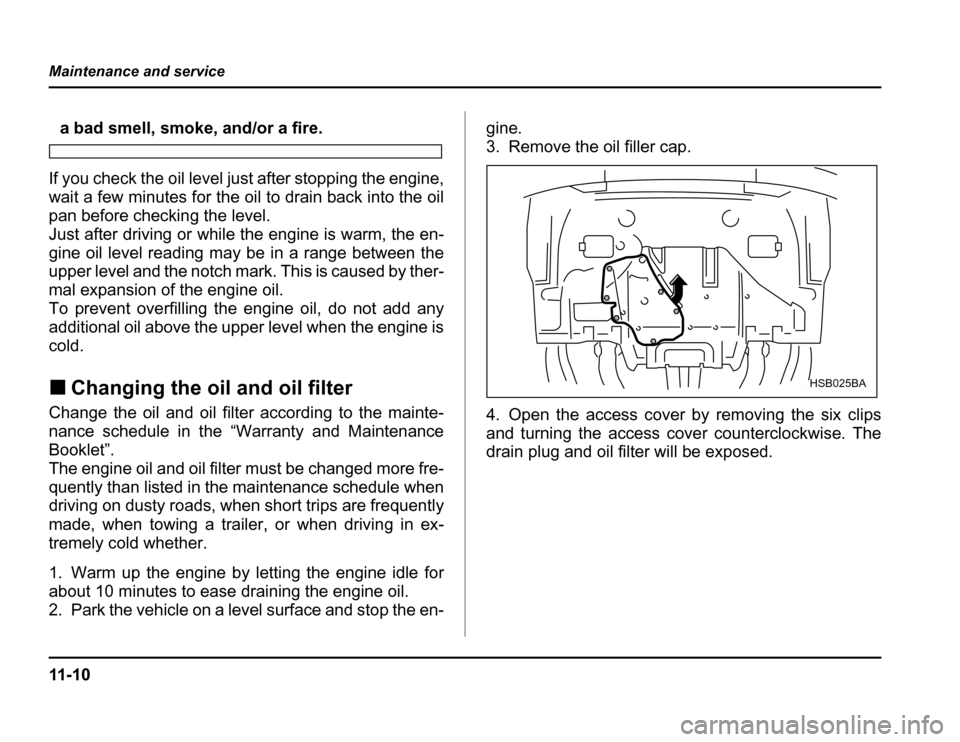
4. Open the access cover by removing the six clips
and turning the access cover counterclockwise. The
drain plug and oil filter will be exposed.
HSB025BA
Page 342 of 420
11-11
Maintenance and service
–CONTINUED –
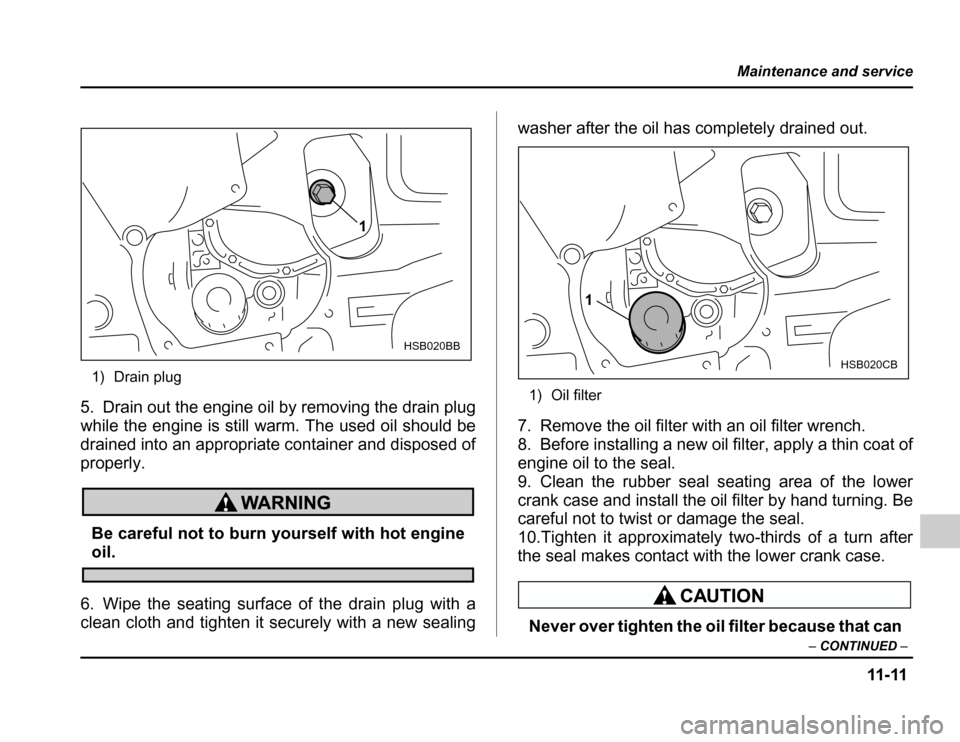
1) Drain plug
5. Drain out the engine oil by removing the drain plug
while the engine is still warm. The used oil should be
drained into an appropriate container and disposed of
properly.
Be careful not to burn yourself with hot engine
oil.
6. Wipe the seating surface of the drain plug with a
clean cloth and tighten it securely with a new sealing washer after the oil has completely drained out.
1) Oil filter
7. Remove the oil filter with an oil filter wrench.
8. Before installing a new oil filter, apply a thin coat of
engine oil to the seal.
9. Clean the rubber seal seating area of the lower
crank case and install the oil filter by hand turning. Be
careful not to twist or damage the seal.
10.Tighten it approximately two-thirds of a turn after
the seal makes contact with the lower crank case.
Never over tighten the oil filter because that can
1
HSB020BB
HSB020CB
1