meter SUBARU FORESTER 2004 Service Repair Manual
[x] Cancel search | Manufacturer: SUBARU, Model Year: 2004, Model line: FORESTER, Model: SUBARU FORESTER 2004Pages: 2870, PDF Size: 38.67 MB
Page 1539 of 2870
ME(H4DOTC)-81
MECHANICAL
Cylinder Head Assembly
6. INTAKE AND EXHAUST VALVE OIL
SEAL
1) Replace the oil seal with a new one in the follow-
ing condition, Refer to procedure 2) for replace-
ment procedure.
Lip portion is damaged.
Spring is out of place.
Valve and valve seat are reconditioned.
Valve guide is replaced.
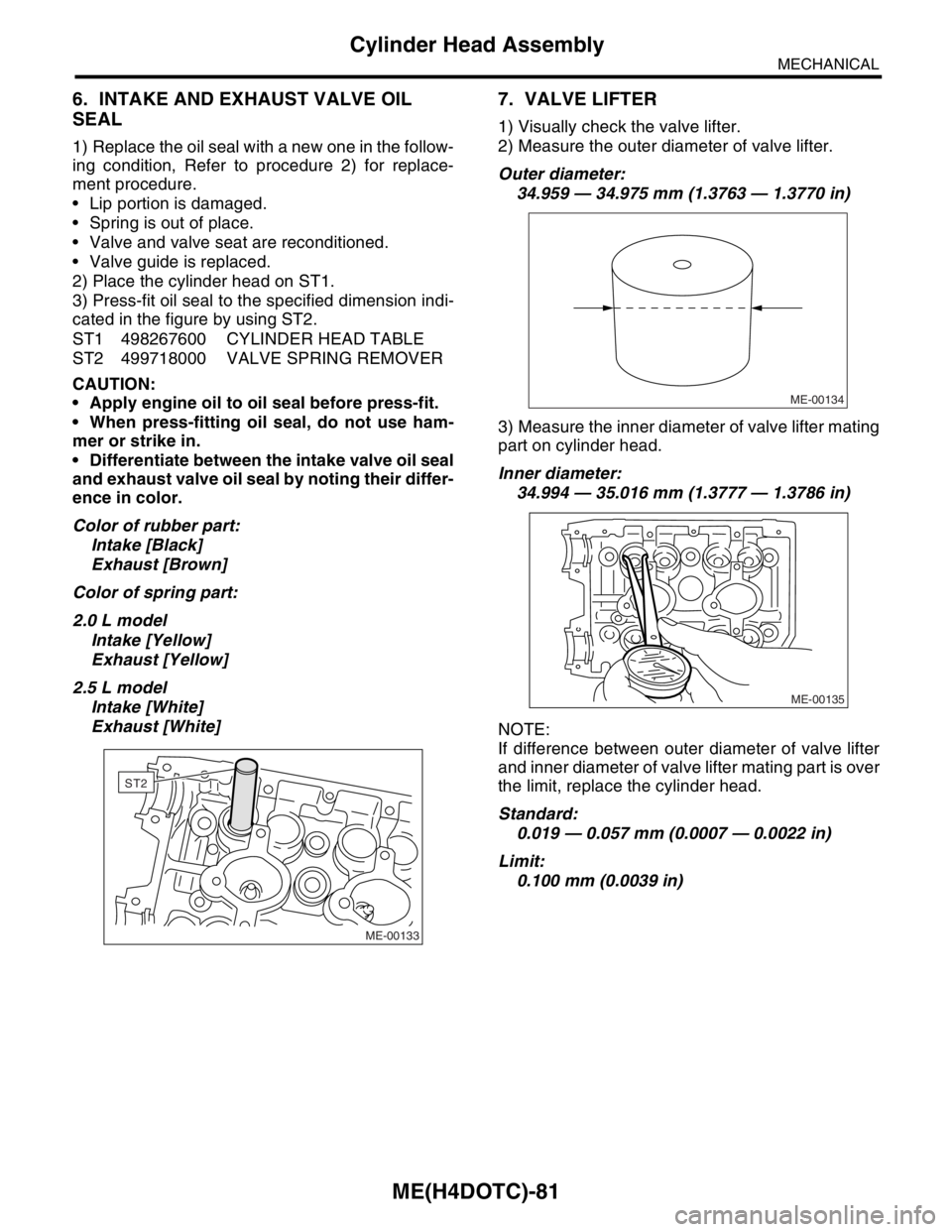
2) Place the cylinder head on ST1.
3) Press-fit oil seal to the specified dimension indi-
cated in the figure by using ST2.
ST1 498267600 CYLINDER HEAD TABLE
ST2 499718000 VALVE SPRING REMOVER
CAUTION:
Apply engine oil to oil seal before press-fit.
When press-fitting oil seal, do not use ham-
mer or strike in.
Differentiate between the intake valve oil seal
and exhaust valve oil seal by noting their differ-
ence in color.
Color of rubber part:
Intake [Black]
Exhaust [Brown]
Color of spring part:
2.0 L model
Intake [Yellow]
Exhaust [Yellow]
2.5 L model
Intake [White]
Exhaust [White]
7. VALVE LIFTER
1) Visually check the valve lifter.
2) Measure the outer diameter of valve lifter.
Outer diameter:
34.959 — 34.975 mm (1.3763 — 1.3770 in)
3) Measure the inner diameter of valve lifter mating
part on cylinder head.
Inner diameter:
34.994 — 35.016 mm (1.3777 — 1.3786 in)
NOTE:
If difference between outer diameter of valve lifter
and inner diameter of valve lifter mating part is over
the limit, replace the cylinder head.
Standard:
0.019 — 0.057 mm (0.0007 — 0.0022 in)
Limit:
0.100 mm (0.0039 in)
ME-00133
ST2
ME-00134
ME-00135
Page 1566 of 2870
ME(H4DOTC)-106
MECHANICAL
Cylinder Block
2.0 L MODEL
Standard diameter:
A: 92.005 — 92.015 mm (3.6222 — 3.6226 in)
B: 91.995 — 92.005 mm (3.6218 — 3.6222 in)
2.5 L MODEL
Standard diameter:
A: 99.505 — 99.515 mm (3.9175 — 3.9179 in)
B: 99.495 — 99.505 mm (3.9171 — 3.9175 in)
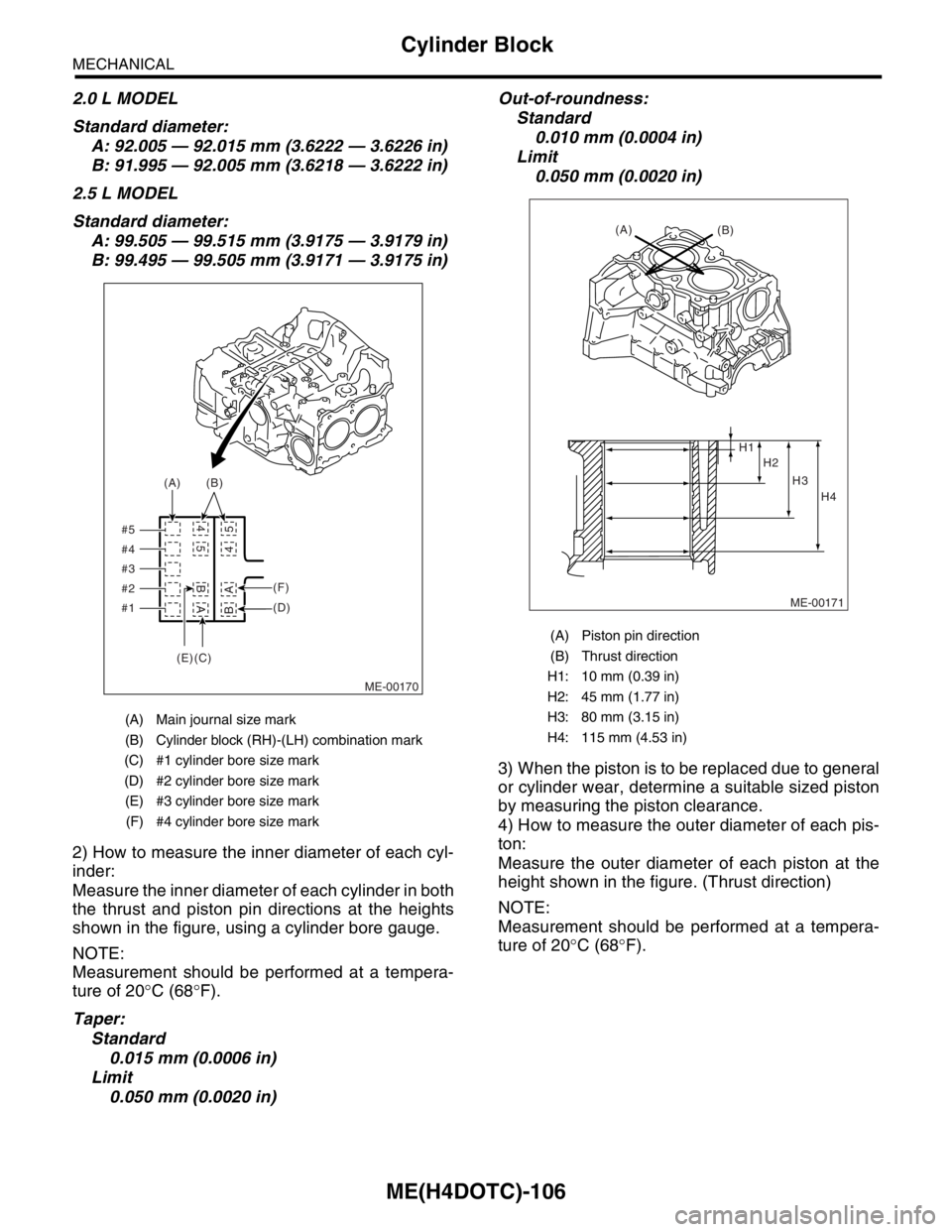
2) How to measure the inner diameter of each cyl-
inder:
Measure the inner diameter of each cylinder in both
the thrust and piston pin directions at the heights
shown in the figure, using a cylinder bore gauge.
NOTE:
Measurement should be performed at a tempera-
ture of 20°C (68°F).
Taper:
Standard
0.015 mm (0.0006 in)
Limit
0.050 mm (0.0020 in)Out-of-roundness:
Standard
0.010 mm (0.0004 in)
Limit
0.050 mm (0.0020 in)
3) When the piston is to be replaced due to general
or cylinder wear, determine a suitable sized piston
by measuring the piston clearance.
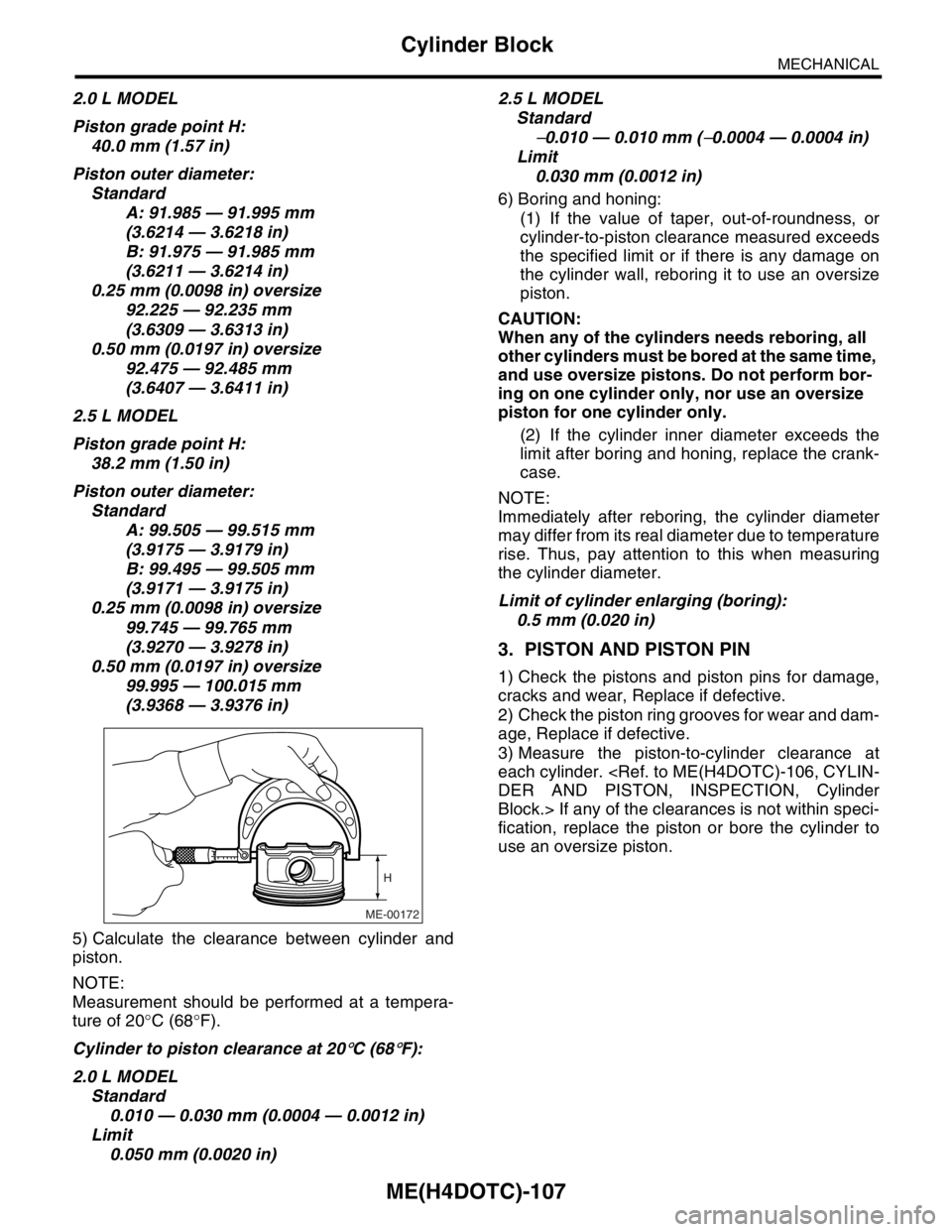
4) How to measure the outer diameter of each pis-
ton:
Measure the outer diameter of each piston at the
height shown in the figure. (Thrust direction)
NOTE:
Measurement should be performed at a tempera-
ture of 20°C (68°F).
(A) Main journal size mark
(B) Cylinder block (RH)-(LH) combination mark
(C) #1 cylinder bore size mark
(D) #2 cylinder bore size mark
(E) #3 cylinder bore size mark
(F) #4 cylinder bore size mark
ME-00170 #5
#4
#3
#2
#1(A)(B)
(F)
(D)
A BA B
5 45 4
(C) (E)
(A) Piston pin direction
(B) Thrust direction
H1: 10 mm (0.39 in)
H2: 45 mm (1.77 in)
H3: 80 mm (3.15 in)
H4: 115 mm (4.53 in)
ME-00171
(A)
(B)
H2 H1
H3
H4
Page 1567 of 2870
ME(H4DOTC)-107
MECHANICAL
Cylinder Block
2.0 L MODEL
Piston grade point H:
40.0 mm (1.57 in)
Piston outer diameter:
Standard
A: 91.985 — 91.995 mm
(3.6214 — 3.6218 in)
B: 91.975 — 91.985 mm
(3.6211 — 3.6214 in)
0.25 mm (0.0098 in) oversize
92.225 — 92.235 mm
(3.6309 — 3.6313 in)
0.50 mm (0.0197 in) oversize
92.475 — 92.485 mm
(3.6407 — 3.6411 in)
2.5 L MODEL
Piston grade point H:
38.2 mm (1.50 in)
Piston outer diameter:
Standard
A: 99.505 — 99.515 mm
(3.9175 — 3.9179 in)
B: 99.495 — 99.505 mm
(3.9171 — 3.9175 in)
0.25 mm (0.0098 in) oversize
99.745 — 99.765 mm
(3.9270 — 3.9278 in)
0.50 mm (0.0197 in) oversize
99.995 — 100.015 mm
(3.9368 — 3.9376 in)
5) Calculate the clearance between cylinder and
piston.
NOTE:
Measurement should be performed at a tempera-
ture of 20°C (68°F).
Cylinder to piston clearance at 20
°C (68°F):
2.0 L MODEL
Standard
0.010 — 0.030 mm (0.0004 — 0.0012 in)
Limit
0.050 mm (0.0020 in)2.5 L MODEL
Standard
−0.010 — 0.010 mm (−0.0004 — 0.0004 in)
Limit
0.030 mm (0.0012 in)
6) Boring and honing:
(1) If the value of taper, out-of-roundness, or
cylinder-to-piston clearance measured exceeds
the specified limit or if there is any damage on
the cylinder wall, reboring it to use an oversize
piston.
CAUTION:
When any of the cylinders needs reboring, all
other cylinders must be bored at the same time,
and use oversize pistons. Do not perform bor-
ing on one cylinder only, nor use an oversize
piston for one cylinder only.
(2) If the cylinder inner diameter exceeds the
limit after boring and honing, replace the crank-
case.
NOTE:
Immediately after reboring, the cylinder diameter
may differ from its real diameter due to temperature
rise. Thus, pay attention to this when measuring
the cylinder diameter.
Limit of cylinder enlarging (boring):
0.5 mm (0.020 in)
3. PISTON AND PISTON PIN
1) Check the pistons and piston pins for damage,
cracks and wear, Replace if defective.
2) Check the piston ring grooves for wear and dam-
age, Replace if defective.
3) Measure the piston-to-cylinder clearance at
each cylinder.
Block.> If any of the clearances is not within speci-
fication, replace the piston or bore the cylinder to
use an oversize piston.
ME-00172
H
Page 1570 of 2870
ME(H4DOTC)-110
MECHANICAL
Cylinder Block
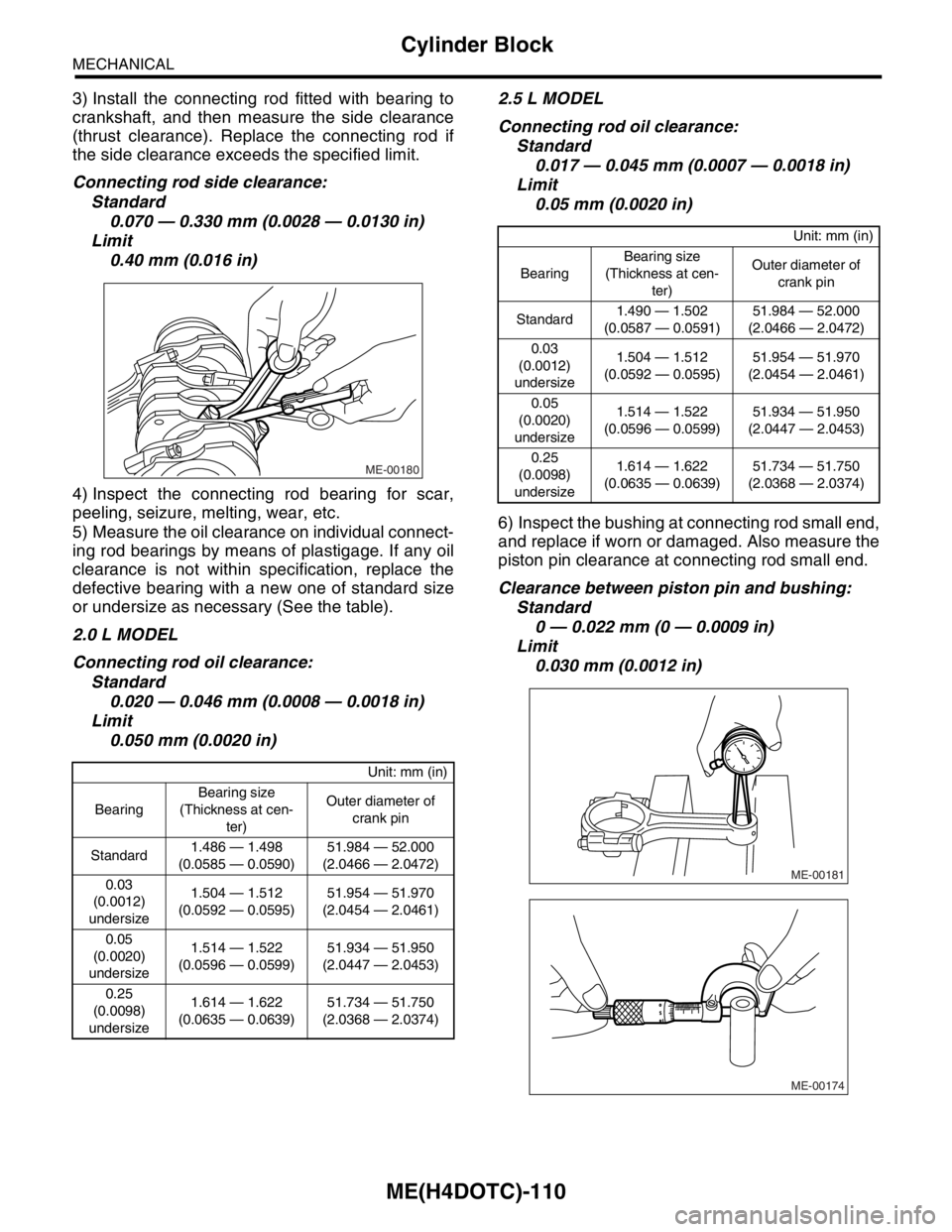
3) Install the connecting rod fitted with bearing to
crankshaft, and then measure the side clearance
(thrust clearance). Replace the connecting rod if
the side clearance exceeds the specified limit.
Connecting rod side clearance:
Standard
0.070 — 0.330 mm (0.0028 — 0.0130 in)
Limit
0.40 mm (0.016 in)
4) Inspect the connecting rod bearing for scar,
peeling, seizure, melting, wear, etc.
5) Measure the oil clearance on individual connect-
ing rod bearings by means of plastigage. If any oil
clearance is not within specification, replace the
defective bearing with a new one of standard size
or undersize as necessary (See the table).
2.0 L MODEL
Connecting rod oil clearance:
Standard
0.020 — 0.046 mm (0.0008 — 0.0018 in)
Limit
0.050 mm (0.0020 in)2.5 L MODEL
Connecting rod oil clearance:
Standard
0.017 — 0.045 mm (0.0007 — 0.0018 in)
Limit
0.05 mm (0.0020 in)
6) Inspect the bushing at connecting rod small end,
and replace if worn or damaged. Also measure the
piston pin clearance at connecting rod small end.
Clearance between piston pin and bushing:
Standard
0 — 0.022 mm (0 — 0.0009 in)
Limit
0.030 mm (0.0012 in)
Unit: mm (in)
BearingBearing size
(Thickness at cen-
ter)Outer diameter of
crank pin
Standard1.486 — 1.498
(0.0585 — 0.0590)51.984 — 52.000
(2.0466 — 2.0472)
0.03
(0.0012)
undersize1.504 — 1.512
(0.0592 — 0.0595)51.954 — 51.970
(2.0454 — 2.0461)
0.05
(0.0020)
undersize1.514 — 1.522
(0.0596 — 0.0599)51.934 — 51.950
(2.0447 — 2.0453)
0.25
(0.0098)
undersize1.614 — 1.622
(0.0635 — 0.0639)51.734 — 51.750
(2.0368 — 2.0374)
ME-00180
Unit: mm (in)
BearingBearing size
(Thickness at cen-
ter)Outer diameter of
crank pin
Standard1.490 — 1.502
(0.0587 — 0.0591)51.984 — 52.000
(2.0466 — 2.0472)
0.03
(0.0012)
undersize1.504 — 1.512
(0.0592 — 0.0595)51.954 — 51.970
(2.0454 — 2.0461)
0.05
(0.0020)
undersize1.514 — 1.522
(0.0596 — 0.0599)51.934 — 51.950
(2.0447 — 2.0453)
0.25
(0.0098)
undersize1.614 — 1.622
(0.0635 — 0.0639)51.734 — 51.750
(2.0368 — 2.0374)
ME-00181
ME-00174
Page 1572 of 2870

ME(H4DOTC)-112
MECHANICAL
Cylinder Block
2.0 L MODEL
O.D.: Outer Diameter
2.5 L MODEL
O.D.: Outer DiameterUnit: mm (in)
Crank journal diameter
Crank pin diameter
#1, #3, #5 #2, #4
StandardJournal O.D.59.992 — 60.008
(2.3619 — 2.3625)59.992 — 60.008
(2.3619 — 2.3625)51.984 — 52.000
(2.0466 — 2.0472)
Bearing size
(Thickness at cen-
ter)1.998 — 2.011
(0.0787 — 0.0792)2.000 — 2.013
(0.0787 — 0.0793)1.486 — 1.498
(0.0585 — 0.0590)
0.03 (0.0012)
undersizeJournal O.D.59.962 — 59.978
(2.3607 — 2.3613)59.962 — 59.978
(2.3607 — 2.3613)51.954 — 51.970
(2.0454 — 2.0461)
Bearing size
(Thickness at cen-
ter)2.017 — 2.020
(0.0794 — 0.0795)2.019 — 2.022
(0.0795 — 0.0796)1.504 — 1.512
(0.0592 — 0.0595)
0.05 (0.0020)
undersizeJournal O.D.59.942 — 59.958
(2.3599 — 2.3605)59.942 — 59.958
(2.3599 — 2.3605)51.934 — 51.950
(2.0447 — 2.0453)
Bearing size
(Thickness at cen-
ter)2.027 — 2.030
(0.0798 — 0.0799)2.029 — 2.032
(0.0799 — 0.0800)1.514 — 1.522
(0.0596 — 0.0599)
0.25 (0.0098)
undersizeJournal O.D.59.742 — 59.758
(2.3520 — 2.3527)59.742 — 59.758
(2.3520 — 2.3527)51.734 — 51.750
(2.0368 — 2.0374)
Bearing size
(Thickness at cen-
ter)2.127 — 2.130
(0.0837 — 0.0839)2.129 — 2.132
(0.0838 — 0.0839)1.614 — 1.622
(0.0635 — 0.0639)
Unit: mm (in)
Crank journal diameter
Crank pin outer diameter
#1, #3, #5 #2, #4
StandardJournal O.D.59.992 — 60.008
(2.3619 — 2.3625)59.992 — 60.008
(2.3619 — 2.3625)51.984 — 52.000
(2.0466 — 2.0472)
Bearing size
(Thickness at cen-
ter)1.998 — 2.011
(0.0787 — 0.0792)2.000 — 2.013
(0.0787 — 0.0793)1.490 — 1.502
(0.0587 — 0.0591)
0.03 (0.0012)
undersizeJournal O.D.59.962 — 59.978
(2.3607 — 2.3613)59.962 — 59.978
(2.3607 — 2.3613)51.954 — 51.970
(2.0454 — 2.0461)
Bearing size
(Thickness at cen-
ter)2.017 — 2.020
(0.0794 — 0.0795)2.019 — 2.022
(0.0795 — 0.0796)1.504 — 1.512
(0.0592 — 0.0595)
0.05 (0.0020)
undersizeJournal O.D.59.942 — 59.958
(2.3599 — 2.3605)59.942 — 59.958
(2.3599 — 2.3605)51.934 — 51.950
(2.0447 — 2.0453)
Bearing size
(Thickness at cen-
ter)2.027 — 2.030
(0.0798 — 0.0799)2.029 — 2.032
(0.0799 — 0.0800)1.514 — 1.522
(0.0596 — 0.0599)
0.25 (0.0098)
undersizeJournal O.D.59.742 — 59.758
(2.3520 — 2.3527)59.742 — 59.758
(2.3520 — 2.3527)51.734 — 51.750
(2.0368 — 2.0374)
Bearing size
(Thickness at cen-
ter)2.127 — 2.130
(0.0837 — 0.0839)2.129 — 2.132
(0.0838 — 0.0839)1.614 — 1.622
(0.0635 — 0.0639)
Page 1618 of 2870

IG(H4DOTC)-2
IGNITION
General Description
1. General Description
A: SPECIFICATION
Item Designation
Ignition coil and ignitor
ASSYModel FK0186
Ignition type Direct ignition
Manufacturer DIAMOND
Spark plugType and manufacturer2.0 L model NGK: PFR6G
2.5 L model NGK: ILFR6B
Thread diameter, pitch, length mm 14, 1.25, 26.5
Spark gap mm (in) 0.7 — 0.8 (0.028 — 0.031)
Electrode2.0 L model Platinum
2.5 L model Irigium
Page 1632 of 2870

EN(H4DOTC)-2
ENGINE (DIAGNOSTIC)
Basic Diagnostics Procedure
1. Basic Diagnostics Procedure
A: PROCEDURE
1. ENGINE
Step Check Yes No
1 CHECK ENGINE START FAILURE.
1) Ask the customer when and how the trou-
ble occurred using the interview check list.
2) Start the engine.Does the engine start? Go to step 2.Inspection using
“Diagnostics for
Engine Start Fail-
ure”.
Diagnostics for
Engine Starting
Fai lu r e.>
2 CHECK ILLUMINATION OF MALFUNCTION
INDICATOR LIGHT.Does malfunction indicator
light illuminate?Go to step 3.Inspection using
“General Diagnos-
tic Table”.
295, General Diag-
nostic Table.>
3 CHECK INDICATION OF DTC ON DISPLAY.
1) Turn the ignition switch to OFF.
2) Connect the Subaru Select Monitor or the
OBD-II general scan tool to data link connec-
tor.
3) Turn the ignition switch to ON and the Sub-
aru Select Monitor or OBD-II general scan tool
switch to ON.
4) Read the DTC on the Subaru Select Moni-
tor or OBD-II general scan tool.Does the Subaru Select Moni-
tor or OBD-II general scan tool
indicate DTC?Record the
DTC.Repair the
trouble cause.
List of Diagnostic
Trouble Code
(DTC).> Go to
step 4.Repair the related
parts.
N
OTE:
If DTC is not shown
on display although
the malfunction in-
dicator light illumi-
nates, perform the
diagnostics for mal-
function indicator
light circuit or com-
bination meter.
Malfunction Indica-
tor Light.>
4 PERFORM THE DIAGNOSIS.
1) Perform clear memory mode.
2) Perform the “INSPECTION MODE”.
tor or OBD-II general scan tool
indicate DTC?Check on “Diag-
nostic Chart with
Diagnostic Trou-
ble Code (DTC)”
Diagnostic Proce-
dure with Diagnos-
tic Trouble Code
(DTC).>Finish the diagno-
sis.
Page 1634 of 2870

EN(H4DOTC)-4
ENGINE (DIAGNOSTIC)
Check List for Interview
2. Check List for Interview
A: INSPECTION
1. CHECK LIST NO. 1
Check the following items when problem has occurred.
NOTE:
Use copies of this page for interviewing customers.
Customer’s name Engine No.
Date of sale Fuel brand
Date of repair
Odometer readingkm
V.I.N.miles
Weather❏ Fine
❏ Cloudy
❏ Rainy
❏ Snowy
❏ Va r i o u s / O t h e r s :
Ambient air temperature°C (°F)
❏ Hot
❏ War m
❏ Cool
❏ Cold
Place❏ Highway
❏ Suburbs
❏ Inner city
❏ Uphill
❏ Downhill
❏ Rough road
❏ Others:
Engine temperature❏ Cold
❏ War ming-up
❏ After warming-up
❏ Any temperature
❏ Others:
Engine speed rpm
Vehicle speed km/h (MPH)
Driving conditions❏ Not affected
❏ At starting
❏ While idling
❏ At racing
❏ While accelerating
❏ While cruising
❏ While decelerating
❏ While turning (RH/LH)
Headlight❏ ON / ❏ OFF Rear defogger❏ ON / ❏ OFF
Blower❏ ON / ❏ OFF Radio❏ ON / ❏ OFF
A/C compressor❏ ON / ❏ OFF CD/Cassette❏ ON / ❏ OFF
Radiator fan❏ ON / ❏ OFF Car phone❏ ON / ❏ OFF
Fr o nt wi pe r❏ ON / ❏ OFF CB❏ ON / ❏ OFF
Rear Wiper❏ ON / ❏ OFF
Page 1636 of 2870
EN(H4DOTC)-6
ENGINE (DIAGNOSTIC)
General Description
3. General Description
A: CAUTION
1) Airbag system wiring harness is routed near the
ECM, main relay and fuel pump relay.
CAUTION:
All airbag system wiring harness and con-
nectors are all colored yellow.Do not use the
electrical test equipment on these circuits.
Be careful not to damage the Airbag system
wiring harness when servicing the ECM, TCM,
main relay and fuel pump relay.
2) Never connect the battery in reverse polarity.
The ECM will be destroyed immediately.
The fuel injector and other part will be damaged.
3) Do not disconnect the battery terminals while the
engine is running.
A large counter electromotive force will be gener-
ated in the generator, and this voltage may damage
electronic parts such as ECM, etc.
4) Before disconnecting the connectors of each
sensor and the ECM, be sure to turn OFF the igni-
tion switch.
5) Poor contact has been identified as a primary
cause of this problem.Measure the voltage or resis-
tance of individual sensor or all electrical control
modules using a tapered pin with a diameter of less
than 0.64 mm (0.025 in).Do not insert the pin more
than 5 mm (0.20 in) into the part.
6) Remove the ECM from the located position after
disconnecting two cables on battery.
Otherwise, the ECM may be damaged.
CAUTION:
When replacing the ECM, be careful not to use
the wrong spec. ECM to avoid damaging the
fuel injection system.
7) Connectors to each sensor in the engine com-
partment and the harness connectors on the en-
gine side and body side are all designed to be
waterproof.However, take care not to allow water to
get into the connectors when washing the vehicle,
or when servicing the vehicle on a rainy day. 8) Use ECM mounting stud bolts on the body
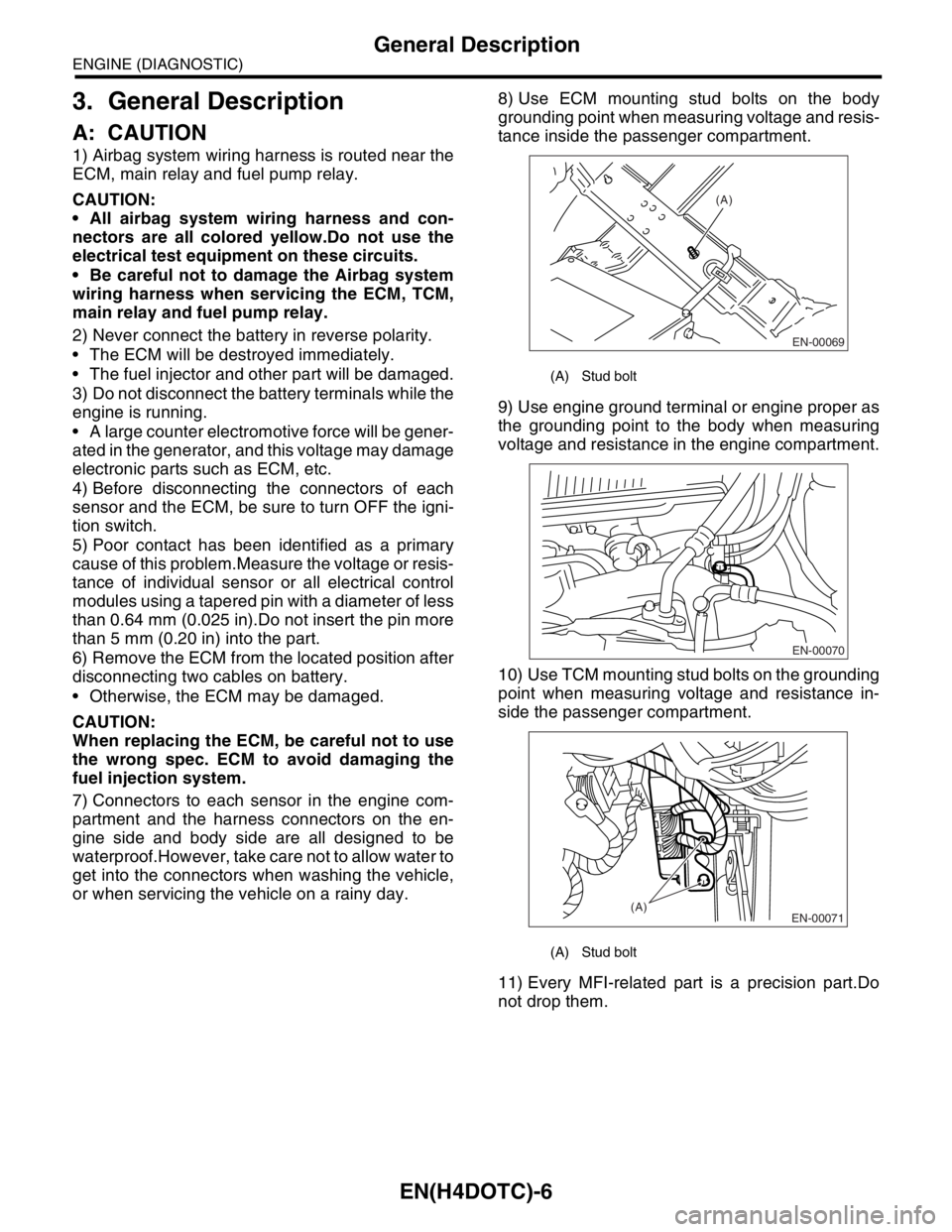
grounding point when measuring voltage and resis-
tance inside the passenger compartment.
9) Use engine ground terminal or engine proper as
the grounding point to the body when measuring
voltage and resistance in the engine compartment.
10) Use TCM mounting stud bolts on the grounding
point when measuring voltage and resistance in-
side the passenger compartment.
11) Every MFI-related part is a precision part.Do
not drop them.
(A) Stud bolt
(A) Stud bolt
EN-00069
(A)
EN-00070
EN-00071(A)
Page 1637 of 2870
EN(H4DOTC)-7
ENGINE (DIAGNOSTIC)
General Description
12) Observe the following cautions when installing
a radio in MFI equipped models.
CAUTION:
The antenna must be kept as far apart as pos-
sible from the control unit. (The ECM is located
under the steering column, inside of the instru-
ment panel lower trim panel.)
The antenna feeder must be placed as far
apart as possible from the ECM and MFI har-
ness.
Carefully adjust the antenna for correct
matching.
When mounting a large power type radio, pay
special attention to the three items above men-
tioned.
Incorrect installation of the radio may affect
the operation of the ECM.
13) Before disconnecting the fuel hose, disconnect
the fuel pump connector and crank the engine for
more than five seconds to release pressure in the
fuel system.If engine starts during this operation,
run it until it stops.
14) Problems in the electronic-controlled automatic
transmission may be caused by failure of the en-
gine, the electronic control system, the transmis-
sion proper, or by a combination of these.These
three causes (engine, electronic control system,
transmission) must be distinguished clearly when
performing diagnostics.
15) Diagnostics should be conducted by rotating
with simple, easy operations and proceeding to
complicated, difficult operations.The most impor-
tant thing in diagnostics is to understand the cus-
tomer’s complaint, and distinguish between the
three causes.
16) On the model with ABS, when performing driv-
ing test in jacked-up or lifted-up position, some-
times the warning light may be lit, but this is not a
malfunction of the system.The reason for this is the
speed difference between the front and rear
wheels.After diagnosis of engine control system,
perform the ABS memory clearance procedure of
self-diagnosis function.
B: INSPECTION
Before performing diagnostics, check the following
items which might affect engine problems:
1. BATTERY
1) Measure battery voltage and specific gravity of
electrolyte.
Standard voltage: 12 V
Specific gravity: Above 1.2602) Check the condition of the main and other fuses,
and harnesses and connectors.Also check for
proper grounding.
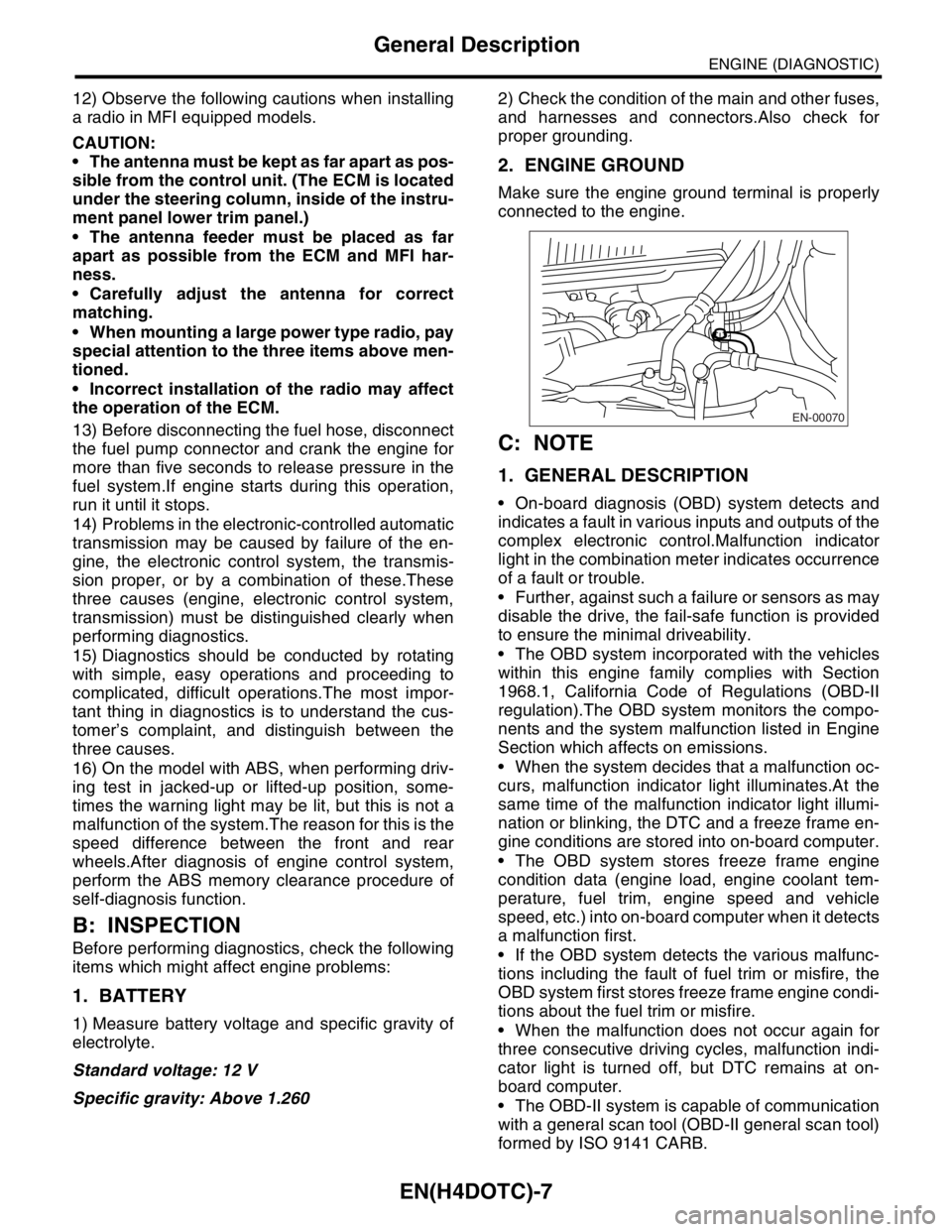
2. ENGINE GROUND
Make sure the engine ground terminal is properly
connected to the engine.
C: NOTE
1. GENERAL DESCRIPTION
On-board diagnosis (OBD) system detects and
indicates a fault in various inputs and outputs of the
complex electronic control.Malfunction indicator
light in the combination meter indicates occurrence
of a fault or trouble.
Further, against such a failure or sensors as may
disable the drive, the fail-safe function is provided
to ensure the minimal driveability.
The OBD system incorporated with the vehicles
within this engine family complies with Section
1968.1, California Code of Regulations (OBD-II
regulation).The OBD system monitors the compo-
nents and the system malfunction listed in Engine
Section which affects on emissions.
When the system decides that a malfunction oc-
curs, malfunction indicator light illuminates.At the
same time of the malfunction indicator light illumi-
nation or blinking, the DTC and a freeze frame en-
gine conditions are stored into on-board computer.
The OBD system stores freeze frame engine
condition data (engine load, engine coolant tem-
perature, fuel trim, engine speed and vehicle
speed, etc.) into on-board computer when it detects
a malfunction first.
If the OBD system detects the various malfunc-
tions including the fault of fuel trim or misfire, the
OBD system first stores freeze frame engine condi-
tions about the fuel trim or misfire.
When the malfunction does not occur again for
three consecutive driving cycles, malfunction indi-
cator light is turned off, but DTC remains at on-
board computer.
The OBD-II system is capable of communication
with a general scan tool (OBD-II general scan tool)
formed by ISO 9141 CARB.
EN-00070