replace brake SUBARU FORESTER 2004 Service User Guide
[x] Cancel search | Manufacturer: SUBARU, Model Year: 2004, Model line: FORESTER, Model: SUBARU FORESTER 2004Pages: 2870, PDF Size: 38.67 MB
Page 760 of 2870
PM-23
PERIODIC MAINTENANCE SERVICE
Clutch System
13.Clutch System
A: INSPECTION AND ADJUSTMENT
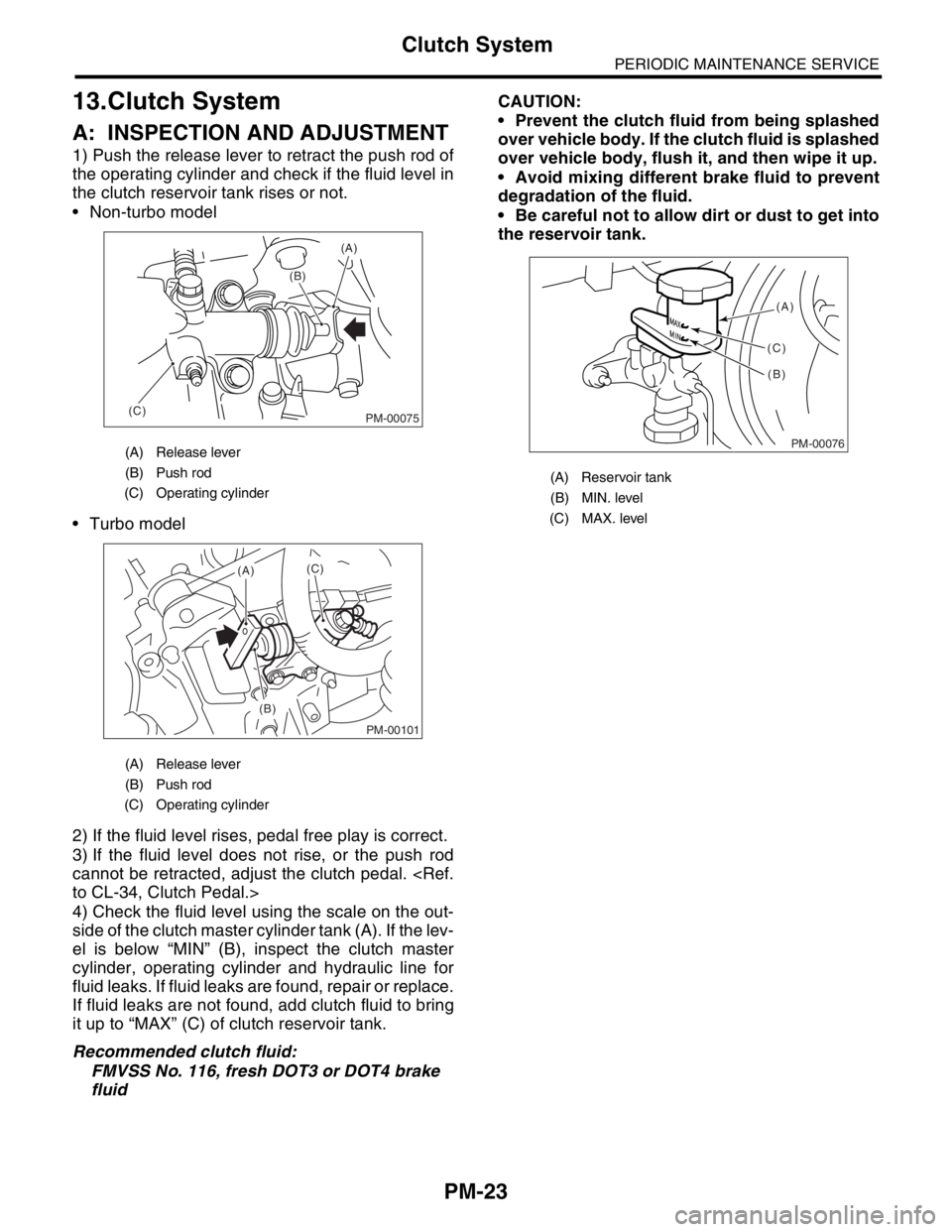
1) Push the release lever to retract the push rod of
the operating cylinder and check if the fluid level in
the clutch reservoir tank rises or not.
Non-turbo model
Turbo model
2) If the fluid level rises, pedal free play is correct.
3) If the fluid level does not rise, or the push rod
cannot be retracted, adjust the clutch pedal.
4) Check the fluid level using the scale on the out-
side of the clutch master cylinder tank (A). If the lev-
el is below “MIN” (B), inspect the clutch master
cylinder, operating cylinder and hydraulic line for
fluid leaks. If fluid leaks are found, repair or replace.
If fluid leaks are not found, add clutch fluid to bring
it up to “MAX” (C) of clutch reservoir tank.
Recommended clutch fluid:
FMVSS No. 116, fresh DOT3 or DOT4 brake
fluidCAUTION:
Prevent the clutch fluid from being splashed
over vehicle body. If the clutch fluid is splashed
over vehicle body, flush it, and then wipe it up.
Avoid mixing different brake fluid to prevent
degradation of the fluid.
Be careful not to allow dirt or dust to get into
the reservoir tank.
(A) Release lever
(B) Push rod
(C) Operating cylinder
(A) Release lever
(B) Push rod
(C) Operating cylinder
PM-00075
(A)
(C)(B)
PM-00101
(A)
(B)(C)
(A) Reservoir tank
(B) MIN. level
(C) MAX. level
PM-00076
(A)
(B) (C)
Page 768 of 2870
PM-31
PERIODIC MAINTENANCE SERVICE
Brake Line
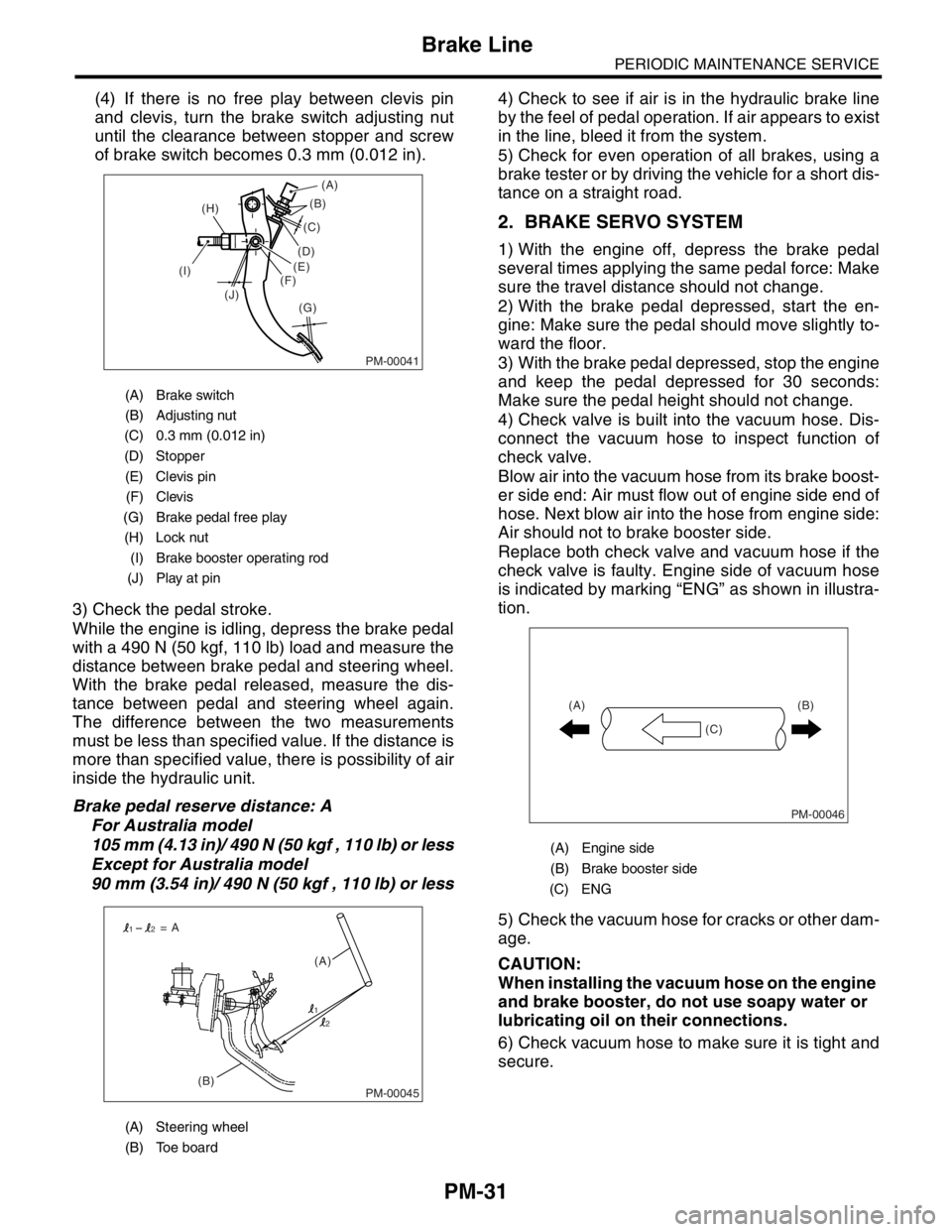
(4) If there is no free play between clevis pin
and clevis, turn the brake switch adjusting nut
until the clearance between stopper and screw
of brake switch becomes 0.3 mm (0.012 in).
3) Check the pedal stroke.
While the engine is idling, depress the brake pedal
with a 490 N (50 kgf, 110 lb) load and measure the
distance between brake pedal and steering wheel.
With the brake pedal released, measure the dis-
tance between pedal and steering wheel again.
The difference between the two measurements
must be less than specified value. If the distance is
more than specified value, there is possibility of air
inside the hydraulic unit.
Brake pedal reserve distance: A
For Australia model
105 mm (4.13 in)/ 490 N (50 kgf , 110 lb) or less
Except for Australia model
90 mm (3.54 in)/ 490 N (50 kgf , 110 lb) or less4) Check to see if air is in the hydraulic brake line
by the feel of pedal operation. If air appears to exist
in the line, bleed it from the system.
5) Check for even operation of all brakes, using a
brake tester or by driving the vehicle for a short dis-
tance on a straight road.
2. BRAKE SERVO SYSTEM
1) With the engine off, depress the brake pedal
several times applying the same pedal force: Make
sure the travel distance should not change.
2) With the brake pedal depressed, start the en-
gine: Make sure the pedal should move slightly to-
ward the floor.
3) With the brake pedal depressed, stop the engine
and keep the pedal depressed for 30 seconds:
Make sure the pedal height should not change.
4) Check valve is built into the vacuum hose. Dis-
connect the vacuum hose to inspect function of
check valve.
Blow air into the vacuum hose from its brake boost-
er side end: Air must flow out of engine side end of
hose. Next blow air into the hose from engine side:
Air should not to brake booster side.
Replace both check valve and vacuum hose if the
check valve is faulty. Engine side of vacuum hose
is indicated by marking “ENG” as shown in illustra-
tion.
5) Check the vacuum hose for cracks or other dam-
age.
CAUTION:
When installing the vacuum hose on the engine
and brake booster, do not use soapy water or
lubricating oil on their connections.
6) Check vacuum hose to make sure it is tight and
secure.
(A) Brake switch
(B) Adjusting nut
(C) 0.3 mm (0.012 in)
(D) Stopper
(E) Clevis pin
(F) Clevis
(G) Brake pedal free play
(H) Lock nut
(I) Brake booster operating rod
(J) Play at pin
(A) Steering wheel
(B) Toe board
PM-00041
(B)
(G) (H)
(I)
(J)(C)
(D)
(E)
(F)(A)
PM-00045(B)(A) = A
1
12
2
(A) Engine side
(B) Brake booster side
(C) ENG
PM-00046
(B)
(C) (A)
Page 769 of 2870
PM-32
PERIODIC MAINTENANCE SERVICE
Brake Fluid
19.Brake Fluid
A: REPLACEMENT
1) Lift-up the vehicle.
2) Remove both front and rear wheels.
3) Draw out the brake fluid from master cylinder
with syringe.
4) Refill the reservoir tank with recommended
brake fluid.
Recommended brake fluid:
FMVSS No. 116, fresh DOT3 or DOT4 brake
fluid
CAUTION:
Avoid mixing different brands of brake fluid
to prevent degrading the quality of the fluid.
Be careful not to allow dirt or dust to get into
the reservoir tank.
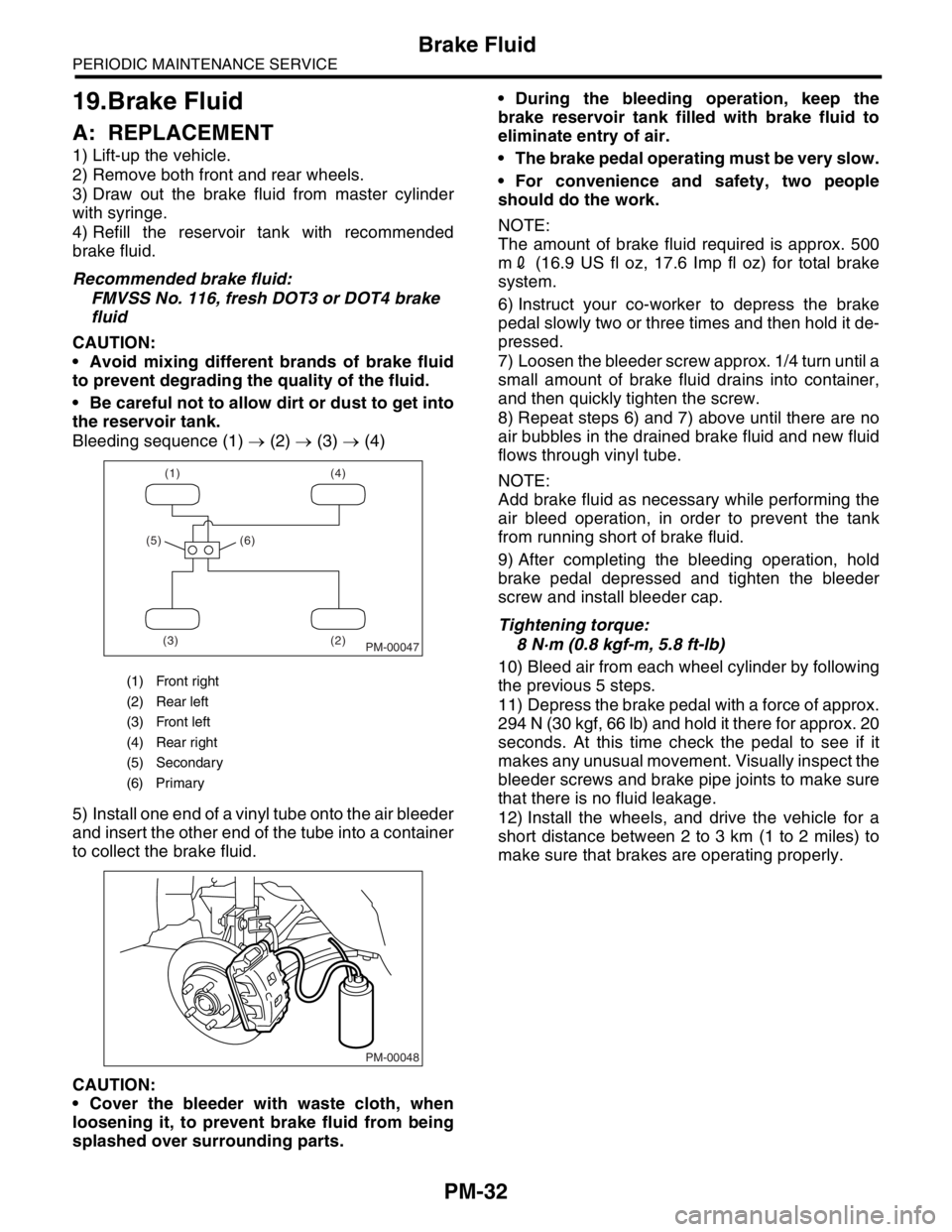
Bleeding sequence (1) → (2) → (3) → (4)
5) Install one end of a vinyl tube onto the air bleeder
and insert the other end of the tube into a container
to collect the brake fluid.
CAUTION:
Cover the bleeder with waste cloth, when
loosening it, to prevent brake fluid from being
splashed over surrounding parts. During the bleeding operation, keep the
brake reservoir tank filled with brake fluid to
eliminate entry of air.
The brake pedal operating must be very slow.
For convenience and safety, two people
should do the work.
NOTE:
The amount of brake fluid required is approx. 500
m2 (16.9 US fl oz, 17.6 Imp fl oz) for total brake
system.
6) Instruct your co-worker to depress the brake
pedal slowly two or three times and then hold it de-
pressed.
7) Loosen the bleeder screw approx. 1/4 turn until a
small amount of brake fluid drains into container,
and then quickly tighten the screw.
8) Repeat steps 6) and 7) above until there are no
air bubbles in the drained brake fluid and new fluid
flows through vinyl tube.
NOTE:
Add brake fluid as necessary while performing the
air bleed operation, in order to prevent the tank
from running short of brake fluid.
9) After completing the bleeding operation, hold
brake pedal depressed and tighten the bleeder
screw and install bleeder cap.
Tightening torque:
8 N·m (0.8 kgf-m, 5.8 ft-lb)
10) Bleed air from each wheel cylinder by following
the previous 5 steps.
11) Depress the brake pedal with a force of approx.
294 N (30 kgf, 66 lb) and hold it there for approx. 20
seconds. At this time check the pedal to see if it
makes any unusual movement. Visually inspect the
bleeder screws and brake pipe joints to make sure
that there is no fluid leakage.
12) Install the wheels, and drive the vehicle for a
short distance between 2 to 3 km (1 to 2 miles) to
make sure that brakes are operating properly.
(1) Front right
(2) Rear left
(3) Front left
(4) Rear right
(5) Secondary
(6) Primary
(1) (4)
(2) (3) (5) (6)
PM-00047
PM-00048
Page 770 of 2870
PM-33
PERIODIC MAINTENANCE SERVICE
Disc Brake Pads and Discs
20.Disc Brake Pads and Discs
A: INSPECTION
1. DISC BRAKE PAD AND DISC
1) Lift-up the vehicle. Then remove the wheels.
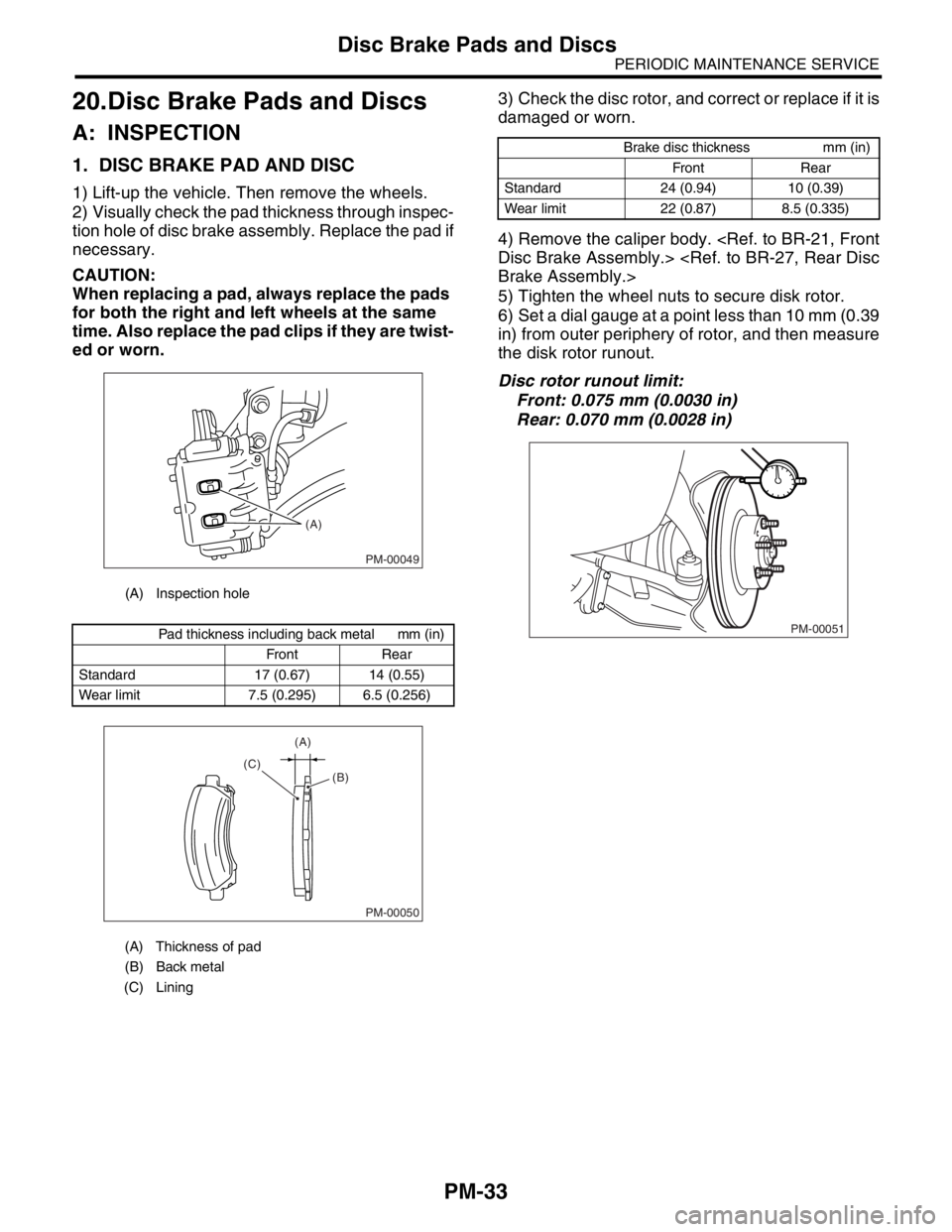
2) Visually check the pad thickness through inspec-
tion hole of disc brake assembly. Replace the pad if
necessary.
CAUTION:
When replacing a pad, always replace the pads
for both the right and left wheels at the same
time. Also replace the pad clips if they are twist-
ed or worn.3) Check the disc rotor, and correct or replace if it is
damaged or worn.
4) Remove the caliper body.
5) Tighten the wheel nuts to secure disk rotor.
6) Set a dial gauge at a point less than 10 mm (0.39
in) from outer periphery of rotor, and then measure
the disk rotor runout.
Disc rotor runout limit:
Front: 0.075 mm (0.0030 in)
Rear: 0.070 mm (0.0028 in)
(A) Inspection hole
Pad thickness including back metal mm (in)
Front Rear
Standard 17 (0.67) 14 (0.55)
Wear limit 7.5 (0.295) 6.5 (0.256)
(A) Thickness of pad
(B) Back metal
(C) Lining
PM-00049
(A)
PM-00050
(A)
(C)
(B)
Brake disc thickness mm (in)
Front Rear
Standard 24 (0.94) 10 (0.39)
Wear limit 22 (0.87) 8.5 (0.335)
PM-00051
Page 771 of 2870
PM-34
PERIODIC MAINTENANCE SERVICE
Brake Linings and Drums
21.Brake Linings and Drums
A: INSPECTION
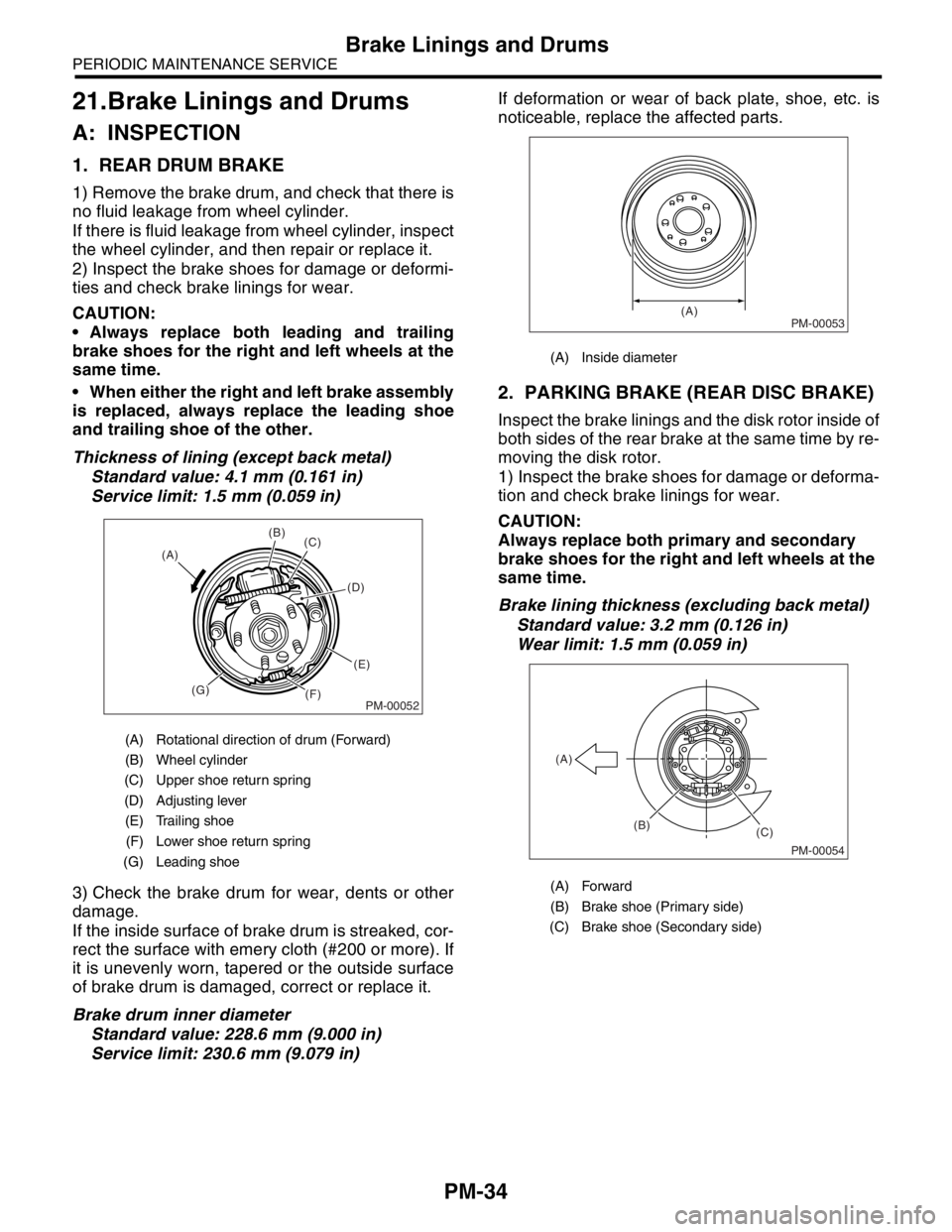
1. REAR DRUM BRAKE
1) Remove the brake drum, and check that there is
no fluid leakage from wheel cylinder.
If there is fluid leakage from wheel cylinder, inspect
the wheel cylinder, and then repair or replace it.
2) Inspect the brake shoes for damage or deformi-
ties and check brake linings for wear.
CAUTION:
Always replace both leading and trailing
brake shoes for the right and left wheels at the
same time.
When either the right and left brake assembly
is replaced, always replace the leading shoe
and trailing shoe of the other.
Thickness of lining (except back metal)
Standard value: 4.1 mm (0.161 in)
Service limit: 1.5 mm (0.059 in)
3) Check the brake drum for wear, dents or other
damage.
If the inside surface of brake drum is streaked, cor-
rect the surface with emery cloth (#200 or more). If
it is unevenly worn, tapered or the outside surface
of brake drum is damaged, correct or replace it.
Brake drum inner diameter
Standard value: 228.6 mm (9.000 in)
Service limit: 230.6 mm (9.079 in)If deformation or wear of back plate, shoe, etc. is
noticeable, replace the affected parts.
2. PARKING BRAKE (REAR DISC BRAKE)
Inspect the brake linings and the disk rotor inside of
both sides of the rear brake at the same time by re-
moving the disk rotor.
1) Inspect the brake shoes for damage or deforma-
tion and check brake linings for wear.
CAUTION:
Always replace both primary and secondary
brake shoes for the right and left wheels at the
same time.
Brake lining thickness (excluding back metal)
Standard value: 3.2 mm (0.126 in)
Wear limit: 1.5 mm (0.059 in)
(A) Rotational direction of drum (Forward)
(B) Wheel cylinder
(C) Upper shoe return spring
(D) Adjusting lever
(E) Trailing shoe
(F) Lower shoe return spring
(G) Leading shoe
PM-00052
(B)
(C)
(D)
(E)
(F) (G) (A)
(A) Inside diameter
(A) Forward
(B) Brake shoe (Primary side)
(C) Brake shoe (Secondary side)
PM-00053(A)
PM-00054
(B)
(C) (A)
Page 772 of 2870
PM-35
PERIODIC MAINTENANCE SERVICE
Brake Linings and Drums
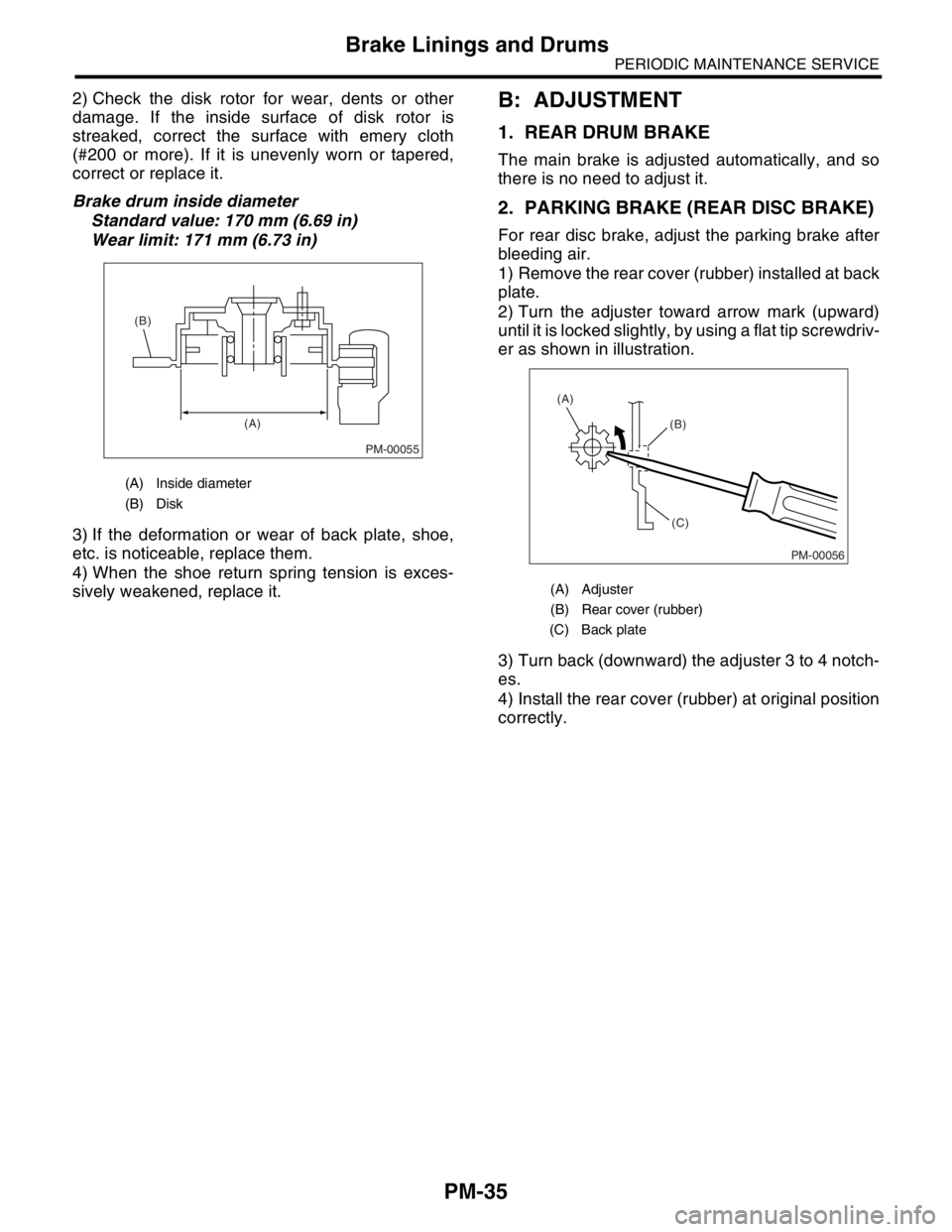
2) Check the disk rotor for wear, dents or other
damage. If the inside surface of disk rotor is
streaked, correct the surface with emery cloth
(#200 or more). If it is unevenly worn or tapered,
correct or replace it.
Brake drum inside diameter
Standard value: 170 mm (6.69 in)
Wear limit: 171 mm (6.73 in)
3) If the deformation or wear of back plate, shoe,
etc. is noticeable, replace them.
4) When the shoe return spring tension is exces-
sively weakened, replace it.B: ADJUSTMENT
1. REAR DRUM BRAKE
The main brake is adjusted automatically, and so
there is no need to adjust it.
2. PARKING BRAKE (REAR DISC BRAKE)
For rear disc brake, adjust the parking brake after
bleeding air.
1) Remove the rear cover (rubber) installed at back
plate.
2) Turn the adjuster toward arrow mark (upward)
until it is locked slightly, by using a flat tip screwdriv-
er as shown in illustration.
3) Turn back (downward) the adjuster 3 to 4 notch-
es.
4) Install the rear cover (rubber) at original position
correctly.
(A) Inside diameter
(B) Disk
PM-00055
(A) (B)
(A) Adjuster
(B) Rear cover (rubber)
(C) Back plate
PM-00056
(B)
(C) (A)
Page 773 of 2870
PM-36
PERIODIC MAINTENANCE SERVICE
Suspension
22.Suspension
A: INSPECTION
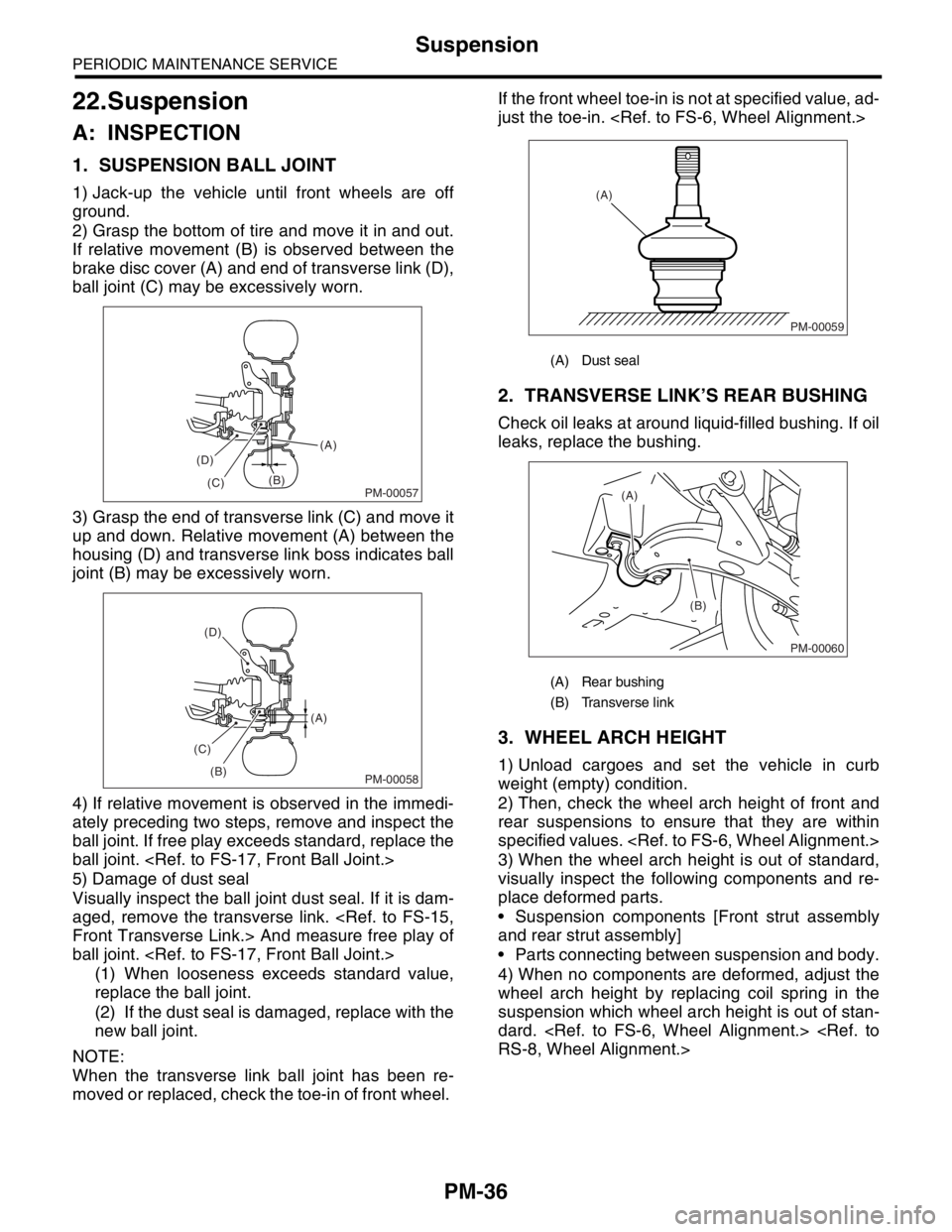
1. SUSPENSION BALL JOINT
1) Jack-up the vehicle until front wheels are off
ground.
2) Grasp the bottom of tire and move it in and out.
If relative movement (B) is observed between the
brake disc cover (A) and end of transverse link (D),
ball joint (C) may be excessively worn.
3) Grasp the end of transverse link (C) and move it
up and down. Relative movement (A) between the
housing (D) and transverse link boss indicates ball
joint (B) may be excessively worn.
4) If relative movement is observed in the immedi-
ately preceding two steps, remove and inspect the
ball joint. If free play exceeds standard, replace the
ball joint.
5) Damage of dust seal
Visually inspect the ball joint dust seal. If it is dam-
aged, remove the transverse link.
ball joint.
(1) When looseness exceeds standard value,
replace the ball joint.
(2) If the dust seal is damaged, replace with the
new ball joint.
NOTE:
When the transverse link ball joint has been re-
moved or replaced, check the toe-in of front wheel. If the front wheel toe-in is not at specified value, ad-
just the toe-in.
2. TRANSVERSE LINK’S REAR BUSHING
Check oil leaks at around liquid-filled bushing. If oil
leaks, replace the bushing.
3. WHEEL ARCH HEIGHT
1) Unload cargoes and set the vehicle in curb
weight (empty) condition.
2) Then, check the wheel arch height of front and
rear suspensions to ensure that they are within
specified values.
3) When the wheel arch height is out of standard,
visually inspect the following components and re-
place deformed parts.
Suspension components [Front strut assembly
and rear strut assembly]
Parts connecting between suspension and body.
4) When no components are deformed, adjust the
wheel arch height by replacing coil spring in the
suspension which wheel arch height is out of stan-
dard.
PM-00057
(A)
(B)
(C) (D)
PM-00058
(A)
(B) (C)(D)
(A) Dust seal
(A) Rear bushing
(B) Transverse link
PM-00059
(A)
PM-00060
(A)
(B)
Page 909 of 2870
ME(H4SO)-40
MECHANICAL
Engine Assembly
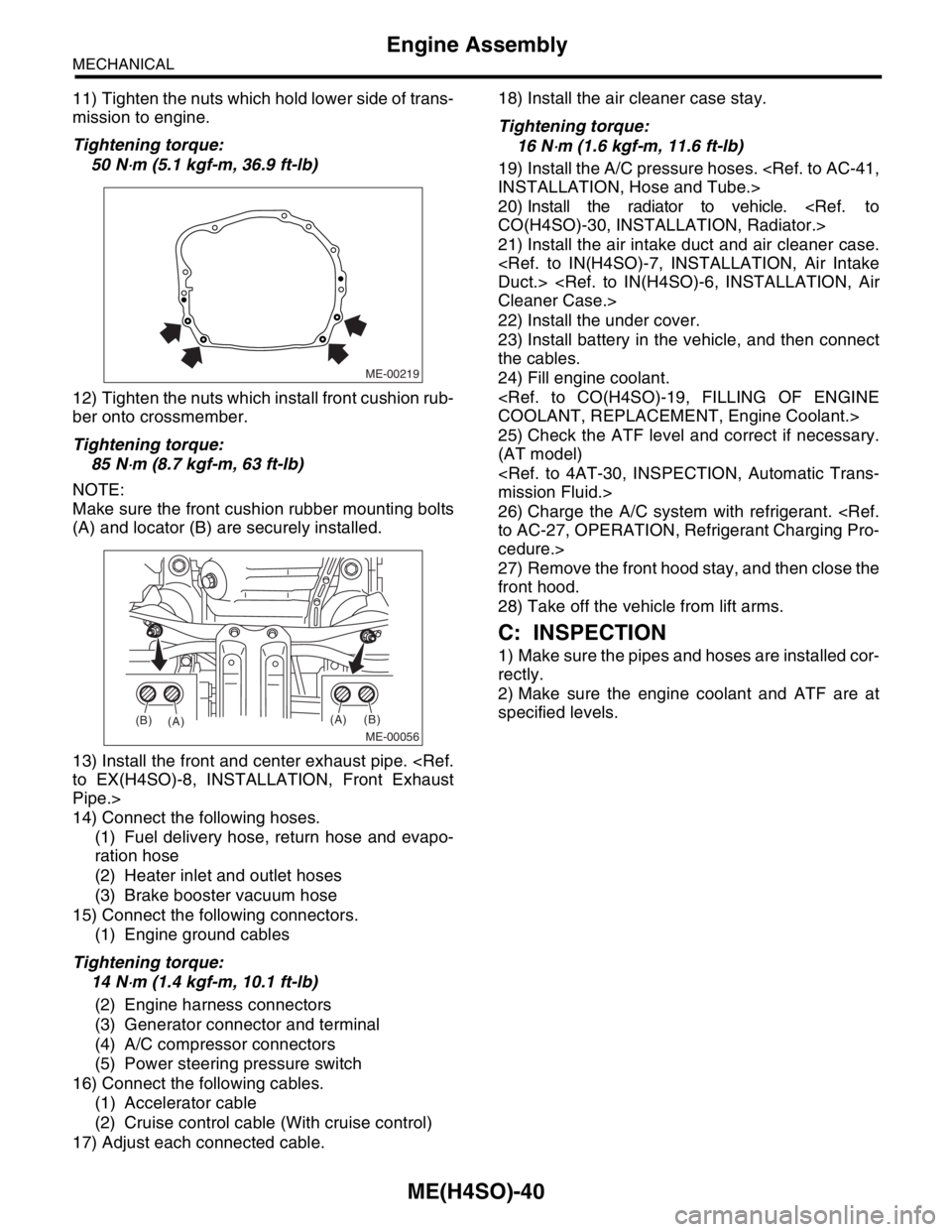
11) Tighten the nuts which hold lower side of trans-
mission to engine.
Tightening torque:
50 N
⋅m (5.1 kgf-m, 36.9 ft-lb)
12) Tighten the nuts which install front cushion rub-
ber onto crossmember.
Tightening torque:
85 N
⋅m (8.7 kgf-m, 63 ft-lb)
NOTE:
Make sure the front cushion rubber mounting bolts
(A) and locator (B) are securely installed.
13) Install the front and center exhaust pipe.
Pipe.>
14) Connect the following hoses.
(1) Fuel delivery hose, return hose and evapo-
ration hose
(2) Heater inlet and outlet hoses
(3) Brake booster vacuum hose
15) Connect the following connectors.
(1) Engine ground cables
Tightening torque:
14 N
⋅m (1.4 kgf-m, 10.1 ft-lb)
(2) Engine harness connectors
(3) Generator connector and terminal
(4) A/C compressor connectors
(5) Power steering pressure switch
16) Connect the following cables.
(1) Accelerator cable
(2) Cruise control cable (With cruise control)
17) Adjust each connected cable.18) Install the air cleaner case stay.
Tightening torque:
16 N
⋅m (1.6 kgf-m, 11.6 ft-lb)
19) Install the A/C pressure hoses.
20) Install the radiator to vehicle.
21) Install the air intake duct and air cleaner case.
22) Install the under cover.
23) Install battery in the vehicle, and then connect
the cables.
24) Fill engine coolant.
25) Check the ATF level and correct if necessary.
(AT model)
26) Charge the A/C system with refrigerant.
cedure.>
27) Remove the front hood stay, and then close the
front hood.
28) Take off the vehicle from lift arms.
C: INSPECTION
1) Make sure the pipes and hoses are installed cor-
rectly.
2) Make sure the engine coolant and ATF are at
specified levels.
ME-00219
ME-00056
(A)
(A)(B)
(B)
Page 1026 of 2870

CO(H4SO)-43
COOLING
Engine Cooling System Trouble in General
12.Engine Cooling System Trouble in General
A: INSPECTION
Trouble Possible cause Corrective action
Over-heatinga. Insufficient engine coolantReplenish the engine coolant, inspect for leakage, and
repair.
b. Loose timing belt Repair or replace the timing belt tensioner.
c. Oil on drive belt Replace.
d. Malfunction of thermostat Replace.
e. Malfunction of water pump Replace.
f. Clogged engine coolant passage Clean.
g. Improper ignition timingInspect and repair the ignition control system.
h. Clogged or leaking radiator Clean or repair, or replace.
i. Improper engine oil in engine coolant Replace the engine coolant.
j. Air/fuel mixture ratio too leanInspect and repair the fuel injection system.
k. Excessive back pressure in exhaust system Clean or replace.
l. Insufficient clearance between piston and cylinder Adjust or replace.
m. Slipping clutch Repair or replace.
n. Dragging brake Adjust.
o. Defective thermostat Replace.
p. Malfunction of radiator fanInspect the radiator fan relay, engine coolant tempera-
ture sensor or radiator motor and replace there.
Over-coolinga. Atmospheric temperature extremely low Partly cover the radiator front area.
b. Defective thermostat Replace.
Engine coolant
leaks.a. Loosened or damaged connecting units on hoses Repair or replace.
b. Leakage from water pump Replace.
c. Leakage from water pipe Repair or replace.
d. Leakage around cylinder head gasket Retighten the cylinder head bolts or replace gasket.
e. Damaged or cracked cylinder head and crankcase Repair or replace.
f. Damaged or cracked thermostat case Repair or replace.
g. Leakage from radiator Repair or replace.
Noisea. Defective drive belt Replace.
b. Defective radiator fan Replace.
c. Defective water pump bearing Replace the water pump.
d. Defective water pump mechanical seal Replace the water pump.
Page 1304 of 2870
EN(H4SO)-206
ENGINE (DIAGNOSTIC)
Diagnostic Procedure with Diagnostic Trouble Code (DTC)
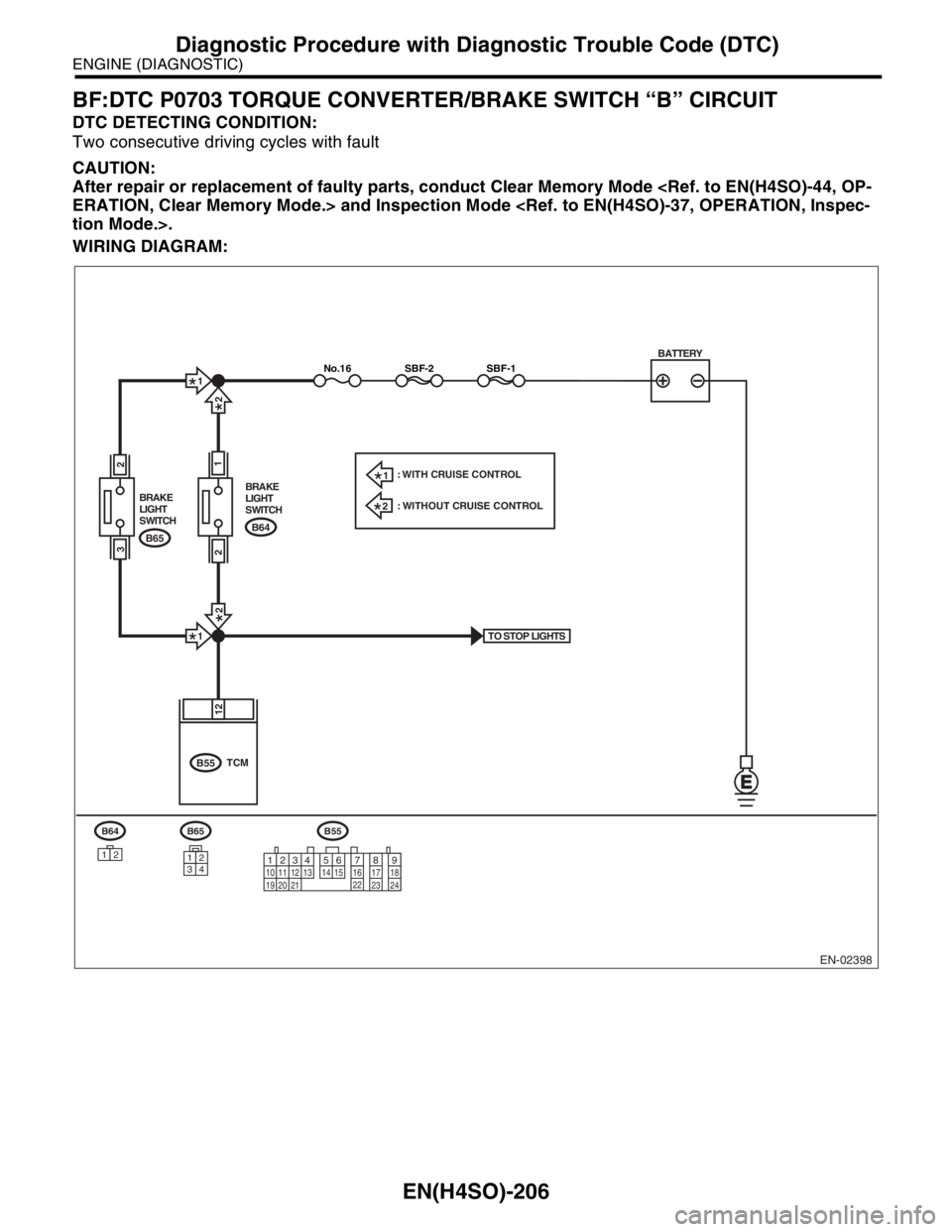
BF:DTC P0703 TORQUE CONVERTER/BRAKE SWITCH “B” CIRCUIT
DTC DETECTING CONDITION:
Two consecutive driving cycles with fault
CAUTION:
After repair or replacement of faulty parts, conduct Clear Memory Mode
WIRING DIAGRAM:
EN-02398
BATTERY
B65
34
12
TO STOP LIGHTS
SBF-1SBF-2No.16
B65 BRAKE
LIGHT
SWITCH
2
3
B64 BRAKE
LIGHT
SWITCH
1
B64
12
B55
B55
12
TCM
2
1
2
2
1
2
1: WITH CRUISE CONTROL
: WITHOUT CRUISE CONTROL
12
789 56 3410 11 12
19 20 2113 14 15 16 17 18
22
23
24