replace brake SUBARU FORESTER 2004 Service Owner's Guide
[x] Cancel search | Manufacturer: SUBARU, Model Year: 2004, Model line: FORESTER, Model: SUBARU FORESTER 2004Pages: 2870, PDF Size: 38.67 MB
Page 2863 of 2870
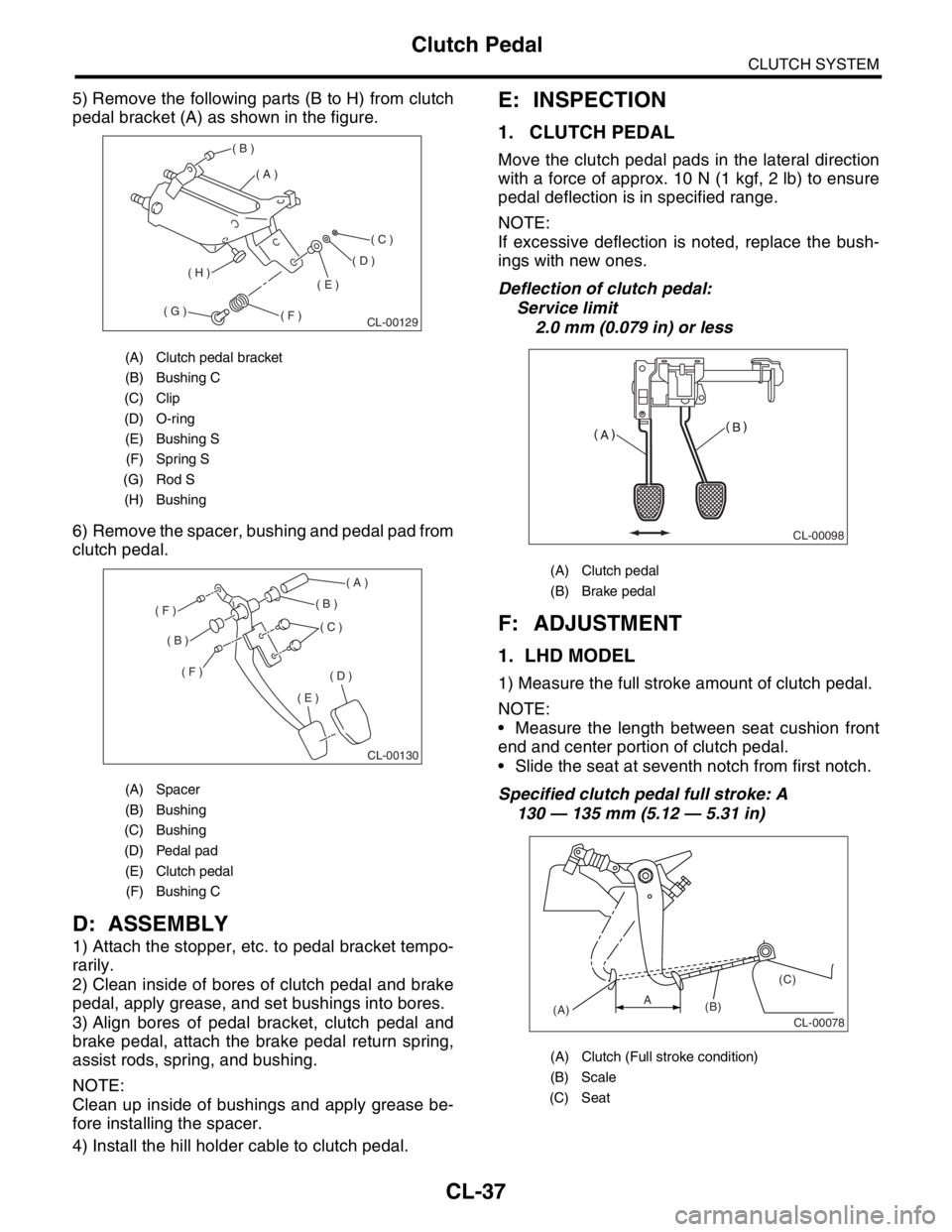
CL-37
CLUTCH SYSTEM
Clutch Pedal
5) Remove the following parts (B to H) from clutch
pedal bracket (A) as shown in the figure.
6) Remove the spacer, bushing and pedal pad from
clutch pedal.
D: ASSEMBLY
1) Attach the stopper, etc. to pedal bracket tempo-
rarily.
2) Clean inside of bores of clutch pedal and brake
pedal, apply grease, and set bushings into bores.
3) Align bores of pedal bracket, clutch pedal and
brake pedal, attach the brake pedal return spring,
assist rods, spring, and bushing.
NOTE:
Clean up inside of bushings and apply grease be-
fore installing the spacer.
4) Install the hill holder cable to clutch pedal.
E: INSPECTION
1. CLUTCH PEDAL
Move the clutch pedal pads in the lateral direction
with a force of approx. 10 N (1 kgf, 2 lb) to ensure
pedal deflection is in specified range.
NOTE:
If excessive deflection is noted, replace the bush-
ings with new ones.
Deflection of clutch pedal:
Service limit
2.0 mm (0.079 in) or less
F: ADJUSTMENT
1. LHD MODEL
1) Measure the full stroke amount of clutch pedal.
NOTE:
Measure the length between seat cushion front
end and center portion of clutch pedal.
Slide the seat at seventh notch from first notch.
Specified clutch pedal full stroke: A
130 — 135 mm (5.12 — 5.31 in)
(A) Clutch pedal bracket
(B) Bushing C
(C) Clip
(D) O-ring
(E) Bushing S
(F) Spring S
(G) Rod S
(H) Bushing
(A) Spacer
(B) Bushing
(C) Bushing
(D) Pedal pad
(E) Clutch pedal
(F) Bushing C
( A )
( B )
( C )
( D )
( E )
( F )( G )
( H )
CL-00129
( A )
( B )
( B )
( C )
( D )
( E )
( F )
( F )
CL-00130
(A) Clutch pedal
(B) Brake pedal
(A) Clutch (Full stroke condition)
(B) Scale
(C) Seat
CL-00098
CL-00078(A)(B)(C)A
Page 2868 of 2870

CL-42
CLUTCH SYSTEM
General Diagnostic Table
12.General Diagnostic Table
A: INSPECTION
1. CLUTCH
Symptom Possible cause Corrective
1. Clutch slippage.
It is hard to perceive clutch slippage in
the early stage, but pay attention to the
following symptoms
Engine speed up when shifting.
High speed driving is impossible; espe-
cially rapid acceleration impossible and
vehicle speed does not increase in pro-
portion to an increase in engine speed.
Power falls, particularly when ascend-
ing a slope, and there is a smell of burn-
ing of the clutch facing.
Method of testing: Put the vehicle in
stationary condition with parking brake
fully applied. Disengage the clutch and
shift the transmission gear into the first.
Gradually allow the clutch to engage
while gradually increasing the engine
speed. The clutch function is satisfactory
if the engine stalls. However, the clutch is
slipping if the vehicle does not start off
and the engine does not stall.(a) Clutch facing smeared by oil Replace.
(b) Worn clutch facing Replace.
(c) Deteriorated diaphragm spring Replace.
(d) Distorted pressure plate or flywheel Replace.
(e) Defective release bearing holder Replace.
2. Clutch drags.
As a symptom of this trouble, a harsh
scratching noise develops and control
becomes quite difficult when shifting
gears. The symptom becomes more
apparent when shifting into the first gear.
However, because much trouble of this
sort is due to defective synchronization
mechanism, carry out the test as
described after.
Method of testing:
DRAG, INSPECTION, General Diagnos-
tic Table.>
It may be judged as insufficient disen-
gagement of clutch if any noise occurs
during this test.(a) Worn or rusty clutch disc hub spline Replace the clutch disc.
(b) Excessive deflection of clutch disc
facingReplace.
(c) Malfunction of crankshaft pilot bearing Replace.
(d) Cracked clutch disc facing Replace.
(e) Stuck clutch disc (smeared by oil or
water)Replace.
3. Clutch chatters.
Clutch chattering is an unpleasant vibra-
tion to the whole body when the vehicle is
just started with clutch partially engaged.(a) Adhesion of oil on the facing Replace the clutch disc.
(b) Weak or broken torsion spring Replace the clutch disc.
(c) Defective facing contact or excessive
disc wornReplace the clutch disc defection.
(d) Warped pressure plate or flywheel Replace.
(e) Loose disc rivets Replace the clutch disc.
(f) Loose engine mounting Retighten or replace the mounting.
(g) Improper adjustment of pitching stop-
perAdjustment.