ECU SUBARU FORESTER 2004 Service Repair Manual
[x] Cancel search | Manufacturer: SUBARU, Model Year: 2004, Model line: FORESTER, Model: SUBARU FORESTER 2004Pages: 2870, PDF Size: 38.67 MB
Page 1924 of 2870
EN(H4DOTC)-291
ENGINE (DIAGNOSTIC)
Diagnostic Procedure with Diagnostic Trouble Code (DTC)
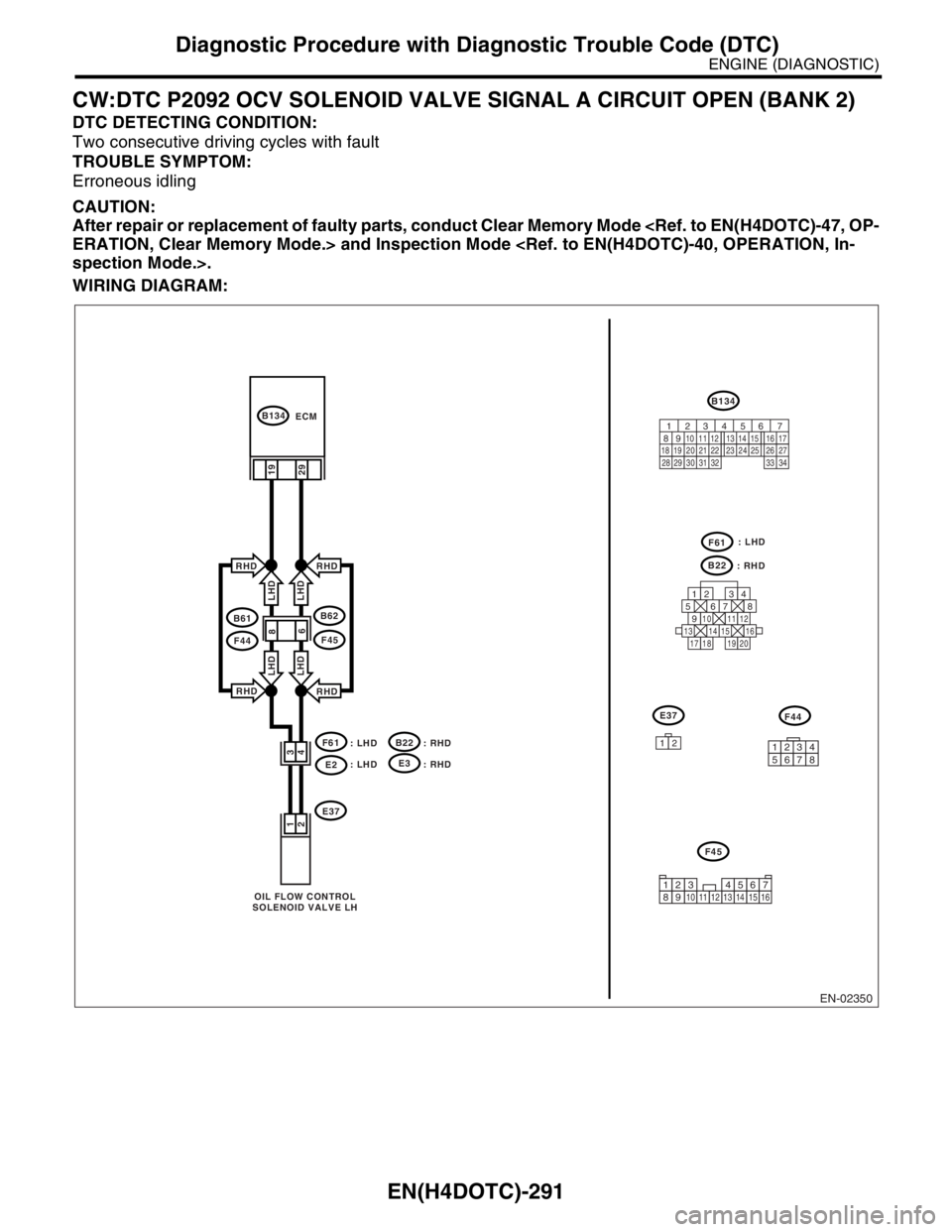
CW:DTC P2092 OCV SOLENOID VALVE SIGNAL A CIRCUIT OPEN (BANK 2)
DTC DETECTING CONDITION:
Two consecutive driving cycles with fault
TROUBLE SYMPTOM:
Erroneous idling
CAUTION:
After repair or replacement of faulty parts, conduct Clear Memory Mode
WIRING DIAGRAM:
EN-02350
F61
: LHD
E2
B134B134
E37 ECM
29 2 1
4
3
B62
F45
RHD
RHD
LHD LHD
RHD
RHD
LHD LHD
: LHD
: RHD
B22
E37
F61
12
F45
B22
: RHD
19
125678
131415169101112
34
17181920
OIL FLOW CONTROL
SOLENOID VALVE LH
56 7
82 1
94 310
24 22 23 25 11 12 13 14 15
26 27
2816 17
18 19 20 21
33 34 29
32 30 31
12345678910111213141516
F44
12345678
B61
F44
: LHD
E3
: RHD
8
6
Page 1926 of 2870
EN(H4DOTC)-293
ENGINE (DIAGNOSTIC)
Diagnostic Procedure with Diagnostic Trouble Code (DTC)
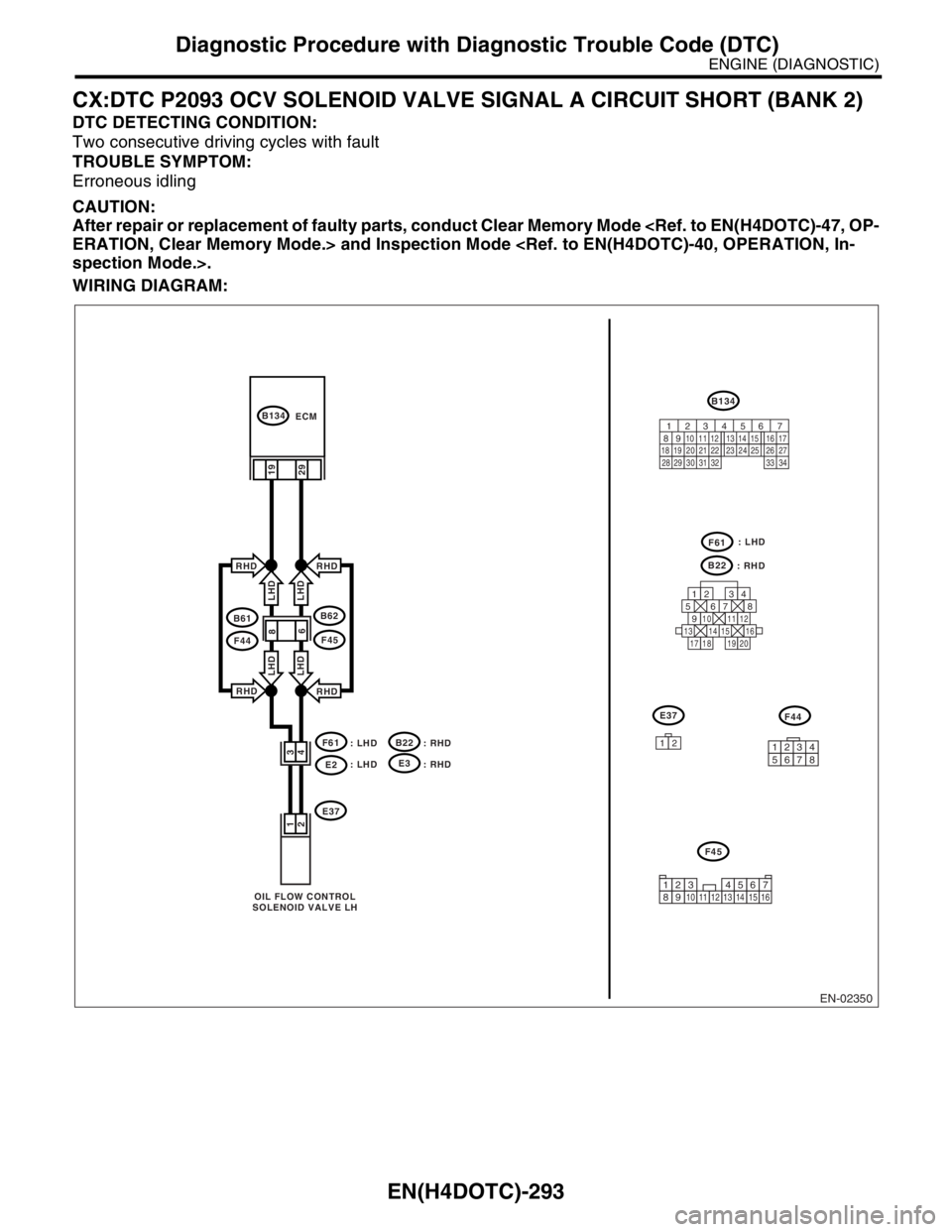
CX:DTC P2093 OCV SOLENOID VALVE SIGNAL A CIRCUIT SHORT (BANK 2)
DTC DETECTING CONDITION:
Two consecutive driving cycles with fault
TROUBLE SYMPTOM:
Erroneous idling
CAUTION:
After repair or replacement of faulty parts, conduct Clear Memory Mode
WIRING DIAGRAM:
EN-02350
F61
: LHD
E2
B134B134
E37 ECM
29 2 1
4
3
B62
F45
RHD
RHD
LHD LHD
RHD
RHD
LHD LHD
: LHD
: RHD
B22
E37
F61
12
F45
B22
: RHD
19
125678
131415169101112
34
17181920
OIL FLOW CONTROL
SOLENOID VALVE LH
56 7
82 1
94 310
24 22 23 25 11 12 13 14 15
26 27
2816 17
18 19 20 21
33 34 29
32 30 31
12345678910111213141516
F44
12345678
B61
F44
: LHD
E3
: RHD
8
6
Page 1929 of 2870

EN(H4DOTC)-296
ENGINE (DIAGNOSTIC)
General Diagnostic Table
*1: Check ignition coil & ignitor ASSY and spark plug.
*2: Indicate the symptom occurring only in cold temperatures.
*3: Ensure the secure installation.
*4: Check fuel injector, fuel pressure regulator and fuel filter.
*5: Inspect air leak in air intake system.
*6: Adjust accelerator cable. 6. Surging1) Manifold absolute pressure sensor
2) Mass air flow and intake air temperature sensor
3) Engine coolant temperature sensor (*2)
4) Crankshaft position sensor (*3)
5) Camshaft position sensor (*3)
6) Fuel injection parts (*4)
7) Throttle position sensor
8) Fuel pump and fuel pump relay
7. Spark knock1) Manifold absolute pressure sensor
2) Mass air flow and intake air temperature sensor
3) Engine coolant temperature sensor
4) Knock sensor
5) Fuel injection parts (*4)
6) Fuel pump and fuel pump relay
8. After burning in exhaust system1) Manifold absolute pressure sensor
2) Mass air flow and intake air temperature sensor
3) Engine coolant temperature sensor (*2)
4) Fuel injection parts (*4)
5) Fuel pump and fuel pump relay Symptom Problem parts
Page 1943 of 2870
FU(H4DOTC 2.5)-13
FUEL INJECTION (FUEL SYSTEM)
Throttle Body
2. Throttle Body
A: REMOVAL
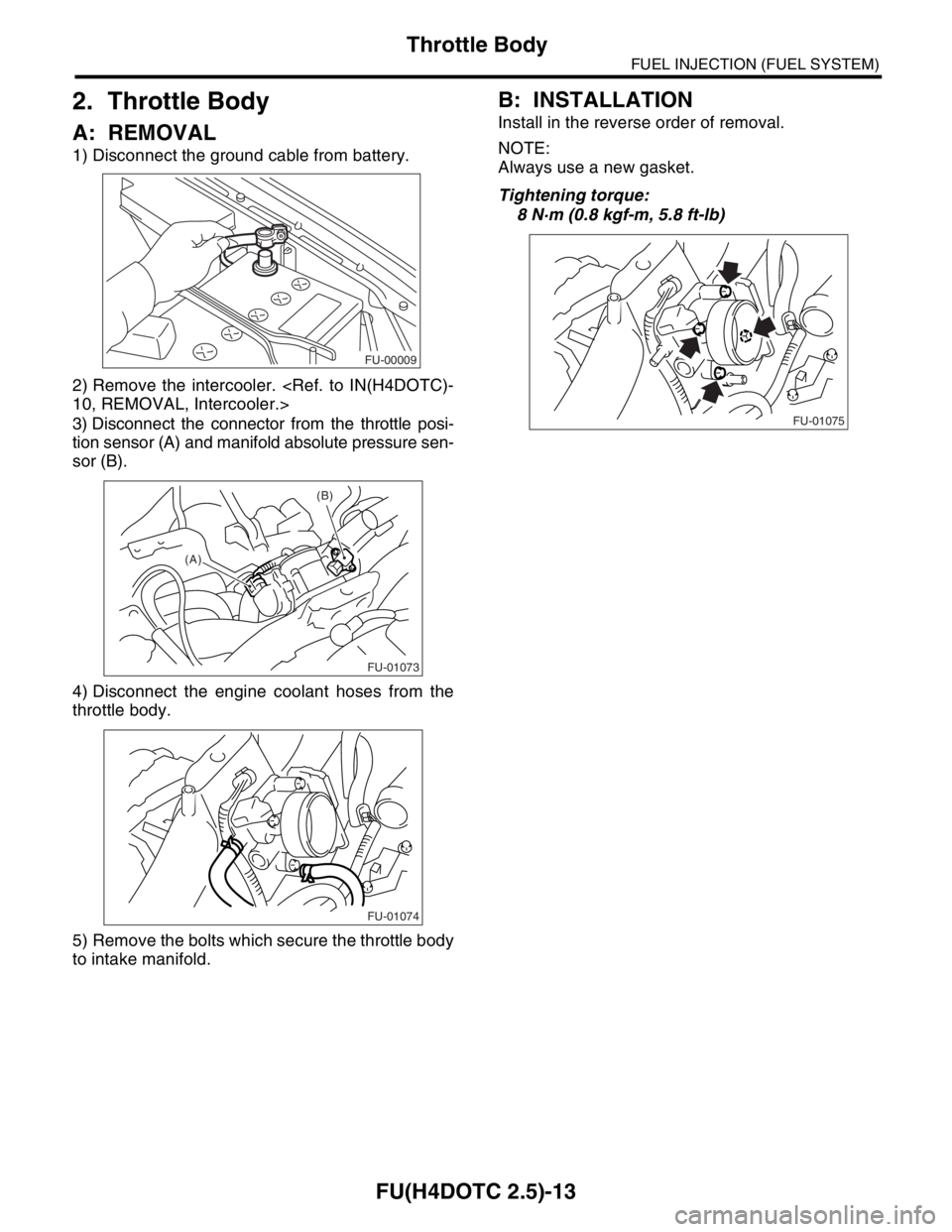
1) Disconnect the ground cable from battery.
2) Remove the intercooler.
3) Disconnect the connector from the throttle posi-
tion sensor (A) and manifold absolute pressure sen-
sor (B).
4) Disconnect the engine coolant hoses from the
throttle body.
5) Remove the bolts which secure the throttle body
to intake manifold.
B: INSTALLATION
Install in the reverse order of removal.
NOTE:
Always use a new gasket.
Tightening torque:
8 N·m (0.8 kgf-m, 5.8 ft-lb)
FU-00009
FU-01073
(A)
(B)
FU-01074
FU-01075
Page 1944 of 2870
FU(H4DOTC 2.5)-14
FUEL INJECTION (FUEL SYSTEM)
Intake Manifold
3. Intake Manifold
A: REMOVAL
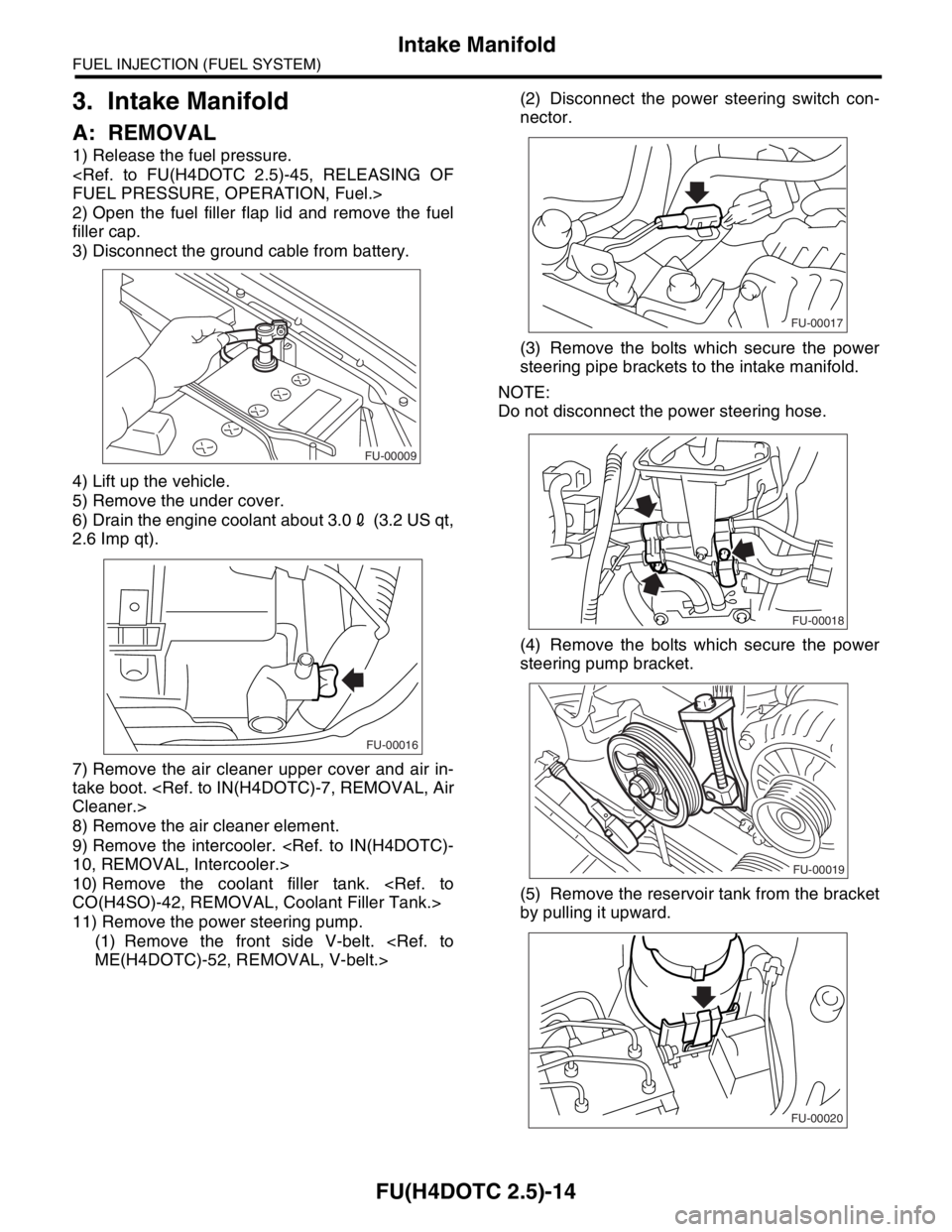
1) Release the fuel pressure.
2) Open the fuel filler flap lid and remove the fuel
filler cap.
3) Disconnect the ground cable from battery.
4) Lift up the vehicle.
5) Remove the under cover.
6) Drain the engine coolant about 3.02 (3.2 US qt,
2.6 Imp qt).
7) Remove the air cleaner upper cover and air in-
take boot.
8) Remove the air cleaner element.
9) Remove the intercooler.
10) Remove the coolant filler tank.
11) Remove the power steering pump.
(1) Remove the front side V-belt.
nector.
(3) Remove the bolts which secure the power
steering pipe brackets to the intake manifold.
NOTE:
Do not disconnect the power steering hose.
(4) Remove the bolts which secure the power
steering pump bracket.
(5) Remove the reservoir tank from the bracket
by pulling it upward.
FU-00009
FU-00016
FU-00017
FU-00018
FU-00019
FU-00020
Page 1946 of 2870
FU(H4DOTC 2.5)-16
FUEL INJECTION (FUEL SYSTEM)
Intake Manifold
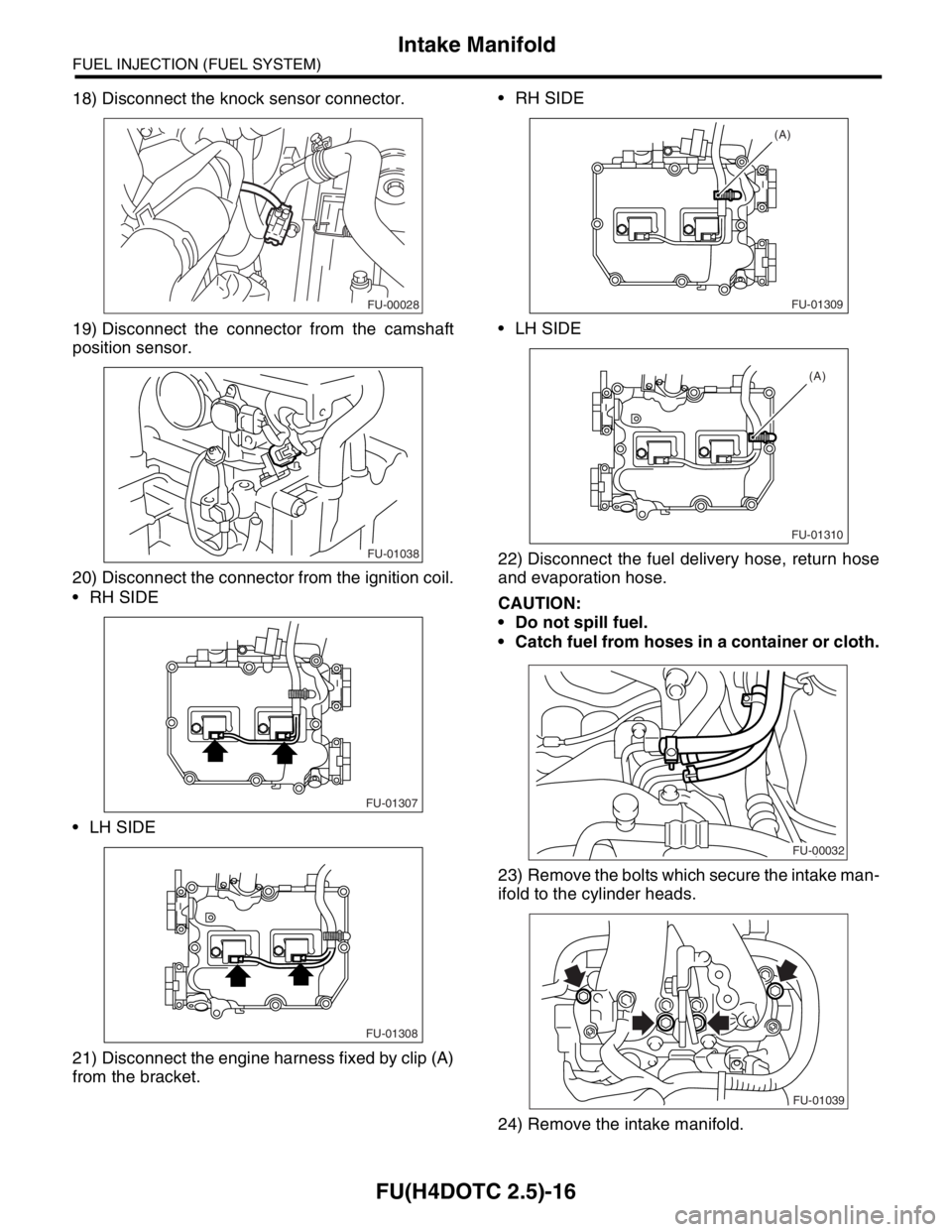
18) Disconnect the knock sensor connector.
19) Disconnect the connector from the camshaft
position sensor.
20) Disconnect the connector from the ignition coil.
RH SIDE
LH SIDE
21) Disconnect the engine harness fixed by clip (A)
from the bracket. RH SIDE
LH SIDE
22) Disconnect the fuel delivery hose, return hose
and evaporation hose.
CAUTION:
Do not spill fuel.
Catch fuel from hoses in a container or cloth.
23) Remove the bolts which secure the intake man-
ifold to the cylinder heads.
24) Remove the intake manifold.
FU-00028
FU-01038
FU-01307
FU-01308
FU-01309 (A)
FU-01310
(A)
FU-00032
FU-01039
Page 1977 of 2870
FU(H4DOTC 2.5)-47
FUEL INJECTION (FUEL SYSTEM)
Fuel Tank
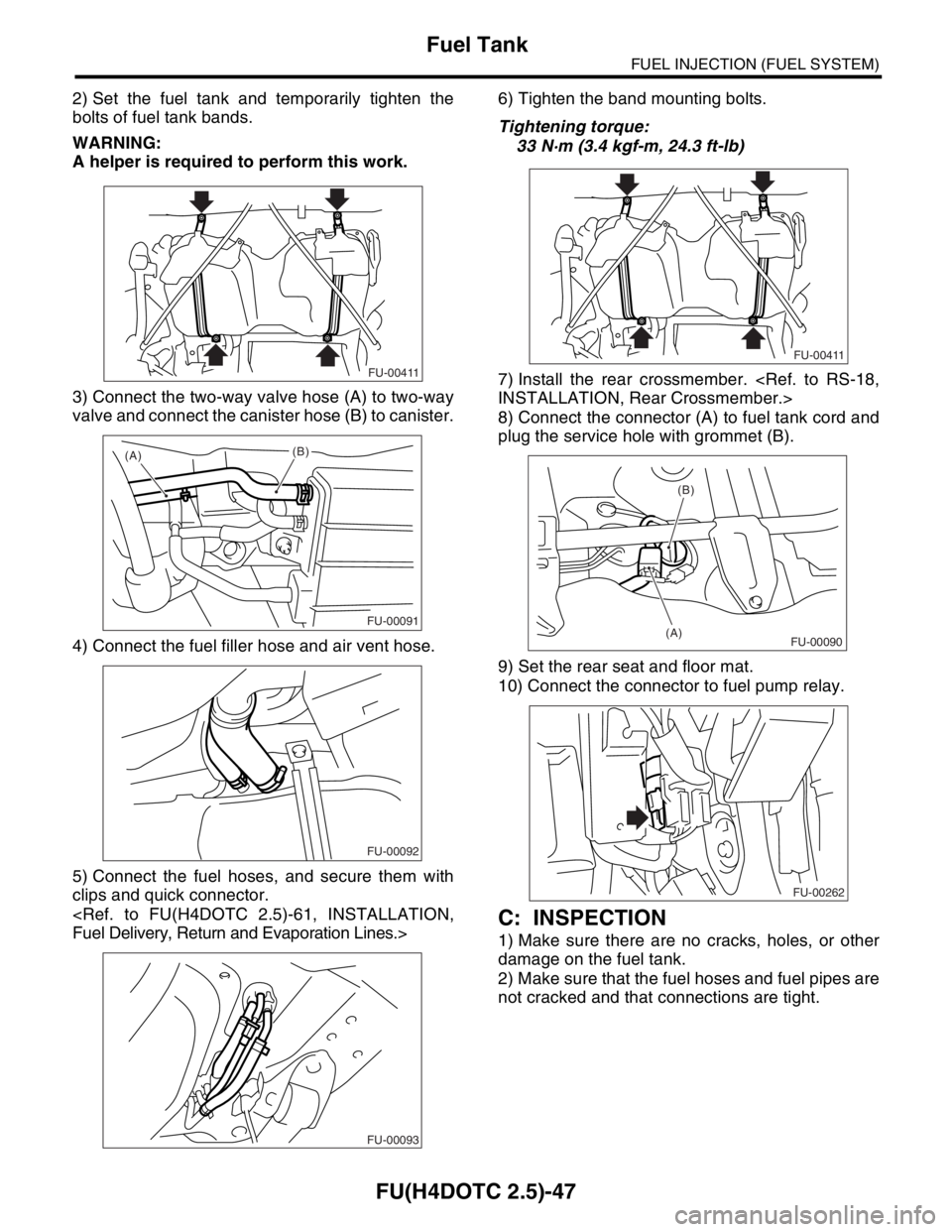
2) Set the fuel tank and temporarily tighten the
bolts of fuel tank bands.
WARNING:
A helper is required to perform this work.
3) Connect the two-way valve hose (A) to two-way
valve and connect the canister hose (B) to canister.
4) Connect the fuel filler hose and air vent hose.
5) Connect the fuel hoses, and secure them with
clips and quick connector.
Tightening torque:
33 N·m (3.4 kgf-m, 24.3 ft-lb)
7) Install the rear crossmember.
8) Connect the connector (A) to fuel tank cord and
plug the service hole with grommet (B).
9) Set the rear seat and floor mat.
10) Connect the connector to fuel pump relay.
C: INSPECTION
1) Make sure there are no cracks, holes, or other
damage on the fuel tank.
2) Make sure that the fuel hoses and fuel pipes are
not cracked and that connections are tight.
FU-00411
(A)(B)
FU-00091
FU-00092
FU-00093
FU-00411
(B)
(A)
FU-00090
FU-00262
Page 1991 of 2870
FU(H4DOTC 2.5)-61
FUEL INJECTION (FUEL SYSTEM)
Fuel Delivery, Return and Evaporation Lines
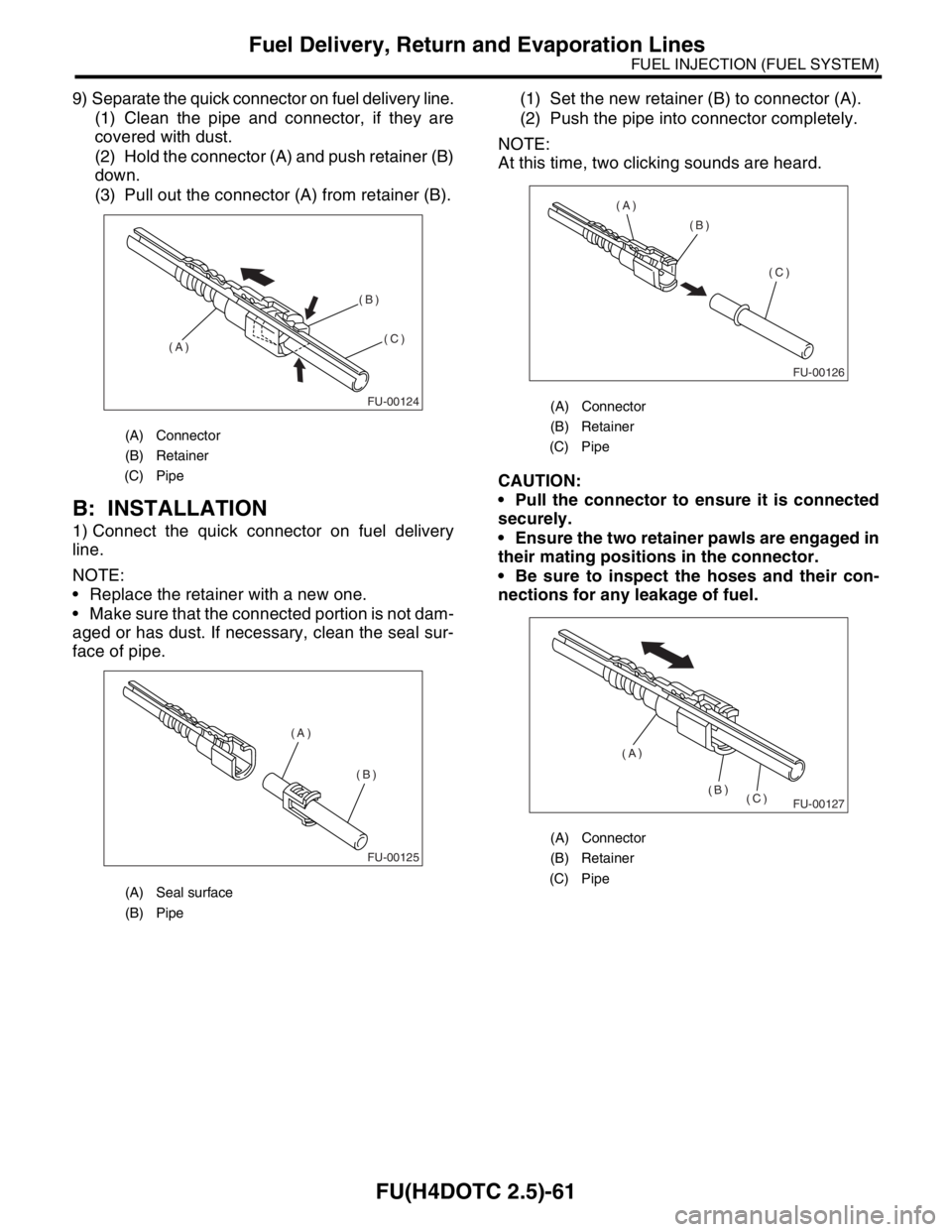
9) Separate the quick connector on fuel delivery line.
(1) Clean the pipe and connector, if they are
covered with dust.
(2) Hold the connector (A) and push retainer (B)
down.
(3) Pull out the connector (A) from retainer (B).
B: INSTALLATION
1) Connect the quick connector on fuel delivery
line.
NOTE:
Replace the retainer with a new one.
Make sure that the connected portion is not dam-
aged or has dust. If necessary, clean the seal sur-
face of pipe.(1) Set the new retainer (B) to connector (A).
(2) Push the pipe into connector completely.
NOTE:
At this time, two clicking sounds are heard.
CAUTION:
Pull the connector to ensure it is connected
securely.
Ensure the two retainer pawls are engaged in
their mating positions in the connector.
Be sure to inspect the hoses and their con-
nections for any leakage of fuel.
(A) Connector
(B) Retainer
(C) Pipe
(A) Seal surface
(B) Pipe
FU-00124
(A)(B)
(C)
FU-00125
(A)
(B)
(A) Connector
(B) Retainer
(C) Pipe
(A) Connector
(B) Retainer
(C) Pipe
FU-00126
(C)
(A)
(B)
FU-00127
(A)
(B)
(C)
Page 1993 of 2870

FU(H4DOTC 2.5)-63
FUEL INJECTION (FUEL SYSTEM)
Fuel System Trouble in General
31.Fuel System Trouble in General
A: INSPECTION
NOTE:
When the vehicle is left unattended for an extended period of time, water may accumulate in the fuel tank.
To prevent water condensation.
(1) Top off the fuel tank or drain the fuel completely.
(2) Drain the water condensation from the fuel filter.
Refilling the fuel tank.
Refill the fuel tank while there is still some fuel left in the tank.
Protecting the fuel system against freezing and water condensation.
(3) Cold areas:
In snow-covered areas, mountainous areas, skiing areas, etc. where ambient temperatures drop below
0°C (32°F) throughout the winter season, use an anti-freeze solution in the cooling system. Refueling will
also complement the effect of anti-freeze solution each time the fuel level drops to about one-half. After
the winter season, drain the water which may have accumulated in the fuel filter and fuel tank in the man-
ner same as that described under “Affected areas” below.
(4) Affected areas:
When the water condensation is notched in the fuel filter, drain the water from both the fuel filter and fuel
tank or use a water removing agent (or anti-freeze solution) in the fuel tank.
Observe the instructions, notes, etc., indicated on the label affixed to the anti-freeze solution (water remov-
ing agent) container before use.
Trouble and possible cause Corrective action
1. Insufficient fuel supply to the injector
1) Fuel pump will not operate.
❍Defective terminal contact.Inspect connections, especially ground, and tighten
securely.
❍Trouble in electromagnetic or electronic circuit parts. Replace the fuel pump.
2) Lowering of fuel pump function. Replace the fuel pump.
3) Clogged dust or water in the fuel filter. Replace the fuel filter, clean or replace fuel tank.
4) Clogged or bent fuel pipe or hose. Clean, correct or replace the fuel pipe or hose.
5) Air is mixed in the fuel system. Inspect or retighten each connection part.
6) Clogged or bent breather tube or pipe. Clean, correct or replace the air breather tube or pipe.
7) Damaged diaphragm of pressure regulator. Replace.
2. Leakage or blow out fuel
1) Loosened joints of the fuel pipe. Retightening.
2) Cracked fuel pipe, hose and fuel tank. Replace.
3) Defective welding part on the fuel tank. Replace.
4) Defective drain packing of the fuel tank. Replace.
5) Clogged or bent air breather tube or air vent tube.Clean, correct or replace the air breather tube or air vent
tube.
3. Gasoline smell inside of compartment
1)Loose joints at air breather tube, air vent tube and fuel filler
pipe.Retightening.
2) Defective packing air tightness on the fuel saucer. Correct or replace the packing.
3) Cracked fuel separator. Replace the separator.
4) Inoperative fuel pump modulator or circuit. Replace.
4. Defective fuel meter indicator
1) Defective operation of fuel level sensor. Replace.
2) Defective operation of fuel meter. Replace.
5. Noise
1) Large operation noise or vibration of fuel pump. Replace.
Page 2017 of 2870
SP(H4DOTC 2.5)-4
SPEED CONTROL SYSTEM
Accelerator Pedal
2. Accelerator Pedal
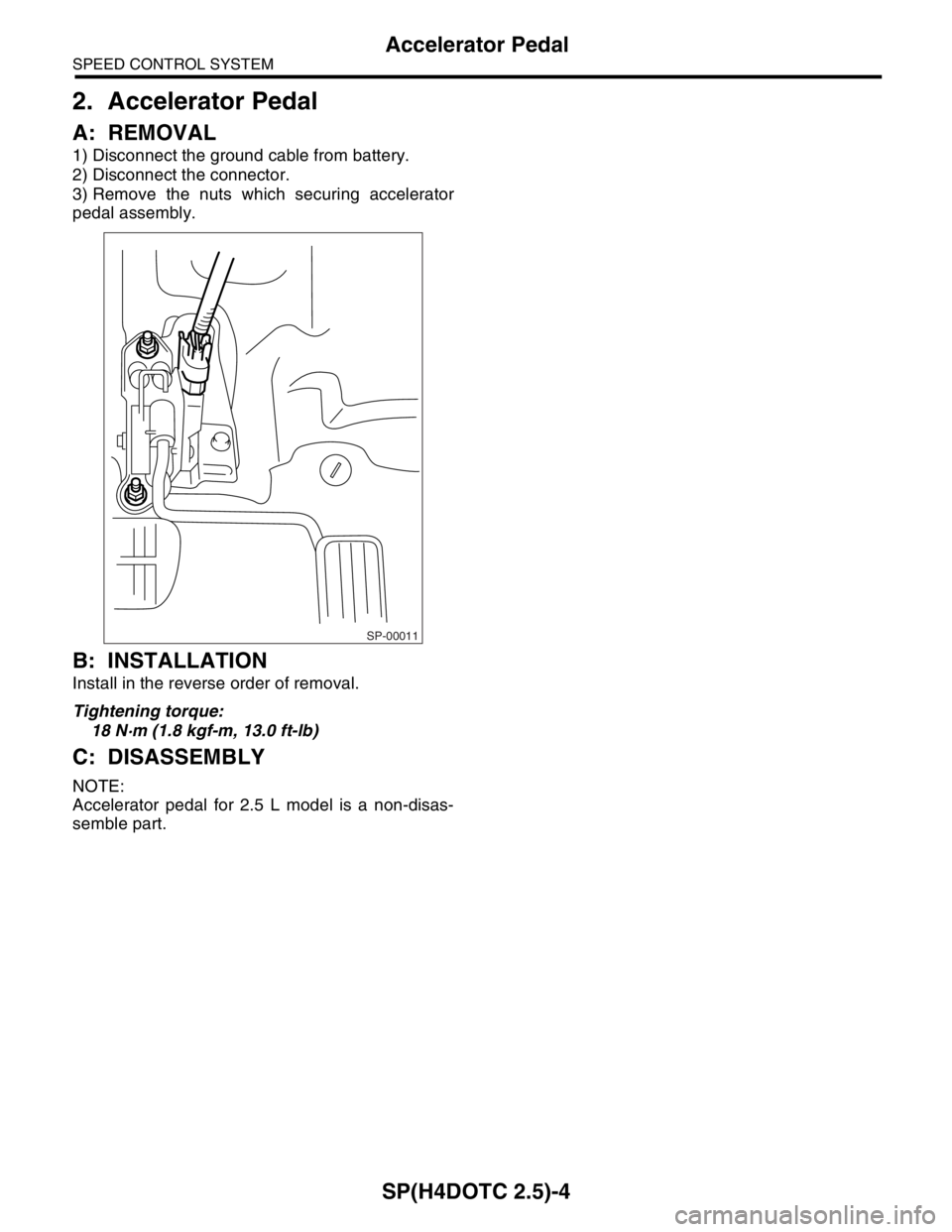
A: REMOVAL
1) Disconnect the ground cable from battery.
2) Disconnect the connector.
3) Remove the nuts which securing accelerator
pedal assembly.
B: INSTALLATION
Install in the reverse order of removal.
Tightening torque:
18 N·m (1.8 kgf-m, 13.0 ft-lb)
C: DISASSEMBLY
NOTE:
Accelerator pedal for 2.5 L model is a non-disas-
semble part.
SP-00011