ECU SUBARU FORESTER 2004 Service Repair Manual
[x] Cancel search | Manufacturer: SUBARU, Model Year: 2004, Model line: FORESTER, Model: SUBARU FORESTER 2004Pages: 2870, PDF Size: 38.67 MB
Page 2030 of 2870
EN(H4DOTC 2.5)-6
ENGINE (DIAGNOSTIC)
General Description
13) Diagnostics should be conducted by rotating
with simple, easy operations and proceeding to
complicated, difficult operations. The most impor-
tant thing in diagnostics is to understand the cus-
tomer’s complaint, and distinguish between the
three causes.
14) On the model with ABS, when performing driv-
ing test in jacked-up or lifted-up position, some-
times the warning light may be lit, but this is not a
malfunction of the system. The reason for this is the
speed difference between the front and rear
wheels. After diagnosis of engine control system,
perform the ABS memory clearance procedure of
self-diagnosis function.
B: INSPECTION
Before performing diagnostics, check the following
items which might affect engine problems:
1. BATTERY
1) Measure battery voltage and specific gravity of
electrolyte.
Standard voltage: 12 V
Specific gravity: Above 1.260
2) Check the condition of the main and other fuses,
and harnesses and connectors. Also check for
proper grounding.
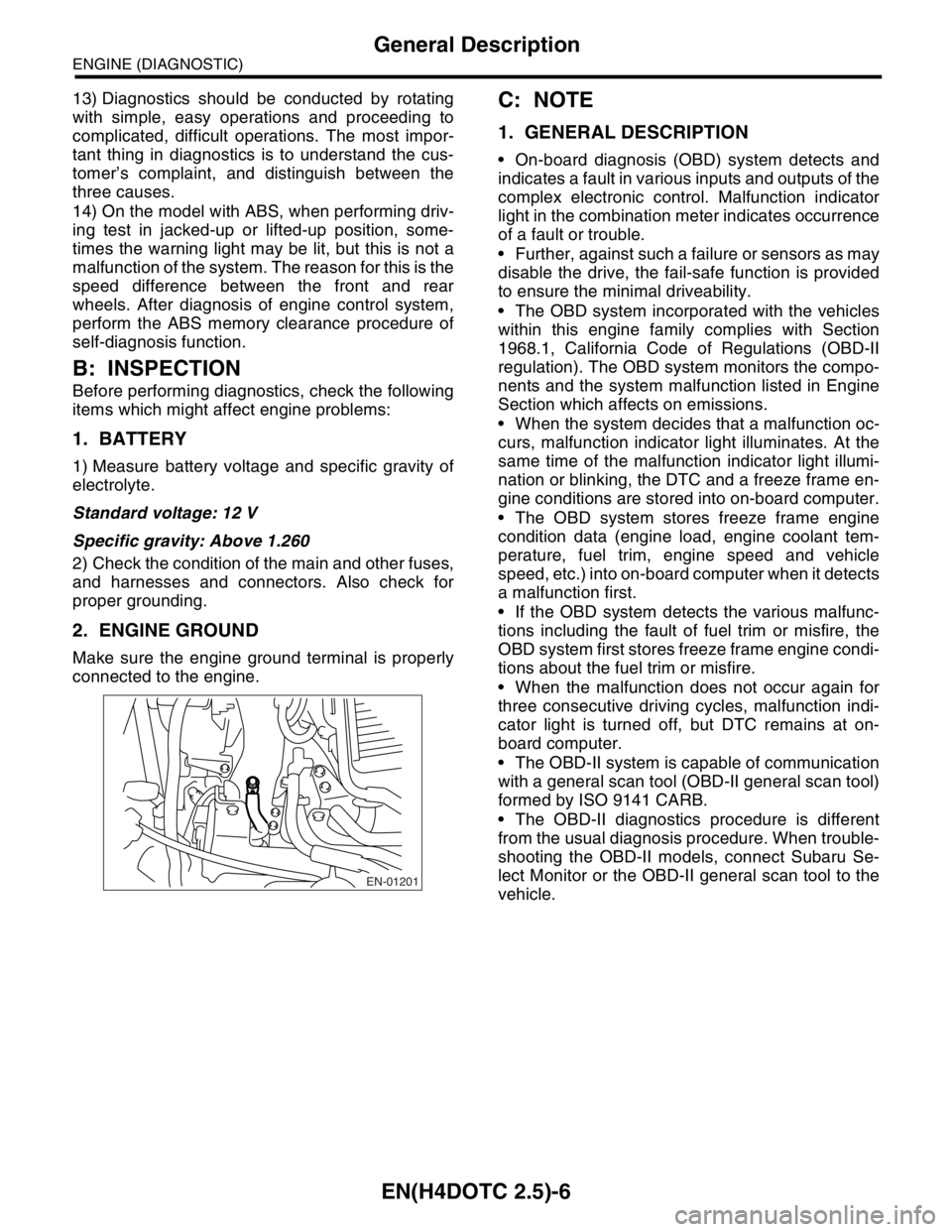
2. ENGINE GROUND
Make sure the engine ground terminal is properly
connected to the engine.
C: NOTE
1. GENERAL DESCRIPTION
On-board diagnosis (OBD) system detects and
indicates a fault in various inputs and outputs of the
complex electronic control. Malfunction indicator
light in the combination meter indicates occurrence
of a fault or trouble.
Further, against such a failure or sensors as may
disable the drive, the fail-safe function is provided
to ensure the minimal driveability.
The OBD system incorporated with the vehicles
within this engine family complies with Section
1968.1, California Code of Regulations (OBD-II
regulation). The OBD system monitors the compo-
nents and the system malfunction listed in Engine
Section which affects on emissions.
When the system decides that a malfunction oc-
curs, malfunction indicator light illuminates. At the
same time of the malfunction indicator light illumi-
nation or blinking, the DTC and a freeze frame en-
gine conditions are stored into on-board computer.
The OBD system stores freeze frame engine
condition data (engine load, engine coolant tem-
perature, fuel trim, engine speed and vehicle
speed, etc.) into on-board computer when it detects
a malfunction first.
If the OBD system detects the various malfunc-
tions including the fault of fuel trim or misfire, the
OBD system first stores freeze frame engine condi-
tions about the fuel trim or misfire.
When the malfunction does not occur again for
three consecutive driving cycles, malfunction indi-
cator light is turned off, but DTC remains at on-
board computer.
The OBD-II system is capable of communication
with a general scan tool (OBD-II general scan tool)
formed by ISO 9141 CARB.
The OBD-II diagnostics procedure is different
from the usual diagnosis procedure. When trouble-
shooting the OBD-II models, connect Subaru Se-
lect Monitor or the OBD-II general scan tool to the
vehicle.
EN-01201
Page 2061 of 2870
EN(H4DOTC 2.5)-37
ENGINE (DIAGNOSTIC)
Inspection Mode
1. PREPARATION FOR THE INSPECTION
MODE
1) Check battery voltage is more than 12 V and fuel
remains half [20 — 402 (5.3 — 10.6 US gal, 4.4 —
8.8 Imp gal)].
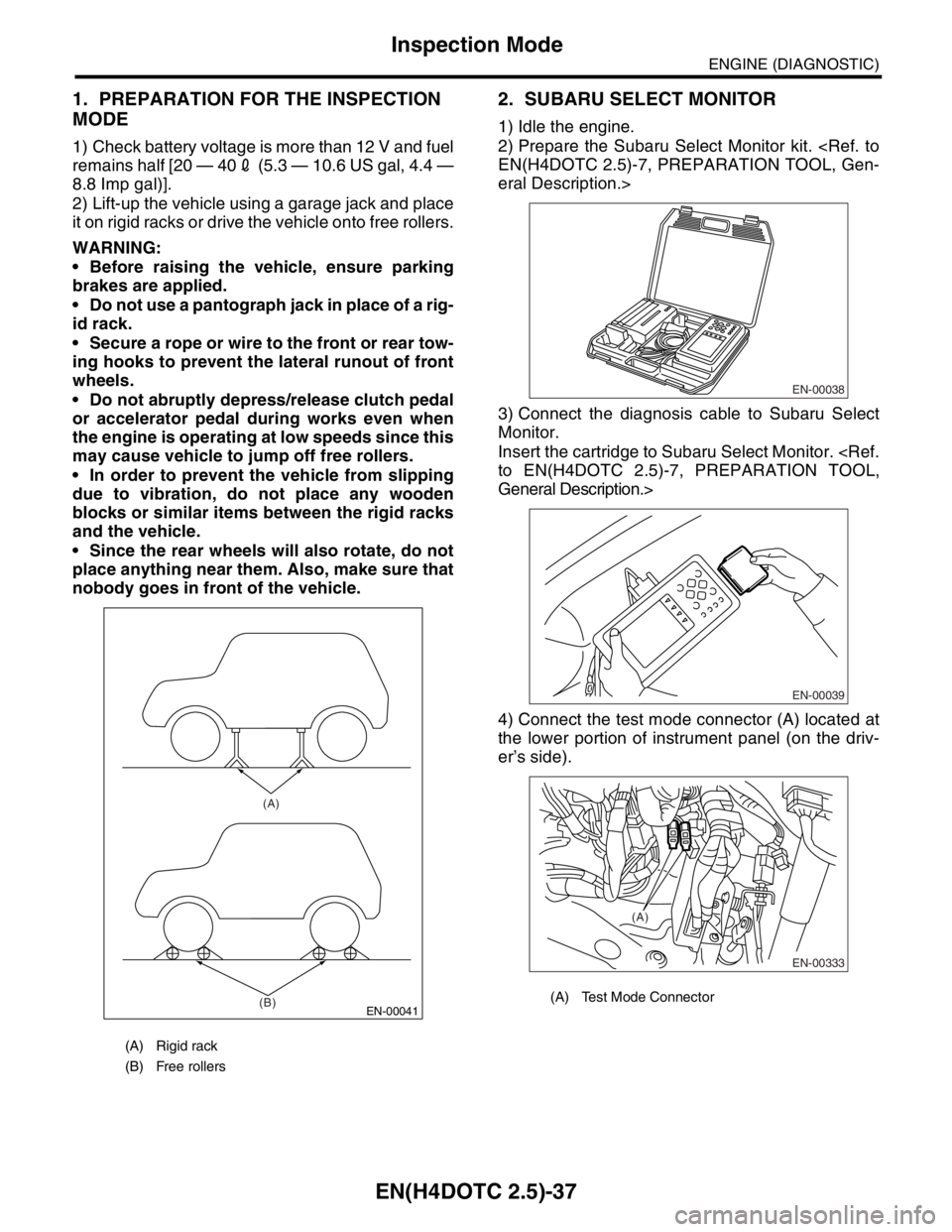
2) Lift-up the vehicle using a garage jack and place
it on rigid racks or drive the vehicle onto free rollers.
WARNING:
Before raising the vehicle, ensure parking
brakes are applied.
Do not use a pantograph jack in place of a rig-
id rack.
Secure a rope or wire to the front or rear tow-
ing hooks to prevent the lateral runout of front
wheels.
Do not abruptly depress/release clutch pedal
or accelerator pedal during works even when
the engine is operating at low speeds since this
may cause vehicle to jump off free rollers.
In order to prevent the vehicle from slipping
due to vibration, do not place any wooden
blocks or similar items between the rigid racks
and the vehicle.
Since the rear wheels will also rotate, do not
place anything near them. Also, make sure that
nobody goes in front of the vehicle.
2. SUBARU SELECT MONITOR
1) Idle the engine.
2) Prepare the Subaru Select Monitor kit.
eral Description.>
3) Connect the diagnosis cable to Subaru Select
Monitor.
Insert the cartridge to Subaru Select Monitor.
General Description.>
4) Connect the test mode connector (A) located at
the lower portion of instrument panel (on the driv-
er’s side).
(A) Rigid rack
(B) Free rollers
EN-00041
(A)
(B)
(A) Test Mode Connector
EN-00038
EN-00039
EN-00333
(A)
Page 2086 of 2870
EN(H4DOTC 2.5)-62
ENGINE (DIAGNOSTIC)
Diagnostics for Engine Starting Failure
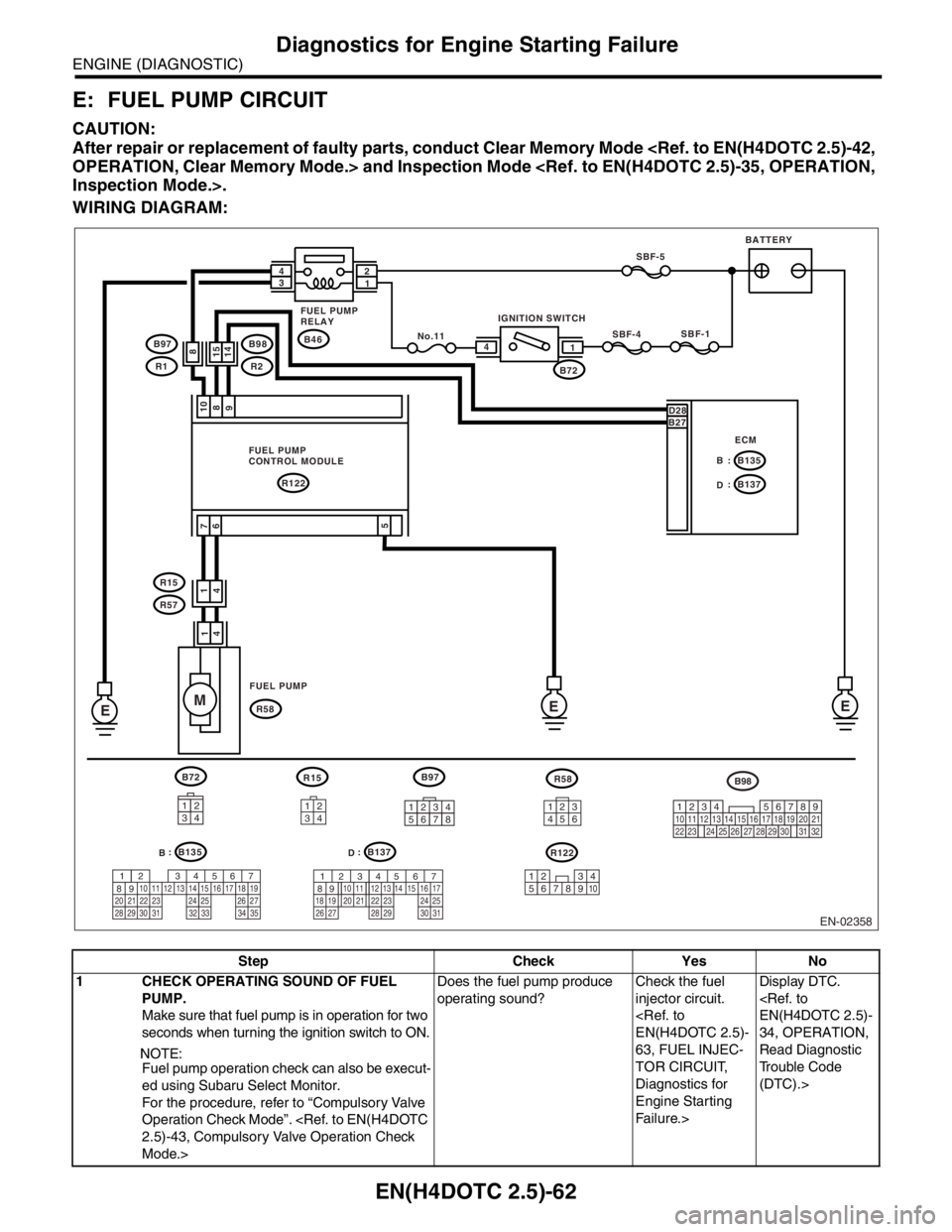
E: FUEL PUMP CIRCUIT
CAUTION:
After repair or replacement of faulty parts, conduct Clear Memory Mode
WIRING DIAGRAM:
Step Check Yes No
1 CHECK OPERATING SOUND OF FUEL
PUMP.
Make sure that fuel pump is in operation for two
seconds when turning the ignition switch to ON.
NOTE:
Fuel pump operation check can also be execut-
ed using Subaru Select Monitor.
For the procedure, refer to “Compulsory Valve
Operation Check Mode”.
Mode.>Does the fuel pump produce
operating sound?Check the fuel
injector circuit.
63, FUEL INJEC-
TOR CIRCUIT,
Diagnostics for
Engine Starting
Fa il u r e. >Display DTC.
34, OPERATION,
Read Diagnostic
Trouble Code
(DTC).>
EN-02358
R15
E
E M
R122: B135 B
: B137
D
R58
B97 B97
3412
B98 R1
R15
R57
567
82 1
94 310
24 22 23 2511 12 13 14 15
26 27
2816 17 18 19
20 21
29 30 31 32 33 34 35567
82 1
94 310
22 23 11 12 13 14 15
24 25
2616 17
18 19 20 21
27 28 29 30 31
R122
3
4 12
5891067
FUEL PUMP
CONTROL MODULE
FUEL PUMPECMBATTERY
B72SBF-1
SBF-4
D28
B27
E
98 10
7
6 1
4 1
415
14
1 4
5
IGNITION SWITCH
B46 FUEL PUMP
RELAY
2
1 4
3SBF-5
No.118B98
R2
12345678219
32
1234
5610 11 12 13 14 15716
23 3019 20
22 26 27 28 29817
24 3118
25
: B135
B: B137
D
B72
3412
R58
23
56 1
4
Page 2135 of 2870
EN(H4DOTC 2.5)-111
ENGINE (DIAGNOSTIC)
Diagnostic Procedure with Diagnostic Trouble Code (DTC)
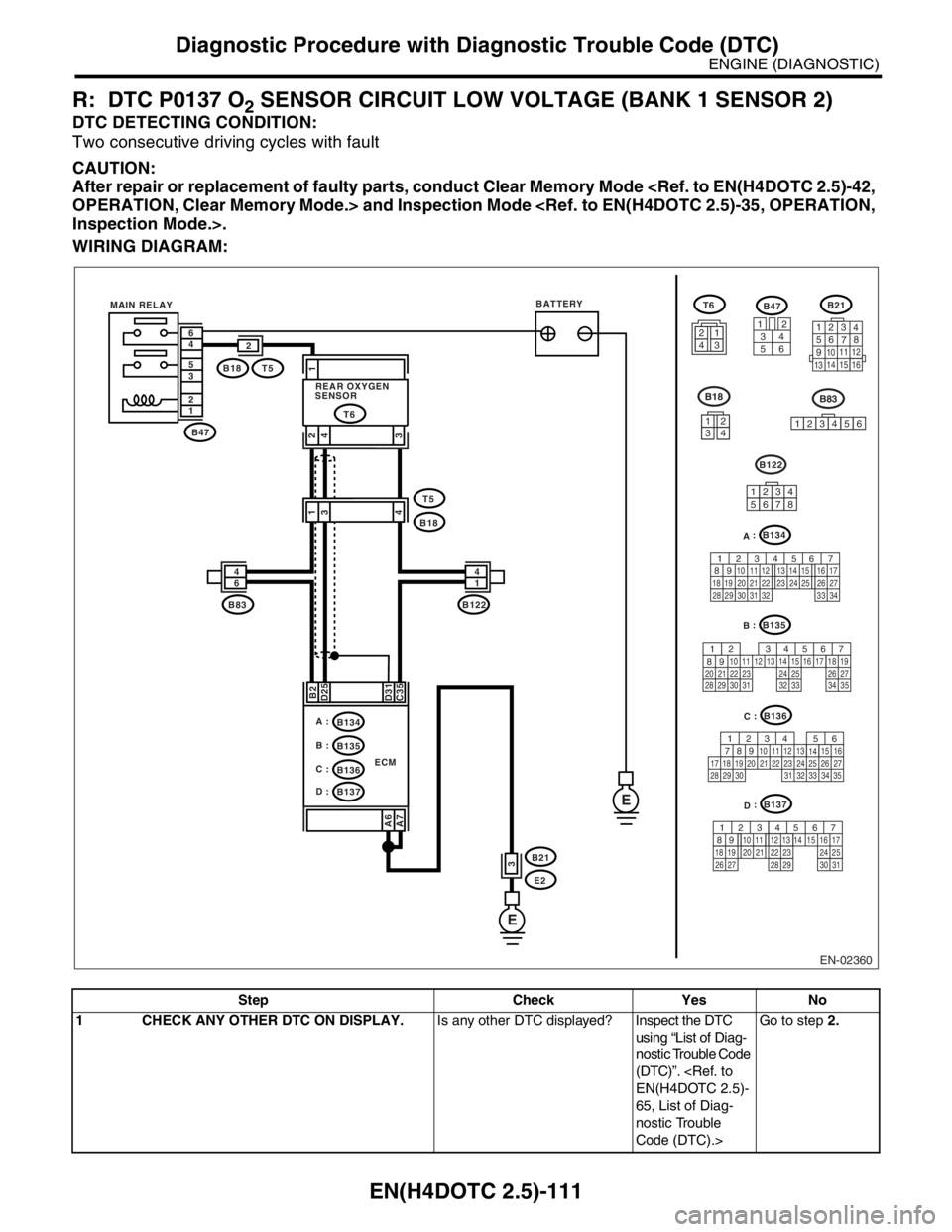
R: DTC P0137 O2 SENSOR CIRCUIT LOW VOLTAGE (BANK 1 SENSOR 2)
DTC DETECTING CONDITION:
Two consecutive driving cycles with fault
CAUTION:
After repair or replacement of faulty parts, conduct Clear Memory Mode
WIRING DIAGRAM:
Step Check Yes No
1 CHECK ANY OTHER DTC ON DISPLAY.Is any other DTC displayed? Inspect the DTC
using “List of Diag-
nostic Trouble Code
(DTC)”.
65, List of Diag-
nostic Trouble
Code (DTC).>Go to step 2.
EN-02360
B122 B47 1 2 3 5 4 6
E
E
B21
E23
4
1
B122
34 12
56123
4
56
78
9
1011 12
1314 15 16
: B134
: B135B21
B47 T6
: B136 T6
A6
A7B2
D25
D31
C35
C : B :
D :
4
6
B83A
B
C
B136
B137 B135 B134 A :
: B137
D
56 7
82 1
94 310
24 22 23 25 11 12 13 14 15
26 27
2816 17
18 19 20 21
33 34 29
32 30 31
56
782 1
94 310
24 22 23 2511 12 13
1415
26 27
2816
17 18 19 20 21
33 34 29
32 30
31 35
567
82 1
94 310
24 22 23 2511 12 13 14 15
26 27
2816 17 18 19
20 21
29 30 31 32 33 34 35
567
82 1
94 310
22 23 11 12 13 14 15
24 25
2616 17
18 19 20 21
27 28 29 30 31
ECM MAIN RELAYBATTERY
REAR OXYGEN
SENSOR
12345678
B18 T52
B18
T5
B18
1234
B83
1
23456
1234
3 1
4
1
2
4
3
Page 2137 of 2870
EN(H4DOTC 2.5)-113
ENGINE (DIAGNOSTIC)
Diagnostic Procedure with Diagnostic Trouble Code (DTC)
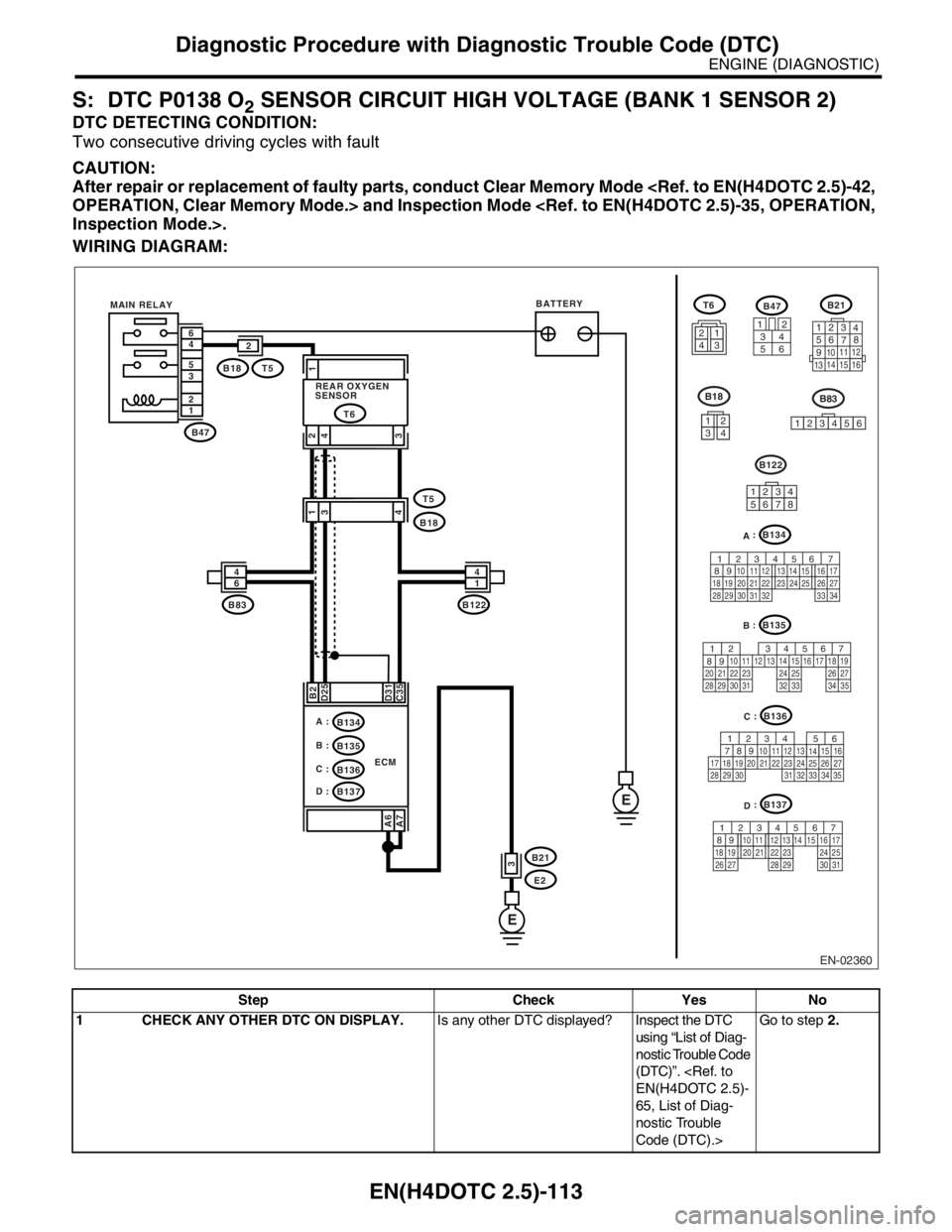
S: DTC P0138 O2 SENSOR CIRCUIT HIGH VOLTAGE (BANK 1 SENSOR 2)
DTC DETECTING CONDITION:
Two consecutive driving cycles with fault
CAUTION:
After repair or replacement of faulty parts, conduct Clear Memory Mode
WIRING DIAGRAM:
Step Check Yes No
1 CHECK ANY OTHER DTC ON DISPLAY.Is any other DTC displayed? Inspect the DTC
using “List of Diag-
nostic Trouble Code
(DTC)”.
65, List of Diag-
nostic Trouble
Code (DTC).>Go to step 2.
EN-02360
B122 B47 1 2 3 5 4 6
E
E
B21
E23
4
1
B122
34 12
56123
4
56
78
9
1011 12
1314 15 16
: B134
: B135B21
B47 T6
: B136 T6
A6
A7B2
D25
D31
C35
C : B :
D :
4
6
B83A
B
C
B136
B137 B135 B134 A :
: B137
D
56 7
82 1
94 310
24 22 23 25 11 12 13 14 15
26 27
2816 17
18 19 20 21
33 34 29
32 30 31
56
782 1
94 310
24 22 23 2511 12 13
1415
26 27
2816
17 18 19 20 21
33 34 29
32 30
31 35
567
82 1
94 310
24 22 23 2511 12 13 14 15
26 27
2816 17 18 19
20 21
29 30 31 32 33 34 35
567
82 1
94 310
22 23 11 12 13 14 15
24 25
2616 17
18 19 20 21
27 28 29 30 31
ECM MAIN RELAYBATTERY
REAR OXYGEN
SENSOR
12345678
B18 T52
B18
T5
B18
1234
B83
1
23456
1234
3 1
4
1
2
4
3
Page 2139 of 2870

EN(H4DOTC 2.5)-115
ENGINE (DIAGNOSTIC)
Diagnostic Procedure with Diagnostic Trouble Code (DTC)
T: DTC P0171 SYSTEM TOO LEAN (BANK 1)
NOTE:
For diagnostic procedure, refer to DTC P0172.
U: DTC P0172 SYSTEM TOO RICH (BANK 1)
DTC DETECTING CONDITION:
Two consecutive driving cycles with fault
TROUBLE SYMPTOM:
Erroneous idling
Engine stalls.
Poor driving performance
CAUTION:
After repair or replacement of faulty parts, conduct Clear Memory Mode
Step Check Yes No
1 CHECK EXHAUST SYSTEM.Are there holes or loose bolts
on exhaust system?Repair exhaust
system.Go to step 2.
2 CHECK AIR INTAKE SYSTEM.Are there holes, loose bolts or
disconnection of hose on air
intake system?Repair air intake
system.Go to step 3.
3 CHECK FUEL PRESSURE.
Warning:
Place “NO FIRE” signs near the working
area.
Be careful not to spill fuel.
1) Release the fuel pressure.
(1) Disconnect the connector from fuel
pump relay.
(2) Start the engine and run it until it stalls.
(3) After the engine stalls, crank it for five
more seconds.
(4) Turn the ignition switch to OFF.
2) Connect the connector to fuel pump relay.
3) Disconnect the fuel delivery hose from fuel
filter, and connect the fuel pressure gauge.
4) Install the fuel filler cap.
5) Start the engine and idle while gear posi-
tion is neutral.
6) Measure the fuel pressure while discon-
necting pressure regulator vacuum hose from
intake manifold.
Warning:
Release fuel pressure before removing the
fuel pressure gauge.
N
OTE:
If fuel pressure does not increase, squeeze the
fuel return hose 2 to 3 times, then measure fuel
pressure again.Is measured value 284 — 314
kPa (2.9 — 3.2 kg/cm
2, 41 —
46 psi)?Go to step 4.Repair the follow-
ing items.
Fuel pressure is
too high:
Clogged fuel
return line or
bent hose
Fuel pressure is
too low:
Improper fuel
pump discharge
Clogged fuel
supply line
Page 2156 of 2870

EN(H4DOTC 2.5)-132
ENGINE (DIAGNOSTIC)
Diagnostic Procedure with Diagnostic Trouble Code (DTC)
Step Check Yes No
1 CHECK HARNESS BETWEEN KNOCK SEN-
SOR AND ECM CONNECTOR.
1) Turn the ignition switch to OFF.
2) Disconnect the connector from ECM.
3) Measure the resistance between ECM har-
ness connector and chassis ground.
Connector & terminal
(B136) No. 25 — Chassis ground:Is the resistance more than
700 kΩ?Go to step 2.Repair the harness
and connector.
N
OTE:
In this case repair
the following:
Open circuit in
harness between
knock sensor and
ECM connector
Poor contact in
knock sensor con-
nector
Poor contact in
coupling connector
2 CHECK KNOCK SENSOR.
1) Disconnect the connector from knock sensor.
2) Measure the resistance between knock
sensor connector terminal and engine ground.
Connector & terminal
(E14) No. 2 — Engine ground:Is the resistance more than
700 kΩ?Go to step 3.Repair the harness
and connector.
NOTE:
In this case repair
the following:
Poor contact in
knock sensor con-
nector
Poor contact in
coupling connector
3 CHECK CONDITION OF KNOCK SENSOR
INSTALLATION.Is the knock sensor installation
bolt tightened securely?Replace the knock
sensor.
29, Knock Sen-
sor.>Tighten knock sen-
sor installation bolt
securely.
Page 2160 of 2870

EN(H4DOTC 2.5)-136
ENGINE (DIAGNOSTIC)
Diagnostic Procedure with Diagnostic Trouble Code (DTC)
Step Check Yes No
1 CHECK HARNESS BETWEEN CRANK-
SHAFT POSITION SENSOR AND ECM CON-
NECTOR.
1) Turn the ignition switch to OFF.
2) Disconnect the connector from the crank-
shaft position sensor.
3) Measure the resistance of harness
between crankshaft position sensor connector
and engine ground.
Connector & terminal
(E10) No. 1 — Engine ground:Is the resistance more than
100 kΩ?Repair the harness
and connector.
N
OTE:
In this case repair
the following:
Open circuit in
harness between
crankshaft posi-
tion sensor and
ECM connector
Poor contact in
ECM connector.
Poor contact in
coupling connectorGo to step 2.
2 CHECK HARNESS BETWEEN CRANK-
SHAFT POSITION SENSOR AND ECM CON-
NECTOR.
Measure the resistance of harness between
crankshaft position sensor connector and
engine ground.
Connector & terminal
(E10) No. 1 — Engine ground:Is the resistance more than 1
MΩ?Go to step 3.Repair ground short
circuit in harness
between crankshaft
position sensor and
ECM connector.
NOTE:
The harness be-
tween both con-
nectors are
shielded. Repair
ground short circuit
in harness togeth-
er with shield.
3 CHECK HARNESS BETWEEN CRANK-
SHAFT POSITION SENSOR AND ECM CON-
NECTOR.
Measure the resistance of harness between
crankshaft position sensor connector and
engine ground.
Connector & terminal
(E10) No. 2 — Engine ground:Is the resistance less than 5 Ω? Go to step 4.Repair the harness
and connector.
NOTE:
In this case repair
the following:
Open circuit in
harness between
crankshaft posi-
tion sensor and
ECM connector
Poor contact in
ECM connector.
Poor contact in
coupling connector
4 CHECK CONDITION OF CRANKSHAFT PO-
SITION SENSOR.Is the crankshaft position sen-
sor installation bolt tightened
securely?Go to step 5.Tighten the crank-
shaft position sen-
sor installation bolt
securely.
5 CHECK CRANKSHAFT POSITION SENSOR.
1) Remove the crankshaft position sensor.
2) Measure the resistance between connector
terminals of crankshaft position sensor.
Te r m i n a l s
No. 1 — No. 2:Is the resistance 1 — 4 kΩ? Repair poor con-
tact in crankshaft
position sensor
connector.Replace the crank-
shaft position sen-
sor.
27, Crankshaft
Position Sensor.>
Page 2162 of 2870

EN(H4DOTC 2.5)-138
ENGINE (DIAGNOSTIC)
Diagnostic Procedure with Diagnostic Trouble Code (DTC)
Step Check Yes No
1 CHECK POWER SUPPLY OF CAMSHAFT
POSITION SENSOR.
1) Turn the ignition switch to OFF.
2) Disconnect the connector from camshaft
position sensor.
3) Measure the voltage between camshaft
position sensor and engine ground.
Connector & terminal
(E36) No. 1 (+) — Engine ground (
−):Is the voltage more than 10 V? Repair the battery
short circuit
between main relay
connector and
camshaft position
sensor connector.Go to step 2.
2 CHECK POWER SUPPLY OF CAMSHAFT
POSITION SENSOR.
1) Turn the ignition switch to ON.
2) Measure the voltage between camshaft
position sensor and engine ground.
Connector & terminal
(E36) No. 1 (+) — Engine ground (
−):Is the voltage more than 10 V? Go to step 3.Repair open or bat-
tery short circuit
between main relay
connector and
camshaft position
sensor connector.
3 CHECK HARNESS BETWEEN CAMSHAFT
POSITION SENSOR AND ECM.
1) Turn the ignition switch to OFF.
2) Disconnect the connector from ECM.
3) Measure the resistance between camshaft
position sensor and ECM.
Connector & terminal
(E36) No. 2 — (B135) No. 9:
(E36) No. 3 — (B136) No. 35:Is the resistance less than 1
Ω?Go to step 4.Repair open circuit
between camshaft
position sensor
and ECM.
4 CHECK HARNESS BETWEEN CAMSHAFT
POSITION SENSOR AND ECM.
Measure the resistance between camshaft
position sensor and engine ground.
Connector & terminal
(E36) No. 2 — Engine ground:
(E36) No. 3 — Engine ground:Is the resistance more than 1
MΩ?Go to step 5.Repair ground short
circuit between
camshaft position
sensor and ECM.
5 CHECK CONDITION OF CAMSHAFT POSI-
TION SENSOR.Is the camshaft position sensor
installation bolt tightened
securely?Go to step 6.Tighten the cam-
shaft position sen-
sor installation bolt
securely.
6 CHECK CAMSHAFT POSITION SENSOR.
Check waveform of camshaft position sensor.
waveform?Replace the cam-
shaft position sen-
sor.
28, Camshaft
Position Sensor.>Go to step 7.
7 CHECK POOR CONTACT.
Check poor contact in ECM connector.Is there poor contact in ECM
connector?Repair the poor
contact in ECM
connector.Replace the ECM.
41, Engine Con-
trol Module
(ECM).>
Page 2164 of 2870

EN(H4DOTC 2.5)-140
ENGINE (DIAGNOSTIC)
Diagnostic Procedure with Diagnostic Trouble Code (DTC)
Step Check Yes No
1 CHECK POWER SUPPLY OF CAMSHAFT
POSITION SENSOR.
1) Turn the ignition switch to OFF.
2) Disconnect the connector from camshaft
position sensor.
3) Measure the voltage between camshaft
position sensor and engine ground.
Connector & terminal
(E35) No. 1 (+) — Engine ground (
−):Is the voltage more than 10 V? Repair the battery
short circuit
between main relay
connector and cam-
shaft position sen-
sor connector.Go to step 2.
2 CHECK POWER SUPPLY OF CAMSHAFT
POSITION SENSOR.
1) Turn the ignition switch to ON.
2) Measure the voltage between camshaft
position sensor and engine ground.
Connector & terminal
(E35) No. 1 (+) — Engine ground (
−):Is the voltage more than 10 V? Go to step 3.Repair open or
battery short cir-
cuit between main
relay connector
and camshaft
position sensor
connector.
3 CHECK HARNESS BETWEEN CAMSHAFT
POSITION SENSOR AND ECM.
1) Turn the ignition switch to OFF.
2) Disconnect the connector from ECM.
3) Measure the resistance between camshaft
position sensor and ECM.
Connector & terminal
(E35) No. 2 — (B135) No. 8:
(E35) No. 3 — (B136) No. 35:Is the resistance less than 1 Ω? Go to step 4.Repair open circuit
between camshaft
position sensor
and ECM.
4 CHECK HARNESS BETWEEN CAMSHAFT
POSITION SENSOR AND ECM.
Measure the resistance between camshaft
position sensor and engine ground.
Connector & terminal
(E35) No. 2 — Engine ground:
(E35) No. 3 — Engine ground:Is the resistance more than 1
MΩ?Go to step 5.Repair ground short
circuit between
camshaft position
sensor and ECM.
5 CHECK CONDITION OF CAMSHAFT POSI-
TION SENSOR.Is the camshaft position sensor
installation bolt tightened
securely?Go to step 6.Tighten the cam-
shaft position sen-
sor installation bolt
securely.
6 CHECK CAMSHAFT POSITION SENSOR.
Check waveform of camshaft position sensor.
waveform?Replace the cam-
shaft position sen-
sor.
28, Camshaft
Position Sensor.>Go to step 7.
7 CHECK POOR CONTACT.
Check poor contact in ECM connector.Is there poor contact in ECM
connector?Repair the poor
contact in ECM
connector.Replace the ECM.
41, Engine Con-
trol Module
(ECM).>