ECU SUBARU FORESTER 2004 Service Owner's Manual
[x] Cancel search | Manufacturer: SUBARU, Model Year: 2004, Model line: FORESTER, Model: SUBARU FORESTER 2004Pages: 2870, PDF Size: 38.67 MB
Page 170 of 2870

AB-38
AIRBAG SYSTEM (DIAGNOSTIC)
Airbag Warning Light Failure
2 CHECK AIRBAG WARNING LIGHT.
1) Turn the ignition switch to OFF, disconnect
the battery ground cable, and wait more than
20 seconds.
2) Connect the connector (1M) in test harness
M to body harness connector (B31).
3) Connect the battery ground cable and turn
the ignition switch to ON.
4) Connect the connectors, (3M) and (4M) in
test harness M.Is the airbag warning light
turned off?Go to step 4.Go to step 3.
3 CHECK BODY HARNESS.
Check the body harness.
N
OTE:
After problem has been eliminated, disconnect
the connectors (3M) and (4M).Is the anything unusual to body
harness?Repair the body
harness.Replace the com-
bination meter
printed circuit.
Meter Assembly.>
4 CHECK POOR CONTACT.
Confirm that firm contact is secured between
the airbag control module and the connector
(AB3).
tor (AB3)? Replace the airbag
main harness with
body harness or
replace the airbag
control module.
Module.>Go to step 5.
5 CHECK AIRBAG MAIN HARNESS.
1) Turn the ignition switch to OFF, disconnect
the battery ground cable, and wait more than
20 seconds.
2) Connect the connector (AB1) to (B31).
3) Disconnect the connectors (AB21) and
(AB26).
4) Remove the glove box and disconnect the
connectors (AB4).
5) Disconnect the connector (AB3) from the
airbag control module, and connect the con-
nector (1R) in test harness R.
6) Connect the battery ground cable and turn
the ignition switch to ON.
7) Connect the connectors (5R) and (6R) in
test harness R.
N
OTE:
After problem has been eliminated, disconnect
the connectors (5R) and (6R).Is the airbag warning light
turned off? Go to step 6.Replace the airbag
main harness with
body harness.
6 CHECK GROUNDING CIRCUIT.
1) Turn the ignition switch to OFF, disconnect
the battery ground cable, and wait more than
20 seconds.
2) Disconnect the connector (AB3) from the
airbag control module.
3) Connect the connector (1R) in test harness
R to body harness connector (AB3).
4) Measure the resistance between connector
(2R) in test harness R and the chassis ground.
Connector & terminal
(2R) No. 10 — Chassis ground:
(2R) No. 11 — Chassis ground: Is the resistance less than 10
Ω?Replace the airbag
control module.
Module.>Repair the body-
grounding circuit. Step Check Yes No
Page 233 of 2870
FUJI HEAVY INDUSTRIES LTD. G8080GE7
2004 FORESTER SERVICE MANUAL QUICK REFERENCE INDEX
BODY SECTION
This service manual has been prepared
to provide SUBARU service personnel
with the necessary information and data
for the correct maintenance and repair
of SUBARU vehicles.
This manual includes the procedures
for maintenance, disassembling, reas-
sembling, inspection and adjustment of
components and diagnostics for guid-
ance of experienced mechanics.
Please peruse and utilize this manual
fully to ensure complete repair work for
satisfying our customers by keeping
their vehicle in optimum condition.
When replacement of parts during
repair work is needed, be sure to use
SUBARU genuine parts.
All information, illustration and specifi-
cations contained in this manual are
based on the latest product information
available at the time of publication
approval.HVAC SYSTEM
(HEATER, VENTILATOR AND A/C)AC
HVAC SYSTEM (AUTO A/C)
(DIAGNOSTIC)AC
AIRBAG SYSTEM AB
AIRBAG SYSTEM (DIAGNOSTIC) AB
SEAT BELT SYSTEM SB
LIGHTING SYSTEM LI
WIPER AND WASHER SYSTEM WW
ENTERTAINMENT ET
COMMUNICATION SYSTEM COM
GLASS/WINDOW/MIRROR GW
BODY STRUCTURE BS
INSTRUMENTATION/DRIVER INFO IDI
SEAT SE
SECURITY AND LOCK SL
SUNROOF/T-TOP/CONVERTIBLE TOP
(SUNROOF)SR
EXTERIOR/INTERIOR TRIM EI
EXTERIOR BODY PANEL EB
Page 248 of 2870
SB-14
SEAT BELT SYSTEM
Disposal of Pretensioner
6. Disposal of Pretensioner
A: CAUTION
Do not discard undeployed pretensioners, because
they may cause serious personal injury when acci-
dentally deployed.
Deployment of the pretensioners should be done
on a flat place free from any possible danger. Avoid
deploying outdoors during heavy rainy or strong
windy weather.
Do not drop or damage the pretensioner.
Because deploying the pretensioners causes a
high-explosive noise, be sure to warn people in the
area, and do not allow anyone within a 5 m (16 ft)
radius of the disposal site.
Some smoke will be emitted after deployment of
the pretensioners. Therefore, it must be deployed
in a well-ventilated area with no smoke alarms
nearby.
Wear gloves, goggles, and earplugs during this
operation. Wash your hands afterwards.
After deployment, the pretensioner is especially
hot. Leave it unattended for 40 minutes or longer,
and then discard it.
Do not let water get on the deployed pretension-
er.
Wrap the deployed pretensioner in an airtight vi-
nyl bag, and then discard it.
If circumstances do not permit pretensioner de-
ployment, contact a SUBARU dealer.
B: OPERATION
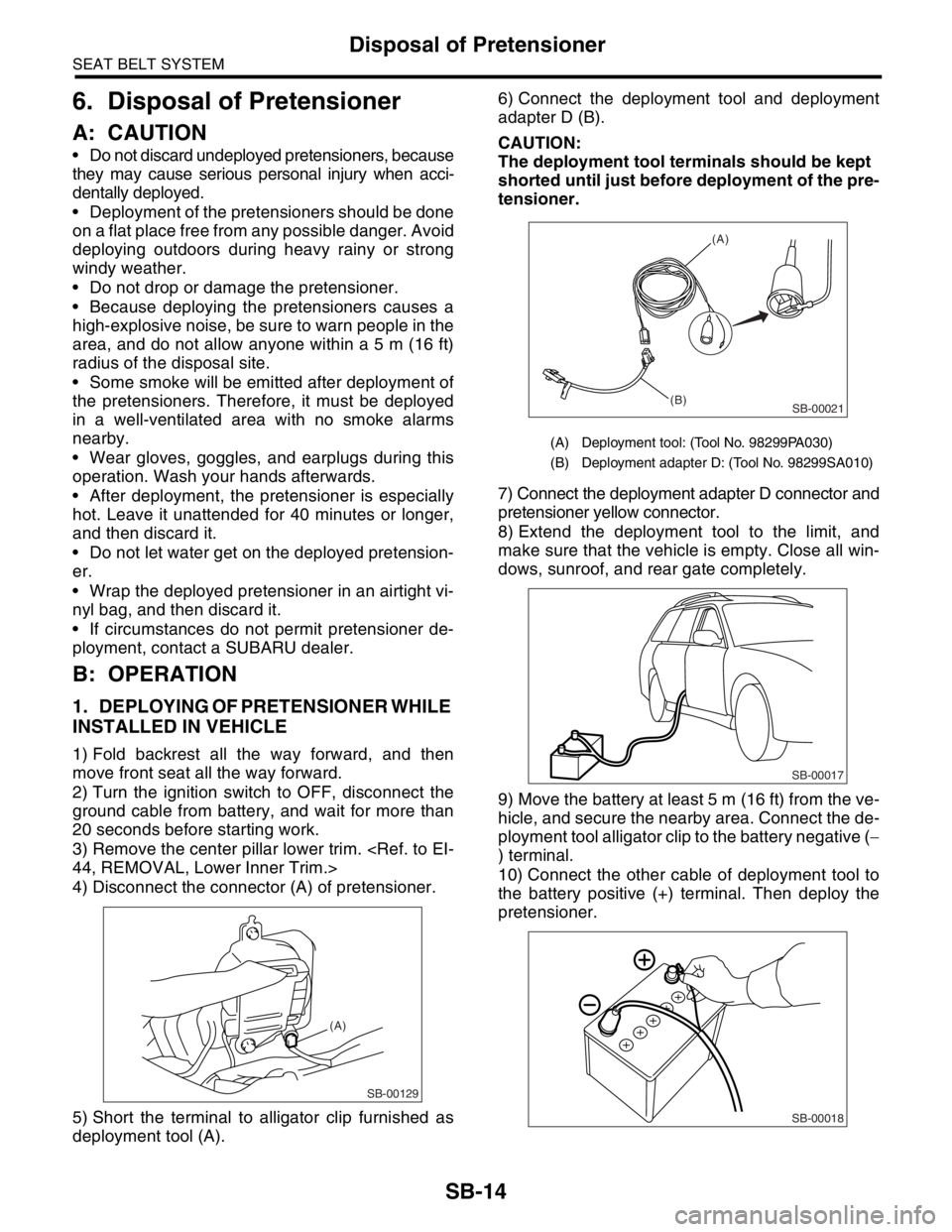
1. DEPLOYING OF PRETENSIONER WHILE
INSTALLED IN VEHICLE
1) Fold backrest all the way forward, and then
move front seat all the way forward.
2) Turn the ignition switch to OFF, disconnect the
ground cable from battery, and wait for more than
20 seconds before starting work.
3) Remove the center pillar lower trim.
4) Disconnect the connector (A) of pretensioner.
5) Short the terminal to alligator clip furnished as
deployment tool (A).6) Connect the deployment tool and deployment
adapter D (B).
CAUTION:
The deployment tool terminals should be kept
shorted until just before deployment of the pre-
tensioner.
7) Connect the deployment adapter D connector and
pretensioner yellow connector.
8) Extend the deployment tool to the limit, and
make sure that the vehicle is empty. Close all win-
dows, sunroof, and rear gate completely.
9) Move the battery at least 5 m (16 ft) from the ve-
hicle, and secure the nearby area. Connect the de-
ployment tool alligator clip to the battery negative (−
) terminal.
10) Connect the other cable of deployment tool to
the battery positive (+) terminal. Then deploy the
pretensioner.
SB-00129
(A)
(A) Deployment tool: (Tool No. 98299PA030)
(B) Deployment adapter D: (Tool No. 98299SA010)
SB-00021
(A)
(B)
SB-00017
SB-00018
Page 249 of 2870
SEAT BELT SYSTEM
Disposal of Pretensioner
CAUTION:
After deployment, pretensioner is especially
hot. Leave it unattended for 40 minutes or long-
er.
Do not let water get on the deployed preten-
sioner.
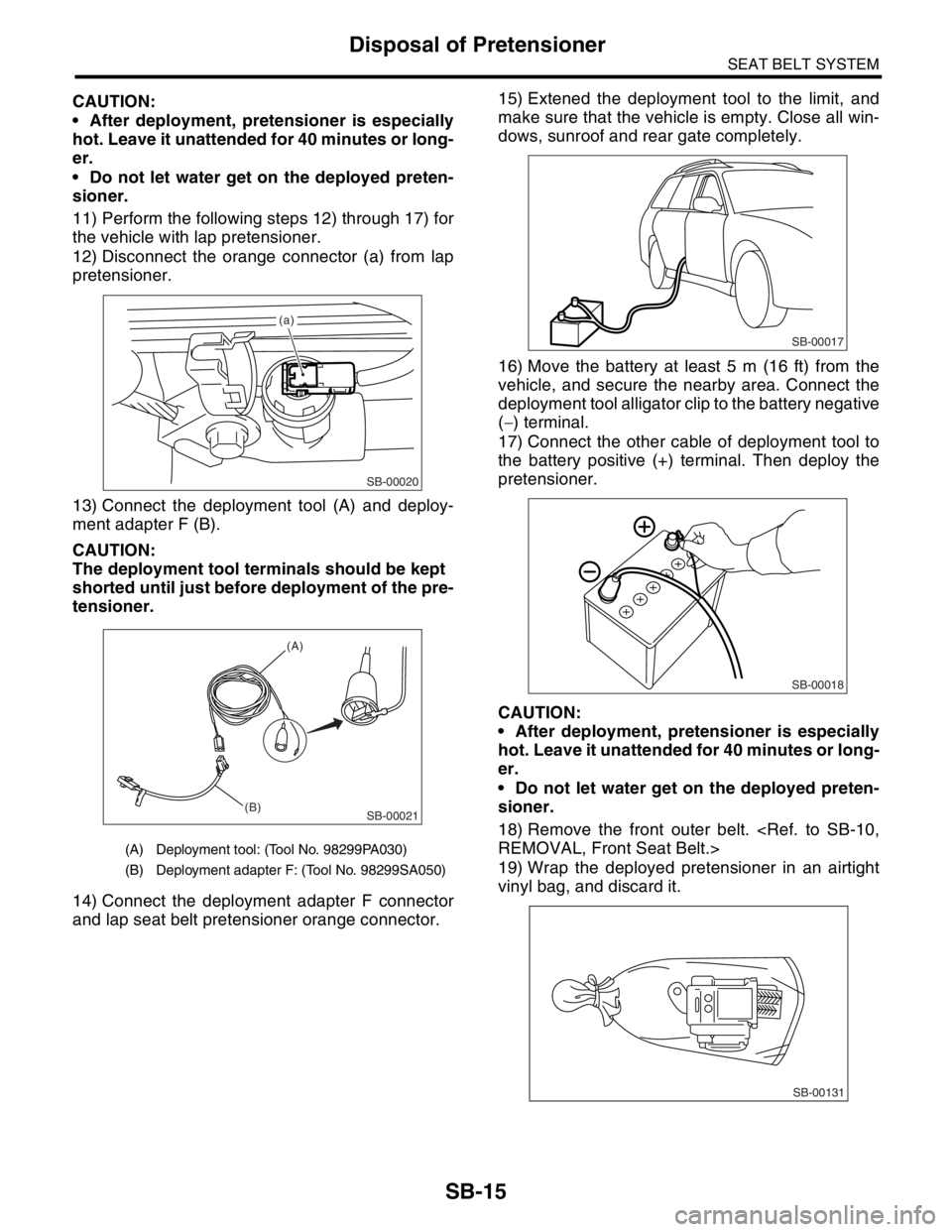
11) Perform the following steps 12) through 17) for
the vehicle with lap pretensioner.
12) Disconnect the orange connector (a) from lap
pretensioner.
13) Connect the deployment tool (A) and deploy-
ment adapter F (B).
CAUTION:
The deployment tool terminals should be kept
shorted until just before deployment of the pre-
tensioner.
14) Connect the deployment adapter F connector
and lap seat belt pretensioner orange connector.15) Extened the deployment tool to the limit, and
make sure that the vehicle is empty. Close all win-
dows, sunroof and rear gate completely.
16) Move the battery at least 5 m (16 ft) from the
vehicle, and secure the nearby area. Connect the
deployment tool alligator clip to the battery negative
(
− ) terminal.
17) Connect the other cable of deployment tool to
the battery positive (+) terminal. Then deploy the
pretensioner.
CAUTION:
After deployment, pretensioner is especially
hot. Leave it unattended for 40 minutes or long-
er.
Do not let water get on the deployed preten-
sioner.
18) Remove the front outer belt.
19) Wrap the deployed pretensioner in an airtight
vinyl bag, and discard it.
(A) Deployment tool: (Tool No. 98299PA030)
(B) Deployment adapter F: (Tool No. 98299SA050)
SB-00020
(a)
SB-00021
(A)
(B)
SB-00017
SB-00018
SB-00131
SB-15
Page 250 of 2870
SB-16
SEAT BELT SYSTEM
Disposal of Pretensioner
2. DEPLOYING OF RETRACTOR PRETEN-
SIONER AFTER REMOVAL FROM VEHICLE
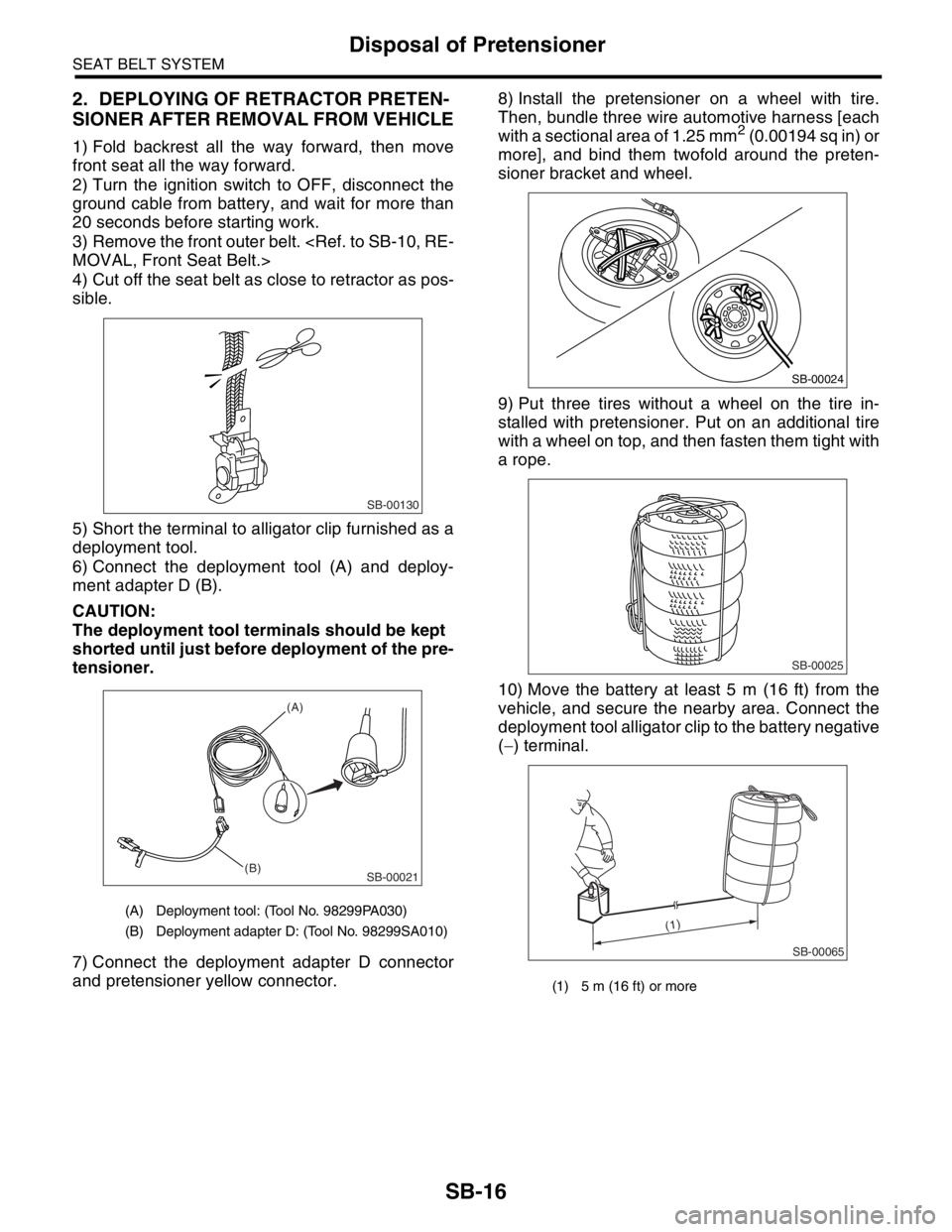
1) Fold backrest all the way forward, then move
front seat all the way forward.
2) Turn the ignition switch to OFF, disconnect the
ground cable from battery, and wait for more than
20 seconds before starting work.
3) Remove the front outer belt.
4) Cut off the seat belt as close to retractor as pos-
sible.
5) Short the terminal to alligator clip furnished as a
deployment tool.
6) Connect the deployment tool (A) and deploy-
ment adapter D (B).
CAUTION:
The deployment tool terminals should be kept
shorted until just before deployment of the pre-
tensioner.
7) Connect the deployment adapter D connector
and pretensioner yellow connector.8) Install the pretensioner on a wheel with tire.
Then, bundle three wire automotive harness [each
with a sectional area of 1.25 mm
2 (0.00194 sq in) or
more], and bind them twofold around the preten-
sioner bracket and wheel.
9) Put three tires without a wheel on the tire in-
stalled with pretensioner. Put on an additional tire
with a wheel on top, and then fasten them tight with
a rope.
10) Move the battery at least 5 m (16 ft) from the
vehicle, and secure the nearby area. Connect the
deployment tool alligator clip to the battery negative
(−) terminal.
(A) Deployment tool: (Tool No. 98299PA030)
(B) Deployment adapter D: (Tool No. 98299SA010)
SB-00130
SB-00021
(A)
(B)
(1) 5 m (16 ft) or more
SB-00024
SB-00025
SB-00065
(1)
Page 252 of 2870
SB-18
SEAT BELT SYSTEM
Disposal of Pretensioner
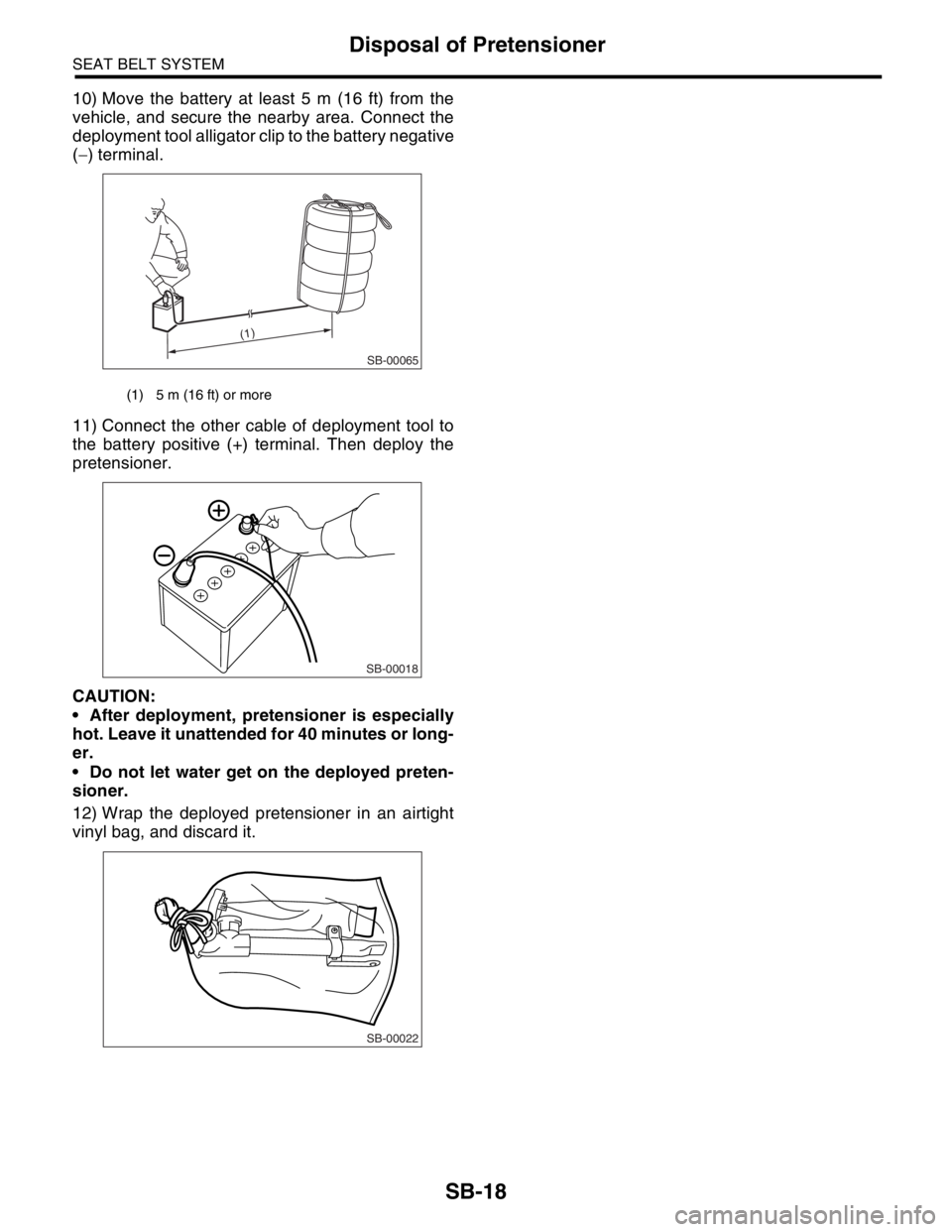
10) Move the battery at least 5 m (16 ft) from the
vehicle, and secure the nearby area. Connect the
deployment tool alligator clip to the battery negative
(−) terminal.
11) Connect the other cable of deployment tool to
the battery positive (+) terminal. Then deploy the
pretensioner.
CAUTION:
After deployment, pretensioner is especially
hot. Leave it unattended for 40 minutes or long-
er.
Do not let water get on the deployed preten-
sioner.
12) Wrap the deployed pretensioner in an airtight
vinyl bag, and discard it.
(1) 5 m (16 ft) or more
SB-00065
(1)
SB-00018
SB-00022
Page 253 of 2870
FUJI HEAVY INDUSTRIES LTD. G8080GE7
2004 FORESTER SERVICE MANUAL QUICK REFERENCE INDEX
BODY SECTION
This service manual has been prepared
to provide SUBARU service personnel
with the necessary information and data
for the correct maintenance and repair
of SUBARU vehicles.
This manual includes the procedures
for maintenance, disassembling, reas-
sembling, inspection and adjustment of
components and diagnostics for guid-
ance of experienced mechanics.
Please peruse and utilize this manual
fully to ensure complete repair work for
satisfying our customers by keeping
their vehicle in optimum condition.
When replacement of parts during
repair work is needed, be sure to use
SUBARU genuine parts.
All information, illustration and specifi-
cations contained in this manual are
based on the latest product information
available at the time of publication
approval.HVAC SYSTEM
(HEATER, VENTILATOR AND A/C)AC
HVAC SYSTEM (AUTO A/C)
(DIAGNOSTIC)AC
AIRBAG SYSTEM AB
AIRBAG SYSTEM (DIAGNOSTIC) AB
SEAT BELT SYSTEM SB
LIGHTING SYSTEM LI
WIPER AND WASHER SYSTEM WW
ENTERTAINMENT ET
COMMUNICATION SYSTEM COM
GLASS/WINDOW/MIRROR GW
BODY STRUCTURE BS
INSTRUMENTATION/DRIVER INFO IDI
SEAT SE
SECURITY AND LOCK SL
SUNROOF/T-TOP/CONVERTIBLE TOP
(SUNROOF)SR
EXTERIOR/INTERIOR TRIM EI
EXTERIOR BODY PANEL EB
Page 256 of 2870

LI-2
LIGHTING SYSTEM
General Description
1. General Description
A: SPECIFICATION
B: PRECAUTIONS
Before removing and installing parts, always disconnect the battery ground cable. When replacing audio,
control module, and other parts provided with memory functions, record memory contents before disconnect-
ing the battery ground cable. Otherwise, the memory will be erased.
Reassemble in reverse order of disassembly, unless otherwise indicated.
Adjust parts to the given specifications.
Connect the connectors and hoses securely during reassembly.
After reassembly, make sure functional parts operate smoothly.
WARNING:
Airbag system wiring harness is routed near electrical parts and switches. All airbag system wiring
harnesses and connectors are yellow. Do not use electric test equipment on these circuits.
Be careful not to damage the airbag system wiring harness when servicing electrical parts and
switches.
C: PREPARATION TOOL
1. GENERAL TOOL
Headlight12 V — 55 W/60 W
Front turn signal light 12 V — 21 W
Clearance light12 V — 5 W
Side marker light12 V — 5 W
Front fog light12 V — 55 W
Rear combination lightTail/Stop light 12 V — 5/21 W
Turn signal light 12 V — 21 W
Back-up light 12 V — 16 W
License plate light12 V — 5 W
High-mounted stop lightStandard type 12 V — 13 W
Rear spoiler built-in type 12 V — 1.2 W
Room light12 V — 8 W
Spot light12 V — 8 W
Luggage room light12 V — 5 W
TOOL NAME REMARKS
Circuit tester Used for measuring resistance and voltage.
Page 265 of 2870
LI-11
LIGHTING SYSTEM
Combination Switch (Light)
10.Combination Switch (Light)
A: REMOVAL
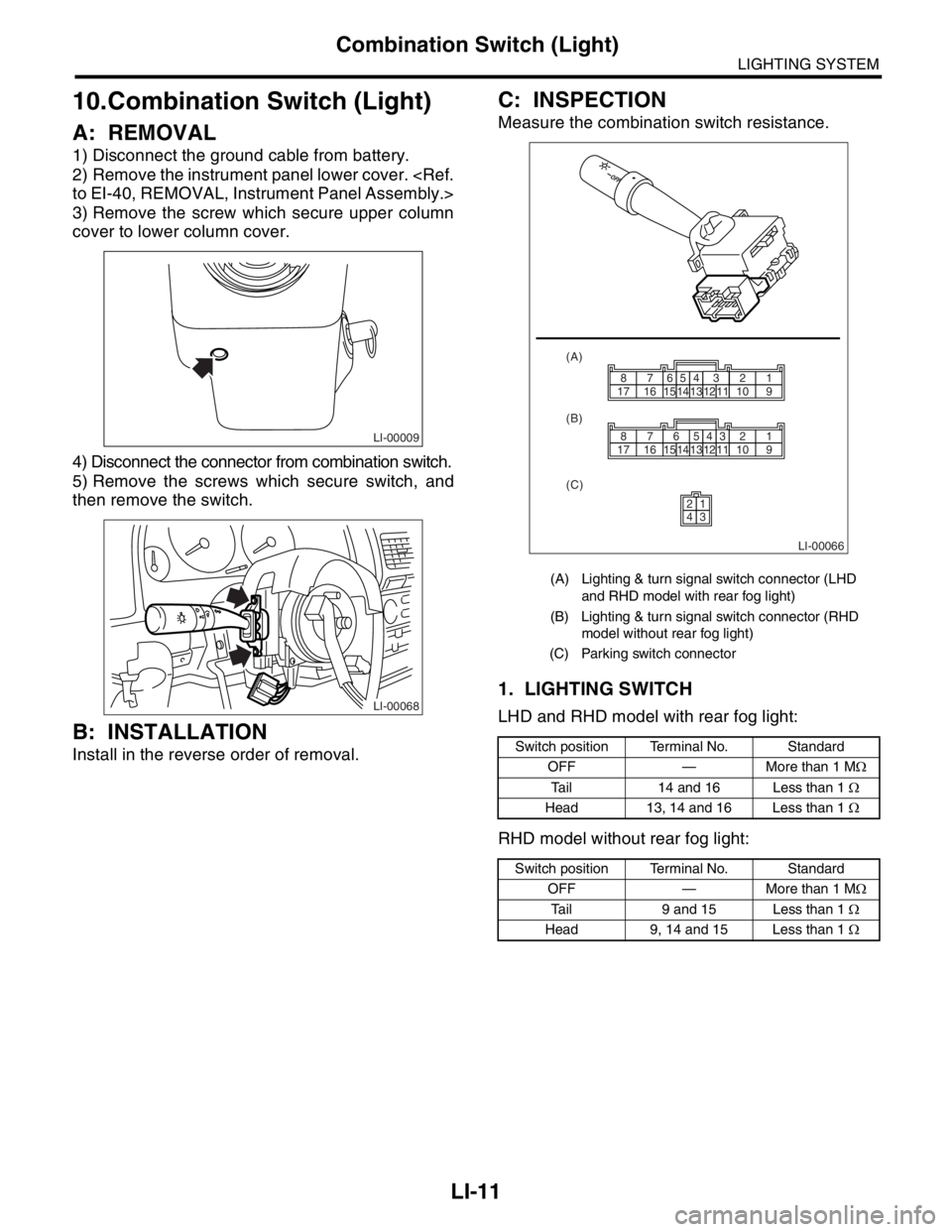
1) Disconnect the ground cable from battery.
2) Remove the instrument panel lower cover.
3) Remove the screw which secure upper column
cover to lower column cover.
4) Disconnect the connector from combination switch.
5) Remove the screws which secure switch, and
then remove the switch.
B: INSTALLATION
Install in the reverse order of removal.
C: INSPECTION
Measure the combination switch resistance.
1. LIGHTING SWITCH
LHD and RHD model with rear fog light:
RHD model without rear fog light:
LI-00009
LI-00068
(A) Lighting & turn signal switch connector (LHD
and RHD model with rear fog light)
(B) Lighting & turn signal switch connector (RHD
model without rear fog light)
(C) Parking switch connector
Switch position Terminal No. Standard
OFF — More than 1 MΩ
Tail 14 and 16 Less than 1 Ω
Head 13, 14 and 16 Less than 1 Ω
Switch position Terminal No. Standard
OFF — More than 1 MΩ
Tail 9 and 15 Less than 1 Ω
Head 9, 14 and 15 Less than 1 Ω
LI-00066
1514131211109171665432187
1514
2143
131211109171665432187
(A)
(B)
(C)
Page 268 of 2870
LI-14
LIGHTING SYSTEM
Headlight Assembly
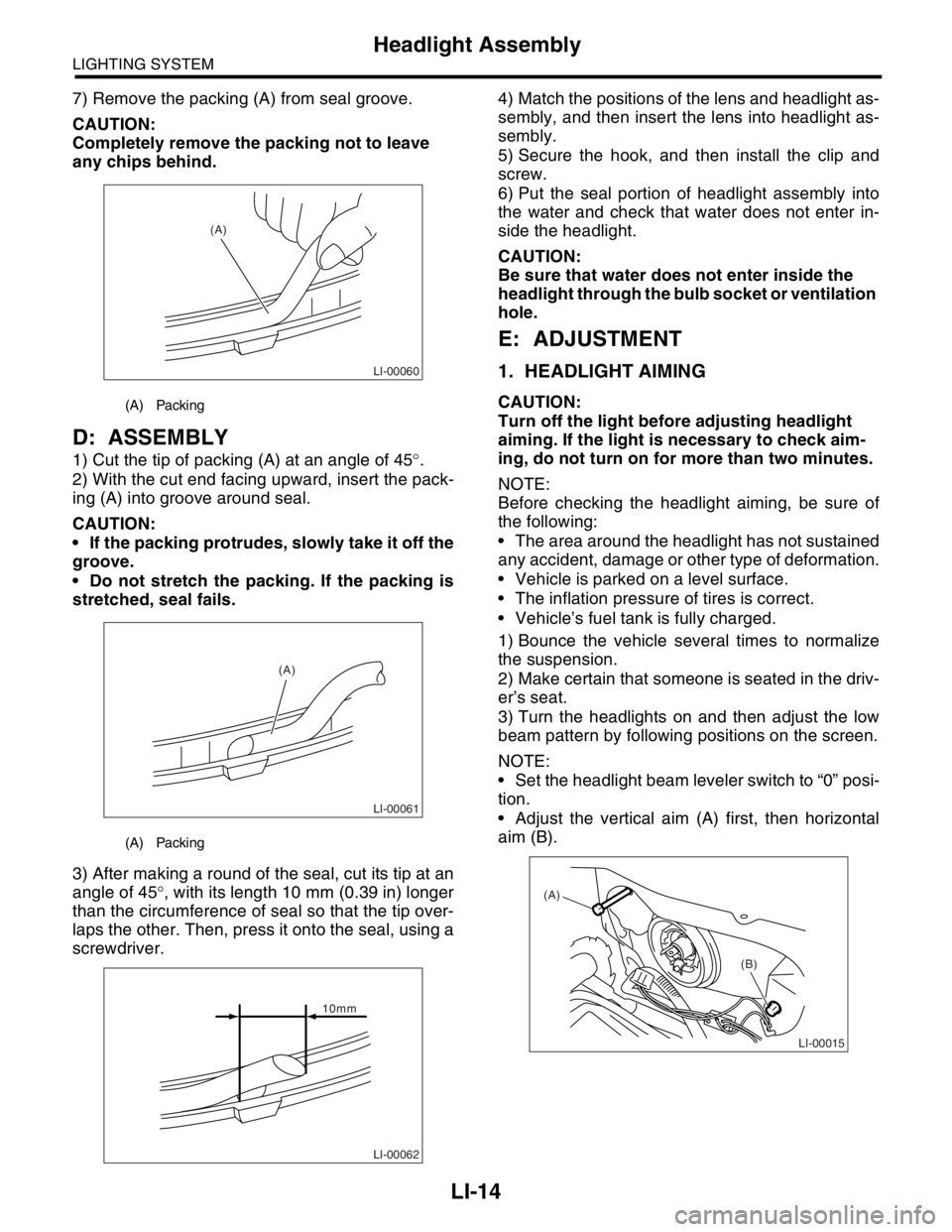
7) Remove the packing (A) from seal groove.
CAUTION:
Completely remove the packing not to leave
any chips behind.
D: ASSEMBLY
1) Cut the tip of packing (A) at an angle of 45°.
2) With the cut end facing upward, insert the pack-
ing (A) into groove around seal.
CAUTION:
If the packing protrudes, slowly take it off the
groove.
Do not stretch the packing. If the packing is
stretched, seal fails.
3) After making a round of the seal, cut its tip at an
angle of 45°, with its length 10 mm (0.39 in) longer
than the circumference of seal so that the tip over-
laps the other. Then, press it onto the seal, using a
screwdriver.4) Match the positions of the lens and headlight as-
sembly, and then insert the lens into headlight as-
sembly.
5) Secure the hook, and then install the clip and
screw.
6) Put the seal portion of headlight assembly into
the water and check that water does not enter in-
side the headlight.
CAUTION:
Be sure that water does not enter inside the
headlight through the bulb socket or ventilation
hole.
E: ADJUSTMENT
1. HEADLIGHT AIMING
CAUTION:
Turn off the light before adjusting headlight
aiming. If the light is necessary to check aim-
ing, do not turn on for more than two minutes.
NOTE:
Before checking the headlight aiming, be sure of
the following:
The area around the headlight has not sustained
any accident, damage or other type of deformation.
Vehicle is parked on a level surface.
The inflation pressure of tires is correct.
Vehicle’s fuel tank is fully charged.
1) Bounce the vehicle several times to normalize
the suspension.
2) Make certain that someone is seated in the driv-
er’s seat.
3) Turn the headlights on and then adjust the low
beam pattern by following positions on the screen.
NOTE:
Set the headlight beam leveler switch to “0” posi-
tion.
Adjust the vertical aim (A) first, then horizontal
aim (B).(A) Packing
(A) Packing
LI-00060
(A)
LI-00061
(A)
LI-00062
10mm
LI-00015
(A)
(B)