ESP SUBARU FORESTER 2004 Service Owner's Manual
[x] Cancel search | Manufacturer: SUBARU, Model Year: 2004, Model line: FORESTER, Model: SUBARU FORESTER 2004Pages: 2870, PDF Size: 38.67 MB
Page 703 of 2870

NT-2
NOTE
Note
1. Note
A: NOTE
This is information that can improve efficiency of
maintenance and assure sound work.
1. FASTENER NOTICE
Fasteners are used to prevent parts from damage
and dislocation due to looseness. Fasteners must
be tightened to the specified torque.
Do not apply paint, lubricant, rust retardant, or oth-
er substances to the surface around bolts, fasten-
ers, etc. Doing so will make it difficult to obtain the
correct torque and result in looseness and other
problems.
2. STATIC ELECTRICITY DAMAGE
Do not touch the control unit, connectors, logic
boards, and other such parts when there is a risk of
static electricity. Always use a static electricity pre-
vention cord or touch grounded metal before con-
ducting work.
3. BATTERY
When removing the battery cables, always be sure
to turn the ignition switch off to prevent electrical
damage to the control unit from rush current.
4. SERVICE PARTS
Use authentic service parts for maximum perfor-
mance and maintenance, when conducting repairs.
Subaru/FHI will not be responsible for poor perfor-
mance resulting from the use of parts not specified
by a genuine dealer.
5. PROTECTING VEHICLE UNDER MAIN-
TENANCE
Make sure to attach the fender cover, seat covers,
etc. before work.
6. ENSURING SAFETY DURING WORK
When working in a group of two or more, perform
the work with calling each other to ensure mutual
safety.
Page 704 of 2870
NT-3
NOTE
Note
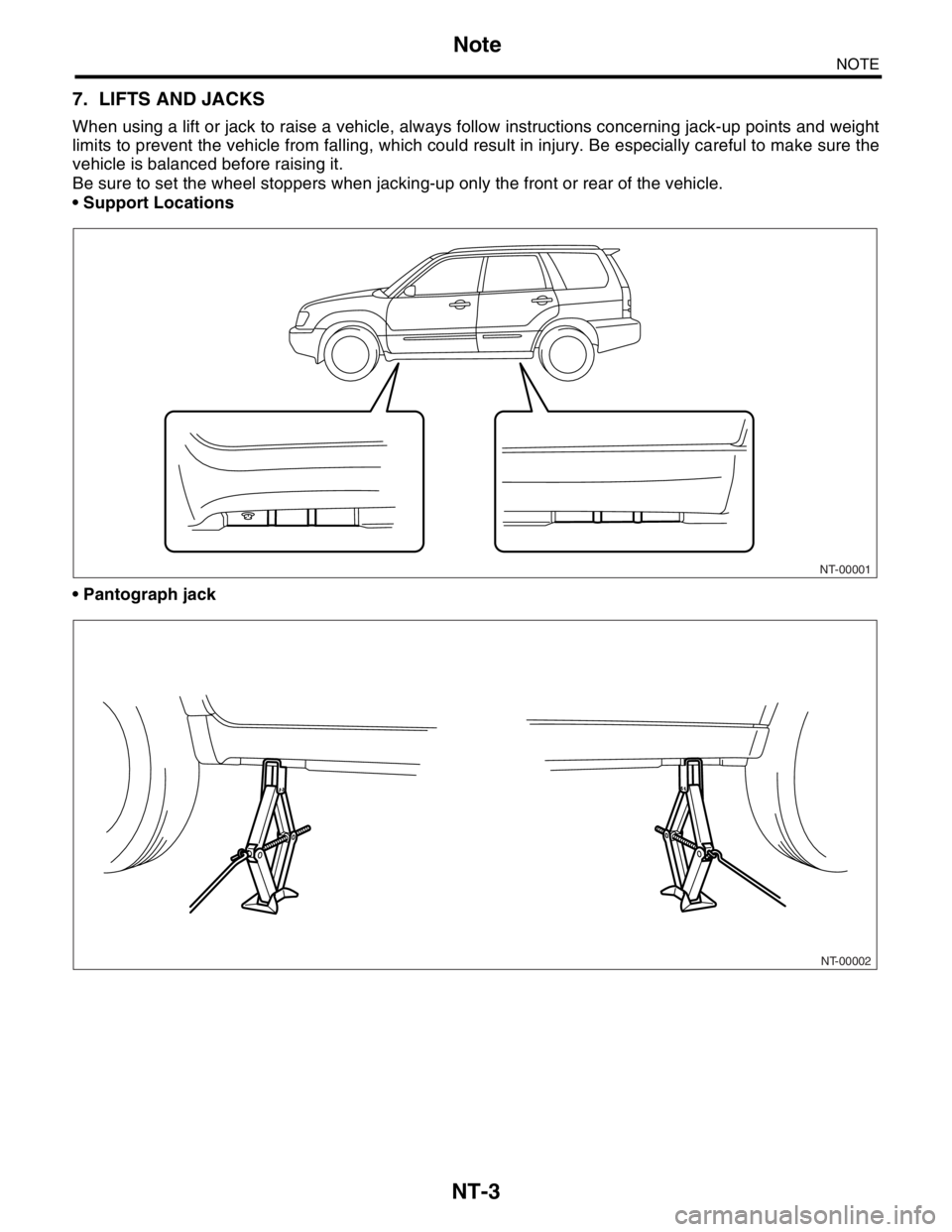
7. LIFTS AND JACKS
When using a lift or jack to raise a vehicle, always follow instructions concerning jack-up points and weight
limits to prevent the vehicle from falling, which could result in injury. Be especially careful to make sure the
vehicle is balanced before raising it.
Be sure to set the wheel stoppers when jacking-up only the front or rear of the vehicle.
• Support Locations
Pantograph jack
NT-00001
NT-00002
Page 714 of 2870

ID-5
IDENTIFICATION
Identification
3. MODEL NUMBER PLATE
The model number plate indicates: the applied model, the option code, the trim code, the engine type, the
transmission type, and the exterior color code. This information is helpful when placing orders for parts.
SG5BL1K
The engine and transmission type are as follows:
Engine
EJ201NWTAA
Digits Code Meaning Details
1 S Series S: FORESTER
2 G Body type G: Wagon
3 5 Engine displacement
Drive system
Suspension system5: 2.0 L AWD
9: 2.5 L AWD
4 B Minor change B: 2004MY
5 L Destination K: RHD (Right-hand drive)
L: LHD (Left-hand drive)
6 1 Grade 1: 2.0X
3: HUNTER Ver
5: 2.0XT
7: 2.5X
B: 2.5XT
7 K Transmission, fuel feed
systemR: SOHC MPI 4-speed AT
K: SOHC MPI Full-time AWD 5-speed MT Dual range
D: DOHC Turbo Full-time AWD 5-speed MT
P: DOHC Turbo 4-speed AT
T: DOHC Turbo 4-speed D-AT
Digits Code Meaning Details
1 and 2 EJ Engine type EJ: 4 cylinders
3 and 4 20 Displacement 20: 2.0L
25: 2.5L
5 1 Fuel feed system 1: D-MPI SOHC-A
5: L-MPI Turbo
6 N Emission control M: Unleaded non-STEP-III
N: Unleaded STEP-III
7 W Transmission W: MT
Y: MT (Response to CO
2 emission control)
X: AT
V: AT (Response to CO
2 emission control)
8 T Minor change T: 2004MY
9 to 10 AA Detailed specifications Used when ordering parts. See the parts catalog for details.
Page 725 of 2870

PI-2
PRE-DELIVERY INSPECTION
Pre-delivery Inspection
1. Pre-delivery Inspection
A: GENERAL
The purposes of the pre-delivery inspection (PDI)
are as follows.
Remove the additional parts used for ensuring
the vehicle quality during transportation and restore
the vehicle to its normal state.
Check if the vehicle before delivery is in a normal
state.
Check for any damage or missing parts that may
have taken place during transportation or storage.
Make sure to deliver a complete vehicle to the
customer.
Because of the above reasons, all SUBARU distrib-
utor service must always carry out the PDIs before
delivering a vehicle.
In addition, all SUBARU distributor service and PDI
centers must check the status of every vehicle re-
ceived to identify who is responsible for any possi-
ble defects.
Page 758 of 2870
PM-21
PERIODIC MAINTENANCE SERVICE
Engine Coolant
12.Engine Coolant
A: REPLACEMENT
1. REPLACEMENT OF ENGINE COOLANT
WARNING:
The radiator is of the pressurized type. Do not
attempt to open the radiator cap immediately
after the engine has been stopped.
1) Lift-up the vehicle.
2) Remove the under cover.
3) Place a container under drain pipe.
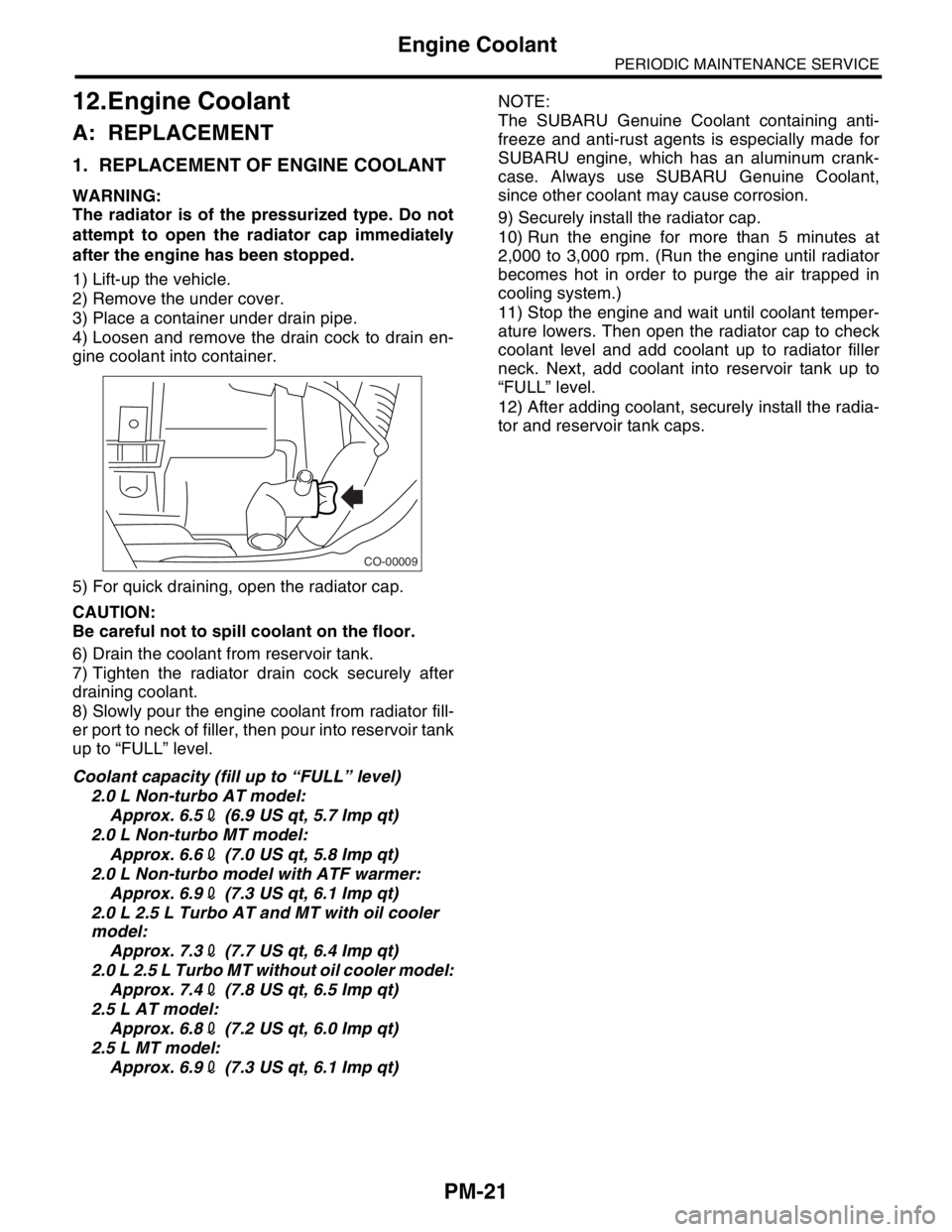
4) Loosen and remove the drain cock to drain en-
gine coolant into container.
5) For quick draining, open the radiator cap.
CAUTION:
Be careful not to spill coolant on the floor.
6) Drain the coolant from reservoir tank.
7) Tighten the radiator drain cock securely after
draining coolant.
8) Slowly pour the engine coolant from radiator fill-
er port to neck of filler, then pour into reservoir tank
up to “FULL” level.
Coolant capacity (fill up to “FULL” level)
2.0 L Non-turbo AT model:
Approx. 6.52 (6.9 US qt, 5.7 Imp qt)
2.0 L Non-turbo MT model:
Approx. 6.62 (7.0 US qt, 5.8 Imp qt)
2.0 L Non-turbo model with ATF warmer:
Approx. 6.92 (7.3 US qt, 6.1 Imp qt)
2.0 L 2.5 L Turbo AT and MT with oil cooler
model:
Approx. 7.32 (7.7 US qt, 6.4 Imp qt)
2.0 L 2.5 L Turbo MT without oil cooler model:
Approx. 7.42 (7.8 US qt, 6.5 Imp qt)
2.5 L AT model:
Approx. 6.82 (7.2 US qt, 6.0 Imp qt)
2.5 L MT model:
Approx. 6.92 (7.3 US qt, 6.1 Imp qt)NOTE:
The SUBARU Genuine Coolant containing anti-
freeze and anti-rust agents is especially made for
SUBARU engine, which has an aluminum crank-
case. Always use SUBARU Genuine Coolant,
since other coolant may cause corrosion.
9) Securely install the radiator cap.
10) Run the engine for more than 5 minutes at
2,000 to 3,000 rpm. (Run the engine until radiator
becomes hot in order to purge the air trapped in
cooling system.)
11) Stop the engine and wait until coolant temper-
ature lowers. Then open the radiator cap to check
coolant level and add coolant up to radiator filler
neck. Next, add coolant into reservoir tank up to
“FULL” level.
12) After adding coolant, securely install the radia-
tor and reservoir tank caps.
CO-00009
Page 774 of 2870

PM-37
PERIODIC MAINTENANCE SERVICE
Suspension
4. WHEEL ALIGNMENT OF FRONT SUS-
PENSION
1) Check the alignment of front suspension to en-
sure that following items conform to standard val-
ues.
Toe-in
Camber angle
Caster angle
Steering angle
2) When the caster angle does not conform to ref-
erence, visually inspect the following components
and replace deformed parts.
Suspension components [Strut assembly, cross-
member, transverse link, etc.]
Body parts to which suspensions are installed.
3) When the toe-in and camber are out of standard
value, adjust them so that they conform to respec-
tive service standard.
ment.>
4) When the right-and-left turning angles of tire are
out of standard, adjust to standard value.
Alignment.>
5. WHEEL ALIGNMENT OF REAR SUS-
PENSION
1) Check the alignment of rear suspension to en-
sure that following items are within standard val-
ues.
Toe-in
Camber angle
Thrust angle
2) When the camber angle does not conform to ref-
erence, visually inspect parts listed below. If defor-
mation is observed, replace the damaged parts.
Suspension components [Shock absorber, front
lateral links, rear lateral links, trailing link, etc.]
Body parts to which suspensions are installed.
3) When the toe-in and thrust angle are out of stan-
dard value, adjust them so that they conform to re-
spective service standard.
ment.>
6. OIL LEAKAGE OF STRUT
Visually inspect the front strut and rear strut for oil
leakage as instructed. If oil leakage reaches under
spring seat lower portion, replace the front strut and
rear strut.
7. TIGHTNESS OF BOLTS AND NUTS
Check the bolts and nuts shown in the figure for
looseness. Retighten the bolts and nuts to speci-
fied torque. If the self-lock nuts and bolts are re-
moved, replace them with new ones.
Front suspension:
Rear suspension:
8. DAMAGE TO SUSPENSION PARTS
Check the following parts and the fastening portion
of the vehicle body for deformation or excessive
rusting which impairs the suspension. Remove the
contaminations on spring seat lower portion with
care because dirt, sand, etc. tend to accumulate on
it. If necessary, replace the damaged parts with
new ones. If minor rust formation, pitting, etc. are
noted, remove the rust and apply remedial anti-cor-
rosion measures.
Front suspension
Transverse link
Crossmember
Strut
Rear suspension
Crossmember
Lateral links
Trailing link
Strut
In the district where salt is sprayed to melt snow
on a road in winter, check suspension parts for
damage caused by rust every 12 months after
lapse of 60 months. Take rust prevention measure
as required.
Page 780 of 2870
PM-43
PERIODIC MAINTENANCE SERVICE
Steering System (Power Steering)
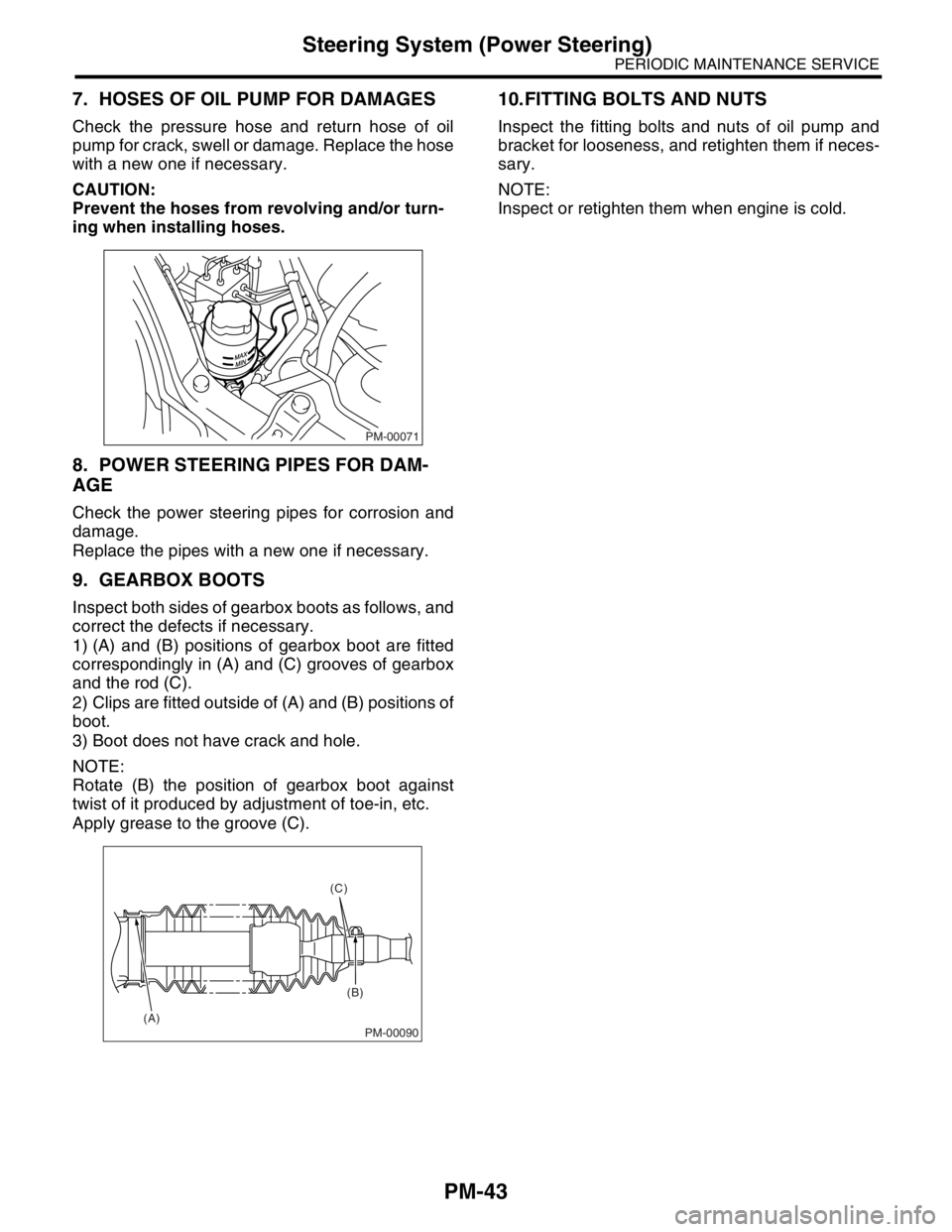
7. HOSES OF OIL PUMP FOR DAMAGES
Check the pressure hose and return hose of oil
pump for crack, swell or damage. Replace the hose
with a new one if necessary.
CAUTION:
Prevent the hoses from revolving and/or turn-
ing when installing hoses.
8. POWER STEERING PIPES FOR DAM-
AGE
Check the power steering pipes for corrosion and
damage.
Replace the pipes with a new one if necessary.
9. GEARBOX BOOTS
Inspect both sides of gearbox boots as follows, and
correct the defects if necessary.
1) (A) and (B) positions of gearbox boot are fitted
correspondingly in (A) and (C) grooves of gearbox
and the rod (C).
2) Clips are fitted outside of (A) and (B) positions of
boot.
3) Boot does not have crack and hole.
NOTE:
Rotate (B) the position of gearbox boot against
twist of it produced by adjustment of toe-in, etc.
Apply grease to the groove (C).
10.FITTING BOLTS AND NUTS
Inspect the fitting bolts and nuts of oil pump and
bracket for looseness, and retighten them if neces-
sary.
NOTE:
Inspect or retighten them when engine is cold.
PM-00071
PM-00090
(C)
(B)
(A)
Page 848 of 2870

FU(H4SO)-66
FUEL INJECTION (FUEL SYSTEM)
Fuel System Trouble in General
29.Fuel System Trouble in General
A: INSPECTION
NOTE:
When the vehicle is left unattended for an ex-
tended period of time, water may accumulate in the
fuel tank.
To prevent water condensation.
(1) Top off the fuel tank or drain the fuel com-
pletely.
(2) Drain the water condensation from the fuel
filter.
Refilling the fuel tank.
Refill the fuel tank while there is still some fuel left in
the tank.
Protecting the fuel system against freezing and
water condensation.
(3) Cold areas :
In snow-covered areas, mountainous areas, ski-
ing areas, etc. where ambient temperatures
drop below 0°C (32°F) throughout the winter
season, use an anti-freeze solution in the fuel
tank. Refueling will also complement the effect
of anti-freeze solution each time the fuel leveldrops to about one-half. After the winter season,
drain the water which may have accumulated in
the fuel filter and fuel tank in the manner same
as that described under “Affected areas” below.
(4) Affected areas :
When the water condensation is notched in the
fuel filter, drain the water from both the fuel filter
and fuel tank or use a water removing agent (or
anti-freeze solution) in the fuel tank.
Observe the instructions, notes, etc., indicated
on the label affixed to the anti-freeze solution (wa-
ter removing agent) container before use.
Trouble and possible cause Corrective action
1. Insufficient fuel supply to the injector
1) Fuel pump will not operate.
❍Defective terminal contact.Inspect connections, especially ground, and tighten
securely.
❍Trouble in electromagnetic or electronic circuit parts. Replace fuel pump.
2) Lowering of fuel pump function. Replace fuel pump.
3) Clogged dust or water in the fuel filter. Replace fuel filter, clean or replace fuel tank.
4) Clogged or bent fuel pipe or hose. Clean, correct or replace fuel pipe or hose.
5) Air is mixed in the fuel system. Inspect or retighten each connection part.
6) Clogged or bent breather tube or pipe. Clean, correct or replace air breather tube or pipe.
7) Damaged diaphragm of pressure regulator. Replace.
2. Leakage or blow out fuel
1) Loosened joints of the fuel pipe. Retightening.
2) Cracked fuel pipe, hose and fuel tank. Replace.
3) Defective welding part on the fuel tank. Replace.
4) Defective drain packing of the fuel tank. Replace.
5) Clogged or bent air breather tube or air vent tube.Clean, correct or replace air breather tube or air vent
tube.
3. Gasoline smell inside of compartment
1)Loose joints at air breather tube, air vent tube and fuel filler
pipe.Retightening.
2) Defective packing air tightness on the fuel saucer. Correct or replace packing.
3) Cracked fuel separator. Replace separator.
4) Inoperative fuel pump modulator or circuit. Replace.
4. Defective fuel meter indicator
1) Defective operation of fuel level sensor. Replace.
2) Defective operation of fuel meter. Replace.
5. Noise
1) Large operation noise or vibration of fuel pump. Replace.
Page 900 of 2870
ME(H4SO)-31
MECHANICAL
Valve Clearance
8. Valve Clearance
A: INSPECTION
NOTE:
Inspection and adjustment of the valve clearance
should be performed while engine is cold.
1) Set the vehicle on a lift.
2) Lift-up the vehicle.
3) Remove the under cover.
4) Lower the vehicle.
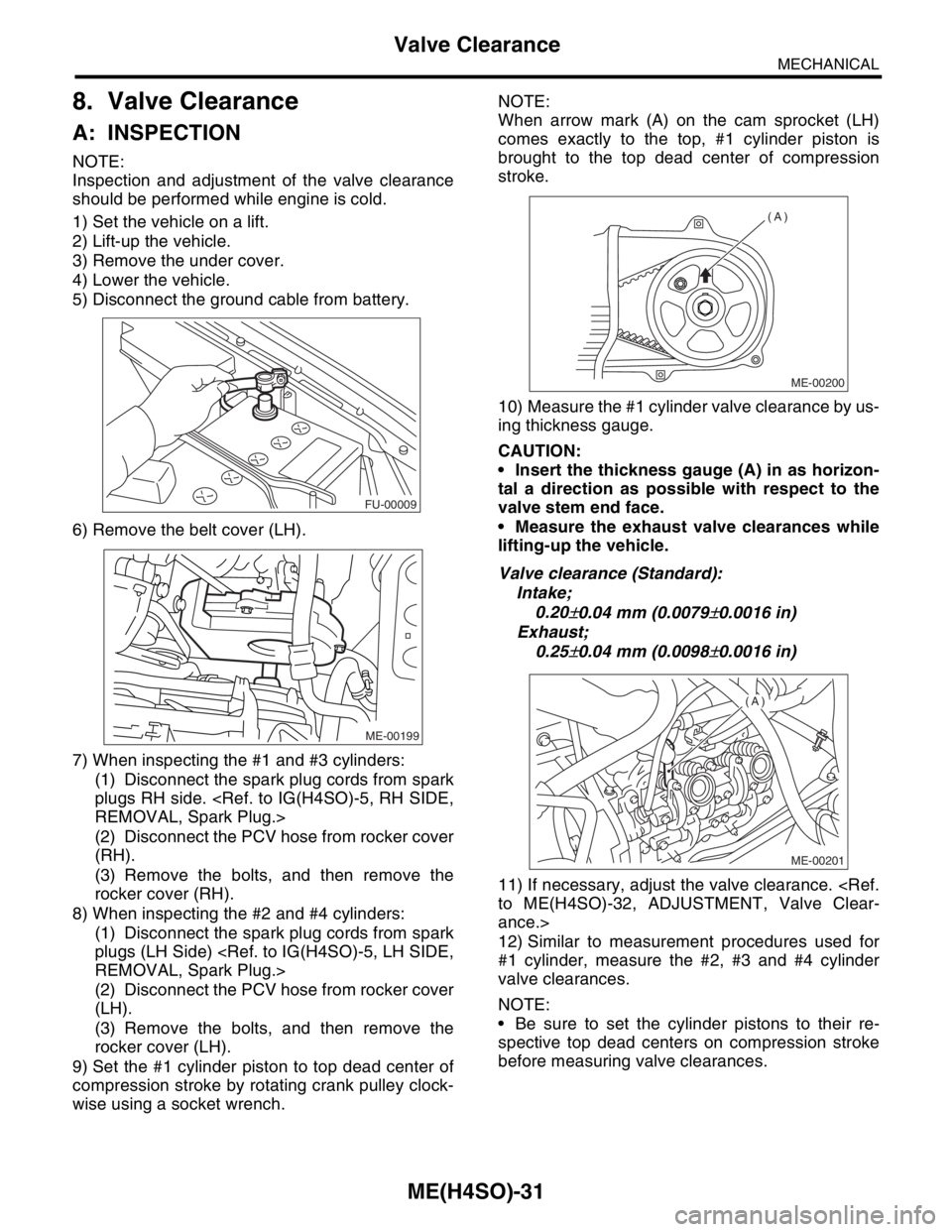
5) Disconnect the ground cable from battery.
6) Remove the belt cover (LH).
7) When inspecting the #1 and #3 cylinders:
(1) Disconnect the spark plug cords from spark
plugs RH side.
(2) Disconnect the PCV hose from rocker cover
(RH).
(3) Remove the bolts, and then remove the
rocker cover (RH).
8) When inspecting the #2 and #4 cylinders:
(1) Disconnect the spark plug cords from spark
plugs (LH Side)
(2) Disconnect the PCV hose from rocker cover
(LH).
(3) Remove the bolts, and then remove the
rocker cover (LH).
9) Set the #1 cylinder piston to top dead center of
compression stroke by rotating crank pulley clock-
wise using a socket wrench.NOTE:
When arrow mark (A) on the cam sprocket (LH)
comes exactly to the top, #1 cylinder piston is
brought to the top dead center of compression
stroke.
10) Measure the #1 cylinder valve clearance by us-
ing thickness gauge.
CAUTION:
Insert the thickness gauge (A) in as horizon-
tal a direction as possible with respect to the
valve stem end face.
Measure the exhaust valve clearances while
lifting-up the vehicle.
Valve clearance (Standard):
Intake;
0.20
±0.04 mm (0.0079±0.0016 in)
Exhaust;
0.25
±0.04 mm (0.0098±0.0016 in)
11) If necessary, adjust the valve clearance.
ance.>
12) Similar to measurement procedures used for
#1 cylinder, measure the #2, #3 and #4 cylinder
valve clearances.
NOTE:
Be sure to set the cylinder pistons to their re-
spective top dead centers on compression stroke
before measuring valve clearances.
FU-00009
ME-00199
ME-00200
(A)
ME-00201
(A)
Page 901 of 2870
ME(H4SO)-32
MECHANICAL
Valve Clearance
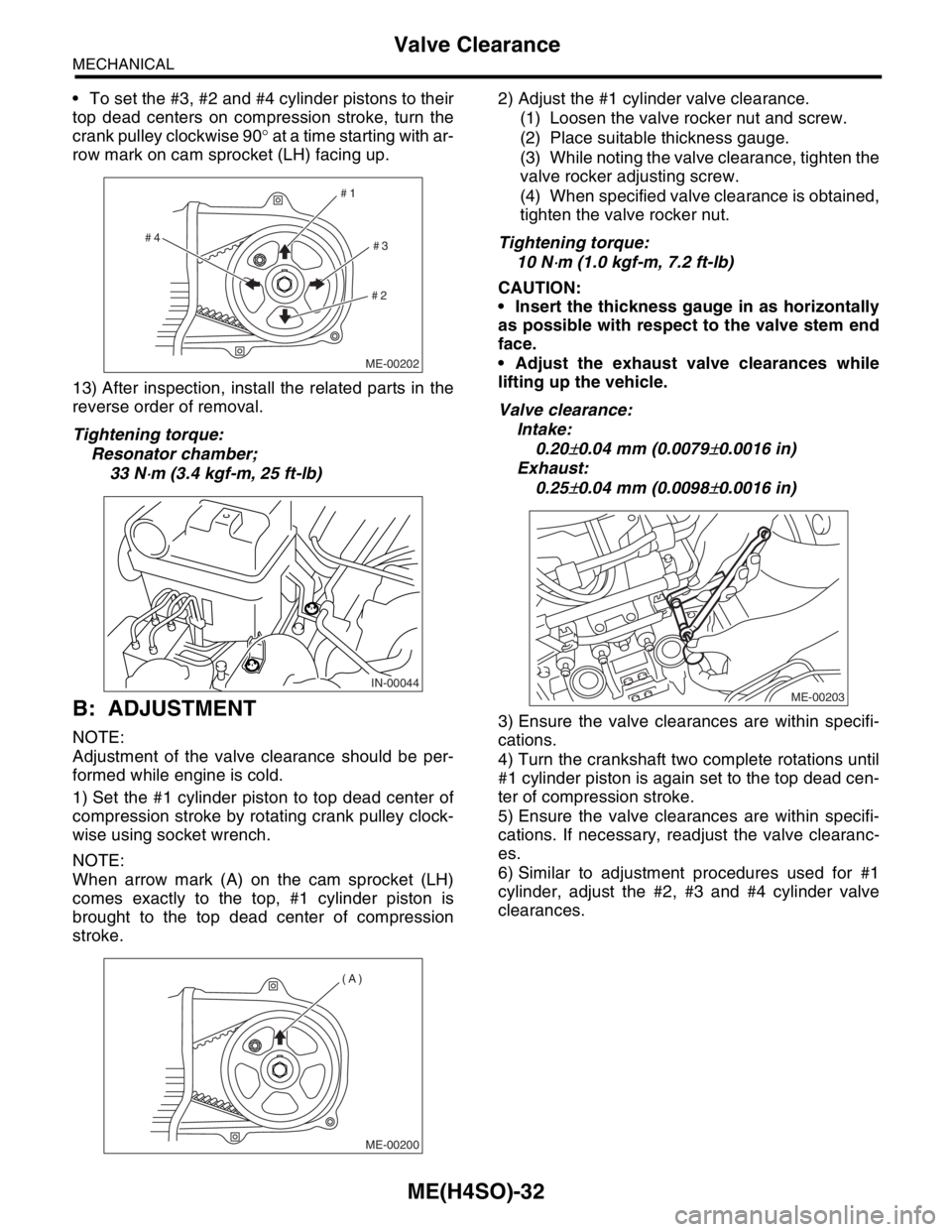
To set the #3, #2 and #4 cylinder pistons to their
top dead centers on compression stroke, turn the
crank pulley clockwise 90° at a time starting with ar-
row mark on cam sprocket (LH) facing up.
13) After inspection, install the related parts in the
reverse order of removal.
Tightening torque:
Resonator chamber;
33 N
⋅m (3.4 kgf-m, 25 ft-lb)
B: ADJUSTMENT
NOTE:
Adjustment of the valve clearance should be per-
formed while engine is cold.
1) Set the #1 cylinder piston to top dead center of
compression stroke by rotating crank pulley clock-
wise using socket wrench.
NOTE:
When arrow mark (A) on the cam sprocket (LH)
comes exactly to the top, #1 cylinder piston is
brought to the top dead center of compression
stroke.2) Adjust the #1 cylinder valve clearance.
(1) Loosen the valve rocker nut and screw.
(2) Place suitable thickness gauge.
(3) While noting the valve clearance, tighten the
valve rocker adjusting screw.
(4) When specified valve clearance is obtained,
tighten the valve rocker nut.
Tightening torque:
10 N
⋅m (1.0 kgf-m, 7.2 ft-lb)
CAUTION:
Insert the thickness gauge in as horizontally
as possible with respect to the valve stem end
face.
Adjust the exhaust valve clearances while
lifting up the vehicle.
Valve clearance:
Intake:
0.20
±0.04 mm (0.0079±0.0016 in)
Exhaust:
0.25
±0.04 mm (0.0098±0.0016 in)
3) Ensure the valve clearances are within specifi-
cations.
4) Turn the crankshaft two complete rotations until
#1 cylinder piston is again set to the top dead cen-
ter of compression stroke.
5) Ensure the valve clearances are within specifi-
cations. If necessary, readjust the valve clearanc-
es.
6) Similar to adjustment procedures used for #1
cylinder, adjust the #2, #3 and #4 cylinder valve
clearances.
ME-00202
#1
#2#3 #4
IN-00044
ME-00200
(A)
ME-00203