check engine light SUBARU FORESTER 2004 Service Workshop Manual
[x] Cancel search | Manufacturer: SUBARU, Model Year: 2004, Model line: FORESTER, Model: SUBARU FORESTER 2004Pages: 2870, PDF Size: 38.67 MB
Page 1305 of 2870

EN(H4SO)-207
ENGINE (DIAGNOSTIC)
Diagnostic Procedure with Diagnostic Trouble Code (DTC)
Step Check Yes No
1 CHECK OPERATION OF BRAKE LIGHT.Does the brake light come on
when depressing the brake
pedal?Go to step 2.Repair or replace
the brake light cir-
cuit.
2 CHECK HARNESS BETWEEN TCM AND
BRAKE LIGHT SWITCH CONNECTOR.
1) Disconnect the connectors from TCM and
brake light switch.
2) Measure the resistance of harness
between TCM and brake light switch connec-
tor.
Connector & terminal
WITHOUT CRUISE CONTROL
(B55) No. 12 — (B64) No. 2:
WITH CRUISE CONTROL
(B55) No. 12 — (B65) No. 3:Is the resistance less than 1
Ω?Go to step 3.Repair or replace
the harness and
connector.
N
OTE:
In this case repair
the following:
Open circuit in
harness between
TCM and brake
light switch con-
nector
Poor contact in
TCM connector
Poor contact in
brake light switch
connector
3 CHECK HARNESS BETWEEN TCM AND
BRAKE LIGHT SWITCH CONNECTOR.
Measure the resistance of harness between
TCM and chassis ground.
Connector & terminal
(B55) No. 12 — Chassis ground:Is the resistance more than 1
MΩ?Go to step 4.Repair ground
short circuit in har-
ness between
TCM and brake
light switch con-
nector.
4 CHECK INPUT SIGNAL FOR TCM.
1) Connect the connectors to TCM and brake
light switch.
2) Measure the voltage between TCM and
chassis ground.
Connector & terminal
(B55) No. 12 (+) — Chassis ground (
−):Is the voltage less than 1 V
when releasing the brake
pedal?Go to step 5.Adjust or replace
the brake light
switch.
SWITCH,
INSPECTION,
Stop Light Sys-
tem.>
5 CHECK INPUT SIGNAL FOR TCM.
Measure the voltage between TCM and chas-
sis ground.
Connector & terminal
(B55) No. 12 (+) — Chassis ground (
−):Is the voltage more than 10 V
when depressing the brake
pedal?Go to step 6.Adjust or replace
the brake light
switch.
SWITCH,
INSPECTION,
Stop Light Sys-
tem.>
6 CHECK POOR CONTACT.
Check poor contact in TCM connector.Is there poor contact in TCM
connector?Repair poor con-
tact in TCM con-
nector.Replace the TCM.
trol Module
(TCM).>
Page 1308 of 2870

EN(H4SO)-210
ENGINE (DIAGNOSTIC)
Diagnostic Procedure with Diagnostic Trouble Code (DTC)
BK:DTC P0741 TORQUE CONVERTER CLUTCH CIRCUIT PERFORMANCE OR
STUCK OFF
DTC DETECTING CONDITION:
Two consecutive driving cycles with fault
TROUBLE SYMPTOM:
No lock-up (after engine warm-up)
No shift or excessive tight corner “braking”
CAUTION:
After repair or replacement of faulty parts, conduct Clear Memory Mode
Step Check Yes No
1 CHECK ANY OTHER DTC ON DISPLAY.Is any other DTC displayed? Inspect the rele-
vant DTC using
“List of Diagnostic
Trouble Code
(DTC)”.
of Diagnostic Trou-
ble Code (DTC).>Go to step 2.
2 CHECK LOCK-UP DUTY SOLENOID CIR-
CUIT.
Check lock-up duty solenoid circuit.
SOLENOID, Diagnostic Procedure with Diag-
nostic Trouble Code (DTC).>Is there any trouble in lock-up
duty solenoid circuit?Repair or replace
the lock-up duty
solenoid circuit.Go to step 3.
3 CHECK THROTTLE POSITION SENSOR
CIRCUIT.
Check the throttle position sensor circuit.
TION SENSOR, Diagnostic Procedure with
Diagnostic Trouble Code (DTC).>Is there any trouble in throttle
position sensor circuit?Repair or replace
the throttle posi-
tion sensor circuit.Go to step 4.
4 CHECK TORQUE CONVERTER TURBINE
SPEED SENSOR CIRCUIT.
Check torque converter turbine speed sensor
circuit.
SENSOR, Diagnostic Procedure with Diagnos-
tic Trouble Code (DTC).>Is there any trouble in torque
converter turbine speed sensor
circuit?Repair or replace
the torque con-
ver ter turbine
speed sensor cir-
cuit.Go to step 5.
5 CHECK ENGINE SPEED INPUT CIRCUIT.
Check engine speed input circuit.
NAL, Diagnostic Procedure with Diagnostic
Trouble Code (DTC).>Is there any trouble in engine
speed input circuit?Repair or replace
the engine speed
input circuit.Go to step 6.
6 CHECK INHIBITOR SWITCH CIRCUIT.
Check inhibitor switch circuit.
Diagnostic Procedure without Diagnostic Trou-
ble Code (DTC).>Is there any trouble in inhibitor
switch circuit?Repair or replace
the inhibitor switch
circuit.Go to step 7.
7 CHECK BRAKE LIGHT SWITCH CIRCUIT.
Check brake light switch circuit.
Diagnostic Procedure without Diagnostic Trou-
ble Code (DTC).>Is there any trouble in brake
light switch circuit?Repair or replace
the brake light
switch circuit.Go to step 8.
Page 1311 of 2870

EN(H4SO)-213
ENGINE (DIAGNOSTIC)
Diagnostic Procedure with Diagnostic Trouble Code (DTC)
Step Check Yes No
1 CHECK ANY OTHER DTC ON DISPLAY.Is DTC P0705 displayed? Inspect the DTC
using “List of Diag-
nostic Trouble
Code (DTC)”.
of Diagnostic Trou-
ble Code (DTC).>Go to step 2.
2 CHECK INPUT SIGNAL FROM ECM.
1) Turn the ignition switch to ON.
2) Shift the select lever to other than “N” and
“P” ranges.
3) Measure the voltage between ECM and
chassis ground.
Connector & terminal
(B136) No. 21 (+) — Chassis ground (
−):Is the voltage more than 10 V? Even if the mal-
function indicator
light illuminates,
the circuit has
returned to a nor-
mal condition at
this time.Go to step 3.
3 CHECK HARNESS BETWEEN ECM AND
TRANSMISSION HARNESS CONNECTOR.
1) Turn the ignition switch to OFF.
2) Disconnect the connectors from ECM and
transmission harness connector (T3).
3) Measure the resistance of harness
between ECM connector and chassis ground.
Connector & terminal
(B136) No. 21 — Chassis ground:Is the resistance more than 1
MΩ?Go to step 4.Repair ground
short circuit in har-
ness between
ECM and trans-
mission harness
connector.
4 CHECK TRANSMISSION HARNESS CON-
NECTOR.
1) Disconnect the connector from inhibitor
switch.
2) Measure the resistance of harness
between transmission harness connector and
engine ground.
Connector & terminal
(T3) No. 12 — Engine ground:Is the resistance more than 1
MΩ?Go to step 5.Repair ground
short circuit in har-
ness between
transmission har-
ness and inhibitor
switch connector.
5 CHECK INHIBITOR SWITCH.
Measure the resistance between inhibitor
switch connector receptacle’s terminals with
select lever at other than “N” and “P” range.
Te r m i n a l s
No. 7 — No. 12:Is the resistance more than 1
MΩ?Go to step 6.Replace inhibitor
switch.
Switch.>
6 CHECK SELECTOR CABLE CONNECTION.Is there any fault in selector
cable connection to inhibitor
switch?Repair the select
cable connection.
Select Cable.>Contact the SUB-
ARU dealer.
N
OTE:
Inspection by DTM
is required, because
probable cause is
deterioration of mul-
tiple parts.
Page 1321 of 2870

EN(H4SO)-223
ENGINE (DIAGNOSTIC)
Diagnostic Procedure with Diagnostic Trouble Code (DTC)
Step Check Yes No
1 CHECK HARNESS BETWEEN ECM AND
TCM CONNECTOR.
1) Turn the ignition switch to ON.
2) Measure the voltage between ECM and
chassis ground.
Connector & terminal
(B134) No. 10 (+) — Chassis ground (
−):Is the voltage less than 1 V? Go to step 2.Even if the mal-
function indicator
light illuminates,
the circuit has
returned to a nor-
mal condition at
this time.
N
OTE:
In this case repair
the following:
Poor contact in
ECM connector.
Poor contact in
TCM connector
2 CHECK HARNESS BETWEEN ECM AND
TCM CONNECTOR.
1) Turn the ignition switch to OFF.
2) Disconnect the connector from ECM and
TCM.
3) Measure the resistance of harness
between ECM and chassis ground.
Connector & terminal
(B134) No. 10 — Chassis ground:Is the resistance more than 1
MΩ?Go to step 3.Repair ground
short circuit in har-
ness between
ECM and TCM
connector.
3 CHECK OUTPUT SIGNAL FROM ECM.
1) Connect the connector to ECM.
2) Turn the ignition switch to ON.
3) Measure the voltage between ECM and
chassis ground.
Connector & terminal
(B134) No. 10 (+) — Chassis ground (
−):Is the voltage more than 5 V? Go to step 4.Repair the poor
contact in ECM
connector.
4 CHECK DTC FOR AUTOMATIC TRANSMIS-
SION.
Read DTC for automatic transmission.
(DTC).>Does the DTC appear for auto-
matic transmission?Check the DTC for
automatic trans-
mission.
Diagnostic Proce-
dure with Diagnos-
tic Trouble Code
(DTC).>Replace the TCM.
trol Module
(TCM).>
Page 1323 of 2870

EN(H4SO)-225
ENGINE (DIAGNOSTIC)
Diagnostic Procedure with Diagnostic Trouble Code (DTC)
Step Check Yes No
1 CHECK HARNESS BETWEEN ECM AND
TCM CONNECTOR.
1) Turn the ignition switch to ON.
2) Measure the voltage between ECM and
chassis ground.
Connector & terminal
(B134) No. 10 (+) — Chassis ground (
−):Is the voltage more than 10 V? Repair battery
short circuit in har-
ness between
ECM and TCM
connector.Go to step 2.
2 CHECK HARNESS BETWEEN ECM AND
TCM CONNECTOR.
Measure the voltage between ECM connector
and chassis ground.
Connector & terminal
(B134) No. 10 (+) — Chassis ground (
−):Is the voltage more than 4 V? Go to step 5.Go to step 3.
3 CHECK HARNESS BETWEEN ECM AND
TCM CONNECTOR.
Measure the voltage between ECM connector
and chassis ground.
Connector & terminal
(B134) No. 10 (+) — Chassis ground (
−):Is the voltage less than 1 V? Repair the poor
contact in ECM
connector.Go to step 4.
4 CHECK OUTPUT SIGNAL FROM ECM.
Measure the voltage between ECM and chas-
sis ground.
Connector & terminal
(B134) No. 10 (+) — Chassis ground (
−):Is the voltage 1 — 4 V? Even if the mal-
function indicator
light illuminates,
the circuit has
returned to a nor-
mal condition at
this time.
N
OTE:
In this case repair
the following:
Poor contact in
ECM connector.
Poor contact in
TCM connectorContact the SUB-
ARU dealer.
NOTE:
Inspection by DTM
is required, because
probable cause is
deterioration of mul-
tiple parts.
5 CHECK HARNESS BETWEEN ECM AND
TCM CONNECTOR.
Measure the voltage between TCM and chas-
sis ground.
Connector & terminal
(B55) No. 17 (+) — Chassis ground (
−):Is the voltage more than 4 V? Go to step 6.Repair the open
circuit in harness
between ECM and
TCM connector.
6 CHECK POOR CONTACT.
Check poor contact in TCM connector.Is there poor contact in TCM
connector?Repair poor con-
tact in TCM con-
nector.Check TCM power
supply line and
grounding line.
Page 1488 of 2870

ME(H4DOTC)-32
MECHANICAL
Idle Speed
3. Idle Speed
A: INSPECTION
1. USING SUBARU SELECT MONITOR
1) Before checking the idle speed, check the fol-
lowing:
(1) Ensure the air cleaner element is free from
clogging, ignition timing is correct, spark plugs
are in good condition, and that the hoses are
connected properly.
(2) Ensure the malfunction indicator light does
not illuminate.
2) Warm-up the engine.
3) Stop the engine, and then turn the ignition switch
to OFF.
4) Insert the cartridge to Subaru Select Monitor.
5) Connect the Subaru Select Monitor to data link
connector.
6) Turn the ignition switch to ON, and Subaru Se-
lect Monitor switch to ON.
7) Select the {2. Each System Check} in Main
Menu.
8) Select the {Engine Control System} in Selection
Menu.
9) Select the {1. Current Data Display & Save} in
Engine Control System Diagnosis.
10) Select the {1.12 Data Display} in Data Display
Menu.
11) Start the engine, and then read the engine idle
speed.
12) Check the idle speed when unloaded. (With
headlights, heater fan, rear defroster, radiator fan,
air conditioning, etc. OFF)
Idle speed [No load and gears in neutral]:
700
±100 rpm
13) Check the idle speed when loaded. (Turn the
air conditioning switch to “ON” and operate the
compressor for at least 1 minute before measure-
ment.)
Idle speed [A/C “ON”, no load and gears in neu-
tral]:
A/C Refrigerant pressure (LOW)
MT: 725
±100 rpm
AT: 750
±100 rpm
A/C Refrigerant pressure (HIGH)
MT: 800
±100 rpm
AT: 825
±100 rpm
NOTE:
As idle speed is controlled by the automatic adjust-
ment type, it can not be adjusted manually. If the
idle speed is out of specifications, refer to General
On-board Diagnosis Table under “Engine Control
System”.
Page 1489 of 2870

ME(H4DOTC)-33
MECHANICAL
Ignition Timing
4. Ignition Timing
A: INSPECTION
1. USING SUBARU SELECT MONITOR
1) Before checking the ignition timing speed, check
the following:
(1) Ensure the air cleaner element is free from
clogging, spark plugs are in good condition, and
that hoses are connected properly.
(2) Ensure the malfunction indicator light does
not illuminate.
2) Warm-up the engine.
3) Stop the engine, and then turn the ignition switch
to OFF.
4) Insert the cartridge to Subaru Select Monitor.
5) Connect the Subaru Select Monitor to data link
connector.
6) Turn the ignition switch to ON, and Subaru Se-
lect Monitor switch to ON.
7) Select the {2. Each System Check} in Main
Menu.
8) Select the {Engine Control System} in Selection
Menu.
9) Select the {1. Current Data Display & Save} in
Engine Control System Diagnosis.
10) Select the {1.12 Data Display} in Data Display
Menu.
11) Start the engine and check the ignition timing at
idle speed.
Ignition timing [BTDC/rpm]:
2.0 L model
12
°±10°/700
2.5 L model
17
°±10°/700
If the timing is not correct, check the ignition control
system. Refer to Engine Control System.
Page 1491 of 2870
ME(H4DOTC)-35
MECHANICAL
Engine Oil Pressure
6. Engine Oil Pressure
A: INSPECTION
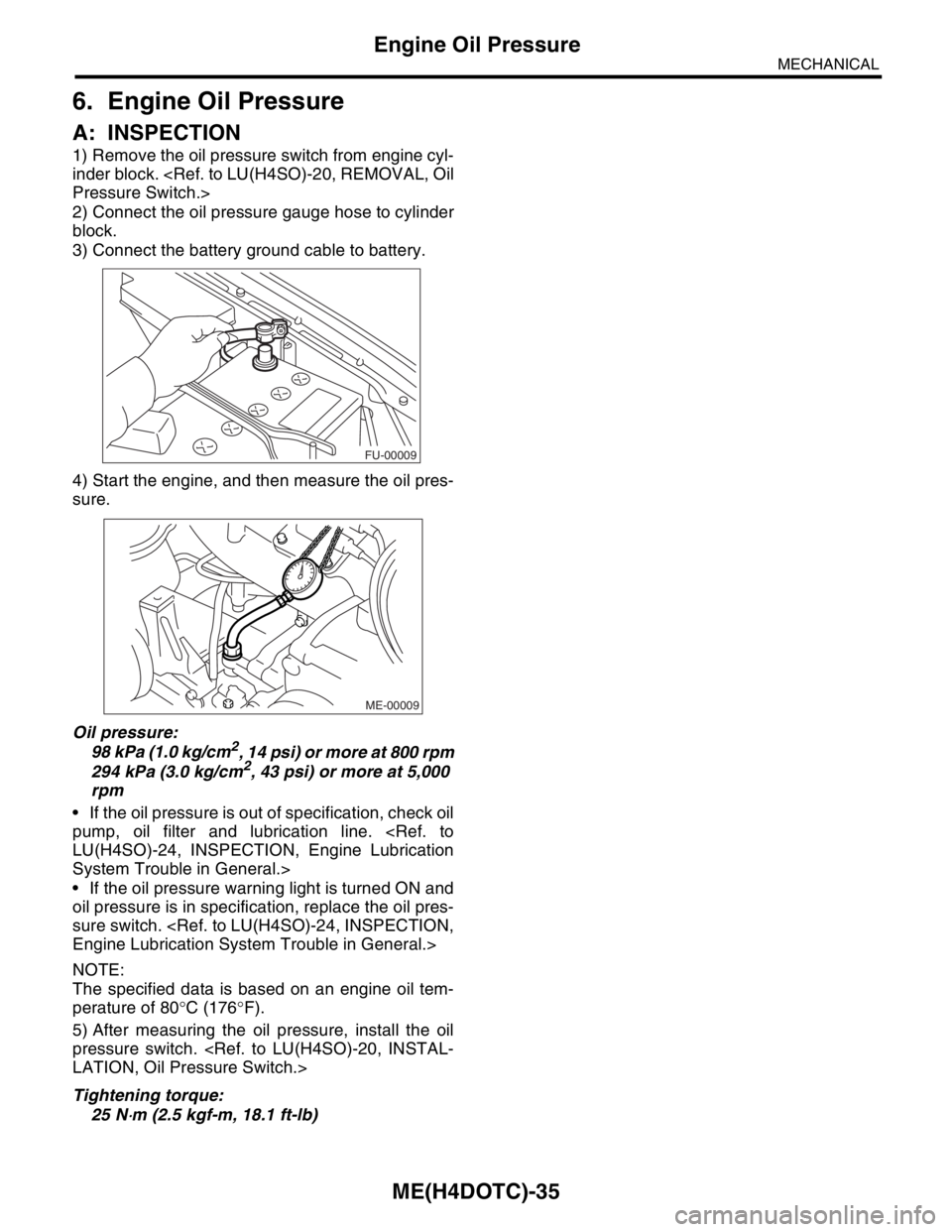
1) Remove the oil pressure switch from engine cyl-
inder block.
2) Connect the oil pressure gauge hose to cylinder
block.
3) Connect the battery ground cable to battery.
4) Start the engine, and then measure the oil pres-
sure.
Oil pressure:
98 kPa (1.0 kg/cm
2, 14 psi) or more at 800 rpm
294 kPa (3.0 kg/cm2, 43 psi) or more at 5,000
rpm
If the oil pressure is out of specification, check oil
pump, oil filter and lubrication line.
System Trouble in General.>
If the oil pressure warning light is turned ON and
oil pressure is in specification, replace the oil pres-
sure switch.
NOTE:
The specified data is based on an engine oil tem-
perature of 80°C (176°F).
5) After measuring the oil pressure, install the oil
pressure switch.
Tightening torque:
25 N
⋅m (2.5 kgf-m, 18.1 ft-lb)
FU-00009
ME-00009
Page 1503 of 2870
ME(H4DOTC)-45
MECHANICAL
Engine Assembly
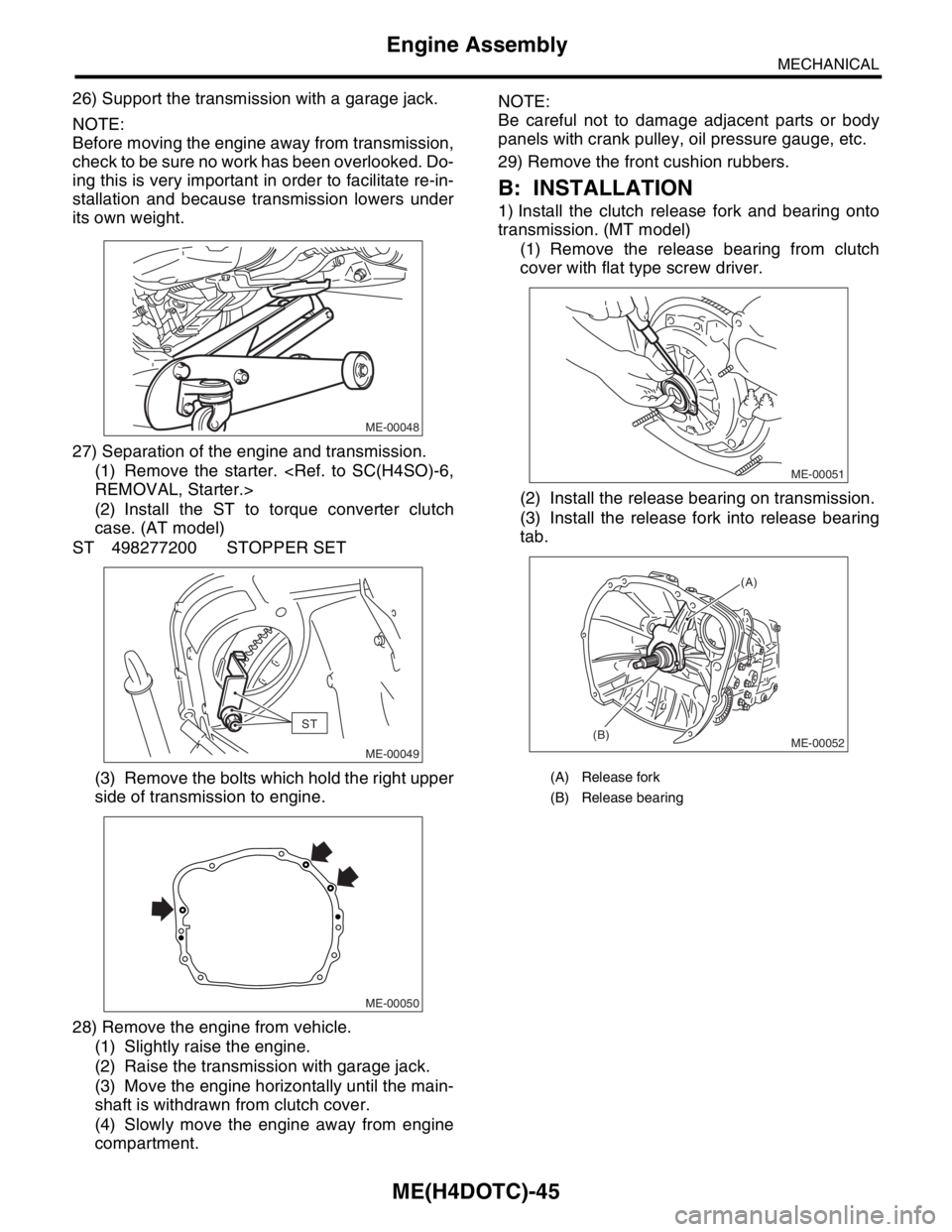
26) Support the transmission with a garage jack.
NOTE:
Before moving the engine away from transmission,
check to be sure no work has been overlooked. Do-
ing this is very important in order to facilitate re-in-
stallation and because transmission lowers under
its own weight.
27) Separation of the engine and transmission.
(1) Remove the starter.
(2) Install the ST to torque converter clutch
case. (AT model)
ST 498277200 STOPPER SET
(3) Remove the bolts which hold the right upper
side of transmission to engine.
28) Remove the engine from vehicle.
(1) Slightly raise the engine.
(2) Raise the transmission with garage jack.
(3) Move the engine horizontally until the main-
shaft is withdrawn from clutch cover.
(4) Slowly move the engine away from engine
compartment.NOTE:
Be careful not to damage adjacent parts or body
panels with crank pulley, oil pressure gauge, etc.
29) Remove the front cushion rubbers.
B: INSTALLATION
1) Install the clutch release fork and bearing onto
transmission. (MT model)
(1) Remove the release bearing from clutch
cover with flat type screw driver.
(2) Install the release bearing on transmission.
(3) Install the release fork into release bearing
tab.
ME-00048
ST
ME-00049
ME-00050
(A) Release fork
(B) Release bearing
ME-00051
ME-00052
(A)
(B)
Page 1536 of 2870
ME(H4DOTC)-78
MECHANICAL
Cylinder Head Assembly
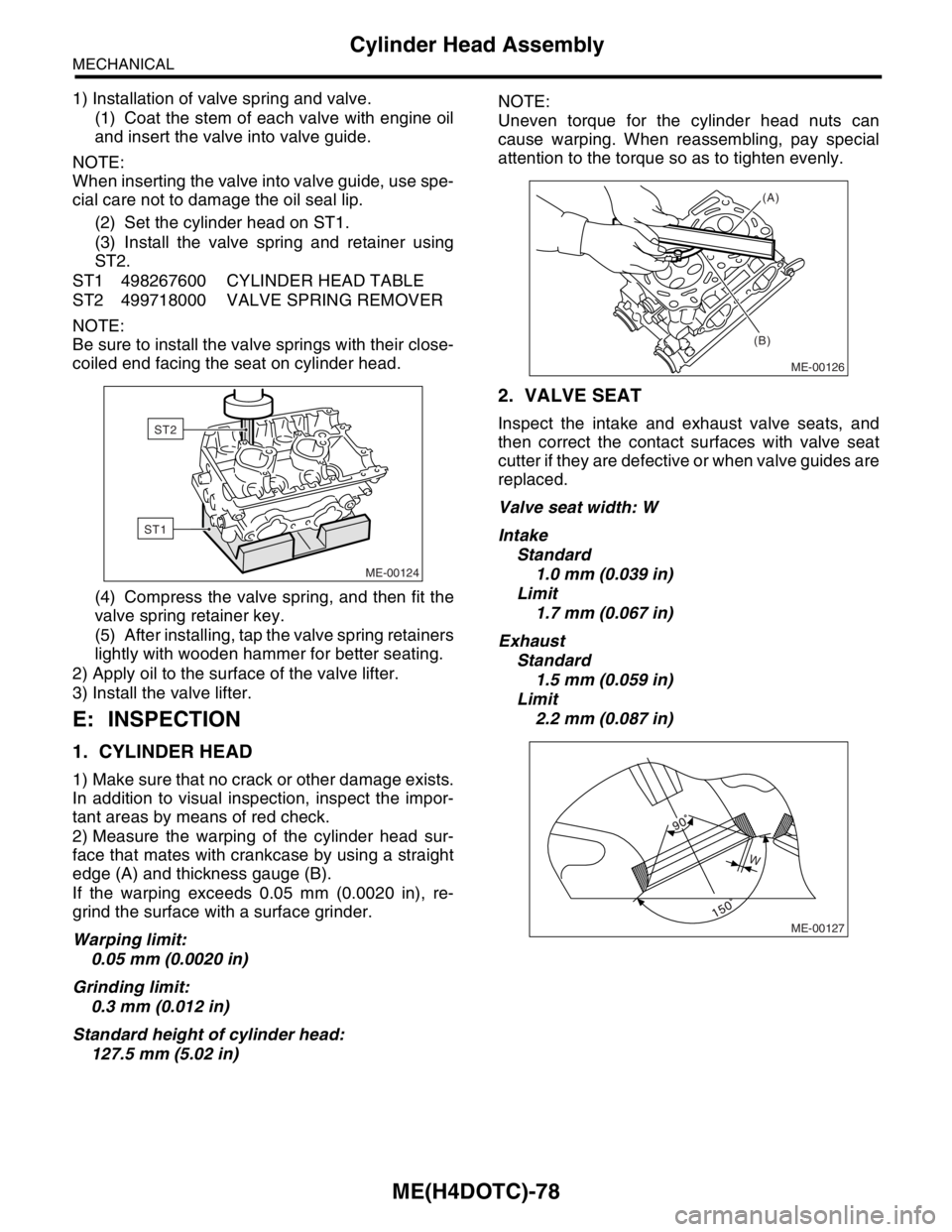
1) Installation of valve spring and valve.
(1) Coat the stem of each valve with engine oil
and insert the valve into valve guide.
NOTE:
When inserting the valve into valve guide, use spe-
cial care not to damage the oil seal lip.
(2) Set the cylinder head on ST1.
(3) Install the valve spring and retainer using
ST2.
ST1 498267600 CYLINDER HEAD TABLE
ST2 499718000 VALVE SPRING REMOVER
NOTE:
Be sure to install the valve springs with their close-
coiled end facing the seat on cylinder head.
(4) Compress the valve spring, and then fit the
valve spring retainer key.
(5) After installing, tap the valve spring retainers
lightly with wooden hammer for better seating.
2) Apply oil to the surface of the valve lifter.
3) Install the valve lifter.
E: INSPECTION
1. CYLINDER HEAD
1) Make sure that no crack or other damage exists.
In addition to visual inspection, inspect the impor-
tant areas by means of red check.
2) Measure the warping of the cylinder head sur-
face that mates with crankcase by using a straight
edge (A) and thickness gauge (B).
If the warping exceeds 0.05 mm (0.0020 in), re-
grind the surface with a surface grinder.
Warping limit:
0.05 mm (0.0020 in)
Grinding limit:
0.3 mm (0.012 in)
Standard height of cylinder head:
127.5 mm (5.02 in)NOTE:
Uneven torque for the cylinder head nuts can
cause warping. When reassembling, pay special
attention to the torque so as to tighten evenly.
2. VALVE SEAT
Inspect the intake and exhaust valve seats, and
then correct the contact surfaces with valve seat
cutter if they are defective or when valve guides are
replaced.
Valve seat width: W
Intake
Standard
1.0 mm (0.039 in)
Limit
1.7 mm (0.067 in)
Exhaust
Standard
1.5 mm (0.059 in)
Limit
2.2 mm (0.087 in)
ME-00124
ST1
ST2
ME-00126
(A)
(B)
ME-00127
W