heating SUBARU FORESTER 2010 SH / 3.G User Guide
[x] Cancel search | Manufacturer: SUBARU, Model Year: 2010, Model line: FORESTER, Model: SUBARU FORESTER 2010 SH / 3.GPages: 402, PDF Size: 14.36 MB
Page 218 of 402

Fuel...................................................................... 7-2
Fuel requirements ............................................... 7-2
Fuel filler lid and cap ........................................... 7-3
State emission testing (U.S. only) ...................... 7-6
Preparing to drive ............................................... 7-7
Starting the engine .............................................. 7-7
Manual transmission model ................................. 7-7
Automatic transmission model ............................ 7-8
Stopping the engine ............................................ 7-9
Remote engine start system (dealer option) ................................................. 7-10
Starting your vehicle .......................................... 7-10
Remote start safety features ............................... 7-10
Entering the vehicle while it is running via remote start ................................................................. 7-11
Entering the vehicle following remote engine start shutdown ......................................................... 7-11
Pre-heating or pre-cooling the interior of the vehicle ............................................................. 7-11
Service mode ..................................................... 7-11
Remote transmitter programming and programmable feature option ............................ 7-11
System maintenance .......................................... 7-12
Manual transmission .......................................... 7-14
Shifting speeds .................................................. 7-14
Driving tips ........................................................ 7-15
Automatic transmission ..................................... 7-15
Select lever ........................................................ 7-16
Shift lock function .............................................. 7-17
Selection of manual mode .................................. 7-19
Driving tips ........................................................ 7-20 SPORT mode
..................................................... 7-20
Power steering ................................................... 7-21
Braking ............................................................... 7-21
Braking tips ....................................................... 7-21
Brake system .................................................... 7-22
Disc brake pad wear warning indicators ............. 7-22
ABS (Anti-lock Brake System) .......................... 7-23
ABS system self-check ...................................... 7-23
ABS warning light .............................................. 7-23
Electronic Brake Force Distribution (EBD) system ............................................................. 7-24
Steps to take if EBD system malfunctions ..... ..... 7-25
Vehicle Dynamics Control system .................... 7-26
Vehicle Dynamics Control system monitor..... ..... 7-27
Vehicle Dynamics Control OFF switch ................ 7-29
Tire pressure monitoring system (TPMS) (U.S.-spec. models). ........................................ 7-30
Parking your vehicle ......................................... 7-31
Parking brake .................................................... 7-31
Parking tips ....................................................... 7-32
Hill start assist system (MT models) ................ 7-33
Hill start assist warning light .............................. 7-34
Cruise control .................................................... 7-34
To set cruise control .......................................... 7-35
To temporarily cancel the cruise control ............. 7-35
To turn off the cruise control .............................. 7-36
To change the cruising speed .. .......................... 7-36
Cruise control indicator light .............................. 7-37
Cruise control set indicator light ........................ 7-38
Starting and operating
7
Page 228 of 402

&Entering the vehicle while it
is running via remote start
1. Unlock the vehicle doors using the
keyless entry system. If the vehicle ’s
doors are unlocked manually using the
key, the vehicle ’s alarm system will trigger
and the remote engine start system will
turn off. Inserting the key into the ignition
switch and turning it to the “ON ”position or
pressing the unlock button “
”on the
remote keyless entry transmitter will dis-
arm the alarm system. Refer to “Alarm
system ”F 2-14.
2. Enter the vehicle. Do not depress the
brake pedal.
3. Insert the key into the ignition switch
and turn to the “ON ”position. If the ignition
switch is accidentally turned to the“ START ”position, the system ’s “starter
anti-grind ”feature will prevent the starter
from re-cranking.
4. Depress the brake pedal. The remote
starter disengages, the vehicle ’s power
window features are re-enabled and the
vehicle will operate normally.
& Entering the vehicle follow-
ing remote engine start shut-down
An alarm trigger may occur if the vehicle is
opened by the remote keyless entry transmitter within a few seconds immedi-
ately following remote engine start shut-down.
& Pre-heating or pre-cooling
the interior of the vehicle
Before exiting the vehicle, set the tem-
perature controls to the desired setting
and operation. After the system starts the
vehicle, the heater or air-conditioning will
activate and heat or cool the interior to
your setting. & Service mode
In service mode, the remote start function
is temporarily disabled to prevent the
system from unexpectedly starting the
engine while being serviced. ! To engage the service mode
Turn the ignition switch to the “ON ”
position, depress and hold the brake
pedal, then press and release the “
”
button on the remote control transmitter
three times. The system will pause for 1
second and then flash the turn signal
lights and honk the horn three times
indicating that the system is in service
mode. When attempting to activate the
remote start system while in service
mode, the turn signal lights will flash and
the horn will honk two times and will not start. !
To disengage the service mode
Turntheignitionswitchtothe “ON ”
position, depress and hold the brake
pedal, then press and release the “
”
button on the remote control transmitter
three times. The system will pause for 1
second and flash the turn signal lights 1
time indicating that the system has exited
service mode.
NOTE
When taking your vehicle in for service,
it is recommended that you inform the
service personnel that your vehicle is
equipped with a remote control startsystem. & Remote transmitter program-
ming and programmable fea-
ture option
New transmitters can be programmed to
the engine starter system in the event that
remote transmitters are lost, stolen or
damaged. The remote engine start system
also has one programmable feature that
can be adjusted for user preference.
The remote engine starter system can be
programmed to either make an audible
horn chirp upon remote start activation or
not. Remote transmitter programming and Starting and operating
7-11
– CONTINUED –
Page 238 of 402
Power steering
The power steering system operates only
when the engine is running.
If you lose power steering assist because
the engine stops or the system fails to
function, you can steer but it will take
much more effort.
CAUTION
Do not hold the steering wheel at the
fully locked position left or right for
more than 5 seconds. This may
damage the power steering pump.
NOTE
Right after the engine has been started
and before it has warmed up, you may
hear a noise coming from areas adja-
cent to the power steering pump which
is located at the right-front area of the
engine compartment. This noise is
normal. It does not indicate power
steering system trouble. Braking &
Braking tips
WARNING
Never rest your foot on the brake
pedal while driving. This can cause
dangerous overheating of the
brakes and needless wear on the
brake pads and linings.
! When the brakes get wet
When driving in rain or after washing the
vehicle, the brakes may get wet. As a
result, brake stopping distance will be
longer. To dry the brakes, drive the vehicle
at a safe speed while lightly depressing
the brake pedal to heat up the brakes. ! Use of engine braking
Remember to make use of engine braking
in addition to foot braking. When descend-
ing a grade, if only the foot brake is used,
the brakes may start working improperly
because of brake fluid overheating,
caused by overheated brake pads. To
help prevent this, shift into a lower gear to
get stronger engine braking. ! Braking when a tire is punctured
Do not depress the brake pedal suddenly
when a tire is punctured. This could cause a loss of control of the vehicle. Keep
driving straight ahead while gradually
reducing speed. Then slowly pull off the
road to a safe place. &
Brake system
! Two separate circuits
Your vehicle has two separate circuit
brake systems. Each circuit works diag-
onally across the vehicle. If one circuit of
the brake system should fail, the other half
of the system still works. If one circuit fails,
the brake pedal will go down much closer
to the floor than usual and you will need to
press it down much harder. And a much
longer distance will be needed to stop thevehicle. ! Brake booster
The brake booster uses engine manifold
vacuum to assist braking force. Do not
turn off the engine while driving because
that will turn off the brake booster, result-
ing in poor braking power.
The brakes will continue to work even
when the brake booster completely stops
functioning. If this happens, however, you
will have to push the pedal much harder
than normal and the braking distance willincrease. Starting and operating
7-21
– CONTINUED –
Page 279 of 402

8-24Driving tips
nificant blind spot.
. Sufficient time should be taken to learn
the “feel ”of the vehicle/trailer combination
before starting out on a trip. In an area free
of traffic, practice turning, stopping and
backing up. ! Driving with a trailer
. You should allow for considerably more
stopping distance when towing a trailer.
Avoid sudden braking because it may
result in skidding or jackknifing and loss ofcontrol. . Avoid abrupt starts and sudden accel-
erations. If your vehicle has a manual
transmission, always start out in first gear
and release the clutch at moderate enginerevolution. . Avoid uneven steering, sharp turns and
rapid lane changes.. Slow down before turning. Make a
longer than normal turning radius because
the trailer wheels will be closer than the
vehicle wheels to the inside of the turn. In
a tight turn, the trailer could hit yourvehicle. . Crosswinds will adversely affect the
handling of your vehicle and trailer, caus-
ing sway. Crosswinds can be due to
weather conditions or the passing of large
trucks or buses. If swaying occurs, firmly
grip the steering wheel and slow down immediately but gradually. .
When passing other vehicles, consid-
erable distance is required because of the
added weight and length caused by
attaching the trailer to your vehicle.
1) Left turn
2) Right turn
. Backing up with a trailer is difficult and
takes practice. When backing up with a
trailer, never accelerate or steer rapidly.
When turning back, grip the bottom of the
steering wheel with one hand and turn it to
the left for a left turn, and turn it to the right
for a right turn. . If the ABS warning light illuminates
while the vehicle is in motion, stop towing
the trailer and have repairs performed
immediately by the nearest SUBARU
dealer. !
Driving on grades
. Before going down a steep hill, slow
down and shift into lower gear (if neces-
sary, use 1st gear) in order to utilize the
engine braking effect and prevent over-
heating of your vehicle ’s brakes. Do not
make sudden downshifts. . When driving uphill in hot weather, the
air conditioner may turn off automatically
to protect the engine from overheating. . When driving uphill in hot weather, pay
attention to the coolant temperature high
warning light (for all models) and AT OIL
TEMP warning light (for AT models)
because the engine and transmission are
relatively prone to overheating under
these conditions. If the coolant tempera-
ture high warning light or the AT OIL TEMP
warning light illuminates, immediately turn
off the air conditioner and stop the vehicle
in the nearest safe location. For further
instructions and additional information,
refer to the following sections.
–“If you park your vehicle in case of
an emergency ”F 9-2
–“ Engine overheating ”F 9-12
–“ Coolant temperature low indicator
light/Coolant temperature high warn-
ing light ”F 3-13
–“ AT OIL TEMP warning light (AT
models) ”F 3-14
. If your vehicle has an automatic trans-
Page 282 of 402

If you park your vehicle in case of anemergency ........................................................ 9-2
Temporary spare tire (if equipped) .................... 9-2
Precautions for AWD models with automatic transmission ..................................................... 9-3
Maintenance tools ............................................... 9-4
Tool bag. ............................................................. 9-4
Under the cargo area ........................................... 9-5
Flat tires ............................................................... 9-6
Changing a flat tire .............................................. 9-6
Tire pressure monitoring system (TPMS) (U.S.-spec. models) ........................................... 9-9
Jump starting ..................................................... 9-10
How to jump start ............................................... 9-10 Engine overheating
........................................... 9-12
If steam is coming from the engine compartment ................................................... 9-12
If no steam is coming from the engine compartment ................................................... 9-12
Towing ................................................................ 9-12
Towing and tie-down hooks. ............................... 9-13
Using a flat-bed truck. ........................................ 9-15
Towing with all wheels on the ground ................. 9-16
Rear gate –if the rear gate cannot be
opened ............................................................. 9-17
Moonroof –if the moonroof cannot be
closed .............................................................. 9-17 In case of emergency
9
Page 293 of 402
9-12In case of emergency
Engine overheating
WARNING
Never attempt to remove the radia-
tor cap until the engine has been
shut off and has fully cooled down.
When the engine is hot, the coolant
is under pressure. Removing the
cap while the engine is still hot
could release a spray of boiling hot
coolant, which could burn you very
seriously.
If the engine overheats, safely pull off the
road and stop the vehicle in a safe place. & If steam is coming from the
engine compartment
Turn off the engine and get everyone
away from the vehicle until it cools down. & If no steam is coming from
the engine compartment
1. Keep the engine running at idling speed.
2. Open the hood to ventilate the engine compartment.
Confirm that the cooling fan is turning. If
the fan is not turning, immediately turn off the engine and contact your authorized
dealer for repair.
3. After the engine coolant temperature
has dropped, turn off the engine.
If the coolant temperature high warning
light illuminates, turn off the engine.
4. After the engine has fully cooled down,
check the coolant level in the reservetank.
If the coolant level is below the
“LOW ”
mark, add coolant up to the “FULL ”mark.
5. If there is no coolant in the reserve
tank, add coolant to the reserve tank.
Then remove the radiator cap and fill the
radiator with coolant.
If you remove the radiator cap from a hot
radiator, first wrap a thick cloth around the
radiator cap, then turn the cap counter-
clockwise slowly without pressing down
until it stops. Release the pressure from
the radiator. After the pressure has been
fully released, remove the cap by pressing
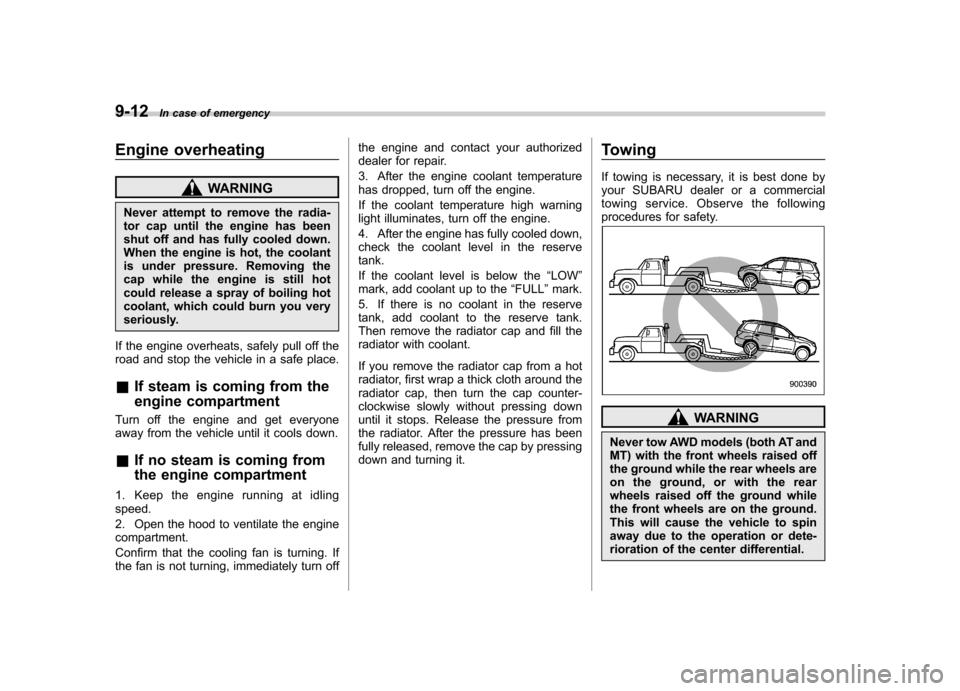
down and turning it. Towing
If towing is necessary, it is best done by
your SUBARU dealer or a commercial
towing service. Observe the following
procedures for safety.
WARNING
Never tow AWD models (both AT and
MT) with the front wheels raised off
the ground while the rear wheels are
on the ground, or with the rear
wheels raised off the ground while
the front wheels are on the ground.
This will cause the vehicle to spin
away due to the operation or dete-
rioration of the center differential.
Page 394 of 402

Oil........................................................................ 11-8 Overheating.......................................................... 9-12
Starting ................................................................... 7-7
Stopping ................................................................. 7-9
Exterior care .............................................................. 10-2
F
Flat tires ..................................................................... 9-6
Floor mat .................................................................. 6-12
Fluid level
Automatic transmission .......................................... 11-20
Brake .................................................................. 11-24
Clutch .................................................................. 11-25
Power steering ..................................................... 11-23
Fog light Indicator light ......................................................... 3-21
Switch .................................................................. 3-28
Folding mirror switch .................................................. 3-40
Front
Differential gear oil ................................................ 11-21
Fog light ............................................................... 3-28
Fog light indicator light ............................................ 3-21
Seatbelt pretensioners ............................................ 1-20
Turn signal light .................................................... 11-49
Front seats .................................................................. 1-2
Forward and backward adjustment ............................. 1-3
Head restraint adjustment ......................................... 1-5
Power seat .............................................................. 1-4
Reclining ................................................................. 1-3
Seat height adjustment (driver ’s seat) ......................... 1-4 Fuel
........................................................................... 7-2
Consumption indicator ............................................. 3-22
Economy hints ........................................................ 8-2
Filler lid and cap ...................................................... 7-3
Gauge .................................................................... 3-8
Requirements ......................................................... 7-2
Fuses ..................................................................... 11-44
Main fuse ............................................................ 11-45
Fuses and circuits ...................................................... 12-6
G
GAWR (Gross Axle Weight Rating) .. ............................. 8-13
Glove box ................................................................... 6-5
GVWR (Gross Vehicle Weight Rating) ........................... 8-13
H
Hazard warning flasher .......................................... 3-5, 9-2
Head restraint adjustment
Front seat ............................................................... 1-5
Rear seat ............................................................... 1-8
Headlight
Beam lever ............................................................ 3-27
Bulb replacing ...................................................... 11-46
Bulb wattage ........................................................ 12-10
Control switch ........................................................ 3-25
Flasher .................................................................. 3-26
Indicator light ......................................................... 3-21
Heater operation (manual climate control system) ... ......... 4-5
High beam indicator light ............................................. 3-21
High/low beam change (dimmer) .................................. 3-26
Hill start assist (MT models) ............................... 7-33, 11-28Index
14-5
Page 396 of 402

Low fuel warning light........................................... 3-8, 3-18
Low tire pressure warning light .................................... 3-15
Lower and tether anchorage ........................................ 1-30
M
Main fuse ................................................................. 11-45
Maintenance Precautions ........................................................... 11-3
Schedule .............................................................. 11-3
Seatbelt ................................................................ 1-20
Tools ...................................................................... 9-4
Malfunction indicator lamp (check engine warning light) ..................................... 3-12
Manual Climate control system ............................................. 4-3
Seat ....................................................................... 1-3
Transmission ......................................................... 7-14
Transmission oil .................................................... 11-19
Map light ........................................................... 6-3, 11-50
Maximum load limits ................................................... 8-18
Meters and gauges ...................................................... 3-5
Mirror defogger .......................................................... 3-40
Mirrors ...................................................................... 3-32
Moonroof .......................................................... 2-23, 9-17
N
New vehicle break-in driving .......................................... 8-2
O
Odometer/Trip meter .................................................... 3-6
Oil filter ..................................................................... 11-9 Oil level
Engine .................................................................. 11-8
Front differential gear ............................................ 11-21
Manual transmission ............................................. 11-19
Rear differential gear ............................................ 11-22
Oil pressure warning light ............................................ 3-14
On-pavement and off-road driving .................................. 8-6
Outside Mirror defogger ...................................................... 3-40
Mirrors .................................................................. 3-39
Temperature indicator .............................................. 3-23
Overhead console ....................................................... 6-7
Overheating engine .................................................... 9-12
PParking Brake .................................................................... 7-31
Brake stroke ........................................................ 11-29
Tips ...................................................................... 7-32
Periodic inspections ..................................................... 8-4
Petrol fuel ................................................................... 7-2
Power Door locking switch .................................................. 2-6
Outside mirrors ...................................................... 3-40
Seat ....................................................................... 1-4
Steering ................................................................ 7-21
Steering fluid ........................................................ 11-23
Windows ............................................................... 2-20
Precautions against vehicle modification ................ 1-23, 1-61
Preparing to drive ........................................................ 7-7 Index
14-7