roof SUBARU FORESTER 2013 SH / 3.G Owner's Manual
[x] Cancel search | Manufacturer: SUBARU, Model Year: 2013, Model line: FORESTER, Model: SUBARU FORESTER 2013 SH / 3.GPages: 436, PDF Size: 15.3 MB
Page 300 of 436
.Do not place anything on the
extended cargo area cover. Such
items could tumble forward in the
event of a sudden stop or a
collision. This could cause ser-
ious injury.
CAUTION
Do not carry spray cans, containers
with flammable or corrosive liquids
or any other dangerous items inside
the vehicle.
NOTE
For better fuel economy, do not carry
unneeded cargo. &
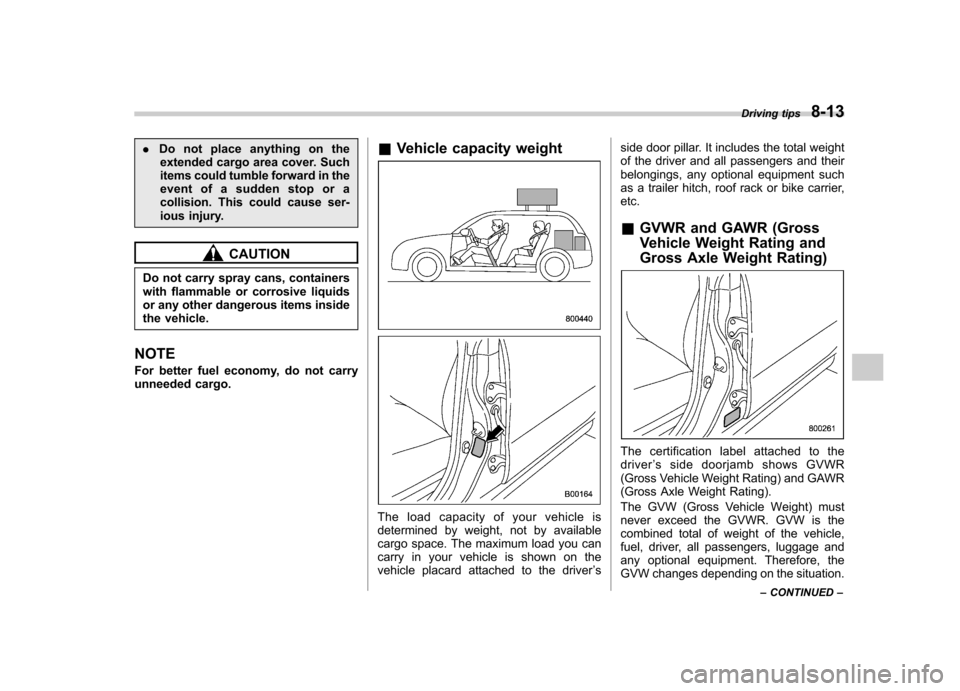
Vehicle capacity weight
The load capacity of your vehicle is
determined by weight, not by available
cargo space. The maximum load you can
carry in your vehicle is shown on the
vehicle placard attached to the driver ’s side door pillar. It includes the total weight
of the driver and all passengers and their
belongings, any optional equipment such
as a trailer hitch, roof rack or bike carrier,etc. &
GVWR and GAWR (Gross
Vehicle Weight Rating and
Gross Axle Weight Rating)
The certification label attached to the driver ’s side doorjamb shows GVWR
(Gross Vehicle Weight Rating) and GAWR
(Gross Axle Weight Rating).
The GVW (Gross Vehicle Weight) must
never exceed the GVWR. GVW is the
combined total of weight of the vehicle,
fuel, driver, all passengers, luggage and
any optional equipment. Therefore, the
GVW changes depending on the situation. Driving tips
8-13
– CONTINUED –
Page 301 of 436

8-14Driving tips
The GVWR equals Curb Weight (actual
weight of your vehicle –including standard
equipment, fluids, emergency tools and
spare tire assembly) plus the vehicle
capacity weight.
In addition, the total weight applied to
each axle (GAW) must never exceed the
GAWR. The front and rear GAWs can be
adjusted by relocating luggage inside thevehicle.
Even if the total weight of your luggage is
lower than the vehicle capacity weight,
either front or rear GAW may exceed the
GAWR, depending on the distribution of
the luggage.
When possible, the load should be evenly
distributed throughout the vehicle.
If you carry heavy loads in the vehicle, you
should confirm that GVW and front and
rear GAWs are within the GVWR and
GAWR by putting your vehicle on a
vehicle scale, found at a commercial
weighing station.
Do not use replacement tires with a lower
load range than the originals because they
may lower the GVWR and GAWR limita-
tions. Replacement tires with a higher load
range than the originals do not increase
the GVWR and GAWR limitations. &
Roof rails (if equipped)
1) Roof rack
Luggage can be carried on the roof after
securing the roof rack to the roof rails.
When installing the roof rack on the roof
rails, follow the manufacturer ’s instruc-
tions. The roof rails are designed to carry
loads (luggage and roof rack) of not morethan 150 lbs (68 kg) .
CAUTION
. When using the roof rack, make
sure that the total carrying load
of the roof rack and luggage does
not exceed 150 lbs (68 kg). Over-
loading may cause damage to
the vehicle.
. For cargo carrying purposes, the roof rails must be used together
with the roof rack and any appro-
priate carrying attachment that
may be needed. The roof rails
must never be used alone to
carry cargo. Otherwise, damage
to the roof or paint or a danger-
ous road hazard due to loss of
cargo could result.
NOTE
Remember that the vehicle ’s center of
gravity is altered with the weight of the
load on the roof, thus affecting drivingcharacteristics.
Drive carefully. Avoid rapid starts, hard
cornering and abrupt stops. Crosswind
effects will be increased.
Page 302 of 436

&Roof molding and crossbar
(if equipped)
CAUTION
. For cargo carrying purposes, the
roof molding must never be used
alone to carry cargo. Otherwise,
damage to the roof or paint or a
dangerous road hazard due to
loss of cargo could result.
. When using the roof crossbar kit,
make sure that the total weight of
the crossbars, carrying attach-
ment and cargo does not exceed
the maximum load limit. Over-
loading may cause damage to
the vehicle and create a safetyhazard. Cargo can be carried after securing the
roof crossbar kit to the roof moldings and
installing the appropriate carrying attach-
ment. When installing the roof crossbar
kit, follow the manufacturer
’s instructions.
When you carry cargo on the roof using
the roof crossbar kit and a carrying
attachment, never exceed the maximum
load limit as explained below. You should
also be careful that your vehicle does not
exceed the Gross Vehicle Weight Rating
(GVWR) and front and rear Gross Axle
Weight Rating (GAWR). For information
about loading cargo into or onto your
vehicle, refer to “Loading your vehicle ”
F 8-12. The maximum load limit of the
cargo, crossbars and carrying attachment
must not exceed 176 lbs (80 kg). Place
the heaviest load at the bottom, nearest
the roof, and evenly distribute the cargo.
Always properly secure all cargo. !
Installing carrying attachments on
the crossbars
When installing any carrying attachment
such as a bike carrier, ski carrier, kayak
carrier, cargo basket, etc. on the cross-
bars, follow the manufacturer ’s instruc-
tions and make sure that the attachment is
securely fixed to the crossbars. Use only
attachments designed specifically for the
crossbars. A set of the crossbars is
designed to carry loads (cargo and attach-
ment) of not more than 165 lbs (75 kg).
Before operating the vehicle, make sure
that the cargo is properly secured on theattachment.
NOTE
Remember that the vehicle ’s center of
gravity is altered with the weight of the
load on the roof, thus affecting the
driving characteristics.
Drive carefully. Avoid rapid starts, hard
cornering and abrupt stops. Crosswind
effects will be increased. Driving tips
8-15
– CONTINUED –
Page 303 of 436
8-16Driving tips
!Removal and installation of the crossbars
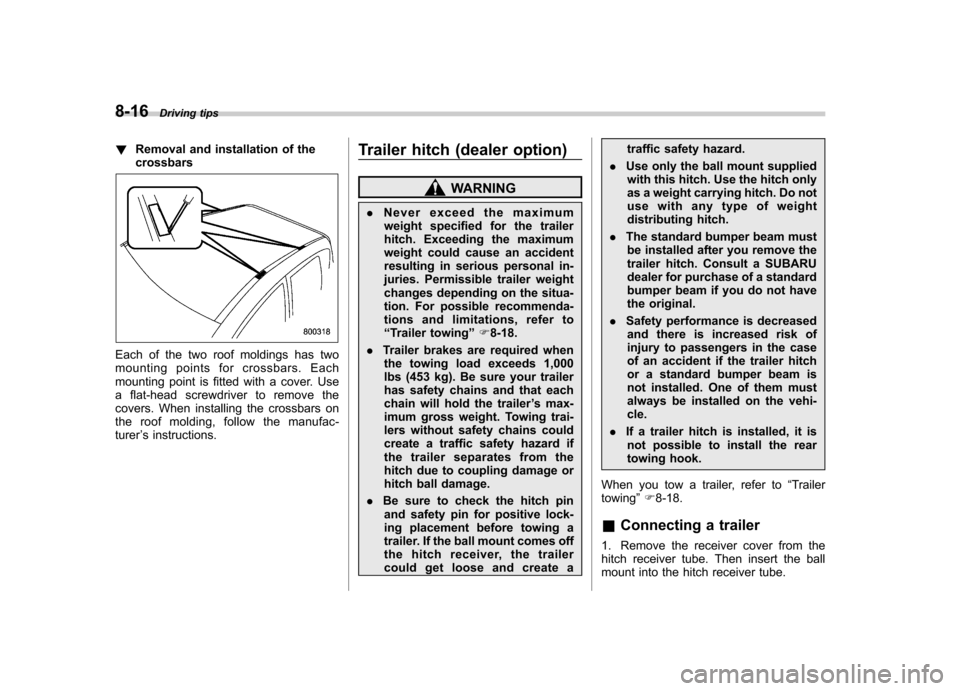
Each of the two roof moldings has two
mounting points for crossbars. Each
mounting point is fitted with a cover. Use
a flat-head screwdriver to remove the
covers. When installing the crossbars on
the roof molding, follow the manufac- turer ’s instructions. Trailer hitch (dealer option)
WARNING
. Never exceed the maximum
weight specified for the trailer
hitch. Exceeding the maximum
weight could cause an accident
resulting in serious personal in-
juries. Permissible trailer weight
changes depending on the situa-
tion. For possible recommenda-
tions and limitations, refer to“ Trailer towing ”F 8-18.
. Trailer brakes are required when
the towing load exceeds 1,000
lbs (453 kg). Be sure your trailer
has safety chains and that each
chain will hold the trailer ’s max-
imum gross weight. Towing trai-
lers without safety chains could
create a traffic safety hazard if
the trailer separates from the
hitch due to coupling damage or
hitch ball damage.
. Be sure to check the hitch pin
and safety pin for positive lock-
ing placement before towing a
trailer. If the ball mount comes off
the hitch receiver, the trailer
could get loose and create a traffic safety hazard.
. Use only the ball mount supplied
with this hitch. Use the hitch only
as a weight carrying hitch. Do not
use with any type of weight
distributing hitch.
. The standard bumper beam must
be installed after you remove the
trailer hitch. Consult a SUBARU
dealer for purchase of a standard
bumper beam if you do not have
the original.
. Safety performance is decreased
and there is increased risk of
injury to passengers in the case
of an accident if the trailer hitch
or a standard bumper beam is
not installed. One of them must
always be installed on the vehi-cle.
. If a trailer hitch is installed, it is
not possible to install the rear
towing hook.
When you tow a trailer, refer to “Trailer
towing ”F 8-18.
& Connecting a trailer
1. Remove the receiver cover from the
hitch receiver tube. Then insert the ball
mount into the hitch receiver tube.
Page 391 of 436

12-2Specifications
Specifications
These specifications are subject to change without notice. &Dimensions
in (mm)
Item Non-turbo models Turbo models
Overall length 179.5 (4,560)
Overall width 70.1 (1,780)
Overall height without roof rail 65.9 (1,675)
with roof rail 66.9 (1,700)
Wheel base 103.0 (2,615)
Tread Front 60.2 (1,530)
Rear 60.2 (1,530)
Ground clearance*
18.7 (220) 8.9 (225)
*1: Measured with vehicle empty
Page 414 of 436

.Passenger car tire
A tire intended for use on passen-
ger cars, multipurpose passenger
vehicles, and trucks, that have a
gross vehicle weight rating (GVWR)
of 10,000 lbs (4,535 kg) or less. . Ply
A layer of rubber-coated parallel cords.. Ply separation
A parting of rubber compound
between adjacent plies.. Pneumatic tire
A mechanical device made of rub-
ber, chemicals, fabric and steel or
other materials, that, when
mounted on an automotive wheel,
provides the traction and contains
the gas or fluid that sustains theload. . Production options weight
The combined weight of those
installed regular production options
weighing over 5.1 lbs (2.3 kg) in
excess of those standard items
which they replace, not previously
considered in curb weight or acces- sory weight, including heavy duty
brakes, ride levelers, roof rack,
heavy duty battery, and special trim.
. Radial ply tire
A pneumatic tire in which the ply
cords that extend to the beads are
laid at substantially 90 degrees to
the centerline of the tread. . Recommended inflation pres-
sure
The cold inflation pressure recom-
mended by a vehicle manufacturer. . Reinforced tire
A tire designed to operate at higher
loads and at higher inflation pres-
sures than the corresponding stan-
dard tire. . Rim
A metal support for a tire or a tire
and tube assembly upon which the
tire beads are seated. . Rim diameter
Nominal diameter of the bead seat. . Rim size designation
Rim diameter and width. .
Rim type designation
The industry of manufacturer ’s des-
ignation for a rim by style or code. . Rim width
Nominal distance between rim flanges. . Section width
The linear distance between the
exteriors of the sidewalls of an
inflated tire, excluding elevations
due to labeling, decoration, or
protective bands. . Sidewall
That portion of a tire between the
tread and bead.. Sidewall separation
The parting of the rubber com-
pound from the cord material in
the sidewall.. Test rim
The rim on which a tire is fitted for
testing, and it may be any rim listed
as appropriate for use with that tire.. Tread
That portion of a tire that comes
into contact with the road.
Consumer information and Reporting safety defects
13-7
– CONTINUED –
Page 417 of 436
13-10Consumer information and Reporting safety defects
Replace any damaged or un-
evenly worn tires at the time of
rotation. After tire rotation, adjust
the tire pressures and make sure
the wheel nuts are correctly tigh-
tened. For information about the
tightening torque and tightening
sequence for the wheel nuts, referto “Flat tires ”F 9-6 .
& Vehicle load limit –how to
determine
The load capacity of your vehicle is
determined by weight, not by avail-
able cargo space. The load limit of
your vehicle is shown on the
vehicle placard attached to the
driver ’s side B-pillar. Locate the
statement “The combined weight
of occupants and cargo should
never exceed XXX kg or XXX lbs ”
on your vehicle ’s placard.
The vehicle placard also shows
seating capacity of your vehicle.
The total load capacity includes the
total weight of driver and all pas-
sengers and their belongings, any cargo, any optional equipment such
as a trailer hitch, roof rack or bike
carrier, etc., and the tongue load of
a trailer. Therefore cargo capacity
can be calculated by the followingmethod.
Cargo capacity = Load limit
(total
weight of occupants + total weight
of optional equipment + tongue
load of a trailer (if applicable))
For information about vehicle load-
ing, refer to “Loading your vehicle ”
F 8-12 .
For information about towing capa-
city and weight limits, refer to“ Trailer towing ”F 8-18 .
! Calculating total and load ca-
pacities varying seating con-
figurations
Calculate the available load capa-
city as shown in the following
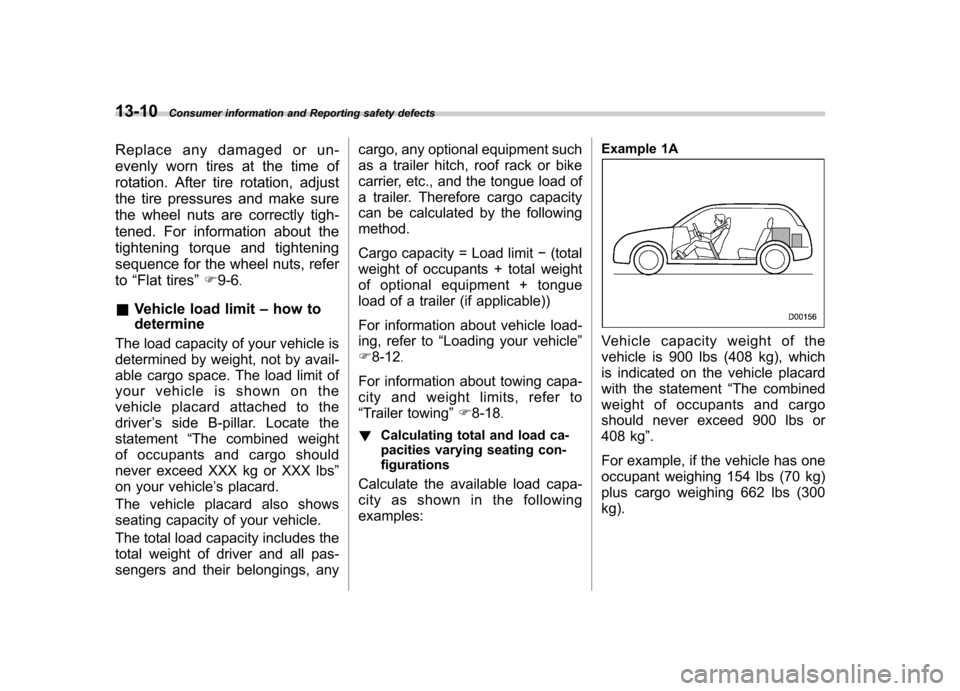
examples: Example 1A
Vehicle capacity weight of the
vehicle is 900 lbs (408 kg), which
is indicated on the vehicle placard
with the statement
“The combined
weight of occupants and cargo
should never exceed 900 lbs or
408 kg ”.
For example, if the vehicle has one
occupant weighing 154 lbs (70 kg)
plus cargo weighing 662 lbs (300kg).
Page 430 of 436

Door step............................................................. 11-50
Front fog ............................................................... 3-32
Front side marker ................................................. 12-15
Ignition switch .......................................................... 3-5
License plate ........................................................ 11-49
Map ............................................................. 6-3, 11-50 Parking ................................................................ 11-48
Rear combination .................................................. 11-48
Stop light ............................................................. 11-48
Tail light ............................................................... 11-48
Turn signal ................................................... 3-31, 11-48
Loading your vehicle .................................................. 8-12
Low fuel warning light ................................................. 3-21
Low tire pressure warning light .................................... 3-18
Lower and tether anchorage ........................................ 1-29
M Maintenance Precautions ........................................................... 11-3
Schedule .............................................................. 11-3
Seatbelt ................................................................ 1-19
Tools ...................................................................... 9-4
Malfunction indicator light (check engine warning light) ... 3-15 Manual
Climate control system ............................................. 4-8
Seat ....................................................................... 1-3
Transmission ......................................................... 7-13
Transmission oil ............................................ 11-19, 12-8
Map light ........................................................... 6-3, 11-50
Maximum load limits ................................................... 8-18
Meters and gauges ...................................................... 3-6 Mirror defogger
.......................................................... 3-44
Mirrors ...................................................................... 3-36
Moonroof ................................................................... 2-24
N
New vehicle break-in driving ......................................... 8-2
O
Odometer/Trip meter .................................................... 3-8
Oil filter ................................................................... 11-11
Oil level
Engine .................................................................. 11-9
Front differential gear ............................................ 11-21
Manual transmission ............................................. 11-19
Rear differential gear ............................................ 11-22
Oil pressure warning light ............................................ 3-17
On-road and off-road driving ...................................... 9, 8-6
Outside
Mirror defogger ...................................................... 3-44
Mirrors .................................................................. 3-43
Temperature indicator .............................................. 3-27
Overhead console ....................................................... 6-6
Overheating engine .................................................... 9-13
PParking Brake .................................................................... 7-29
Brake stroke ........................................................ 11-29
Light ................................................................... 11-48
Tips ...................................................................... 7-29
Periodic inspections ..................................................... 8-4 Index
14-7
Page 432 of 436

Rocking the vehicle.................................................... 8-12
Roof molding and crossbar ......................................... 8-15
Roof rails .................................................................. 8-14
S Safety Precautions when driving ............................................. 5
Symbol ...................................................................... 2
Warnings ................................................................... 2
Satellite radio ............................................................ 5-18
Screensaver .............................................................. 5-55
Seat Fabric ................................................................... 10-5
Front ...................................................................... 1-2
Heater .................................................................... 1-6
Height adjustment .................................................... 1-4
Power ..................................................................... 1-4
Rear ....................................................................... 1-7
Seatbelt ................................................................. 5, 1-12
Fastening .............................................................. 1-13
Maintenance .......................................................... 1-19
Pretensioners ........................................................ 1-20
Safety tips ............................................................. 1-12
Warning light and chime ......................................... 3-13
Security Alarm system ........................................................ 2-14
Immobilizer. ............................................................. 2-3
Indicator light ......................................................... 3-23
Shock sensors ....................................................... 2-19
Select lever ............................................................... 7-16
Position indicator ................................................... 3-24 Shift lock function
................................................... 7-17
Shock sensors ........................................................... 2-19
Shopping bag hook ..................................................... 6-13
Snow tires ....................................................... 8-11, 11-29
Snowy and icy roads .................................................. 8-10
Sounding a panic alarm .............................................. 2-10
Spark plugs ..................................................... 11-17, 12-3
Specifications ............................................................. 12-2
Speedometer .............................................................. 3-8
SPORT mode ............................................................ 7-20
Indicator light ......................................................... 3-24
SRS Curtain airbag ........................................................ 1-47
Frontal airbag ......................................................... 1-37
Side airbag ............................................................ 1-47
SRS airbag (Supplemental Restraint System airbag)... 5, 1-33
SRS airbag system Monitors ................................................................ 1-57
Servicing ............................................................... 1-58
Warning light .......................................................... 3-14
Starting the engine ...................................................... 7-7
State emission testing (U.S. only) .................................. 7-6
Steering wheel Power ................................................................... 7-21
Tilt/telescopic ......................................................... 3-46
Stop light ................................................................. 11-48
Stopping the engine ..................................................... 7-9
Storage compartment ................................................... 6-5
Sun shade ................................................................. 2-26
Sun visors .................................................................. 6-4
Supplemental Restraint System airbag (SRS) ................ 1-33Index
14-9