Led SUBARU FORESTER 2017 SJ / 4.G User Guide
[x] Cancel search | Manufacturer: SUBARU, Model Year: 2017, Model line: FORESTER, Model: SUBARU FORESTER 2017 SJ / 4.GPages: 634, PDF Size: 11.77 MB
Page 51 of 634
Seat, seatbelt and SRS airbags/Seatbelts
WARNING
When wearing the seatbelts, make
sure the shoulder portion of the
webbing does not pass over your
neck. If it does, adjust the seatbelt
anchor to a lower position. Placing
the shoulder belt over the neck may
result in neck injury during sudden
braking or in a collision.! Unfastening the seatbelt
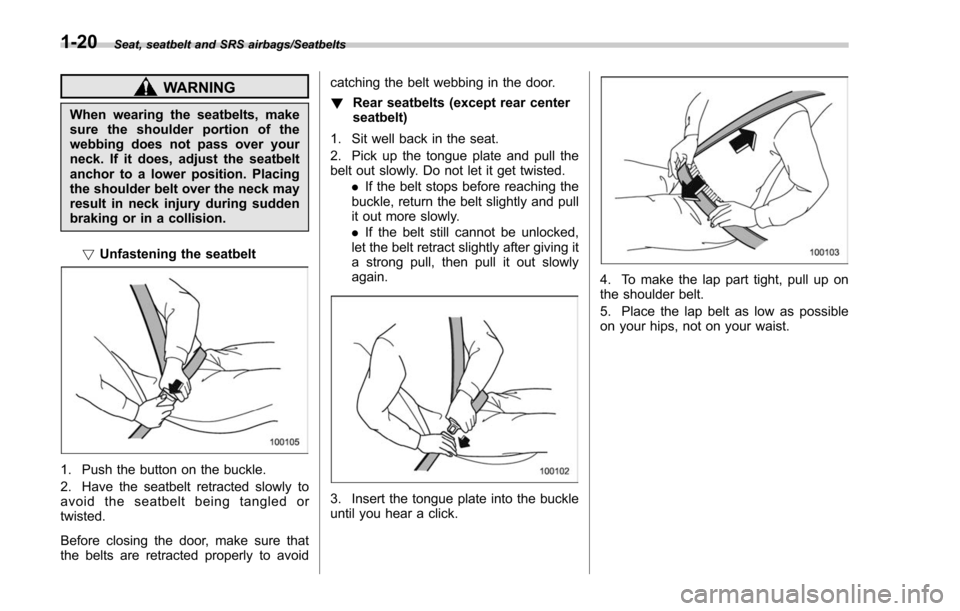
1. Push the button on the buckle.
2. Have the seatbelt retracted slowly to
avoid the seatbelt being tangled or
twisted.
Before closing the door, make sure that
the belts are retracted properly to avoid catching the belt webbing in the door.
!
Rear seatbelts (except rear center
seatbelt)
1. Sit well back in the seat.
2. Pick up the tongue plate and pull the
belt out slowly. Do not let it get twisted. .If the belt stops before reaching the
buckle, return the belt slightly and pull
it out more slowly.
. If the belt still cannot be unlocked,
let the belt retract slightly after giving it
a strong pull, then pull it out slowly
again.
3. Insert the tongue plate into the buckle
until you hear a click.
4. To make the lap part tight, pull up on
the shoulder belt.
5. Place the lap belt as low as possible
on your hips, not on your waist.
1-20
Page 52 of 634
!Unfastening the seatbelt
1. Push the button on the buckle.
2. Have the seatbelt retracted slowly to
avoid the seatbelt being tangled or
twisted.
Before closing the door, make sure that
the belts are retracted properly to avoid
catching the belt webbing in the door. !
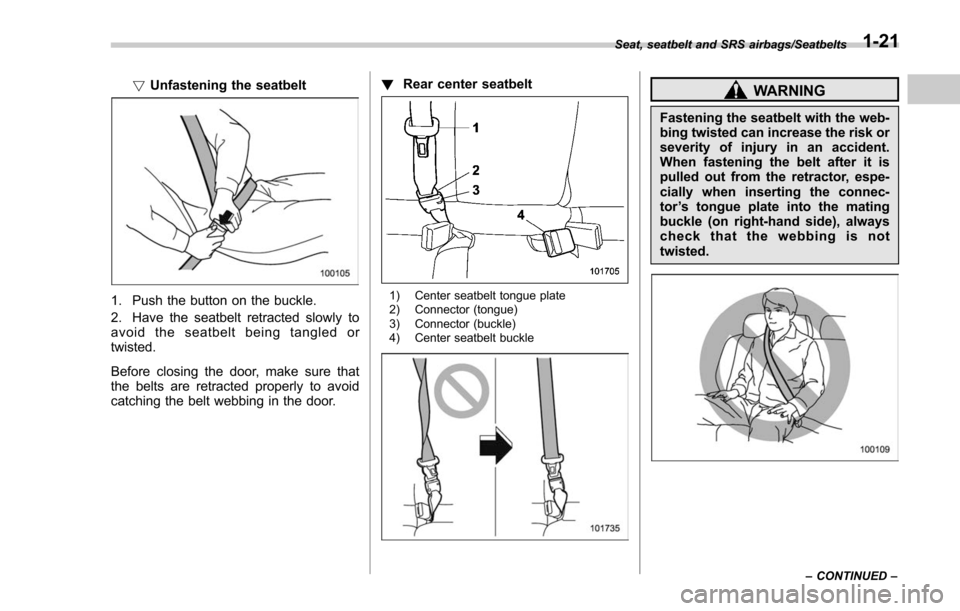
Rear center seatbelt1) Center seatbelt tongue plate
2) Connector (tongue)
3) Connector (buckle)
4) Center seatbelt buckle
WARNING
Fastening the seatbelt with the web-
bing twisted can increase the risk or
severity of injury in an accident.
When fastening the belt after it is
pulled out from the retractor, espe-
cially when inserting the connec-
tor’s tongue plate into the mating
buckle (on right-hand side), always
check that the webbing is not
twisted.
Seat, seatbelt and SRS airbags/Seatbelts
–CONTINUED –1-21
Page 55 of 634
Seat, seatbelt and SRS airbags/Seatbelts
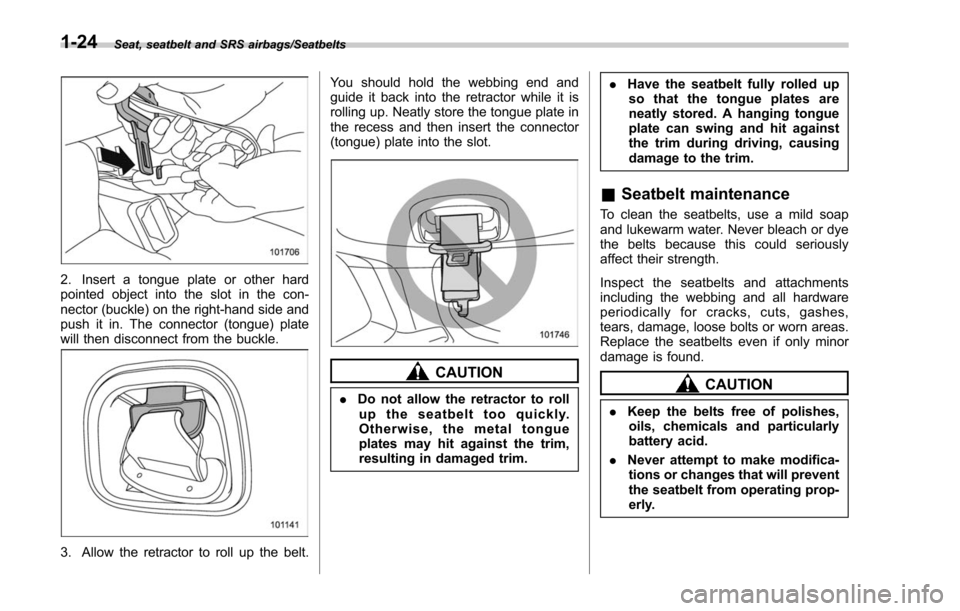
2. Insert a tongue plate or other hard
pointed object into the slot in the con-
nector (buckle) on the right-hand side and
push it in. The connector (tongue) plate
will then disconnect from the buckle.
3. Allow the retractor to roll up the belt.You should hold the webbing end and
guide it back into the retractor while it is
rolling up. Neatly store the tongue plate in
the recess and then insert the connector
(tongue) plate into the slot.
CAUTION
.
Do not allow the retractor to roll
up the seatbelt too quickly.
Otherwise, the metal tongue
plates may hit against the trim,
resulting in damaged trim. .
Have the seatbelt fully rolled up
so that the tongue plates are
neatly stored. A hanging tongue
plate can swing and hit against
the trim during driving, causing
damage to the trim.
& Seatbelt maintenance
To clean the seatbelts, use a mild soap
and lukewarm water. Never bleach or dye
the belts because this could seriously
affect their strength.
Inspect the seatbelts and attachments
including the webbing and all hardware
periodically for cracks, cuts, gashes,
tears, damage, loose bolts or worn areas.
Replace the seatbelts even if only minor
damage is found.
CAUTION
. Keep the belts free of polishes,
oils, chemicals and particularly
battery acid.
. Never attempt to make modifica-
tions or changes that will prevent
the seatbelt from operating prop-
erly.
1-24
Page 56 of 634
Front seatbelt pretensioners
The driver’s and front passenger ’s seat-
belts have a seatbelt pretensioner. The
seatbelt pretensioners are designed to be
activated in the event of an accident
involving moderate to severe frontal and
side collisions and rollover accidents.
& Seatbelt with shoulder belt
pretensioner
NOTE
This section is applicable to the dri-
ver ’s side seatbelt.
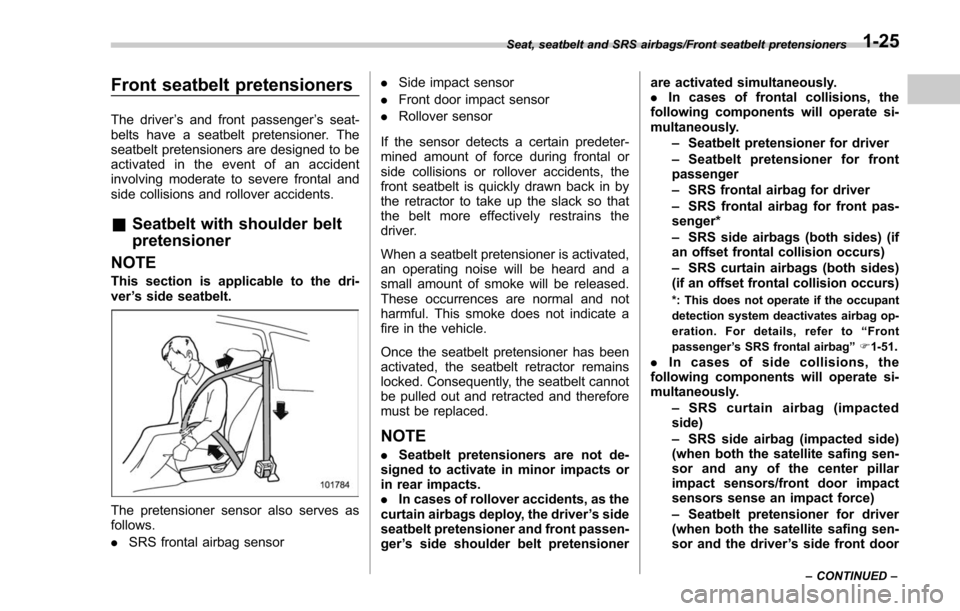
The pretensioner sensor also serves as
follows.
. SRS frontal airbag sensor .
Side impact sensor
. Front door impact sensor
. Rollover sensor
If the sensor detects a certain predeter-
mined amount of force during frontal or
side collisions or rollover accidents, the
front seatbelt is quickly drawn back in by
the retractor to take up the slack so that
the belt more effectively restrains the
driver.
When a seatbelt pretensioner is activated,
an operating noise will be heard and a
small amount of smoke will be released.
These occurrences are normal and not
harmful. This smoke does not indicate a
fire in the vehicle.
Once the seatbelt pretensioner has been
activated, the seatbelt retractor remains
locked. Consequently, the seatbelt cannot
be pulled out and retracted and therefore
must be replaced.
NOTE
. Seatbelt pretensioners are not de-
signed to activate in minor impacts or
in rear impacts.
. In cases of rollover accidents, as the
curtain airbags deploy, the driver ’s side
seatbelt pretensioner and front passen-
ger ’s side shoulder belt pretensioner are activated simultaneously.
.
In cases of frontal collisions, the
following components will operate si-
multaneously.
–Seatbelt pretensioner for driver
– Seatbelt pretensioner for front
passenger
– SRS frontal airbag for driver
– SRS frontal airbag for front pas-
senger*
– SRS side airbags (both sides) (if
an offset frontal collision occurs)
– SRS curtain airbags (both sides)
(if an offset frontal collision occurs)
*: This does not operate if the occupant
detection system deactivates airbag op-
eration. For details, refer to “Front
passenger ’s SRS frontal airbag ”F 1-51
.
. In cases of side collisions, the
following components will operate si-
multaneously.
–SRS curtain airbag (impacted
side)
– SRS side airbag (impacted side)
(when both the satellite safing sen-
sor and any of the center pillar
impact sensors/front door impact
sensors sense an impact force)
– Seatbelt pretensioner for driver
(when both the satellite safing sen-
sor and the driver ’s side front door
Seat, seatbelt and SRS airbags/Front seatbelt pretensioners
–CONTINUED –1-25
Page 57 of 634
Seat, seatbelt and SRS airbags/Front seatbelt pretensioners
impact sensor sense an impact
force)
However, when a center pillar im-
pact sensor detects a signal faster
than the front door impact sensor,
or both sensors detect signals
simultaneously, the seatbelt preten-
sioner does not activate.
–Seatbelt pretensioner for front
passenger (shoulder belt preten-
sioner only) (when both the satellite
safing sensor and the front passen-
ger ’s side front door impact sensor
sense an impact force)
However, when a center pillar im-
pact sensor detects a signal faster
than the front door impact sensor,
or both sensors detect signals
simultaneously, the seatbelt preten-
sioner does not activate.
. Pretensioners are designed to func-
tion on a one-time-only basis. In the
event that a pretensioner is activated,
both the driver ’s and front passenger ’s
seatbelt retractor assemblies should
be replaced only by an authorized
SUBARU dealer. When replacing seat-
belt retractor assemblies, use only
genuine SUBARU parts.
. If either front seatbelt does not
retract or cannot be pulled out due to
a malfunction or activation of the pretensioner, contact your SUBARU
dealer as soon as possible.
.
If the front seatbelt retractor assem-
bly or surrounding area has been
damaged, contact your SUBARU dealer
as soon as possible.
. When you sell your vehicle, we urge
you to explain to the buyer that it has
seatbelt pretensioners by alerting the
buyer to the contents of this section.
WARNING
. To obtain maximum protection,
the occupants should sit in an
upright position with their seat-
belts properly fastened. Refer to
“ Seatbelts ”F 1-16.
. Do not modify, remove or strike
the front seatbelt retractor as-
semblies or surrounding area.
This could result in accidental
activation of the seatbelt preten-
sioners or could make the sys-
tem inoperative, possibly result-
ing in serious injury. Seatbelt
pretensioners have no user-ser-
viceable parts. For required ser-
vicing of front seatbelt retractors
equipped with seatbelt preten-
sioners, consult your SUBARU
dealer. .
When discarding front seatbelt
retractor assemblies or scrap-
ping the entire vehicle due to
collision damage or for other
reasons, consult your SUBARU
dealer.
& Seatbelt with shoulder belt
and lap belt pretensioners
NOTE
This section is applicable to the front
passenger ’s side seatbelt.
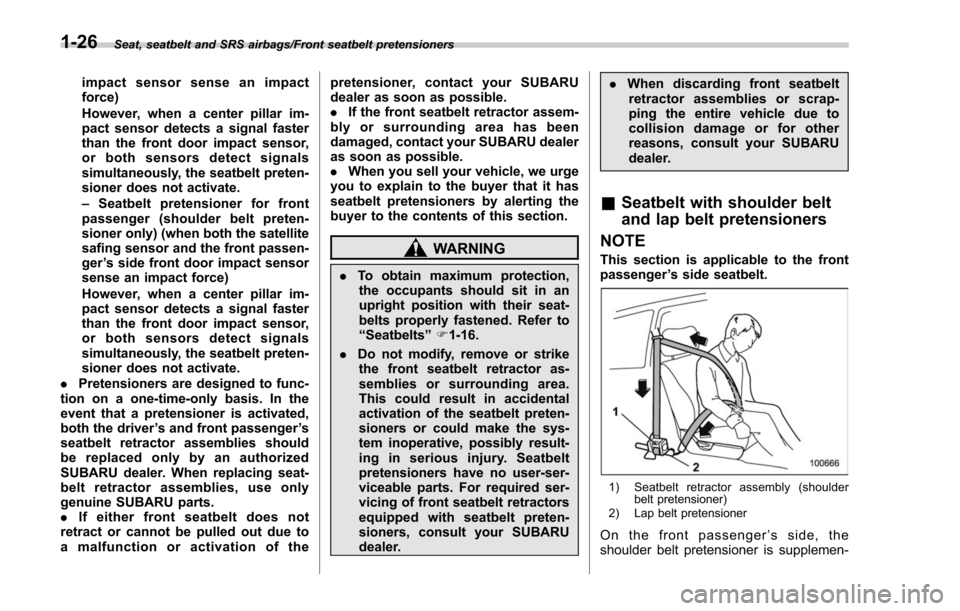
1) Seatbelt retractor assembly (shoulder
belt pretensioner)
2) Lap belt pretensioner
On the front passenger ’s side, the
shoulder belt pretensioner is supplemen-
1-26
Page 58 of 634
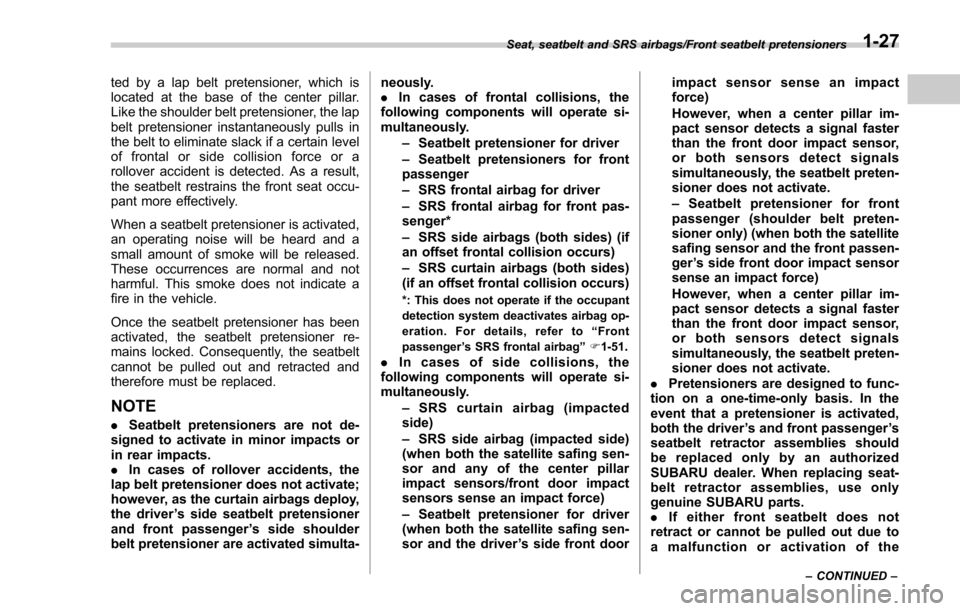
ted by a lap belt pretensioner, which is
located at the base of the center pillar.
Like the shoulder belt pretensioner, the lap
belt pretensioner instantaneously pulls in
the belt to eliminate slack if a certain level
of frontal or side collision force or a
rollover accident is detected. As a result,
the seatbelt restrains the front seat occu-
pant more effectively.
When a seatbelt pretensioner is activated,
an operating noise will be heard and a
small amount of smoke will be released.
These occurrences are normal and not
harmful. This smoke does not indicate a
fire in the vehicle.
Once the seatbelt pretensioner has been
activated, the seatbelt pretensioner re-
mains locked. Consequently, the seatbelt
cannot be pulled out and retracted and
therefore must be replaced.
NOTE
.Seatbelt pretensioners are not de-
signed to activate in minor impacts or
in rear impacts.
. In cases of rollover accidents, the
lap belt pretensioner does not activate;
however, as the curtain airbags deploy,
the driver ’s side seatbelt pretensioner
and front passenger ’s side shoulder
belt pretensioner are activated simulta- neously.
.
In cases of frontal collisions, the
following components will operate si-
multaneously.
–Seatbelt pretensioner for driver
– Seatbelt pretensioners for front
passenger
– SRS frontal airbag for driver
– SRS frontal airbag for front pas-
senger*
– SRS side airbags (both sides) (if
an offset frontal collision occurs)
– SRS curtain airbags (both sides)
(if an offset frontal collision occurs)
*: This does not operate if the occupant
detection system deactivates airbag op-
eration. For details, refer to “Front
passenger ’s SRS frontal airbag ”F 1-51
.
. In cases of side collisions, the
following components will operate si-
multaneously.
–SRS curtain airbag (impacted
side)
– SRS side airbag (impacted side)
(when both the satellite safing sen-
sor and any of the center pillar
impact sensors/front door impact
sensors sense an impact force)
– Seatbelt pretensioner for driver
(when both the satellite safing sen-
sor and the driver ’s side front door impact sensor sense an impact
force)
However, when a center pillar im-
pact sensor detects a signal faster
than the front door impact sensor,
or both sensors detect signals
simultaneously, the seatbelt preten-
sioner does not activate.
–
Seatbelt pretensioner for front
passenger (shoulder belt preten-
sioner only) (when both the satellite
safing sensor and the front passen-
ger ’s side front door impact sensor
sense an impact force)
However, when a center pillar im-
pact sensor detects a signal faster
than the front door impact sensor,
or both sensors detect signals
simultaneously, the seatbelt preten-
sioner does not activate.
. Pretensioners are designed to func-
tion on a one-time-only basis. In the
event that a pretensioner is activated,
both the driver ’s and front passenger ’s
seatbelt retractor assemblies should
be replaced only by an authorized
SUBARU dealer. When replacing seat-
belt retractor assemblies, use only
genuine SUBARU parts.
. If either front seatbelt does not
retract or cannot be pulled out due to
a malfunction or activation of the
Seat, seatbelt and SRS airbags/Front seatbelt pretensioners
–CONTINUED –1-27
Page 61 of 634

Seat, seatbelt and SRS airbags/Child restraint systems
properly secured in the vehicle. When
installing the child restraint system, care-
fully follow the manufacturer’s instructions.
According to accident statistics, children
are safer when properly restrained in the
rear seating positions than in the front
seating positions.
All U.S. states and Canadian provinces
require that infants and small children be
restrained in an approved child restraint
system at all times while the vehicle is
moving.
WARNING
Never let a passenger hold a child
on his or her lap or in his or her
arms while the vehicle is moving.
The passenger cannot protect the child from injury in a collision,
because the child will be caught
between the passenger and objects
inside the vehicle.
Additionally, holding a child in your
lap or arms in the front seat exposes
that child to another serious danger.
Since the SRS airbag deploys with
considerable speed and force, the
child could be injured or even killed.
WARNING
Children should be properly re-
strained at all times. Never allow a
child to stand up, or to kneel on any
seat. Unrestrained children will be
thrown forward during sudden stop
or in an accident and can be injured
seriously.
Additionally, children standing up or
kneeling on or in front of the front
seat are exposed another serious
danger. Since the SRS airbag de-
ploys with considerable speed and
force, the child could be injured or
even killed.
&
Where to place a child re-
straint system
The following are SUBARU ’s recommen-
dations on where to place a child restraint
system in your vehicle.
1-30
Page 64 of 634
child suffering personal injury in the
event of an accident may be in-
creased.
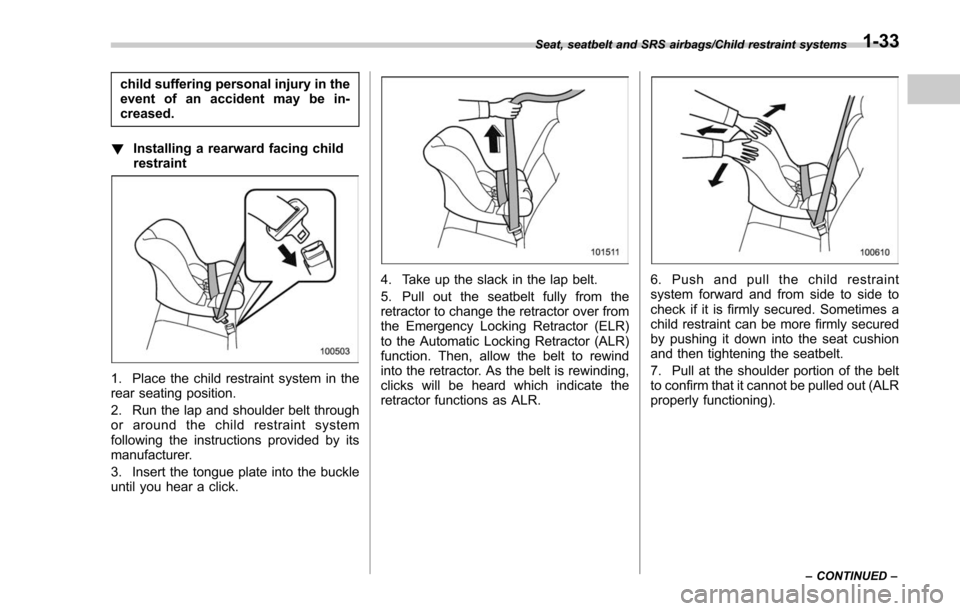
! Installing a rearward facing child
restraint
1. Place the child restraint system in the
rear seating position.
2. Run the lap and shoulder belt through
or around the child restraint system
following the instructions provided by its
manufacturer.
3. Insert the tongue plate into the buckle
until you hear a click.
4. Take up the slack in the lap belt.
5. Pull out the seatbelt fully from the
retractor to change the retractor over from
the Emergency Locking Retractor (ELR)
to the Automatic Locking Retractor (ALR)
function. Then, allow the belt to rewind
into the retractor. As the belt is rewinding,
clicks will be heard which indicate the
retractor functions as ALR.6. Push and pull the child restraint
system forward and from side to side to
check if it is firmly secured. Sometimes a
child restraint can be more firmly secured
by pushing it down into the seat cushion
and then tightening the seatbelt.
7. Pull at the shoulder portion of the belt
to confirm that it cannot be pulled out (ALR
properly functioning).
Seat, seatbelt and SRS airbags/Child restraint systems
–CONTINUED –1-33
Page 65 of 634
Seat, seatbelt and SRS airbags/Child restraint systems
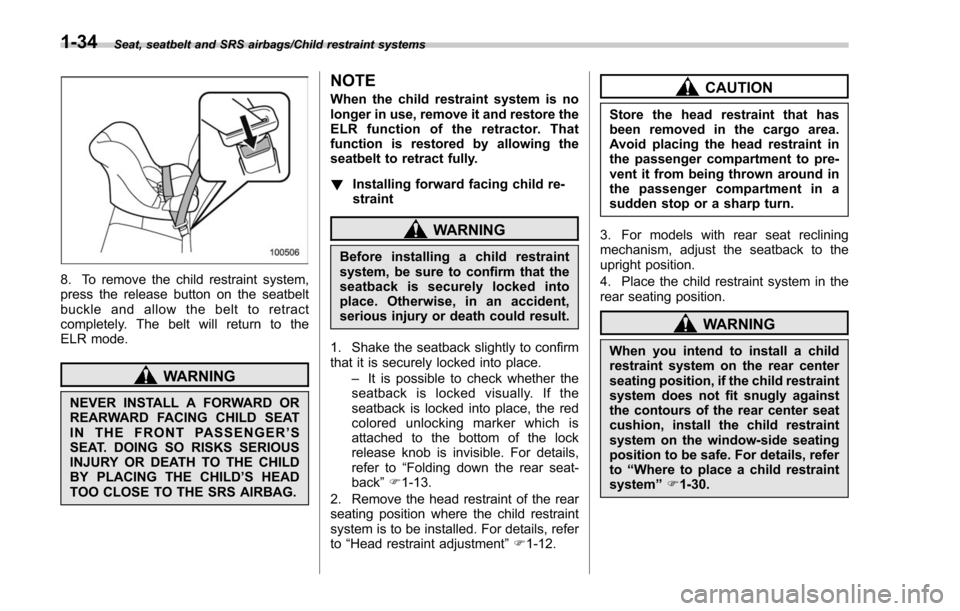
8. To remove the child restraint system,
press the release button on the seatbelt
buckle and allow the belt to retract
completely. The belt will return to the
ELR mode.
WARNING
NEVER INSTALL A FORWARD OR
REARWARD FACING CHILD SEAT
IN THE FRONT PASSENGER’S
SEAT. DOING SO RISKS SERIOUS
INJURY OR DEATH TO THE CHILD
BY PLACING THE CHILD ’S HEAD
TOO CLOSE TO THE SRS AIRBAG.
NOTE
When the child restraint system is no
longer in use, remove it and restore the
ELR function of the retractor. That
function is restored by allowing the
seatbelt to retract fully.
! Installing forward facing child re-
straint
WARNING
Before installing a child restraint
system, be sure to confirm that the
seatback is securely locked into
place. Otherwise, in an accident,
serious injury or death could result.
1. Shake the seatback slightly to confirm
that it is securely locked into place. –It is possible to check whether the
seatback is locked visually. If the
seatback is locked into place, the red
colored unlocking marker which is
attached to the bottom of the lock
release knob is invisible. For details,
refer to “Folding down the rear seat-
back ”F 1-13.
2. Remove the head restraint of the rear
seating position where the child restraint
system is to be installed. For details, refer
to “Head restraint adjustment ”F 1-12.
CAUTION
Store the head restraint that has
been removed in the cargo area.
Avoid placing the head restraint in
the passenger compartment to pre-
vent it from being thrown around in
the passenger compartment in a
sudden stop or a sharp turn.
3. For models with rear seat reclining
mechanism, adjust the seatback to the
upright position.
4. Place the child restraint system in the
rear seating position.
WARNING
When you intend to install a child
restraint system on the rear center
seating position, if the child restraint
system does not fit snugly against
the contours of the rear center seat
cushion, install the child restraint
system on the window-side seating
position to be safe. For details, refer
to “Where to place a child restraint
system ”F 1-30.
1-34
Page 66 of 634
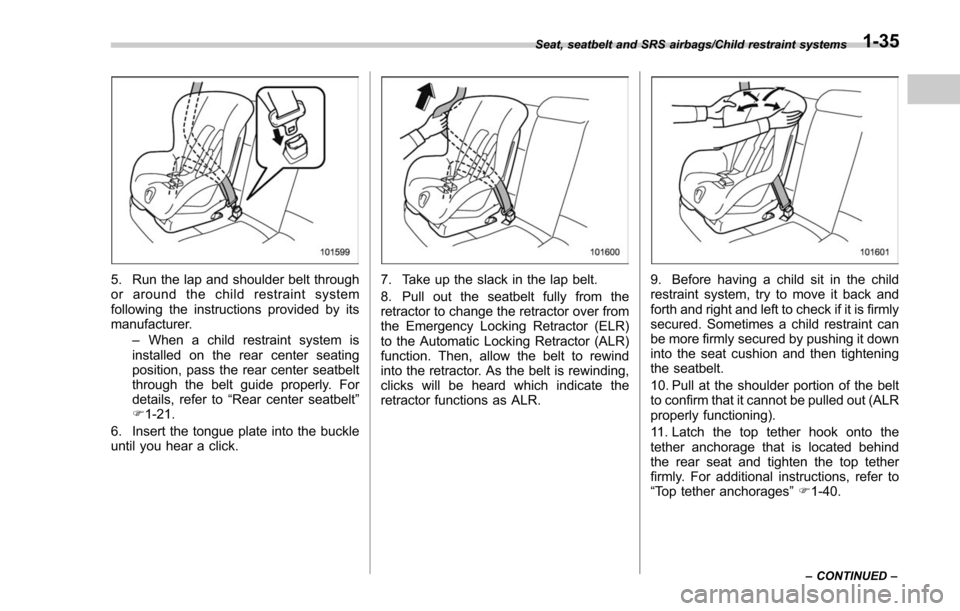
5. Run the lap and shoulder belt through
or around the child restraint system
following the instructions provided by its
manufacturer.–When a child restraint system is
installed on the rear center seating
position, pass the rear center seatbelt
through the belt guide properly. For
details, refer to “Rear center seatbelt ”
F 1-21.
6. Insert the tongue plate into the buckle
until you hear a click.7. Take up the slack in the lap belt.
8. Pull out the seatbelt fully from the
retractor to change the retractor over from
the Emergency Locking Retractor (ELR)
to the Automatic Locking Retractor (ALR)
function. Then, allow the belt to rewind
into the retractor. As the belt is rewinding,
clicks will be heard which indicate the
retractor functions as ALR.9. Before having a child sit in the child
restraint system, try to move it back and
forth and right and left to check if it is firmly
secured. Sometimes a child restraint can
be more firmly secured by pushing it down
into the seat cushion and then tightening
the seatbelt.
10. Pull at the shoulder portion of the belt
to confirm that it cannot be pulled out (ALR
properly functioning).
11. Latch the top tether hook onto the
tether anchorage that is located behind
the rear seat and tighten the top tether
firmly. For additional instructions, refer to
“ Top tether anchorages ”F 1-40.
Seat, seatbelt and SRS airbags/Child restraint systems
–CONTINUED –1-35